

EN ISO 11929-3:2025
(Main)Determination of the characteristic limits (decision threshold, detection limit and limits of the coverage interval) for measurements of ionizing radiation - Fundamentals and application - Part 3: Applications to unfolding methods (ISO/DIS 11929-3:2025)
- Abstract
The ISO 11929 series specifies a procedure, in the field of ionizing radiation metrology, for the calculation of the “decision threshold”, the “detection limit” and the “limits of the coverage interval” for a non-negative ionizing radiation measurand when counting measurements with preselection of time or counts are carried out. The measurand results from a gross count rate and a background count rate as well as from further quantities on the basis of a model of the evaluation. In particular, the measurand can be the net count rate as the difference of the gross count rate and the background count rate, or the net activity of a sample. It can also be influenced by calibration of the measuring system, by sample treatment and by other factors.
ISO 11929 has been divided into four parts covering elementary applications in ISO 11929-1, advanced applications on the basis of the ISO/IEC Guide 98-3:2008/Suppl 1:2008 in ISO 11929-2, applications to unfolding methods in this document, and guidance to the application in ISO 11929-4.
ISO 11929-1 covers basic applications of counting measurements frequently used in the field of ionizing radiation metrology. It is restricted to applications for which the uncertainties can be evaluated on the basis of the ISO/IEC Guide 98-3 (JCGM 2008). In ISO 11929-1:2025, Annex A, the special case of repeated counting measurements with random influences is covered, while measurements with linear analogous ratemeters, are covered in ISO 11929-1:2025, Annex B.
This document deals with the evaluation of measurements using unfolding methods and counting spectrometric multi-channel measurements if evaluated by unfolding methods, in particular, for alpha- and gamma‑spectrometric measurements. Further, it provides some advice on how to deal with correlations and covariances.
ISO 11929-4 gives guidance to the application of the ISO 11929 series, summarizes shortly the general procedure and then presents a wide range of numerical examples.
ISO 11929 Standard also applies analogously to other measurements of any kind especially if a similar model of the evaluation is involved. Further practical examples can be found, for example, in ISO 18589[7], ISO 9696[2], ISO 9697[3], ISO 9698[4], ISO 10703[5], ISO 7503[1], ISO 28218[8], and ISO 11665[6].
NOTE A code system, named UncertRadio, is available for calculations according to ISO 11929- 1 to ISO 11929-3. UncertRadio[35][36] can be downloaded for free from https://www.thuenen.de/en/institutes/fisheries-ecology/fields-of-activity/marine-environment/coordination-centre-of-radioactivity/uncertradio.The download contains a setup installation file which copies all files and folders into a folder specified by the user. After installation one has to add information to the PATH of Windows as indicated by a pop‑up window during installation. English language can be chosen and extensive “help” information is available.
- Status
- Published
- Publication Date
- 16-Dec-2025
- Current Stage
- 6060 - Definitive text made available (DAV) - Publishing
- Start Date
- 17-Dec-2025
- Completion Date
- 17-Dec-2025


Overview
EN ISO 11929-3:2025 - Determination of the characteristic limits (decision threshold, detection limit and limits of the coverage interval) - Part 3: Applications to unfolding methods is the CEN-adopted part of the ISO 11929 series that addresses calculating detection-related characteristic limits for ionizing radiation measurands evaluated by unfolding methods. The standard covers non-negative measurands derived from counting measurements (preselected by time or counts) such as net count rates or net activity, and accounts for influences like calibration, sample treatment and measurement-model parameters. EN ISO 11929-3:2025 is based on Bayesian statistics and the ISO/IEC Guide 98-3 family (including Monte Carlo supplements) for uncertainty treatment.
Key topics and technical requirements
- Characteristic limits: formal definitions and calculation procedures for the decision threshold, detection limit, and limits of the coverage interval for a non-negative measurand.
- Unfolding methods: modelling and evaluation of multichannel spectrometric measurements (notably alpha and gamma spectrometry) where unfolding/deconvolution is used to derive primary measurands.
- Uncertainty evaluation: propagation of uncertainties using ISO/IEC Guide 98-3 approaches, including Monte Carlo techniques and Bayesian foundations to handle non-repeatable or non-random influences.
- Poisson corrections: modifications for Poisson-distributed count data in unfolding contexts.
- Correlations and covariances: guidance (Annex A) on treating correlated input quantities and covariance matrices arising from unfolding.
- Documentation and reporting: requirements for documenting models, input quantities, procedures and numerical results to support reproducibility and regulatory use.
- Practical tools: reference to UncertRadio software for computations compliant with ISO 11929-1 to -3.
Applications and users
EN ISO 11929-3:2025 is intended for professionals and organizations involved in ionizing radiation metrology and detection-capability assessment, including:
- National metrology institutes and calibration laboratories
- Environmental radioactivity monitoring and emergency response teams
- Nuclear industry laboratories (waste, decommissioning, process control)
- Radiological protection and health physics services
- Instrument vendors and software developers implementing unfolding/spectrum analysis
Typical applications include evaluating detection capability of gamma/alpha spectrometry systems, assessing compliance with regulatory limits, validating measurement procedures that use unfolding/deconvolution, and producing defensible uncertainty statements for reporting.
Related standards and references
- EN ISO 11929 series: Part 1 (basic applications), Part 2 (advanced applications), Part 4 (guidance & examples)
- ISO/IEC Guide 98-3 and its supplements (Monte Carlo and multivariate treatments)
- Cross-referenced ISO standards on radioactivity measurement and sampling (listed in the ISO 11929 series bibliography)
- UncertRadio (free computational tool) - download information available from the Thünen Institute coordination centre (link referenced in the standard)
Keywords: EN ISO 11929-3:2025, detection limit, decision threshold, coverage interval, unfolding methods, ionizing radiation metrology, gamma spectrometry, measurement uncertainty, Bayesian statistics.
Relations
- Effective Date
- 13-Nov-2024
- Effective Date
- 25-Aug-2026
- Effective Date
- 25-Aug-2026
- Effective Date
- 25-Aug-2026
- Effective Date
- 09-Feb-2026
- Effective Date
- 09-Feb-2026
- Effective Date
- 09-Feb-2026
- Effective Date
- 09-Feb-2026
- Effective Date
- 28-Jan-2026
- Effective Date
- 28-Jan-2026
- Effective Date
- 28-Jan-2026
- Effective Date
- 12-Feb-2026
Get Certified
Connect with accredited certification bodies for this standard

BSMI (Bureau of Standards, Metrology and Inspection)
Taiwan's standards and inspection authority.
Sponsored listings
Frequently Asked Questions
EN ISO 11929-3:2025 is a standard published by the European Committee for Standardization (CEN). Its full title is "Determination of the characteristic limits (decision threshold, detection limit and limits of the coverage interval) for measurements of ionizing radiation - Fundamentals and application - Part 3: Applications to unfolding methods (ISO/DIS 11929-3:2025)". This standard covers: The ISO 11929 series specifies a procedure, in the field of ionizing radiation metrology, for the calculation of the “decision threshold”, the “detection limit” and the “limits of the coverage interval” for a non-negative ionizing radiation measurand when counting measurements with preselection of time or counts are carried out. The measurand results from a gross count rate and a background count rate as well as from further quantities on the basis of a model of the evaluation. In particular, the measurand can be the net count rate as the difference of the gross count rate and the background count rate, or the net activity of a sample. It can also be influenced by calibration of the measuring system, by sample treatment and by other factors. ISO 11929 has been divided into four parts covering elementary applications in ISO 11929-1, advanced applications on the basis of the ISO/IEC Guide 98-3:2008/Suppl 1:2008 in ISO 11929-2, applications to unfolding methods in this document, and guidance to the application in ISO 11929-4. ISO 11929-1 covers basic applications of counting measurements frequently used in the field of ionizing radiation metrology. It is restricted to applications for which the uncertainties can be evaluated on the basis of the ISO/IEC Guide 98-3 (JCGM 2008). In ISO 11929-1:2025, Annex A, the special case of repeated counting measurements with random influences is covered, while measurements with linear analogous ratemeters, are covered in ISO 11929-1:2025, Annex B. This document deals with the evaluation of measurements using unfolding methods and counting spectrometric multi-channel measurements if evaluated by unfolding methods, in particular, for alpha- and gamma‑spectrometric measurements. Further, it provides some advice on how to deal with correlations and covariances. ISO 11929-4 gives guidance to the application of the ISO 11929 series, summarizes shortly the general procedure and then presents a wide range of numerical examples. ISO 11929 Standard also applies analogously to other measurements of any kind especially if a similar model of the evaluation is involved. Further practical examples can be found, for example, in ISO 18589[7], ISO 9696[2], ISO 9697[3], ISO 9698[4], ISO 10703[5], ISO 7503[1], ISO 28218[8], and ISO 11665[6]. NOTE A code system, named UncertRadio, is available for calculations according to ISO 11929- 1 to ISO 11929-3. UncertRadio[35][36] can be downloaded for free from https://www.thuenen.de/en/institutes/fisheries-ecology/fields-of-activity/marine-environment/coordination-centre-of-radioactivity/uncertradio.The download contains a setup installation file which copies all files and folders into a folder specified by the user. After installation one has to add information to the PATH of Windows as indicated by a pop‑up window during installation. English language can be chosen and extensive “help” information is available.
The ISO 11929 series specifies a procedure, in the field of ionizing radiation metrology, for the calculation of the “decision threshold”, the “detection limit” and the “limits of the coverage interval” for a non-negative ionizing radiation measurand when counting measurements with preselection of time or counts are carried out. The measurand results from a gross count rate and a background count rate as well as from further quantities on the basis of a model of the evaluation. In particular, the measurand can be the net count rate as the difference of the gross count rate and the background count rate, or the net activity of a sample. It can also be influenced by calibration of the measuring system, by sample treatment and by other factors. ISO 11929 has been divided into four parts covering elementary applications in ISO 11929-1, advanced applications on the basis of the ISO/IEC Guide 98-3:2008/Suppl 1:2008 in ISO 11929-2, applications to unfolding methods in this document, and guidance to the application in ISO 11929-4. ISO 11929-1 covers basic applications of counting measurements frequently used in the field of ionizing radiation metrology. It is restricted to applications for which the uncertainties can be evaluated on the basis of the ISO/IEC Guide 98-3 (JCGM 2008). In ISO 11929-1:2025, Annex A, the special case of repeated counting measurements with random influences is covered, while measurements with linear analogous ratemeters, are covered in ISO 11929-1:2025, Annex B. This document deals with the evaluation of measurements using unfolding methods and counting spectrometric multi-channel measurements if evaluated by unfolding methods, in particular, for alpha- and gamma‑spectrometric measurements. Further, it provides some advice on how to deal with correlations and covariances. ISO 11929-4 gives guidance to the application of the ISO 11929 series, summarizes shortly the general procedure and then presents a wide range of numerical examples. ISO 11929 Standard also applies analogously to other measurements of any kind especially if a similar model of the evaluation is involved. Further practical examples can be found, for example, in ISO 18589[7], ISO 9696[2], ISO 9697[3], ISO 9698[4], ISO 10703[5], ISO 7503[1], ISO 28218[8], and ISO 11665[6]. NOTE A code system, named UncertRadio, is available for calculations according to ISO 11929- 1 to ISO 11929-3. UncertRadio[35][36] can be downloaded for free from https://www.thuenen.de/en/institutes/fisheries-ecology/fields-of-activity/marine-environment/coordination-centre-of-radioactivity/uncertradio.The download contains a setup installation file which copies all files and folders into a folder specified by the user. After installation one has to add information to the PATH of Windows as indicated by a pop‑up window during installation. English language can be chosen and extensive “help” information is available.
EN ISO 11929-3:2025 is classified under the following ICS (International Classification for Standards) categories: 17.240 - Radiation measurements. The ICS classification helps identify the subject area and facilitates finding related standards.
EN ISO 11929-3:2025 has the following relationships with other standards: It is inter standard links to EN ISO 11929-3:2021, ISO 80000-10:2019, ISO 80000-1:2022, ISO 3534-1:2006, ISO/IEC Guide 98-3:2008, ISO/IEC Guide 98-3:2008/Suppl 1:2008, ISO/IEC Guide 98-3:2008/Suppl 2:2011, ISO/IEC Guide 99:2007, EN 14825:2022/prA1, EN 1372:2015, EN 6059-309:2018, ISO 11929-3:2025. Understanding these relationships helps ensure you are using the most current and applicable version of the standard.
EN ISO 11929-3:2025 is available in PDF format for immediate download after purchase. The document can be added to your cart and obtained through the secure checkout process. Digital delivery ensures instant access to the complete standard document.
Standards Content (Sample)
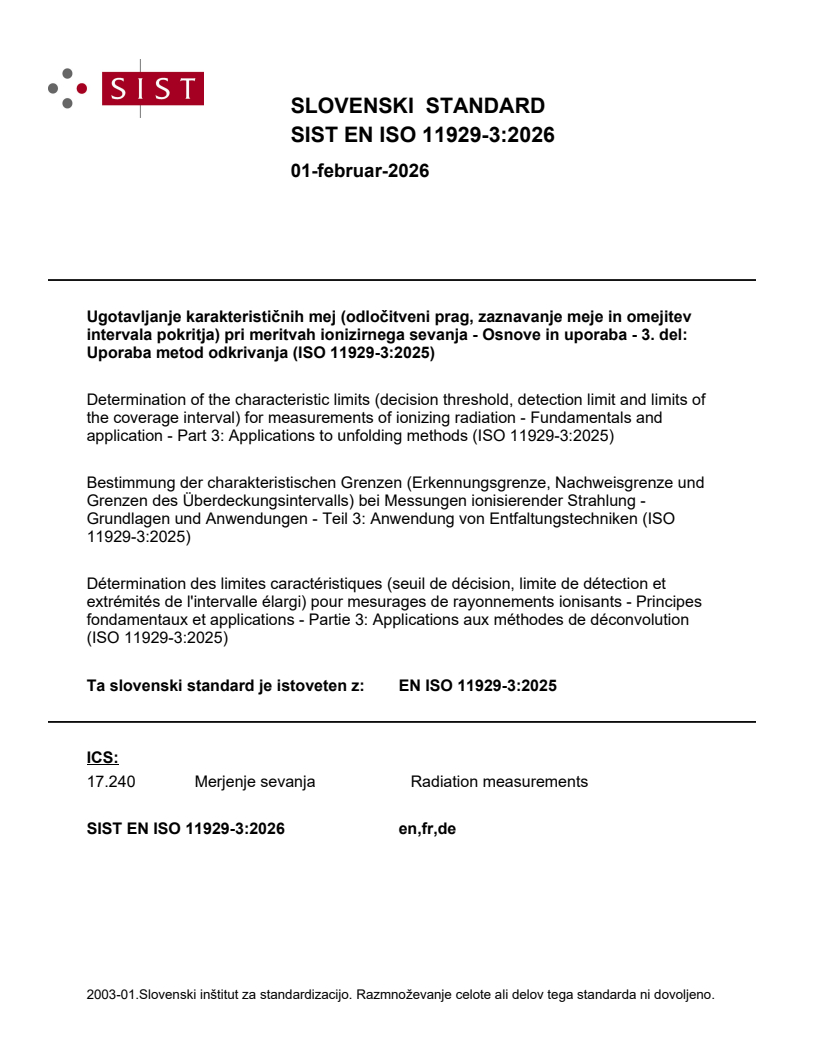
SLOVENSKI STANDARD
01-februar-2026
Ugotavljanje karakterističnih mej (odločitveni prag, zaznavanje meje in omejitev
intervala pokritja) pri meritvah ionizirnega sevanja - Osnove in uporaba - 3. del:
Uporaba metod odkrivanja (ISO 11929-3:2025)
Determination of the characteristic limits (decision threshold, detection limit and limits of
the coverage interval) for measurements of ionizing radiation - Fundamentals and
application - Part 3: Applications to unfolding methods (ISO 11929-3:2025)
Bestimmung der charakteristischen Grenzen (Erkennungsgrenze, Nachweisgrenze und
Grenzen des Überdeckungsintervalls) bei Messungen ionisierender Strahlung -
Grundlagen und Anwendungen - Teil 3: Anwendung von Entfaltungstechniken (ISO
11929-3:2025)
Détermination des limites caractéristiques (seuil de décision, limite de détection et
extrémités de l'intervalle élargi) pour mesurages de rayonnements ionisants - Principes
fondamentaux et applications - Partie 3: Applications aux méthodes de déconvolution
(ISO 11929-3:2025)
Ta slovenski standard je istoveten z: EN ISO 11929-3:2025
ICS:
17.240 Merjenje sevanja Radiation measurements
2003-01.Slovenski inštitut za standardizacijo. Razmnoževanje celote ali delov tega standarda ni dovoljeno.
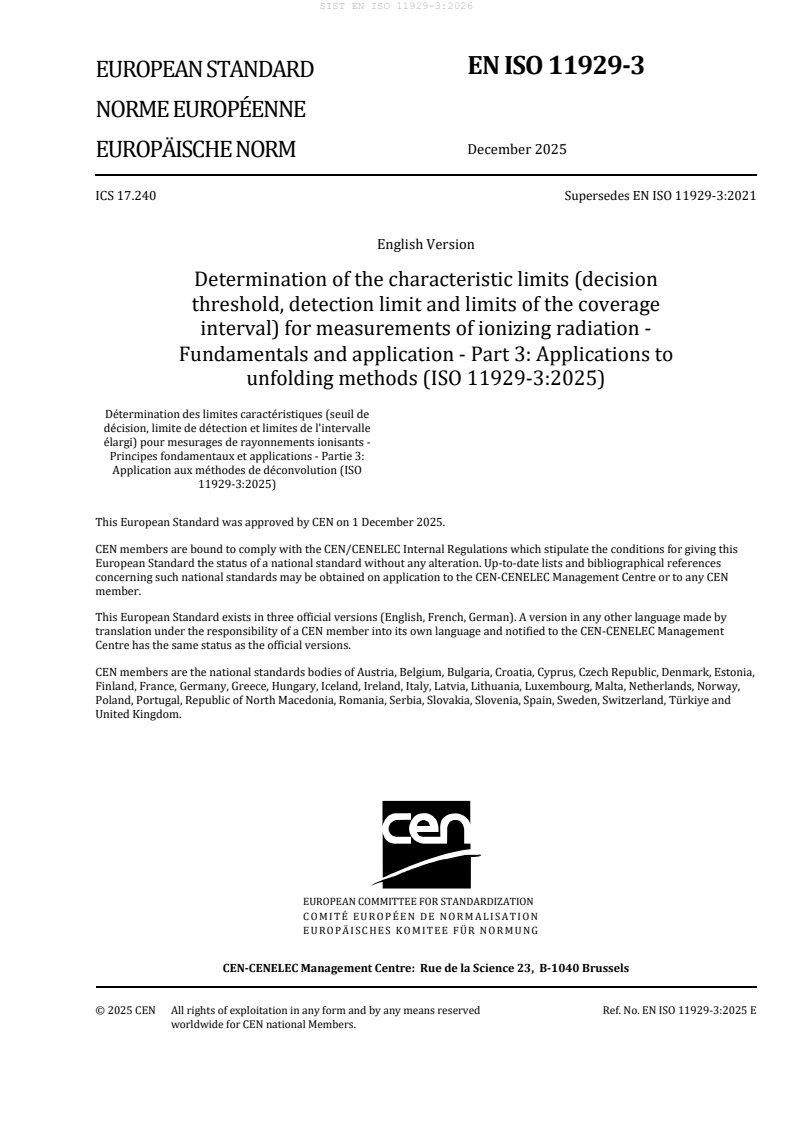
EN ISO 11929-3
EUROPEAN STANDARD
NORME EUROPÉENNE
December 2025
EUROPÄISCHE NORM
ICS 17.240 Supersedes EN ISO 11929-3:2021
English Version
Determination of the characteristic limits (decision
threshold, detection limit and limits of the coverage
interval) for measurements of ionizing radiation -
Fundamentals and application - Part 3: Applications to
unfolding methods (ISO 11929-3:2025)
Détermination des limites caractéristiques (seuil de
décision, limite de détection et limites de l'intervalle
élargi) pour mesurages de rayonnements ionisants -
Principes fondamentaux et applications - Partie 3:
Application aux méthodes de déconvolution (ISO
11929-3:2025)
This European Standard was approved by CEN on 1 December 2025.
CEN members are bound to comply with the CEN/CENELEC Internal Regulations which stipulate the conditions for giving this
European Standard the status of a national standard without any alteration. Up-to-date lists and bibliographical references
concerning such national standards may be obtained on application to the CEN-CENELEC Management Centre or to any CEN
member.
This European Standard exists in three official versions (English, French, German). A version in any other language made by
translation under the responsibility of a CEN member into its own language and notified to the CEN-CENELEC Management
Centre has the same status as the official versions.
CEN members are the national standards bodies of Austria, Belgium, Bulgaria, Croatia, Cyprus, Czech Republic, Denmark, Estonia,
Finland, France, Germany, Greece, Hungary, Iceland, Ireland, Italy, Latvia, Lithuania, Luxembourg, Malta, Netherlands, Norway,
Poland, Portugal, Republic of North Macedonia, Romania, Serbia, Slovakia, Slovenia, Spain, Sweden, Switzerland, Türkiye and
United Kingdom.
EUROPEAN COMMITTEE FOR STANDARDIZATION
COMITÉ EUROPÉEN DE NORMALISATION
EUROPÄISCHES KOMITEE FÜR NORMUNG
CEN-CENELEC Management Centre: Rue de la Science 23, B-1040 Brussels
© 2025 CEN All rights of exploitation in any form and by any means reserved Ref. No. EN ISO 11929-3:2025 E
worldwide for CEN national Members.
Contents Page
European foreword . 3
European foreword
This document (EN ISO 11929-3:2025) has been prepared by Technical Committee ISO/TC 85 "Nuclear
energy, nuclear technologies, and radiological protection" in collaboration with Technical Committee
CEN/TC 430 “Nuclear energy, nuclear technologies, and radiological protection” the secretariat of
which is held by AFNOR.
This European Standard shall be given the status of a national standard, either by publication of an
identical text or by endorsement, at the latest by June 2026, and conflicting national standards shall be
withdrawn at the latest by June 2026.
Attention is drawn to the possibility that some of the elements of this document may be the subject of
patent rights. CEN shall not be held responsible for identifying any or all such patent rights.
This document supersedes EN ISO 11929-3:2021.
Any feedback and questions on this document should be directed to the users’ national standards
body/national committee. A complete listing of these bodies can be found on the CEN website.
According to the CEN-CENELEC Internal Regulations, the national standards organizations of the
following countries are bound to implement this European Standard: Austria, Belgium, Bulgaria,
Croatia, Cyprus, Czech Republic, Denmark, Estonia, Finland, France, Germany, Greece, Hungary, Iceland,
Ireland, Italy, Latvia, Lithuania, Luxembourg, Malta, Netherlands, Norway, Poland, Portugal, Republic of
North Macedonia, Romania, Serbia, Slovakia, Slovenia, Spain, Sweden, Switzerland, Türkiye and the
United Kingdom.
Endorsement notice
The text of ISO 11929-3:2025 has been approved by CEN as EN ISO 11929-3:2025 without any
modification.
International
Standard
ISO 11929-3
Third edition
Determination of the characteristic
2025-12
limits (decision threshold, detection
limit and limits of the coverage
interval) for measurements of
ionizing radiation — Fundamentals
and application —
Part 3:
Applications to unfolding methods
Détermination des limites caractéristiques (seuil de
décision, limite de détection et limites de l’intervalle élargi)
pour mesurages de rayonnements ionisants — Principes
fondamentaux et applications —
Partie 3: Application aux méthodes de déconvolution
Reference number
ISO 11929-3:2025(en) © ISO 2025
ISO 11929-3:2025(en)
© ISO 2025
All rights reserved. Unless otherwise specified, or required in the context of its implementation, no part of this publication may
be reproduced or utilized otherwise in any form or by any means, electronic or mechanical, including photocopying, or posting on
the internet or an intranet, without prior written permission. Permission can be requested from either ISO at the address below
or ISO’s member body in the country of the requester.
ISO copyright office
CP 401 • Ch. de Blandonnet 8
CH-1214 Vernier, Geneva
Phone: +41 22 749 01 11
Email: copyright@iso.org
Website: www.iso.org
Published in Switzerland
ii
ISO 11929-3:2025(en)
Contents Page
Foreword .iv
Introduction .v
1 Scope . 1
2 Normative references . 2
3 Terms and definitions . 2
4 Quantities and symbols . 6
5 Evaluation of a measurement using unfolding methods . 8
5.1 General aspects .8
5.2 Models of unfolding and general uncertainty evaluation .8
5.3 Unfolding as a sub-model .10
5.4 Input quantities and their uncertainties .10
5.5 Parameters of unfolding .11
5.6 Procedure for unfolding . 12
5.7 Modification for Poisson distributed count numbers for unfolding .14
5.8 Evaluation of the primary results and their associated standard uncertainties. 15
5.9 Standard uncertainty as a function of an assumed true value of the measurand .16
5.10 Decision threshold, detection limit and assessments .17
5.10.1 Specifications .17
5.10.2 Decision threshold .17
5.10.3 Detection limit .18
5.10.4 Assessments .18
5.11 Coverage interval and the best estimate and its associated standard uncertainty .18
5.11.1 General aspects .18
5.11.2 The probabilistically symmetric coverage interval .19
5.11.3 The shortest coverage interval .19
5.12 Documentation .19
Annex A (informative) Correlations and covariances.21
Annex B (informative) Spectrum unfolding in nuclear spectrometric measurement .24
Bibliography .35
iii
ISO 11929-3:2025(en)
Foreword
ISO (the International Organization for Standardization) is a worldwide federation of national standards
bodies (ISO member bodies). The work of preparing International Standards is normally carried out through
ISO technical committees. Each member body interested in a subject for which a technical committee
has been established has the right to be represented on that committee. International organizations,
governmental and non-governmental, in liaison with ISO, also take part in the work. ISO collaborates closely
with the International Electrotechnical Commission (IEC) on all matters of electrotechnical standardization.
The procedures used to develop this document and those intended for its further maintenance are described
in the ISO/IEC Directives, Part 1. In particular, the different approval criteria needed for the different types
of ISO document should be noted. This document was drafted in accordance with the editorial rules of the
ISO/IEC Directives, Part 2 (see www.iso.org/directives).
ISO draws attention to the possibility that the implementation of this document may involve the use of (a)
patent(s). ISO takes no position concerning the evidence, validity or applicability of any claimed patent
rights in respect thereof. As of the date of publication of this document, ISO had not received notice of (a)
patent(s) which may be required to implement this document. However, implementers are cautioned that
this may not represent the latest information, which may be obtained from the patent database available at
www.iso.org/patents. ISO shall not be held responsible for identifying any or all such patent rights.
Any trade name used in this document is information given for the convenience of users and does not
constitute an endorsement.
For an explanation of the voluntary nature of standards, the meaning of ISO specific terms and expressions
related to conformity assessment, as well as information about ISO's adherence to the World Trade
Organization (WTO) principles in the Technical Barriers to Trade (TBT), see www.iso.org/iso/foreword.html.
This document was prepared by ISO/TC 85, Nuclear energy, nuclear technologies, and radiological
protection, Subcommittee SC 2, Radiological protection, in collaboration with the European Committee
for Standardization (CEN) Technical Committee CEN/TC 430, Nuclear energy, nuclear technologies, and
radiological protection, in accordance with the Agreement on technical cooperation between ISO and CEN
(Vienna Agreement).
This third edition of ISO 11929-3 replaces ISO 11929-3:2019, of which it constitutes a minor revision.
The main changes are as follows:
— correction of the internal references within the text;
— correction of the definitions of decision threshold (3.12) and the detection limit (3.13);
— correction of Clause 4 according to comments;
— correction of Formulae (B.2) and (B.4);
th
— correction of the 8 paragraph in B.3.2;
st
— correction of the 1 paragraph B.3.5;
th
— correction of the 7 paragraph B.5.2.
A list of all the parts in the ISO 11929 series can be found on the ISO website.
iv
ISO 11929-3:2025(en)
Introduction
Measurement uncertainties and characteristic values, such as the decision threshold, the detection limit and
limits of the coverage interval for measurements as well as the best estimate and its associated standard
measurement uncertainty, are of importance in metrology in general and for radiological protection in
particular. The quantification of the uncertainty associated with a measurement result provides a basis for
the trust an individual can have in a measurement result. Conformity with regulatory limits, constraints or
reference values can only be demonstrated by taking into account and quantifying all sources of uncertainty.
Characteristic limits provide, at the end, the basis for deciding under uncertainty.
This standard provides characteristic values of a non-negative measurand of ionizing radiation. It is also
applicable for a wide range of measuring methods extending beyond measurements of ionizing radiation.
The limits to be provided according to the ISO 11929 series for specified probabilities of wrong decisions
allow detection possibilities to be assessed for a measurand and for the physical effect quantified by this
measurand as follows:
— the “decision threshold” allows a decision to be made on whether or not the physical effect quantified by
the measurand is present;
— the “detection limit” indicates the smallest true quantity value of the measurand that can still be detected
with the applied measurement procedure; this gives a decision on whether or not the measurement
procedure satisfies the requirements and is therefore suitable for the intended measurement purpose;
— the “limits of the coverage interval” enclose, in the case of the physical effect recognized as present, a
coverage interval containing the true quantity value of the measurand with a specified probability.
Hereinafter, the limits mentioned are jointly called the “characteristic limits”.
NOTE According to ISO/IEC Guide 99:2007 updated by JCGM 200:2012 the term “coverage interval” is used here
instead of “confidence interval” in order to distinguish the wording of Bayesian terminology from that of conventional
statistics.
All the characteristic values are based on Bayesian statistics and on the ISO/IEC 98-3 Guide to the
Expression of Uncertainty in Measurement as well as on the ISO/IEC Guide 98-3:2008/Suppl 1:2008 and
ISO/IEC Guide 98-3:2008/Suppl 2:2011. As explained in detail in ISO 11929-2, the characteristic values are
mathematically defined by means of moments and quantiles of probability distributions of the possible
measurand values.
Since measurement uncertainty plays an important part in ISO 11929, the evaluation of measurements and
the treatment of measurement uncertainties are carried out by means of the general procedures according
to the ISO/IEC Guide 98-3 and to the ISO/IEC Guide 98-3:2008/Suppl 1:2008; see also References [9] to [13]
This enables the strict separation of the evaluation of the measurements, on the one hand, and the provision
and calculation of the characteristic values, on the other hand. The ISO 11929 series makes use of a theory
[14] to [16]
of uncertainty in measurement based on Bayesian statistics (e.g. References [17] to [22]) in order
to allow to take into account also those uncertainties that cannot be derived from repeated or counting
measurements. The latter uncertainties cannot be handled by frequentist statistics.
Because of developments in metrology concerning measurement uncertainty laid down in the
ISO/IEC Guide 98-3, ISO 11929:2010 was drawn up on the basis of the ISO/IEC Guide 98-3, but using Bayesian
statistics and the Bayesian theory of measurement uncertainty. This theory provides a Bayesian foundation
for the ISO/IEC Guide 98-3. Moreover, ISO 11929:2010 was based on the definitions of the characteristic
[9] [10] [11]
values , the standard proposal , and the introducing article . It unified and replaced all earlier parts
of ISO 11929 and was applicable not only to a large variety of particular measurements of ionizing radiation
but also, in analogy, to other measurement procedures.
Since the ISO/IEC Guide 98-3:2008/Suppl 1:2008 has been published, dealing comprehensively with a more
general treatment of measurement uncertainty using the Monte Carlo method in complex measurement
[12]
evaluations. This provided an incentive for writing a corresponding Monte Carlo supplement to
ISO 11929:2010 and to revise ISO 11929:2010. The revised ISO 11929 is also essentially founded on
Bayesian statistics and can serve as a bridge between ISO 11929:2010 and the ISO/IEC Guide 98-3:2008/
v
ISO 11929-3:2025(en)
Suppl 1:2008. Moreover, more general definitions of the characteristic values (ISO 11929-2) and the Monte
Carlo computation of the characteristic values make it possible to go a step beyond the present state of
standardization laid down in ISO 11929:2010 since probability distributions rather than uncertainties can
be propagated. It is thus more comprehensive and extending the range of applications.
The revised ISO 11929, moreover, is more explicit on the calculation of the characteristic values. It corrects
also a problem in ISO 11929:2010 regarding uncertain quantities and influences, which do not behave
randomly in measurements repeated several times. Reference [13] gives a survey on the basis of the revision.
Furthermore, this document gives detailed advice how to calculate characteristic values in the case of
multivariate measurements using unfolding methods. For such measurements, the ISO/IEC Guide 98-3:2008/
Suppl 2:2011 provides the basis of the uncertainty evaluation.
Formulas are provided for the calculation of the characteristic values of an ionizing radiation measurand
via the “standard measurement uncertainty” of the measurand (hereinafter the “standard uncertainty”)
derived according to the ISO/IEC Guide 98-3 as well as via probability density functions (PDFs) of the
measurand derived in accordance with ISO/IEC Guide 98-3:2008/Suppl 1:2008. The standard uncertainties
or probability density functions take into account the uncertainties of the actual measurement as well as
those of sample treatment, calibration of the measuring system and other influences. The latter uncertainties
are assumed to be known from previous investigations.
vi
International Standard ISO 11929-3:2025(en)
Determination of the characteristic limits (decision
threshold, detection limit and limits of the coverage interval)
for measurements of ionizing radiation — Fundamentals and
application —
Part 3:
Applications to unfolding methods
1 Scope
The ISO 11929 series specifies a procedure, in the field of ionizing radiation metrology, for the calculation
of the “decision threshold”, the “detection limit” and the “limits of the coverage interval” for a non-negative
ionizing radiation measurand when counting measurements with preselection of time or counts are carried
out. The measurand results from a gross count rate and a background count rate as well as from further
quantities on the basis of a model of the evaluation. In particular, the measurand can be the net count rate
as the difference of the gross count rate and the background count rate, or the net activity of a sample. It can
also be influenced by calibration of the measuring system, by sample treatment and by other factors.
ISO 11929 has been divided into four parts covering elementary applications in ISO 11929-1, advanced
applications on the basis of the ISO/IEC Guide 98-3:2008/Suppl 1:2008 in ISO 11929-2, applications to
unfolding methods in this document, and guidance to the application in ISO 11929-4.
ISO 11929-1 covers basic applications of counting measurements frequently used in the field of ionizing
radiation metrology. It is restricted to applications for which the uncertainties can be evaluated on the basis
of the ISO/IEC Guide 98-3 (JCGM 2008). In ISO 11929-1:2025, Annex A, the special case of repeated counting
measurements with random influences is covered, while measurements with linear analogous ratemeters,
are covered in ISO 11929-1:2025, Annex B.
This document deals with the evaluation of measurements using unfolding methods and counting
spectrometric multi-channel measurements if evaluated by unfolding methods, in particular, for alpha- and
gamma-spectrometric measurements. Further, it provides some advice on how to deal with correlations and
covariances.
ISO 11929-4 gives guidance to the application of the ISO 11929 series, summarizes shortly the general
procedure and then presents a wide range of numerical examples.
ISO 11929 Standard also applies analogously to other measurements of any kind especially if a similar
[7]
model of the evaluation is involved. Further practical examples can be found, for example, in ISO 18589 ,
[2] [3] [4] [5] [1] [8] [6]
ISO 9696 , ISO 9697 , ISO 9698 , ISO 10703 , ISO 7503 , ISO 28218 , and ISO 11665 .
NOTE A code system, named UncertRadio, is available for calculations according to ISO 11929- 1 to ISO 11929-3.
[35][36]
UncertRadio can be downloaded for free from https:// www .thuenen .de/ en/ institutes/ fisheries -ecology/ fields
-of -activity/ marine -environment/ coordination -centre -of -radioactivity/ uncertradio .The download contains a setup
installation file which copies all files and folders into a folder specified by the user. After installation one has to add
information to the PATH of Windows as indicated by a pop-up window during installation. English language can be
chosen and extensive “help” information is available.
ISO 11929-3:2025(en)
2 Normative references
The following documents are referred to in the text in such a way that some or all of their content constitutes
requirements of this document. For dated references, only the edition cited applies. For undated references,
the latest edition of the referenced document (including any amendments) applies.
ISO 3534-1, Statistics — Vocabulary and symbols — Part 1: General statistical terms and terms used in
probability
ISO 80000-1, Quantities and units — Part 1: General
ISO 80000-10, Quantities and units — Part 10: Atomic and nuclear physics
ISO/IEC Guide 98-3, Uncertainty of measurement — Part 3: Guide to the expression of uncertainty in
measurement (GUM:1995)
ISO/IEC Guide 98-3:2008/Suppl 1:2008, Evaluation of measurement data — Supplement 1 to the “Guide to the
expression of uncertainty in measurement” — a Propagation of distributions using a Monte Carlo method, JCGM
101:2008
ISO/IEC Guide 98-3:2008/Suppl 2:2011, Evaluation of measurement data — Supplement 2 to the “Guide to the
expression of uncertainty in measurement” — Models with any number of output quantities, JCGM 102:2011
ISO/IEC Guide 99, International vocabulary of metrology — Basic and general concepts and associated terms (VIM)
3 Terms and definitions
For the purposes of this document, the terms and definitions given in ISO 80000-1, ISO 80000-10,
ISO/IEC Guide 98-3, ISO/IEC Guide 98-3:2008/Suppl 1:2008, ISO/IEC Guide 98-3:2008/Suppl 2:2011,
ISO/IEC Guide 99 and ISO 3534-1 and the following apply.
— ISO Online browsing platform: available at https:// www .iso .org/ obp
— IEC Electropedia: available at http:// www .electropedia .org/
3.1
quantity value
value of a quantity
value
number and reference together expressing magnitude of a quantity
[SOURCE: JCGM 200:2012, 1.19]
3.2
measurement
process of experimentally obtaining one or more quantity values that can reasonably be attributed to a
quantity
[SOURCE: JCGM 200:2012, 2.1]
3.3
measurand
quantity intended to be measured
[SOURCE: JCGM 200:2012, 2.3]
ISO 11929-3:2025(en)
3.4
coverage interval
interval containing the set of true quantity values of a measurand with a stated probability, based on the
information available
[SOURCE: JCGM 200:2012, 2.36]
Note 1 to entry: A coverage interval does not need to be centred on the chosen measured quantity value (see
JCGM 101:2008).
Note 2 to entry: A coverage interval should not be termed “confidence interval” to avoid confusion with the statistical
concept.
3.5
measurement method
method of measurement
generic description of a logical organization of operations used in a measurement
[SOURCE: JCGM 200:2012, 2.5]
3.6
measurement procedure
detailed description of a measurement according to one or more measurement principles and to a
given measurement method, based on a measurement model and including any calculation to obtain a
measurement result
[SOURCE: JCGM 200:2012, 2.6]
3.7
measurement result
result of measurement
set of quantity values being attributed to a measurand together with any other available relevant information
[SOURCE: JCGM 200:2012, 2.9]
3.8
measured quantity value
value of a measured quantity
measured value
quantity value representing a measurement result
[SOURCE: JCGM 200:2012, 2.10]
3.9
true quantity value
true value of a quantity
true value
quantity value consistent with the definition of a quantity
[SOURCE: JCGM 200:2012, 2.11]
Note 1 to entry: In the Error Approach to describing measurement, a true quantity value is considered unique and, in
practice, unknowable. The Uncertainty Approach is to recognize that, owing to the inherently incomplete amount of
detail in the definition of a quantity, there is not a single true quantity value but rather a set of true quantity values
consistent with the definition. However, this set of values is, in principle and in practice, unknowable. Other approaches
dispense altogether with the concept of true quantity value and rely on the concept of metrological compatibility of
measurement results for assessing their validity.
Note 2 to entry: When the definitional uncertainty associated with the measurand is considered to be negligible
compared to the other components of the measurement uncertainty, the measurand may be considered to have
an “essentially unique” true quantity value. This is the approach taken by the ISO/IEC Guide 98-3 and associated
documents, where the word “true” is considered to be redundant.
ISO 11929-3:2025(en)
3.10
measurement uncertainty
uncertainty of measurement
uncertainty
non-negative parameter characterizing the dispersion of the quantity values being attributed to a
measurand, based on the information used
[SOURCE: JCGM 200:2012, 2.26]
Note 1 to entry: Measurement uncertainty includes components arising from systematic effects, such as components
associated with corrections and the assigned quantity values of measurement standards, as well as the definitional
uncertainty. Sometimes estimated systematic effects are not corrected for but, instead, associated measurement
uncertainty components are incorporated.
Note 2 to entry: The parameter may be, for example, a standard deviation called standard measurement uncertainty
(or a specified multiple of it), or the half-width of an interval, having a stated coverage probability.
Note 3 to entry: Measurement uncertainty comprises, in general, many components. Some of these may be evaluated
by Type A evaluation of measurement uncertainty from the statistical distribution of the quantity values from series
of measurements and can be characterized by standard deviations. The other components, which may be evaluated
by Type B evaluation of measurement uncertainty, can also be characterized by standard deviations, evaluated from
probability density functions based on experience or other information.
Note 4 to entry: In general, for a given set of information, it is understood that the measurement uncertainty is
associated with a stated quantity value attributed to the measurand. A modification of this value results in a
modification of the associated uncertainty.
3.11
model of evaluation
set of mathematical relationships between all measured and other quantities involved in the evaluation of
measurements
Note 1 to entry: The model of evaluation does not need to be an explicit function; it can also be an algorithm realized
by a computer code.
3.12
decision threshold
value of the estimator of the measurand, which when exceeded by the result of an actual measurement using
a given measurement procedure of a measurand quantifying a physical effect, is used to decide that the
physical effect is present
Note 1 to entry: In cases where the measurement result, y, exceeds the decision threshold, y*, it is decided to conclude
that the physical effect is present. The probability of making an erroneous decision in this case is equal to the pre-
selected probability α. An incorrect decision means assuming a physical effect, even though it is, in fact, absent.
Note 2 to entry: If the result, y, is below the decision threshold, y*, it is decided to conclude that the result cannot be
attributed to the physical effect; nevertheless, it cannot be concluded that it is absent.
Note 3 to entry: The probability α is the probability that a measured value exceeds the decision threshold and is
accepted as indicator for a non-zero true value although it is, in fact, zero. In this case, the conclusion ỹ > 0 would be a
wrong decision.
Note 4 to entry: The probability β is hereby the probability that a measured value lies below the decision threshold
#
and the result is therefore not attributed to the physical effect although the true value equals the detection limit y . In
this case, the conclusion ỹ = 0 would be a wrong decision.
ISO 11929-3:2025(en)
3.13
detection limit
smallest true value of the measurand which ensures a specified probability of being detectable by the
measurement procedure
#
Note 1 to entry: The detection limit, y , is the smallest true value for which the probability that the measured value y
falls below the decision threshold (3.12) is the pre-selected probability β. If a measured value falls below the decision
threshold, it is decided to conclude that there is no physical effect, although, in fact, exists. This would result in a wrong
decision being made with the probability β. The probability of making the correct decision is consequently (1- β).
Note 2 to entry: The terms detection limit and decision threshold are used in an ambiguous way in different standards
(e.g. standards related to chemical analysis or quality assurance). If these terms are referred to one has to state
according to which standard they are used.
3.14
limits of the coverage interval
values which define a coverage interval
Note 1 to entry: A coverage interval is sometimes known as a credible interval or a Bayesian interval. Its limits are
calculated in the ISO 11929 series to contain the true value of the measurand with a specified probability (1 − γ).
Note 2 to entry: The definition of a coverage interval is ambiguous without further stipulations. In this standard two
alternatives, namely the probabilistically symmetric and the shortest coverage interval are used.
3.15
best estimate of the true quantity value of the measurand
expectation value of the probability distribution of the true quantity value of the measurand, given the
experimental result and all prior information on the measurand
Note 1 to entry: The best estimate is the one, among all possible estimates of the measurand on the basis of given
information, which is associated with the minimum uncertainty.
3.16
guideline value
value which corresponds to scientific, legal or other requirements with regard to the detection capability
and which is intended to be assessed by the measurement procedure by comparison with the detection limit
Note 1 to entry: The guideline value can be given, for example, as an activity, a specific activity or an activity
concentration, a surface activity or a dose rate.
Note 2 to entry: The comparison of the detection limit with a guideline value allows a decision on whether or not
the measurement procedure satisfies the requirements set forth by the guideline value and is therefore suitable for
the intended measurement purpose. The measurement procedure satisfies the requirement if the detection limit is
smaller than the guideline value.
Note 3 to entry: The guideline value shall not be confused with other values stipulated as conformity requests or as
regulatory limits.
3.17
background effect
measurement effect caused by radiation other than that caused by the object of the measurement itself
Note 1 to entry: The background effect can be due to natural radiation sources or radioactive materials in or around
the measuring instrumentation and also to the sample itself (for instance, from other lines in a spectrum).
3.18
background effect in spectrometric measurement
number of events of no interest in the region of a specific line in the spectrum
3.19
net effect
contribution of the possible radiation of a measurement object (for instance, of a radiation source or radiation
field) to the measurement effect
ISO 11929-3:2025(en)
3.20
gross effect
measurement effect caused by the background effect and the net effect
3.21
shielding factor
factor describing the reduction of the background count rate by the effect of shielding caused by the
measurement object
3.22
relaxation time constant
duration in which the output signal of a linear-scale ratemeter decreases to 1/e times the starting value
after stopping the sequence of the input pulses
4 Quantities and symbols
The symbols for auxiliary quantities and the symbols only used in the annexes are not listed. Physical
quantities are denoted by upper-case letters but shall be carefully distinguished from their values, denoted
by the corresponding lower-case letters.
A response matrix of the spectrometer
A elements of the response matrix A
ik
a , a parameters in an algebraic expression of the standard uncertainty of a net counting rate
0 1
b width of a gamma peak, in channels
c position parameter of a peak j, in gamma-ray or alpha-ray spectrometry
j
diag indicator for a diagonal matrix
D matrix converting measured activities to decay corrected activity concentrations
d set of statistically independent quantities
f function representing the analogue of the total peak area method design factor [1 + b/(2L)] for
B
the peak fitting case (gamma-ray spectrometry)
f self-attenuation correction factor for gamma-line i
att,i
f true-coincidence-summing correction factor for gamma-line i
TCS,i
f decay correction factor including the decay during the measurement
d
G function of the input quantities X (i = 1, …, m)
k i
G column matrix of the G
k
h full width at half-maximum of a peak, in channels
h(.) function as part of an implicit model
H ϑ functional relationship representing the spectral density at ϑ of a multi-channel spectrum
()
i i
i number of a channel in a multi-channel spectrum obtained by a spectrometric nuclear radiation
measurement (i = 1, ., m)
+
J matrix of partial derivatives of y with respect to parameters y
ISO 11929-3:2025(en)
L width of a background region (in channels) adjacent to a gamma peak
L k-th element of a system of functions describing spectral densities, which constitute by superpo-
k
sition the total fitting function
m number of input quantities; or number of channels in the spectrum; number of lines per nuclide
used for activity calculation; or a parameter index
N Poisson-distributed random variable of events counted in channel, i, during the measuring time,
i
t (i =1, …, m)
n number of events counted in a channel, i, during the measuring time, t (i =1, …, m), estimate of N
i i
n number of output quantities in unfolding
n gross counts in a peak region
g
n average background counts per channel (spectrum)
p estimate of an input quantity which is not subject to fitting (parameter); contained in the re-
i
sponse matrix A
p column matrix of the p
i
p values of non-linear parameters held fixed at their calibrated estimates
c
p alpha emission probability of alpha-line i
α,i
p gamma emission probability of gamma-line i
γ,i
q column matrix of input quantities considered as parameters; mainly contained in the matrix D
Q matrix of partial derivatives of y with respect to parameters p
+
Q′ matrix of partial derivatives of y with respect to parameters q
R net counting rate of the peak i of interest
ni
R net counting rate of a background spectrum peak at the position of the peak i of interest
ni,0
R gross counting rate of the peak i of interest
gi
R counting rate of the trapezoidal background continuum of the peak i of interest
Ti
t duration of measurement
X random variable of the rate of events counted in channel i during the measuring time, t, input
i
quantity of the evaluation, X = N /t (i = 1, …, m)
i i
X column matrix of the X
i
x rate of events counted in channel, i, during the measuring time, t, x = n /t (i = 1, …, m), estimate of X
i i i i
x column matrix of the x
i
x column matrix of net counting rates
net
u(x , x ) covariance associated with x and x
i j i j
u(y ) standard uncertainty associated with y
k k
U uncertainty matrix of X
x
ISO 11929-3:2025(en)
U uncertainty matrix of Y
y
T
w column matrix of input estimates; w = (x , …, x , p , p , …) (transposed row matrix)
1 m 1 2
Y output quantity (parameter) derived from the multi-channel spectrum by unfolding methods
k
(k = 1, …, n)
Y column matrix of the Y
k
y estimate of the output quantity Y (k = 1, …, n) resulting from (primary) unfolding
k k
y column matrix y after replacement of y with y
+
Y column matrix of final output quantity values after conversion to decay corrected activity con-
centrations
Y column matrix of background counting rates
z column matrix of values z fitted to the values x
i i
Δ fractional size of a parameter j, used for the parameter increment in partial derivatives with
j
respect to this parameter
ϑ continuous parameter, e.g. energy or time, related to the different channel numbers in a gam-
ma-ray spectrum
ϑ value of ϑ connected with channel (i = 1, …, m)
i
ε detection efficiency of a nuclide i or of a gamma-line i
i
η area fraction of tailing component l of an alpha peak, shape parameter in alpha spectrometry
l
τ tailing parameter of tailing component l of an alpha peak, shape parameter in alpha spectrometry
l
σ width of a Gaussian, parameter in alpha spectrometry
ψ ϑ function describing the shape of an individual spectral line or of a background contribution
()
k
(k = 1, …, n)
5 Evaluation of a measurement using unfolding methods
5.1 General aspects
This clause is based on the ISO/IEC Guide 98-3 and the ISO/IEC Guide 98-3:2008/Suppl 2:2011. The latter
extends the ISO/IEC Guide 98-3 framework to any number of output quantities. Stipulations are made
regarding the evaluation of nuclear radiation counting and spectrometric measurements by unfolding
methods and the calculation of the characteristic values.
5.2 Models of unfolding and general uncertainty evaluation
When simultaneously measuring more than one output quantity, their individual probability distributions
are superimposed with respect to an independent quantity such as radiation energy or time, which may
yield (e.g. an energy spectrum or a time-dependent decay-curve) as the primary output of the measurement.
Most often, the superposition is linear. A problem occurs if their individual probability distributions suffer
from smearing or broadening (e.g. by a non-ideal detector response distribution function). The process of
reconstructing the original probability density functions from the measured one, an energy spectrum or a
decay-curve, and from the (known) detection response density function is termed as “unfolding”.
Thus, measuring values y of physical quantities Y (rank n), like radionuclide-specific activities or coun
...