

EN 14274:2013
(Main)Automotive fuels - Assessment of petrol and diesel quality - Fuel quality monitoring system (FQMS)
- Abstract
This European Standard describes a fuel quality monitoring system (FQMS) for assessing the quality of petrol and automotive diesel fuel placed on the market in any of the Member States within the European Community.
European Directive 98/70/EC [1] requires that every separate nationally defined fuel grade should comply with one specification as defined in the Directive. Therefore, for each nationally defined fuel grade, there will be a corresponding European parent fuel grade. For instance, unleaded petrol grades placed on the market in Europe can be 91, 95, 98 RON petrol. See also the example discussed in 5.4.2.
Some basic background ideas behind the FQMS are given in Annex A.
Since the specifications for automotive fuels contain climatic related requirements, the FQMS is run twice a year, once during the winter period and once during the summer period. Information about the dates for the summer and winter periods in a specific country are defined in the country's national annex to EN 228 and EN 590. Fuel samples taken during transition periods shall not be included in the FQMS.
For the purposes of this FQMS, grades of petrol that constitute less than 10% of the total amount of petrol placed on the market in any one country, and grades of automotive diesel fuels that constitute less than 10% of the total amount of automotive diesel fuel dispensed in any country may require separate handling as described in Clause 5 of this European Standard.
- Status
- Published
- Publication Date
- 12-Feb-2013
- Withdrawal Date
- 30-Aug-2013
- Technical Committee
- CEN/TC 19 - Petroleum products, lubricants and related products
- Drafting Committee
- CEN/TC 19 - Petroleum products, lubricants and related products
- Current Stage
- 9093 - Decision to confirm - Review Enquiry
- Start Date
- 04-Jul-2024
- Completion Date
- 21-Oct-2026

Overview
EN 14274:2013 - Automotive fuels: Assessment of petrol and diesel quality - Fuel Quality Monitoring System (FQMS) - is a CEN European Standard that defines a statistically based monitoring system to assess the quality of petrol and automotive diesel placed on the market in each Member State. The standard supports compliance with European Directive 98/70/EC (and its amendments) and sets out the structure, sampling frequency, minimum sample numbers and reporting principles for a national FQMS.
Key topics and requirements
- FQMS scope: Monitoring petrol and diesel fuel quality representative for an entire Member State (not a specific distribution chain or policing purpose without adjustment).
- Seasonal monitoring: The FQMS is run twice a year - once for the winter period and once for the summer period; samples taken during transition periods are excluded.
- Fuel grades and market share: Nationally defined fuel grades map to European parent fuel grades (e.g., 91/95/98 RON petrol). Grades representing less than 10% of national market share may require separate handling (Clause 5).
- Minimum sample numbers: The standard defines minimum sample sizes per model (A, B, C) and per country size (small vs. large). Example minima (per season): small-country petrol per grade - 50/100/50 (models A/B/C); diesel - 50/100/50. Large-country petrol - 100/200 (models A/B); diesel - 100/200 (models A/B).
- Statistical basis: Sampling design and minimum sample numbers are founded on statistical reasoning; Annex A provides background on determining sample numbers.
- Laboratory competence: Laboratories and sampling organisations must meet acceptance criteria (Annex B) and are expected to comply with EN ISO/IEC 17025 and relevant sampling standards (EN 14275).
- Design and reporting: FQMS model examples and design options are given (Annex C); reporting formats and final report content are covered (Annex E).
Applications and users
Who uses EN 14274:2013:
- National authorities and market surveillance agencies establishing a national fuel quality monitoring system (FQMS)
- Accredited testing laboratories and sampling organisations performing petrol/diesel analysis
- Fuel suppliers, oil companies and trade associations monitoring compliance with EN 228, EN 590 and Directive 98/70/EC Practical applications:
- Verifying that petrol and diesel on the market meet EU fuel specifications
- Seasonal monitoring of climate-related parameters (summer/winter fuel requirements)
- Producing representative national reports for regulatory compliance and trend analysis
Related standards
- EN 228 - Unleaded petrol: requirements and test methods
- EN 590 - Diesel: requirements and test methods
- EN 14275 - Sampling from retail and commercial site pumps
- EN ISO 4259 - Precision data for test methods
- EN ISO/IEC 17025 - Competence of testing laboratories
EN 14274:2013 is essential for establishing robust, statistically valid national fuel quality monitoring procedures and for ensuring consistency with EU fuel legislation.
Relations
- Effective Date
- 20-Feb-2013
- Effective Date
- 20-Feb-2013
- Effective Date
- 24-Jun-2026
- Effective Date
- 24-Jun-2026
- Effective Date
- 28-Jan-2026
- Effective Date
- 28-Jan-2026
- Effective Date
- 28-Jan-2026
- Effective Date
- 28-Jan-2026
- Effective Date
- 28-Jan-2026
- Effective Date
- 28-Jan-2026
- Effective Date
- 31-Jul-2013
Get Certified
Connect with accredited certification bodies for this standard

Element Materials Technology
Materials testing and product certification.

ABS Group Brazil
ABS Group certification services in Brazil.

ABS Quality Evaluations Inc.
American Bureau of Shipping quality certification.
Sponsored listings
Frequently Asked Questions
EN 14274:2013 is a standard published by the European Committee for Standardization (CEN). Its full title is "Automotive fuels - Assessment of petrol and diesel quality - Fuel quality monitoring system (FQMS)". This standard covers: This European Standard describes a fuel quality monitoring system (FQMS) for assessing the quality of petrol and automotive diesel fuel placed on the market in any of the Member States within the European Community. European Directive 98/70/EC [1] requires that every separate nationally defined fuel grade should comply with one specification as defined in the Directive. Therefore, for each nationally defined fuel grade, there will be a corresponding European parent fuel grade. For instance, unleaded petrol grades placed on the market in Europe can be 91, 95, 98 RON petrol. See also the example discussed in 5.4.2. Some basic background ideas behind the FQMS are given in Annex A. Since the specifications for automotive fuels contain climatic related requirements, the FQMS is run twice a year, once during the winter period and once during the summer period. Information about the dates for the summer and winter periods in a specific country are defined in the country's national annex to EN 228 and EN 590. Fuel samples taken during transition periods shall not be included in the FQMS. For the purposes of this FQMS, grades of petrol that constitute less than 10% of the total amount of petrol placed on the market in any one country, and grades of automotive diesel fuels that constitute less than 10% of the total amount of automotive diesel fuel dispensed in any country may require separate handling as described in Clause 5 of this European Standard.
This European Standard describes a fuel quality monitoring system (FQMS) for assessing the quality of petrol and automotive diesel fuel placed on the market in any of the Member States within the European Community. European Directive 98/70/EC [1] requires that every separate nationally defined fuel grade should comply with one specification as defined in the Directive. Therefore, for each nationally defined fuel grade, there will be a corresponding European parent fuel grade. For instance, unleaded petrol grades placed on the market in Europe can be 91, 95, 98 RON petrol. See also the example discussed in 5.4.2. Some basic background ideas behind the FQMS are given in Annex A. Since the specifications for automotive fuels contain climatic related requirements, the FQMS is run twice a year, once during the winter period and once during the summer period. Information about the dates for the summer and winter periods in a specific country are defined in the country's national annex to EN 228 and EN 590. Fuel samples taken during transition periods shall not be included in the FQMS. For the purposes of this FQMS, grades of petrol that constitute less than 10% of the total amount of petrol placed on the market in any one country, and grades of automotive diesel fuels that constitute less than 10% of the total amount of automotive diesel fuel dispensed in any country may require separate handling as described in Clause 5 of this European Standard.
EN 14274:2013 is classified under the following ICS (International Classification for Standards) categories: 75.160.20 - Liquid fuels. The ICS classification helps identify the subject area and facilitates finding related standards.
EN 14274:2013 has the following relationships with other standards: It is inter standard links to EN 14274:2003, EN 14274:2003/AC:2004, EN ISO 4259-1:2026, EN ISO 4259-2:2026, EN ISO/IEC 17025:2017, EN 228:2025, EN 14275:2013, EN ISO 4259-1:2017, EN 590:2025, EN ISO 4259-2:2017, EN 14274:2013/AC:2013. Understanding these relationships helps ensure you are using the most current and applicable version of the standard.
EN 14274:2013 is associated with the following European legislation: EU Directives/Regulations: 98/70/EC. When a standard is cited in the Official Journal of the European Union, products manufactured in conformity with it benefit from a presumption of conformity with the essential requirements of the corresponding EU directive or regulation.
EN 14274:2013 is available in PDF format for immediate download after purchase. The document can be added to your cart and obtained through the secure checkout process. Digital delivery ensures instant access to the complete standard document.
Standards Content (Sample)
2003-01.Slovenski inštitut za standardizacijo. Razmnoževanje celote ali delov tega standarda ni dovoljeno.Goriva za motorna vozila - Ocena kakovosti motornih bencinov in dizelskih goriv - Monitoring kakovosti goriv (FQMS)Kraftstoffe für Kraftfahrzeuge - Ermittlung der Qualität von Ottokraftstoff und Dieselkraftstoff - System zum Kraftstoffqualitätsnachweis (FQMS)Carburants pour automobiles - Evaluation de la qualité de l'essence et du combustible pour moteur diesel (gazole) - Système de suivi de la qualité des carburants (FQMS)Automotive fuels - Assessment of petrol and diesel quality - Fuel quality monitoring system (FQMS)75.160.20Liquid fuelsICS:Ta slovenski standard je istoveten z:EN 14274:2013SIST EN 14274:2013en,de01-april-2013SIST EN 14274:2013SLOVENSKI
STANDARDSIST EN 14274:2003/AC:2004SIST EN 14274:20031DGRPHãþD
EUROPEAN STANDARD NORME EUROPÉENNE EUROPÄISCHE NORM
EN 14274
February 2013 ICS 75.160.20 Supersedes EN 14274:2003English Version
Automotive fuels - Assessment of petrol and diesel quality - Fuel quality monitoring system (FQMS)
Carburants pour automobiles - Evaluation de la qualité de l'essence et du carburant pour moteur diesel (gazole) - Système de suivi de la qualité des carburants (FQMS)
Kraftstoffe für Kraftfahrzeuge - Ermittlung der Qualität von Ottokraftstoff und Dieselkraftstoff - System zum Kraftstoffqualitätsnachweis (FQMS) This European Standard was approved by CEN on 8 December 2012.
CEN members are bound to comply with the CEN/CENELEC Internal Regulations which stipulate the conditions for giving this European Standard the status of a national standard without any alteration. Up-to-date lists and bibliographical references concerning such national standards may be obtained on application to the CEN-CENELEC Management Centre or to any CEN member.
This European Standard exists in three official versions (English, French, German). A version in any other language made by translation under the responsibility of a CEN member into its own language and notified to the CEN-CENELEC Management Centre has the same status as the official versions.
CEN members are the national standards bodies of Austria, Belgium, Bulgaria, Croatia, Cyprus, Czech Republic, Denmark, Estonia, Finland, Former Yugoslav Republic of Macedonia, France, Germany, Greece, Hungary, Iceland, Ireland, Italy, Latvia, Lithuania, Luxembourg, Malta, Netherlands, Norway, Poland, Portugal, Romania, Slovakia, Slovenia, Spain, Sweden, Switzerland, Turkey and United Kingdom.
EUROPEAN COMMITTEE FOR STANDARDIZATION
COMITÉ EUROPÉEN DE NORMALISATION EUROPÄISCHES KOMITEE FÜR NORMUNG
Management Centre:
Avenue Marnix 17,
B-1000 Brussels © 2013 CEN All rights of exploitation in any form and by any means reserved worldwide for CEN national Members. Ref. No. EN 14274:2013: ESIST EN 14274:2013
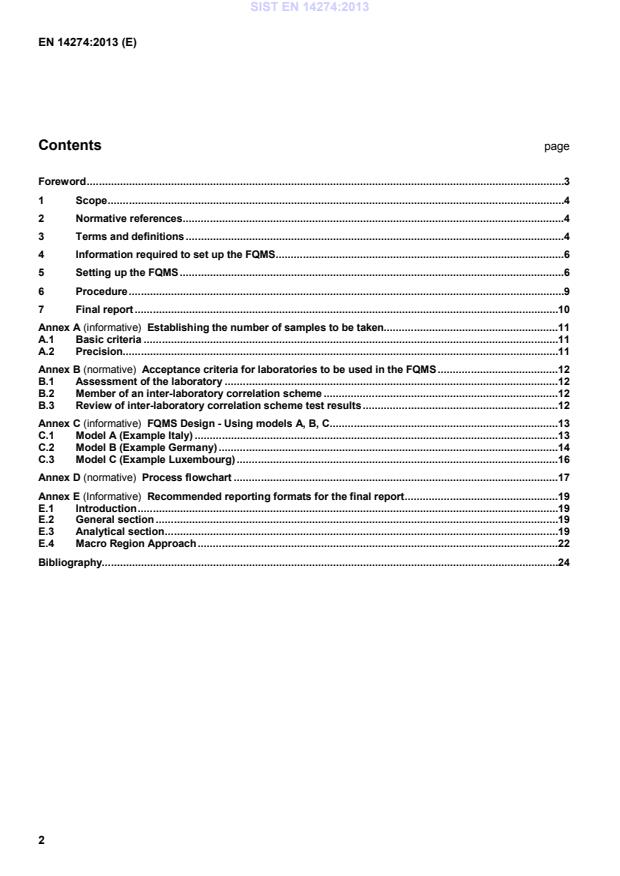
page Foreword . 3 1 Scope . 4 2 Normative references . 4 3 Terms and definitions . 4 4 Information required to set up the FQMS . 6 5 Setting up the FQMS . 6 6 Procedure . 9 7 Final report . 10 Annex A (informative)
Establishing the number of samples to be taken . 11 A.1 Basic criteria . 11 A.2 Precision . 11 Annex B (normative)
Acceptance criteria for laboratories to be used in the FQMS . 12 B.1 Assessment of the laboratory . 12 B.2 Member of an inter-laboratory correlation scheme . 12 B.3 Review of inter-laboratory correlation scheme test results . 12 Annex C (informative)
FQMS Design - Using models A, B, C . 13 C.1 Model A (Example Italy) . 13 C.2 Model B (Example Germany) . 14 C.3 Model C (Example Luxembourg) . 16 Annex D (normative)
Process flowchart . 17 Annex E (Informative)
Recommended reporting formats for the final report . 19 E.1 Introduction . 19 E.2 General section . 19 E.3 Analytical section . 19 E.4 Macro Region Approach . 22 Bibliography. 24
Therefore, this European Standard cannot be used without considerable adjustment for the representative monitoring of fuel quality in a specific region nor for a specific distribution chain nor for policing purposes, as the statistical reasoning, which forms the basis for this European Standard, may not be valid for these purposes. The required adjustments for an extension of the monitoring system are rather complex. They are beyond the scope of this European Standard and are therefore not included here. The provisions in this European Standard may, however, in principle be extended to allow for additional purposes. For several specific parameters, the European fuel specifications in EN 228 and EN 590 request that each country selects limiting values from a given set of values and specifies these country specific limiting values in the corresponding normative annex to EN 228 and EN 590 in order to adjust for geographic and climatic factors. These values may differ from country to country. Therefore, for these specific parameters, also the results obtained in this monitoring system will differ from country to country. The minimum number of samples that are to be drawn is based on the information and comprehensive statistical analysis available at the time of publication of this European Standard. A statistical explanation on how the different statistical models and minimum samples numbers were achieved will be added as an informative annex to this document at a later stage. As more information becomes available, the number of samples required may change. For this reason this European Standard will be reviewed from time to time. According to the CEN/CENELEC Internal Regulations, the national standards organisations of the following countries are bound to implement this European Standard: Austria, Belgium, Bulgaria, Croatia, Cyprus, Czech Republic, Denmark, Estonia, Finland, Former Yugoslav Republic of Macedonia, France, Germany, Greece, Hungary, Iceland, Ireland, Italy, Latvia, Lithuania, Luxembourg, Malta, Netherlands, Norway, Poland, Portugal, Romania, Slovakia, Slovenia, Spain, Sweden, Switzerland, Turkey and the United Kingdom. SIST EN 14274:2013
country size size of a country in relation to the total amount of fuel being placed on the market in that country 3.2.1 small-size country country in which a total of 15 million tons or less of automotive fuel is being placed on the market per annum 3.2.2
large-size country country in which a total of more than 15 million tons of automotive fuel is being placed on the market per annum 3.3 fuel dispensing site site, retail or commercial, where fuel is dispensed into road vehicles for propulsion 3.3.1
retail site site where the general public can purchase automotive fuel 3.3.2 commercial site site that is not open to the general public but where automotive fuel is dispensed 3.4 model design of the FQMS based on a number of different statistical, administrative or logistic criteria 3.5 sample size minimum number of samples required to be analysed in one country to make the results of the monitoring system representative for that country Note1 to entry: A country may, at its own discretion, use more than the minimum number of samples, but not less. 3.6 summer period period of the year as defined in specifications for fuel grades as per 3.1 3.7
winter period period of the year as defined in specifications for fuel grades as per 3.1 3.8 macro regions specific grouping of geographical or political regions within a country formed for efficient design of the FQMS Note1 to entry: See also 5.5. 3.9 variability factor factor, not exceeding a value of 10, designed to describe the variability in fuel supply in a specific macro region, which takes account of the number of different fuel sources (petrol or diesel fuel) that distribute fuel in a macro SIST EN 14274:2013
Petrol, per grade 50 100 50 Diesel fuel 50 100 50 Large-size country
Petrol, per grade 100 200 -- Diesel fuel 100 200 --
5.4 Minimum number of samples for fuel grades with market shares below 10% 5.4.1 For fuel grades with market shares below 10%, the minimum number of fuel dispensing sites in any country to be sampled shall be calculated as follows. 5.4.2 For each fuel grade with a market share of less than 10%, taking petrol and diesel separately, the minimum number of fuel dispensing sites to be sampled shall be calculated proportionally from the number of samples for the corresponding parent grade, using the following formula: gradeparent XGrade)gradeparent(
sharemarket )XGrade(
sharemarket NN×= (1) EXAMPLE Parent grade
Parent grade Grade X Super 95 Regular 91 Super 98 Parent of grade X yes no --
Market share 55 % 38 % 7 % Sample numbers 100 100 13 5.4.3 When a regional model is used (see 5.5) and the minimum sample number for a specific grade is calculated to be less than 1, at least one sample of that fuel grade shall be drawn from within that region. SIST EN 14274:2013
Therefore, the variability factor is not simply the sum of all refineries and terminals present in a certain region, but the number of different supply points that are supplying fuel from different sources. Once these variability factors have been defined for each geographical or political region in the country, the regions shall be grouped into macro regions with approximately the same total variability factor and same total volumes in each macro region, thereby ensuring that the sampling proportional to fuel volumes also captures fuel variability. An explicit example is given in Annex C. If appropriate, the macro regions may be fur
...