

EN 15276-1:2019
(Main)Fixed firefighting systems - Condensed aerosol extinguishing systems - Part 1: Requirements and test methods for components
- Abstract
This document specifies requirements and test methods for condensed aerosol extinguishing system components.
This document covers the use of condensed aerosol extinguishing systems for total flooding applications.
This document in not applicable to explosion suppression applications.
This document does not cover all legislative requirements. In certain countries specific national regulations apply and take precedence over this document. Users of this document are advised to inform themselves of the applicability or non-applicability for this document by their national responsible authorities.
- Status
- Published
- Publication Date
- 02-Apr-2019
- Withdrawal Date
- 30-Oct-2019
- Technical Committee
- CEN/TC 191 - Fixed firefighting systems
- Drafting Committee
- CEN/TC 191/WG 6 - Gas extinguishing Systems and components
- Current Stage
- 6060 - Definitive text made available (DAV) - Publishing
- Start Date
- 03-Apr-2019
- Due Date
- 05-May-2019
- Completion Date
- 03-Apr-2019

Overview
EN 15276-1:2019 is a CEN European standard for fixed firefighting systems using condensed aerosol extinguishing systems. Part 1 specifies requirements and test methods for components intended for total-flooding fire suppression applications. It covers component design, performance, durability and verification testing for aerosol generators and associated parts. The standard is not applicable to explosion suppression applications and national/regulatory requirements take precedence where relevant.
Key Topics
The standard defines component-level expectations and test procedures, including:
- Condensed aerosol generator requirements and function reliability
- Solid aerosol forming compound characteristics and handling considerations
- Activation devices (electrical, thermal and other activation methods) - performance and reliability tests
- End plate and housing construction and marking requirements
- Extinguishant characteristics and extinguishing density (coverage and distribution)
- Discharge parameters: discharge time, aerosol flow temperature and casing temperature
- Environmental and durability testing: ambient temperature/humidity ranges, accelerated ageing, corrosion, stress-corrosion, vibration, mechanical shock and drop tests
- Service life, shelf life and storage conditions expectations
- Documentation and marking requirements for traceability and safe use
- Test methods and compliance criteria, including detailed procedures for extinguishing density, distribution, activation performance and fire exposure tests
(These topics reflect clauses and testing annexes defined in the standard; exact test set‑ups and acceptance criteria are described in the published document.)
Applications
EN 15276-1:2019 is focused on total flooding condensed aerosol systems used to protect enclosed hazards such as electrical rooms, telecommunications equipment, engine compartments, and other enclosed spaces where aerosol suppression is suitable. It supports:
- Component manufacturers seeking product design and verification requirements
- Test laboratories conducting type testing and durability evaluations
- System designers and specifiers selecting compliant components for fixed aerosol systems
- Certification and approval bodies assessing conformity to European component standards
- Asset owners, facility managers and insurers evaluating system performance claims
Note: installers and system designers must also confirm compliance with local national regulations that may impose additional requirements.
Who Should Use This Standard
- Fire protection component manufacturers
- R&D and product development engineers for aerosol generators
- Accredited test houses and conformity assessment bodies
- System designers, integrators and installers of fixed firefighting systems
- Regulatory authorities and certification bodies
Related Standards
- Other parts of the EN 15276 series (system-level requirements and installation documents) and national fire safety regulations may be applicable. EN 15276-1:2019 supersedes CEN/TR 15276-1:2009 and should be used in conjunction with applicable regional standards and codes.
Relations
- Effective Date
- 10-Apr-2019
- Effective Date
- 09-Feb-2026
- Effective Date
- 09-Feb-2026
- Effective Date
- 09-Feb-2026
- Effective Date
- 28-Jan-2026
- Effective Date
- 28-Jan-2026
- Effective Date
- 28-Jan-2026
- Effective Date
- 28-Jan-2026
Get Certified
Connect with accredited certification bodies for this standard

CIS Institut d.o.o.
Personal Protective Equipment (PPE) certification body. Notified Body NB-2890 for EU Regulation 2016/425 PPE.

Kiwa BDA Testing
Building and construction product certification.
Kmetijski inštitut Slovenije
Agricultural Institute of Slovenia. Soil testing, plant health, agricultural product analysis.
Sponsored listings
Frequently Asked Questions
EN 15276-1:2019 is a standard published by the European Committee for Standardization (CEN). Its full title is "Fixed firefighting systems - Condensed aerosol extinguishing systems - Part 1: Requirements and test methods for components". This standard covers: This document specifies requirements and test methods for condensed aerosol extinguishing system components. This document covers the use of condensed aerosol extinguishing systems for total flooding applications. This document in not applicable to explosion suppression applications. This document does not cover all legislative requirements. In certain countries specific national regulations apply and take precedence over this document. Users of this document are advised to inform themselves of the applicability or non-applicability for this document by their national responsible authorities.
This document specifies requirements and test methods for condensed aerosol extinguishing system components. This document covers the use of condensed aerosol extinguishing systems for total flooding applications. This document in not applicable to explosion suppression applications. This document does not cover all legislative requirements. In certain countries specific national regulations apply and take precedence over this document. Users of this document are advised to inform themselves of the applicability or non-applicability for this document by their national responsible authorities.
EN 15276-1:2019 is classified under the following ICS (International Classification for Standards) categories: 13.220.20 - Fire protection. The ICS classification helps identify the subject area and facilitates finding related standards.
EN 15276-1:2019 has the following relationships with other standards: It is inter standard links to CEN/TR 15276-1:2009, EN 60068-2-6:2008, EN 60068-2-30:2005, ISO 5660-1:2015, EN 15276-2:2019, EN 2:1992, EN 1860-2:2023, EN 19694-5:2016. Understanding these relationships helps ensure you are using the most current and applicable version of the standard.
EN 15276-1:2019 is available in PDF format for immediate download after purchase. The document can be added to your cart and obtained through the secure checkout process. Digital delivery ensures instant access to the complete standard document.
Standards Content (Sample)
SLOVENSKI STANDARD
01-julij-2019
Nadomešča:
SIST-TP CEN/TR 15276-1:2009
Vgrajeni gasilni sistemi - Sistemi za gašenje s kondenziranim aerosolom - 1. del:
Zahteve in preskusne metode za sestavne dele
Fixed firefighting systems - Condensed aerosol extinguishing systems - Part 1:
Requirements and test methods for components
Ortsfeste Brandbekämpfungsanlagen - Löschanlagen für kondensierte Aerosole - Teil 1:
Anforderungen und Prüfverfahren für Bauteile
Installations fixes de lutte contre l'incendie - Systèmes d'extinction à aérosol - Partie 1:
Exigences et méthodes d'essais pour les éléments constitutifs
Ta slovenski standard je istoveten z: EN 15276-1:2019
ICS:
13.220.10 Gašenje požara Fire-fighting
2003-01.Slovenski inštitut za standardizacijo. Razmnoževanje celote ali delov tega standarda ni dovoljeno.
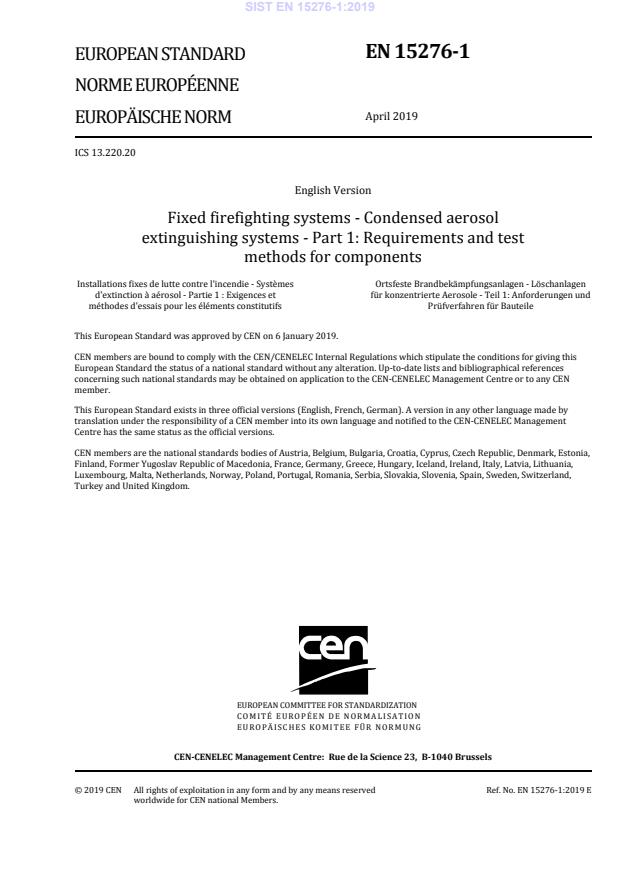
EN 15276-1
EUROPEAN STANDARD
NORME EUROPÉENNE
April 2019
EUROPÄISCHE NORM
ICS 13.220.20
English Version
Fixed firefighting systems - Condensed aerosol
extinguishing systems - Part 1: Requirements and test
methods for components
Installations fixes de lutte contre l'incendie - Systèmes Ortsfeste Brandbekämpfungsanlagen - Löschanlagen
d'extinction à aérosol - Partie 1 : Exigences et für konzentrierte Aerosole - Teil 1: Anforderungen und
méthodes d'essais pour les éléments constitutifs Prüfverfahren für Bauteile
This European Standard was approved by CEN on 6 January 2019.
CEN members are bound to comply with the CEN/CENELEC Internal Regulations which stipulate the conditions for giving this
European Standard the status of a national standard without any alteration. Up-to-date lists and bibliographical references
concerning such national standards may be obtained on application to the CEN-CENELEC Management Centre or to any CEN
member.
This European Standard exists in three official versions (English, French, German). A version in any other language made by
translation under the responsibility of a CEN member into its own language and notified to the CEN-CENELEC Management
Centre has the same status as the official versions.
CEN members are the national standards bodies of Austria, Belgium, Bulgaria, Croatia, Cyprus, Czech Republic, Denmark, Estonia,
Finland, Former Yugoslav Republic of Macedonia, France, Germany, Greece, Hungary, Iceland, Ireland, Italy, Latvia, Lithuania,
Luxembourg, Malta, Netherlands, Norway, Poland, Portugal, Romania, Serbia, Slovakia, Slovenia, Spain, Sweden, Switzerland,
Turkey and United Kingdom.
EUROPEAN COMMITTEE FOR STANDARDIZATION
COMITÉ EUROPÉEN DE NORMALISATION
EUROPÄISCHES KOMITEE FÜR NORMUNG
CEN-CENELEC Management Centre: Rue de la Science 23, B-1040 Brussels
© 2019 CEN All rights of exploitation in any form and by any means reserved Ref. No. EN 15276-1:2019 E
worldwide for CEN national Members.
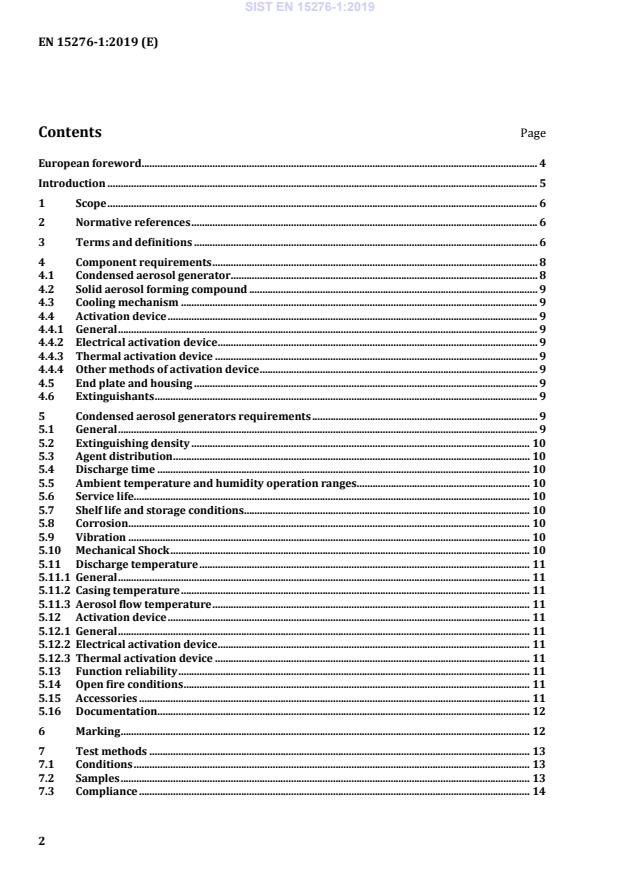
Contents Page
European foreword . 4
Introduction . 5
1 Scope . 6
2 Normative references . 6
3 Terms and definitions . 6
4 Component requirements . 8
4.1 Condensed aerosol generator . 8
4.2 Solid aerosol forming compound . 9
4.3 Cooling mechanism . 9
4.4 Activation device . 9
4.4.1 General . 9
4.4.2 Electrical activation device . 9
4.4.3 Thermal activation device . 9
4.4.4 Other methods of activation device . 9
4.5 End plate and housing . 9
4.6 Extinguishants . 9
5 Condensed aerosol generators requirements . 9
5.1 General . 9
5.2 Extinguishing density . 10
5.3 Agent distribution . 10
5.4 Discharge time . 10
5.5 Ambient temperature and humidity operation ranges . 10
5.6 Service life . 10
5.7 Shelf life and storage conditions. 10
5.8 Corrosion . 10
5.9 Vibration . 10
5.10 Mechanical Shock . 10
5.11 Discharge temperature . 11
5.11.1 General . 11
5.11.2 Casing temperature . 11
5.11.3 Aerosol flow temperature . 11
5.12 Activation device . 11
5.12.1 General . 11
5.12.2 Electrical activation device . 11
5.12.3 Thermal activation device . 11
5.13 Function reliability . 11
5.14 Open fire conditions . 11
5.15 Accessories . 11
5.16 Documentation . 12
6 Marking . 12
7 Test methods . 13
7.1 Conditions . 13
7.2 Samples . 13
7.3 Compliance . 14
7.4 Extinguishing density determination . 14
7.5 Coverage determination . 14
7.6 Temperature and humidity operation range tests . 14
7.6.1 General . 14
7.6.2 Test procedure . 14
7.6.3 Low temperature Test. 15
7.7 Accelerated ageing test . 15
7.7.1 General . 15
7.7.2 Objective of test . 15
7.7.3 Performance requirements . 15
7.7.4 Test . 15
7.7.5 Remark . 15
7.7.6 Number of product under test . 15
7.7.7 Remark . 15
7.8 Corrosion test . 16
7.9 Stress corrosion test . 16
7.10 Vibration test. 16
7.11 Drop test . 17
7.11.1 Impact Surface . 17
7.11.2 Procedure . 17
7.11.3 Requirements . 17
7.12 Aerosol flow temperature test . 17
7.13 Activation performance test . 17
7.14 Function test . 18
7.14.1 Discharge time . 18
7.14.2 Aerosol flow temperatures . 18
7.14.3 Test procedure . 18
7.14.4 Casing temperature test . 18
7.14.5 Efficiency . 18
7.14.6 Requirements . 19
7.15 Fire Exposure Test . 19
7.15.1 Object of the test . 19
7.15.2 Test procedure . 19
7.15.3 Requirements . 20
Annex A (normative) Extinguishing density/coverage test procedure . 21
A.1 General . 21
A.2 Principle . 21
A.3 Extinguishing system. 22
A.4 Extinguishing Density . 23
A.5 Aerosol generator distribution verification tests . 23
A.6 Extinguishing density tests . 30
A.7 Hold Time Test of the determination of the maximum leakage area/volume ratio . 47
Bibliography . 50
European foreword
This document (EN 15276-1:2019) has been prepared by Technical Committee CEN/TC 191 “Fixed
firefighting systems”, the secretariat of which is held by BSI.
This European Standard shall be given the status of a national standard, either by publication of an
identical text or by endorsement, at the latest by October 2019, and conflicting national standards shall
be withdrawn at the latest by October 2019.
Attention is drawn to the possibility that some of the elements of this document may be the subject of
patent rights. CEN shall not be held responsible for identifying any or all such patent rights.
This document supersedes CEN/TR 15276-1:2009.
In comparison with the previous edition CEN/TR 15276-1:2009, the following technical modifications
have been made:
− the Technical Report CEN/TR 15276-1:2009 has been revised and published as a standard;
− Normative references have been updated;
− Clause 3 "Terms and definitions" has been revised;
− 4.5 "End plate and housing" has been revised;
− 5.11.3 "Aerosol flow temperature" has been revised;
− Clause 6 "Marking" has been revised;
− Clause 7 "Test methods" has been revised;
− Annex A "Extinguishing density/coverage test procedure" has been revised;
− the standard has been editorially revised.
According to the CEN-CENELEC Internal Regulations, the national standards organisations of the
following countries are bound to implement this European Standard: Austria, Belgium, Bulgaria,
Croatia, Cyprus, Czech Republic, Denmark, Estonia, Finland, Former Yugoslav Republic of Macedonia,
France, Germany, Greece, Hungary, Iceland, Ireland, Italy, Latvia, Lithuania, Luxembourg, Malta,
Netherlands, Norway, Poland, Portugal, Romania, Serbia, Slovakia, Slovenia, Spain, Sweden, Switzerland,
Turkey and the United Kingdom.
Introduction
It has been assumed in the preparation of this document that the execution of its provisions is entrusted
to appropriately qualified and experienced people in the specification, design, installation, testing,
approval, inspection, operation and maintenance of systems and equipment, for whose guidance it has
been prepared, and who can be expected to exercise a duty of care to avoid unnecessary release of
extinguishant.
Firefighting systems covered in this document are designed to provide a supply of fixed condensed
aerosol extinguishing medium to extinguish fire.
The requirements of this document are made in the light of the best technical data known at the time of
writing but, since a wide field is covered, it has been impracticable to consider every possible factor or
circumstance that might affect implementation of the requirements.
It is important that the fire protection of a building or plant be considered as a whole. Aerosol
extinguishant systems form only a part, though an important part, of the available facilities, but it
should not be assumed that their adoption necessarily removes the need to consider supplementary
measures, such as the provision of portable fire extinguishers or other mobile appliances for first aid or
emergency use, or to deal with special hazards.
Aerosol extinguishants have been recognized as effective media for the extinction of Class A fires (solid
surface burning fires) and Class B and Class C fires according to EN 2 but it should not be forgotten, in
the planning of comprehensive schemes, that there can be hazards for which these mediums are not
suitable, or that in certain circumstances or situations there can be dangers in their use requiring
special precautions.
Advice on these matters can be obtained from the appropriate manufacturer of the aerosol generators
or the extinguishing system. Information can also be sought from the appropriate fire authority, the
health and safety authorities and insurers. In addition, reference should be made as necessary to other
standards and statutory regulations.
It is essential that fire-fighting equipment be carefully maintained to ensure instant readiness when
required. Routine maintenance is liable to be overlooked or given insufficient attention by the owner of
the system. It is, however, neglected at peril to the lives of occupants of the premises and at the risk of
crippling financial loss. The importance of maintenance cannot be too highly emphasized.
Condensed aerosol can contain traces of toxic substances like those produced by a fire, and will obscure
vision like smoke from fire. This standard requires, as a precaution, that the room is evacuated and
sealed off whenever a generator is activated — much like recommended response to fires. Precautions
include evacuation of the proximity area, criteria for re-entering and other safeguards.
1 Scope
This document specifies requirements and test methods for condensed aerosol extinguishing system
components.
This document covers the use of condensed aerosol extinguishing systems for total flooding
applications.
This document in not applicable to explosion suppression applications.
This document does not cover all legislative requirements. In certain countries specific national
regulations apply and take precedence over this document. Users of this document are advised to
inform themselves of the applicability or non-applicability for this document by their national
responsible authorities.
2 Normative references
The following documents are referred to in the text in such a way that some or all of their content
constitutes requirements of this document. For dated references, only the edition cited applies. For
undated references, the latest edition of the referenced document (including any amendments) applies.
EN 2, Classification of fires
EN 15276-2, Fixed firefighting systems — Condensed aerosol extinguishing systems — Part 2: Design,
installation and maintenance
EN 60068-2-6:2008, Environmental testing — Part 2-6: Tests — Test Fc: Vibration (sinusoidal)
(IEC 60068-2-6:2007)
EN 60068-2-30:2005, Environmental testing — Part 2-30: Tests — Test Db: Damp heat, cyclic (12 h + 12 h
cycle) (IEC 60068-2-30:2005)
ISO 5660-1, Reaction-to-fire tests — Heat release, smoke production and mass loss rate — Part 1: Heat
release rate (cone calorimeter method) and smoke production rate (dynamic measurement)
3 Terms and definitions
For the purposes of this document, the terms and definitions given in EN 15276-2 and the following
apply.
ISO and IEC maintain terminological databases for use in standardization at the following addresses:
— IEC Electropedia: available at http://www.electropedia.org/
— ISO Online browsing platform: available at http://www.iso.org/obp
3.1
Clearance
3.1.1
electrical clearance
unobstructed air distance between extinguishing system equipment and unenclosed or uninsulated live
electrical components not at ground potential
3.1.2
thermal clearance
air distance between a condensed aerosol generator and any structure or components sensitive to the
temperature developed by the generator
3.2
condensed aerosol
extinguishing medium consisting of finely divided solid particles and gaseous matter, these being
generated by a combustion process of a solid aerosol-forming compound
3.3
condensed aerosol generator
non-pressurized device which, when activated, generates an aerosol and includes the mounting
brackets
3.4
design application density
extinguishing density multiplied by the safety factor, required for system design purposes
Note 1 to entry: The extinguishing density and the design application density is expressed in grams per cubic
meter.
Note 2 to entry: Extinguishing density is the actual concentration of aerosol in the test room.
3.5
discharge time
time from the generator activation to the end of its discharge
3.6
efficiency
efficiency is the assessment of the effective mass of discharged extinguishant per generator type and
provides in the actual density amount of aerosol extinguishing agent in the enclosure
3.7
extinguishing density
effective minimum mass of discharged extinguishant per unit of enclosure volume required to
extinguish fire involving specific fuel under defined experimental conditions
Note 1 to entry: Measured in g/m .
3.8
family
group of generators with same solid compound, same kind of cooling device, same kind of discharge
outlet, same ignition device, same layout and same internal or external architecture
3.9
ignition device
activation device
any device which is intended to ignite the solid aerosol-forming compound
3.10
maintenance
thorough check to give maximum assurance that the extinguishing system will operate as intended
Note 1 to entry: It includes a thorough examination and any necessary repair or replacement of system
components.
3.11
monitoring
supervision of the operating integrity of an electrical, mechanical, pneumatic or hydraulic control
feature of a system
3.12
protected volume
volume enclosed by the building elements around the protected enclosure, minus the volume of any
permanent impermeable building element within the enclosure
3.13
release
physical discharge or emission of an aerosol as a consequence of the generator activation
3.14
safety factor
multiplier of the extinguishing density to determine the design application density
3.15
solid aerosol forming compound
mixture of oxidant, combustible component and technical admixtures producing fire extinguishing
aerosol upon activation
3.16
supplier
legal person that is responsible for the product and is able to ensure that its quality is ensured
3.17
thermal activation device
device which automatically operates at a rated temperature and is arranged for the activation of the
solid aerosol-forming compound
4 Component requirements
4.1 Condensed aerosol generator
The condensed aerosol generator typically consists of the following main components:
a) solid aerosol-forming compound;
b) cooling mechanism (if applicable);
c) activation device(s);
d) end plate discharge outlet(s);
e) housing;
f) mounting bracket.
The generator is a non-pressurized canister, because aerosol is generated and distributed by the
combustion process of the solid aerosol-forming compound.
4.2 Solid aerosol forming compound
Mixture of oxidant, combustible component and technical admixtures producing fire extinguishing
aerosol upon activation.
4.3 Cooling mechanism
The cooling mechanism provides cooling of the hot aerosol prior to its discharge into the enclosure.
4.4 Activation device
4.4.1 General
The activation device is arranged to initiate the aerosol-forming compound.
If the activation device is a complex device incorporating several components, all components shall be
specified by the manufacturer.
4.4.2 Electrical activation device
The electrical activation device shall be capable of operating via an electrical input and arranged to
initiate the aerosol-forming compound.
4.4.3 Thermal activation device
The thermal activation device shall be capable of operating at a rated temperature and arranged to
initiate the aerosol-forming compound.
4.4.4 Other methods of activation device
Methods capable to initiate the aerosol-forming compound, other than 4.4.2 and 4.4.3, shall be specified
by the manufacturer.
4.5 End plate and housing
The outer case and all parts inside the generator shall be made of corrosion-resistant material or shall
be suitably treated to resist corrosion. The manufacturer shall ensure that the materials of construction
are also compatible with the solid aerosol-forming compound and the cooling device so that corrosion
or chemical action does not adversely affect performance.
Materials for non-metallic components that are exposed to ultraviolet light shall be UV-stabilized.
The housing shall be designed so that the function cannot be adversely affected by ageing or
environmental influences.
Non-metallic materials and elastomers shall be selected to be stable and not alter their performance
over the working life recommended by the manufacturer.
4.6 Extinguishants
The extinguishants referred to in this document are electrically non-conductive media.
5 Condensed aerosol generators requirements
5.1 General
The test samples shall conform to the technical description (drawings, parts list, description of function,
operating instructions) as stated by the manufacturer (see 5.17 and 7.3).
The manufacturer shall specify the minimum distance from the generator outlet to the first obstacle.
The manufacturer shall specify the minimum and maximum mass of aerosol compound discharged from
the generator.
5.2 Extinguishing density
The extinguishing density for specific fuels under different classes of fires shall be determined by test
using the fire test protocol described in Annex A.
5.3 Agent distribution
The maximum area coverage and the related maximum and minimum height of the protected enclosure
for each aerosol generator unit size shall be determined by tests using the fire test protocol described in
7.5.
5.4 Discharge time
Discharge time shall be specified by the manufacturer and shall not exceed 90 s when tested in
accordance with 7.14.1.
5.5 Ambient temperature and humidity operation ranges
Condensed aerosol generators shall operate at ambient temperatures as specified by the manufacturer
and as a minimum requirement from −20 °C to +50 °C.
Condensed aerosol generators shall operate at ambient humidity up to 95 %.
These operation ranges shall be verified by the temperature and humidity operation range tests as
described in 7.6.
5.6 Service life
The service life of condensed aerosol generator under specific conditions, as described in 5.5, shall be
specified by the manufacturer and as a minimum requirement shall not be less than 15 years.
The specified service life shall be verified by test using the accelerated ageing test as described in 7.7.
5.7 Shelf life and storage conditions
The shelf life and storage conditions shall be specified by the manufacturer.
5.8 Corrosion
The aerosol generator shall operate according to 7.14 and shall show no sign of damage which could
alter the proper extinguishing action after being subjected to the corrosion test described in 7.8.
Any copper alloy part used in the component shall not crack, when tested in accordance with 7.9 (stress
corrosion test).
5.9 Vibration
The aerosol generator shall operate according to 7.14 after being subjected to a vibration test described
in 7.10.
5.10 Mechanical Shock
The aerosol generator shall operate according to 7.14 after being subjected to a drop test as described
in 7.11.
5.11 Discharge temperature
5.11.1 General
The requirements of 5.11.2 and 5.11.3 shall be verified by test according to the procedure described in
7.14.4.
5.11.2 Casing temperature
The manufacturer shall specify the maximum developed temperature for aerosol casing that shall not
exceed 400 °C.
5.11.3 Aerosol flow temperature
The selected unit sizes shall be appropriate for the protected area in terms of the minimum thermal
clearance from the discharge outlets.
The following general criteria shall apply:
— for locations where personnel can be situated, the minimum thermal clearance shall refer to a
temperature not exceeding 75 °C;
— for locations where combustible materials or equipment can be situated, the minimum thermal
clearance shall refer to a temperature not exceeding 200 °C;
— for locations where non-combustible equipment can be situated, the minimum thermal clearance
shall refer to a temperature not exceeding 400 °C.
5.12 Activation device
5.12.1 General
The characteristics of the activation device shall be verified and the reliability of operation tested by
using the test method as described in 7.13.
5.12.2 Electrical activation device
The manufacturer shall specify at least the minimum activation current and its duration, form of the
signal, maximum monitoring current, range of voltage and the type of connection for a multiple
generators arrangement.
5.12.3 Thermal activation device
The manufacturer shall specify at least the minimum rated temperature at which the device operates.
5.13 Function reliability
When activated, the aerosol generator shall operate satisfactorily when tested in accordance with the
procedure described in 7.14 (Function test).
5.14 Open fire conditions
As the aerosol generators are installed inside the protected enclosure, the generators shall pass the
function test after being subjected to the fire exposure test as described in 7.15.
5.15 Accessories
The mounting bracket shall be tested together with the generator for corrosion, vibration and drop test
as described in 7.8, 7.10, and 7.13.
5.16 Documentation
The manufacturer shall prepare and maintain documentation.
The manufacturer shall prepare installation and user documentation.
This documentation shall comprise at least the following:
a) general description of the components;
b) technical specification including:
1) information mentioned in 5.1 and 7.15;
2) sufficient information to permit an assessment of the compatibility with other components of
the system (if applicable e.g. mechanical, electric or software compatibility);
c) installation instructions including mounting instructions;
d) operating instructions;
e) maintenance instructions;
f) safety data sheet.
The manufacturer shall prepare design documentation. This documentation shall include drawings,
parts lists, block diagrams (if applicable), circuit diagrams (if applicable) and a functional description to
such an extent that conformity to this document can be checked and that a general assessment of the
design is possible.
6 Marking
Each generator shall be marked with the following information:
a) name of the product;
b) manufacturer’s name or trade mark;
c) some mark(s) or code(s) (e.g. serial number or batch code), by which the date or batch and place of
manufacture (if several places of manufacture) can be identified by the manufacturer;
d) mass of aerosol-forming compound;
e) date of manufacture;
f) temperature range;
g) storage humidity range;
h) service life;
i) distances as specified in 5.11.3;
j) fire classes according to EN 2;
k) reference to the relevant version of operation and instruction manual.
The markings shall be non-detachable, non-flammable, permanent and legible.
7 Test methods
7.1 Conditions
The components shall be tested assembled as recommended for installation by the manufacturer. The
tests shall be carried at a temperature of (25 ± 10) °C, except when otherwise stated.
The tolerance for all test parameters is ±5 %, unless otherwise stated.
7.2 Samples
The manufacturer shall submit for tests a minimum of 55 samples from the same family. From this
number, 20 samples shall be tested according to the function test in 7.14 only.
The order of tests (with the exception of the compliance test and the function test) can be changed
when necessary.
The sequence of tests is shown in Table 1 and is given by the numbers 1, 2, 3 etc. in the columns A, B etc.
are the different samples.
Table 1 — Test order for samples
Test method A B C D E F G H I J K H
Amount
3 3 3 3 3 3 3 3 3 3 5 100
Samples
7.3 Compliance 1 1 1 1 1 1 1 1 1 1 1 1
7.6 Temperature and humidity
operation range tests
7.6.2 Temperature and
humidity test
7.6.3 Low temperature test 2
7.7. Accelerated ageing test 2
7.8 Corrosion test 2
7.9 Stress corrosion test 2
7.10 Vibration test 2
7.11 Drop test 2
7.13 Activation performance
test
7.14 Function test 3 3 3 3 – 3 3 3 2
7.14.1 Discharge test 2
7.14.2 Aerosol flow
temperature
7.14.4 Casing temperature test 2
7.15 Fire exposure test 2
7.3 Compliance
A visual and measurement check shall be made to determine whether the condensed aerosol generator
corresponds to the description in the technical literature (drawings, parts lists, description of functions,
operating and installation instructions).
7.4 Extinguishing density determination
The extinguishing density for specific fuels under different classes of fires shall be determined by
specific tests using the fire test procedures described in Annex A.
Extinguishing density tests shall be conducted with generator(s) of the same family. The number of
aerosol generator units shall be sufficient to provide the needed extinguishing density in the test
enclosure. The mass of the generator unit prior and after discharge shall be recorded in order to
determine the efficiency of the generator.
7.5 Coverage determination
NOTE This test relates to the requirements of 5.3.
The maximum coverage and maximum and minimum height of the protected enclosure for each aerosol
generator unit size shall be determined by test using the fire test procedures as described in Annex A.
7.6 Temperature and humidity operation range tests
7.6.1 General
The object of the test is to demonstrate the ability of the equipment to function correctly at high relative
humidity (with condensation) which can occur for short periods in the anticipated service environment.
7.6.2 Test procedure
7.6.2.1 General
The test procedure as described in EN 60068-2-30:2005, using the variant 1 test cycle and controlled
recovery conditions shall be used.
7.6.2.2 Conditioning
Apply the following severity of conditioning:
a) lower temperature: (25 ± 3) °C;
b) upper temperature: (55 ± 2) °C;
c) relative humidity at lower temperature: (95 ± 3) %;
d) relative humidity at upper temperature: (95 ± 3) %;
e) number of cycles: 10.
7.6.2.3 Final measurements
After the recovery period, the sample shall be visually checked externally, and shall be subjected to the
function test.
7.6.2.4 Requirements
When subjected to the function test, the sample shall perform correctly.
7.6.3 Low temperature Test
Condition the sample at −20 °C, or the service temperature recommended by the manufacturer
whichever is the lower, for a minimum of 16 h.
Then carry out the function test immediately. When subjected to the function test, the sample shall
respond correctly.
7.7 Accelerated ageing test
7.7.1 General
Procedure to establish the service life of a condensed aerosol generators.
7.7.2 Objective of test
The objective of the test is to demonstrate the ability of the condensed aerosol generators to function
correctly during the service life period of 15 years when stored in a dry, non-corrosive environment.
NOTE The service life period includes the storage and installation life period for the product.
7.7.3 Performance requirements
The service life period is determined by thermal aging. The condensed aerosol generator and activator
is tested in its original housing including mounting bracket. The aerosol generator is placed in a
temperature and humidity controlled cabinet in which the temperature can be cycled (aging cabinet).
After the test is completed, the performance of the aerosol generator is determined in accordance with
the function test.
7.7.4 Test
The following test shall be performed.
Aging cabinet settings:
— Start from ambient temperature and set a humidity of 70 %;
— set to −10 °C and then to 50 °C (±2 °C) and alternate between these temperatures every 4 h
— once cycle amounts to a full transition from −10 °C to 50 °C, and then back to −10 °C within 8 h;
— number of cycles is 50.
End from −10 °C to ambient temperature.
7.7.5 Remark
Service life period of 15 years if stored in a dry, non-corrosive environment. The test shall be performed
on fully assembled condensed aerosol generators. The mounting bracket shall be tested together with
the generator.
7.7.6 Number of product under test
A minimum of three generators in the smallest and largest size within a family shall be tested.
7.7.7 Remark
This test is used for several materials of construction. The stability of the molecular structure of the
material is tested by the temperature cycles. During each cycle the material passes the dew point which
will lead to condensation on the exterior of the object. During the cold period this can lead to freezing in
hairline cracks in the material which can affect the structure of the material. In use the components are
not exposed to rain, i.e. they are not exposed to a full water load, but they can be affected by
condensation, which is simulated by this test. This thermal ageing method is intended to obtain
information about the long-term behaviour of materials in the short-term. The effect of this on the fire
extinguishing performance is realistic and functional.
7.8 Corrosion test
The sample shall be exposed to a salt spray within a fog chamber.
The essential components and properties of the reagents and the test configuration are:
— Solutions consists of NaCl in distilled water;
— Concentrations of the solution: (5 ± 1) %;
— pH value: 6,5 to 7,5;
— spray pressure: 0,6 bar to 1,5 bar;
— spray volume: 1 ml/h to 2 ml/h on an area of 80 cm ;
— temperature in test cabinet: 35;
— position of the sample: 150 to the vertical axis;
— spray time: (240 ± 2) h;
— drying time: (168 ± 5) h at a humidity of maximum 70 %.
The sample shall be subjected to a function test in accordance with 7.14.
7.9 Stress corrosion test
This test is to be conducted only on generators using copper alloys. The stress corrosion test is to be
conducted unless it can be shown that the materials used in the construction are not susceptible to
ammonia stress corrosion.
The aqueous ammonia solution shall have a specific weight of (0,94 ± 0,02) kg/l. The sample shall be
filled with (10 ± 0,5) ml of the solution for each litre of container volume.
The sample shall be degreased for the test and shall be exposed for 10 d to the moist atmosphere of
ammonia and air, at a temperature of (34 ±
...