

EN 13395-1:2002
(Main)Products and systems for the protection and repair of concrete structures - Test methods - Determination of workability - Part 1: Test for flow of thixotropic mortars
- Abstract
This European Standard specifies a method for determining the workability (or consistence) of trowel-grade hydraulic cement mortars CC, polymer modified hydraulic cement mortars PCC and polymer bound mortars PC for the protection and repair of concrete, as defined in EN 1504-1.
- Status
- Published
- Publication Date
- 21-May-2002
- Technical Committee
- CEN/TC 104 - Concrete ( performance, production, placing and compliance criteria )
- Drafting Committee
- CEN/TC 104/SC 8/WG 2 - Repair
- Current Stage
- 9020 - Submission to 2 Year Review Enquiry - Review Enquiry
- Start Date
- 15-Jul-2026
- Completion Date
- 15-Jul-2026

Overview
EN 13395-1:2002 defines a standardized laboratory method to determine the workability (consistence) of trowel‑grade thixotropic repair mortars used for the protection and repair of concrete structures. It covers hydraulic cement mortars (CC), polymer‑modified hydraulic cement mortars (PCC) and polymer‑bound mortars (PC) as defined in EN 1504‑1. The test measures mortar flow on a flow table after a controlled jolting action, providing repeatable data for product development, quality control and specification compliance.
Key topics and technical requirements
- Scope: Applicable to trowel‑grade thixotropic mortars for protection and repair of concrete (EN 1504‑1 references).
- Principle: Flow spread after 15 jolts of a flow table; method based on EN 1015‑3.
- Equipment:
- Mortar or concrete mixer (EN 196‑1 mixer or forced action pan mixer); note some mortars may foam in certain mixers - a concrete mixer can be used as alternative.
- Tamper: 40 ±1 mm diameter, (200 ±10) mm length, flat square tamping face, mass (0.250 ±0.015) kg.
- Flow table and truncated conical mould (per EN 1015‑3 Annex A).
- Calipers (accuracy 1 mm up to 300 mm), stopwatch (1 s accuracy).
- Standard lab climate: 21 ±2 °C and 60 ±10 % RH.
- Sample preparation:
- Condition materials ≥24 h in standard climate.
- For CC and PCC: mix at low speed, pour gauging liquid, add dry ingredients, mix for 2 minutes after all ingredients added.
- Remix mortar 20 ±2 s immediately before testing.
- Test procedure & timing:
- Test samples at (10 ±5) min, (30 ±5) min or other agreed intervals; two samples per interval.
- Place mortar in mould in two layers, compact with tamper, skim excess, wait 30 s, lift mould, jolt platen 15 times at ~1 drop/s.
- Results & acceptance:
- Measure two orthogonal diameters, record to nearest 1 mm, mean of two tests = Flow Value.
- If the two results differ by >10% from the mean, test two additional samples.
- Test report: Must include reference to standard, laboratory and manufacturer details, batch ID, test dates/conditions, equipment, individual values and mean flow, precision data, and signature.
Applications and users
- Manufacturers: product development, formulation optimization and batch quality control.
- Independent test laboratories: performance verification and certification testing.
- Specifiers and consultants: setting performance requirements in repair contracts and tenders.
- Contractors: verifying workmanship and suitability of trowel‑grade mortars on site (laboratory acceptance tests).
- Regulators / certifiers: conformity assessment relative to EN 1504 series.
Related standards
- EN 1504‑1 (definitions and requirements for repair products)
- EN 1015‑3 (flow table method reference)
- EN 13395 parts 2–4 (flow of grout/mortar, repair concrete, overhead application)
Keywords: EN 13395-1:2002, thixotropic mortars, workability test, flow table, trowel‑grade repair mortar, concrete repair standards.
Relations
- Effective Date
- 28-Jan-2026
- Effective Date
- 28-Jan-2026
- Effective Date
- 28-Jan-2026
- Effective Date
- 28-Jan-2026
- Effective Date
- 28-Jan-2026
- Effective Date
- 28-Jan-2026
- Effective Date
- 28-Jan-2026
Get Certified
Connect with accredited certification bodies for this standard

DIBt (Deutsches Institut für Bautechnik)
German Institute for Building Technology.
DIN CERTCO
DIN Group product certification.

Aboma Certification B.V.
Specialized in construction, metal, and transport sectors.
Sponsored listings
Frequently Asked Questions
EN 13395-1:2002 is a standard published by the European Committee for Standardization (CEN). Its full title is "Products and systems for the protection and repair of concrete structures - Test methods - Determination of workability - Part 1: Test for flow of thixotropic mortars". This standard covers: This European Standard specifies a method for determining the workability (or consistence) of trowel-grade hydraulic cement mortars CC, polymer modified hydraulic cement mortars PCC and polymer bound mortars PC for the protection and repair of concrete, as defined in EN 1504-1.
This European Standard specifies a method for determining the workability (or consistence) of trowel-grade hydraulic cement mortars CC, polymer modified hydraulic cement mortars PCC and polymer bound mortars PC for the protection and repair of concrete, as defined in EN 1504-1.
EN 13395-1:2002 is classified under the following ICS (International Classification for Standards) categories: 91.080.40 - Concrete structures; 91.100.10 - Cement. Gypsum. Lime. Mortar. The ICS classification helps identify the subject area and facilitates finding related standards.
EN 13395-1:2002 has the following relationships with other standards: It is inter standard links to EN 196-1:2016, EN 1015-3:1999, EN 1504-1:2005, prEN 1504-3, EN 1504-10:2003, EN 1504-10:2017, EN 1504-3:2005. Understanding these relationships helps ensure you are using the most current and applicable version of the standard.
EN 13395-1:2002 is associated with the following European legislation: EU Directives/Regulations: 305/2011, 89/106/EEC. When a standard is cited in the Official Journal of the European Union, products manufactured in conformity with it benefit from a presumption of conformity with the essential requirements of the corresponding EU directive or regulation.
EN 13395-1:2002 is available in PDF format for immediate download after purchase. The document can be added to your cart and obtained through the secure checkout process. Digital delivery ensures instant access to the complete standard document.
Standards Content (Sample)
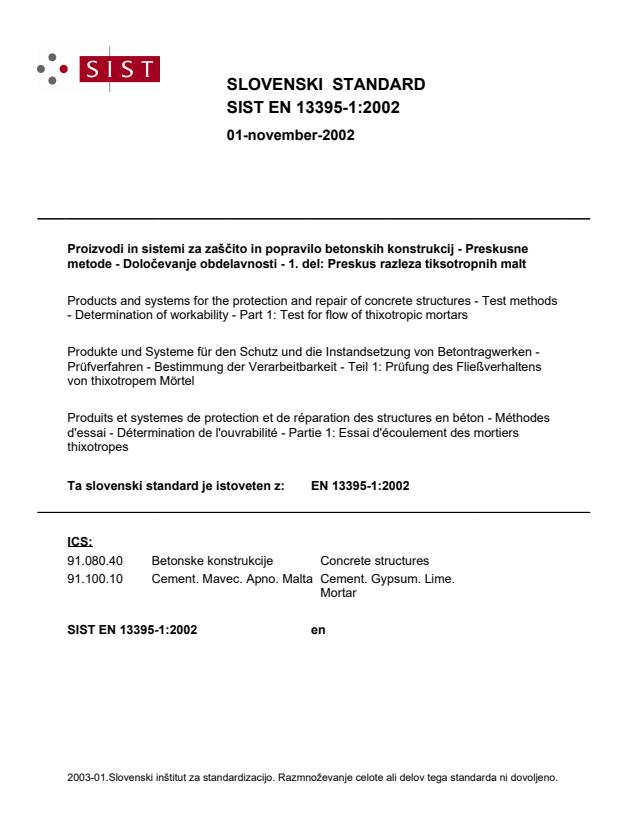
2003-01.Slovenski inštitut za standardizacijo. Razmnoževanje celote ali delov tega standarda ni dovoljeno.Produkte und Systeme für den Schutz und die Instandsetzung von Betontragwerken - Prüfverfahren - Bestimmung der Verarbeitbarkeit - Teil 1: Prüfung des Fließverhaltens von thixotropem MörtelProduits et systemes de protection et de réparation des structures en béton - Méthodes d'essai - Détermination de l'ouvrabilité - Partie 1: Essai d'écoulement des mortiers thixotropesProducts and systems for the protection and repair of concrete structures - Test methods - Determination of workability - Part 1: Test for flow of thixotropic mortars91.100.10Cement. Mavec. Apno. MaltaCement. Gypsum. Lime. Mortar91.080.40Betonske konstrukcijeConcrete structuresICS:Ta slovenski standard je istoveten z:EN 13395-1:2002SIST EN 13395-1:2002en01-november-2002SIST EN 13395-1:2002SLOVENSKI
STANDARD
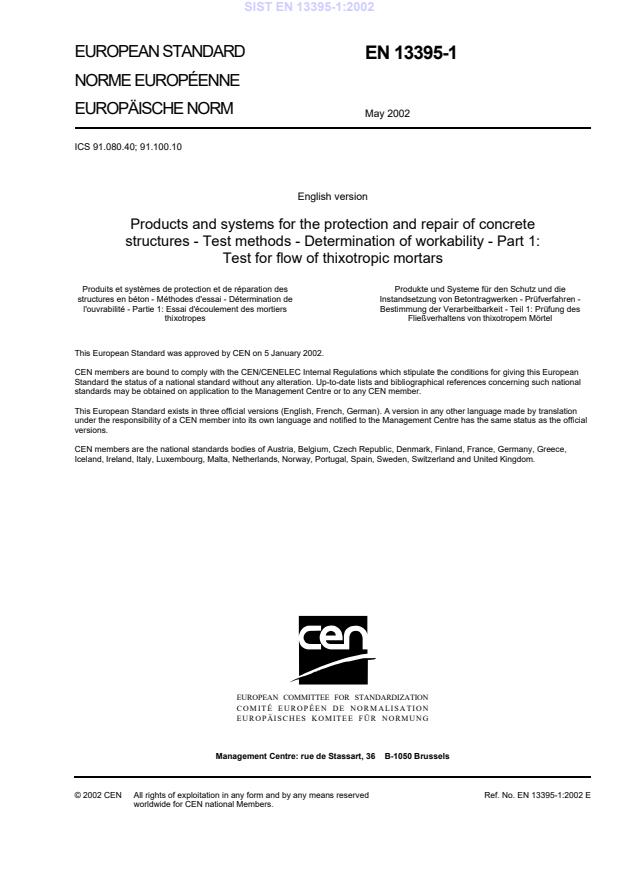
EUROPEAN STANDARDNORME EUROPÉENNEEUROPÄISCHE NORMEN 13395-1May 2002ICS 91.080.40; 91.100.10English versionProducts and systems for the protection and repair of concretestructures - Test methods - Determination of workability - Part 1:Test for flow of thixotropic mortarsProduits et systèmes de protection et de réparation desstructures en béton - Méthodes d'essai - Détermination del'ouvrabilité - Partie 1: Essai d'écoulement des mortiersthixotropesProdukte und Systeme für den Schutz und dieInstandsetzung von Betontragwerken - Prüfverfahren -Bestimmung der Verarbeitbarkeit - Teil 1: Prüfung desFließverhaltens von thixotropem MörtelThis European Standard was approved by CEN on 5 January 2002.CEN members are bound to comply with the CEN/CENELEC Internal Regulations which stipulate the conditions for giving this EuropeanStandard the status of a national standard without any alteration. Up-to-date lists and bibliographical references concerning such nationalstandards may be obtained on application to the Management Centre or to any CEN member.This European Standard exists in three official versions (English, French, German). A version in any other language made by translationunder the responsibility of a CEN member into its own language and notified to the Management Centre has the same status as the officialversions.CEN members are the national standards bodies of Austria, Belgium, Czech Republic, Denmark, Finland, France, Germany, Greece,Iceland, Ireland, Italy, Luxembourg, Malta, Netherlands, Norway, Portugal, Spain, Sweden, Switzerland and United Kingdom.EUROPEAN COMMITTEE FOR STANDARDIZATIONCOMITÉ EUROPÉEN DE NORMALISATIONEUROPÄISCHES KOMITEE FÜR NORMUNGManagement Centre: rue de Stassart, 36
B-1050 Brussels© 2002 CENAll rights of exploitation in any form and by any means reservedworldwide for CEN national Members.Ref. No. EN 13395-1:2002 ESIST EN 13395-1:2002
...