

EN 2591-100:2018
(Main)Aerospace series - Elements of electrical and optical connection - Test methods - Part 100: General
- Abstract
This European Standard specifies the general requirements for the methods of testing elements of
electrical, optical and data transmission system connections used in aerospace applications.
- Status
- Withdrawn
- Publication Date
- 14-Aug-2018
- Withdrawal Date
- 29-Sep-2026
- Technical Committee
- ASD-STAN - Aerospace
- Drafting Committee
- ASD-STAN/D 2 - Electrical
- Current Stage
- 9960 - Withdrawal effective - Withdrawal
- Start Date
- 02-Oct-2024
- Completion Date
- 30-Sep-2026

Relations
- Effective Date
- 06-Feb-2013
- Effective Date
- 25-Aug-2026
- Effective Date
- 25-Aug-2026
- Effective Date
- 10-Feb-2026
- Effective Date
- 10-Feb-2026
- Effective Date
- 10-Feb-2026
- Effective Date
- 28-Jan-2026
- Effective Date
- 28-Jan-2026
- Effective Date
- 28-Jan-2026
- Effective Date
- 28-Jan-2026
- Effective Date
- 28-Jan-2026
- Effective Date
- 28-Jan-2026
- Effective Date
- 28-Jan-2026
- Effective Date
- 28-Jan-2026
- Effective Date
- 28-Jan-2026
Get Certified
Connect with accredited certification bodies for this standard

BUREAU VERITAS Certification Germany
Bureau Veritas certification in Germany.

Element Materials Technology
Materials testing and product certification.

AQMS Ltd.
AQMS provides ISO certification to SMEs across the UK.
Sponsored listings
Frequently Asked Questions
EN 2591-100:2018 is a standard published by the European Committee for Standardization (CEN). Its full title is "Aerospace series - Elements of electrical and optical connection - Test methods - Part 100: General". This standard covers: This European Standard specifies the general requirements for the methods of testing elements of electrical, optical and data transmission system connections used in aerospace applications.
This European Standard specifies the general requirements for the methods of testing elements of electrical, optical and data transmission system connections used in aerospace applications.
EN 2591-100:2018 is classified under the following ICS (International Classification for Standards) categories: 49.060 - Aerospace electric equipment and systems; 49.090 - On-board equipment and instruments. The ICS classification helps identify the subject area and facilitates finding related standards.
EN 2591-100:2018 has the following relationships with other standards: It is inter standard links to EN 2591-100:2005, IEC 60050-581:2008, IEC 61300-3-35:2015, EN IEC 60793-1-45:2024, EN 60793-1-43:2015, EN IEC 60512-1:2018, EN 2591-6406:2001, EN 2591-401:1996, EN 2591-708:2001, EN 2591-508:2023, EN 2591-409:1999, EN 2591-312:1997, EN 2591-208:1996, EN 2591-503:2001, EN 2591-502:2001. Understanding these relationships helps ensure you are using the most current and applicable version of the standard.
EN 2591-100:2018 is available in PDF format for immediate download after purchase. The document can be added to your cart and obtained through the secure checkout process. Digital delivery ensures instant access to the complete standard document.
Standards Content (Sample)
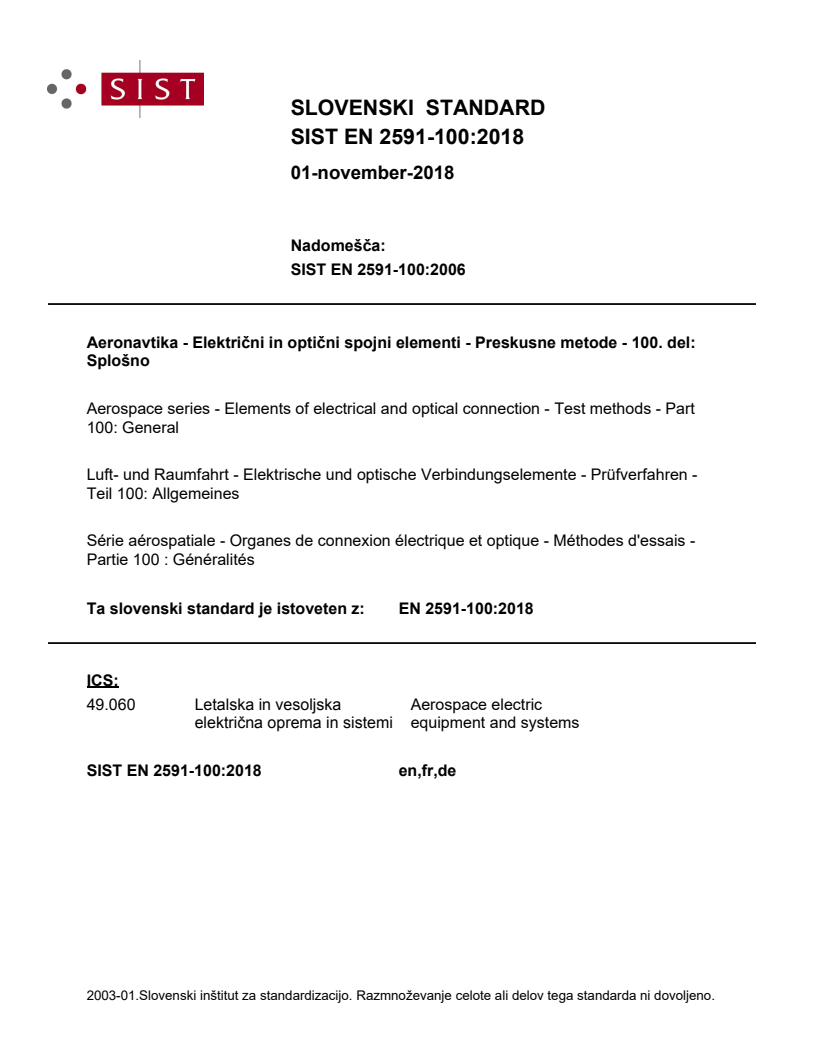
2003-01.Slovenski inštitut za standardizacijo. Razmnoževanje celote ali delov tega standarda ni dovoljeno.6SORãQRLuft- und Raumfahrt - Elektrische und optische Verbindungselemente - Prüfverfahren - Teil 100: AllgemeinesSérie aérospatiale - Organes de connexion électrique et optique - Méthodes d'essais - Partie 100 : GénéralitésAerospace series - Elements of electrical and optical connection - Test methods - Part 100: General49.060Aerospace electric equipment and systemsICS:Ta slovenski standard je istoveten z:EN 2591-100:2018SIST EN 2591-100:2018en,fr,de01-november-2018SIST EN 2591-100:2018SLOVENSKI
STANDARDSIST EN 2591-100:20061DGRPHãþD
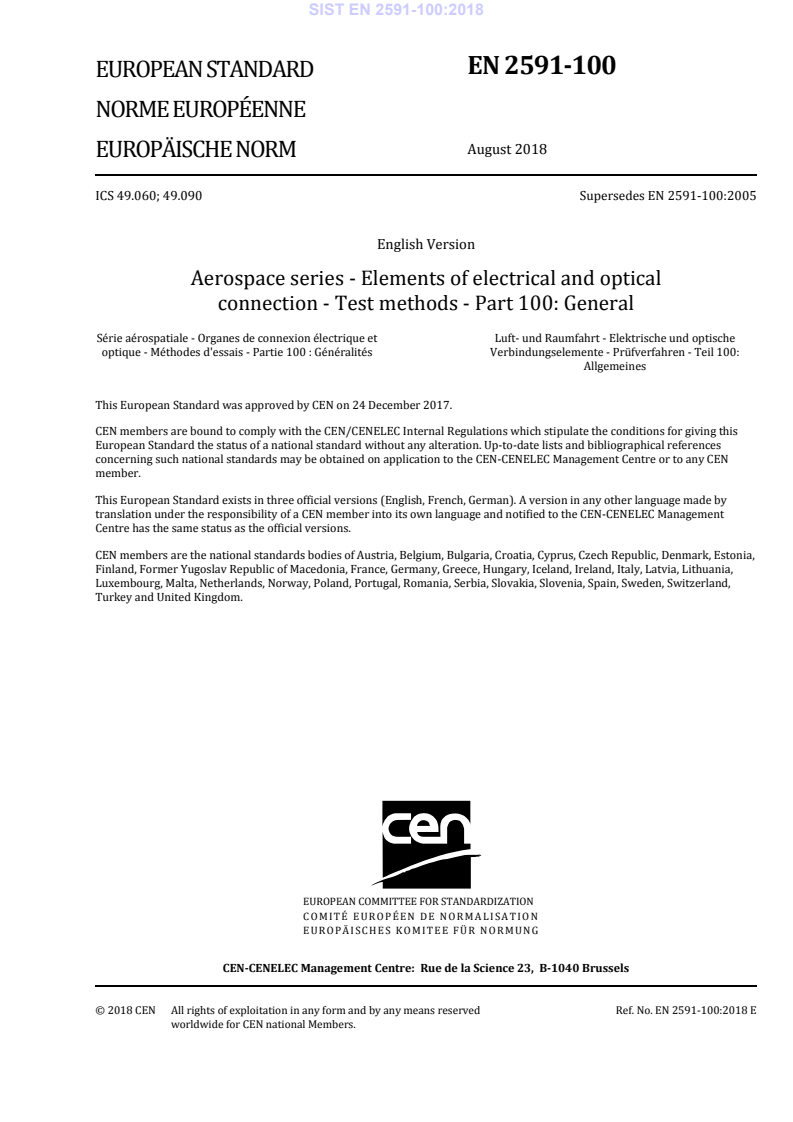
EUROPEAN STANDARD NORME EUROPÉENNE EUROPÄISCHE NORM
EN 2591-100
August
t r s z ICS
v {ä r x râ
v {ä r { r Supersedes EN
t w { sæ s r rã t r r wEnglish Version
Aerospace series æ Elements of electrical and optical connection æ Test methods æ Part
s r rã General Série aérospatiale æ Organes de connexion électrique et optique æ Méthodes d 5essais æ Partie
s r r ã Généralités Luftæ und Raumfahrt æ Elektrische und optische Verbindungselemente æ Prüfverfahren æ Teil
s r rã Allgemeines This European Standard was approved by CEN on
t v December
t r s yä
egulations which stipulate the conditions for giving this European Standard the status of a national standard without any alterationä Upætoædate lists and bibliographical references concerning such national standards may be obtained on application to the CENæCENELEC Management Centre or to any CEN memberä
translation under the responsibility of a CEN member into its own language and notified to the CENæCENELEC Management Centre has the same status as the official versionsä
CEN members are the national standards bodies of Austriaá Belgiumá Bulgariaá Croatiaá Cyprusá Czech Republicá Denmarká Estoniaá Finlandá Former Yugoslav Republic of Macedoniaá Franceá Germanyá Greeceá Hungaryá Icelandá Irelandá Italyá Latviaá Lithuaniaá Luxembourgá Maltaá Netherlandsá Norwayá Polandá Portugalá Romaniaá Serbiaá Slovakiaá Sloveniaá Spainá Swedená Switzerlandá Turkey and United Kingdomä
EUROPEAN COMMITTEE FOR STANDARDIZATION COMITÉ EUROPÉEN DE NORMALISATION EUROPÄISCHES KOMITEE FÜR NORMUNG
CEN-CENELEC Management Centre:
Rue de la Science 23,
B-1040 Brussels
t r s z CEN All rights of exploitation in any form and by any means reserved worldwide for CEN national Membersä Refä Noä EN
t w { sæ s r rã t r s z ESIST EN 2591-100:2018
EN 2083, Aerospace series — Copper or copper alloy conductors for electrical cables — Product standard EN 2084, Aerospace series — Cables, electrical, general purpose, with conductors in copper or copper alloy — Technical specification
EN 2234, Aerospace series — Cable, electrical, fire resistant — Technical specification EN 2346, Aerospace series — Fire resistant electrical cables — Dimensions, conductor resistance and mass 1) EN 2591 (all parts), Aerospace series — Elements of electrical and optical connection — Test methods EN 3745-201, Aerospace series — Fibres and cables, optical, aircraft use — Test methods — Part 201: Visual examination EN 4641-100, Aerospace series — Cables, optical 125 µm diameter cladding — Part 100: Tight structure 62,5/125 µm core GI fibre 1,8 mm outside diameter — Product standard EN 60512-1, Connectors for electronic equipment — Tests and measurements — Part 1: General (IEC 60512-1:2001) EN 60793-1-43, Optical fibres — Part 1-43: Measurement methods and test procedures — Numerical aperture measurement EN 60793-1-45, Optical fibres — Part 1-45: Measurement methods and test procedures — Mode field diameter TR 4257, Aerospace series — Elements of electrical and optical connection — Relationship between the numbering systems for parts of EN 2591 2)
IEC 60050-581, International Electrotechnical Vocabulary — Part 581: Electromechanical components for electronic equipment 3)
1) Published as ASD-STAN Prestandard at the date of publication of this standard. (http://www.asd-stan.org/) 2) Published as ASD-STAN Technical Report at the date of publication of this standard. (http://www.asd-stan.org/) 3) Published by: IEC Commission Electrotechnique Internationale http://www.iec.ch/
IEC Electropedia: available at http://www.electropedia.org/
ISO Online browsing platform: available at http://www.iso.org/obp 3.1 element of electrical or optical connection 4) component such as connector, module, etc., the purpose of which is to ensure the connection of circuits 3.2 flight cover (or protective cover) accessory designed to ensure, in flight, mechanical protection and sealing of front face of a non-coupled connector 3.3 connector with built-in protection of contacts connector with characteristics such that male or female contacts, mounted in a plug or receptacle, cannot come into contact with the front of the connector to which it is coupled (scoop-proof) and in which, in the event of accidental coupling of two parts or the connector equipped with male contacts, no electrical contact can take place 3.4 contact pressure point point at which a square ended gauge pin of the same basic diameter as the mating contact first engages the female contact spring member 3.5 initial measurement examination or measurement of characteristics carried out to determine the magnitude of the variations produced by the stress or stresses applied This examination or measurement is carried out at the end of pre-conditioning and under normal atmospheric conditions for measuring. 3.6 final measurement examination or measurement of characteristics carried out at the end of the recovery to assess the condition of the specimen after testing and to determine the magnitude of the variations in characteristics in relation to the values recorded at initial measuring
4) In test standards the term "element of connection" shall be used. SIST EN 2591-100:2018
it retains its electrical role for six minutes;
the flame does not propagate to the other side of the support in the first twenty minutes. 3.9 values of alternating voltage and current unless otherwise indicated, alternating voltage and current are indicated in root mean square values 3.10 line data bus pair of twisted wires, shielded, having a specified impedance, a matched impedance at its two ends and used for data transport 3.11 branch line section of twisted wires, shielded, with a specified impedance, which connects equipment to a bus line 3.12 line coupler element of electrical or optical connection the purpose of which is to shunt the transmission signals from a bus line to equipment 3.13 line coupler, single coupler consisting of one line and one branch 3.14 line coupler, double coupler consisting of one line and two branches 3.15 in-line splice permanent element of electrical or optical connection for two-wire cables 3.16 line termination end line component the purpose of which is to match the bus line to its characteristic impedance 3.17 branch termination end branch termination the purpose of which is to eventually replace equipment SIST EN 2591-100:2018
5.1.2.1 End face profile If terminated in a connector ferrule or contact, the fibre/ferrule end-face will be required to have a particular profile depending on the application. The most common connector profiles are listed below: The connector end face profile will determine the connector insertion loss and return loss (back reflection). Minimizing back reflection is of great importance in certain high-speed and analogue fibre optic links to prevent instability at the source. PC Polish — A Physical Contact (PC) polish results in a slightly curved connector surface, forcing the fibre ends of mating connector pairs into physical contact with each other. This produces much lower back reflection of − 30 dB to − 40 dB. The PC polish is the most prevalent connector end face in most applications. APC Polish — The Angled PC (APC) polish uses an 8 degree angle to the connector end face. Back reflections of < − 60 dB can routinely be accomplished with this type of polish.
It is useful to describe the industry standard parameters for a PC (Physical Contact) profile. These are shown in Figure 1. This profile is characterised typically by three key parameters namely, (1) fibre/ferrule radius of curvature, (2) fibre height (undercut or protrusion with respect to the ferrule) and (3) polish offset (essentially the difference between the fibre centre and any higher polish apex of the polished end-face. If the system under test has a particular fibre interface profile then the light launch system should also have a similar profile.
a) Radius of curvature b) Fibre undercut (planar)
c) Fibre protrusion (planar) d) Polish offset Key 1 Fibre centre 2 Polish Apex Figure 1 — PC parameters for a fibre connection
For connectorised fibres quantitative descriptions of allowable defect and scratch sizes for different fibre types and sizes can be found in document IEC 61300-3-35. For the purposes of setting requirements on end face quality the end face of the fibre is divided into measurement regions. These are reproduced from IEC 61300-3-35 in Table 1. The standard goes on to specify allowable numbers and sizes of features in each region. Note in this standard scratches are defined as permanent linear features. Defects are all non-linear features detectable on the fibre. This includes particulates and other debris, pits, chips, edge chipping, etc. Table 1 — Measurement regions for single fibre connectors (reproduced from IEC 61300-3-35) Zone Diameter for single mode Diameter for multimode A: core 0 µm to 25 µm 0 µm to 65 µm B: cladding 25 µm to 120 µm 65 µm to 120 µm C: adhesive 120 µm to 130 µm 120 µm to 130 µm D: contact 130 µm to 250 µm 130 µm to 250 µm NOTE 1 All data above assumes a 125 µm cladding diameter. NOTE 2 Mutimode core zone diameter is set at 65 µm to accommodate all common core sizes in a practical manner. NOTE 3 A defect is defined as existing entirely within the inner-most zone which it touches.
Table 2 — Example of visual requirements (allowable surface features and sizes) for multimode single fibre connectors (reproduced from IEC 61300-3-35) Zone name Scratches Defects A: core No limit ≤ 3 µm 0 > 5 µm 4 ≤ 5 µm None > 5 µm B: cladding No limit ≤ 5 µm 0 > 5 µm No limit < 2 µm 5 from 2 µm to 5 µm None > 5 µm C: adhesive No limit No limit D: contact No limit None
·
s r µm NOTE 1 For scratches, the requirement refers to width. NOTE 2 No visible subsurface cracks are allowed in the core or cladding zones. NOTE 3 All loose particles should be removed. If defect(s) are non-removable, it should be within the criteria above to be acceptable for use. NOTE 4 There are no requirements for the area outside the contact zone since defects in this area have no influence on the performance. Cleaning loose debris beyond this region is recommended good practice. NOTE 5 The zone size for multimode fibres has been set at 65 µm to accommodate both 50 µm and 62,5 µm core size fibres. This is done to simplify the grading process. NOTE 6 Structural features that are part on the functional design of the optical fibre, such as microstructures, are not considered defects.
·
s r µm NOTE 1 For scratches, the requirement refers to width. NOTE 2 No visible subsurface cracks are allowed in the core or cladding zones. NOTE 3 All loose particles should be removed. If defect(s) are non-removable, it should be within the criteria above to be acceptable for use. NOTE 4 There are no requirements for the area outside the contact zone since defects in this area have no influence on the performance. Cleaning loose debris beyond this region is recommended good practice. NOTE 5 Structural features that are part on the functional design of the optical fibre, such as microstructures, are not considered defects.
To provide clarity for automated systems, scratches are defined as being less than 4 µm wide, linear in nature, and with a length that is at least 30 times their width. Defects size is defined as the diameter of the smallest circle that can encompass the entire defect.
An example of allowable features for a multimode connector is shown in Table 2. As can be seen, no scratches or defects larger than 5 µm are allowed in the core region. In comparison for a low reflectance single-mode connector (see Table 3), no scratches are allowed in the much smaller single-mode core. The reader is referred to this standard for inspection criteria for other fibre types such as higher reflectance single-mode and also angle polished connectors. 5.1.3 Methods Any method of fibre end preparation is acceptable provided that the parameters defined in 5.1.2 are within the range specified for the fibre type and end profile
...