

EN 12001:2012
(Main)Conveying, spraying and placing machines for concrete and mortar - Safety requirements
- Abstract
1.1 This European Standard specifies the safety requirements for
- conveying machines,
- spraying machines,
- placing machines, and
- delivery line systems
for concrete and mortar as defined in the definitions in 3.3 to 3.6.
The machinery can be stationary or mobile.
This European Standard does not cover:
- machines that are mobile during conveying, spraying and placing;
- cabins for any machines covered by this standard;
- additional functions beyond conveying, spraying and placing concrete and mortar, e.g. separate mixing function or crane function;
- requirements for operation in tunnels;
- support structures (i.e. tower systems) not exclusively designed for the use with concrete distribution booms.
This European Standard does not establish the additional requirements for operations subject to special rules (e.g. potentially explosive atmospheres, supply by electrical networks where voltage, frequency and tolerance differ from those of the public supply, earthquake, lightning, using on public roads, etc.).
1.2 This European Standard deals with all significant hazards, hazardous situations and events relevant to conveying, spraying and placing machines when they are used as intended and under the conditions of misuse which are reasonably foreseeable by the manufacturer (see Clause 4). This European Standard specifies the appropriate technical measures to eliminate or reduce risks arising from the significant hazards during transportation, assembly, dismantling, disabling, scrapping, operation and maintenance.
1.3 This European Standard is not applicable to machines which are manufactured before the date of publication of this document by CEN.
- Status
- Published
- Publication Date
- 28-Aug-2012
- Withdrawal Date
- 27-Feb-2013
- Technical Committee
- CEN/TC 151 - Construction equipment and building material machines - Safety
- Drafting Committee
- CEN/TC 151/WG 8 - Concrete preparation and handling equipment - Safety
- Current Stage
- 9092 - Decision on results of review/2YR ENQ - revise - Review Enquiry
- Start Date
- 05-Mar-2022
- Completion Date
- 21-Oct-2026
- Directive
- 2006/42/EC - Directive 2006/42/EC of the European Parliament and of the Council of 17 May 2006 on machinery, and amending Directive 95/16/EC (recast)OJ Ref: C, C 350 OJ Date: 15-Nov-2012

Overview
EN 12001:2012 - Conveying, spraying and placing machines for concrete and mortar - Safety requirements is a European type-C standard issued by CEN that defines safety requirements for machines used to convey, spray and place concrete and mortar. It applies to stationary and mobile machinery and delivery-line systems but excludes machines that are mobile during operation, cabins, additional functions (e.g. integrated mixers or cranes), tunnel operation and certain support structures. The standard addresses hazards throughout the machine lifecycle: transport, assembly, operation, maintenance, dismantling and scrapping. It also supports the essential requirements of EU Directive 2006/42/EC.
Key topics
EN 12001:2012 covers a broad set of technical and safety topics, including:
- Hazard identification and risk reduction for conveying, spraying and placing machines and delivery line systems
- Mechanical and control-system safety, including requirements aligned with EN ISO 13849-1 for control reliability
- Hydraulic and pneumatic failure prevention and related protective measures
- Electrical safety and EMC (electromagnetic compatibility) considerations (references include EN 60204-1 and EN 13309)
- Stop systems, thermal protection and exhaust-fume management
- Ergonomics, operator controls and multiple control-station requirements
- Fixed guards, stability and transport/travel safety provisions
- Noise emission testing and declaration (Annex C: noise test code)
- Verification, inspection and marking requirements, including verification tables and inspection records
- Documentation and traceability: Instruction Handbooks, Log Book (Annex B) and marking for pumps, booms, hoses and delivery systems
- Remote control function allocation (normative Annex D)
- Diagrams and machine classification examples (informative Annex A)
Applications
This standard is essential for:
- Manufacturers and designers of concrete pumps, shotcreting machines, mortar-conveying and spraying machines, placing booms and delivery-line systems
- Safety engineers and compliance officers performing risk assessments and CE conformity tasks
- Test laboratories and notified bodies performing verification, noise testing and inspection
- Construction site managers and maintenance teams implementing safe use, inspection schedules and logbooks
Practical uses include designing machine guards and control systems, preparing instruction manuals, compiling log books and inspection reports, performing noise measurements, and ensuring machines meet European safety and marking requirements.
Related standards
EN 12001:2012 references and complements other machinery and safety standards such as:
- EN ISO 13849-1 (control-system safety)
- EN 60204-1 (electrical equipment of machines)
- EN 13309 (EMC for construction machinery)
- Ergonomics and guard standards (EN 614-1, EN 894 series, EN 953)
Keywords: EN 12001:2012, concrete pump safety, shotcreting machine safety, conveying spraying placing machines, delivery line systems, construction equipment safety, noise test code, machine log book.
Relations
- Effective Date
- 26-Sep-2009
- Effective Date
- 25-Aug-2026
- Effective Date
- 28-Jan-2026
- Effective Date
- 28-Jan-2026
- Effective Date
- 28-Jan-2026
- Effective Date
- 28-Jan-2026
- Effective Date
- 28-Jan-2026
- Effective Date
- 28-Jan-2026
- Effective Date
- 28-Jan-2026
- Effective Date
- 28-Jan-2026
- Effective Date
- 28-Jan-2026
- Refers
EN ISO 13850:2008 - Safety of machinery - Emergency stop - Principles for design (ISO 13850:2006) - Effective Date
- 28-Jan-2026
- Effective Date
- 28-Jan-2026
- Effective Date
- 28-Jan-2026
- Effective Date
- 28-Jan-2026
Get Certified
Connect with accredited certification bodies for this standard

DIBt (Deutsches Institut für Bautechnik)
German Institute for Building Technology.
DIN CERTCO
DIN Group product certification.

Aboma Certification B.V.
Specialized in construction, metal, and transport sectors.
Sponsored listings
Frequently Asked Questions
EN 12001:2012 is a standard published by the European Committee for Standardization (CEN). Its full title is "Conveying, spraying and placing machines for concrete and mortar - Safety requirements". This standard covers: 1.1 This European Standard specifies the safety requirements for - conveying machines, - spraying machines, - placing machines, and - delivery line systems for concrete and mortar as defined in the definitions in 3.3 to 3.6. The machinery can be stationary or mobile. This European Standard does not cover: - machines that are mobile during conveying, spraying and placing; - cabins for any machines covered by this standard; - additional functions beyond conveying, spraying and placing concrete and mortar, e.g. separate mixing function or crane function; - requirements for operation in tunnels; - support structures (i.e. tower systems) not exclusively designed for the use with concrete distribution booms. This European Standard does not establish the additional requirements for operations subject to special rules (e.g. potentially explosive atmospheres, supply by electrical networks where voltage, frequency and tolerance differ from those of the public supply, earthquake, lightning, using on public roads, etc.). 1.2 This European Standard deals with all significant hazards, hazardous situations and events relevant to conveying, spraying and placing machines when they are used as intended and under the conditions of misuse which are reasonably foreseeable by the manufacturer (see Clause 4). This European Standard specifies the appropriate technical measures to eliminate or reduce risks arising from the significant hazards during transportation, assembly, dismantling, disabling, scrapping, operation and maintenance. 1.3 This European Standard is not applicable to machines which are manufactured before the date of publication of this document by CEN.
1.1 This European Standard specifies the safety requirements for - conveying machines, - spraying machines, - placing machines, and - delivery line systems for concrete and mortar as defined in the definitions in 3.3 to 3.6. The machinery can be stationary or mobile. This European Standard does not cover: - machines that are mobile during conveying, spraying and placing; - cabins for any machines covered by this standard; - additional functions beyond conveying, spraying and placing concrete and mortar, e.g. separate mixing function or crane function; - requirements for operation in tunnels; - support structures (i.e. tower systems) not exclusively designed for the use with concrete distribution booms. This European Standard does not establish the additional requirements for operations subject to special rules (e.g. potentially explosive atmospheres, supply by electrical networks where voltage, frequency and tolerance differ from those of the public supply, earthquake, lightning, using on public roads, etc.). 1.2 This European Standard deals with all significant hazards, hazardous situations and events relevant to conveying, spraying and placing machines when they are used as intended and under the conditions of misuse which are reasonably foreseeable by the manufacturer (see Clause 4). This European Standard specifies the appropriate technical measures to eliminate or reduce risks arising from the significant hazards during transportation, assembly, dismantling, disabling, scrapping, operation and maintenance. 1.3 This European Standard is not applicable to machines which are manufactured before the date of publication of this document by CEN.
EN 12001:2012 is classified under the following ICS (International Classification for Standards) categories: 91.220 - Construction equipment. The ICS classification helps identify the subject area and facilitates finding related standards.
EN 12001:2012 has the following relationships with other standards: It is inter standard links to EN 12001:2003+A1:2009, ISO 8598:1996, EN ISO 3744:2010, EN 894-2:1997+A1:2008, EN ISO 13849-1:2008, EN 953:1997+A1:2009, EN ISO 13857:2008, EN ISO 13732-1:2008, EN 894-1:1997+A1:2008, EN 894-3:2000+A1:2008, EN ISO 13855:2010, EN ISO 13850:2008, EN ISO 11204:2010, EN 614-1:2006+A1:2009, EN ISO 11688-1:2009. Understanding these relationships helps ensure you are using the most current and applicable version of the standard.
EN 12001:2012 is associated with the following European legislation: EU Directives/Regulations: 2006/42/EC; Standardization Mandates: M/396. When a standard is cited in the Official Journal of the European Union, products manufactured in conformity with it benefit from a presumption of conformity with the essential requirements of the corresponding EU directive or regulation.
EN 12001:2012 is available in PDF format for immediate download after purchase. The document can be added to your cart and obtained through the secure checkout process. Digital delivery ensures instant access to the complete standard document.
Standards Content (Sample)
2003-01.Slovenski inštitut za standardizacijo. Razmnoževanje celote ali delov tega standarda ni dovoljeno.Stroji za transport, brizganje in polaganje betona in malte - Varnostne zahteveFörder-, Spritz- und Verteilmaschinen für Beton und Mörtel - SicherheitsanforderungenMachines pour le transport, la projection et la distribution de béton et mortier - Prescriptions de sécuritéConveying, spraying and placing machines for concrete and mortar - Safety requirements91.220Gradbena opremaConstruction equipmentICS:Ta slovenski standard je istoveten z:EN 12001:2012SIST EN 12001:2012en,fr,de01-november-2012SIST EN 12001:2012SLOVENSKI
STANDARDSIST EN 12001:2004+A1:20101DGRPHãþD
EUROPEAN STANDARD NORME EUROPÉENNE EUROPÄISCHE NORM
EN 12001
August 2012 ICS 91.220 Supersedes EN 12001:2003+A1:2009English Version
Conveying, spraying and placing machines for concrete and mortar - Safety requirements
Machines pour le transport, la projection et la distribution de béton et mortier - Prescriptions de sécurité
Förder-, Spritz- und Verteilmaschinen für Beton und Mörtel - Sicherheitsanforderungen This European Standard was approved by CEN on 6 July 2012.
CEN members are bound to comply with the CEN/CENELEC Internal Regulations which stipulate the conditions for giving this European Standard the status of a national standard without any alteration. Up-to-date lists and bibliographical references concerning such national standards may be obtained on application to the CEN-CENELEC Management Centre or to any CEN member.
This European Standard exists in three official versions (English, French, German). A version in any other language made by translation under the responsibility of a CEN member into its own language and notified to the CEN-CENELEC Management Centre has the same status as the official versions.
CEN members are the national standards bodies of Austria, Belgium, Bulgaria, Croatia, Cyprus, Czech Republic, Denmark, Estonia, Finland, Former Yugoslav Republic of Macedonia, France, Germany, Greece, Hungary, Iceland, Ireland, Italy, Latvia, Lithuania, Luxembourg, Malta, Netherlands, Norway, Poland, Portugal, Romania, Slovakia, Slovenia, Spain, Sweden, Switzerland, Turkey and United Kingdom.
EUROPEAN COMMITTEE FOR STANDARDIZATION
COMITÉ EUROPÉEN DE NORMALISATION EUROPÄISCHES KOMITEE FÜR NORMUNG
Management Centre:
Avenue Marnix 17,
B-1000 Brussels © 2012 CEN All rights of exploitation in any form and by any means reserved worldwide for CEN national Members. Ref. No. EN 12001:2012: ESIST EN 12001:2012
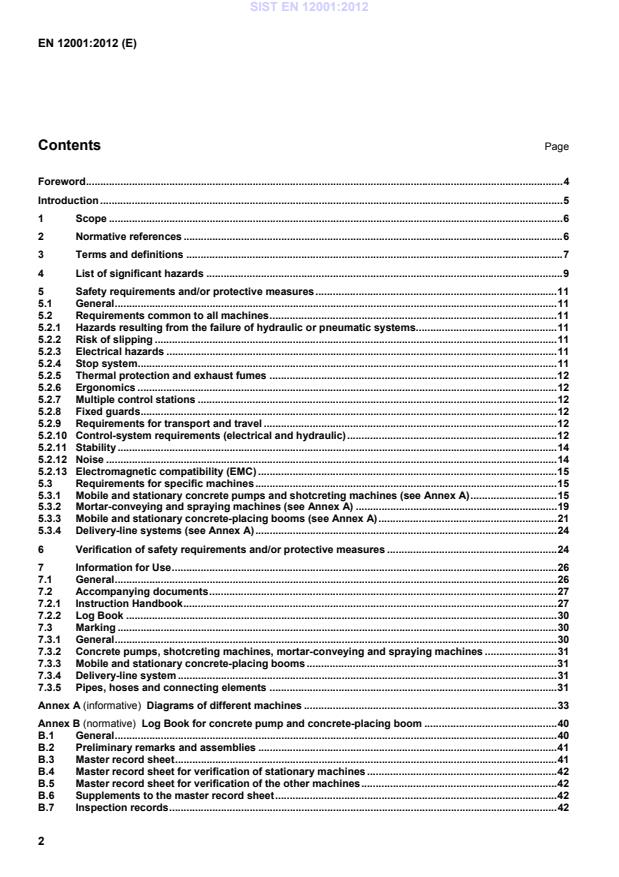
Diagrams of different machines . 33Annex B (normative)
Log Book for concrete pump and concrete-placing boom . 40B.1General . 40B.2Preliminary remarks and assemblies . 41B.3Master record sheet . 41B.4Master record sheet for verification of stationary machines . 42B.5Master record sheet for verification of the other machines . 42B.6Supplements to the master record sheet . 42B.7Inspection records . 42SIST EN 12001:2012
Noise test code for machines and equipment for conveying, spraying and placing concrete and mortar . 57C.1Scope . 57C.2Determination of the A-weighted sound power level . 57C.2.1General. 57C.2.2Measurement surface and microphone positions . 57C.3Determination of the A-weighted emission sound pressure level at workstations . 58C.3.1General. 58C.3.2Workstations . 58C.4Operating conditions . 58C.4.1Operating conditions during test . 58C.4.2Test under load . 59C.4.3Period of observation . 59C.5Information to be recorded during the test . 59C.6Information to be reported . 59C.7Declaration and verification of noise emission values . 59Annex D (normative)
Remote control – Function allocation . 61Annex ZA (informative)
Relationship between this European Standard and the Essential Requirements of EU Directive 2006/42/EC . 62Bibliography . 63 SIST EN 12001:2012
remote-control panel. A machine can be fitted with more than one control device. 3.7.2 emergency-control station control station not foreseen for normal operation, but to bring the machine into a safe status in case of a control failure
Note 1 to entry: See 3.9, emergency operation. 3.8 normal operation operation of the machine with all systems functioning Note 1 to entry: Exceptions: repair and maintenance, emergency operation. 3.9 emergency operation operation of the machine under circumvention of the emergency-stop system
Note 1 to entry: Emergency operation can be: operation of a machine with system malfunction driven by a hydraulic power pack and operated via manual valve control because of engine failure. 3.10 maximum delivery pressure maximum pressure in the delivery line system including the case of blockage in the delivery line system 4 List of significant hazards This clause contains all the significant hazards, hazardous situations and events, as far as they are dealt with in this standard, identified by risk assessment as significant for this type of machinery and which require action to eliminate or reduce the risk. SIST EN 12001:2012
Hazards Locations/circumstances/consequencessee Subclause/Annex: 4.1 Mechanical hazards
4.1.1 Crushing Accessibility to zones between fixed and moving parts 5.3.1.1, 5.3.1.2, 5.3.1.3, 5.3.1.4, 5.3.1.5, 5.3.1.7, 5.3.2.1, 5.3.2.2, 5.3.2.3, 5.3.2.6, 5.3.3.2, 5.3.3.3 4.1.2 Shearing Access to areas between fixed and moving parts outside and inside conveying and spraying machines Access to fixed and moving parts inside the hopper, either from the inlet or from another point 5.3.1.2, 5.3.1.3 4.1.3 Entanglement Access to unprotected shafts
5.3.1.5, 5.3.2.3 4.1.4 Entrapment Access to moving parts inside the hopper Access to the moving parts of the mixer Access to feed points of V-belt or chain-sprocket drives 5.3.1.5, 5.3.2.3 4.1.5 Impact Access to moving parts of outriggers and concrete-placing boom 5.3.3.4, Figure A.5 4.1.6 High-pressure fluid ejection Access to the hydraulic system Access to the delivery-line system 5.3.4 4.1.7 Ejection of parts or material Access to outlet and wear of piping 5.3.1.1, 5.3.1.6, 5.3.2.4, 5.3.4 4.1.8 Strength Loss of strength 5.3.1.6, 5.3.3.1 4.1.9 Stability Loss of stability 5.3.1.6, 5.3.2.4, 5.3.3.1, 5.2.10.6.3, 5.2.10.7, 5.2.11 4.1.10 Slipping, tripping, falling Access to areas where slipping, tripping or falling is possible 5.2.2, 5.3.1.6, 5.3.2.5, 5.3.3.1 4.2 Electrical hazards Electrocution, electric shocks or burns 5.2.3, 5.2.7, 5.2.10 4.3 Thermal hazards Access to hot machine parts 5.2.5 4.4 Noise hazards Hearing loss and other physiological damage, impaired oral communication and perception of warning signals 5.2.12, 7.2.1.1 m), Annex C4.5 Hazards from materials and consumables used Contact with or inhalation of harmful fluids, gases, dust or aerosols 5.2.1, 5.2.5, 5.3.4, 7 4.6 Ergonomics Injury due to poor design of control stations/ panels Inadequate lighting Unsuitable operator’s position for fuelling Inadequate access means
5.2.6 7.2.1.1 k) 5.2.6 5.2.2, 5.3.1.6, 5.3.2.5, 5.3.3.1 4.7 Hazards resulting from system failures Failure of power supply Failure of control systems 5.2.1, 5.2.4, 5.2.7, 5.2.10, 5.3.2.4, 5.3.3.2 4.8 Electromagnetic compatibility (EMC) Unforeseeable functions of the machine and/or disturbance of external devices 5.2.13 SIST EN 12001:2012
Component Hazard group Hazard Safety measures 5.3.1.1
Hopper Mechanical Crushing between agitator, valve, hopper wall and grill-type type guard Grill-type guards in hopper openings of concrete pumps and shotcreting machines on filling or cleaning openings shall be movable guards interlocked with the drives of the agitators/valves in such a way that the drives are stopped within 0,5 s when opened. The closing of the grill-type guard shall not restart operation. The restarting in operating conditions may be effected by voluntary actuation of a device other than the normal starting device, positioned in a way that the operator is able to see the hopper. The interlocking control system of the grill-type guard shall fulfil Performance Level c. Grill-type guards shall be secured by design or lockable in their open position. With concrete pumps and shotcreting machines, the filling opening of the hopper shall be secured by a grill-type guard in the following dimensions:
Grill-type guard,
unidirectional type Grill-type guard,
mesh type
a (Figure 4) 70 mm 35 mm h (Figure 1 and 2) 200 mm 100 mm b (Figure 3) 80 mm 70 mm 40 mm h (Figure 1 and 2) 180 mm 150 mm 90 mm
a = maximum permissible clearance between rods in mm b = maximum permissible mesh width in mm h = minimum permissible clearance of grill-type guards from crushing point between agitator and hopper wall in mm NOTE These clearances between the rods or mesh widths are the best compromise between safety and performance to allow the bulk material “concrete” to be filled (other clearances hamper the bulk material). Stepping on the grill-type guard shall be prohibited (see 7.2.1.1 h)). Moving mechanical components (e.g. switch mechanism for concrete valve) shall be covered with a fixed guard according to EN 953:1997+A1:2009. SIST EN 12001:2012
Table 2 (continued) Component Hazard group Hazard Safety measures
Mechanical Ejection of parts or material due to low concrete level in hopper or during back pumping The proper concrete filling height in the hopper during the pumping process shall be defined. For concrete pumps, a cover shall be provided to prevent ejection of concrete (see 7.2.1.1 h)). Cleaning procedure shall be defined in the Information for Use (see 7.2.1.1 i)). Mobile and stationary concrete pumps and shotcreting machines: Dimensions in millimetres
Key h minimum permissible clearance of grill-type guards
from crushing point between agitator and hopper wall in mm Figure 1 — Guard (grill) – crushing-point clearance
Key b maximum permissible mesh width in mm Figure 3 — Guard (grill), mesh type
Key h minimum permissible clearance of grill-type guards from crushing point between agitator and hopper wall in mm Figure 2 — Hopper wall – guard clearance
Key a maximum permissible clearance between rods in mm Figure 4 — Guard (grill), unidirectional type SIST EN 12001:2012
Discharge opening of the hopper
Mechanical Crushing or shearing between fixed and movable parts The control device(s) for power-operated discharge-opening covers shall be of hold-to-run type. The distance from the control device(s) to the crushing points shall be large enough to ensure that, when the control device(s) is (are) released, the hazard points are accessible only when the hazardous movement has ended. The distances shall be in accordance with EN ISO 13855:2010. The size of the discharge opening shall allow material to leave the hopper during cleaning procedure without having to reach into the hazard zone under normal operating conditions. Description of the danger shall be given in the Information for Use including appropriate signage to the dangerous point on the machine (see 7.2.1.1 i) and 7.2.1.1 j)). 5.3.1.3
Delivery-line connection
Crushing or shearing between fixed and movable parts Description of the danger shall be given in the Information for Use including appropriate signage to the dangerous point on the machine (see 7.2.1.1 h), 7.2.1.1 i) and 7.2.1.1 j)). 5.3.1.4
Pump Mechanical Crushing between fixed and movable parts Crushing points shall be protected by fixed guards. Moving mechanical components (e.g. between waterbox and delivery piston) shall be covered with a fixed guard in accordance with EN 953:1997+A1:2009. 5.3.1.5
Drive area Mechanical Crushing between hinged guards and machine parts Hinged guards shall be located or equipped in such a way that they cannot close inadvertently when in open position. Entanglement by free-running shafts Fixed guards with distances according to EN ISO 13857:2008. Entrapment between V-belt and driving pulleys Fixed guards with distances according to EN ISO 13857:2008. 5.3.1.6
Entire machine Mechanical Strength The design of the machine shall be carried out using state-of-the art techniques (see 5.1). The intended use of the machine shall be considered. Stability due to faulty support on the subsoil The maximum support forces occurring shall be marked on the outriggers. Loss of stability by the machine or parts thereof while being moved by lifting gear on the construction site Machines or their individual components that can be moved or lifted with lifting gear for assembly purposes on construction sites shall be equipped with suitable lifting points. Ejection of parts or material The machines shall be constructed in such a way that blockages in the delivery lines can be removed with minimised risk. This can be achieved with a reverse-pumping device.
System failure Inadvertent, uncontrolled movements of machine parts due to several control stations at the machine The operation shall only be possible from one preselected control station. The actuati
...