

prEN 12845-1
(Main)Fixed firefighting systems - Automatic sprinkler systems - Part 1: Design, installation and maintenance
- Abstract
This European standard specifies requirements for the design, installation and maintenance of new automatic sprinkler systems as well as any addition, extension, repair or other modification of existing automatic sprinkler systems.
In certain countries specific national regulations apply and take precedence over this European Standard. Users of this European Standard are advised to inform themselves of the applicability or non-applicability for this European Standard by their national responsible authorities.
- Status
- Not Published
- Publication Date
- 15-Jan-2023
- Technical Committee
- CEN/TC 191 - Fixed firefighting systems
- Drafting Committee
- CEN/TC 191/WG 5 - Sprinkler systems
- Current Stage
- 4098 - Decision to abandon - Enquiry
- Start Date
- 01-Sep-2022
- Completion Date
- 21-Oct-2026

Overview
prEN 12845-1 is a CEN draft European standard for fixed firefighting systems - automatic sprinkler systems (Part 1: Design, installation and maintenance). It specifies requirements for the design, installation and maintenance of new automatic sprinkler systems and for additions, extensions, repairs or modifications of existing systems. The standard is intended for use across CEN member states, though national regulations may take precedence; users should confirm applicability with their national authorities.
Key topics and technical requirements
This standard covers the full lifecycle of an automatic sprinkler system with focus on safety, reliability and regulatory compliance. Major technical topics include:
- Fire hazard classification (storage and non-storage occupancies) and the methodology for assigning design hazards.
- Hydraulic design criteria and compartment design approaches for sprinkler performance.
- Pipe sizing, layout and hydraulic calculations to ensure adequate water flow and pressure.
- System types and installation methods: wet pipe, dry pipe, pre-action and other installation types.
- Sprinkler components and design characteristics: sprinkler types, thermal sensitivity, spacing, coverage area, guards and corrosion protection.
- Protection of special hazards: flammable liquid storage, aerosol containers, in-rack storage, car stackers, high-rise and residential specifics.
- Valves, pipework and pipe supports, including underground and above-ground piping considerations.
- Alarms, monitoring and transmission: water flow alarms, electrical switches, fire brigade connections and signal conditions.
- Water supplies and pump-house requirements, including storage, maximum pressures and test facilities.
- Contract planning, documentation and maintenance requirements, including design stage deliverables, block plans, signs and record-keeping.
Applications and practical value
prEN 12845-1 is practical for ensuring consistent, auditable design and performance of automatic sprinkler systems across a wide range of buildings and occupancies:
- Industrial warehouses and high-hazard storage facilities
- Manufacturing plants and special hazards installations
- Commercial buildings, office complexes and residential/high-rise properties
- Parking structures and automatic car stackers
- Facilities requiring integration with building fire detection and remote monitoring
Using this standard helps design and installation teams achieve compliant hydraulic performance, reliable alarm transmission and maintainable systems that meet stakeholder, insurer and authority expectations.
Who uses this standard
- Fire protection and sprinkler system designers
- Building services and mechanical engineers
- Installation contractors and commissioning teams
- Facility managers and maintenance crews
- Insurance assessors and authorities having jurisdiction (AHJs)
Related standards and notes
- prEN 12845-1 is part of the EN 12845 family and (per draft text) will supersede EN 12845:2015+A1:2019 when adopted.
- Always verify national regulations and other applicable international standards when applying prEN 12845-1 to projects.
Relations
- Effective Date
- 17-Nov-2021
- Effective Date
- 10-Mar-2020
Get Certified
Connect with accredited certification bodies for this standard

CIS Institut d.o.o.
Personal Protective Equipment (PPE) certification body. Notified Body NB-2890 for EU Regulation 2016/425 PPE.

Kiwa BDA Testing
Building and construction product certification.
Kmetijski inštitut Slovenije
Agricultural Institute of Slovenia. Soil testing, plant health, agricultural product analysis.
Sponsored listings
Frequently Asked Questions
prEN 12845-1 is a draft published by the European Committee for Standardization (CEN). Its full title is "Fixed firefighting systems - Automatic sprinkler systems - Part 1: Design, installation and maintenance". This standard covers: This European standard specifies requirements for the design, installation and maintenance of new automatic sprinkler systems as well as any addition, extension, repair or other modification of existing automatic sprinkler systems. In certain countries specific national regulations apply and take precedence over this European Standard. Users of this European Standard are advised to inform themselves of the applicability or non-applicability for this European Standard by their national responsible authorities.
This European standard specifies requirements for the design, installation and maintenance of new automatic sprinkler systems as well as any addition, extension, repair or other modification of existing automatic sprinkler systems. In certain countries specific national regulations apply and take precedence over this European Standard. Users of this European Standard are advised to inform themselves of the applicability or non-applicability for this European Standard by their national responsible authorities.
prEN 12845-1 is classified under the following ICS (International Classification for Standards) categories: 13.220.20 - Fire protection. The ICS classification helps identify the subject area and facilitates finding related standards.
prEN 12845-1 has the following relationships with other standards: It is inter standard links to EN 12845:2015/AC:2016, EN 12845:2015+A1:2019. Understanding these relationships helps ensure you are using the most current and applicable version of the standard.
prEN 12845-1 is available in PDF format for immediate download after purchase. The document can be added to your cart and obtained through the secure checkout process. Digital delivery ensures instant access to the complete standard document.
Standards Content (Sample)
SLOVENSKI STANDARD
01-februar-2022
Vgrajene naprave za gašenje - Avtomatski sprinklerski sistemi - 1. del:
Projektiranje, vgradnja in vzdrževanje
Fixed firefighting systems - Automatic sprinkler systems - Part 1: Design, installation and
maintenance
Ortsfeste Brandbekämpfungsanlagen - Automatische Sprinkleranlagen - Planung,
Installation und Instandhaltung
Installations fixes de lutte contre lincendie - Systèmes dextinction automatique du type
sprinkleur - Conception, installation et maintenance
Ta slovenski standard je istoveten z: prEN 12845-1
ICS:
13.220.10 Gašenje požara Fire-fighting
2003-01.Slovenski inštitut za standardizacijo. Razmnoževanje celote ali delov tega standarda ni dovoljeno.
DRAFT
EUROPEAN STANDARD
NORME EUROPÉENNE
EUROPÄISCHE NORM
December 2021
ICS 13.220.20 Will supersede EN 12845:2015+A1:2019
English Version
Fixed firefighting systems - Automatic sprinkler systems -
Part 1: Design, installation and maintenance
Installations fixes de lutte contre l¿incendie - Systèmes Ortsfeste Brandbekämpfungsanlagen - Automatische
d¿extinction automatique du type sprinkleur - Sprinkleranlagen - Planung, Installation und
Conception, installation et maintenance Instandhaltung
This draft European Standard is submitted to CEN members for enquiry. It has been drawn up by the Technical Committee
CEN/TC 191.
If this draft becomes a European Standard, CEN members are bound to comply with the CEN/CENELEC Internal Regulations
which stipulate the conditions for giving this European Standard the status of a national standard without any alteration.
This draft European Standard was established by CEN in three official versions (English, French, German). A version in any other
language made by translation under the responsibility of a CEN member into its own language and notified to the CEN-CENELEC
Management Centre has the same status as the official versions.
CEN members are the national standards bodies of Austria, Belgium, Bulgaria, Croatia, Cyprus, Czech Republic, Denmark, Estonia,
Finland, France, Germany, Greece, Hungary, Iceland, Ireland, Italy, Latvia, Lithuania, Luxembourg, Malta, Netherlands, Norway,
Poland, Portugal, Republic of North Macedonia, Romania, Serbia, Slovakia, Slovenia, Spain, Sweden, Switzerland, Turkey and
United Kingdom.
Recipients of this draft are invited to submit, with their comments, notification of any relevant patent rights of which they are
aware and to provide supporting documentation.
Warning : This document is not a European Standard. It is distributed for review and comments. It is subject to change without
notice and shall not be referred to as a European Standard.
EUROPEAN COMMITTEE FOR STANDARDIZATION
COMITÉ EUROPÉEN DE NORMALISATION
EUROPÄISCHES KOMITEE FÜR NORMUNG
CEN-CENELEC Management Centre: Rue de la Science 23, B-1040 Brussels
© 2021 CEN All rights of exploitation in any form and by any means reserved Ref. No. prEN 12845-1:2021 E
worldwide for CEN national Members.
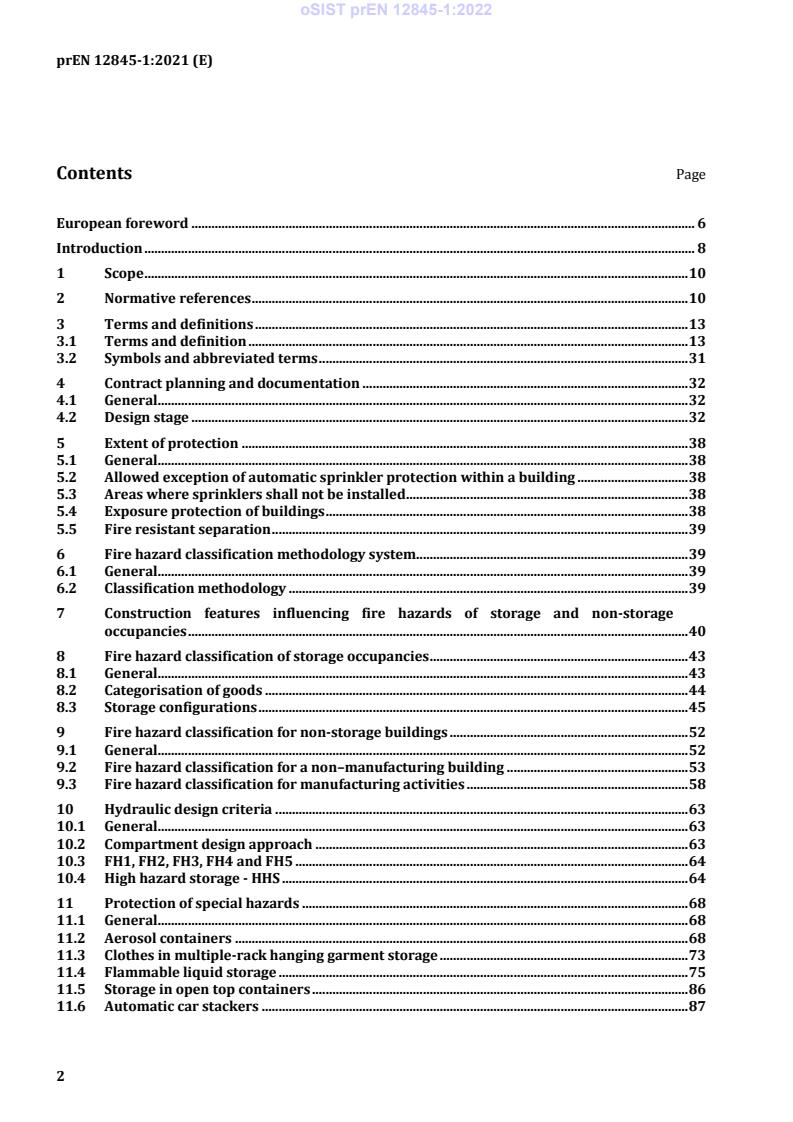
Contents Page
European foreword . 6
Introduction . 8
1 Scope . 10
2 Normative references . 10
3 Terms and definitions . 13
3.1 Terms and definition . 13
3.2 Symbols and abbreviated terms . 31
4 Contract planning and documentation . 32
4.1 General . 32
4.2 Design stage . 32
5 Extent of protection . 38
5.1 General . 38
5.2 Allowed exception of automatic sprinkler protection within a building . 38
5.3 Areas where sprinklers shall not be installed . 38
5.4 Exposure protection of buildings . 38
5.5 Fire resistant separation . 39
6 Fire hazard classification methodology system. 39
6.1 General . 39
6.2 Classification methodology . 39
7 Construction features influencing fire hazards of storage and non-storage
occupancies . 40
8 Fire hazard classification of storage occupancies . 43
8.1 General . 43
8.2 Categorisation of goods . 44
8.3 Storage configurations . 45
9 Fire hazard classification for non-storage buildings . 52
9.1 General . 52
9.2 Fire hazard classification for a non–manufacturing building . 53
9.3 Fire hazard classification for manufacturing activities . 58
10 Hydraulic design criteria . 63
10.1 General . 63
10.2 Compartment design approach . 63
10.3 FH1, FH2, FH3, FH4 and FH5 . 64
10.4 High hazard storage - HHS . 64
11 Protection of special hazards . 68
11.1 General . 68
11.2 Aerosol containers . 68
11.3 Clothes in multiple-rack hanging garment storage . 73
11.4 Flammable liquid storage . 75
11.5 Storage in open top containers . 86
11.6 Automatic car stackers . 87
11.7 Special requirements for buildings with residential occupancies . 89
11.8 Special requirements for high rise systems . 89
11.9 Extended coverage sprinklers for storage and non-storage application . 93
12 Pipe sizing, layout and hydraulic calculations . 106
12.1 Pipe sizing . 106
12.2 Calculation of pressure losses in pipework . 106
12.3 Fully calculated systems . 109
13 Sprinkler system components . 115
14 Installation type and size . 116
14.1 Wet pipe installation . 116
14.2 Dry pipe installations . 122
14.3 Pre-action installations . 125
15 Spacing and location of sprinklers . 129
15.1 General . 129
15.2 Vertical clearance below sprinklers . 129
15.3 Installation of sprinklers . 129
15.4 Maximum area of coverage per sprinkler. 130
15.5 Minimum distance between sprinklers . 132
15.6 Location of sprinklers in relation to building construction . 132
15.7 In-rack sprinklers . 140
16 Sprinkler design characteristics and uses . 145
16.1 General . 145
16.2 Sprinkler types and application . 145
16.3 Flow from sprinklers . 146
16.4 Sprinkler nominal operating temperature . 146
16.5 Sprinkler thermal sensitivity . 147
16.6 Sprinkler guards . 149
16.7 Sprinkler water shields . 149
16.8 Sprinkler rosettes . 150
16.9 Corrosion protection of sprinklers . 150
17 Valves . 150
17.1 Alarm valve set . 150
17.2 Stop valves . 151
17.3 Ring main valves . 151
17.4 Drain valves . 151
17.5 Test valves . 152
17.6 Pressure gauges. 153
18 Pipework and pipe supports . 154
18.1 Underground piping . 154
18.2 Above ground piping . 154
18.3 Pipe supports . 163
18.4 Pipework in concealed spaces . 167
19 Alarms and alarm devices . 167
19.1 Water flow alarms . 167
19.2 Electrical water flow and pressure switches . 167
19.3 Fire brigade and remote central station alarm connection . 168
20 Signs, notices, and information . 168
20.1 Block plan . 168
20.2 Signs and notices . 169
21 Alarm generation, monitoring and transmission to remote manned station . 171
21.1 Monitoring equipment . 171
21.2 Fire alarms and fault signals . 171
21.3 Fault signals . 171
21.4 Alarm conditions . 174
21.5 Fire brigade alarm signalling . 174
22 Water supplies . 174
22.1 General . 174
22.2 Maximum water pressure . 175
22.3 Connections for other services . 175
22.4 Housing of pump set and related equipment. 177
22.5 Test facility devices . 180
22.6 Optional fire brigade connection . 181
23 Type of water supply . 182
23.1 General . 182
23.2 Town mains . 182
23.3 Water storage . 183
23.4 Inexhaustible sources, settling and suction chambers . 186
23.5 Pressure tanks . 189
23.6 Choice of water supply . 191
23.7 Isolation of water supply . 192
24 Pumps . 193
24.1 General . 193
24.2 Multiple pump arrangements. 193
24.3 Compartments for pump sets . 194
24.4 Maximum temperature of water supply . 194
24.5 Valves and accessories . 194
24.6 Pressure gauges . 194
24.7 Pump set assembly . 194
24.8 Suction conditions . 195
24.9 Performance characteristics . 199
24.10 Electrically driven sprinkler pump sets . 200
24.11 Diesel engine driven pump sets . 203
24.12 Installation requirements for submersible pumps . 204
25 Commissioning and first inspection. 204
25.1 Pre-commissioning requirements . 204
25.2 Preparation of the commissioning . 205
25.3 Performing the commissioning . 205
25.4 Completion documents . 206
25.5 First inspection . 207
26 Replacement sprinklers . 207
26.1 Spare sprinklers . 207
26.2 Number of spare sprinklers . 207
27 Maintenance and inspection . 207
27.1 Periodic system inspection . 207
27.2 User control program . 207
27.3 Small modifications to the system . 209
27.4 Frequency of inspection, testing and maintenance . 209
Annex A (normative) Overview of HHS category by goods . 224
Annex B (normative) Model maintenance report . 236
B.1 General . 236
B.2 General requirements of the model maintenance report . 236
B.3 Details of model maintenance report . 237
Annex C (informative) Independent certification body . 245
Annex D (normative) Pre-calculated systems – FH1 and FH2 . 246
D.1 General . 246
D.2 Risk evaluation . 246
D.3 Design of protection . 246
D.4 Installation . 248
D.5 Water supplies . 255
D.6 Special requirements for pre-calculated high-rise systems . 259
Annex E (normative) Additional measures to improve system reliability and availability . 261
E.1 Usage . 261
E.2 Subdivision into zones . 261
E.3 Wet pipe installations . 261
E.4 Sprinkler sensitivity . 261
E.5 Control valve set . 261
E.6 Water supplies . 261
E.7 Additional precautions for maintenance . 261
Annex F (normative) Precautions and procedures when a system is not fully operational. 263
F.1 Minimizing the effects . 263
F.2 Planned shutdown . 263
F.3 Unplanned shutdown . 263
F.4 Action following sprinkler operation . 264
Annex G (normative) Testing of sprinklers from existing sprinkler installations . 265
G.1 General . 265
G.2 Visual inspection . 265
G.3 Test of nominal operating temperature . 266
G.4 Functional test and test of water flow (k-factor). 268
Annex H (normative) Distilled spirits in wooden barrels . 270
H.1 General . 270
H.2 Palletized storage arrays (barrels stored upright/on their ends) . 270
H.3 Rack storage with barrels on their sides . 273
H.4 Rack storage with upright barrels (on their ends) . 274
Annex I (normative) Measurement of wall thickness with ultra-sound . 283
I.1 General . 283
I.2 Inspecting the residual wall thicknesses . 283
I.3 Assessing the residual wall thickness . 284
Annex J (normative) Special protection concepts . 287
J.1 Picking racks special protection concept for racks with solid shelves and gangways
for STC7 . 287
J.2 Control mode density area sprinkler protection criteria for carton records storage
with catwalk access for STC 8 . 291
J.3 Storage configuration in automatic rack storage retrieval systems with small units
(mini load) - STC10 . 295
Bibliography . 305
European foreword
This document (prEN 12845-1:2021) has been prepared by Technical Committee CEN/TC 191 “Fixed
firefighting systems”, the secretariat of which is held by BSI.
This document is currently submitted to the CEN Enquiry.
This document will supersede EN 12845:2015.
This document is included in a series of European standards:
CEN/TS 14816, Fixed firefighting systems - Water spray systems - Design, installation and maintenance;
CEN/TS 17551, Fixed firefighting systems — Automatic sprinkler systems — Guidance for earthquake
bracing
EN 671 (all parts), Fixed firefighting systems - Hose systems;
EN 12094 (all parts), Fixed firefighting systems - Components for gas extinguishing systems;
EN 12101 (all parts), Smoke and heat control systems;
EN 12259 (all parts), Fixed firefighting systems - Components for sprinkler and water spray systems;
EN 12416 (all parts), Fixed firefighting systems - Powder systems;
EN 13565 (all parts), Fixed firefighting systems - Foam systems;
EN 14972 (all parts), Fixed firefighting systems - Water mist systems;
EN 17451, Fixed firefighting systems - Automatic sprinkler systems - Design, assembly, installation and
commissioning of pump sets.
The built environment continuously evolves. So do the fire protection challenges faced. This edition of
EN 12845 is a substantial revision. The objectives of the revision were to:
provide the European market and users of EN 12845 with the most up to date and state of the art
sprinkler technologies; and
preserve the excellent levels of performance (availability, reliability, and maintainability) of
automatic fire sprinkler systems.
The expert group responsible for drafting EN 12845 draw their expertise and knowledge from global fire
protection practices. Research and emerging best practice from around the world have been utilised in
this update.
The bibliography of this document identifies some of the sources of knowledge and research drawn upon
in the preparation of this document, and other sources of useful information in the sector. This list is not
intended to be exhaustive.
In comparison with the previous edition, the following technical modifications have been made:
the sequence of clauses has been revised to reflect the flow of work in the design and installation of a
sprinkler system;
a new approach to hazard classification has been introduced to reduce the number of classifications,
give more guidance for common hazards and to assist designers to determine the correct hazard
classification;
hazard classification has been separated from hydraulic design criteria to allow for more than one
design approach for each hazard classification and to incorporate additional solutions;
new names have been introduced for the hazard classifications;
additional design options have been added for many hazard classifications to offer more flexibility
and to introduce new technology;
the design criteria for storage protection have been updated;
new design criteria for sprinkler systems under high ceilings have been added;
new design criteria to take account of the effect of combustible construction on sprinkler system
performance have been added;
some previous annexes have been incorporated in the body of the standard;
ESFR and CMSA solutions were separated into a second part;
pre-calculated systems were consolidated into an annex;
furthermore, considering the changes in fire risk profiles introduced by the extensive use of plastics
in many industrial manufacturing processes, in the building construction components as well as in
the packaging of goods, this revision has introduced special considerations to reflect these challenges
in the sprinkler protection design.
Introduction
This document covers the classification of hazards, provision of water supplies, components to be used,
installation and testing of the system, maintenance, and the extension of existing systems, and identifies
construction details of buildings which are the minimum necessary for satisfactory performance of
automatic sprinkler systems. CMDA design approaches are covered in this document, while design
approaches for ESFR and CMSA designs are in EN 12845-2, which is to be used in conjunction with
EN 12845-1.
Sprinkler systems according to this document provide protection of life and property, and mitigate
business interruption.
An automatic sprinkler system is designed to detect a fire and extinguish it with water in its early stages
or hold the fire in check so that extinguishment can be completed by other means. An automatic sprinkler
system consists of a water supply (or supplies) and one or more sprinkler installations; each installation
consists of a set of installation main alarm valves and a pipe array fitted with sprinkler heads. The
sprinkler heads are fitted at specified locations at the roof or ceiling, and where necessary between racks,
below shelves, and in ovens or stoves. The main elements of a typical installation are shown in Figure 1.
Key
1 trunk main (see 3.127) 5 drop (see 3.34)
2 alarm valve set (see 3.28) 6 arm pipe (see 3.17)
3 riser (see 3.83) 7 range pipe (see 3.82)
4 distribution pipe (see 3.31) 8 automatic sprinkler (see 3.84)
Figure 1 — Main elements of a sprinkler installation
The sprinklers operate at predetermined temperatures to discharge water over the affected part of the
area below. The flow of water through the alarm valve initiates a fire alarm. The sprinkler operating
temperature is generally selected to suit ambient temperature conditions.
Only sprinklers in the vicinity of the fire, i.e. those which become sufficiently heated, operate. The
sprinkler system is intended to extend throughout the premises with only limited exceptions.
In some applications additional measures to improve automatic sprinkler system reliability and
availability may be specified, such as where the automatic sprinkler system is part of the measures
designed to maintain safe conditions during evacuation.
It should not be assumed that the provision of an automatic sprinkler system eliminates the need for
other means of fighting fires and it is important to consider the fire precautions in the premises as a
whole.
Structural fire resistance, escape routes, fire detection and fire alarm systems, particular hazards needing
other fire protection methods, provision of hose reels and fire hydrants and portable fire extinguishers,
etc., safe working and goods handling methods, management supervision and good housekeeping all need
consideration.
Automatic sprinkler systems should be properly maintained to ensure they operate when required. This
routine is liable to be overlooked or given insufficient attention by supervisors. It is, however, neglected
at peril to the lives of occupants of the premises and at the risk of crippling financial loss. The importance
of proper maintenance cannot be too highly emphasised.
This document is intended for use by those concerned with purchasing, designing, installing, testing,
inspecting, approving, operating and maintaining automatic sprinkler systems, in order that such a
system will function as intended throughout its life.
It is a basic assumption that this standard is for the use of companies employing personnel competent in
the field of application with which it deals. Only trained and experienced personnel should undertake the
design, installation and maintenance of sprinkler systems (see 3.152). Similarly, competent technicians
should be used in the installation and testing of the equipment.
Research periodically leads to the introduction of new sprinkler concepts. Authorities may accept these
new sprinkler systems if they are satisfied that there is sufficient evidence that they offer equivalent or
better performance and reliability to the technology in this standard.
1 Scope
This document specifies requirements for the design, installation and maintenance of new automatic
sprinkler systems as well as any addition, extension, repair or other modification of existing automatic
sprinkler systems.
This document does not cover all legislative requirements. In certain countries specific national
regulations apply and take precedence over this document. Users of this document are advised to inform
themselves of the applicability or non-applicability for this document by their national responsible
authorities.
2 Normative references
The following documents are referenced in the text in such a way that some or all of their content
constitutes requirements of this document. For dated references, only the edition cited applies. For
undated references, the latest edition of the referenced document (including any amendments) applies.
CEN/TS 54-14, Guidelines for planning, design, installation, commissioning, use and maintenance
CEN/TS 14816:2008, Fixed firefighting systems — Water spray systems — Design, installation and
maintenance
EAD 330232-00-0601, Mechanical fasteners for use in concrete
EN 54-2, Fire detection and fire alarm systems — Part 2: Control and indicating equipment
EN 54-4, Fire detection and fire alarm systems — Part 4: Power supply equipment
EN 54-21, Fire detection and fire alarm systems — Part 21: Alarm transmission and fault warning routing
equipment
EN 837-1:1998, Pressure gauges — Part 1: Bourdon tube pressure gauges — Dimensions, metrology,
requirements and testing
EN 837-2, Pressure gauges — Part 2: Selection and installation recommendations for pressure gauges
EN 1057, Copper and copper alloys — Seamless, round copper tubes for water and gas in sanitary and
heating applications
EN 1092-1 (all parts), Flanges and their joints — Circular flanges for pipes, valves, fittings and accessories,
PN designated
EN 1254 (all parts), Copper and copper alloys
EN 1568 (all parts), Fire extinguishing media — Foam concentrates
EN 10216-1, Seamless steel tubes for pressure purposes — Technical delivery conditions — Part 1: Non-
alloy steel tubes with specified room temperature properties
EN 10217-1, Welded steel tubes for pressure purposes — Technical delivery conditions — Part 1: Electric
welded and submerged arc welded non-alloy steel tubes with specified room temperature properties
EN 10224, Non-alloy steel tubes and fittings for the conveyance of water and other aqueous liquids —
Technical delivery conditions
EN 10225 (all parts), Weldable structural steels for fixed offshore structures — Technical delivery
conditions
EN 10242, Threaded pipe fittings in malleable cast iron
EN 10255, Non-alloy steel tubes suitable for welding and threading — Technical delivery conditions
EN 10305-3, Steel tubes for precision applications — Technical delivery conditions — Welded cold sized
tubes
EN 10312, Welded stainless steel tubes for the conveyance of aqueous liquids including water for human
consumption — Technical delivery conditions
EN 12259-1:1999, Fixed firefighting systems — Components for sprinkler and water spray systems —
Part 1: Sprinklers
EN 12259-2, Fixed firefighting systems — Components for sprinkler and water spray systems — Part 2: Wet
alarm valve assemblies
EN 12259-3, Fixed firefighting systems — Components for sprinkler and water spray systems — Part 3: Dry
alarm valve assemblies
EN 12259-4, Fixed firefighting systems — Components for sprinkler and water spray systems — Part 4:
Water motor alarms
EN 12259-5, Fixed firefighting systems — Components for sprinkler and water spray systems — Part 5:
Water flow detectors
EN 12259-9, Fixed firefighting systems — Components for sprinkler and water spray systems — Part 9:
Deluge alarm valves
EN 12259-14, Fixed firefighting systems — Components for sprinkler and water spray systems — Part 14:
Sprinklers for residential applications
EN 12845-2, Fixed firefighting systems — Automatic sprinkler systems — Part 2:
EN 13501–1, Fire classification of construction products and building elements — Part 1: Classification
using data from reaction to fire tests
EN 13501–2, Fire classification of construction products and building elements — Part 2: Classification
using data from fire resistance tests, excluding ventilation services
EN 13501–3, Fire classification of construction products and building elements — Part 3: Classification
using data from fire resistance tests on products and elements used in building serv
...