

EN 13381-1:2020
(Main)Test methods for determining the contribution to the fire resistance of structural members - Part 1: Horizontal protective membranes
- Abstract
This document specifies a test method for determining the ability of a horizontal protective membrane, when used as a fire resistant barrier, to contribute to the fire resistance of standard horizontal structural building members as defined in 6.4.2.
Test of horizontal protective membrane installed under a specific non-standard floor should be tested according to EN 1365-2.
This document contains the fire test which specifies the tests which are carried out whereby the horizontal protective membrane, together with the structural member to be protected, is exposed to a fire test according to the procedures defined herein. The fire exposure, to the temperature/time curve given in EN 1363-1, is applied from below the membrane itself.
The test method makes provision, through specified optional additional procedures, for the collection of data which can be used as direct input to the calculation of fire resistance according to the processes given within EN 1992-1-2, EN 1993-1-2, EN 1994-1-2 and EN 1995-1-2.
This document also contains the assessment which provides information relative to the analysis of the test data and gives guidance for the interpretation of the results of the fire test, in terms of loadbearing capacity criteria of the protected horizontal structural member.
In special circumstances, where specified in national building regulations, there can be a need to subject the protection material to a smouldering curve. The test for this and the special circumstances for its use are detailed in Annex C.
The limits of applicability of the results of the assessment arising from the fire test are defined, together with permitted direct application of the results to different structures, membranes and fittings.
This document applies only where there is a gap and a cavity between the horizontal protective membrane and the structural building member. Otherwise, the test methods in EN 13381-3, EN 13381-4 or EN 13381-5, as appropriate, apply.
Tests are intended to be carried out without additional combustible materials in the cavity.
Annex A gives details of assessing the performance of the ceiling when exposed to a semi-natural fire.
- Status
- Published
- Publication Date
- 30-Jun-2020
- Withdrawal Date
- 30-Jan-2021
- Technical Committee
- CEN/TC 127 - Fire safety in buildings
- Drafting Committee
- CEN/TC 127/WG 1 - Structural and separating elements
- Current Stage
- 9093 - Decision to confirm - Review Enquiry
- Start Date
- 05-Mar-2026
- Completion Date
- 21-Oct-2026


Overview
EN 13381-1:2020, developed by CEN, specifies standardized test methods for assessing the contribution of horizontal protective membranes to the fire resistance of structural building members. This European Standard is crucial for evaluating how horizontal fire-resistant barriers such as ceilings or suspended membranes enhance the loadbearing capacity and fire protection of floors and other horizontal structures. The standard ensures that testing is conducted under controlled conditions, delivering reliable data to support calculations and compliance with fire safety requirements in the built environment.
Key Topics
Test Methodology: EN 13381-1 defines procedures for exposing horizontal protective membranes and their supporting structural members to fire scenarios, applying the temperature/time curve from EN 1363-1. Tests must be performed with a cavity between the membrane and the building member, simulating realistic installation conditions.
Assessment and Interpretation: Detailed guidance is included for the evaluation and interpretation of test data, especially with regard to the loadbearing capacity during fire exposure. The standard explains how to use optional additional procedures to collect data that assists in fire resistance calculations according to Eurocodes (EN 1992-1-2, EN 1993-1-2, EN 1994-1-2, EN 1995-1-2).
Applicability and Limitations: The results from these fire resistance tests are limited to configurations that replicate the tested assembly, including the presence of a gap or cavity. There are clear rules for directly applying test outcomes to similar structures, membranes, and fittings.
Special Testing Scenarios: For specific national regulatory needs, the standard details the use of a smouldering fire (slow heating) test curve, as described in Annex C.
Safety Instructions: Strong emphasis is placed on health and safety during fire testing, with laboratories required to implement risk assessments, smoke extraction, and provide staff training.
Applications
EN 13381-1:2020 is essential for:
- Manufacturers of Fire Protective Membranes: Proving product performance and gaining certifications.
- Construction and Engineering Firms: Selecting compliant materials and systems to meet fire resistance requirements in new builds or renovations.
- Fire Safety Engineers and Consultants: Using standard test data as inputs for structural fire safety design and calculation methods per Eurocodes.
- Regulatory Authorities and Inspectors: Verifying compliance with both national and European fire-safety regulations.
- R&D and Testing Laboratories: Standardizing the assessment methodology for new designs or prototypes of horizontal protective membranes.
The standard applies to:
- Commercial ceilings and suspended membrane systems
- Fire-resistant floor and soffit linings with an air gap above
- Membrane systems intended for retrofitting existing structures
It is important to note that if a horizontal protective membrane is directly attached to a member without a cavity, other related standards (such as EN 13381-3, EN 13381-4, or EN 13381-5) apply.
Related Standards
Professionals should consider these related fire resistance standards:
- EN 1363-1: Fire resistance tests - General requirements
- EN 1363-2: Fire resistance tests - Alternative and additional procedures
- EN 13381-2: Vertical protective membranes
- EN 13381-3/4/5/7: Protection to specific structural member types (concrete, steel, composite, timber)
- EN 1992-1-2, EN 1993-1-2, EN 1994-1-2, EN 1995-1-2: Eurocode fire design
- EN ISO 13943: Fire safety - Vocabulary
EN 13381-1:2020 is a key reference for achieving consistent fire protection performance, meeting European regulatory compliance, and supporting the development of safer, fire-resistant building environments.
Relations
- Effective Date
- 06-Feb-2019
- Effective Date
- 22-Jul-2026
- Effective Date
- 25-Mar-2026
- Effective Date
- 25-Mar-2026
- Effective Date
- 11-Mar-2026
- Effective Date
- 28-Jan-2026
- Effective Date
- 28-Jan-2026
- Refers
EN 1992-1-2:2023 - Eurocode 2 - Design of concrete structures - Part 1-2: Structural fire design - Effective Date
- 28-Jan-2026
- Refers
EN 1995-1-2:2025 - Eurocode 5 - Design of timber structures - Part 1-2: Structural fire design - Effective Date
- 28-Jan-2026
- Effective Date
- 28-Jan-2026
- Effective Date
- 28-Jan-2026
- Effective Date
- 28-Jan-2026
- Effective Date
- 28-Jan-2026
- Effective Date
- 28-Jan-2026
- Effective Date
- 28-Jan-2026
Get Certified
Connect with accredited certification bodies for this standard

CIS Institut d.o.o.
Personal Protective Equipment (PPE) certification body. Notified Body NB-2890 for EU Regulation 2016/425 PPE.
Gozdarski inštitut Slovenije
Slovenian Forestry Institute. Forest management certification support, timber testing.

Kiwa BDA Testing
Building and construction product certification.
Sponsored listings
Frequently Asked Questions
EN 13381-1:2020 is a standard published by the European Committee for Standardization (CEN). Its full title is "Test methods for determining the contribution to the fire resistance of structural members - Part 1: Horizontal protective membranes". This standard covers: This document specifies a test method for determining the ability of a horizontal protective membrane, when used as a fire resistant barrier, to contribute to the fire resistance of standard horizontal structural building members as defined in 6.4.2. Test of horizontal protective membrane installed under a specific non-standard floor should be tested according to EN 1365-2. This document contains the fire test which specifies the tests which are carried out whereby the horizontal protective membrane, together with the structural member to be protected, is exposed to a fire test according to the procedures defined herein. The fire exposure, to the temperature/time curve given in EN 1363-1, is applied from below the membrane itself. The test method makes provision, through specified optional additional procedures, for the collection of data which can be used as direct input to the calculation of fire resistance according to the processes given within EN 1992-1-2, EN 1993-1-2, EN 1994-1-2 and EN 1995-1-2. This document also contains the assessment which provides information relative to the analysis of the test data and gives guidance for the interpretation of the results of the fire test, in terms of loadbearing capacity criteria of the protected horizontal structural member. In special circumstances, where specified in national building regulations, there can be a need to subject the protection material to a smouldering curve. The test for this and the special circumstances for its use are detailed in Annex C. The limits of applicability of the results of the assessment arising from the fire test are defined, together with permitted direct application of the results to different structures, membranes and fittings. This document applies only where there is a gap and a cavity between the horizontal protective membrane and the structural building member. Otherwise, the test methods in EN 13381-3, EN 13381-4 or EN 13381-5, as appropriate, apply. Tests are intended to be carried out without additional combustible materials in the cavity. Annex A gives details of assessing the performance of the ceiling when exposed to a semi-natural fire.
This document specifies a test method for determining the ability of a horizontal protective membrane, when used as a fire resistant barrier, to contribute to the fire resistance of standard horizontal structural building members as defined in 6.4.2. Test of horizontal protective membrane installed under a specific non-standard floor should be tested according to EN 1365-2. This document contains the fire test which specifies the tests which are carried out whereby the horizontal protective membrane, together with the structural member to be protected, is exposed to a fire test according to the procedures defined herein. The fire exposure, to the temperature/time curve given in EN 1363-1, is applied from below the membrane itself. The test method makes provision, through specified optional additional procedures, for the collection of data which can be used as direct input to the calculation of fire resistance according to the processes given within EN 1992-1-2, EN 1993-1-2, EN 1994-1-2 and EN 1995-1-2. This document also contains the assessment which provides information relative to the analysis of the test data and gives guidance for the interpretation of the results of the fire test, in terms of loadbearing capacity criteria of the protected horizontal structural member. In special circumstances, where specified in national building regulations, there can be a need to subject the protection material to a smouldering curve. The test for this and the special circumstances for its use are detailed in Annex C. The limits of applicability of the results of the assessment arising from the fire test are defined, together with permitted direct application of the results to different structures, membranes and fittings. This document applies only where there is a gap and a cavity between the horizontal protective membrane and the structural building member. Otherwise, the test methods in EN 13381-3, EN 13381-4 or EN 13381-5, as appropriate, apply. Tests are intended to be carried out without additional combustible materials in the cavity. Annex A gives details of assessing the performance of the ceiling when exposed to a semi-natural fire.
EN 13381-1:2020 is classified under the following ICS (International Classification for Standards) categories: 13.220.50 - Fire-resistance of building materials and elements; 79.060.20 - Fibre and particle boards. The ICS classification helps identify the subject area and facilitates finding related standards.
EN 13381-1:2020 has the following relationships with other standards: It is inter standard links to EN 13381-1:2014, EN 312:2010, EN 1994-1-1:2026, EN 1994-1-2:2026, ISO 8421-2:1987, EN 1363-1:2020, EN 1994-1-1:2004, EN 1992-1-2:2023, EN 1995-1-2:2025, EN 13381-4:2013, EN 1994-1-2:2005, EN 13381-5:2014, EN ISO 13943:2023, EN 1993-1-2:2024, EN ISO 29466:2022. Understanding these relationships helps ensure you are using the most current and applicable version of the standard.
EN 13381-1:2020 is associated with the following European legislation: EU Directives/Regulations: 305/2011; Standardization Mandates: M/117. When a standard is cited in the Official Journal of the European Union, products manufactured in conformity with it benefit from a presumption of conformity with the essential requirements of the corresponding EU directive or regulation.
EN 13381-1:2020 is available in PDF format for immediate download after purchase. The document can be added to your cart and obtained through the secure checkout process. Digital delivery ensures instant access to the complete standard document.
Standards Content (Sample)
SLOVENSKI STANDARD
01-september-2020
Nadomešča:
SIST EN 13381-1:2014
Preskusne metode za ugotavljanje prispevka k požarni odpornosti konstrukcijskih
elementov - 1. del: Vodoravne zaščitne membrane
Test methods for determining the contribution to the fire resistance of structural members
- Part 1: Horizontal protective membranes
Prüfverfahren zur Bestimmung des Beitrages zum Feuerwiderstand von tragenden
Bauteilen - Teil 1: Horizontal angeordnete Brandschutzbekleidungen
Méthodes d’essai pour déterminer la contribution à la résistance au feu des éléments de
construction - Partie 1 : Membranes de protection horizontales
Ta slovenski standard je istoveten z: EN 13381-1:2020
ICS:
13.220.50 Požarna odpornost Fire-resistance of building
gradbenih materialov in materials and elements
elementov
91.080.01 Gradbene konstrukcije na Structures of buildings in
splošno general
2003-01.Slovenski inštitut za standardizacijo. Razmnoževanje celote ali delov tega standarda ni dovoljeno.
EN 13381-1
EUROPEAN STANDARD
NORME EUROPÉENNE
July 2020
EUROPÄISCHE NORM
ICS 13.220.50; 79.060.20 Supersedes EN 13381-1:2014
English Version
Test methods for determining the contribution to the fire
resistance of structural members - Part 1: Horizontal
protective membranes
Méthodes d'essai pour déterminer la contribution à la Prüfverfahren zur Bestimmung des Beitrages zum
résistance au feu des éléments de construction - Partie Feuerwiderstand von tragenden Bauteilen - Teil 1:
1 : Membranes de protection horizontales Horizontal angeordnete Brandschutzbekleidungen
This European Standard was approved by CEN on 7 May 2020.
CEN members are bound to comply with the CEN/CENELEC Internal Regulations which stipulate the conditions for giving this
European Standard the status of a national standard without any alteration. Up-to-date lists and bibliographical references
concerning such national standards may be obtained on application to the CEN-CENELEC Management Centre or to any CEN
member.
This European Standard exists in three official versions (English, French, German). A version in any other language made by
translation under the responsibility of a CEN member into its own language and notified to the CEN-CENELEC Management
Centre has the same status as the official versions.
CEN members are the national standards bodies of Austria, Belgium, Bulgaria, Croatia, Cyprus, Czech Republic, Denmark, Estonia,
Finland, France, Germany, Greece, Hungary, Iceland, Ireland, Italy, Latvia, Lithuania, Luxembourg, Malta, Netherlands, Norway,
Poland, Portugal, Republic of North Macedonia, Romania, Serbia, Slovakia, Slovenia, Spain, Sweden, Switzerland, Turkey and
United Kingdom.
EUROPEAN COMMITTEE FOR STANDARDIZATION
COMITÉ EUROPÉEN DE NORMALISATION
EUROPÄISCHES KOMITEE FÜR NORMUNG
CEN-CENELEC Management Centre: Rue de la Science 23, B-1040 Brussels
© 2020 CEN All rights of exploitation in any form and by any means reserved Ref. No. EN 13381-1:2020 E
worldwide for CEN national Members.
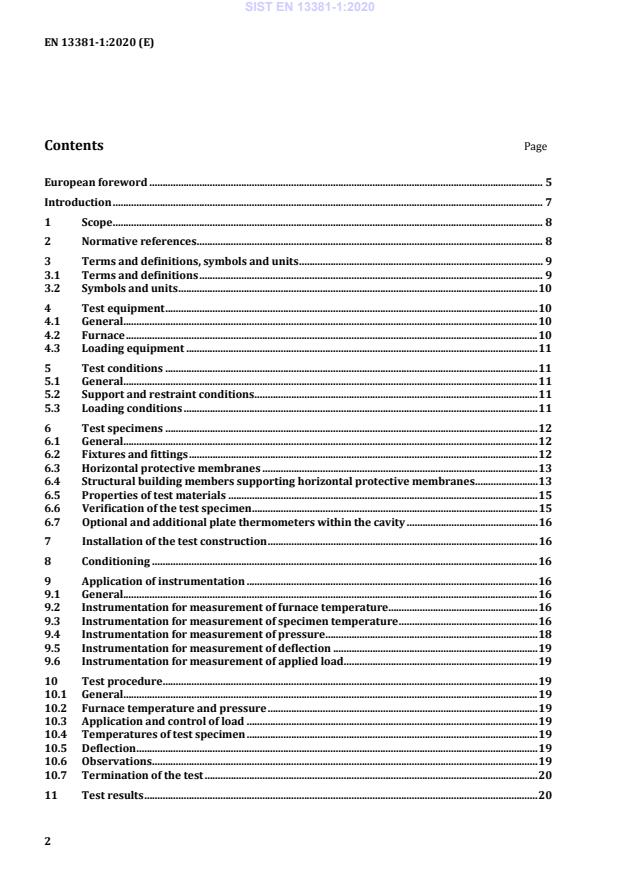
Contents Page
European foreword . 5
Introduction . 7
1 Scope . 8
2 Normative references . 8
3 Terms and definitions, symbols and units . 9
3.1 Terms and definitions . 9
3.2 Symbols and units . 10
4 Test equipment . 10
4.1 General . 10
4.2 Furnace . 10
4.3 Loading equipment . 11
5 Test conditions . 11
5.1 General . 11
5.2 Support and restraint conditions . 11
5.3 Loading conditions . 11
6 Test specimens . 12
6.1 General . 12
6.2 Fixtures and fittings . 12
6.3 Horizontal protective membranes . 13
6.4 Structural building members supporting horizontal protective membranes . 13
6.5 Properties of test materials . 15
6.6 Verification of the test specimen . 15
6.7 Optional and additional plate thermometers within the cavity . 16
7 Installation of the test construction . 16
8 Conditioning . 16
9 Application of instrumentation . 16
9.1 General . 16
9.2 Instrumentation for measurement of furnace temperature . 16
9.3 Instrumentation for measurement of specimen temperature . 16
9.4 Instrumentation for measurement of pressure . 18
9.5 Instrumentation for measurement of deflection . 19
9.6 Instrumentation for measurement of applied load . 19
10 Test procedure . 19
10.1 General . 19
10.2 Furnace temperature and pressure . 19
10.3 Application and control of load . 19
10.4 Temperatures of test specimen . 19
10.5 Deflection . 19
10.6 Observations . 19
10.7 Termination of the test . 20
11 Test results . 20
11.1 Acceptability of test results . 20
11.2 Presentation of test results . 20
12 Test report . 21
13 Assessment . 21
13.1 General . 21
13.2 Assessment of loadbearing capacity . 22
13.3 Assessment of data for calculation purposes . 23
14 Report of the assessment . 23
15 Limits of applicability of the results of the assessment . 25
15.1 Type of structural building member . 25
15.2 Type of concrete . 31
15.3 Type of steel beam . 32
15.4 Type of steel/concrete composite structures . 32
15.5 Type of timber structure . 33
15.6 Height of the cavity . 33
15.7 Exposed width of test specimen. 33
15.8 Properties of the horizontal protective membrane . 33
15.9 Size of panels within the horizontal protective membrane . 33
15.10 Fixtures and fittings . 33
15.11 Gaps between grid members and test frame or walls . 34
Annex A (normative) Exposure to a semi-natural fire . 40
A.1 General . 40
A.2 Semi-natural fire source . 40
A.3 Test equipment . 40
A.4 Test conditions . 41
A.5 Test specimen . 41
A.6 Installation of the test specimen . 42
A.7 Conditioning. 42
A.8 Application of instrumentation . 42
A.9 Test procedure . 42
A.10 Test results . 42
A.11 Test report . 42
A.12 The assessment . 42
A.13 The assessment report . 43
Annex B (normative) Measurement of properties of horizontal protective membranes and
components . 44
B.1 General . 44
B.2 Thickness of horizontal protective membrane and its components . 44
B.3 Density of horizontal protective membranes and components thereof . 45
B.4 Moisture content of horizontal protective membrane and components thereof . 46
Annex C (normative) Test method to the smouldering fire (slow heating curve) . 47
C.1 Introduction . 47
C.2 Test equipment . 47
C.3 Test specimens . 47
C.4 Termination of test . 47
C.5 Evaluation of the results . 48
Bibliography . 49
European foreword
This document (EN 13381-1:2020) has been prepared by Technical Committee CEN/TC 127 “Fire safety
in buildings”, the secretariat of which is held by BSI.
This European Standard shall be given the status of a national standard, either by publication of an
identical text or by endorsement, at the latest by January 2021, and conflicting national standards shall
be withdrawn at the latest by January 2021.
Attention is drawn to the possibility that some of the elements of this document may be the subject of
patent rights. CEN shall not be held responsible for identifying any or all such patent rights.
This document supersedes EN 13381-1:2014.
The main changes with respect to the previous edition are listed below:
Clarifications regarding the following items:
a) determination of the characteristic surface temperature curve;
b) limits of applicability (addition of integrity and insulation performances in the tables);
c) assessment when the semi-natural fire test is performed (Annex A).
This document has been prepared under a mandate given to CEN by the European Commission and the
European Free Trade Association.
This document is one of a series of standards for evaluating the contribution to the fire resistance of
structural members by applied fire protection materials. The other parts of this series are:
— Part 2: Vertical protective membranes,
— Part 3: Applied protection to concrete members,
— Part 4: Applied passive protection to steel members,
— Part 5: Applied protection to concrete/profiled sheet steel composite members,
— Part 6: Applied protection to concrete filled hollow steel columns,
— Part 7: Applied protection to timber members,
— Part 8: Applied reactive protection to steel members,
— Part 9: Applied fire protection systems to steel beams with web openings.
The fire protection capacity of the horizontal protective membrane can be nullified by the presence of
combustible materials in the cavity above the membrane. The applicability of the results of the
assessment is limited according to the quantity and position of such combustible materials within that
cavity. The amount of combustible material permissible in the cavity is typically given in national
regulations.
According to the CEN-CENELEC Internal Regulations, the national standards organisations of the
following countries are bound to implement this European Standard: Austria, Belgium, Bulgaria, Croatia,
Cyprus, Czech Republic, Denmark, Estonia, Finland, France, Germany, Greece, Hungary, Iceland, Ireland,
Italy, Latvia, Lithuania, Luxembourg, Malta, Netherlands, Norway, Poland, Portugal, Republic of North
Macedonia, Romania, Serbia, Slovakia, Slovenia, Spain, Sweden, Switzerland, Turkey and the United
Kingdom.
Introduction
CAUTION: The attention of all persons concerned with managing and carrying out this fire resistance
test is drawn to the fact that fire testing can be hazardous and that there is a possibility that toxic and/or
harmful smoke and gases can be evolved during the test. Mechanical and operational hazards can also
arise during the construction of test elements or structures, their testing and the disposal of test
residues.
An assessment of all potential hazards and risks to health should be made and safety precautions should
be identified and provided. Written safety instructions should be issued. Appropriate training should be
given to relevant personnel. Laboratory personnel should ensure that they follow written safety
instructions at all times.
The specific health and safety instructions contained within this document should be followed.
WARNING: When performing this test method, laboratories should expect that there can be significant
quantities of smoke released. This smoke release is expected to be very significant where the fire test
involves timber and timber based components. Laboratories should ensure that appropriate smoke
extraction facilities are provided.
1 Scope
This document specifies a test method for determining the ability of a horizontal protective membrane,
when used as a fire resistant barrier, to contribute to the fire resistance of standard horizontal structural
building members as defined in 6.4.2.
Test of horizontal protective membrane installed under a specific non-standard floor should be tested
according to EN 1365-2.
This document contains the fire test which specifies the tests which are carried out whereby the
horizontal protective membrane, together with the structural member to be protected, is exposed to a
fire test according to the procedures defined herein. The fire exposure, to the temperature/time curve
given in EN 1363-1, is applied from below the membrane itself.
The test method makes provision, through specified optional additional procedures, for the collection of
data which can be used as direct input to the calculation of fire resistance according to the processes
given within EN 1992-1-2, EN 1993-1-2, EN 1994-1-2 and EN 1995-1-2.
This document also contains the assessment which provides information relative to the analysis of the
test data and gives guidance for the interpretation of the results of the fire test, in terms of loadbearing
capacity criteria of the protected horizontal structural member.
In special circumstances, where specified in national building regulations, there can be a need to subject
the protection material to a smouldering curve. The test for this and the special circumstances for its use
are detailed in Annex C.
The limits of applicability of the results of the assessment arising from the fire test are defined, together
with permitted direct application of the results to different structures, membranes and fittings.
This document applies only where there is a gap and a cavity between the horizontal protective
membrane and the structural building member. Otherwise, the test methods in EN 13381-3, EN 13381-4
or EN 13381-5, as appropriate, apply.
Tests are intended to be carried out without additional combustible materials in the cavity.
Annex A gives details of assessing the performance of the ceiling when exposed to a semi-natural fire.
2 Normative references
The following documents are referred to in the text in such a way that some or all of their content
constitutes requirements of this document. For dated references, only the edition cited applies. For
undated references, the latest edition of the referenced document (including any amendments) applies.
EN 1363-1:2020, Fire resistance tests — Part 1: General Requirements
EN 1363-2, Fire resistance tests — Part 2: Alternative and additional procedures
EN 1992-1-1, Eurocode 2: Design of concrete structures — Part 1-1: General rules and rules for buildings
EN 1992-1-2, Eurocode 2: Design of concrete structures — Part 1-2: General rules — Structural fire design
EN 1993-1-1, Eurocode 3: Design of steel structures — Part 1-1: General rules and rules for buildings
EN 1993-1-2, Eurocode 3: Design of steel structures — Part 1-2: General rules — Structural fire design
EN 1994-1-1, Eurocode 4: Design of composite steel and concrete structures — Part 1-1: General rules and
rules for buildings
EN 1994-1-2, Eurocode 4 — Design of composite steel and concrete structures — Part 1-2: General rules —
Structural fire design
EN 1995-1-1, Eurocode 5: Design of timber structures — Part 1-1: General — Common rules and rules for
buildings
EN 1995-1-2, Eurocode 5: Design of timber structures — Part 1-2: General — Structural fire design
EN 312, Particleboards — Specifications
EN 823, Thermal insulating products for building applications — Determination of thickness
EN 12467, Fibre-cement flat sheets — Product specification and test methods
EN 13381-4, Test methods for determining the contribution to the fire resistance of structural members —
Part 4: Applied passive protection to steel members
EN 13381-5, Test methods for determining the contribution to the fire resistance of structural members —
Part 5: Applied protection to concrete/profiled sheet steel composite member
EN 13381-7, Test methods for determining the contribution to the fire resistance of structural members —
Part 7: Applied protection to timber members
EN ISO 13943, Fire safety — Vocabulary (ISO 13943)
ISO 8421-2, Fire protection — Vocabulary — Part 2: Structural fire protection
3 Terms and definitions, symbols and units
3.1 Terms and definitions
For the purposes of this document, the terms and definitions given in EN 1363-1, EN ISO 13943 and
ISO 8421-2 and the following apply.
ISO and IEC maintain terminological databases for use in standardization at the following addresses:
• IEC Electropedia: available at http://www.electropedia.org/
• ISO Online browsing platform: available at https://www.iso.org/obp/ui
3.1.1
horizontal structural building member
horizontal structural element of building construction which is loadbearing, separating and which is
fabricated from concrete, steel, steel/concrete composite or timber
3.1.2
horizontal protective membrane
horizontal membrane or ceiling lining that does not form any part of any loadbearing part of the
structure and can comprise multiple layers of materials, together with any supporting framework,
hangers, fixings and any insulation materials which is either suspended from or attached directly to a
structural building member, or is self-supporting and fixed beneath a structural building member, and
which is intended to give additional fire resistance to that structural building member, as for example
ceiling tiles resting on a light supporting frame, ceiling boards, metal trays, plastered and similar ceilings
not directly applied to the underside of the structural member
3.1.3
separating gap
distance between the non-exposed surface of the horizontal protective membrane and the lowest
surface of the exposed side of the structural building member
3.1.4
cavity
whole void or voids between the non-exposed surface of the horizontal protective membrane and the
highest surface of the exposed side of the structural building member
3.1.5
horizontal protective membrane test specimen
full horizontal protective membrane assembly submitted for test, including typical fixing equipment and
methods and typical features such as insulating materials, light fittings, ventilation ducts and access
panels
3.1.6
fire protection
protection afforded to the structural building member by the horizontal protective membrane system
such that the temperature on the surface of the structural building member and within the cavity is
limited throughout the period of exposure to fire
3.1.7
characteristic temperature
average of the mean temperature and the maximum individual temperature [(mean + maximum)/2] for
a group of thermocouples
3.2 Symbols and units
Symbol Unit Designation
−1
Am/V m Section factor of unprotected steel beam (see EN 13381-4).
L mm Exposed length of the structural building member.
exp
L mm Total length of the main beams or members of the structural building member.
spec
L mm Centre to centre distance between the supports of the structural building member
sup
tested.
4 Test equipment
4.1 General
The furnace and test equipment shall be as specified in EN 1363-1.
4.2 Furnace
The furnace shall be designed to permit the dimensions of the test specimen to be exposed to heating to
be as specified in 6.4.1 and its installation to be as described in Clause 7.
4.3 Loading equipment
Loading shall be applied according to EN 1363-1. The loading system shall permit loading, of the
magnitude defined in 5.3, to be uniformly applied along the length and width of the test specimen at
loading points positioned as defined in 5.3.
The loading equipment shall not inhibit the free movement of air above the test specimen and no part of
the loading equipment, other than at the loading points, shall be closer than 60 mm to the unexposed
surface of the test specimen.
5 Test conditions
5.1 General
A horizontal structural building member, including any supporting construction, which carries a
horizontal protective membrane, to be used as a fire resistant barrier against fire from below, is
subjected to predefined loading and to the fire test defined herein.
The temperature within the cavity and the surface temperature of the structural building member are
measured throughout the test.
Any leakage through the structural floor slab and at the sides of the structure shall be minimized. The
gap between the floor slab and the furnace shall be made tight by e.g. mineral wool pads or similar in
such a way that the slab can deflect vertically.
It is recommended that the test is continued until the characteristic temperature recorded by all
thermocouples within the cavity reaches the appropriate limiting temperature of the structural building
members used or until any individual temperature recorded within the cavity rises to 750 °C for
concrete, steel, or concrete/profiled steel composite members and 500 °C for timber structural
members.
The procedures given in EN 1363-1 and, if applicable, in EN 1363-2, shall be followed in the
performance of this test method unless specific contrary instruction is given. Where required, the semi-
natural fire test shall be performed in accordance with Annex A.
5.2 Support and restraint conditions
5.2.1 Standard conditions
The test specimen shall be tested as a simply supported one way structure with two free edges and an
exposed surface and span as specified in 6.4.1.
It shall be installed to allow freedom for longitudinal movement and deflection using at one side rolling
support(s) and at the other hinge support(s) as shown in Figure 1.
The surface of the bearings shall be smooth concrete or steel plates. The width of the bearings shall be at
least as wide as the beam.
5.2.2 Other support and restraint conditions
Support and restraint conditions differing from the standard conditions specified in 5.2.1 shall be
described in the test report and the validity of the results restricted to that tested.
5.3 Loading conditions
The test specimen shall be subjected to loads determined in accordance with EN 1363-1. The means of
determination of the load shall be clearly indicated in the test report.
The applied load shall be calculated such that the maximum bending moment equals 60 % of the
ultimate cold condition limit state value of the design moment resistance specified in the appropriate
structural Eurocodes (EN 1992-1-1, EN 1993-1-1, EN 1994-1-1 and EN 1995-1-1).
The design moment resistance shall be calculated using either the actual or nominal material properties,
derived according to 6.5, of the loadbearing member with a material safety factor (γm) equal to 1,0.
The load shall be symmetrically applied to the test specimen either along two transverse loading lines,
applied at 1/4 L and 3/4 L and separated from each other by a distance of L /2, see Figure 2, or by
sup sup sup
the use of dead weights. In both cases the loading shall produce stresses approximating to a uniformly
distributed load.
The method of loading shall be by a system which will produce a bending moment, which is uniform
over at least 20 % of the span of the beam around mid-span.
Point loads shall be transferred to the test specimen, along the two transverse loading lines, through
load distribution beams or plates, see Figure 1 and Figure 3, the total contact area between these and the
test specimen shall be as specified in EN 1363-1.
Load distribution beams, for safety reasons, shall have a height to width ratio < 1.
If the load distribution plates are of steel or any other high conductivity material, they shall be insulated
from the surface of the test specimen by a suitable thermal insulation material.
Unexposed surface thermocouples shall not be closer than 100 mm to any part of the load distribution
system.
6 Test specimens
6.1 General
One test specimen shall normally be required.
The structural building member to be used in the test shall be as given in 6.4.1 and be chosen from the
standard elements described in 6.4.2 and be representative of that to be used in practice.
Where a horizontal protective membrane is manufactured with elements or components of variable size
or may be installed by different procedures, then separate tests shall be carried out on elements or
components at maximum and minimum sizes (the components which are cut to finish the ceiling
extremities shall not be considered as smaller size components). The installation procedures for which
the sponsor requires approval shall be deemed as being represented by the fire test.
The horizontal protective membrane to be used in the test shall be constructed as described in 6.3 and
shall be installed according to practice, by the procedures given in the installation manual or other
written instruction provided by the sponsor. It shall include all thermal insulating layers or materials to
be used in practice within the cavity.
6.2 Fixtures and fittings
All fixtures and fittings, such as light fittings, ventilation openings and access panels expected to be
installed, shall be tested in a separate full size test. The installation and frequency of use of these shall
then if possible be representative of practice. Such fixtures and fittings shall not be installed within the
test specimen at a distance of less than 250 mm from any of its edges.
6.3 Horizontal protective membranes
The test specimen shall reproduce the conditions of use, including junctions between membrane and
walls and edge panels, joints and jointing materials and be installed from below by the same method and
procedures as given in the installation manual, or in written instructions, which shall be provided by the
sponsor.
It shall be fitted with all the components for hanging, expansion and abutting, plus any other fixtures
which are to be defined by the sponsor, with a frequency representative of practice.
For horizontal protective membranes which are suspended from the structural building member by
hangers, the suspension system and the length of the hangers shall be representative of practice.
The profiles bearing the various panels shall be installed against each other without any gap, unless a
gap (or gaps) is required for design purposes. In this case the gap (or gaps) at the junctions of main
runners shall be representative of that to be used in practice and shall be installed within the main
runners and not at their ends.
The profiles within the test specimen shall include a joint representative of joints to be used in practice
in both longitudinal and transverse directions.
The horizontal protective membrane shall be fixed according to normal practice on all four edges, either
directly to the furnace walls or to a test frame. A test frame, where used, shall be fixed directly to the
horizontal structural building member being protected, or to the furnace walls.
If the construction or properties of the horizontal protective membrane are different in the longitudinal
and transverse directions, the performance of the specimen may vary depending upon which
components are aligned with the longitudinal axis. If known from experience, the specimen shall be
installed so as to represent the most onerous condition by arranging the more critical components
parallel to the longitudinal axis. If the more onerous condition cannot be identified, two separate tests
shall be carried out with the components arranged both parallel and perpendicular to the longitudinal
axis.
6.4 Structural building members supporting horizontal protective membranes
6.4.1 General principles
The dimensions of the structural building member supporting the horizontal protective membrane and
which is exposed to the furnace shall be:
a) exposed length (L ) : at least 4 000 mm
exp
b) span (L ) : L plus up to 400 mm maximum at each end
sup exp
c) length (L ) : L plus up to 500 mm at each end
spec exp
d) exposed width : at least 3 000 mm
The additional length, required for installation purposes, shall be kept as small as practically possible.
Test specimens of exposed width less than 3 000 mm may be tested according to this method. However,
application of the result shall be restricted to constructions of equal or less width than that tested.
The gap between the structural building member and the longitudinal furnace walls or simulated
furnace walls shall not exceed 30 mm and shall be sealed with compressed mineral fibres or ceramic
fibres of adequate fire performance (or comparable materials of equivalent performance) to allow both
deflection of the member under heating conditions and prevention of leakage of hot gases during the
test.
6.4.2 Standard horizontal structural building members
The following structural building members are considered to be standard for this test method:
a) Reinforced aerated concrete slabs on steel beams:
The structural member shall comprise hot rolled steel `I' section beams of profiles with section
−1
factor Am/V equal to (275 ± 25) m (for three sided exposure) and with a section depth of typically
(160 ± 20) mm. The grade of steel used shall be any structural grade (S designation) according to
the specification given in EN 13381-4. Engineering grades (E designation) shall not be used.
These beams shall be spaced at (700 ± 100) mm centres resting on the bearing surface of the
furnace test frame. The beams may be assembled incorporating cross members welded at the ends.
The centre of either of the outer steel beams shall not be placed less than 275 mm from the furnace
wall in order that the edge of the horizontal protective membrane rests only on the peripheral
support. The centre of either of the outer steel beams shall not be placed more than 450 mm from
the furnace wall.
The reinforced aerated concrete slabs shall be of density not more than 650 kg/m and minimum
thickness 100 mm and maximum width 650 mm. They shall be placed transversely on the profiles of
the steel beams and separated from each other by gaps of 5 mm to 10 mm which shall be sealed
with ceramic fibre or equivalent material and silicone flexible sealant. New, unused, reinforced
aerated concrete slabs shall be used for each test.
The aerated concrete slabs shall rest on the steel beam framework without mechanical connection
so that there is no gain in mechanical strength of the structure with increasing deformation.
b) Reinforced dense aggregate concrete slabs on steel beams:
All the principles given in a) for reinforced aerated concrete slabs on steel beams apply except that
the concrete slabs shall comprise dense aggregate concrete of density (2 350 ± 150) kg/m and shall
have a thickness of between 60 mm to 120 mm. See EN 13381-3 for the aggregates of the concrete.
c) Timber floors (or roofs):
The standard structural building member from which a horizontal membrane is suspended for the
protection of a timber structural building member shall comprise equally spaced softwood joists, of
nominal density (450 ± 75) kg/m and cross-section (220 ± 10) mm x (75 ± 5) mm at 530 mm to
600 mm centres, see Figure 4. The number of joists (preferably six) and their spacing shall be
appropriate to the exposed width, which shall be from 3 000 mm to 3 300 mm.
The joists shall be connected by cross members of the same material and cross-section, located in
the area of the furnace support. They shall also be connected by cross members of the same material
but with cross-section (175 ± 10) mm x (40 ± 5) mm, located around mid-span, see Figure 4. The
wooden floor shall be made from particle board sheets of thickness (21 ± 3) mm and density
(600 ± 50) kg/m according to EN 312, laid perpendicular to the joists, with tongue and groove
joints and nailed down.
d) Concrete/profiled steel sheet composite slabs:
The standard concrete/profiled steel sheet composite test slab shall be prepared according to the
specification given in EN 13381-5. The grade of steel and the concrete type, composition and
strength shall be as specified in EN 13381-5.
The standard concrete/profiled steel sheet composite slab shall be fixed to and supported on steel
beams with a representative span as specified in 6.4.1.
Safety suspensions may be provided on the unexposed side of the slab, without contributing to the
loadbearing capacity of the structural member, in order to avoid collapse of the structural member
under test during the test.
6.5 Properties of test materials
Where appropriate, the actual properties of materials used in the structural building member tested
(e.g. concrete strength) shall be determined according to EN 1363-1 or using an appropriate product
test standard, e.g. concrete strength. Otherwise, nominal values, e.g. for steel or wood based materials,
may be used. The dimensions of the structural building member used shall be measured.
The material composition of the horizontal protective membrane shall be specified by the sponsor. For
confidentiality reasons the sponsor may not wish detailed formulation of composition details to be
reported in the test report. Such data shall, however, be provided and maintained in confidence in
laboratory files.
The actual thickness, density and moisture content of the components of the horizontal protective
membrane shall be measured and recorded, just prior to the time of test, on the components themselves
or on special test samples taken from the test component. These shall be conditioned as defined in
Clause 8. The procedures appropriate to different types of material are given in Annex B.
The thickness of slab or board type fire protection materials should not deviate by more than 15 % of
the mean value over the whole of its surface. The mean value shall be used in the assessment of the
results and in the limits of applicability of the assessment. If the board thickness varies by more than
15 % then the maximum thickness recorded shall be used in the assessment.
The thickness of sprayed or coated, passive or reactive type fire protection materials when used as
component parts of horizontal protective membranes shall be measured according to Annex B. The
thickness shall not deviate by more than 20 % of the mean value over the whole of its surface. The mean
value shall be used in the assessment of the results and the limits of applicability of the assessment. If it
deviates by more than 20 %, the maximum thickness recorded shall be used in the ass
...