

EN 12790-1:2023
(Main)Child care articles - Reclined cradles - Part 1: Reclined cradles for children up to when they start to try to sit up
- Abstract
This document specifies safety requirements and the corresponding test methods for fixed or folding reclined cradles intended for children up to when they start to try to sit up.
This document applies also to car seats complying with UN ECE R44 or UN ECE R129 that can be used as reclined cradles according to manufacturer’s instructions. If usage as reclined cradle is not included in the product information or marketing material, car seats are excluded from the scope of this document.
If a reclined cradle has several functions or can be converted into another function the relevant European standards apply to it.
- Status
- Published
- Publication Date
- 07-Mar-2023
- Technical Committee
- CEN/TC 252 - Child use and care articles
- Drafting Committee
- CEN/TC 252/WG 1 - Seating and body care
- Current Stage
- 6060 - Definitive text made available (DAV) - Publishing
- Start Date
- 08-Mar-2023
- Completion Date
- 08-Mar-2023
- Directive
- 2001/95/EC - General product safetyOJ Ref: 2024/2406, OJ L, OJ L, 2024/2406 OJ Date: 13-Sep-2024

Overview
EN 12790-1:2023 - Child care articles - Reclined cradles - Part 1: Reclined cradles for children up to when they start to try to sit up - is a CEN European standard that specifies safety requirements and corresponding test methods for fixed or folding reclined cradles. It applies to products intended for infants before they begin to attempt sitting, and also covers car seats meeting UN ECE R44 or UN ECE R129 when the manufacturer explicitly allows their use as a reclined cradle. EN 12790-1:2023 supersedes EN 12790:2009 and has been adopted by CEN members as a national standard (e.g., SIST EN 12790-1:2024).
Key Topics
The standard addresses comprehensive safety and testing aspects relevant to reclined cradles and includes, but is not limited to:
- Test equipment and masses - defined test masses, probes and apparatus used for replicable laboratory testing (e.g., impactor, feeler gauges, small parts cylinder).
- Chemical hazards - migration of certain elements, formaldehyde, colourants and other chemical risk controls.
- Thermal hazards - requirements and test methods to prevent burn or overheating risks.
- Mechanical hazards - extensive requirements for:
- entrapment and finger entrapment prevention,
- moving parts (compression/shear points),
- protection against falls (seat angle, restraint systems),
- locking mechanisms for carrying handles,
- folding mechanism safety and durability,
- entanglement from cords or ribbons,
- choking, ingestion and suffocation hazards.
- Structural integrity and durability - static and dynamic strength tests, durability of powered mechanisms and handle locking systems.
- Stability and slippage - tests for tipping and unintended movement.
- Acoustic and electrical safety - sound level limits and electrical leakage prevention for powered models.
- Product information and marking - mandatory labeling, purchase information and user instructions, including requirements specific to electrically powered reclined cradles.
Applications
EN 12790-1:2023 is used by:
- Manufacturers and product designers to design safe reclined cradles and ensure compliance with EU market expectations.
- Test laboratories for conducting standardized mechanical, chemical, thermal and electrical tests.
- Regulatory authorities, certification bodies and retailers for conformity assessment, market surveillance and product selection.
- Importers and safety consultants for risk assessment, documentation and labeling verification.
Practical benefits include safer product design, demonstrable compliance for market access in Europe, reduced recall risk, and clearer user instructions for caregivers.
Related standards
- UN ECE R44 and UN ECE R129 - referenced when car seats are intended for use as reclined cradles.
- Other relevant European standards for multifunction childcare articles (apply when a reclined cradle converts to another function).
Keywords: EN 12790-1:2023, reclined cradles, child care articles, safety requirements, test methods, CEN, UN ECE R44, UN ECE R129, product safety, infant recliners.
Relations
- Effective Date
- 06-Dec-2017
- Effective Date
- 09-Feb-2026
- Effective Date
- 09-Feb-2026
- Effective Date
- 09-Feb-2026
- Effective Date
- 09-Feb-2026
- Effective Date
- 09-Feb-2026
- Effective Date
- 09-Feb-2026
- Effective Date
- 09-Feb-2026
- Effective Date
- 28-Jan-2026
- Effective Date
- 28-Jan-2026
- Effective Date
- 28-Jan-2026
- Effective Date
- 28-Jan-2026
- Effective Date
- 28-Jan-2026
- Effective Date
- 28-Jan-2026
- Effective Date
- 28-Jan-2026
Frequently Asked Questions
EN 12790-1:2023 is a standard published by the European Committee for Standardization (CEN). Its full title is "Child care articles - Reclined cradles - Part 1: Reclined cradles for children up to when they start to try to sit up". This standard covers: This document specifies safety requirements and the corresponding test methods for fixed or folding reclined cradles intended for children up to when they start to try to sit up. This document applies also to car seats complying with UN ECE R44 or UN ECE R129 that can be used as reclined cradles according to manufacturer’s instructions. If usage as reclined cradle is not included in the product information or marketing material, car seats are excluded from the scope of this document. If a reclined cradle has several functions or can be converted into another function the relevant European standards apply to it.
This document specifies safety requirements and the corresponding test methods for fixed or folding reclined cradles intended for children up to when they start to try to sit up. This document applies also to car seats complying with UN ECE R44 or UN ECE R129 that can be used as reclined cradles according to manufacturer’s instructions. If usage as reclined cradle is not included in the product information or marketing material, car seats are excluded from the scope of this document. If a reclined cradle has several functions or can be converted into another function the relevant European standards apply to it.
EN 12790-1:2023 is classified under the following ICS (International Classification for Standards) categories: 97.190 - Equipment for children. The ICS classification helps identify the subject area and facilitates finding related standards.
EN 12790-1:2023 has the following relationships with other standards: It is inter standard links to EN 12790:2009, EN 61558-2-16:2009, EN IEC 62115:2020/A11:2020, EN IEC 62115:2020, EN 61558-2-7:2007, EN 61672-1:2013, EN 61558-2-16:2009/A1:2013, ISO 48-4:2018, EN ISO 14184-1:2011, EN ISO 17234-1:2020, EN ISO 14362-1:2017, EN 717-1:2004, EN 12790-2:2023, EN 71-2:2020, EN 622-1:2003. Understanding these relationships helps ensure you are using the most current and applicable version of the standard.
EN 12790-1:2023 is associated with the following European legislation: EU Directives/Regulations: 2001/95/EC; Standardization Mandates: M/264. When a standard is cited in the Official Journal of the European Union, products manufactured in conformity with it benefit from a presumption of conformity with the essential requirements of the corresponding EU directive or regulation.
EN 12790-1:2023 is available in PDF format for immediate download after purchase. The document can be added to your cart and obtained through the secure checkout process. Digital delivery ensures instant access to the complete standard document.
Standards Content (Sample)
SLOVENSKI STANDARD
01-junij-2024
Nadomešča:
SIST EN 12790:2009
Izdelki za otroke - Sklopne zibelke - 1. del: Sklopne zibelke za otroke, ki še ne
poskušajo sedeti
Child care articles - Reclined cradles - Part 1: Reclined cradles for children up to when
they try to sit up
Artikel für Säuglinge und Kleinkinder - Kinderliegesitze - Teil 1: Kinderliegesitze für
Kinder, bis sie versuchen sich aufzusetzen
Articles de puériculture - Transats - Partie 1: Transats pour enfants jusqu'à ce qu'ils
essayent de s'asseoir
Ta slovenski standard je istoveten z: EN 12790-1:2023
ICS:
97.190 Otroška oprema Equipment for children
2003-01.Slovenski inštitut za standardizacijo. Razmnoževanje celote ali delov tega standarda ni dovoljeno.
EN 12790-1
EUROPEAN STANDARD
NORME EUROPÉENNE
March 2023
EUROPÄISCHE NORM
ICS 97.190 Supersedes EN 12790:2009
English Version
Child care articles - Reclined cradles - Part 1: Reclined
cradles for children up to when they start to try to sit up
Articles de puériculture - Transats - Partie 1 : Transats Artikel für Säuglinge und Kleinkinder - Kinderliegesitze
pour enfants jusqu'à ce qu'ils commencent à essayer de - Teil 1: Kinderliegesitze für Kinder bis sie versuchen,
s'asseoir sich aufzusetzen
This European Standard was approved by CEN on 22 August 2022.
CEN members are bound to comply with the CEN/CENELEC Internal Regulations which stipulate the conditions for giving this
European Standard the status of a national standard without any alteration. Up-to-date lists and bibliographical references
concerning such national standards may be obtained on application to the CEN-CENELEC Management Centre or to any CEN
member.
This European Standard exists in three official versions (English, French, German). A version in any other language made by
translation under the responsibility of a CEN member into its own language and notified to the CEN-CENELEC Management
Centre has the same status as the official versions.
CEN members are the national standards bodies of Austria, Belgium, Bulgaria, Croatia, Cyprus, Czech Republic, Denmark, Estonia,
Finland, France, Germany, Greece, Hungary, Iceland, Ireland, Italy, Latvia, Lithuania, Luxembourg, Malta, Netherlands, Norway,
Poland, Portugal, Republic of North Macedonia, Romania, Serbia, Slovakia, Slovenia, Spain, Sweden, Switzerland, Türkiye and
United Kingdom.
EUROPEAN COMMITTEE FOR STANDARDIZATION
COMITÉ EUROPÉEN DE NORMALISATION
EUROPÄISCHES KOMITEE FÜR NORMUNG
CEN-CENELEC Management Centre: Rue de la Science 23, B-1040 Brussels
© 2023 CEN All rights of exploitation in any form and by any means reserved Ref. No. EN 12790-1:2023 E
worldwide for CEN national Members.
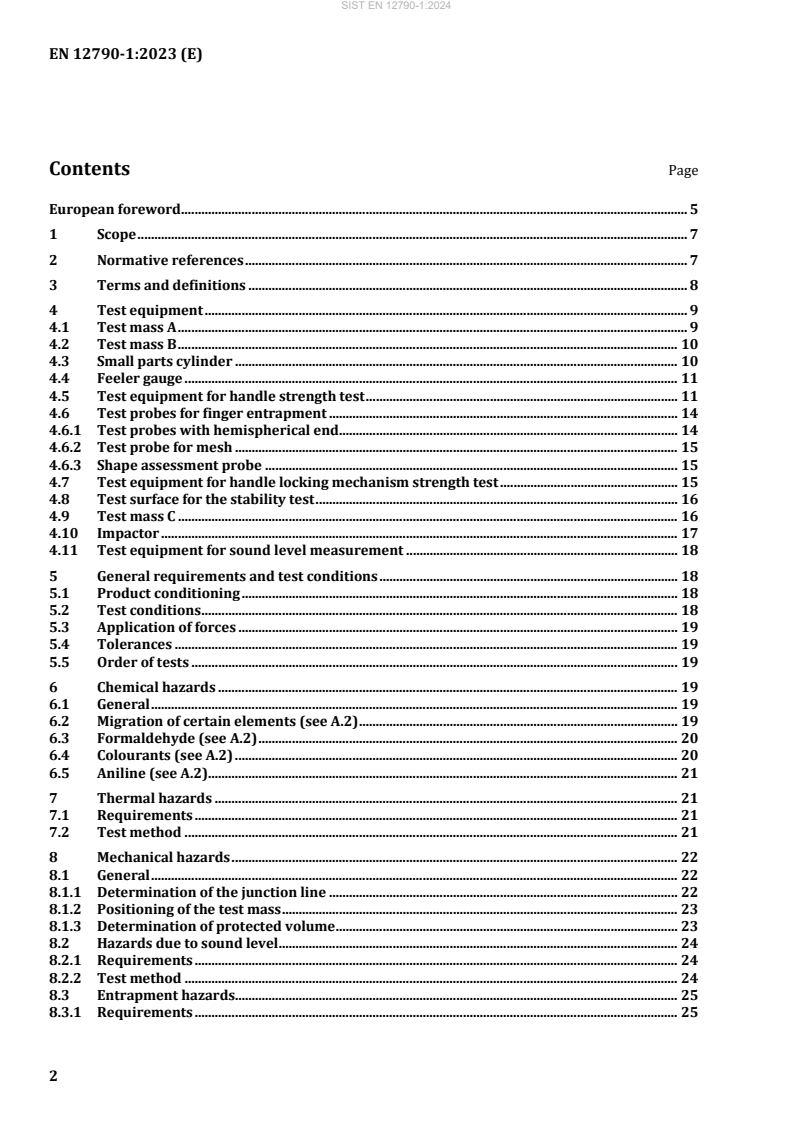
Contents Page
European foreword . 5
1 Scope . 7
2 Normative references . 7
3 Terms and definitions . 8
4 Test equipment . 9
4.1 Test mass A . 9
4.2 Test mass B . 10
4.3 Small parts cylinder . 10
4.4 Feeler gauge . 11
4.5 Test equipment for handle strength test . 11
4.6 Test probes for finger entrapment . 14
4.6.1 Test probes with hemispherical end . 14
4.6.2 Test probe for mesh . 15
4.6.3 Shape assessment probe . 15
4.7 Test equipment for handle locking mechanism strength test . 15
4.8 Test surface for the stability test . 16
4.9 Test mass C . 16
4.10 Impactor . 17
4.11 Test equipment for sound level measurement . 18
5 General requirements and test conditions . 18
5.1 Product conditioning . 18
5.2 Test conditions . 18
5.3 Application of forces . 19
5.4 Tolerances . 19
5.5 Order of tests . 19
6 Chemical hazards . 19
6.1 General . 19
6.2 Migration of certain elements (see A.2) . 19
6.3 Formaldehyde (see A.2) . 20
6.4 Colourants (see A.2) . 20
6.5 Aniline (see A.2). 21
7 Thermal hazards . 21
7.1 Requirements . 21
7.2 Test method . 21
8 Mechanical hazards . 22
8.1 General . 22
8.1.1 Determination of the junction line . 22
8.1.2 Positioning of the test mass . 23
8.1.3 Determination of protected volume . 23
8.2 Hazards due to sound level . 24
8.2.1 Requirements . 24
8.2.2 Test method . 24
8.3 Entrapment hazards. 25
8.3.1 Requirements . 25
8.3.2 Test methods . 25
8.4 Hazards due to moving parts . 25
8.4.1 Requirements for compression points . 25
8.4.2 Requirements for shear points . 25
8.5 Hazards due to falling of the child . 26
8.5.1 Angle of seat unit . 26
8.5.2 Restraint system . 27
8.5.3 Locking mechanism(s) for carrying handle(s) . 28
8.6 Hazards due to folding of the product . 31
8.6.1 Requirements . 31
8.6.2 Test methods . 32
8.7 Hazards from entanglement in cords, ribbons and similar parts . 32
8.7.1 Requirements . 32
8.7.2 Test method . 33
8.8 Choking and ingestion hazard . 33
8.8.1 Requirements . 33
8.8.2 Test methods . 34
8.9 Suffocation hazards from plastic packaging . 35
8.10 Hazards from edges, corners and protruding parts . 35
8.11 Hazards from inadequate structural integrity . 35
8.11.1 Static strength . 35
8.11.2 Dynamic strength . 36
8.11.3 Reclining system . 36
8.11.4 Durability of powered mechanisms . 37
8.11.5 Durability of reclined cradles with carrying handle(s) . 37
8.11.6 Strength of carrying handle(s) locking mechanism(s) . 38
8.11.7 Toy bar attachment integrity . 40
8.12 Hazards from inadequate stability . 41
8.12.1 Requirements . 41
8.12.2 Test method . 41
8.13 Hazards from possible slippage of the reclined cradle . 42
8.13.1 Requirement . 42
8.13.2 Test method . 42
8.14 Electrical hazards . 42
8.14.1 General . 42
8.14.2 Leakage prevention . 43
8.14.3 Test methods . 43
9 Product information . 43
9.1 General . 43
9.2 Marking of the product . 43
9.2.1 General requirements . 43
9.2.2 Requirements for reclined cradles with electrical components . 44
9.3 Purchase information . 45
9.4 Instructions for use . 46
9.4.1 General requirements . 46
9.4.2 Requirements for reclined cradles with electrical components . 47
Annex A (informative) Rationales . 48
A.1 Introduction. 48
A.1.1 General . 48
A.1.2 Static reclined cradle . 48
A.1.3 Rocking reclined cradle . 48
A.1.4 Bouncing reclined cradle . 48
A.2 Chemical hazards (see Clause 6) . 48
A.3 Thermal hazards (see Clause 7) . 48
A.4 Mechanical hazards (see Clause 8) . 49
A.4.1 Protected volume (see 8.1.3) . 49
A.4.2 Hazards due to sound level (see 8.2) . 49
A.4.3 Entrapment hazards (see 8.3) . 49
A.4.4 Hazards due to moving parts (see 8.4) . 49
A.4.5 Hazards due to falling of the child (see 8.5) . 49
A.4.6 Entanglement hazards (see 8.7) . 49
A.4.7 Choking and ingestion hazards (see 8.8) . 50
A.4.8 Suffocation hazards (see 8.9) . 50
A.4.9 Hazardous edges, corners and protruding parts (see 8.10) . 50
A.4.10 Hazards from inadequate structural integrity (see 8.11) . 50
A.4.11 Hazards due to the reclining system (see 8.11.3). 50
A.4.12 Hazards due to release of toy bar (see 8.11.7) . 50
A.4.13 Hazards from slippage of the reclined cradle (see 8.13) . 50
Annex B (normative) Warnings . 51
Annex C (informative) A-deviations . 72
Annex ZA (informative) Relationship between this European Standard and the safety
requirements of Directive 2001/95/EC aimed to be covered . 73
Bibliography . 73
European foreword
This document (EN 12790-1:2023) has been prepared by Technical Committee CEN/TC 252 “Child care
articles”, the secretariat of which is held by AFNOR.
This European Standard shall be given the status of a national standard, either by publication of an
identical text or by endorsement, at the latest by September 2023, and conflicting national standards shall
be withdrawn at the latest by March 2024.
Attention is drawn to the possibility that some of the elements of this document may be the subject of
patent rights. CEN shall not be held responsible for identifying any or all such patent rights.
This document supersedes EN 12790:2009.
In comparison with EN 12790:2009, the significant technical changes relate to the following topics:
a) chemical hazards;
b) thermal hazards;
c) hazards due to sound level;
d) entrapment hazards;
e) entanglement hazards;
f) suffocation hazards from plastic packaging;
g) requirements for powered mechanisms;
h) requirements for toy bar attachment;
i) electrical hazards;
j) general update of product information clause with the introduction of symbols following
CEN/TR 13387-5;
k) introduction of an Annex giving relevant translations for warning sentences.
EN 12790 has been divided into the following two different parts to widen the scope of the standard:
— EN 12790-1, that covers reclined cradles intended for children up to when they start to try to sit up
(same as EN 12790:2009); and
— EN 12790-2, that covers reclined cradles intended for children up to when they start to stand up, not
covered in EN 12790:2009.
This document has been prepared under a Standardization Request given to CEN by the European
Commission and the European Free Trade Association, and supports essential requirements of EU
Directive(s) / Regulation(s).
For relationship with EU Directive(s) / Regulation(s), see informative Annex ZA, which is an integral part
of this document.
Any feedback and questions on this document should be directed to the users’ national standards body.
A complete listing of these bodies can be found on the CEN website.
According to the CEN-CENELEC Internal Regulations, the national standards organisations of the
following countries are bound to implement this European Standard: Austria, Belgium, Bulgaria, Croatia,
Cyprus, Czech Republic, Denmark, Estonia, Finland, France, Germany, Greece, Hungary, Iceland, Ireland,
Italy, Latvia, Lithuania, Luxembourg, Malta, Netherlands, Norway, Poland, Portugal, Republic of North
Macedonia, Romania, Serbia, Slovakia, Slovenia, Spain, Sweden, Switzerland, Türkiye and the United
Kingdom.
1 Scope
This document specifies safety requirements and the corresponding test methods for fixed or folding
reclined cradles intended for children up to when they start to try to sit up.
This document applies also to car seats complying with UN ECE R44 or UN ECE R129 that can be used as
reclined cradles according to manufacturer’s instructions. If usage as reclined cradle is not included in
the product information or marketing material, car seats are excluded from the scope of this document.
If a reclined cradle has several functions or can be converted into another function the relevant European
standards apply to it.
2 Normative references
The following documents are referred to in the text in such a way that some or all of their content
constitutes requirements of this document. For dated references, only the edition cited applies. For
undated references, the latest edition of the referenced document (including any amendments) applies.
EN 12790-2:2023, Child care articles — Reclined cradles — Part 2: Reclined cradles for children up to when
they start to stand up
EN 71-2:2020, Safety of toys — Part 2: Flammability
EN 71-3, Safety of toys — Part 3: Migration of certain elements
NOTE The latest edition of EN 71-3 cited in the OJEU applies.
EN 71-10:2005, Safety of toys — Part 10: Organic chemical compounds — Sample preparation and
extraction
EN 71-11:2005, Safety of toys — Part 11: Organic chemical compounds — Methods of analysis
EN 622-1:2003, Fibreboards — Specifications — Part 1: General requirements
EN 717-1:2004, Wood-based panels — Determination of formaldehyde release — Part 1: Formaldehyde
emission by the chamber method
EN ISO 105-A03:2019, Textiles — Tests for colour fastness — Part A03: Grey scale for assessing staining
(ISO 105-A03:2019)
EN 61558-2-7:2007, Safety of power transformers, power supplies, reactors and similar products — Part 2-
7: Particular requirements and tests for transformers and power supplies for toys (IEC 61558-2-7:2007)
EN 61558-2-16:2009 , Safety of transformers, reactors, power supply units and similar products for supply
voltages up to 1 100 V — Part 2-16: Particular requirements and tests for switch mode power supply units
and transformers for switch mode power supply units (IEC 61558-2-16:2009)
EN IEC 62115:2020 , Electric toys — Safety (IEC 62115:2017, modified)
As impacted by EN 61558-2-16:2009/A1:2013.
As impacted by EN IEC 62115:2020/A11:2020.
EN ISO 3746:2010, Acoustics — Determination of sound power levels and sound energy levels of noise
sources using sound pressure — Survey method using an enveloping measurement surface over a reflecting
plane (ISO 3746:2010)
EN 61672-1:2013, Electroacoustics — Sound level meters — Part 1: Specifications (IEC 61672-1:2013)
EN ISO 14184-1:2011, Textiles — Determination of formaldehyde — Part 1: Free and hydrolysed
formaldehyde (water extraction method) (ISO 14184-1:2011)
EN ISO 14362-1:2017, Textiles — Methods for determination of certain aromatic amines derived from azo
colorants — Part 1: Detection of the use of certain azo colorants accessible with and without extracting the
fibres (ISO 14362-1:2017)
EN ISO 17234-1:2020, Leather — Chemical tests for the determination of certain azo colourants in dyed
leathers — Part 1: Determination of certain aromatic amines derived from azo colorants (ISO 17234-
1:2020)
ISO 48-4:2018, Rubber, vulcanized or thermoplastic — Determination of hardness — Part 4: Indentation
hardness by durometer method (Shore hardness)
3 Terms and definitions
For the purposes of this document, the following terms and definitions apply.
ISO and IEC maintain terminology databases for use in standardization at the following addresses:
• ISO Online browsing platform: available at https://www.iso.org/obp
• IEC Electropedia: available at https://www.electropedia.org/
3.1
reclined cradle
article intended to accommodate a child in a reclined position
Note 1 to entry: Reclined cradles may be static, rocking or bouncing and may have an adjustable backrest and/or
seat, see A.1.
3.2
seat unit
part of the reclined cradle that supports the child, either in the form of a hammock or composed by a seat
and a backrest
3.3
restraint system
system to restrain the child within the reclined cradle
3.4
crotch restraint
device designed to pass between the child’s legs to prevent the child from sliding forward
3.5
carrying handle
component to enable the reclined cradle, with the child in it, to be carried by hand
3.6
junction line
intersection of the seat and the backrest
3.7
toy bar
any bar or mobile connected to the frame of the product in any location with one or more attachment
points typically used to suspend toys over the occupant
Note 1 to entry: Canopies and carrying handles, fixed and rotating, are not considered a toy bar regardless of
whether they allow for the attachment of toys.
4 Test equipment
4.1 Test mass A
Test mass A is a rigid cylinder (160 ± 5) mm in diameter and (300 ± 5) mm in height, having a mass of
+0,01
9 kg and with its centre of gravity in the centre of the cylinder. All edges shall have a radius of (5 ± 1)
mm. Two anchorage points shall be provided. These shall be positioned (150 ± 2,5) mm from the base
and at 180° to each other around the circumference (see Figure 1).
Dimensions in millimetres
Key
1 radius: (5 ± 1) mm
2 two anchorage points
Figure 1 — Test mass A
4.2 Test mass B
Test mass B is a rigid cylinder (200 ± 5) mm in diameter and (300 ± 5) mm in height, having a mass of
+0,01
15 kg and with its centre of gravity in the centre of the cylinder. All edges shall have a radius of (5 ± 1)
mm. Two anchorage points shall be provided. These shall be positioned (150 ± 2,5) mm from the base
and at 180° to each other around the circumference (see Figure 2).
Dimensions in millimetres
Key
1 radius: (5 ± 1) mm
2 two anchorage points
Figure 2 — Test mass B
4.3 Small parts cylinder
Small parts cylinder for the assessment of small components, having dimensions in accordance with
Figure 3.
Dimension in millimetres
Figure 3 — Small parts cylinder
4.4 Feeler gauge
Gauge with a thickness of (0,4 ± 0,02) mm and an insertion edge radius of (3 ± 0,5) mm (see Figure 4).
Dimensions in millimetres
Figure 4 — Feeler gauge
4.5 Test equipment for handle strength test
Hooks rigidly connected to a metal plate (see Figure 5).
The distance between the central axis of two hooks shall be (70 ± 2) mm (see Figure 5).
Dimensions in millimetres
a) b) c)
Key
a) 3D view
b) 2D view
c) Distance detail between the central axis of two hooks
tolerance of dimension: ± 2 except for the 12 mm diameter
Figure 5 — Metal hooks
Rubber adaptor with a Hardness of (70 ± 5) Shore A and a thickness: 10 mm ± 1 mm as in Figure 6.
Dimensions in millimetres
a) b)
Key
a) 2D view
b) 3D view
1 slots to insert the rubber adaptor onto the hooks
Figure 6 — Rubber adaptor
Four stops of 15 mm high, 30 mm diameter and of hardness (70 ± 5) Shore A according to ISO 48-4:2018,
which are screwed on the rigid frame (see Figure 7).
Dimensions in millimetres
Key
1 metal plate: [(300 ± 5) × (300 ± 5)] mm and thickness 6 mm
2 metal hooks (see Figure 5) rigidly fixed to the metal plate
3 stops
4 frame made of steel square tube: [(30 ± 5) × (30 ± 5)] mm and thickness 1,5 mm
Figure 7 — Apparatus for dynamic strength test
4.6 Test probes for finger entrapment
4.6.1 Test probes with hemispherical end
+01,
Probes made from plastic or other hard, smooth material of diameters 7 mm and 12 mm with a
−01, 0
full hemispherical end that can be mounted on a force-measuring device, see Figure 8.
Dimensions in millimetres
Key
Probe type 7 mm probe 12 mm probe
Diameter A 0
+01,
−01,
Radius RB half of diameter A half of diameter A
1 Line ascribed around circumference showing depth of penetration
Figure 8 — Test probes with hemispherical end
4.6.2 Test probe for mesh
Mesh probe made from plastic or other hard, smooth material as shown in Figure 9.
Dimensions in millimetres
Key
Probe type mesh probe
Diameter A
−01,
Diameter B
5,6
−01,
Radius RB half of diameter B
Figure 9 — Test probe for mesh
4.6.3 Shape assessment probe
Probe made from plastic or other hard, smooth material with the dimensions shown in Figure 10.
Dimensions in millimetres
Key
A front view
B top view
C side view
D 3D view
Figure 10 — Shape assessment probe
4.7 Test equipment for handle locking mechanism strength test
Rotation point: L shaped section made of steel or similar material with dimensions of 30 mm x 30 mm x
3 mm and a length of 200 mm, fixed on the vertical surface as in Figure 11 and adjustable in height.
Vertical surface: Rigid and smooth vertical surface.
Suspension system: Chain (with links less than or equal to 45 mm) or steel wire (with a diameter less
than or equal to 2 mm) to suspend the cradle.
S hook: an appropriate S hook to suspend the cradle.
The distance between the S hook and the rotation point as well as the length of the suspension system
shall be adjustable to accommodate the positioning of reclined cradles at the required test angles (see
8.11.5.2).
The suspension system shall be attached to the vertical surface using the S hook.
Key
1 rotation point
2 vertical surface
3 suspension system
4 S hook
Figure 11 — Test equipment for handle locking mechanism strength test
4.8 Test surface for the stability test
A rigid flat surface covered with a 2 mm thick rubber covering with a hardness of (75 ± 10) Shore A
according to ISO 48-4:2018.
4.9 Test mass C
An object made of steel with a total mass of (9 ± 0,1) kg and with dimensions as specified in Figure 12.
All edges shall be rounded or chamfered.
Dimensions in millimetres
Key
1 seat part [mass: (4,495 ± 0,05) kg]
2 backrest part [mass: (4,501 ± 0,05) kg]
3 hinge pin made of steel [mass of hinge pin: (17 ± 0,5) g, length: 79,5 mm]
D diameter: 6 mm
Dimension of tolerances: ± 2 mm
Figure 12 — Test mass C
4.10 Impactor
A weld cap made of hard, smooth material with dimensions as in Figure 13 with an additional weight
fixed on the inside so that the total weight is 15 kg.
Dimensions in millimetres
Figure 13 — Impactor
4.11 Test equipment for sound level measurement
The instrumentation system, including the microphone and cable, shall meet the requirements of a class 1
instrument specified in EN 61672-1:2013.
When measuring high peak emission sound pressure levels, the microphone and the entire
instrumentation system shall have the capability of handling linear peak levels at least up to 125 dB.
5 General requirements and test conditions
5.1 Product conditioning
Before testing, any fabrics used shall be cleaned or washed and dried twice in accordance with the
manufacturer's instructions.
The sample shall be conditioned at a temperature of (23 ± 10) °C for at least 2 h prior to tests.
5.2 Test conditions
The tests shall be carried out in ambient conditions of (23 ± 10) °C.
The tests are designed to be applied to reclined cradles that are fully assembled and ready for use in
accordance with the manufacturer’s instructions. If the reclined cradle can be assembled or adjusted in
different ways in accordance with the manufacturer’s instructions, the most onerous combinations shall
be used for each test, unless otherwise specified in the test method.
Unless otherwise specified in the tests, reclined cradles that are used with batteries are tested using new
alkaline batteries. If the manufacturer specifies a different battery technology, chemistry or type, the tests
shall be repeated with the specified battery in addition to the battery required for the test. If the reclined
cradle is supplied with its own rechargeable battery pack, it shall be tested with the battery pack fully
charged in accordance with the instructions for use.
The batteries used are those with the voltage and size specified on the reclined cradle or in the
instructions.
If the reclined cradle fails to withstand a test and this could be due to a defective battery, the test shall be
repeated with a new set of batteries.
5.3 Application of forces
The forces in the static load tests shall be applied sufficiently slowly to ensure that negligible dynamic
force is applied.
5.4 Tolerances
Unless otherwise stated, the accuracy of the test equipment shall be:
— Forces: ±5 % of the nominal force;
— Masses: ±0,5 % of the nominal mass;
— Dimensions: ±1 mm;
— Angles: ±0,5°;
— Time: ±1 s;
The tests are described in terms of the application of forces. Masses can however be used. The
relationship 10 N = 1 kg may be used for this purpose.
Unless otherwise specified, the test forces may be applied by any suitable device which does not adversely
affect the results.
5.5 Order of tests
Unless otherwise stated in the test methods, the tests shall be carried out on the same recline cradle in
the order listed in this standard.
6 Chemical hazards
6.1 General
If testing is required, a separate unconditioned sample shall be used for the tests in Clause 6.
6.2 Migration of certain elements (see A.2)
The migration of elements from materials on exterior surfaces shall not exceed the limits listed in Table 1.
Table 1 — Limits for heavy metals migration
Element mg/kg
Aluminium 28 130
Antimony 560
Arsenic 47
Barium 18 750
Boron 15 000
Cadmium 17
Chromium (III) 460
Chromium (VI) 0,053
Cobalt 130
Copper 7 700
Lead 23
Manganese 15 000
Mercury 94
Nickel 930
Selenium 460
Strontium 56 000
Tin 180 000
Organic tin 12
Zinc 46 000
When testing is performed, the method described in EN 71-3 shall be used.
Materials on the back of the backrest and any component below the sitting surface are excluded from
these requirements.
6.3 Formaldehyde (see A.2)
Accessible textile components shall not contain free and hydrolysed formaldehyde in excess of 30 mg/kg.
When testing is performed, the method described in EN ISO 14184-1:2011 shall be used.
Resin-bonded wood components shall not release formaldehyde in excess of 0,124 mg/m (class E1
according to EN 622-1:2003).
When testing is performed, the method described in EN 717-1:2004 shall be used.
6.4 Colourants (see A.2)
When tested in accordance with EN 71-10:2005, Annex A, if the colour fastness to sweat of textile
components within the protected volume (see 8.1.3) is lower than 3-4 on the grey scale as defined in
EN ISO 105-A03:2019, the part shall be tested for colourants with the methods described in
EN 71-10:2005 and EN 71-11:2005 and the limits in Table 2 shall be fulfilled.
Table 2 — Colourants limits
Colour Index Generic Colour Index CAS Number Limit
Name (CIGN) Constitution Number
(CICN)
Disperse Blue 1 64500 2475–45–8 Action limit
Disperse Blue 3 61505 2475–46–9 Action limit
Disperse Blue 106 111935 12223–01–7 Action limit
Disperse Blue 124 111938 61951–51–7 Action limit
Disperse Yellow 3 11855 2832–40–8 Action limit
Disperse Orange 3 11005 730–40–5 Action limit
Disperse Orange 11132 12223–33–5 Action limit
37/76/59
13301–61–6
Disperse Red 1 11110 2872–52–8 Action limit
Solvent Yellow 1 11000 60–09–3 Action limit
Solvent Yellow 2 11020 60–11–7 Action limit
Solvent Yellow 3 11160 97–56–3 Action limit
Basic Red 9 42500 569–61–9 Action limit
Basic Violet 1 42535 8004–87–3 Action limit
Basic Violet 3 42555 548–62–9 Action limit
Acid Red 26 16150 3761–53–3 Action limit
Acid Violet 49 42640 1694–09–3 Action limit
6.5 Aniline (see A.2)
Aniline shall not exceed the limit of 30 mg/kg after reductive cleavage from textile components within
the protected volume (see 8.1.3).
When testing is performed the methods of EN ISO 14362-1:2017 and EN ISO 17234-1:2020, adapted as
appropriate to measure aniline, shall be used.
7 Thermal hazards
7.1 Requirements
When tested in accordance with 7.2, there shall be no surface flash and the rate of spread of flame shall
not exceed 50 mm/s.
A separate sample, conditioned according to 5.1, may be used for these tests.
7.2 Test method
To verify the surface flash effect apply the test flame defined in EN 71-2:2020, 5.5 for (3 ± 0,5) s to the
reclined cradle in different places likely to cause surface flash.
To verify rate of spread of flame apply the test flame defined in EN 71-2:2020, 5.4.
8 Mechanical hazards
8.1 General
8.1.1 Determination of the junction line
The junction line for reclined cradle not in the form of a hammock is determined as in Figure 14.
Key
LL junction line
1 backrest
2 seat
Figure 14 — Junction line
When the reclined cradle is in the form of a hammock, then a theoretical junction line, “LL”, is determined
as shown in Figure 15. For these products, the junction line will vary when the backrest is adjusted in
different positions.
Key
LL junction line
CL vertical projection of C on the hammock
Figure 15 — Junction line for reclined cradles in form of a hammock
8.1.2 Positioning of the test mass
Where the test mass A or test mass B is used, it shall be positioned in the reclined cradle as shown in
Figure 16 and retained by the restraint system.
Key
LL junction line
CL vertical projection of C on the hammock
Figure 16 — Positioning of the test mass
8.1.3 Determination of protected volume
8.1.3.1 General
The protected volume for car seats complying with UN ECE R44 or UN ECE R129 is the inner upper
surface that supports the child.
With the exception of car seats complying with UN ECE R44 or UN ECE R129, the protected volume is
determined as follows.
Place test mass C (see 4.9) on the seat unit with part 1 against the seat and with part 2 against the backrest
with the hinge aligned with the junction line and the longitudinal axis of the test mass aligned with the
longitudinal axis of the seat unit as shown in Figure 17.
The protected volume is the space around the test mass defined by a part of a cylinder with its main axis
along the projection of the junction line on the top surface of the test mass, a radius of 330 mm and a
width of 350 mm on each side from the longitudinal axis of the test mass as shown in Figure 17.
The area located behind the backrest and the area located underneath the seat is outside of the protected
volume.
Dimensions in millimetres
a) b)
Key
1 origin from which the protected volume shall be measured: middle point of the junction line on the top
surface of the test mass C
2 seat
3 backrest
a side view
b top view
Figure 17 — Protected volume
8.2 Hazards due to sound level
8.2.1 Requirements
When tested in accordance with 8.2.2, reclined cradles that include any device designed
...