

CEN/TS 1401-2:2025
(Main)Plastics piping systems for non-pressure underground drainage and sewerage - Unplasticized poly(vinyl chloride) (PVC-U) - Part 2: Guidance for the assessment of conformity
- Abstract
This document gives requirements and guidance for the assessment of conformity of formulations, products and assemblies in accordance with EN 1401-1 intended to be included in the manufacturer’s quality plan as part of the quality management system and for the establishment of third-party certification procedures.
NOTE 1 The quality management system is expected to conform to or is no less stringent than the relevant requirements to EN ISO 9001 [1].
NOTE 2 If third party certification is involved, the certification body is expected to be compliant with either EN ISO/IEC 17065 [2] or EN ISO/IEC 17021-series [3], as applicable.
NOTE 3 In order to help the reader, a basic test matrix is given in Annex A.
In conjunction with EN 1401-1, this document is applicable to piping systems made of unplasticized poly(vinyl chloride) (PVC-U) intended for non-pressure underground drainage and sewerage:
- buried in ground outside the building structure (application area code "U");
- both buried in ground within the building structure and outside the building structure (application area code "UD").
- Status
- Published
- Publication Date
- 30-Sep-2025
- Technical Committee
- CEN/TC 155 - Plastics piping systems and ducting systems
- Current Stage
- 6060 - Definitive text made available (DAV) - Publishing
- Start Date
- 01-Oct-2025
- Due Date
- 23-Feb-2026
- Completion Date
- 01-Oct-2025

Overview
CEN/TS 1401-2:2025 - Plastics piping systems for non-pressure underground drainage and sewerage - Unplasticized poly(vinyl chloride) (PVC‑U) - Part 2: Guidance for the assessment of conformity - provides requirements and practical guidance for assessing conformity of PVC‑U formulations, products, joints and assemblies in accordance with EN 1401‑1. It is intended for inclusion in a manufacturer’s quality plan and for establishing third‑party certification procedures for non‑pressure underground drainage and sewerage systems (application codes “U” and “UD”).
Key topics and technical requirements
- Scope and applicability: Guidance applies to PVC‑U piping systems buried outside buildings (U) and both inside/outside (UD) in combination with EN 1401‑1.
- Quality management: Manufacturers are expected to operate a quality management system at least as stringent as EN ISO 9001 and to document a quality plan covering formulations, joints and assemblies.
- Conformity assessment procedures: Defines roles and expectations for manufacturers, inspection bodies and certification bodies (preferably compliant with EN ISO/IEC 17065 or EN ISO/IEC 17021-series).
- Material specification: Formulations must specify PVC resin, additives and non‑virgin (recycled) content and dose levels; recycled material control and sustainability considerations are emphasized.
- Testing regimes: Detailed guidance on testing types and frequency:
- Type testing (TT) - proving product/formulation capability.
- Batch release tests (BRT) - manufacturer tests prior to batch release.
- Process verification tests (PVT) - periodic checks that production remains capable.
- Audit tests (AT) - independent tests for conformity and QMS effectiveness.
- Indirect tests (IT) and witness tests (WT) as alternative or supervised options.
- Grouping, sampling and records: Rules for size/fitting grouping, sample selection, test records and traceability. A basic test matrix is provided in Annex A.
Applications and who uses it
- Manufacturers of PVC‑U pipes, fittings and assemblies - to build conformity schemes and quality plans.
- Certification and inspection bodies - to establish third‑party certification and audit protocols.
- Testing laboratories - for planning TT, BRT, PVT and AT in compliance with EN ISO/IEC 17025 expectations.
- Specifiers, engineers and procurement teams - to verify that drainage products meet standardized conformity assessment procedures.
- Regulators and project owners - to reference in procurement and compliance checks for underground sewerage works.
Related standards
- EN 1401‑1: Specifications for PVC‑U pipes, fittings and system
- EN ISO 9001: Quality management systems
- EN ISO/IEC 17065 / EN ISO/IEC 17021-series: Certification and conformity assessment
- EN ISO/IEC 17025: Testing laboratory competence
Keywords: CEN/TS 1401-2:2025, PVC‑U, assessment of conformity, non‑pressure underground drainage, EN 1401‑1, quality plan, type testing, batch release, process verification, audit test.
Relations
- Effective Date
- 10-Jul-2024
- Effective Date
- 28-Jan-2026
Get Certified
Connect with accredited certification bodies for this standard

Institut za varilstvo d.o.o. (Welding Institute)
Slovenia's leading welding institute since 1952. ISO 3834, EN 1090, pressure equipment certification, NDT personnel, welder qualification. Only IIW Au
Sponsored listings
Frequently Asked Questions
CEN/TS 1401-2:2025 is a technical specification published by the European Committee for Standardization (CEN). Its full title is "Plastics piping systems for non-pressure underground drainage and sewerage - Unplasticized poly(vinyl chloride) (PVC-U) - Part 2: Guidance for the assessment of conformity". This standard covers: This document gives requirements and guidance for the assessment of conformity of formulations, products and assemblies in accordance with EN 1401-1 intended to be included in the manufacturer’s quality plan as part of the quality management system and for the establishment of third-party certification procedures. NOTE 1 The quality management system is expected to conform to or is no less stringent than the relevant requirements to EN ISO 9001 [1]. NOTE 2 If third party certification is involved, the certification body is expected to be compliant with either EN ISO/IEC 17065 [2] or EN ISO/IEC 17021-series [3], as applicable. NOTE 3 In order to help the reader, a basic test matrix is given in Annex A. In conjunction with EN 1401-1, this document is applicable to piping systems made of unplasticized poly(vinyl chloride) (PVC-U) intended for non-pressure underground drainage and sewerage: - buried in ground outside the building structure (application area code "U"); - both buried in ground within the building structure and outside the building structure (application area code "UD").
This document gives requirements and guidance for the assessment of conformity of formulations, products and assemblies in accordance with EN 1401-1 intended to be included in the manufacturer’s quality plan as part of the quality management system and for the establishment of third-party certification procedures. NOTE 1 The quality management system is expected to conform to or is no less stringent than the relevant requirements to EN ISO 9001 [1]. NOTE 2 If third party certification is involved, the certification body is expected to be compliant with either EN ISO/IEC 17065 [2] or EN ISO/IEC 17021-series [3], as applicable. NOTE 3 In order to help the reader, a basic test matrix is given in Annex A. In conjunction with EN 1401-1, this document is applicable to piping systems made of unplasticized poly(vinyl chloride) (PVC-U) intended for non-pressure underground drainage and sewerage: - buried in ground outside the building structure (application area code "U"); - both buried in ground within the building structure and outside the building structure (application area code "UD").
CEN/TS 1401-2:2025 is classified under the following ICS (International Classification for Standards) categories: 23.040.01 - Pipeline components and pipelines in general. The ICS classification helps identify the subject area and facilitates finding related standards.
CEN/TS 1401-2:2025 has the following relationships with other standards: It is inter standard links to CEN/TS 1401-2:2020, EN 1401-1:2019+A1:2023. Understanding these relationships helps ensure you are using the most current and applicable version of the standard.
CEN/TS 1401-2:2025 is available in PDF format for immediate download after purchase. The document can be added to your cart and obtained through the secure checkout process. Digital delivery ensures instant access to the complete standard document.
Standards Content (Sample)
SLOVENSKI STANDARD
01-december-2025
Cevni sistemi iz polimernih materialov za odpadno vodo in kanalizacijo, ki delujejo
po težnostnem principu in so položeni v zemljo - Nemehčan polivinilklorid (PVC-U)
- 2. del: Navodilo za ugotavljanje skladnosti
Plastics piping systems for non-pressure underground drainage and sewerage -
Unplasticized poly(vinyl chloride) (PVC-U) - Part 2: Guidance for the assessment of
conformity
Kunststoff-Rohrleitungssysteme für erdverlegte drucklose Abwasserkanäle und -
leitungen - Weichmacherfreies Polyvinylchlorid (PVC-U) - Teil 2: Empfehlungen für die
Beurteilung der Konformität
Systèmes de canalisations en plastique pour les branchements et les collecteurs
d'assainissement enterrés sans pression - Poly(chlorure de vinyle) non plastifié (PVC-U)
- Partie 2 : Guide pour l'évaluation de la conformité
Ta slovenski standard je istoveten z: CEN/TS 1401-2:2025
ICS:
23.040.05 Cevovodi za zunanje Pipeline and its parts for
sisteme za odpadno vodo in external sewage systems
njihovi deli
93.030 Zunanji sistemi za odpadno External sewage systems
vodo
2003-01.Slovenski inštitut za standardizacijo. Razmnoževanje celote ali delov tega standarda ni dovoljeno.
CEN/TS 1401-2
TECHNICAL SPECIFICATION
SPÉCIFICATION TECHNIQUE
October 2025
TECHNISCHE SPEZIFIKATION
ICS 23.040.01 Supersedes CEN/TS 1401-2:2020
English Version
Plastics piping systems for non-pressure underground
drainage and sewerage - Unplasticized poly(vinyl chloride)
(PVC-U) - Part 2: Guidance for the assessment of
conformity
Systèmes de canalisations en plastique pour les Kunststoff-Rohrleitungssysteme für erdverlegte
branchements et les collecteurs d'assainissement drucklose Abwasserkanäle und -leitungen -
enterrés sans pression - Poly(chlorure de vinyle) non Weichmacherfreies Polyvinylchlorid (PVC-U) - Teil 2:
plastifié (PVC-U) - Partie 2 : Guide pour l'évaluation de Empfehlungen für die Beurteilung der Konformität
la conformité
This Technical Specification (CEN/TS) was approved by CEN on 11 August 2025 for provisional application.
The period of validity of this CEN/TS is limited initially to three years. After two years the members of CEN will be requested to
submit their comments, particularly on the question whether the CEN/TS can be converted into a European Standard.
CEN members are required to announce the existence of this CEN/TS in the same way as for an EN and to make the CEN/TS
available promptly at national level in an appropriate form. It is permissible to keep conflicting national standards in force (in
parallel to the CEN/TS) until the final decision about the possible conversion of the CEN/TS into an EN is reached.
CEN members are the national standards bodies of Austria, Belgium, Bulgaria, Croatia, Cyprus, Czech Republic, Denmark, Estonia,
Finland, France, Germany, Greece, Hungary, Iceland, Ireland, Italy, Latvia, Lithuania, Luxembourg, Malta, Netherlands, Norway,
Poland, Portugal, Republic of North Macedonia, Romania, Serbia, Slovakia, Slovenia, Spain, Sweden, Switzerland, Türkiye and
United Kingdom.
EUROPEAN COMMITTEE FOR STANDARDIZATION
COMITÉ EUROPÉEN DE NORMALISATION
EUROPÄISCHES KOMITEE FÜR NORMUNG
CEN-CENELEC Management Centre: Rue de la Science 23, B-1040 Brussels
© 2025 CEN All rights of exploitation in any form and by any means reserved Ref. No. CEN/TS 1401-2:2025 E
worldwide for CEN national Members.
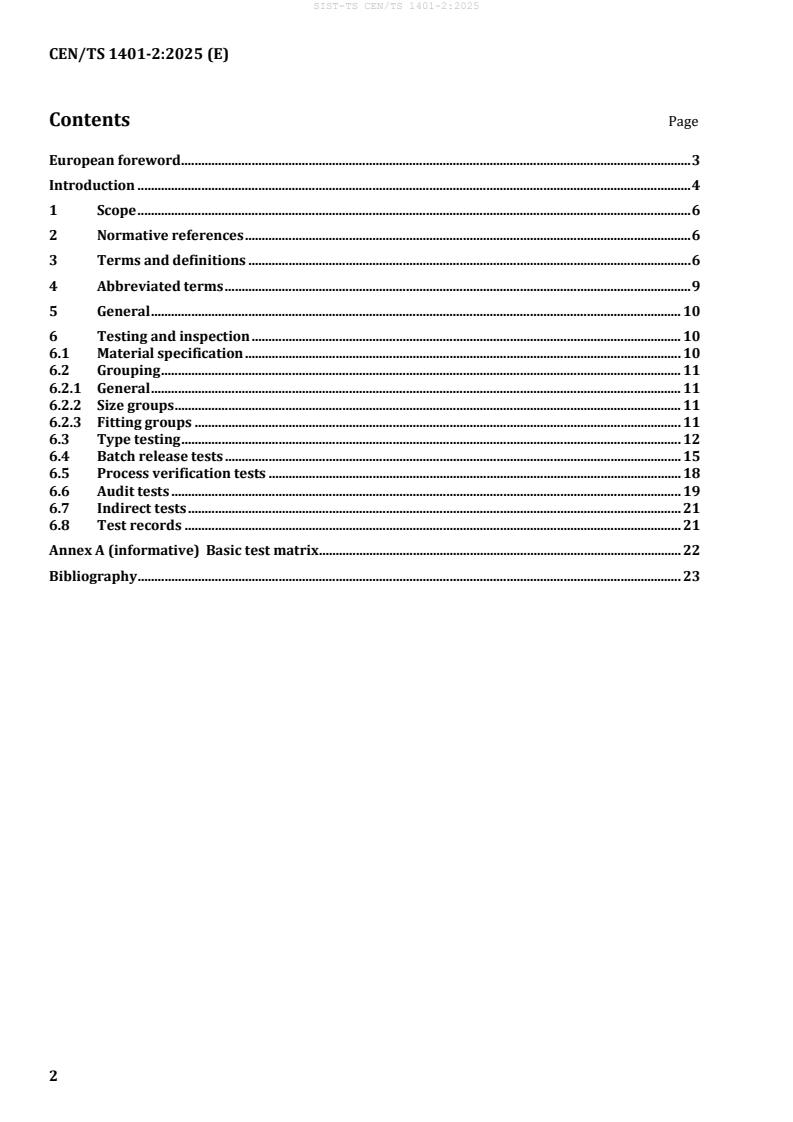
Contents Page
European foreword . 3
Introduction . 4
1 Scope . 6
2 Normative references . 6
3 Terms and definitions . 6
4 Abbreviated terms . 9
5 General . 10
6 Testing and inspection . 10
6.1 Material specification . 10
6.2 Grouping . 11
6.2.1 General . 11
6.2.2 Size groups . 11
6.2.3 Fitting groups . 11
6.3 Type testing . 12
6.4 Batch release tests . 15
6.5 Process verification tests . 18
6.6 Audit tests . 19
6.7 Indirect tests . 21
6.8 Test records . 21
Annex A (informative) Basic test matrix . 22
Bibliography . 23
European foreword
This document (CEN/TS 1401-2:2025) has been prepared by Technical Committee CEN/TC 155 “Plastics
piping systems and ducting systems”, the secretariat of which is held by NEN.
Attention is drawn to the possibility that some of the elements of this document may be the subject of
patent rights. CEN shall not be held responsible for identifying any or all such patent rights.
This document supersedes CEN/TS 1401-2:2020.
Compared with CEN/TS 1401-2:2020 the following changes have been made:
— Update of normative references to EN 1401-1:2019+A1:2023
The EN 1401 series, Plastics piping systems for non-pressure underground drainage and sewerage —
Unplasticized poly(vinyl chloride) (PVC-U), consists of the following Parts:
— Part 1: Specifications for pipes, fittings and the system;
— Part 2: Guidance for the assessment of conformity.
Any feedback and questions on this document should be directed to the users’ national standards body.
A complete listing of these bodies can be found on the CEN website.
According to the CEN/CENELEC Internal Regulations, the national standards organisations of the
following countries are bound to announce this Technical Specification: Austria, Belgium, Bulgaria,
Croatia, Cyprus, Czech Republic, Denmark, Estonia, Finland, France, Germany, Greece, Hungary, Iceland,
Ireland, Italy, Latvia, Lithuania, Luxembourg, Malta, Netherlands, Norway, Poland, Portugal, Republic of
North Macedonia, Romania, Serbia, Slovakia, Slovenia, Spain, Sweden, Switzerland, Türkiye and the
United Kingdom.
Introduction
This revision of the EN 1401 series is proposed in order to improve the 'level of sustainability' and the
'environmental impact' of PVC piping systems, whilst improving the recommendations and safe use of
recycled material. Recycled material is categorized as non-virgin material in this document.
Regarding this specific target, more focus was given to the control of applied material formulation and to
the final characteristics and performance of products.
This document is based on the template prepared in CEN/TC 155/WG21 version V.5.
Figures 1 and 2 are intended to provide general information on the concept of testing and organization
of those tests used for the purpose of the assessment of conformity. This document details the applicable
characteristics to be assessed as well as the frequency and sampling of testing for each type of test, i.e.
type testing (TT), batch release test (BRT), process verification test (PVT) and audit test (AT).
A typical scheme for the assessment of conformity of formulations pipes, fittings, assemblies by
manufacturers is given in Figure 1.
Figure 1 — Typical scheme for the assessment of conformity by a manufacturer
A typical scheme for the assessment of conformity of formulations, pipes, fittings, assemblies by
manufacturers, including a third-party certification, is given in Figure 2.
Figure 2 — Typical scheme for the assessment of conformity by a manufacturer, including a
third party certification
1 Scope
This document gives requirements and guidance for the assessment of conformity of formulations,
products and assemblies in accordance with EN 1401-1 intended to be included in the manufacturer’s
quality plan as part of the quality management system and for the establishment of third-party
certification procedures.
NOTE 1 The quality management system is expected to conform to or is no less stringent than the relevant
requirements to EN ISO 9001 [1].
NOTE 2 If third party certification is involved, the certification body is expected to be compliant with either
EN ISO/IEC 17065 [2] or EN ISO/IEC 17021 series [3], as applicable.
NOTE 3 In order to help the reader, a basic test matrix is given in Annex A.
In conjunction with EN 1401-1, this document is applicable to piping systems made of unplasticized
poly(vinyl chloride) (PVC-U) intended for non-pressure underground drainage and sewerage:
— buried in ground outside the building structure (application area code “U”);
— both buried in ground within the building structure and outside the building structure (application
area code “UD”).
2 Normative references
The following documents are referred to in the text in such a way that some or all of their content
constitutes requirements of this document. For dated references, only the edition cited applies. For
undated references, the latest edition of the referenced document (including any amendments) applies.
EN 1401-1:2019+A1:2023, Plastics piping systems for non-pressure underground drainage and sewerage
— Unplasticized poly(vinyl chloride) (PVC-U) — Part 1: Specifications for pipes, fittings and the system
3 Terms and definitions
For the purposes of this document, the terms and definitions given in EN 1401-1 and the following apply.
ISO and IEC maintain terminology databases for use in standardization at the following addresses:
— ISO Online browsing platform: available at https://www.iso.org/obp
— IEC Electropedia: available at https://www.electropedia.org/
3.1
certification body
impartial body, governmental or non-governmental, possessing the necessary competence and
responsibility to carry out certification of conformity according to given rules of procedure and
management
Note 1 to entry: A certification body is preferably compliant with EN ISO/IEC 17065 [2].
3.2
inspection body
body, that performs inspection
Note 1 to entry: An inspection body can be an organization or a part of an organization.
Note 2 to entry: An inspection body is preferably compliant with EN ISO/IEC 17020 [4].
3.3
testing laboratory
laboratory which measures, tests, calibrates or otherwise determines the characteristics of the
performance of materials and products
Note 1 to entry: In the context of this document, the materials and products can be subjected to type testing, batch
release testing, process verification testing, audit testing and/or witness testing, as applicable.
Note 2 to entry: A testing laboratory is preferably compliant with EN ISO/IEC 17025 [5].
3.4
quality management system
part of a management system with regard to quality
Note 1 to entry: Requirements for quality management systems are given in EN ISO 9001 [1].
[SOURCE: EN ISO 9000:2015 [6], definition 3.5.4]
3.5
quality plan
document setting out the specific quality practices, resources and sequence of activities relevant to a
particular product or range of products
3.6
type testing
TT
testing performed to prove that the formulation, product, joint or assembly is capable of conforming to
the requirements given in the relevant standard
Note 1 to entry: The type test results remain valid until there is a change in the formulation or product or
assembly provided that the process verification tests are done regularly.
3.7
batch release test
BRT
test performed by or on behalf of the manufacturer on a batch of materials or products, which has to be
satisfactorily completed before the batch can be released
3.8
process verification test
PVT
test performed by or on behalf of the manufacturer on formulation, products, joints or assemblies at
specific intervals to confirm that the process continues to be capable of producing products which
conform to the requirements given in the relevant standard
Note 1 to entry: Such tests are not required to release batches of formulation or products; but they are carried
out as a measure of process control.
3.9
audit test
AT
test performed by a test laboratory on behalf of an inspection body or certification body to confirm that
the formulation, product, joint or assembly continues to conform to the requirements given in the
relevant standard and to provide information to assess the effectiveness of the quality management
system
3.10
indirect test
IT
test performed by or on behalf of the manufacturer, different from that specified test for that particular
characteristic, having previously verified its correlation with the specified test
3.11
witness test
WT
test accepted by an inspection or a certification body for type testing and/or audit testing, which is carried
out by or on behalf of the manufacturer and supervised by a representative of the inspection or
certification body, qualified in testing
3.12
material
generic term for formulations grouped by families, expressed by generic names, e.g. poly(vinyl chloride),
stainless steel, brass or EPDM
3.13
formulation
clearly defined homogenous mixture of base polymer with additives, i.e. anti-oxidants, pigments,
stabilizers and others, at a dosage level necessary for the processing and the intended use of the final
product
Note 1 to entry: The term “compound” is sometime used with similar meaning as “formulation”.
Note 2 to entry: A formulation may contain virgin and/or non-virgin material.
3.14
material batch
clearly identified quantity of a given homogeneous formulation manufactured under uniform conditions
and defined and identified by the formulation manufacturer
3.15
product
pipe or fitting of a clearly identified type intended to be a part of a piping system which the manufacturer
puts on the market
3.16
product batch
clearly identified collection of products, manufactured consecutively or continuously under the same
conditions, using the same formulation conforming to the same specification
Note 1 to entry: The production batch is defined and identified by the product manufacturer.
3.17
sample
one or more products drawn from the same production batch, selected at random without regard to their
quality
Note 1 to entry: The number of products in the sample is the sample size.
3.18
group
defined collection of similar products from which samples are selected for testing purposes
Note 1 to entry: Similar products may have different shapes or diameter or functions (see Table 3 and Table 4).
3.19
component
product manufactured out of a specific formulation, brought to the market as part of another product or
as a spare part
3.20
joint
connection between two products
3.21
assembly
product that can be dismantled into a set of components
3.22
cavity
part of the injection mould which gives the form to the injection moulded product
4 Abbreviated terms
To avoid misunderstanding, the abbreviations in this Clause are defined as being the same in each
language. For the same reason, the terms are given in the three languages, English, French and German.
EN FR DE
AT audit test essai d’audit Überwachungsprüfung
BRT batch release test essai de libération de campagne de Freigabeprüfung einer Charge
fabrication
IT indirect test essai indirect indirekte Prüfung
PVT process verification test essai de vérification du procédé de Prozessüberprüfung
fabrication
TT type testing essai de type Typprüfung
WT witness test essai en présence de témoin Prüfung unter Aufsicht
5 General
Formulations, products, joints and assemblies shall conform to the requirements given in EN 1401-1.
Products shall be produced by the manufacturer under a quality management system which includes a
quality plan (including specifications on joints and assemblies).
NOTE It is expected that the quality management system conforms to or is no less stringent than the relevant
requirements in EN ISO 9001 [1].
6 Testing and inspection
6.1 Material specification
For the purposes of this document, the material specification consists of a formulation which defines PVC
resin, additives, non-virgin material (if applicable) and their dosage levels.
The dosage level of ingredients of a formulation shall not exceed the tolerances given in Table 1. If any
dosage level exceeds the tolerance or if a type is changed, this variation constitutes a change in material
(it is referred to as “M” in Tables 4 to 6).
In Table 1, the values of the parts X added to 100 parts by mass of PVC shall be specified by the
manufacturer in the quality plan.
Table 1 — Formulation tolerances
a
Ingredients Type Tolerance
Virgin part of the formulation
PVC resin Nominal k-value as specified by ±3 units
the manufacturer
Type of stabilizer or master 1) OBS (Organic Based X : ± 25 %
batch Stabilizers)
2) Ca-Zn
3) Sn
4) Ca-Sn
5) Others
Lubricants for X ≤ 0,2: X : ± 50 %
2 2
All
for X > 0,2: X : ± 0,1 phr
2 2
Fillers 1) CaCO X : ± 3 phr
3 3
2) Others X : ± 25 %
Impact modifiers All X : ± 1 phr
Flow agents for X ≤ 2: X : ± 25 %
6 6
All
for X > 2: X : ± 0,5 phr
6 6
Pigments No requirement -
a
Ingredients Type Tolerance
Non-virgin part of the formulation
b c
Own reprocessed material No requirement ≤ X
c
External reprocessed and/or See EN 1401-1:2019+A1:2023, ≤ X
recycled material with a Table A.1
defined agreed specification
NOTE A change of the supplier does not necessarily constitute a change in formulation.
a
phr means parts per hundred resin.
b
The manufacturer quality plan shall allow the source and content of own reprocessed material in the
formulation to be demonstrated.
c
X and X shall not exceed the declared values as required in EN 1401-1:2019+A1:2023, Clause A.1,
7 8
which means that a lower content of own reprocessed and external reprocessed and/or recycled material in
the formulation which has already been Type Tested and which is fulfilling the agreed specification is not
considered as a material change.
6.2 Grouping
6.2.1 General
For the purposes of this document, the groups specified in 6.2.2 and 6.2.3 apply.
6.2.2 Size groups
Three size groups are defined for pipes and fittings, as given in Table 2.
For testing purposes, one individual nominal diameter, d , shall be selected from each group.
n
Table 2 — Size groups
Size group Nominal outside diameter
d
n
mm
1 d ≤ 200
n
2 200 < d ≤ 500
n
3 500 < d ≤ 1 000
n
6.2.3 Fitting groups
Fittings having a similar design are divided into three groups, as given in Table 3.
For testing purposes, one individual fitting shall be selected from each group.
Table 3 — Fitting groups
Fitting group Type of fitting
1 Bends
2 Branches
3 Other fittings
6.3 Type test
...