

EN 15380-4:2013
(Main)Railway applications - Classification system for railway vehicles - Part 4: Function groups
- Abstract
This European Standard is concerned with the functions associated with general railway vehicles or their assemblies. It covers functionality associated with systems and equipment such as wheelsets and bogies, doors, brakes and traction.
This standard may also be applied to railway vehicles with very specific functions like track machines and snow ploughs. However, while the functions that are common with general railway vehicles are included, the functions which are specific to their work processes are not included in this standard. They will be added for these individual projects.
- Status
- Published
- Publication Date
- 08-Jan-2013
- Technical Committee
- CEN/TC 256 - Railway applications
- Drafting Committee
- CEN/TC 256/WG 19 - Technical drawings
- Current Stage
- 9060 - Closure of 2 Year Review Enquiry - Review Enquiry
- Start Date
- 03-Mar-2024
- Completion Date
- 03-Mar-2024

Overview
EN 15380-4:2013 - "Railway applications - Classification system for railway vehicles - Part 4: Function groups" (CEN) defines a standardized Functional Breakdown Structure (FBS) for railway vehicles and their assemblies. The standard describes functions associated with general rolling stock - e.g., wheelsets and bogies, doors, brakes, traction - and provides a hierarchical classification of function groups (levels 1–5), transverse functions, and code-letter designations to support consistent specification, validation and communication across the vehicle life cycle.
Key topics and requirements
- Functional Breakdown Structure (FBS): a hierarchical set of functions (1st to 5th level) that describes vehicle behaviour and services without prescribing physical implementation.
- Function levels: definitions and rules for assigning functions to 1st (general domain) through 5th (activities) levels; level definitions and levelling rules are included.
- Transverse functions: functions that apply across multiple higher-level groups (e.g., diagnostics, displays) and how they are levelling.
- Code letters and notation: system of code letters used to identify function groups from first to third level and to indicate function groupings in documentation.
- Function-to-product mapping: guidance on interrelation between the FBS and the Product Breakdown Structure (PBS) from EN 15380-2 to correlate functional requirements with subsystems and components.
- Documentation and annexes: informative annexes provide examples for level 4/5 functions, rules for function naming, and classification of detail properties (reliability, availability, performance, etc.).
- Scope constraint: applies to general rolling stock and common functions of specialized machines (track machines, snow ploughs); project-specific operational functions for specialized work processes are excluded and added per project.
Practical applications
- Use in early concept and specification phases to capture functional requirements and use cases before physical design decisions.
- Supports RAMS/LCC (Reliability, Availability, Maintainability, Safety / Life‑Cycle Cost) analyses by providing a consistent functional structure for failure modes, diagnostics and maintenance planning.
- Facilitates interoperable system requirements, testing, validation and traceability between functions and physical subsystems.
- Helps suppliers, integrators and operators align on requirements for subsystems such as doors, brakes, traction, bogies and wheelsets.
- Useful for drafting specifications, maintenance programmes, inspection criteria and recording operational events (protocols/alarms).
Who should use it
- Rolling stock designers and system engineers
- Vehicle integrators and subsystem suppliers
- RAMS/LCC analysts, safety engineers and maintainers
- Procurement teams and technical writers specifying functional requirements
- Authorities and organisations adopting CEN standards
Related standards
- EN 15380 series (Parts 1–5) - complementary parts covering general principles, product groups (EN 15380-2), installation sites and systems.
- EN 15663 (referenced) and other normative references cited in EN 15380-4 for specific definitions and terms.
Using EN 15380-4:2013 ensures consistent, traceable functional classification across rolling stock projects, improving communication, safety analysis and lifecycle planning.
Relations
- Effective Date
- 28-Jan-2026
Get Certified
Connect with accredited certification bodies for this standard

IRIS Certification (UNIFE)
International Railway Industry Standard certification.

TÜV SÜD Rail GmbH
TÜV SÜD railway certification services.

Bureau Veritas Railway Certification
Railway and transportation certification.
Sponsored listings
Frequently Asked Questions
EN 15380-4:2013 is a standard published by the European Committee for Standardization (CEN). Its full title is "Railway applications - Classification system for railway vehicles - Part 4: Function groups". This standard covers: This European Standard is concerned with the functions associated with general railway vehicles or their assemblies. It covers functionality associated with systems and equipment such as wheelsets and bogies, doors, brakes and traction. This standard may also be applied to railway vehicles with very specific functions like track machines and snow ploughs. However, while the functions that are common with general railway vehicles are included, the functions which are specific to their work processes are not included in this standard. They will be added for these individual projects.
This European Standard is concerned with the functions associated with general railway vehicles or their assemblies. It covers functionality associated with systems and equipment such as wheelsets and bogies, doors, brakes and traction. This standard may also be applied to railway vehicles with very specific functions like track machines and snow ploughs. However, while the functions that are common with general railway vehicles are included, the functions which are specific to their work processes are not included in this standard. They will be added for these individual projects.
EN 15380-4:2013 is classified under the following ICS (International Classification for Standards) categories: 01.110 - Technical product documentation; 45.060.01 - Railway rolling stock in general. The ICS classification helps identify the subject area and facilitates finding related standards.
EN 15380-4:2013 has the following relationships with other standards: It is inter standard links to EN 15663:2017+A2:2024. Understanding these relationships helps ensure you are using the most current and applicable version of the standard.
EN 15380-4:2013 is associated with the following European legislation: EU Directives/Regulations: 2001/16/EC, 2008/57/EC, 96/48/EC; Standardization Mandates: M/275, M/334, M/483. When a standard is cited in the Official Journal of the European Union, products manufactured in conformity with it benefit from a presumption of conformity with the essential requirements of the corresponding EU directive or regulation.
EN 15380-4:2013 is available in PDF format for immediate download after purchase. The document can be added to your cart and obtained through the secure checkout process. Digital delivery ensures instant access to the complete standard document.
Standards Content (Sample)
2003-01.Slovenski inštitut za standardizacijo. Razmnoževanje celote ali delov tega standarda ni dovoljeno.VNXSLQHBahnanwendungen - Kennzeichnungssystematik für Schienenfahrzeuge - Teil 4: FunktionsgruppenApplications ferroviaires - Système de classification pour véhicules ferroviaires - Partie 4: Groupes des fonctionsRailway applications - Classification system for railway vehicles - Part 4: Function groups45.060.01Železniška vozila na splošnoRailway rolling stock in general01.110L]GHONHTechnical product documentationICS:Ta slovenski standard je istoveten z:EN 15380-4:2013SIST EN 15380-4:2014en,fr,de01-april-2014SIST EN 15380-4:2014SLOVENSKI
STANDARD
EUROPEAN STANDARD NORME EUROPÉENNE EUROPÄISCHE NORM
EN 15380-4
January 2013 ICS 01.110; 45.060.01 English Version
Railway applications - Classification system for railway vehicles -Part 4: Function groups
Applications ferroviaires - Système de classification pour véhicules ferroviaires - Partie 4: Groupes des fonctions
Bahnanwendungen - Kennzeichnungssystematik für Schienenfahrzeuge - Teil 4: Funktionsgruppen This European Standard was approved by CEN on 3 November 2012.
CEN members are bound to comply with the CEN/CENELEC Internal Regulations which stipulate the conditions for giving this European Standard the status of a national standard without any alteration. Up-to-date lists and bibliographical references concerning such national standards may be obtained on application to the CEN-CENELEC Management Centre or to any CEN member.
This European Standard exists in three official versions (English, French, German). A version in any other language made by translation under the responsibility of a CEN member into its own language and notified to the CEN-CENELEC Management Centre has the same status as the official versions.
CEN members are the national standards bodies of Austria, Belgium, Bulgaria, Croatia, Cyprus, Czech Republic, Denmark, Estonia, Finland, Former Yugoslav Republic of Macedonia, France, Germany, Greece, Hungary, Iceland, Ireland, Italy, Latvia, Lithuania, Luxembourg, Malta, Netherlands, Norway, Poland, Portugal, Romania, Slovakia, Slovenia, Spain, Sweden, Switzerland, Turkey and United Kingdom.
EUROPEAN COMMITTEE FOR STANDARDIZATION
COMITÉ EUROPÉEN DE NORMALISATION EUROPÄISCHES KOMITEE FÜR NORMUNG
Management Centre:
Avenue Marnix 17,
B-1000 Brussels © 2013 CEN All rights of exploitation in any form and by any means reserved worldwide for CEN national Members. Ref. No. EN 15380-4:2013: ESIST EN 15380-4:2014
Functions on level 4 and level 5 . 40Annex B (informative)
Interrelation between EN 15380-2 and EN 15380-4 . 65Annex C (informative)
Code letters used to designate detail properties . 67Annex D (informative)
Rules to define the function level . 70Annex E (informative)
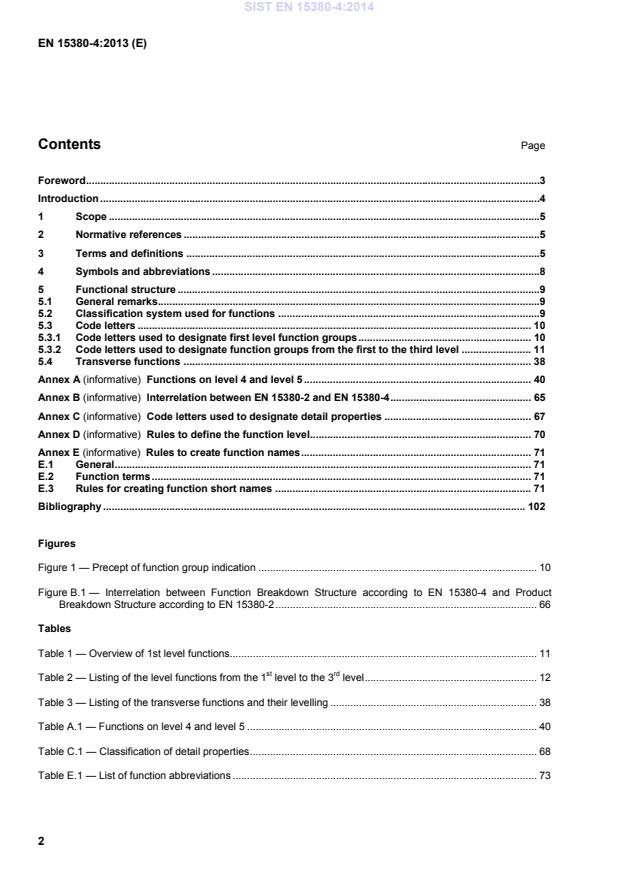
Rules to create function names . 71E.1 General . 71E.2 Function terms . 71E.3 Rules for creating function short names . 71Bibliography . 102 Figures Figure 1 — Precept of function group indication . 10 Figure B.1 — Interrelation between Function Breakdown Structure according to EN 15380-4 and Product Breakdown Structure according to EN 15380-2 . 66 Tables Table 1 — Overview of 1st level functions. 11 Table 2 — Listing of the level functions from the 1st level to the 3rd level . 12 Table 3 — Listing of the transverse functions and their levelling . 38 Table A.1 — Functions on level 4 and level 5 . 40 Table C.1 — Classification of detail properties . 68 Table E.1 — List of function abbreviations . 73 SIST EN 15380-4:2014
Function groups (the present document); Part 5: Systems, System groups — System requirements. According to the CEN/CENELEC Internal Regulations, the national standards organisations of the following countries are bound to implement this European Standard: Austria, Belgium, Bulgaria, Croatia, Cyprus, Czech Republic, Denmark, Estonia, Finland, Former Yugoslav Republic of Macedonia, France, Germany, Greece, Hungary, Iceland, Ireland, Italy, Latvia, Lithuania, Luxembourg, Malta, Netherlands, Norway, Poland, Portugal, Romania, Slovakia, Slovenia, Spain, Sweden, Switzerland, Turkey and the United Kingdom. SIST EN 15380-4:2014
sub function which may apply to more than one higher level function
Note 1 to entry: For example, providing diagnostics or displaying information. 3.3 Functional Breakdown Structure (FBS) hierarchical structure summarising a set of functions leading to the same general focus or service Note 1 to entry: To define the level of a function within a FBS, see Clause 5. 3.4 function level level of group functions of equal purpose Note 1 to entry: Assignment to the appropriate level is described in the rules. 3.4.1 1st level function functional domain or general focus or service for the considered (rolling stock) system SIST EN 15380-4:2014
Note 1 to entry: Functional requirements and use cases first come from passenger/payload and operator requests. Later in the engineering process, functional requirements from integrators and suppliers are added. They express the requirements on a certain functionality given in the FBS regarding interoperability (with other functions), safety, operation, function/behaviour, or functional architecture/design constraints.
The functional designation is usually stated more precisely by detail properties (see also Annex D) that provide more information referring to reliability, availability, performance, quality, documentation, input, output, realtime.
3.5.2 system requirement requirement on a subsystem or device
Note 1 to entry: Requirement on a subsystem or device regarding the requested technical capability, reliability, availability, maintainability, environmental impact/conditions (recyclables, emissions, EMC, climate, vibration), safety, LCC, performance, quality, documentation, realtime behaviour, physical limits (dimension, weight), electrical interface (plugs, voltage, physical layer), or mechanical interface (fixing points, fixing method). 3.6 scenario possible transient, unsteady or steady states of the regarded system or of system-user interaction including environmental or other influences Note 1 to entry: Operational and environmental conditions under which the system is intended to or actually functions. 3.7 use case summary of scenarios for a single task or goal from the view of an exterior observer under defined conditions 3.8 object (unit of observation) component, element, device, subsystem, functional unit, operating medium or system that can be observed in its own right [SOURCE: EN 15380-2:2006] 3.9 error deviation from the intended design which could result in unintended system behaviour or failure [SOURCE: EN 50129:2003] Note 1 to entry: An error needs corrective action. It is caused by defect component and can be displayed to the driver or workshop. An error can lead to a failure. Note 2 to entry: An error also is a discrepancy between a computed, observed or measured value or condition and the true, specified or theoretically correct value or condition, e.g. a computing error made by faulty computer equipment. 3.10 fault abnormal condition which could lead to an error in the system
Note 1 to entry: A fault can be random or systematic. [SOURCE: EN 50129:2003, modified] 3.11 failure deviation from the specified performance of a system [SOURCE: EN 50129:2003] Note 1 to entry: A failure also is a deviation from specified performance of a function. SIST EN 15380-4:2014
Note 2 to entry: "Man" in this specific context means passenger, train crew or maybe control operator. 3.16 elementary function basic function which cannot be sub-divided Note 1 to entry: An elementary function is not specific to a particular rail vehicle. 3.17 function carrier physical unit of observation to fulfil or partly fulfil one or more required functions Note 1 to entry: Function carriers need to be considered as black box while describing the function. 4 Symbols and abbreviations FBS
Functional Breakdown Structure FRS Functional Requirement Specification HMI
Human-Machine-Interface PBS Product Breakdown Structure RAMS Reliability, Availability, Maintainability and Safety ATC Automatic Train Control ATO Automatic Train Operation ATP
Automatic Train Protection DC
Direct Current SIST EN 15380-4:2014
General remarks The hierarchy of the functional groups serves as a guideline when creating functional structures. Functions are realised at the technical level as hardware and software within hierarchically structured units. Although the units interact at the functional level, they may be spatially separated from one another. Expanding the functions, elementary functions and characteristic features is possible within the scope of this standard. Whether it is necessary to make use of this option will depend on the specific application being considered.
Changing the existing functional levels shall be avoided.
Functional units can be associated with several functions. A single function can be distributed over several functional units. The FBS is organised in such a way that the whole driver interface functionality is described under HE "Allow proper control". This driver interface functionality does not contain any control functionality itself. It only provides information to the driver, including the status signals from other functionalities. 5.2
Classification system used for functions Functions are designated using letters of the alphabet only, as set out in Table 1, Table 2 and Table 3. The use of the letters I and O, as well as special characters and separators, have not been used. The first level functions, functions on lower levels and transverse functions are coded in their respective levels using a single letter. If transverse functions are applicable for each function several lines with related transverse function can be added in following way = AAAAA.TTT, AAAAA.TTT, where AAA is the identifier for FBS and TTT is the identifier for transverse function found in Table 3. If a transverse function is not used the identifier for FBS is = AAAAA. The classification systems can be used either in whole or in part. As a minimum it is recommended to use it from level 1 to level 5. SIST EN 15380-4:2014
Key 1 sign ”function“ according to EN 81346-1 2 level 1 function according to 5.3.1 3 level 2 function according to 5.3.2 4 level 3 function according to 5.3.2 5 level 4 function according to Annex A 6 level 5 function according to Annex A 7 seperator between function and transverse function 8 level 1 transverse function according to 5.4 9 level 2 transverse function according to 5.4 10 level 3 transverse function according to 5.4 Figure 1 — Precept of function group indication 5.3 Code letters 5.3.1 Code letters used to designate 1st level function groups
The first level functions are specified using the letters as listed in Table 1. SIST EN 15380-4:2014
5.3.2 Code letters used to designate function groups from the 1st to the 3rd level The functions and function levels are specified using the letters as shown in Table 2. SIST EN 15380-4:2014
B
Carry and protect passengers, train crew and load ride comfort is not considered here; the load shall be defined according to design mass calculation in EN 15663 B B
Arrange interior space
interior design B B B
Provide floor and flooring non slip floor covering B B C
Provide roof and roofing
B B D
Provide partitioning interior and exterior walls or screens, interior doors B B E
Provide lining and panelling ceilings and wall coverings B B F
Provide acoustic/thermal insulation
B B G
Provide luggage storage space in the vehicle space for hand luggage, travel luggage, bicycles, prams and pushchairs and cloakroom facilities B B H
Carry and secure accompanying object luggage racks, cycle rack stands, lockers B B J
Provide access to upper levels and user zones staircases B C
Carry and enclose the load (including people and equipment) B C B
Fasten equipment / load attachments B C C
Enclose the load encase the load to be transported B C D
Carry and Protect the load carbody structure to support normal structural loadsB C E
Protect installed equipment / components
B D
Protect in case of crash
B D B
Absorb crash energy energy dissipation in vehicle structure, crash safety B D C
Protect driver, crew and passengers inside their compartments
against intrusions, against pitch on the desk, against structural deformations B D D
Limit deceleration
B D E
Prevent vehicle override equipment to prevent vehicle override during head-on collisions B E
Protect against fire
B E B
Manage / Provide smoke detection by smoke detectors B E C
Manage / Provide fire detection
B E D
Manage signalling of fire management of fire alert (system), fire warning (system), notification of fire B E E a Manage / Provide fire extinguishment
B E E a Manage automatical fire extinguish system
B E E a Monitor volume of extinguishing agent
B E E a Provide manual fire extinguish facilities
C
Provide appropriate conditions to passenger, train crew and load includes equipment for service, comfort and climatisation; the load shall be defined according to design mass calculation in EN 15663 C B
Provide safe and comfortable sitting, lying and standing positions seats, couchettes, measures taken to ensure safe standing room C B B
Provide support for standing support straps, handles and rails, occupant restraint systems C B C a Provide seating possibilities seats, benches, stools C B C a Provide ergonomic seating conditions
C B C a Provide adjustments of position
C B C a Provide storage space in the back of the seat
C B C a Provide tables
C B D a Provide lying possibilities
C B D a Provide ergonomic lying conditions
C B D a Provide adjustments of lying positions
C B D a Provide storage space at the table position
C C
Provide external view
C C B a Ensure outside passenger view
by windows C C B a Ensure outside view
C C B a Protect passenger against sun
C C C a Provide external view for train operation by outside mirror or cameras (in any weather / light conditions) C C C a Clean the windscreen
C C C a Defrost the windscreen
C C C a Protect against blinding
C C C a Avoid condensation
C C C a Provide rear view
C C C a Provide view in the darkness by illumination of the track and reflective signals by headlights C D
Provide interior lighting
C D B a Provide workplace lighting
C D B a Provide desk lighting
C D B a Provide timetable lighting
C D B a Provide "background" lighting
C D C a Provide common interior lighting
C D C a Provide interior standard lighting
C D C a Provide reduced mode lighting
C D C a Provide atmosphere lighting
C D D a Provide emergency lighting
C D D a Provide guidance to exit
C D D a Provide backup lighting
C D E a Provide special/individual lighting
C D E a Provide reading lighting lighting at the seat C D E a Provide working lighting
C D E a Provide sanitary (make-up) lighting
C D E a Provide advertisment lighting
C E
Provide proper climate
C E B a Manage HVAC mode
C E B a Manage HVAC Automatic mode
C E B a Manage HVAC Fire outside mode
C E B a Manage HVAC Pressure protection mode
C E B a Manage HVAC Frost protection mode
C E B a Manage HVAC Recirculation mode
C E B a Manage HVAC Platform mode
C E B a Manage HVAC Cool keeping mode
C E B a Manage HVAC Warm keeping mode
C E B a Manage HVAC Pre-conditioning mode
C E B a Manage HVAC Washing mode
C E B a Manage HVAC Flush mode
C E B a Manage HVAC Fire inside mode
C E C a Supply the desired temperature
C E C a Provide adjustment of desired temperature
C E C a Heat the air
C E C a Cool the air
C E D a Supply the desired air flow
C E D a Distribute the air
C E D a Provide adjustments for individual airflow
C E D a Treat air quality / filter the air
C E D a Provide emergency ventilation
C E D a Ensure cab clear front window (by airflow)
C E E a Supply the desired humidity
C E E a Moisture the air
C E E a Dry the air
C E F a Supply clean fresh air
C E F a Filter the air from outside
C E F a Supply with fresh air
C E F a Exhaust air
C E F a Provide possibility to open windows
C E G a Protect against pressure waves
C E G a Provide active sealing
C E G a Provide passive sealing
C E H
Signal inside and outside temperature
C F
Provide public address, passenger information, intercommunication and entertainment
C F B
Manage priority of information and announcements
C F C a Provide Public Address
C F C a Provide manual public address
C F C a Provide public address from the crew
C F C a Provide public address from the control centre
C F C a Provide automatic public address
C F C a Provide selective address to internal zone or train
C F C a Provide selective address to external zone
C F D a Manage emergency alarm from passengers
C F D a Manage passenger emergency request
C F D a Manage toilet emergency request
C F D a Manage other emergency request
C F E a Provide passenger information
C F E a Provide travel assistance
C F E a Provide dynamic train connection info
C F E a Provide comfort info
C F E a Provide tourist info
C F E a Provide route information
C F E a Select route
C F E a Upload route
C F E a Upload route manually
C F E a Adjust route manually
C F E a Display route information
C F E a Announcement silent forward
C F E a Announcement silent backwards
C F F a Provide intercom
C F F a Provide intercom between driver cabs
C F F a Provide passenger emergency intercommunication
C F G a Provide seat reservation
C F G a Enter seat information
C F G a Read seat information data medium
C F G a Enter seat information manually
C F G a Display seat information in passenger compartment SIST EN 15380-4:2014
C F H a Provide and support multimedia for passenger entertainment
C F H a Provide content sources
C F H a Manage and distribute multimedia information
C F H a Provide interfaces to passengers
C F J
Support and provide external multimedia communication
C G
Provide surveillance (for passenger or load)
C G B
Manage surveillance sources
C G C a Collect surveillance information
C G C a Collect surveillance mode in normal conditions
C G C a Enhance surveillance data aquisition
C G D
Analyse surveillance functions
C G E a Display surveillance information
C G E a Display operator selected source
C G E a Display source of triggered alarm
C G E a Scroll manually or automatically between display sources
C G F a Record surveillance information
C G F a Record surveillance information in normal mode
C G F a Manage overfill of storage capacity
C G F a Download locally or remotely surveillance data
C H
Provide sanitary services
C H B a Manage sanitary system
C H B a Control toilet door
C H B a Indicate toilet occupied status
C H B a Toilet service request
C H B a Open / close / lock function (UWC)
C H C a Provide fresh water
C H C a Supply and store fresh water
C H C a Indicate fresh water level
C H C a Distribute fresh water
C H D a Collect and dispose waste water
C H D a collect waste water
C H D a Store waste water
C H D a Indicate waste water level
C H D a Dispose of waste water
C H E a Collect and dispose grey water
C H E a Collect grey water
C H E a Store grey water
C H E a Indicate grey water level
C H E a Dispose of grey water
C H G a Provide antifreeze protection
C H G a Heat plumbing and tanks
C H G a Drain plumbing and tanks
C H H a Provide hygiene for baby and individual hygienics C H H a Provide baby care facilities
C H H a Provide waste disposal
C H H a Provide make-up facilities
C H H a Provide assistance to handicapped
C J
Provide catering
C J B a Provide proper environment for catering
C J B a Provide hygienic "working space"
C J B a Provide cleaning facilities
C J B a Provide water and dispose greywater
C J B a Collect and dispose waste
C J B a Provide exhaust auxiliaries
C J C a Store drinks and food
C J C a Provide space
C J C a Provide cooling / freezing
C J D
Provide marketing, service and payment facilities
C J E
Prepare drinks and food equipment to prepare food and drinks C J F a Serve drinks and food service equipment C J F a Serve drinks and food in the restaurant coach
C J F a Provide mobile catering services
C K
Provide additional service related functions
C K B a Provide ticketing
C K B a Sell ticket
C K B a Provide timetable and price info
C K B a Select ticket
C K B a Provide online accounting
C K B a Print ticket
C K B a Punch ticket
C K C a Provide miscellaneous service functions
C K C a Provide automatic vending of goods and services
C K D
Count passengers
C L
Provide ride comfort control carbody accelerations C L B
Control carbody x-acceleration
by buffers and link to brake and propulsion control C L C
Control carbody y-acceleration e. g. tilting and suspension C L C a Tilt the vehicle
including pantograph guiding while tilting
D
Provide access and loading
D B
Provide external access functions associated with the management of the external doors D B B a Release external doors
enable the doors to be opened by passengers D B B a Release external door by driver authorise the opening on the left or right side of the door by a command of the driver D B B a Release external doors by beacon/ATC train level command of the doors by a beacon: D B B a Enable release external doors velocity of vehicle shall be lower than … (5) km/h, for door release D B B a Cancel release external doors
D B B a Indicate external doors released indications to the driver in the cab and to the passengers in the coach D B C a Open external doors use of a handle or push button by a passenger to make the door open D B C a Open external doors by local control (mechanical handle or push button) mechanical lever with cutout for drive and door control, but registering opening and derive signal to train control to start emergency brake
D B C a Open external doors following driver or crew activation to start opening system, door drive D B C a Open external doors automatically opening order coming from atc D B C a Open external doors by actuating ramp after special demand via special signal button, acting after actuating button or key switch, special sequence D B C a Open external doors by actuating lift after special demand via signal button, acting after actuating button or key switch, special sequence D B C a Enable selective external door opening in order to make unaccessible some vehicles of the train D B D a Close external doors command lock of doors 2 sides; command a sound signalling before the lock of doors D B D a Close external doors automatically close doors automatically if no person is moving within defined time, using light barier, movement detector necessary preconditions: - cancel of door open enable by driver or crew a) by driver - doors close if no passenger movement within 3 s b) by staff - doors close if staff cancels enable
- local automatic close
closing of doors by ATC command D B D a Close the external doors upon exceeding a speed threshold
D B D a Enable selective external door closing
D B D a Close external doors by driver or the staff command D B D a Close external doors by passenger request
D B E a Manage door system upon obstacle
D B E a Detect obstacle
D B E a Manage the door according to obstacle detection
D B F a Lock external doors
D B F a Lock external doors mechanically
D B F a Lock external doors mechanically automatically pneumatic control deactivated, locked by actuators, is a part of the door closing sequence D B F a Lock external doors mechanically manually in case of failure or malfunction pneumatic: control cut out by crew indicate isolation to driver and optionally to passengers D B F a Lock external doors electrically
D B F a Lock external doors electrically automatically cut out of door drive, is a part of the door closing sequence D B F a Lock external doors electrically manually in case of failure or malfunction: cut out by crew indicate isolation to driver and optionally to passengers D B G
Unlock external doors
D B H a Enable selective external door opening in order to make certain vehicles of the train unaccessible D B H a Enable individual door opening
D B H a Enable side selective door opening
D B H a Enable section selective door opening
D B H a Allow a local door to remain open under crew control D B J
Provide entrance lighting
D B K
Isolate external doors
D B L
Signal all external door closed and locked state
D B M a Signal external door status change/open/close signalling by buzzer, jingles, lights: door in motion (opening or closing), failure or isolated status
D B M a Signal external door status change internal and or external to the vehicle
D B M a Signal external door status to the crew
D B N a Enable external door opening in emergency mechanical lever with cutout for drive and door control, but registering opening and derive signal to train control to start emergency brake sequence/prevent start D B N a Enable external door opening in emergency while driving mechanical lever with cutout for drive and door control, but registering opening and derive signal to train control to start emergency brake sequence/prevent start SIST EN 15380-4:2014
D B N a Enable external door opening in emergency while standing
mechanical lever to couple out door leaves from drive, open directly D B P a Reduce the gap between vehicle and platform as well distance reduction as height reduction between platform and train floor level D B P a Manage steps control system for movable steps D B P a Enable steps deployment
D B P a Enable step withdrawal
D B P a Enable manual step locking
D B P a Adapt step height to the platform
D B Q a Ensure passenger access by external doors for people with reduced mobility
D B Q a Manage ramp
D B Q a Detect opening request by push button D B Q a Enable ramp deployment release ramp after opening request D B Q a Enable ramp withdrawal release after weight sensor, light barrier or movement detector detected nothing after defined time D B Q a Detect obstacle in ramp needed current or force is measured. If too high then reverse D B Q a Detect obstruction in ramp if malfunction or failure in mechanism/control is diagnosed D B Q a Enable manual ramp locking
D B R
Provide access for driver and crew seperate driver and crew access to the train D B S a Provide access by special emergency exits functions associated with the management of the emergency front doors and other emergency exits (i.e. windows) D B S a Provide passenger emergency exits via front evacuation doors
D B S a Provide ramps for access
D C
Provide access by internal doors doors between vehicles enabling passengers to circulate in the train D C B
Detect internal door opening request
D C C
Detect obstacle in internal door
D C D
Close internal door automatically
D C E
Open internal door (automatically)
D C F
Ensure driver and crew access in the cab within the train (e. g. internal doors) D C G
Isolate Internal door
D D
Ensure goods loading and unloading hatches, loading compartment doors, filling systems, emptying systems, gravity unloading D D B
Permit goods loading and unloading
D D C a Provide proper conditions for loading/unloading
D D C a Provide lighting for load unload
E
Connect vehicles and/or consists
E B
Enable coupling and uncoupling allow free operational configuration of the consists to built up a train
E B B a Manage coupling
E B B a Prepare the coupling
E B B a Open cover
E B B a Configure for coupling mode
E B B a Manage exterior lights in coupled mode
E B B a Execute the coupling
E B B a Execute the coupling automatically
E B B a Execute the coupling manually
E B B a Complete the coupling
E B C a Manage uncoupling
E B C a Prepare the uncoupling
E B C a Execute the uncoupling
E B C a Execute the uncoupling automatically
E B C a Execute the uncoupling manually
E B C a Complete the uncoupling
E B C a Close cover
E B C a Check uncoupling is completed
E B D a Transmit forces via coupler
E B D a Transmit drawing forces
E B D a Transmit buffing forces
E B D a Dissipate impact energy
E B D a Protect force transmission elements
E B E a Connect signals, utilities and power service lines
E B E a Connect signals, utilities and power service lines for semipermanent coupling
E B E a Connect signals, utilities and power service lines for consists
E B F a Ensure adequate reaction on unintended uncoupling E B F a Detect uncoupling
E B F a Provide reaction on uncoupling e. g. braking E C
Allow intercar passenger and goods circulation
E C B
Provide shelter from exterior conditions during transfer
E C C
Enable transition
E C D
Manage intercar circulation
F
Provide energy
F B
Provide electrical energy for traction
F B B a Manage electrical energy for traction configure high voltage system with respect to the line voltage F B B a Sense catenary current
F B B a Sense catenary voltage
F B B a Configure input energy system
F B C
Acquire energy demand for traction system transmission of the power set value from the propulsion system to the supply system F B D a Generate electrical energy for traction on board
F B D a Transform fuel cell energy into electrical energy
F B E a Collect electrical energy for traction energy collection via pantograph F B E a Manage collection device
F B E a Ensure good electrical contact on high voltage side
F B E a Ensure good electrical contact on current return
F B E a Protect collection devices and catenary
F B E a Prevent damage to the catenary
F B F a Transform electrical energy for traction transformer and input converter (rectifier) F B F a Manage transformation and conversion system
F B F a Protect transformation devices
F B F a Protect high voltage elect
...