

EN 15553:2021/prA1
(Amendment)Petroleum products and related materials - Determination of hydrocarbon types - Fluorescent indicator adsorption method
- Abstract
This document specifies a fluorescent indicator adsorption method for the determination of hydrocarbon types over the concentration ranges from 5 % (V/V) to 99 % (V/V) aromatic hydrocarbons, 0,3 % (V/V) to 55 % (V/V) olefins, and 1 % (V/V) to 95 % (V/V) saturated hydrocarbons in petroleum fractions that distil below 315 °C. This method can apply to concentrations outside these ranges, but the precision has not been determined.
When samples containing oxygenated blending components are analysed, the hydrocarbon type results can be reported on an oxygenate-free basis or, when the oxygenate content is known, the results can be corrected to a total-sample basis.
This test method is applicable to full boiling range products. Cooperative data have established that the precision statement does not apply to petroleum fractions with narrow boiling ranges near the 315 °C limit. Such samples are not eluted properly, and results are erratic.
It does not apply to samples containing dark-coloured components that interfere with reading the chromatographic bands that cannot be analysed.
NOTE 1 The oxygenated blending components methanol, ethanol, tert-butyl methyl ether (MTBE), methyl tert-pentyl ether (TAME) and tert-butyl ethyl ether (ETBE) do not interfere with the determination of hydrocarbon types at concentrations normally found in commercial petroleum blends. These oxygenated compounds are not detected since they elute with the alcohol desorbent. The effects of other oxygenated compounds are individually verified.
NOTE 2 For the purposes of this document, the terms “% (m/m)” and “% (V/V)” are used to represent respectively the mass fraction and the volume fraction.
WARNING — The use of this document can involve hazardous materials, operations and equipment. This document does not purport to address all of the safety problems associated with its use. It is the responsibility of the user of this document to establish appropriate safety and health practices and determine the applicability of regulatory limitations prior to use.
- Status
- Not Published
- Publication Date
- 26-Jan-2026
- Technical Committee
- CEN/TC 19 - Petroleum products, lubricants and related products
- Drafting Committee
- CEN/TC 19/WG 21 - Specification for unleaded petrol
- Current Stage
- 4097 - End of interruption of work - split/merged
- Start Date
- 12-Sep-2024
- Completion Date
- 14-Oct-2026

Overview
EN 15553:2021/prA1 (CEN) specifies the fluorescent indicator adsorption (FIA) method for the determination of hydrocarbon types in petroleum products and related materials. The method separates and quantifies aromatics, olefins and saturated hydrocarbons in petroleum fractions that distil below 315 °C. This amendment (prA1) updates precision data and clarifies reproducibility for certain concentration levels.
Key topics and requirements
- Scope and concentration ranges
- Aromatics: 5 % (V/V) to 99 % (V/V)
- Olefins: 0.3 % (V/V) to 55 % (V/V)
- Saturates: 1 % (V/V) to 95 % (V/V)
- Method may be applied outside these ranges, but precision has not been established there.
- Applicability
- For petroleum fractions distilling below 315 °C and full boiling range products.
- Not suitable for samples with dark-coloured components that prevent reading chromatographic bands.
- Samples with narrow boiling ranges near 315 °C can elute improperly; precision statement does not apply.
- Oxygenated blending components
- Common oxygenates (methanol, ethanol, MTBE, TAME, ETBE) do not interfere at commercial concentrations because they elute with the alcohol desorbent and are not detected by this method.
- Results may be reported on an oxygenate-free basis or corrected to a total-sample basis when oxygenate content is known.
- Precision and reproducibility
- The document provides repeatability (r) and reproducibility (R) figures across concentration levels for aromatics, olefins and saturates. The prA1 amendment updates select entries (for example, aromatics level corrected to 95 % and saturates reproducibility adjusted to 4.0 % (V/V)).
- Safety
- The method involves hazardous materials and equipment; users must establish appropriate health, safety and regulatory practices.
Applications
- Quality control and composition profiling of gasoline, diesel and other petroleum fractions.
- Regulatory compliance, blending verification and formulation control where hydrocarbon class composition (aromatic, olefinic, saturated) is required.
- Feedstock and product specification in refineries, fuel laboratories and petrochemical quality laboratories.
Who should use this standard
- Laboratory managers and chemists in refining, fuel testing, petrochemical and regulatory labs.
- Technical personnel responsible for fuel blending, specifications and compliance.
- Standards bodies and auditors evaluating analytical methods for hydrocarbon class determination.
Related standards
- Refer to other CEN or ISO methods for complementary analyses (e.g., boiling range, distillation, oxygenate quantification). Always consult national implementations and safety regulations when applying EN 15553:2021/prA1.
Relations
- Effective Date
- 18-Sep-2024
- Effective Date
- 25-Oct-2023
Get Certified
Connect with accredited certification bodies for this standard

Element Materials Technology
Materials testing and product certification.

ABS Group Brazil
ABS Group certification services in Brazil.

ABS Quality Evaluations Inc.
American Bureau of Shipping quality certification.
Sponsored listings
Frequently Asked Questions
EN 15553:2021/prA1 is a draft published by the European Committee for Standardization (CEN). Its full title is "Petroleum products and related materials - Determination of hydrocarbon types - Fluorescent indicator adsorption method". This standard covers: This document specifies a fluorescent indicator adsorption method for the determination of hydrocarbon types over the concentration ranges from 5 % (V/V) to 99 % (V/V) aromatic hydrocarbons, 0,3 % (V/V) to 55 % (V/V) olefins, and 1 % (V/V) to 95 % (V/V) saturated hydrocarbons in petroleum fractions that distil below 315 °C. This method can apply to concentrations outside these ranges, but the precision has not been determined. When samples containing oxygenated blending components are analysed, the hydrocarbon type results can be reported on an oxygenate-free basis or, when the oxygenate content is known, the results can be corrected to a total-sample basis. This test method is applicable to full boiling range products. Cooperative data have established that the precision statement does not apply to petroleum fractions with narrow boiling ranges near the 315 °C limit. Such samples are not eluted properly, and results are erratic. It does not apply to samples containing dark-coloured components that interfere with reading the chromatographic bands that cannot be analysed. NOTE 1 The oxygenated blending components methanol, ethanol, tert-butyl methyl ether (MTBE), methyl tert-pentyl ether (TAME) and tert-butyl ethyl ether (ETBE) do not interfere with the determination of hydrocarbon types at concentrations normally found in commercial petroleum blends. These oxygenated compounds are not detected since they elute with the alcohol desorbent. The effects of other oxygenated compounds are individually verified. NOTE 2 For the purposes of this document, the terms “% (m/m)” and “% (V/V)” are used to represent respectively the mass fraction and the volume fraction. WARNING — The use of this document can involve hazardous materials, operations and equipment. This document does not purport to address all of the safety problems associated with its use. It is the responsibility of the user of this document to establish appropriate safety and health practices and determine the applicability of regulatory limitations prior to use.
This document specifies a fluorescent indicator adsorption method for the determination of hydrocarbon types over the concentration ranges from 5 % (V/V) to 99 % (V/V) aromatic hydrocarbons, 0,3 % (V/V) to 55 % (V/V) olefins, and 1 % (V/V) to 95 % (V/V) saturated hydrocarbons in petroleum fractions that distil below 315 °C. This method can apply to concentrations outside these ranges, but the precision has not been determined. When samples containing oxygenated blending components are analysed, the hydrocarbon type results can be reported on an oxygenate-free basis or, when the oxygenate content is known, the results can be corrected to a total-sample basis. This test method is applicable to full boiling range products. Cooperative data have established that the precision statement does not apply to petroleum fractions with narrow boiling ranges near the 315 °C limit. Such samples are not eluted properly, and results are erratic. It does not apply to samples containing dark-coloured components that interfere with reading the chromatographic bands that cannot be analysed. NOTE 1 The oxygenated blending components methanol, ethanol, tert-butyl methyl ether (MTBE), methyl tert-pentyl ether (TAME) and tert-butyl ethyl ether (ETBE) do not interfere with the determination of hydrocarbon types at concentrations normally found in commercial petroleum blends. These oxygenated compounds are not detected since they elute with the alcohol desorbent. The effects of other oxygenated compounds are individually verified. NOTE 2 For the purposes of this document, the terms “% (m/m)” and “% (V/V)” are used to represent respectively the mass fraction and the volume fraction. WARNING — The use of this document can involve hazardous materials, operations and equipment. This document does not purport to address all of the safety problems associated with its use. It is the responsibility of the user of this document to establish appropriate safety and health practices and determine the applicability of regulatory limitations prior to use.
EN 15553:2021/prA1 is classified under the following ICS (International Classification for Standards) categories: 75.080 - Petroleum products in general. The ICS classification helps identify the subject area and facilitates finding related standards.
EN 15553:2021/prA1 has the following relationships with other standards: It is inter standard links to EN 15553:2021+A1:2024, EN 15553:2021. Understanding these relationships helps ensure you are using the most current and applicable version of the standard.
EN 15553:2021/prA1 is available in PDF format for immediate download after purchase. The document can be added to your cart and obtained through the secure checkout process. Digital delivery ensures instant access to the complete standard document.
Standards Content (Sample)
SLOVENSKI STANDARD
01-april-2024
Naftni proizvodi in sorodni materiali - Določevanje vrste ogljikovodikov -
Adsorpcijska metoda s fluorescenčnim indikatorjem
Petroleum products and related materials - Determination of hydrocarbon types -
Fluorescent indicator adsorption method
Mineralölerzeugnisse und verwandte Produkte - Bestimmung der
Kohlenwasserstofftypen - Adsorptionsverfahren mit Fluoreszenz-Indikator
Produits pétroliers et produits connexes - Détermination des groupes d'hydrocarbures -
Méthode par adsorption en présence d'indicateur fluorescent
Ta slovenski standard je istoveten z: EN 15553:2021/prA1
ICS:
75.080 Naftni proizvodi na splošno Petroleum products in
general
2003-01.Slovenski inštitut za standardizacijo. Razmnoževanje celote ali delov tega standarda ni dovoljeno.
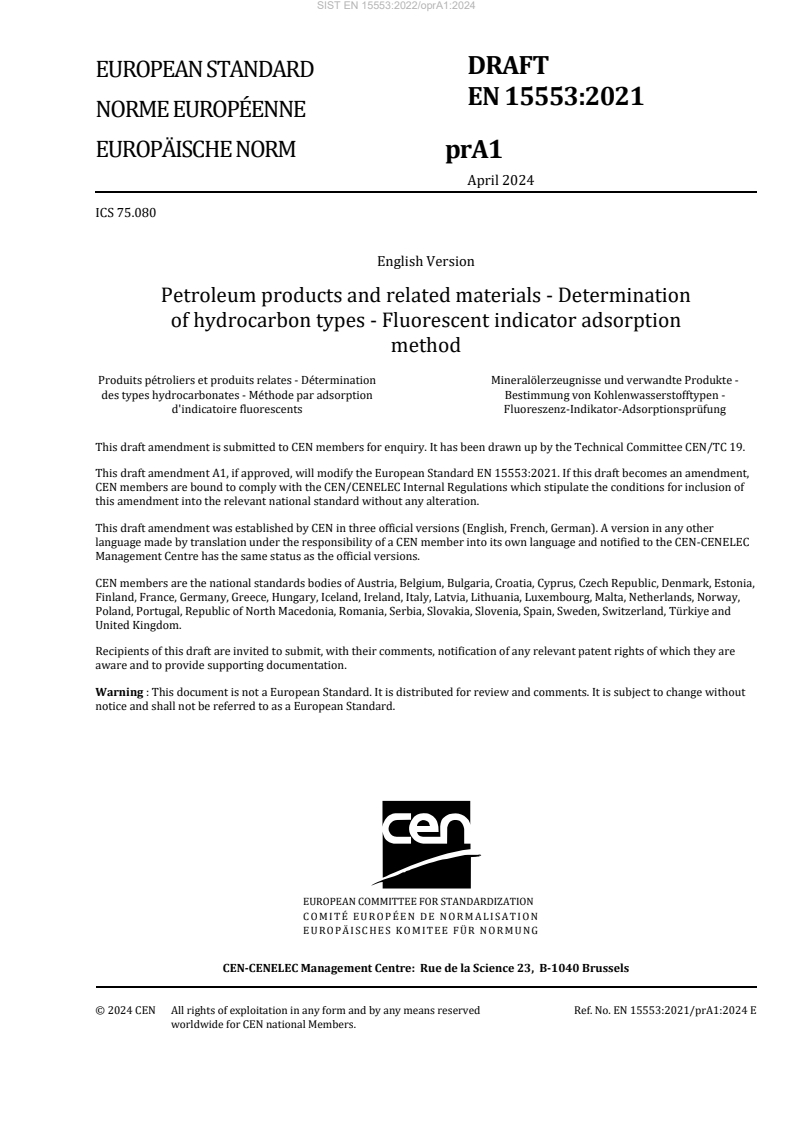
DRAFT
EUROPEAN STANDARD
EN 15553:2021
NORME EUROPÉENNE
EUROPÄISCHE NORM
prA1
April 2024
ICS 75.080
English Version
Petroleum products and related materials - Determination
of hydrocarbon types - Fluorescent indicator adsorption
method
Produits pétroliers et produits relates - Détermination Mineralölerzeugnisse und verwandte Produkte -
des types hydrocarbonates - Méthode par adsorption Bestimmung von Kohlenwasserstofftypen -
d'indicatoire fluorescents Fluoreszenz-Indikator-Adsorptionsprüfung
This draft amendment is submitted to CEN members for enquiry. It has been drawn up by the Technical Committee CEN/TC 19.
This draft amendment A1, if approved, will modify the European Standard EN 15553:2021. If this draft becomes an amendment,
CEN members are bound to comply with the CEN/CENELEC Internal Regulations which stipulate the conditions for inclusion of
this amendment into the relevant national standard without any alteration.
This draft amendment was established by CEN in three official versions (English, French, German). A version in any other
language made by translation under the responsibility of a CEN member into its own language and notified to the CEN-CENELEC
Management Centre has the same status as the official versions.
CEN members are the national standards bodies of Austria, Belgium, Bulgaria, Croatia, Cyprus, Czech Republic, Denmark, Estonia,
Finland, France, Germany, Greece, Hungary, Iceland, Ireland, Italy, Latvia, Lithuania, Luxembourg, Malta, Netherlands, Norway,
Poland, Portugal, Republic of North Macedonia, Romania, Serbia, Slovakia, Slovenia, Spain, Sweden, Switzerland, Türkiye and
United Kingdom.
Recipients of this draft are invited to sub
...