

EN ISO 9001:2026
(Main)Quality management systems - Requirements (ISO 9001:2026)
General Information
- Abstract
This document specifies requirements for a quality management system when an organization:
needs to demonstrate its ability to consistently provide products and services that meet customer and applicable statutory and regulatory requirements;
aims to enhance customer satisfaction through the effective application of the system, including processes for improvement of the system and the assurance of conformity to customer and applicable statutory and regulatory requirements.
All the requirements of this document are generic.
This document is applicable to any organization, regardless of its type or size, or the products and services it provides.
NOTE 1 In this document, the terms “product” or “service” only apply to products and services intended for, or required by, a customer.
NOTE 2 Statutory and regulatory requirements can be expressed as legal requirements.
- Status
- Published
- Publication Date
- 15-Sep-2026
- Technical Committee
- CEN/SS F20 - Quality assurance
- Drafting Committee
- CEN/SS F20 - Quality assurance
- Current Stage
- 6060 - Definitive text made available (DAV) - Publishing
- Start Date
- 16-Sep-2026
- Completion Date
- 16-Sep-2026


Overview
EN ISO 9001:2026 - Quality management systems - Requirements is the latest international standard developed by CEN and ISO for quality management systems (QMS). This standard specifies a framework for organizations seeking to demonstrate their ability to consistently provide products and services that meet customer, statutory, and regulatory requirements. It is designed to enhance customer satisfaction through effective implementation and continual improvement of a QMS.
All requirements in EN ISO 9001:2026 are generic and intended for any organization, regardless of size, type, or the products and services provided. The standard promotes the adoption of sound quality principles, a process approach, and the integration of risk-based and opportunity-based thinking across organizational processes. EN ISO 9001:2026 replaces the previous edition, building on established best practices for quality assurance and operational excellence.
Key Topics
Core Principles and Requirements:
- Customer Focus: Ensuring customer requirements and satisfaction are a central concern.
- Leadership and Commitment: Top management must lead, support, and sustain the QMS.
- Process Approach: Systematically managing activities as processes and understanding their interactions.
- Risk-Based Thinking: Identifying, analyzing, and addressing risks and opportunities to improve outcomes.
- Continual Improvement: Establishing a culture and mechanisms for ongoing enhancement of the QMS.
Key Clauses:
- Context of the Organization: Understanding internal and external factors affecting objectives.
- Leadership: Defining roles, responsibilities, and the quality policy.
- Planning: Addressing risks, opportunities, and quality objectives.
- Support: Resource management, competence, awareness, and documented information.
- Operation: Planning, controlling processes and changes, communication with customers, and design controls.
- Performance Evaluation: Monitoring, auditing, and reviewing QMS performance.
- Improvement: Handling nonconformities, corrective actions, and driving continual enhancement.
Applications
EN ISO 9001:2026 is applicable to organizations of all types and industries, and is frequently adopted in:
- Manufacturing: Ensuring consistent product quality, traceability, and compliance.
- Service Providers: Delivering reliable and high-quality services that meet client expectations.
- Public Sector: Enhancing transparency, regulatory compliance, and stakeholder confidence.
- Healthcare, Education, and Nonprofits: Improving administrative processes, effectiveness, and accountability.
- Supply Chains: Promoting quality assurance across global and local supplier networks.
Practical benefits include:
- Enhanced customer satisfaction and trust
- Improved operational efficiency and consistency
- Stronger compliance with national and international regulations
- Increased competitive advantage and market opportunities
- Better management of risks and opportunities
Organizations seeking ISO 9001 certification often find it strengthens their reputation, supports market access, and aligns with regulatory or contractual requirements.
Related Standards
For effective implementation and broader understanding, the following standards are directly relevant to EN ISO 9001:2026:
- ISO 9000: Quality management systems - Fundamentals and vocabulary (provides essential definitions and concepts)
- ISO/TS 9002: Quality management systems - Guidelines for the application of ISO 9001 (offers practical usage guidance)
- ISO 9004: Quality management - Quality of an organization - Guidance to achieve sustained success
- Industry or sector-specific QMS standards, such as for automotive, aerospace, or healthcare, which may include additional or tailored requirements
Organizations are encouraged to reference these related documents to support effective adoption, integration with other management systems (such as environmental or health and safety), and ongoing improvement of quality management practices.
By implementing EN ISO 9001:2026, organizations position themselves for greater operational reliability, consistent customer satisfaction, and sustained improvement-core elements for long-term success in any market.
Relations
- Effective Date
- 03-Sep-2025
- Effective Date
- 22-Nov-2023
- Effective Date
- 30-Sep-2026
- Effective Date
- 17-Sep-2026
- Referred By
EN 54-25:2008 - Fire detection and fire alarm systems - Part 25: Components using radio links - Effective Date
- 17-Sep-2026
- Effective Date
- 17-Sep-2026
- Effective Date
- 17-Sep-2026
- Referred By
EN 12101-1:2005 - Smoke and heat control systems - Part 1: Specification for smoke barriers - Effective Date
- 17-Sep-2026
- Effective Date
- 17-Sep-2026
- Effective Date
- 17-Sep-2026
- Effective Date
- 17-Sep-2026
- Effective Date
- 17-Sep-2026
- Effective Date
- 17-Sep-2026
- Effective Date
- 17-Sep-2026
- Effective Date
- 17-Sep-2026
Get Certified
Connect with accredited certification bodies for this standard

BSI Group
BSI (British Standards Institution) is the business standards company that helps organizations make excellence a habit.

Bureau Veritas
Bureau Veritas is a world leader in laboratory testing, inspection and certification services.

DNV
DNV is an independent assurance and risk management provider.
Sponsored listings
Frequently Asked Questions
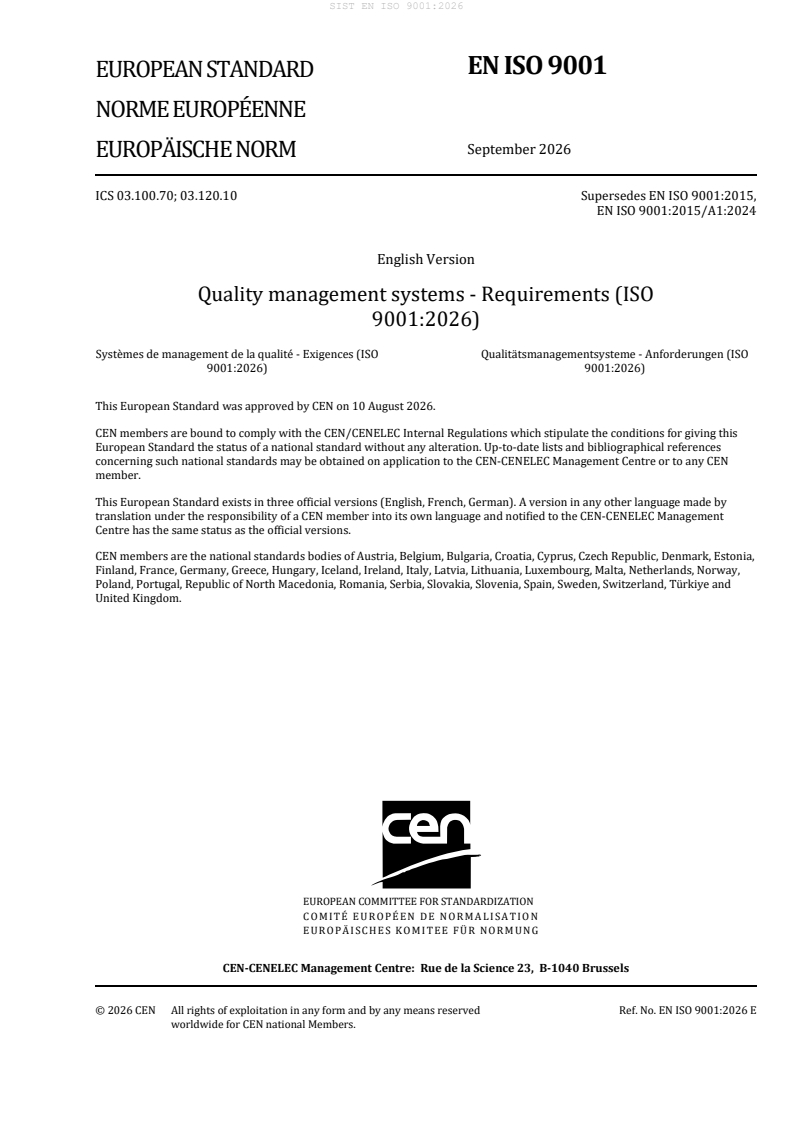
EN ISO 9001:2026 is a standard published by the European Committee for Standardization (CEN). Its full title is "Quality management systems - Requirements (ISO 9001:2026)". This standard covers: This document specifies requirements for a quality management system when an organization: needs to demonstrate its ability to consistently provide products and services that meet customer and applicable statutory and regulatory requirements; aims to enhance customer satisfaction through the effective application of the system, including processes for improvement of the system and the assurance of conformity to customer and applicable statutory and regulatory requirements. All the requirements of this document are generic. This document is applicable to any organization, regardless of its type or size, or the products and services it provides. NOTE 1 In this document, the terms “product” or “service” only apply to products and services intended for, or required by, a customer. NOTE 2 Statutory and regulatory requirements can be expressed as legal requirements.
This document specifies requirements for a quality management system when an organization: needs to demonstrate its ability to consistently provide products and services that meet customer and applicable statutory and regulatory requirements; aims to enhance customer satisfaction through the effective application of the system, including processes for improvement of the system and the assurance of conformity to customer and applicable statutory and regulatory requirements. All the requirements of this document are generic. This document is applicable to any organization, regardless of its type or size, or the products and services it provides. NOTE 1 In this document, the terms “product” or “service” only apply to products and services intended for, or required by, a customer. NOTE 2 Statutory and regulatory requirements can be expressed as legal requirements.
EN ISO 9001:2026 is classified under the following ICS (International Classification for Standards) categories: 03.100.70 - Management systems; 03.120.10 - Quality management and quality assurance. The ICS classification helps identify the subject area and facilitates finding related standards.
EN ISO 9001:2026 has the following relationships with other standards: It is inter standard links to EN ISO 9001:2015/A1:2024, EN ISO 9001:2015, ISO 9000:2026, EN 14236:2007, EN 54-25:2008, EN 12368:2006, EN 14545:2008, EN 12101-1:2005, EN 1474-1:2008, EN 9200:2004, EN 12781:2001, EN 12966-3:2005, EN 12326-1:2004, EN 1504-8:2004, EN 13850:2012. Understanding these relationships helps ensure you are using the most current and applicable version of the standard.
EN ISO 9001:2026 is associated with the following European legislation: EU Directives/Regulations: 765/2008; Standardization Mandates: M/580. When a standard is cited in the Official Journal of the European Union, products manufactured in conformity with it benefit from a presumption of conformity with the essential requirements of the corresponding EU directive or regulation.
EN ISO 9001:2026 is available in PDF format for immediate download after purchase. The document can be added to your cart and obtained through the secure checkout process. Digital delivery ensures instant access to the complete standard document.
Standards Content (Sample)
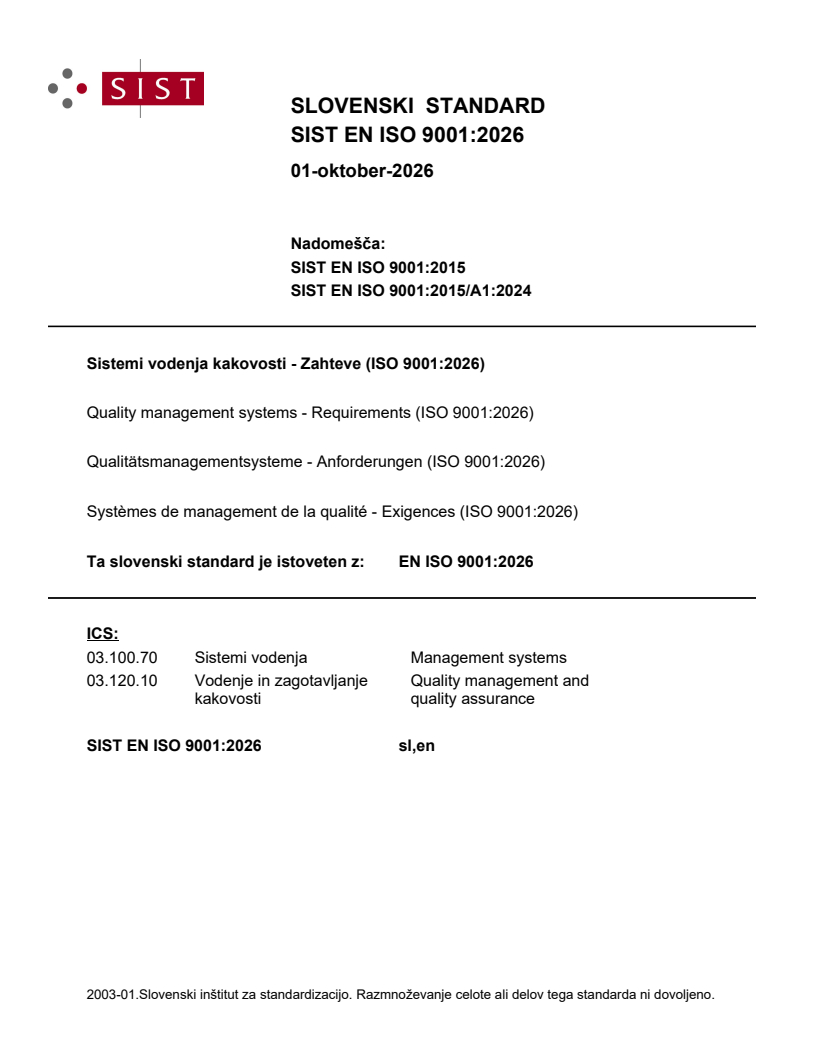
SLOVENSKI STANDARD
01-oktober-2026
Nadomešča:
SIST EN ISO 9001:2015
SIST EN ISO 9001:2015/A1:2024
Sistemi vodenja kakovosti - Zahteve (ISO 9001:2026)
Quality management systems - Requirements (ISO 9001:2026)
Qualitätsmanagementsysteme - Anforderungen (ISO 9001:2026)
Systèmes de management de la qualité - Exigences (ISO 9001:2026)
Ta slovenski standard je istoveten z: EN ISO 9001:2026
ICS:
03.100.70 Sistemi vodenja Management systems
03.120.10 Vodenje in zagotavljanje Quality management and
kakovosti quality assurance
2003-01.Slovenski inštitut za standardizacijo. Razmnoževanje celote ali delov tega standarda ni dovoljeno.
EN ISO 9001
EUROPEAN STANDARD
NORME EUROPÉENNE
September 2026
EUROPÄISCHE NORM
ICS 03.100.70; 03.120.10 Supersedes EN ISO 9001:2015,
EN ISO 9001:2015/A1:2024
English Version
Quality management systems - Requirements (ISO
9001:2026)
Systèmes de management de la qualité - Exigences (ISO Qualitätsmanagementsysteme - Anforderungen (ISO
9001:2026) 9001:2026)
This European Standard was approved by CEN on 10 August 2026.
CEN members are bound to comply with the CEN/CENELEC Internal Regulations which stipulate the conditions for giving this
European Standard the status of a national standard without any alteration. Up-to-date lists and bibliographical references
concerning such national standards may be obtained on application to the CEN-CENELEC Management Centre or to any CEN
member.
This European Standard exists in three official versions (English, French, German). A version in any other language made by
translation under the responsibility of a CEN member into its own language and notified to the CEN-CENELEC Management
Centre has the same status as the official versions.
CEN members are the national standards bodies of Austria, Belgium, Bulgaria, Croatia, Cyprus, Czech Republic, Denmark, Estonia,
Finland, France, Germany, Greece, Hungary, Iceland, Ireland, Italy, Latvia, Lithuania, Luxembourg, Malta, Netherlands, Norway,
Poland, Portugal, Republic of North Macedonia, Romania, Serbia, Slovakia, Slovenia, Spain, Sweden, Switzerland, Türkiye and
United Kingdom.
EUROPEAN COMMITTEE FOR STANDARDIZATION
COMITÉ EUROPÉEN DE NORMALISATIO N
EUROPÄISCHES KOMITEE FÜR NORMUN G
CEN-CENELEC Management Centre: Rue de la Science 23, B-1040 Brussels
© 2026 CEN All rights of exploitation in any form and by any means reserved Ref. No. EN ISO 9001:2026 E
worldwide for CEN national Members.
Contents Page
European foreword . 3
European foreword
This document (EN ISO 9001:2026) has been prepared by Technical Committee ISO/TC 176 "Quality
management and quality assurance" in collaboration with CCMC.
This European Standard shall be given the status of a national standard, either by publication of an
identical text or by endorsement, at the latest by March 2027, and conflicting national standards shall
be withdrawn at the latest by March 2027.
Attention is drawn to the possibility that some of the elements of this document may be the subject of
patent rights. CEN shall not be held responsible for identifying any or all such patent rights.
This document supersedes EN ISO 9001:2015, EN ISO 9001:2015/A1:2024.
Any feedback and questions on this document should be directed to the users’ national standards
body/national committee. A complete listing of these bodies can be found on the CEN website.
According to the CEN-CENELEC Internal Regulations, the national standards organizations of the
following countries are bound to implement this European Standard: Austria, Belgium, Bulgaria,
Croatia, Cyprus, Czech Republic, Denmark, Estonia, Finland, France, Germany, Greece, Hungary, Iceland,
Ireland, Italy, Latvia, Lithuania, Luxembourg, Malta, Netherlands, Norway, Poland, Portugal, Republic of
North Macedonia, Romania, Serbia, Slovakia, Slovenia, Spain, Sweden, Switzerland, Türkiye and the
United Kingdom.
Endorsement notice
The text of ISO 9001:2026 has been approved by CEN as EN ISO 9001:2026 without any modification.
International
Standard
ISO 9001
Sixth edition
Quality management systems —
2026-09
Requirements
Systèmes de management de la qualité — Exigences
Reference number
ISO 9001:2026(en) © ISO 2026
ISO 9001:2026(en)
© ISO 2026
All rights reserved. Unless otherwise specified, or required in the context of its implementation, no part of this publication may
be reproduced or utilized otherwise in any form or by any means, electronic or mechanical, including photocopying, or posting on
the internet or an intranet, without prior written permission. Permission can be requested from either ISO at the address below
or ISO’s member body in the country of the requester.
ISO copyright office
CP 401 • Ch. de Blandonnet 8
CH-1214 Vernier, Geneva
Phone: +41 22 749 01 11
Email: copyright@iso.org
Website: www.iso.org
Published in Switzerland
ii
ISO 9001:2026(en)
Contents Page
Foreword .v
Introduction .vi
0.1 General .vi
0.2 Quality management principles .vi
0.3 Process approach . vii
0.3.1 General . vii
0.3.2 Plan-Do-Check-Act cycle .viii
0.4 Relationship with other management system standards .viii
1 Scope . 1
2 Normative references . 1
3 Terms and definitions . 1
4 Context of the organization . 5
4.1 Understanding the organization and its context .5
4.2 Understanding the needs and expectations of interested parties .5
4.3 Determining the scope of the quality management system .6
4.4 Quality management system .6
5 Leadership . 7
5.1 Leadership and commitment .7
5.1.1 General .7
5.1.2 Customer focus .7
5.2 Quality policy .8
5.3 Roles, responsibilities and authorities .8
6 Planning . 8
6.1 Actions to address risks and opportunities .8
6.1.1 Determining risks and opportunities .8
6.1.2 Actions to address risks .9
6.1.3 Actions to address opportunities .9
6.2 Quality objectives and planning to achieve them.9
6.3 Planning of changes .10
7 Support .10
7.1 Resources .10
7.1.1 General .10
7.1.2 People .10
7.1.3 Infrastructure .11
7.1.4 Environment for the operation of processes .11
7.1.5 Monitoring and measuring resources .11
7.1.6 Organizational knowledge . 12
7.2 Competence . 12
7.3 Awareness . 12
7.4 Communication . 12
7.5 Documented information . 13
7.5.1 General . 13
7.5.2 Creating and updating documented information . 13
7.5.3 Control of documented information . 13
8 Operation . 14
8.1 Operational planning and control .14
8.2 Requirements for products and services .14
8.2.1 Customer communication .14
8.2.2 Determining requirements for products and services . .14
8.2.3 Review of requirements for products and services . 15
8.2.4 Changes to requirements for products and services . 15
8.3 Design and development of products and services . 15
iii
ISO 9001:2026(en)
8.3.1 General . 15
8.3.2 Design and development planning . 15
8.3.3 Design and development inputs .16
8.3.4 Design and development controls .16
8.3.5 Design and development outputs .16
8.3.6 Design and development changes .17
8.4 Control of externally provided processes, products and services .17
8.4.1 General .17
8.4.2 Type and extent of control .17
8.4.3 Information for external providers .18
8.5 Production and service provision .18
8.5.1 Control of production and service provision .18
8.5.2 Identification and traceability .19
8.5.3 Property belonging to customers or external providers .19
8.5.4 Preservation .19
8.5.5 Post-delivery activities .19
8.5.6 Control of changes . 20
8.6 Release of products and services . 20
8.7 Control of nonconforming outputs . 20
9 Performance evaluation .21
9.1 Monitoring, measurement, analysis and evaluation . .21
9.1.1 General .21
9.1.2 Customer satisfaction .21
9.1.3 Analysis and evaluation .21
9.2 Internal audit . 22
9.2.1 General . 22
9.2.2 Internal audit programme . 22
9.3 Management review . 22
9.3.1 General . 22
9.3.2 Management review inputs . 22
9.3.3 Management review results . 23
10 Improvement .23
10.1 Continual improvement . 23
10.2 Nonconformity and corrective action . 23
Annex A (informative) Clarification of structure, terminology and clauses .25
Bibliography .36
iv
ISO 9001:2026(en)
Foreword
ISO (the International Organization for Standardization) is a worldwide federation of national standards
bodies (ISO member bodies). The work of preparing International Standards is normally carried out through
ISO technical committees. Each member body interested in a subject for which a technical committee
has been established has the right to be represented on that committee. International organizations,
governmental and non-governmental, in liaison with ISO, also take part in the work. ISO collaborates closely
with the International Electrotechnical Commission (IEC) on all matters of electrotechnical standardization.
The procedures used to develop this document and those intended for its further maintenance are described
in the ISO/IEC Directives, Part 1. In particular, the different approval criteria needed for the different types
of ISO document should be noted. This document was drafted in accordance with the editorial rules of the
ISO/IEC Directives, Part 2 (see www.iso.org/directives).
ISO draws attention to the possibility that the implementation of this document may involve the use of (a)
patent(s). ISO takes no position concerning the evidence, validity or applicability of any claimed patent
rights in respect thereof. As of the date of publication of this document, ISO had not received notice of (a)
patent(s) which may be required to implement this document. However, implementers are cautioned that
this may not represent the latest information, which may be obtained from the patent database available at
www.iso.org/patents. ISO shall not be held responsible for identifying any or all such patent rights.
Any trade name used in this document is information given for the convenience of users and does not
constitute an endorsement.
For an explanation of the voluntary nature of standards, the meaning of ISO specific terms and expressions
related to conformity assessment, as well as information about ISO’s adherence to the World Trade
Organization (WTO) principles in the Technical Barriers to Trade (TBT), see www.iso.org/iso/foreword.html.
This document was prepared by Technical Committee ISO/TC 176, Quality management and quality
assurance, Subcommittee SC 2, Quality systems, in collaboration with the European Committee for
Standardization (CEN), in accordance with the Agreement on technical cooperation between ISO and CEN
(Vienna Agreement).
This sixth edition cancels and replaces the fifth edition (ISO 9001:2015), which has been technically revised.
It also incorporates the Amendment ISO 9001:2015/Amd 1:2024.
The main changes are as follows:
— Inclusion of core ISO management system terms and definitions: Clause 3 of the document now includes
a limited number of terms and definitions. ISO 9000 remains the normative reference for all quality
management terms and definitions.
— Introduction of quality culture and ethical behaviour: Quality culture and ethical behaviour are now
addressed within the requirements, particularly in relation to leadership, awareness and the environment
for the operation of processes.
— Separation of risks and opportunities: Risks and opportunities are more clearly distinguished, with
separate consideration of actions to address each.
— Strengthened management of change: Requirements related to changes to the quality management
system have been reinforced to support the achievement of intended results.
— Enhanced explanatory content in Annex A: It has been revised to provide enhanced clarification of the
structure, terminology and intent of the requirements as informative text, without introducing additional
requirements.
— Removal of Annex B: It previously provided information on other ISO/TC 176 standards. References to
these standards are now included in Annex A and on the ISO/TC 176 website.
Any feedback or questions on this document should be directed to the user’s national standards body. A
complete listing of these bodies can be found at www.iso.org/members.html.
v
ISO 9001:2026(en)
Introduction
0.1 General
Establishing and implementing a quality management system is a strategic decision for an organization that
supports improved performance, enhances customer satisfaction, and provides a foundation for sustained
success and sustainable development initiatives.
The potential benefits to an organization of implementing a quality management system based on the
requirements in this document are:
a) the ability to consistently provide products and services that meet customer and applicable statutory
and regulatory requirements;
b) facilitating opportunities to enhance customer satisfaction;
c) addressing risks and opportunities associated with its context and objectives;
d) the ability to demonstrate conformity to quality management system requirements.
This document can be used by internal and external parties.
This document does not imply the need for:
— uniformity in the structure of different quality management systems;
— alignment of documentation to the clause structure of this document;
— the use of the specific terminology of this document within the organization.
The quality management system requirements in this document are complementary to requirements for
products and services.
Consistently meeting requirements and addressing future needs and expectations of customers and other
relevant interested parties poses a challenge for organizations in an increasingly dynamic and complex
environment. To achieve this objective, the organization can pursue continual improvement in various ways,
such as incremental or breakthrough change, innovation or reorganization initiatives.
Annex A provides information and clarifications that can support understanding of the structure, terms and
clauses of this document. It does not contain any additional requirements.
[1]
For guidance on the application of all clauses in this document, see ISO 9002 .
0.2 Quality management principles
[2]
This document is based on the quality management principles described in ISO 9000 . The descriptions
include a statement of each principle, a rationale of why the principle is important for the organization, some
examples of benefits associated with the principle and examples of actions to improve the organization’s
performance when applying the principle.
The quality management principles are:
— customer focus;
— leadership;
— engagement of people;
— process approach;
— improvement;
vi
ISO 9001:2026(en)
— evidence-based decision-making;
— relationship management.
0.3 Process approach
0.3.1 General
This document promotes the adoption of a process approach when establishing, implementing and
improving the effectiveness of a quality management system, to enhance customer satisfaction by meeting
customer requirements. Specific requirements considered essential to the application of a process approach
are included in 4.4.
Understanding and managing interrelated processes as a system contributes to the organization’s
effectiveness and efficiency in achieving its intended results. This approach enables the organization to
control the interrelationships and interdependencies among the processes of the system, so that the overall
performance of the organization can be enhanced.
The process approach involves the systematic determination and management of processes, and their
interactions, so as to achieve the intended results in accordance with the quality policy and strategic
direction of the organization. Management of the processes and the system as a whole can be achieved using
the Plan-Do-Check-Act (PDCA) cycle (see 0.3.2) with an overall focus on risk-based thinking (see A.6.1.2)
aimed at preventing undesired results, and opportunity-based thinking (see A.6.1.3) aimed at pursuing
desired results by taking advantage of opportunities.
The application of the process approach in a quality management system enables:
a) understanding and consistency in meeting requirements;
b) consideration of processes in terms of risk, opportunity and added value;
c) achievement of effective process performance;
d) improvement of processes based on the results of evaluation of data and information.
Figure 1 gives a schematic representation of any single process and shows the interaction of its elements.
The monitoring and measuring check points, which are necessary for control, are specific to each process
and will vary depending on the process steps and related risks.
Figure 1 — Schematic representation of the elements of a single process
vii
ISO 9001:2026(en)
0.3.2 Plan-Do-Check-Act cycle
The PDCA cycle can be briefly described as follows:
— Plan: Establish the objectives of the system and its processes, and the resources needed to deliver results
in accordance with customer and other relevant interested party requirements and the organization’s
policies, and determine and address risks and opportunities.
— Do: Implement what was planned.
— Check: Monitor and, as applicable, measure processes and the resulting products and services against
policies, objectives, requirements and planned activities, and report the results.
— Act: Take actions to improve the performance of the quality management system.
The PDCA cycle can be applied to all processes and to the quality management system as a whole. Figure 2
illustrates how Clause 4 to Clause 10 can be grouped in relation to the PDCA cycle.
NOTE Numbers in brackets refer to the clauses in this document.
Figure 2 — Representation of the structure of this document in the PDCA cycle
0.4 Relationship with other management system standards
This document applies the harmonized approach as published in the ISO/IEC Directives related to the
development of management system standards. The intention is to support alignment and facilitate the
integration of the requirements and recommendations of one or more management system standards into
an organization’s management system.
For more information, see https://www.iso.org/management-system-standards.html.
This document provides a basis for an organization to apply the process approach, coupled with the
PDCA cycle, risk-based thinking and opportunity-based thinking, in order to align or integrate its quality
management system with the requirements of other management system standards.
viii
ISO 9001:2026(en)
This document relates to the following standards:
[2]
— ISO 9000 provides the fundamental concepts and vocabulary essential for understanding the
requirements of this document;
[1]
— ISO 9002 provides guidance on the application of the requirements of this document;
[3]
— ISO 9004 provides guidance on enhancing the quality of an organization and its ability to achieve
sustained success.
This document does not include requirements specific to other management systems, such as those for
environmental management, occupational health and safety management, or asset management.
Sector-specific ISO quality management system standards based on the requirements of this document have
been developed. Some of these standards specify additional quality management system requirements,
while others are limited to providing guidance to the application of this document within the particular
sector.
ix
International Standard ISO 9001:2026(en)
Quality management systems — Requirements
1 Scope
This document specifies requirements for a quality management system when an organization:
a) needs to demonstrate its ability to consistently provide products and services that meet customer and
applicable statutory and regulatory requirements;
b) aims to enhance customer satisfaction through the effective application of the system, including
processes for improvement of the system and the assurance of conformity to customer and applicable
statutory and regulatory requirements.
All the requirements of this document are generic.
This document is applicable to any organization, regardless of its type or size, or the products and services
it provides.
NOTE 1 In this document, the terms “product” or “service” only apply to products and services intended for, or
required by, a customer.
NOTE 2 Statutory and regulatory requirements can be expressed as legal requirements.
2 Normative references
The following documents are referred to in the text in such a way that some or all of their content constitutes
requirements of this document. For dated references, only the edition cited applies. For undated references,
the latest edition of the referenced document (including any amendments) applies.
ISO 9000, Quality management — Fundamentals and vocabulary
3 Terms and definitions
For the purposes of this document, the terms and definitions given in ISO 9000 and the following apply.
ISO and IEC maintain terminology databases for use in standardization at the following addresses:
— ISO Online browsing platform: available at https:// www .iso .org/ obp
— IEC Electropedia: available at https:// www .electropedia .org
3.1
organization
person or group of people that has its own functions with responsibilities, authorities and relationships to
achieve its objectives (3.6)
Note 1 to entry: The concept of organization includes, but is not limited to, sole-trader, company, corporation, firm,
enterprise, authority, partnership, charity or institution, or part or combination thereof, whether incorporated or not,
public or private.
Note 2 to entry: If the organization is part of a larger entity, the term “organization” refers only to the part of the larger
entity that is within the scope of the quality management system (3.4.1).
ISO 9001:2026(en)
3.2
interested party
stakeholder
person or organization (3.1) that can affect, be affected by, or perceive itself to be affected by a decision or
activity
EXAMPLE Customers, owners, people in an organization, providers, bankers, regulatory authorities, unions,
partners or society that can include competitors or opposing pressure groups.
3.3
top management
person or group of people who directs and controls an organization (3.1) at the highest level
Note 1 to entry: Top management has the power to delegate authority and provide resources within the organization.
Note 2 to entry: If the scope of the management system (3.4) covers only part of an organization, then top management
refers to those who direct and control that part of the organization.
3.4
management system
set of interrelated or interacting elements of an organization (3.1) to establish policies (3.5) and objectives
(3.6), as well as processes (3.8) to achieve those objectives
Note 1 to entry: A management system can address a single discipline or several disciplines.
Note 2 to entry: The management system elements include the organization’s structure, roles and responsibilities,
planning and operation.
Note 3 to entry: The management system elements can include the organization’s policies, practices, rules and beliefs.
Note 4 to entry: An organization manages its interrelated elements in an orderly manner to achieve its objectives.
Note 5 to entry: The scope of a management system can include the whole of the organization, specific and identified
functions of the organization, specific and identified sections of the organization, or one or more functions across a
group of organizations.
3.4.1
quality management system
part of the overall management system (3.4) of an organization (3.1) related to quality
3.5
policy
intentions and direction of an organization (3.1) as formally expressed by its top management (3.3)
3.5.1
quality policy
policy (3.5) related to quality
Note 1 to entry: The quality policy:
— is generally consistent with the overall policy of the organization (3.1);
— can be aligned with the organization’s vision and mission;
— provides a framework for the setting of quality objectives.
[2]
Note 2 to entry: The quality management principles presented in ISO 9000 can form a basis for the establishment of
a quality policy.
3.6
objective
result to be achieved
Note 1 to entry: An objective can be strategic, tactical or operational.
ISO 9001:2026(en)
Note 2 to entry: Objectives can relate to different disciplines (e.g. finance, health and safety, environment). They can
be, for example, organization-wide or specific to a project, product, service or process (3.8).
Note 3 to entry: An objective can be expressed in other ways, such as an intended result, as a purpose, as an operational
criterion, as a quality objective (3.6.1) or by the use of other words with similar meaning (e.g. aim, goal, target).
Note 4 to entry: In the context of quality management systems (3.4.1), quality objectives (3.6.1) are set by the organization
(3.1), consistent with the quality policy (3.5.1), to achieve specific results.
3.6.1
quality objective
objective (3.6) related to quality
Note 1 to entry: Quality objectives are generally based on the organization’s (3.1) quality policy (3.5.1).
Note 2 to entry: Quality objectives are generally specified for relevant functions, levels and processes (3.8) in the
organization.
3.7
risk
effect of uncertainty
Note 1 to entry: An effect is a deviation from the expected — positive or negative.
Note 2 to entry: Uncertainty is the state, even partial, of deficiency of information related to, understanding or
knowledge of, an event, its consequence, or likelihood.
Note 3 to entry: Risk is often characterized by reference to potential events and consequences, or a combination of
these.
Note 4 to entry: Risk is often expressed in terms of a combination of the consequences of an event (including changes
in circumstances) and the associated likelihood of occurrence.
Note 5 to entry: The word “risk” is sometimes used when there is the possibility of only negative consequences.
3.8
process
set of interrelated or interacting activities that uses or transforms inputs to deliver a result
Note 1 to entry: Whether the result of a process is called an output, a product or a service depends on the context of
the reference.
Note 2 to entry: Inputs to a process are generally the outputs of other processes and outputs of a process are generally
the inputs to other processes.
Note 3 to entry: Two or more interrelated and interacting processes in series can also be referred to as a “process”.
Note 4 to entry: Processes in an organization (3.1) are generally planned and carried out under controlled conditions
to ensure that intended results can be achieved.
Note 5 to entry: A process where the conformity (3.15) of the resulting output cannot be readily or economically
validated is frequently referred to as a “special process”.
3.9
competence
ability to apply knowledge and skills to achieve intended results
3.10
documented information
information required to be controlled and maintained by an organization (3.1) and the medium on which it
is contained
Note 1 to entry: Documented information can be in any format and media and from any source.
Note 2 to entry: Documented information can refer to:
ISO 9001:2026(en)
— the management system (3.4), including related processes (3.8);
— information created in order for the organization to operate (documentation);
— evidence of results achieved (records).
3.11
performance
measurable result
Note 1 to entry: Performance can relate either to quantitative or qualitative findings.
Note 2 to entry: Performance can relate to managing activities, processes (3.8), products, services, systems or
organizations (3.1).
3.12
continual improvement
recurring activity to enhance performance (3.11)
3.13
effectiveness
extent to which planned activities are realized and planned results are achieved
3.14
requirement
need or expectation that is stated, generally implied or obligatory
Note 1 to entry: “Generally implied” means that it is custom or common practice for the organization (3.1) and
interested parties (3.2) that the need or expectation under consideration is implied.
Note 2 to entry: A specified requirement is one that is stated, e.g. in documented information (3.10).
Note 3 to entry: A qualifier can be used to denote a specific type of requirement, e.g. product requirement, service
requirement, quality management requirement, customer requirement, quality requirement.
Note 4 to entry: Requirements can be generated by different interested parties or by the organization itself.
Note 5 to entry: It can be necessary for achieving high customer satisfaction to fulfil an expectation of a customer even
if it is neither stated nor generally implied or obligatory.
3.15
conformity
fulfilment of a requirement (3.14)
Note 1 to entry: The term “conformance” is synonymous but deprecated.
3.16
nonconformity
non-fulfilment of a requirement (3.14)
3.17
corrective action
action to eliminate the cause(s) of a nonconformity (3.16) and to prevent recurrence
Note 1 to entry: Corrective action is taken to prevent recurrence whereas preventive action is taken to prevent
occurrence.
3.18
audit
...