

EN 13195:2013
(Main)Aluminium and aluminium alloys - Specifications for wrought and cast products for marine applications (shipbuilding, marine and offshore)
- Abstract
This European Standard specifies properties and technical conditions for inspection and delivery of wrought and cast aluminium and aluminium alloy products recommended for marine applications, including shipbuilding and offshore applications.
Additional information is given about high magnesium alloys, with special regard to their sensitivity to intergranular and exfoliation corrosion.
This European Standard is intended to be used in conjunction with relevant European, national or international regulations as applicable, to which it comes in support.
For products intended to be used in marine constructions to be classified by a Classification Society, the relevant requirements of this Society apply.
This European Standard covers:
- wrought products in aluminium alloys (see Clause 6);
- castings in aluminium alloys (see Clause 7).
Information is given in Annex A to guide the user in the selection of aluminium and aluminium alloys and tempers for various applications.
This European Standard does not cover:
- execution and design, covered by the rules of the Classification Societies or EN 1090 3 and EN 1999 1 1 to EN 1999 1 5;
- welding, covered by EN 1011 4.
- Status
- Published
- Publication Date
- 01-Oct-2013
- Withdrawal Date
- 29-Apr-2014
- Technical Committee
- CEN/TC 132 - Aluminium and aluminium alloys
- Drafting Committee
- WG 33 - Specific applications
- Current Stage
- 9060 - Closure of 2 Year Review Enquiry - Review Enquiry
- Start Date
- 02-Dec-2018
- Completion Date
- 02-Dec-2018

Overview
EN 13195:2013 - "Aluminium and aluminium alloys - Specifications for wrought and cast products for marine applications (shipbuilding, marine and offshore)" is a CEN European Standard that defines the properties, inspection and delivery conditions for aluminium products recommended for marine, shipbuilding and offshore use. It covers both wrought products and castings, provides guidance on alloy and temper selection, and gives special requirements for high‑magnesium (5xxx series) alloys that are sensitive to intergranular and exfoliation corrosion.
Key topics and technical requirements
- Scope: Applies to wrought aluminium alloys (Clause 6) and aluminium castings (Clause 7) intended for marine service.
- Material selection guidance: Annex A contains recommendations for choosing alloys and tempers for different marine applications. Series 5xxx alloys must be used only in the tempers specified in the standard.
- Corrosion‑sensitive alloys: Special provisions for EN AW‑5059, EN AW‑5083, EN AW‑5086, EN AW‑5383 and EN AW‑5456 (5xxx group with ≥ 3% Mg nominal).
- Tempers H116 and H321: Defined for strain‑hardened or thermally stabilised products that must meet accelerated corrosion‑test requirements. Suitable for continuous service ≤ 65 °C.
- Corrosion testing: Sheet/plate/strip in H116/H321 must be assessed using intergranular corrosion (NAMLT / ASTM G67) and exfoliation corrosion (ASSET / ASTM G66) test methods. EN AW‑5383 extrusions in H112 can be tested when agreed.
- Inspection, delivery and mechanical properties: Technical conditions and mechanical property requirements reference the relevant product EN standards (e.g., EN 485, EN 586, EN 755, EN 1706). Annex B gives mechanical properties for EN AW‑5383 extrusions.
- Ordering and certification: Orders should state expected seawater exposure and whether Classification Society inspection applies. An EN 10204 3.1 inspection certificate is required.
- Limitations: EN 13195 does not cover structural design/execution (see EN 1090‑3, EN 1999 series) or welding practice (EN 1011‑4). Classification Societies’ rules may impose additional requirements.
Practical applications
- Selecting aluminium grades and tempers for hulls, superstructures, decks, fittings and offshore components where seawater exposure or splash zones occur.
- Specifying test regimes and acceptance criteria for suppliers and manufacturers of marine aluminium products.
- Preparing purchase orders and inspection documentation for aluminium materials to be used in shipbuilding and offshore fabrication.
Who uses this standard
- Naval architects, shipbuilders and offshore engineers specifying aluminium materials.
- Material engineers and quality managers at aluminium mills, foundries and fabricators.
- Classification Societies, inspectors, procurement professionals and testing laboratories working on marine projects.
Related standards
- EN 485 series, EN 586, EN 755 series, EN 1706 (castings), EN 10204 (inspection documents), EN 1090‑3 / EN 1999 (design/execution), EN 1011‑4 (welding).
- Test standards referenced: ASTM G66 (ASSET) and ASTM G67 (NAMLT) for corrosion assessment.
Keywords: EN 13195:2013, aluminium alloys, marine applications, shipbuilding, offshore, wrought and cast products, corrosion testing, H116, H321, NAMLT, ASSET.
Relations
- Effective Date
- 09-Oct-2013
- Effective Date
- 25-Mar-2026
- Effective Date
- 28-Jan-2026
- Effective Date
- 28-Jan-2026
- Effective Date
- 28-Jan-2026
- Effective Date
- 28-Jan-2026
- Effective Date
- 28-Jan-2026
- Effective Date
- 28-Jan-2026
- Effective Date
- 28-Jan-2026
- Effective Date
- 28-Jan-2026
- Effective Date
- 28-Jan-2026
- Effective Date
- 28-Jan-2026
- Effective Date
- 28-Jan-2026
- Effective Date
- 28-Jan-2026
- Effective Date
- 28-Jan-2026
Get Certified
Connect with accredited certification bodies for this standard

Element Materials Technology
Materials testing and product certification.

Inštitut za kovinske materiale in tehnologije
Institute of Metals and Technology. Materials testing, metallurgical analysis, NDT.
Sponsored listings
Frequently Asked Questions
EN 13195:2013 is a standard published by the European Committee for Standardization (CEN). Its full title is "Aluminium and aluminium alloys - Specifications for wrought and cast products for marine applications (shipbuilding, marine and offshore)". This standard covers: This European Standard specifies properties and technical conditions for inspection and delivery of wrought and cast aluminium and aluminium alloy products recommended for marine applications, including shipbuilding and offshore applications. Additional information is given about high magnesium alloys, with special regard to their sensitivity to intergranular and exfoliation corrosion. This European Standard is intended to be used in conjunction with relevant European, national or international regulations as applicable, to which it comes in support. For products intended to be used in marine constructions to be classified by a Classification Society, the relevant requirements of this Society apply. This European Standard covers: - wrought products in aluminium alloys (see Clause 6); - castings in aluminium alloys (see Clause 7). Information is given in Annex A to guide the user in the selection of aluminium and aluminium alloys and tempers for various applications. This European Standard does not cover: - execution and design, covered by the rules of the Classification Societies or EN 1090 3 and EN 1999 1 1 to EN 1999 1 5; - welding, covered by EN 1011 4.
This European Standard specifies properties and technical conditions for inspection and delivery of wrought and cast aluminium and aluminium alloy products recommended for marine applications, including shipbuilding and offshore applications. Additional information is given about high magnesium alloys, with special regard to their sensitivity to intergranular and exfoliation corrosion. This European Standard is intended to be used in conjunction with relevant European, national or international regulations as applicable, to which it comes in support. For products intended to be used in marine constructions to be classified by a Classification Society, the relevant requirements of this Society apply. This European Standard covers: - wrought products in aluminium alloys (see Clause 6); - castings in aluminium alloys (see Clause 7). Information is given in Annex A to guide the user in the selection of aluminium and aluminium alloys and tempers for various applications. This European Standard does not cover: - execution and design, covered by the rules of the Classification Societies or EN 1090 3 and EN 1999 1 1 to EN 1999 1 5; - welding, covered by EN 1011 4.
EN 13195:2013 is classified under the following ICS (International Classification for Standards) categories: 77.150.10 - Aluminium products. The ICS classification helps identify the subject area and facilitates finding related standards.
EN 13195:2013 has the following relationships with other standards: It is inter standard links to EN 13195:2009, EN 573-3:2026, EN 1592-3:1997, EN 485-1:2016, EN 754-4:2008, EN 754-3:2008, EN 485-2:2016+A1:2018, EN 573-3:2019+A2:2023, EN 755-1:2016, EN 1706:2020+A1:2021, EN 10204:2004, EN 755-7:2016, EN 515:2017, EN 754-8:2016, EN 755-4:2008. Understanding these relationships helps ensure you are using the most current and applicable version of the standard.
EN 13195:2013 is available in PDF format for immediate download after purchase. The document can be added to your cart and obtained through the secure checkout process. Digital delivery ensures instant access to the complete standard document.
Standards Content (Sample)
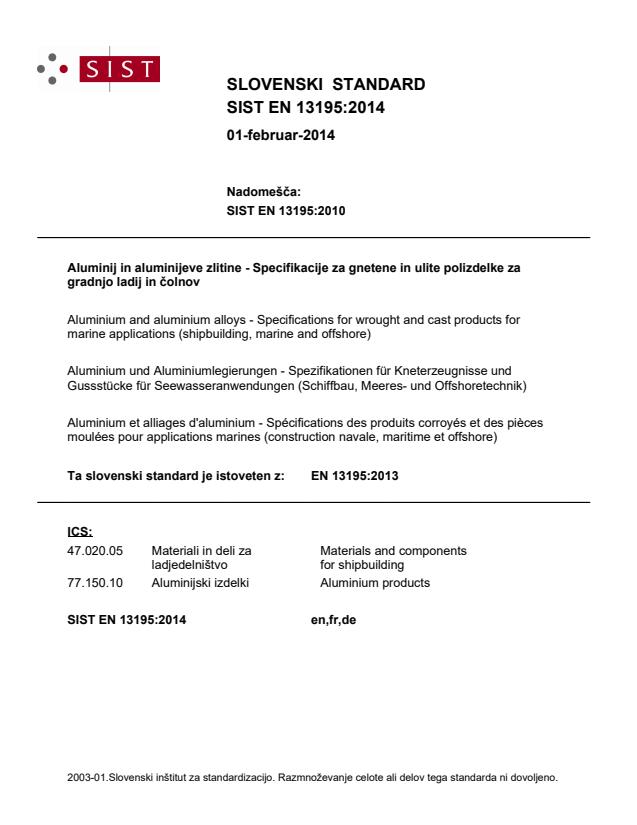
2003-01.Slovenski inštitut za standardizacijo. Razmnoževanje celote ali delov tega standarda ni dovoljeno.Aluminium und Aluminiumlegierungen - Spezifikationen für Kneterzeugnisse und Gussstücke für Seewasseranwendungen (Schiffbau, Meeres- und Offshoretechnik)Aluminium et alliages d'aluminium - Spécifications des produits corroyés et des pièces moulées pour applications marines (construction navale, maritime et offshore)Aluminium and aluminium alloys - Specifications for wrought and cast products for marine applications (shipbuilding, marine and offshore)77.150.10Aluminijski izdelkiAluminium products47.020.05Materiali in deli za ladjedelništvoMaterials and components for shipbuildingICS:Ta slovenski standard je istoveten z:EN 13195:2013SIST EN 13195:2014en,fr,de01-februar-2014SIST EN 13195:2014SLOVENSKI
STANDARDSIST EN 13195:20101DGRPHãþD
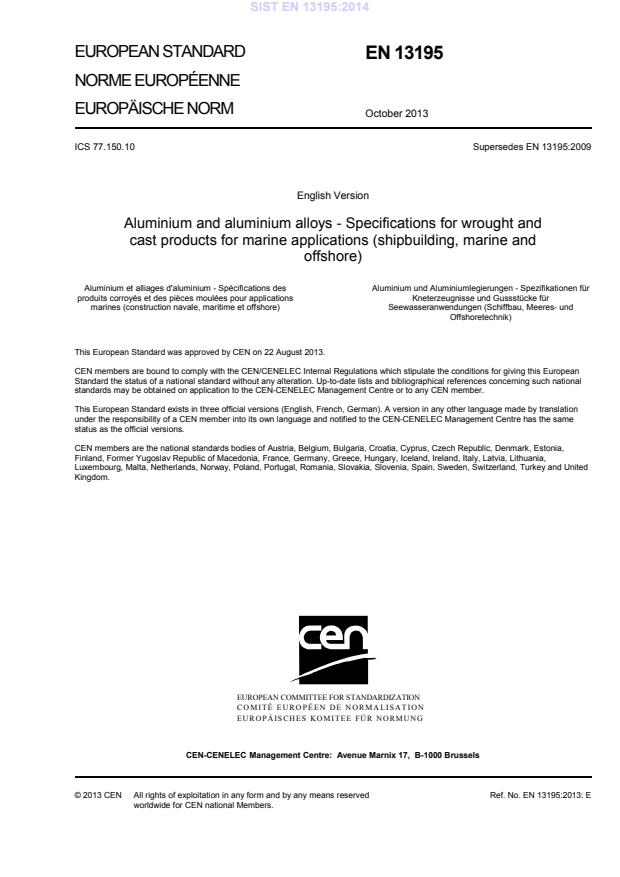
EUROPEAN STANDARD NORME EUROPÉENNE EUROPÄISCHE NORM
EN 13195
October 2013 ICS 77.150.10 Supersedes EN 13195:2009English Version
Aluminium and aluminium alloys - Specifications for wrought and cast products for marine applications (shipbuilding, marine and offshore)
Aluminium et alliages d'aluminium - Spécifications des produits corroyés et des pièces moulées pour applications marines (construction navale, maritime et offshore)
Aluminium und Aluminiumlegierungen - Spezifikationen für Kneterzeugnisse und Gussstücke für Seewasseranwendungen (Schiffbau, Meeres- und Offshoretechnik) This European Standard was approved by CEN on 22 August 2013.
CEN members are bound to comply with the CEN/CENELEC Internal Regulations which stipulate the conditions for giving this European Standard the status of a national standard without any alteration. Up-to-date lists and bibliographical references concerning such national standards may be obtained on application to the CEN-CENELEC Management Centre or to any CEN member.
This European Standard exists in three official versions (English, French, German). A version in any other language made by translation under the responsibility of a CEN member into its own language and notified to the CEN-CENELEC Management Centre has the same status as the official versions.
CEN members are the national standards bodies of Austria, Belgium, Bulgaria, Croatia, Cyprus, Czech Republic, Denmark, Estonia, Finland, Former Yugoslav Republic of Macedonia, France, Germany, Greece, Hungary, Iceland, Ireland, Italy, Latvia, Lithuania, Luxembourg, Malta, Netherlands, Norway, Poland, Portugal, Romania, Slovakia, Slovenia, Spain, Sweden, Switzerland, Turkey and United Kingdom.
EUROPEAN COMMITTEE FOR STANDARDIZATION
COMITÉ EUROPÉEN DE NORMALISATION EUROPÄISCHES KOMITEE FÜR NORMUNG
CEN-CENELEC Management Centre:
Avenue Marnix 17,
B-1000 Brussels © 2013 CEN All rights of exploitation in any form and by any means reserved worldwide for CEN national Members. Ref. No. EN 13195:2013: ESIST EN 13195:2014
Foreword .3 1 Scope .4 2 Normative references .4 3 Terms and definitions .6 4 Selection of materials .6 5 Ordering information .7 6 Wrought aluminium alloy products for marine applications .7 6.1 Technical conditions for inspection and delivery .7 6.2 Mechanical properties .7 6.3 Tolerances on dimensions and form .7 6.4 Special requirements for corrosion-testing of EN AW-5059, EN AW-5083, EN AW-5086, EN AW-5383, EN AW-5456 alloys .8 7 Castings .9 7.1 Mechanical properties .9 7.2 Technical conditions for delivery of castings .9 Annex A (informative)
Recommendations for the proper use of certain alloys . 12 A.1 Materials selection . 12 A.2 Wrought alloys . 12 A.2.1 Wrought heat treatable alloys . 12 A.2.2 Wrought non-heat treatable alloys. 13 A.3 Casting alloys . 13 A.4 Welding . 14 Annex B (normative)
Mechanical properties of aluminium alloy EN AW-5383 for extruded products . 19 Annex C (informative)
Explanation of temper designations . 20 Bibliography . 21
1 Scope This European Standard specifies properties and technical conditions for inspection and delivery of wrought and cast aluminium and aluminium alloy products recommended for marine applications, including shipbuilding and offshore applications. Additional information is given about high magnesium alloys, with special regard to their sensitivity to intergranular and exfoliation corrosion. This European Standard is intended to be used in conjunction with relevant European, national or international regulations as applicable, to which it comes in support. For products intended to be used in marine constructions to be classified by a Classification Society, the relevant requirements of this Society apply. This European Standard covers: — wrought products in aluminium alloys (see Clause 6); — castings in aluminium alloys (see Clause 7). Information is given in Annex A to guide the user in the selection of aluminium and aluminium alloys and tempers for various applications. This European Standard does not cover: — execution and design, covered by the rules of the Classification Societies or EN 1090-3 and EN 1999-1-1 to EN 1999-1-5; — welding, covered by EN 1011-4. 2 Normative references The following documents, in whole or in part, are normatively referenced in this document and are indispensable for its application. For dated references, only the edition cited applies. For undated references, the latest edition of the referenced document (including any amendments) applies. EN 485-1, Aluminium and aluminium alloys — Sheet, strip and plate — Part 1: Technical conditions for inspection and delivery EN 485-2, Aluminium and aluminium alloys — Sheet, strip and plate — Part 2: Mechanical properties EN 485-3, Aluminium and aluminium alloys — Sheet, strip and plate — Part 3: Tolerances on dimensions and form for hot-rolled products EN 485-4, Aluminium and aluminium alloys — Sheet, strip and plate — Part 4: Tolerances on shape and dimensions for cold-rolled products EN 515, Aluminium and aluminium alloys — Wrought products — Temper designations EN 573-3, Aluminium and aluminium alloys — Chemical composition and form of wrought products — Part 3: Chemical composition and form of products SIST EN 13195:2014
...