Hot rolled products of structural steels - Part 6: Technical delivery conditions for flat products of high yield strength structural steels in the quenched and tempered condition

This document specifies technical delivery conditions for flat products of high yield strength alloy special steels. The grades and qualities are given in Tables 1 to 3 (chemical composition) and Tables 4 to 6 (mechanical properties) and are supplied in the quenched and tempered condition.
The steels specified in this document are applicable to hot-rolled flat products with a minimum nominal thickness of 3 mm and a maximum nominal thickness of 200 mm for grades S460, S500, S550, S620 and S690, a maximum nominal thickness of 125 mm for grades S890 and S960, in steels which, after quenching and tempering, have a specified minimum yield strength of 460 MPa to 960 MPa.

Warmgewalzte Erzeugnisse aus Baustählen - Teil 6: Technische Lieferbedingungen für Flacherzeugnisse aus Stählen mit höherer Streckgrenze im vergüteten Zustand

Dieses Dokument legt die technischen Lieferbedingungen für Flacherzeugnisse aus legierten Edelstählen mit höherer Streckgrenze fest. Die Sorten und Gütegruppen sind in den Tabellen 1 bis 3 (chemische Zusammensetzung) sowie 4 bis 6 (mechanische Eigenschaften) aufgeführt und sie werden im vergüteten Zustand geliefert.
Die Stähle nach diesem Dokument sind anwendbar für warmgewalzte Flacherzeugnisse mit einer Mindestnenndicke von 3 mm und einer Höchstnenndicke von 200 mm für die Sorten S460, S500, S550, S620 und S690 sowie einer Höchstnenndicke von 125 mm für die Sorten S890 und S960, die nach dem Vergüten festgelegte Mindestwerte der Streckgrenze im Bereich von 460 MPa bis 960 MPa aufweisen.

Produits laminés à chaud en aciers de construction - Partie 6 : Conditions techniques de livraison pour produits plats des aciers à haute limite d'élesticité à l'état trempé et revenu

Le présent document spécifie les conditions techniques de livraison pour les produits plats en aciers alliés spéciaux à haute limite d'élasticité. Les nuances et qualités sont données dans les Tableaux 1 à 3 (composition chimique) et 4 à 6 (caractéristiques mécaniques) et sont livrées à l'état trempé et revenu.
Les aciers spécifiés dans le présent document sont applicables aux produit plats laminés à chaud ayant une épaisseur nominale minimale de 3 mm et une épaisseur nominale maximale de 200 mm pour les nuances S460, S500, S550, S620 et S690 et une épaisseur nominale maximale de 125 mm pour les nuances S890 et S960, dans les aciers qui, après trempe et revenu, ont une limite d’élasticité minimale spécifiée comprise entre 460 MPa et 960 MPa.

Vroče valjani izdelki iz konstrukcijskih jekel - 6. del: Tehnični dobavni pogoji za ploščate izdelke iz konstrukcijskih jekel z visoko mejo plastičnosti v poboljšanem stanju jekla

6. del tega dokumenta poleg 1. dela določa zahteve za ploščate izdelke konstrukcijskih jekel z veliko plastično trdnostjo. Razredi in kakovosti so podani v tabelah od 2 do 4 (kemična sestava) ter tabelah od 5 do 7 (mehanske lastnosti); jekla so dobavljena v kaljenem in poboljšanem stanju, kot je navedeno v točki 6.3.
Jekla iz tega dokumenta veljajo za toplo valjane ploščate izdelke z najmanjšo nazivno debelino 3 mm in največjo nazivno debelino < 150 mm za razrede S460, S500, S550, S620 in S690, največjo nazivno debelino < 100 mm za razred S890 in največjo nazivno debelino < 50 mm za razred S960 pri jeklih, ki imajo po kaljenju in poboljšanju minimalno trdnost med 460 MPa in 960 MPa.

General Information

Status
Withdrawn
Publication Date
13-Aug-2019
Withdrawal Date
13-Apr-2025
Current Stage
9960 - Withdrawal effective - Withdrawal
Start Date
30-Nov-2022
Completion Date
14-Apr-2025

Relations

Effective Date
21-Aug-2019
Effective Date
19-Jan-2023
Effective Date
27-Oct-2021

Frequently Asked Questions

EN 10025-6:2019 is a standard published by the European Committee for Standardization (CEN). Its full title is "Hot rolled products of structural steels - Part 6: Technical delivery conditions for flat products of high yield strength structural steels in the quenched and tempered condition". This standard covers: This document specifies technical delivery conditions for flat products of high yield strength alloy special steels. The grades and qualities are given in Tables 1 to 3 (chemical composition) and Tables 4 to 6 (mechanical properties) and are supplied in the quenched and tempered condition. The steels specified in this document are applicable to hot-rolled flat products with a minimum nominal thickness of 3 mm and a maximum nominal thickness of 200 mm for grades S460, S500, S550, S620 and S690, a maximum nominal thickness of 125 mm for grades S890 and S960, in steels which, after quenching and tempering, have a specified minimum yield strength of 460 MPa to 960 MPa.

This document specifies technical delivery conditions for flat products of high yield strength alloy special steels. The grades and qualities are given in Tables 1 to 3 (chemical composition) and Tables 4 to 6 (mechanical properties) and are supplied in the quenched and tempered condition. The steels specified in this document are applicable to hot-rolled flat products with a minimum nominal thickness of 3 mm and a maximum nominal thickness of 200 mm for grades S460, S500, S550, S620 and S690, a maximum nominal thickness of 125 mm for grades S890 and S960, in steels which, after quenching and tempering, have a specified minimum yield strength of 460 MPa to 960 MPa.

EN 10025-6:2019 is classified under the following ICS (International Classification for Standards) categories: 77.140.10 - Heat-treatable steels; 77.140.50 - Flat steel products and semi-products. The ICS classification helps identify the subject area and facilitates finding related standards.

EN 10025-6:2019 has the following relationships with other standards: It is inter standard links to EN 10025-6:2004+A1:2009, EN 10025-6:2019+A1:2022, EN 10025-6:2019/prA1. Understanding these relationships helps ensure you are using the most current and applicable version of the standard.

You can purchase EN 10025-6:2019 directly from iTeh Standards. The document is available in PDF format and is delivered instantly after payment. Add the standard to your cart and complete the secure checkout process. iTeh Standards is an authorized distributor of CEN standards.

Standards Content (Sample)


SLOVENSKI STANDARD
01-november-2019
Nadomešča:
SIST EN 10025-6:2005+A1:2009
Vroče valjani izdelki iz konstrukcijskih jekel - 6. del: Tehnični dobavni pogoji za
ploščate izdelke iz konstrukcijskih jekel z visoko mejo plastičnosti v poboljšanem
stanju jekla
Hot rolled products of structural steels - Part 6: Technical delivery conditions for flat
products of high yield strength structural steels in the quenched and tempered condition
Warmgewalzte Erzeugnisse aus Baustählen - Teil 6: Technische Lieferbedingungen für
Flacherzeugnisse aus Stählen mit höherer Streckgrenze im vergüteten Zustand
Produits laminés à chaud en aciers de construction - Partie 6 : Conditions techniques de
livraison pour produits plats des aciers à haute limite d'élesticité à l'état trempé et revenu
Ta slovenski standard je istoveten z: EN 10025-6:2019
ICS:
77.140.10 Jekla za toplotno obdelavo Heat-treatable steels
77.140.50 Ploščati jekleni izdelki in Flat steel products and semi-
polizdelki products
2003-01.Slovenski inštitut za standardizacijo. Razmnoževanje celote ali delov tega standarda ni dovoljeno.

EN 10025-6
EUROPEAN STANDARD
NORME EUROPÉENNE
August 2019
EUROPÄISCHE NORM
ICS 77.140.10; 77.140.50 Supersedes EN 10025-6:2004+A1:2009
English Version
Hot rolled products of structural steels - Part 6: Technical
delivery conditions for flat products of high yield strength
structural steels in the quenched and tempered condition
Produits laminés à chaud en aciers de construction - Warmgewalzte Erzeugnisse aus Baustählen - Teil 6:
Partie 6 : Conditions techniques de livraison pour Technische Lieferbedingungen für Flacherzeugnisse
produits plats des aciers à haute limite d'élesticité à aus Stählen mit höherer Streckgrenze im vergüteten
l'état trempé et revenu Zustand
This European Standard was approved by CEN on 16 June 2019.

CEN members are bound to comply with the CEN/CENELEC Internal Regulations which stipulate the conditions for giving this
European Standard the status of a national standard without any alteration. Up-to-date lists and bibliographical references
concerning such national standards may be obtained on application to the CEN-CENELEC Management Centre or to any CEN
member.
This European Standard exists in three official versions (English, French, German). A version in any other language made by
translation under the responsibility of a CEN member into its own language and notified to the CEN-CENELEC Management
Centre has the same status as the official versions.

CEN members are the national standards bodies of Austria, Belgium, Bulgaria, Croatia, Cyprus, Czech Republic, Denmark, Estonia,
Finland, France, Germany, Greece, Hungary, Iceland, Ireland, Italy, Latvia, Lithuania, Luxembourg, Malta, Netherlands, Norway,
Poland, Portugal, Republic of North Macedonia, Romania, Serbia, Slovakia, Slovenia, Spain, Sweden, Switzerland, Turkey and
United Kingdom.
EUROPEAN COMMITTEE FOR STANDARDIZATION
COMITÉ EUROPÉEN DE NORMALISATION

EUROPÄISCHES KOMITEE FÜR NORMUNG

CEN-CENELEC Management Centre: Rue de la Science 23, B-1040 Brussels
© 2019 CEN All rights of exploitation in any form and by any means reserved Ref. No. EN 10025-6:2019 E
worldwide for CEN national Members.

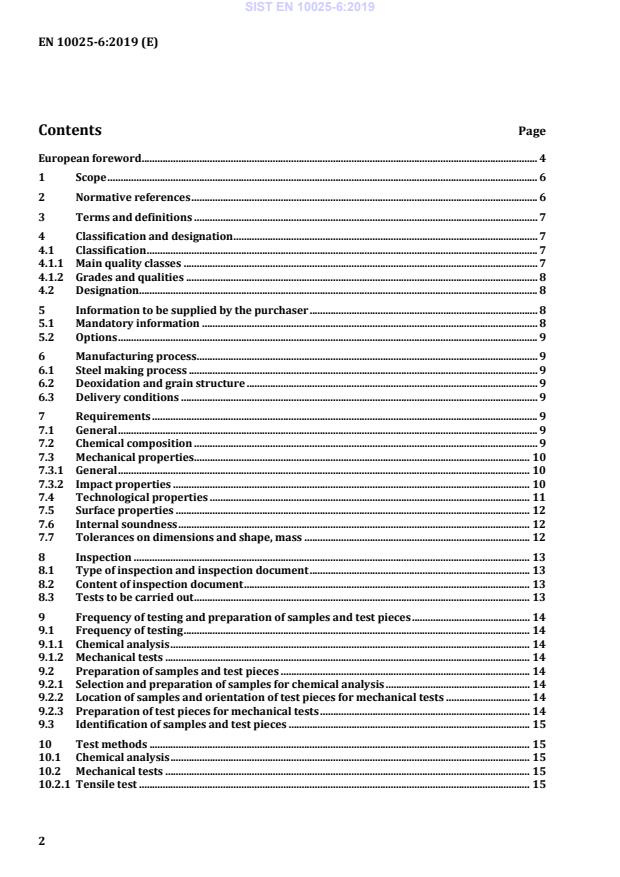
Contents Page
European foreword . 4
1 Scope . 6
2 Normative references . 6
3 Terms and definitions . 7
4 Classification and designation . 7
4.1 Classification . 7
4.1.1 Main quality classes . 7
4.1.2 Grades and qualities . 8
4.2 Designation. 8
5 Information to be supplied by the purchaser . 8
5.1 Mandatory information . 8
5.2 Options . 9
6 Manufacturing process . 9
6.1 Steel making process . 9
6.2 Deoxidation and grain structure . 9
6.3 Delivery conditions . 9
7 Requirements . 9
7.1 General . 9
7.2 Chemical composition . 9
7.3 Mechanical properties . 10
7.3.1 General . 10
7.3.2 Impact properties . 10
7.4 Technological properties . 11
7.5 Surface properties . 12
7.6 Internal soundness . 12
7.7 Tolerances on dimensions and shape, mass . 12
8 Inspection . 13
8.1 Type of inspection and inspection document . 13
8.2 Content of inspection document . 13
8.3 Tests to be carried out . 13
9 Frequency of testing and preparation of samples and test pieces . 14
9.1 Frequency of testing . 14
9.1.1 Chemical analysis . 14
9.1.2 Mechanical tests . 14
9.2 Preparation of samples and test pieces . 14
9.2.1 Selection and preparation of samples for chemical analysis . 14
9.2.2 Location of samples and orientation of test pieces for mechanical tests . 14
9.2.3 Preparation of test pieces for mechanical tests . 14
9.3 Identification of samples and test pieces . 15
10 Test methods . 15
10.1 Chemical analysis . 15
10.2 Mechanical tests . 15
10.2.1 Tensile test . 15
10.2.2 Impact test . 16
10.3 Ultrasonic testing . 16
10.4 Retests . 16
11 Marking, labelling, packaging . 16
12 Complaints . 17
13 Options . 17
Annex A (normative) Location of samples and test pieces . 23
Annex B (informative) Minimum recommended inside bend radii for flanging . 24
Annex C (informative) List of Options of EN 10025-2 to −6 . 25

European foreword
This document (EN 10025-6:2019) has been prepared by Technical Committee CEN/TC 459/SC 3
“Structural steels other than reinforcements”, the secretariat of which is held by DIN.
This European Standard shall be given the status of a national standard, either by publication of an
identical text or by endorsement, at the latest by February 2020 and conflicting national standards shall
be withdrawn at the latest by February 2020.
Attention is drawn to the possibility that some of the elements of this document may be the subject of
patent rights. CEN shall not be held responsible for identifying any or all such patent rights.
This document supersedes EN 10025-6:2004+A1:2009.
This document consists of the following parts, under the general title Hot rolled products of structural
steels:
— Part 1: General technical delivery conditions
— Part 2: Technical delivery conditions for non-alloy structural steels
— Part 3: Technical delivery conditions for normalized/normalized rolled weldable fine grain structural
steels
— Part 4: Technical delivery conditions for thermomechanical rolled weldable fine grain structural steels
— Part 5: Technical delivery conditions for structural steels with improved atmospheric corrosion
resistance
— Part 6: Technical delivery conditions for flat products of high yield strength structural steels in the
quenched and tempered condition
For a short transition period there will be a coexistence of EN 10025-1:2004 with EN 10025-2:2019to
EN 10025−6:2019, since the new EN 10025-1 has to fulfil the requirements of the CPR and will
therefore be published later. For this short transition period up-to-the publication of the next edition of
part 1 the following is to be taken into account for EN 10025-1:2004:
a) all dated and undated references to EN 10025-1:2004 to EN 10025-6:2004 are unchanged to this
version with following exception: In 9.2.2.1 the references are 8.3.1 and 8.3.2 instead of 8.4.1 and
8.4.2;
b) Clauses 5, 12 and 13 of EN 10025-1:2004 are no longer relevant.
The main changes with respect to the previous edition are listed below:
a) part 6 is now a stand-alone standard for technical delivery conditions including the preparation of
samples and test pieces, the test methods, the marking, labelling and packaging and the drawings;
b) for applications under the CPR this document and part 1 are used together;
c) requirements for elements not definded were added to 7.2.1 and 7.2.2;
d) Option 33 was added, Option 3 was renumbered to Option 24 and Option 9 was deleted;
e) Si-content in 7.2.4 was changed;
f) 7.4.3 concerning hot-dip zinc coating was modified;
g) in Tables 3 and 4 the values were extended for thicknesses up to 200 mm;
h) references were updated and document editorial revised.
According to the CEN-CENELEC Internal Regulations, the national standards organisations of the
following countries are bound to implement this European Standard: Austria, Belgium, Bulgaria,
Croatia, Cyprus, Czech Republic, Denmark, Estonia, Finland, Republic of North Macedonia, France,
Germany, Greece, Hungary, Iceland, Ireland, Italy, Latvia, Lithuania, Luxembourg, Malta, Netherlands,
Norway, Poland, Portugal, Romania, Serbia, Slovakia, Slovenia, Spain, Sweden, Switzerland, Turkey and
the United Kingdom.
1 Scope
This document specifies technical delivery conditions for flat products of high yield strength alloy
special steels. The grades and qualities are given in Tables 1 to 3 (chemical composition) and Tables 4
to 6 (mechanical properties) and are supplied in the quenched and tempered condition.
The steels specified in this document are applicable to hot-rolled flat products with a minimum nominal
thickness of 3 mm and a maximum nominal thickness of 200 mm for grades S460, S500, S550, S620 and
S690, a maximum nominal thickness of 125 mm for grades S890 and S960, in steels which, after
quenching and tempering, have a specified minimum yield strength of 460 MPa to 960 MPa.
2 Normative references
The following documents are referred to in the text in such a way that some or all of their content
constitutes requirements of this document. For dated references, only the edition cited applies. For
undated references, the latest edition of the referenced document (including any amendments) applies.
EN 1011-2, Welding — Recommendations for welding of metallic materials — Part 2: Arc welding of
ferritic steels
EN 10020:2000, Definition and classification of grades of steel
EN 10021, General technical delivery conditions for steel products
EN 10025-1, Hot rolled products of structural steels — Part 1: General technical delivery conditions
EN 10027-1, Designation systems for steels — Part 1: Steel names
EN 10027-2, Designation systems for steels — Part 2: Numerical system
EN 10029, Hot-rolled steel plates 3 mm thick or above — Tolerances on dimensions and shape
EN 10048, Hot rolled narrow steel strip — Tolerances on dimensions and shape
EN 10051, Continuously hot-rolled strip and plate/sheet cut from wide strip of non-alloy and alloy steels
— Tolerances on dimensions and shape
EN 10079, Definition of steel products
EN 10160, Ultrasonic testing of steel flat product of thickness equal or greater than 6 mm (reflection
method)
EN 10163-1, Delivery requirements for surface condition of hot-rolled steel plates, wide flats and sections
— Part 1: General requirements
EN 10163-2, Delivery requirements for surface condition of hot-rolled steel plates, wide flats and sections
— Part 2: Plate and wide flats
EN 10164, Steel products with improved deformation properties perpendicular to the surface of the
product — Technical delivery conditions
EN 10168, Steel products — Inspection documents — List of information and description
EN 10204, Metallic products — Types of inspection documents
EN 10315, Routine method for analysis of high alloy steel by X-ray Fluorescence Spectrometry (XRF) by
using a near by technique
CR 10320, Optical emission analysis of low alloy steels (routine method) — Method for determination of C,
Si, S, P, Mn, Cr, Ni and Cu
EN ISO 148-1, Metallic materials — Charpy pendulum impact test — Part 1: Test method (ISO 148-1)
EN ISO 377, Steel and steel products — Location and preparation of samples and test pieces for
mechanical testing (ISO 377)
EN ISO 2566-1, Steel — Conversion of elongation values — Part 1: Carbon and low alloy steels
(ISO 2566-1)
EN ISO 6892-1:2016, Metallic materials — Tensile testing — Part 1: Method of test at room temperature
(ISO 6892-1:2016)
EN ISO 14713-2:2009, Zinc coatings — Guidelines and recommendations for the protection against
corrosion of iron and steel in structures — Part 2: Hot dip galvanizing (ISO 14713-2:2009)
EN ISO 14284, Steel and iron — Sampling and preparation of samples for the determination of chemical
composition (ISO 14284)
EN ISO 15350, Steel and iron — Determination of total carbon and sulfur content – Infrared absorption
method after combustion in an induction furnace (routine method) (ISO 15350)
3 Terms and definitions
For the purposes of this document, the terms and definitions given in EN 10079 and the following apply.
ISO and IEC maintain terminological databases for use in standardization at the following addresses:
— IEC Electropedia: available at http://www.electropedia.org/
— ISO Online browsing platform: available at http://www.iso.org/obp
3.1
quenching
operation which consists of cooling a ferrous product more rapidly than in still air
3.2
tempering
heat treatment applied to a ferrous product generally after quench hardening or other heat treatment
to bring the properties to the required level
Note 1 to entry: Tempering consists of heating to specific temperatures ( followed by cooling at an appropriate rate.
4 Classification and designation
4.1 Classification
4.1.1 Main quality classes
The steel grades specified in this document shall be classified as alloy special steels according to
EN 10020.
4.1.2 Grades and qualities
This document specifies seven steel grades. They differ in their minimum yield strength at room
temperature.
All steel grades may be supplied in the following qualities as specified at the time of the order:
— with specified minimum values of impact energy at temperatures not lower than −20 °C, designated
as Q;
— with specified minimum values of impact energy at temperatures not lower than −40 °C, designated
as QL;
— with specified minimum values of impact energy at temperatures not lower than −60 °C, designated
as QL1.
4.2 Designation
4.2.1 For the steel grades covered by this document the steel names shall be allocated in accordance
with EN 10027-1; the steel numbers shall be allocated in accordance with EN 10027-2.
4.2.2 The designation shall consist of:
— the number of this document (EN 10025-6);
— the steel name or the steel number; the steel name consisting of:
— the symbol S (for structural steel);
— the indication of the minimum specified yield strength for thickness ≤ 50 mm expressed in
MPa;
— the delivery condition Q;
— the capital letter L or L1 for the quality with specified minimum values of impact energy at
temperatures not lower than −40 °C or −60 °C.
EXAMPLE Structural steel (S) quenched and tempered (Q), with a specified minimum yield strength at room
temperature of 460 MPa and with a specified minimum of impact energy at −40 °C (L):
EN 10025-6 – S460QL
Or
EN 10025-6 - 1.8906
5 Information to be supplied by the purchaser
5.1 Mandatory information
The following information shall be supplied by the purchaser at the time of the order:
a) quantity to be delivered;
b) product form and the number of the standard for dimensions and tolerances (see 2.2);
c) nominal dimensions and tolerances on dimensions and shape (see 7.7.1);
d) steel designation (see 4.2.2);
e) additional requirements of inspection and testing and all required options (see 5.2 and Clause 13);
f) type of inspection document according to EN 10204 (see 8.1).
5.2 Options
A number of options are specified in Clause 13. In the event that the purchaser does not indicate his
wish to implement any of these options, the supplier shall supply in accordance with the basic
specification, see 5.1 a) to d) and f).
6 Manufacturing process
6.1 Steel making process
The steel making process is at the discretion of the manufacturer with the exclusion of the open hearth
(Siemens-Martin) process.
See Option 1, Clause 13 (details of manufacturing process).
6.2 Deoxidation and grain structure
Steels of EN 10025-6 shall:
— be fully killed;
— have a fine grain structure;
— contain nitrogen binding elements in amounts sufficient to bind the available nitrogen (for example
min. 0,020 % total aluminium). The usual guideline is a minimum aluminium to nitrogen ratio of
2:1, when no other nitrogen binding elements are present. Such other elements and their content
(% mass) shall be reported in the inspection document (see Table 1).
6.3 Delivery conditions
The products shall be supplied in the quenched and tempered condition (Q) as defined in Clause 3.
NOTE Direct quenching after hot-rolling followed by tempering is considered equivalent to conventional
quenching and tempering.
7 Requirements
7.1 General
The requirements in 7.2 and 7.3 apply for sampling, preparation of test pieces and testing specified in
Clauses 9 and 10.
7.2 Chemical composition
7.2.1 The chemical composition determined by heat analysis shall comply with the specified values of
Table 1.
For elements not defined in the table for the chemical composition for heat analysis, limit values of
Table 1 of EN 10020:2000 shall apply as maximum values.
7.2.2 The upper limits applicable for the product analysis are given in Table 2. The product analysis
shall be carried out when specified at the time of the order.
See Option 2, Clause 13 (product analysis).
For elements not defined in the table for the chemical composition for product analysis, limit values of
Table 1 of EN 10020:2000 shall apply as maximum values.
7.2.3 The maximum carbon equivalent values based on the heat analysis, given in Table 3 shall apply.
For determining the carbon equivalent value the following IIW (International Institute of Welding)
formula shall be used:
Cr++Mo V Ni+ Cu
Mn
CEV=C++ +
6 5 15
7.2.4 When products are supplied with a control on Si e.g. for hot-dip zinc-coating so that there could
be a need to increase the content of other elements like C and Mn to achieve the required tensile
properties, the maximum carbon equivalent values of Table 3 shall be increased as follows:
— for Si ≤ 0,04 %, increase the value of the CEV by 0,02;
— for Si ≤ 0,25 %, increase the value of the CEV by 0,01.
7.3 Mechanical properties
7.3.1 General
7.3.1.1 Under the inspection and testing conditions as specified in Clauses 8, 9 and 10 and in the
delivery condition as specified in 6.3 the mechanical properties shall comply with the values given in
Tables 4, 5 and 6.
The maximum stress-relief temperature should be at least 30 °C below the tempering temperature and
not be held for more than 1 h. As this temperature is normally not known in advance it is recommended
that the purchaser if he intends to perform a stress relief treatment to contact the steel producer. If the
purchaser intends to stress relief the products at higher temperatures or for longer times than
mentioned above the minimum values of the mechanical properties after such a treatment should be
agreed upon at the time of the order.
7.3.1.2 For the products specified in this document the nominal thickness applies.
7.3.2 Impact properties
7.3.2.1 The verification of the impact energy value shall be carried out, unless otherwise agreed
upon (see 7.3.2.2 and 7.3.2.3) with longitudinal test pieces for:
— quality Q at −20 °C;
— quality QL at −40 °C;
— quality QL1 at −60 °C.
7.3.2.2 Another temperature (given in Tables 5 and 6) may be agreed upon at the time of the order.
See Option 24, Clause 13 (Agreement on another impact test temperature).
7.3.2.3 If agreed upon at the time of the order the impact properties shall be verified on transverse
V-notch test pieces instead of longitudinal test pieces with minimum values as given in Table 6.
See Option 30, Clause 13 (Impact properties verified on transverse test pieces).
7.3.2.4 If specified at the time of the order on each heat treatment unit the impact properties only
or the impact properties and the tensile properties shall be verified.
See Option 13, Clause 13 (For each heat treatment unit impact properties only to be verified).
See Option 14, Clause 13 (For each heat treatment unit impact and tensile properties to be verified).
7.3.3 Improved deformation properties perpendicular to the surface
If agreed upon at the time of the order the products shall comply with one of the requirements of
EN 10164.
See Option 4, Clause 13 (Deformation properties perpendicular to the surface).
7.4 Technological properties
7.4.1 Weldability
The steels specified in this document do not have unlimited suitability for the various welding
processes, since the behaviour of a steel during and after welding d
...


SLOVENSKI STANDARD
01-november-2019
Nadomešča:
SIST EN 10025-6:2005+A1:2009
Vroče valjani izdelki iz konstrukcijskih jekel - 6. del: Tehnični dobavni pogoji za
ploščate izdelke iz konstrukcijskih jekel z veliko plastično trdnostjo v kaljenem in
popuščenem stanju
Hot rolled products of structural steels - Part 6: Technical delivery conditions for flat
products of high yield strength structural steels in the quenched and tempered condition
Warmgewalzte Erzeugnisse aus Baustählen - Teil 6: Technische Lieferbedingungen für
Flacherzeugnisse aus Stählen mit höherer Streckgrenze im vergüteten Zustand
Produits laminés à chaud en aciers de construction - Partie 6 : Conditions techniques de
livraison pour produits plats des aciers à haute limite d'élesticité à l'état trempé et revenu
Ta slovenski standard je istoveten z: EN 10025-6:2019
ICS:
77.140.10 Jekla za toplotno obdelavo Heat-treatable steels
77.140.50 Ploščati jekleni izdelki in Flat steel products and semi-
polizdelki products
2003-01.Slovenski inštitut za standardizacijo. Razmnoževanje celote ali delov tega standarda ni dovoljeno.

EN 10025-6
EUROPEAN STANDARD
NORME EUROPÉENNE
August 2019
EUROPÄISCHE NORM
ICS 77.140.10; 77.140.50 Supersedes EN 10025-6:2004+A1:2009
English Version
Hot rolled products of structural steels - Part 6: Technical
delivery conditions for flat products of high yield strength
structural steels in the quenched and tempered condition
Produits laminés à chaud en aciers de construction - Warmgewalzte Erzeugnisse aus Baustählen - Teil 6:
Partie 6 : Conditions techniques de livraison pour Technische Lieferbedingungen für Flacherzeugnisse
produits plats des aciers à haute limite d'élesticité à aus Stählen mit höherer Streckgrenze im vergüteten
l'état trempé et revenu Zustand
This European Standard was approved by CEN on 16 June 2019.

CEN members are bound to comply with the CEN/CENELEC Internal Regulations which stipulate the conditions for giving this
European Standard the status of a national standard without any alteration. Up-to-date lists and bibliographical references
concerning such national standards may be obtained on application to the CEN-CENELEC Management Centre or to any CEN
member.
This European Standard exists in three official versions (English, French, German). A version in any other language made by
translation under the responsibility of a CEN member into its own language and notified to the CEN-CENELEC Management
Centre has the same status as the official versions.

CEN members are the national standards bodies of Austria, Belgium, Bulgaria, Croatia, Cyprus, Czech Republic, Denmark, Estonia,
Finland, France, Germany, Greece, Hungary, Iceland, Ireland, Italy, Latvia, Lithuania, Luxembourg, Malta, Netherlands, Norway,
Poland, Portugal, Republic of North Macedonia, Romania, Serbia, Slovakia, Slovenia, Spain, Sweden, Switzerland, Turkey and
United Kingdom.
EUROPEAN COMMITTEE FOR STANDARDIZATION
COMITÉ EUROPÉEN DE NORMALISATION

EUROPÄISCHES KOMITEE FÜR NORMUNG

CEN-CENELEC Management Centre: Rue de la Science 23, B-1040 Brussels
© 2019 CEN All rights of exploitation in any form and by any means reserved Ref. No. EN 10025-6:2019 E
worldwide for CEN national Members.

Contents Page
European foreword . 4
1 Scope . 6
2 Normative references . 6
3 Terms and definitions . 7
4 Classification and designation . 7
4.1 Classification . 7
4.1.1 Main quality classes . 7
4.1.2 Grades and qualities . 8
4.2 Designation. 8
5 Information to be supplied by the purchaser . 8
5.1 Mandatory information . 8
5.2 Options . 9
6 Manufacturing process . 9
6.1 Steel making process . 9
6.2 Deoxidation and grain structure . 9
6.3 Delivery conditions . 9
7 Requirements . 9
7.1 General . 9
7.2 Chemical composition . 9
7.3 Mechanical properties . 10
7.3.1 General . 10
7.3.2 Impact properties . 10
7.4 Technological properties . 11
7.5 Surface properties . 12
7.6 Internal soundness . 12
7.7 Tolerances on dimensions and shape, mass . 12
8 Inspection . 13
8.1 Type of inspection and inspection document . 13
8.2 Content of inspection document . 13
8.3 Tests to be carried out . 13
9 Frequency of testing and preparation of samples and test pieces . 14
9.1 Frequency of testing . 14
9.1.1 Chemical analysis . 14
9.1.2 Mechanical tests . 14
9.2 Preparation of samples and test pieces . 14
9.2.1 Selection and preparation of samples for chemical analysis . 14
9.2.2 Location of samples and orientation of test pieces for mechanical tests . 14
9.2.3 Preparation of test pieces for mechanical tests . 14
9.3 Identification of samples and test pieces . 15
10 Test methods . 15
10.1 Chemical analysis . 15
10.2 Mechanical tests . 15
10.2.1 Tensile test . 15
10.2.2 Impact test . 16
10.3 Ultrasonic testing . 16
10.4 Retests . 16
11 Marking, labelling, packaging . 16
12 Complaints . 17
13 Options . 17
Annex A (normative) Location of samples and test pieces . 23
Annex B (informative) Minimum recommended inside bend radii for flanging . 24
Annex C (informative) List of Options of EN 10025-2 to −6 . 25

European foreword
This document (EN 10025-6:2019) has been prepared by Technical Committee CEN/TC 459/SC 3
“Structural steels other than reinforcements”, the secretariat of which is held by DIN.
This European Standard shall be given the status of a national standard, either by publication of an
identical text or by endorsement, at the latest by February 2020 and conflicting national standards shall
be withdrawn at the latest by February 2020.
Attention is drawn to the possibility that some of the elements of this document may be the subject of
patent rights. CEN shall not be held responsible for identifying any or all such patent rights.
This document supersedes EN 10025-6:2004+A1:2009.
This document consists of the following parts, under the general title Hot rolled products of structural
steels:
— Part 1: General technical delivery conditions
— Part 2: Technical delivery conditions for non-alloy structural steels
— Part 3: Technical delivery conditions for normalized/normalized rolled weldable fine grain structural
steels
— Part 4: Technical delivery conditions for thermomechanical rolled weldable fine grain structural steels
— Part 5: Technical delivery conditions for structural steels with improved atmospheric corrosion
resistance
— Part 6: Technical delivery conditions for flat products of high yield strength structural steels in the
quenched and tempered condition
For a short transition period there will be a coexistence of EN 10025-1:2004 with EN 10025-2:2019to
EN 10025−6:2019, since the new EN 10025-1 has to fulfil the requirements of the CPR and will
therefore be published later. For this short transition period up-to-the publication of the next edition of
part 1 the following is to be taken into account for EN 10025-1:2004:
a) all dated and undated references to EN 10025-1:2004 to EN 10025-6:2004 are unchanged to this
version with following exception: In 9.2.2.1 the references are 8.3.1 and 8.3.2 instead of 8.4.1 and
8.4.2;
b) Clauses 5, 12 and 13 of EN 10025-1:2004 are no longer relevant.
The main changes with respect to the previous edition are listed below:
a) part 6 is now a stand-alone standard for technical delivery conditions including the preparation of
samples and test pieces, the test methods, the marking, labelling and packaging and the drawings;
b) for applications under the CPR this document and part 1 are used together;
c) requirements for elements not definded were added to 7.2.1 and 7.2.2;
d) Option 33 was added, Option 3 was renumbered to Option 24 and Option 9 was deleted;
e) Si-content in 7.2.4 was changed;
f) 7.4.3 concerning hot-dip zinc coating was modified;
g) in Tables 3 and 4 the values were extended for thicknesses up to 200 mm;
h) references were updated and document editorial revised.
According to the CEN-CENELEC Internal Regulations, the national standards organisations of the
following countries are bound to implement this European Standard: Austria, Belgium, Bulgaria,
Croatia, Cyprus, Czech Republic, Denmark, Estonia, Finland, Republic of North Macedonia, France,
Germany, Greece, Hungary, Iceland, Ireland, Italy, Latvia, Lithuania, Luxembourg, Malta, Netherlands,
Norway, Poland, Portugal, Romania, Serbia, Slovakia, Slovenia, Spain, Sweden, Switzerland, Turkey and
the United Kingdom.
1 Scope
This document specifies technical delivery conditions for flat products of high yield strength alloy
special steels. The grades and qualities are given in Tables 1 to 3 (chemical composition) and Tables 4
to 6 (mechanical properties) and are supplied in the quenched and tempered condition.
The steels specified in this document are applicable to hot-rolled flat products with a minimum nominal
thickness of 3 mm and a maximum nominal thickness of 200 mm for grades S460, S500, S550, S620 and
S690, a maximum nominal thickness of 125 mm for grades S890 and S960, in steels which, after
quenching and tempering, have a specified minimum yield strength of 460 MPa to 960 MPa.
2 Normative references
The following documents are referred to in the text in such a way that some or all of their content
constitutes requirements of this document. For dated references, only the edition cited applies. For
undated references, the latest edition of the referenced document (including any amendments) applies.
EN 1011-2, Welding — Recommendations for welding of metallic materials — Part 2: Arc welding of
ferritic steels
EN 10020:2000, Definition and classification of grades of steel
EN 10021, General technical delivery conditions for steel products
EN 10025-1, Hot rolled products of structural steels — Part 1: General technical delivery conditions
EN 10027-1, Designation systems for steels — Part 1: Steel names
EN 10027-2, Designation systems for steels — Part 2: Numerical system
EN 10029, Hot-rolled steel plates 3 mm thick or above — Tolerances on dimensions and shape
EN 10048, Hot rolled narrow steel strip — Tolerances on dimensions and shape
EN 10051, Continuously hot-rolled strip and plate/sheet cut from wide strip of non-alloy and alloy steels
— Tolerances on dimensions and shape
EN 10079, Definition of steel products
EN 10160, Ultrasonic testing of steel flat product of thickness equal or greater than 6 mm (reflection
method)
EN 10163-1, Delivery requirements for surface condition of hot-rolled steel plates, wide flats and sections
— Part 1: General requirements
EN 10163-2, Delivery requirements for surface condition of hot-rolled steel plates, wide flats and sections
— Part 2: Plate and wide flats
EN 10164, Steel products with improved deformation properties perpendicular to the surface of the
product — Technical delivery conditions
EN 10168, Steel products — Inspection documents — List of information and description
EN 10204, Metallic products — Types of inspection documents
EN 10315, Routine method for analysis of high alloy steel by X-ray Fluorescence Spectrometry (XRF) by
using a near by technique
CR 10320, Optical emission analysis of low alloy steels (routine method) — Method for determination of C,
Si, S, P, Mn, Cr, Ni and Cu
EN ISO 148-1, Metallic materials — Charpy pendulum impact test — Part 1: Test method (ISO 148-1)
EN ISO 377, Steel and steel products — Location and preparation of samples and test pieces for
mechanical testing (ISO 377)
EN ISO 2566-1, Steel — Conversion of elongation values — Part 1: Carbon and low alloy steels
(ISO 2566-1)
EN ISO 6892-1:2016, Metallic materials — Tensile testing — Part 1: Method of test at room temperature
(ISO 6892-1:2016)
EN ISO 14713-2:2009, Zinc coatings — Guidelines and recommendations for the protection against
corrosion of iron and steel in structures — Part 2: Hot dip galvanizing (ISO 14713-2:2009)
EN ISO 14284, Steel and iron — Sampling and preparation of samples for the determination of chemical
composition (ISO 14284)
EN ISO 15350, Steel and iron — Determination of total carbon and sulfur content – Infrared absorption
method after combustion in an induction furnace (routine method) (ISO 15350)
3 Terms and definitions
For the purposes of this document, the terms and definitions given in EN 10079 and the following apply.
ISO and IEC maintain terminological databases for use in standardization at the following addresses:
— IEC Electropedia: available at http://www.electropedia.org/
— ISO Online browsing platform: available at http://www.iso.org/obp
3.1
quenching
operation which consists of cooling a ferrous product more rapidly than in still air
3.2
tempering
heat treatment applied to a ferrous product generally after quench hardening or other heat treatment
to bring the properties to the required level
Note 1 to entry: Tempering consists of heating to specific temperatures ( followed by cooling at an appropriate rate.
4 Classification and designation
4.1 Classification
4.1.1 Main quality classes
The steel grades specified in this document shall be classified as alloy special steels according to
EN 10020.
4.1.2 Grades and qualities
This document specifies seven steel grades. They differ in their minimum yield strength at room
temperature.
All steel grades may be supplied in the following qualities as specified at the time of the order:
— with specified minimum values of impact energy at temperatures not lower than −20 °C, designated
as Q;
— with specified minimum values of impact energy at temperatures not lower than −40 °C, designated
as QL;
— with specified minimum values of impact energy at temperatures not lower than −60 °C, designated
as QL1.
4.2 Designation
4.2.1 For the steel grades covered by this document the steel names shall be allocated in accordance
with EN 10027-1; the steel numbers shall be allocated in accordance with EN 10027-2.
4.2.2 The designation shall consist of:
— the number of this document (EN 10025-6);
— the steel name or the steel number; the steel name consisting of:
— the symbol S (for structural steel);
— the indication of the minimum specified yield strength for thickness ≤ 50 mm expressed in
MPa;
— the delivery condition Q;
— the capital letter L or L1 for the quality with specified minimum values of impact energy at
temperatures not lower than −40 °C or −60 °C.
EXAMPLE Structural steel (S) quenched and tempered (Q), with a specified minimum yield strength at room
temperature of 460 MPa and with a specified minimum of impact energy at −40 °C (L):
EN 10025-6 – S460QL
Or
EN 10025-6 - 1.8906
5 Information to be supplied by the purchaser
5.1 Mandatory information
The following information shall be supplied by the purchaser at the time of the order:
a) quantity to be delivered;
b) product form and the number of the standard for dimensions and tolerances (see 2.2);
c) nominal dimensions and tolerances on dimensions and shape (see 7.7.1);
d) steel designation (see 4.2.2);
e) additional requirements of inspection and testing and all required options (see 5.2 and Clause 13);
f) type of inspection document according to EN 10204 (see 8.1).
5.2 Options
A number of options are specified in Clause 13. In the event that the purchaser does not indicate his
wish to implement any of these options, the supplier shall supply in accordance with the basic
specification, see 5.1 a) to d) and f).
6 Manufacturing process
6.1 Steel making process
The steel making process is at the discretion of the manufacturer with the exclusion of the open hearth
(Siemens-Martin) process.
See Option 1, Clause 13 (details of manufacturing process).
6.2 Deoxidation and grain structure
Steels of EN 10025-6 shall:
— be fully killed;
— have a fine grain structure;
— contain nitrogen binding elements in amounts sufficient to bind the available nitrogen (for example
min. 0,020 % total aluminium). The usual guideline is a minimum aluminium to nitrogen ratio of
2:1, when no other nitrogen binding elements are present. Such other elements and their content
(% mass) shall be reported in the inspection document (see Table 1).
6.3 Delivery conditions
The products shall be supplied in the quenched and tempered condition (Q) as defined in Clause 3.
NOTE Direct quenching after hot-rolling followed by tempering is considered equivalent to conventional
quenching and tempering.
7 Requirements
7.1 General
The requirements in 7.2 and 7.3 apply for sampling, preparation of test pieces and testing specified in
Clauses 9 and 10.
7.2 Chemical composition
7.2.1 The chemical composition determined by heat analysis shall comply with the specified values of
Table 1.
For elements not defined in the table for the chemical composition for heat analysis, limit values of
Table 1 of EN 10020:2000 shall apply as maximum values.
7.2.2 The upper limits applicable for the product analysis are given in Table 2. The product analysis
shall be carried out when specified at the time of the order.
See Option 2, Clause 13 (product analysis).
For elements not defined in the table for the chemical composition for product analysis, limit values of
Table 1 of EN 10020:2000 shall apply as maximum values.
7.2.3 The maximum carbon equivalent values based on the heat analysis, given in Table 3 shall apply.
For determining the carbon equivalent value the following IIW (International Institute of Welding)
formula shall be used:
Cr++Mo V Ni+ Cu
Mn
CEV=C++ +
6 5 15
7.2.4 When products are supplied with a control on Si e.g. for hot-dip zinc-coating so that there could
be a need to increase the content of other elements like C and Mn to achieve the required tensile
properties, the maximum carbon equivalent values of Table 3 shall be increased as follows:
— for Si ≤ 0,04 %, increase the value of the CEV by 0,02;
— for Si ≤ 0,25 %, increase the value of the CEV by 0,01.
7.3 Mechanical properties
7.3.1 General
7.3.1.1 Under the inspection and testing conditions as specified in Clauses 8, 9 and 10 and in the
delivery condition as specified in 6.3 the mechanical properties shall comply with the values given in
Tables 4, 5 and 6.
The maximum stress-relief temperature should be at least 30 °C below the tempering temperature and
not be held for more than 1 h. As this temperature is normally not known in advance it is recommended
that the purchaser if he intends to perform a stress relief treatment to contact the steel producer. If the
purchaser intends to stress relief the products at higher temperatures or for longer times than
mentioned above the minimum values of the mechanical properties after such a treatment should be
agreed upon at the time of the order.
7.3.1.2 For the products specified in this document the nominal thickness applies.
7.3.2 Impact properties
7.3.2.1 The verification of the impact energy value shall be carried out, unless otherwise agreed
upon (see 7.3.2.2 and 7.3.2.3) with longitudinal test pieces for:
— quality Q at −20 °C;
— quality QL at −40 °C;
— quality QL1 at −60 °C.
7.3.2.2 Another temperature (given in Tables 5 and 6) may be agreed upon at the time of the order.
See Option 24, Clause 13 (Agreement on another impact test temperature).
7.3.2.3 If agreed upon at the time of the order the impact properties shall be verified on transverse
V-notch test pieces instead of longitudinal test pieces with minimum values as given in Table 6.
See Option 30, Clause 13 (Impact properties verified on transverse test pieces).
7.3.2.4 If specified at the time of the order on each heat treatment unit the impact properties only
or the impact properties and the tensile properties shall be verified.
See Option 13, Clause 13 (For each heat treatment unit impact properties only to be verified).
See Option 14, Clause 13 (For each heat treatment unit impact and tensile properties to be verified).
7.3.3 Improved deformation properties perpendicular to the surface
If agreed upon at the time of the order the products shall comply with one of the requirements of
EN 10164.
See Option 4, Clause 13 (Deformation properties perpendicular to the surface).
7.4 Technological properties
7.4.1 Weldability
The steels specified in this document do not have unlimited suitability for the various welding
processes, since the behaviour of a steel during and after weldin
...

Questions, Comments and Discussion

Ask us and Technical Secretary will try to provide an answer. You can facilitate discussion about the standard in here.

Loading comments...

La norme EN 10025-6:2019 établit des conditions techniques de livraison pour des produits plats en aciers de construction à haute résistance. Son champ d'application est clairement défini, spécifiant les aciers alliés spéciaux à haute résistance, qui sont offerts dans un état de trempe et de revenu. Les tableaux 1 à 3 fournissent des informations détaillées sur la composition chimique des différents grades, tandis que les tableaux 4 à 6 décrivent leurs propriétés mécaniques. L’un des points forts de cette norme est sa capacité à assurer une efficacité optimale lors de l'utilisation de produits en acier dans des constructions où la résistance est primordiale. La norme s'applique aux produits plats laminés à chaud ayant une épaisseur nominale minimale de 3 mm et maximale de 200 mm pour les grades S460, S500, S550, S620 et S690, et jusqu'à 125 mm pour les grades S890 et S960. Cela permet une flexibilité considérable dans le choix des matériaux, en répondant ainsi aux exigences variées des projets de construction modernes. Cette standardisation est particulièrement pertinente dans le domaine de la construction et de l'ingénierie, où la compréhension précise des propriétés mécaniques et chimiques des matériaux est essentielle pour garantir la sécurité et la durabilité des structures. La spécification d'une résistance à la traction minimale de 460 MPa à 960 MPa après traitement thermique (trempe et revenu) démontre un engagement clair envers la qualité et la performance des matériaux utilisés. En somme, la norme SIST EN 10025-6:2019 joue un rôle crucial dans le secteur de l'acier, en fournissant des directives claires et des critères fiables pour les produits en acier de construction à haute résistance, ce qui en fait un document incontournable pour les professionnels du secteur.

SIST EN 10025-6:2019は、高強度構造用鋼の熱間圧延製品に関する技術的な納入条件を定めた文書です。この規格の主な範囲は、特に焼入れ及び焼戻し処理されたフラット製品に適用される、高強度合金特殊鋼に焦点を当てています。具体的には、鋼の化学組成と機械的性質が表形式で整理されており、使いやすさと明確性が大きな強みとされています。 EN 10025-6:2019では、鋼材の最小名目厚さが3 mm、最大名目厚さが200 mmの製品に対応しており、S460、S500、S550、S620、及びS690等のグレードについては非常に広範な適用範囲を持っています。S890やS960のような高強度鋼に関しても、最大名目厚さが125 mmと制限が適用されていることから、製品設計においての選択肢が豊富です。これにより、特定のプロジェクトや用途に応じた最適な材料の選定が容易になります。 また、規格は最小降伏強度が460 MPaから960 MPaの範囲であることを明記しており、これらの数値は構造物の強度設計において非常に重要です。このように、技術的なデータと条件が整備されているため、エンジニアや設計者は安心してこれらの製品を採用できます。 全体として、SIST EN 10025-6:2019は、高強度構造用鋼に必要な技術的要件や物理的特性を明確にし、その重要性を強調しているため、建設や製造業における幅広い適用が期待されます。この規格は、高性能且つ信頼性の高い材料選定を支援するための不可欠なリファレンスとなっており、特に品質管理や材料選定において、非常に価値のある指針となっています。

The EN 10025-6:2019 standard provides a comprehensive framework for the technical delivery conditions of hot-rolled flat products made from high yield strength structural steels that undergo quenching and tempering processes. This standard is particularly critical for industries requiring structural materials that possess enhanced mechanical properties and reliability, such as construction and heavy machinery. The scope of EN 10025-6:2019 includes detailed specifications for flat products with a thickness range from a minimum of 3 mm to a maximum of 200 mm for higher strength grades like S460, S500, S550, S620, and S690. Notably, grades S890 and S960 are limited to a maximum thickness of 125 mm. This precise delineation ensures that users can select the appropriate steel grades tailored to their structural needs while being assured of their mechanical integrity. One of the significant strengths of this standard is its focus on both the chemical composition and mechanical properties of the steels, as detailed in Tables 1 to 6. By providing rigorous specifications for yield strength ranging from 460 MPa to 960 MPa, EN 10025-6:2019 effectively underpins the development and usage of high yield strength alloys that can withstand significant stress conditions. This makes the standard particularly relevant in applications where safety and structural performance are paramount. The relevance of this standard is further underscored by its alignment with contemporary manufacturing techniques and industry demands for high-performance materials. As engineering and construction projects become increasingly ambitious in terms of scale and complexity, having a standardized approach to such high yield strength structural steels enhances consistency and quality control across the supply chain. In conclusion, EN 10025-6:2019 stands as a vital standard, guiding the use of high yield strength steel products in flat formats for various applications, ensuring that manufacturers and end-users alike can achieve the necessary levels of performance and safety.

Die Norm EN 10025-6:2019 legt die technischen Lieferbedingungen für kaltgewalzte Produkte aus hochfesten Strukturstählen im vergüteten Zustand fest. Der Anwendungsbereich dieser Norm ist auf flache Produkte von Hochleistungslegierungsstählen ausgerichtet, die in konstruktiven Anwendungen Verwendung finden. Die Norm bietet eine umfassende Spezifikation, die die chemische Zusammensetzung und die mechanischen Eigenschaften der Werkstoffe in Tabellenform darlegt. Ein besonders hervorzuhebender Aspekt der EN 10025-6:2019 ist die klare Struktur der enthaltenen Tabellen, die es ermöglicht, die verschiedenen Stahlsorten und ihre jeweiligen Qualitäten schnell zu identifizieren. Die in den Tabellen 1 bis 3 dargestellten chemischen Zusammensetzungen sind detailliert und ermöglichen eine präzise Auswahl des Materials, basierend auf spezifischen Projektanforderungen. Die Tabellen 4 bis 6 hingegen klären die relevanten mechanischen Eigenschaften, die für den Einsatz im Bauwesen entscheidend sind. Die Norm ist für Hersteller, Konstrukteure und Ingenieure von großer Relevanz, da sie sicherstellt, dass die gelieferten Produkte bestimmte Mindestanforderungen an die Streckgrenze aufweisen. Mit einer festgelegten Mindeststreckgrenze von 460 MPa bis zu 960 MPa für die verschiedenen Güten bietet die Norm eine solide Grundlage für die Dimensionierung und Sicherheit von tragenden Konstruktionen. Es wird festgelegt, dass die Flachprodukte mit einer nominellen Dicke von mindestens 3 mm und bis zu 200 mm für die Güten S460, S500, S550, S620 und S690 sowie bis zu 125 mm für die Güten S890 und S960 ausgeliefert werden können. Zusammenfassend lässt sich sagen, dass die EN 10025-6:2019 eine wesentliche Ressource für alle Fachleute im Bereich des Maschinen- und Anlagenbaus sowie des Bauwesens darstellt. Ihre präzisen Spezifikationen geben Sicherheit und sorgen für die Qualität der verwendeten Materialien, was sie zu einer unverzichtbaren Referenz im Bereich der hochfesten Strukturstähle macht.

SIST EN 10025-6:2019 표준 문서는 고수율 강재 플랫 제품의 기술적 납품 조건을 규정하고 있습니다. 이 표준은 고수율 합금 특수강 제품을 다루며, 이는 기계적 특성과 화학 성분에서 다양한 등급과 품질을 명확히 정의합니다. 특히, 표 1부터 3까지의 화학 성분과 표 4부터 6까지의 기계적 성질을 통해 사용자가 필요한 스펙을 손쉽게 확인할 수 있도록 하고 있습니다. 이 표준의 장점 중 하나는 높은 항복강도를 가지는 스틸 제품이 적절한 품질 보증 기준을 충족하며, 이로 인해 사용자가 자신이 필요로 하는 강재의 성능을 신축적으로 선택할 수 있는 점입니다. 높은 항복강도를 요구하는 구조적 응용 분야에서는 S460부터 S960까지의 여러 등급이 제공되어 있어, 사용자는 요구되는 기계적 성질에 맞는 강재를 선택할 수 있습니다. 또한, 이 표준은 3mm에서 200mm까지 다양한 두께의 핫롤 플랫 제품을 요구하는 산업에 적용 가능하다는 점에서 매우 실용적입니다. 사양된 스틸은 담금질 및 템퍼링 후 최소 항복강도가 460 MPa에서 960 MPa까지 도달할 수 있도록 설계되어 있어, 고강도를 필요로 하는 건축 및 제조 분야에서 중요하게 활용됩니다. SIST EN 10025-6:2019의 적용 범위는 현대 산업에서 고수율 강재의 필요성을 잘 반영하며, 이러한 표준은 안전하고 신뢰할 수 있는 구조물의 제작을 지원합니다. 이러한 특성들은 이 표준이 관련 산업계에서 더욱 중요해지도록 만들어 변화하는 요구에 대응할 수 있는 기초를 제공합니다.