

EN 17255-2:2020
(Main)Stationary source emissions - Data acquisition and handling systems - Part 2: Specification of requirements on data acquisition and handling systems
- Abstract
This document specifies the performance requirements on data acquisition and handling systems (DAHS) regarding implementation of the procedures defined in EN 17255-1 including
— data acquisition;
— data processing;
— data storage;
— data output;
— generation of reports;
— system functions;
— data security;
— documentation.
This document supports the requirements of EN 14181 and legislation such as the IED and E-PRTR. It does not preclude the use of additional features and functions provided the minimum requirements of this document are met and that these features do not adversely affect data quality, clarity or access.
- Status
- Published
- Publication Date
- 28-Apr-2020
- Withdrawal Date
- 30-Oct-2020
- Technical Committee
- CEN/TC 264 - Air quality
- Drafting Committee
- CEN/TC 264/WG 9 - Quality assurance of automated measuring systems
- Current Stage
- 9093 - Decision to confirm - Review Enquiry
- Start Date
- 05-Dec-2025
- Completion Date
- 14-Oct-2026



Overview
EN 17255-2:2020 - "Stationary source emissions - Data acquisition and handling systems (DAHS) - Part 2" - defines performance and functional requirements for DAHS used to collect, process, store and report emissions data from automated measuring systems (AMS). Published by CEN in 2020, this part implements the procedures of EN 17255-1 and supports compliance with EN 14181 and European legislation such as the IED and E-PRTR. The standard focuses on ensuring data quality, integrity, availability and traceability for stationary source emissions monitoring.
Key Topics
The standard sets out practical requirements across DAHS functionality, including:
- Data acquisition
- Interfaces to AMS and peripheral systems
- Manual data input and remote data logger support
- Data processing
- Validation rules and processing of first level data (FLD)
- Conversion, averaging and application of selection criteria
- Data storage
- Time stamping and permanent (non‑volatile) storage for FLD, STA, SSTA, VSTA and QAL3 data
- Event logs and configuration archival
- Data output & reporting
- Emission reports, system reports, warnings/alarms/violations handling
- System functions
- Event log, configuration management, export functions, test mode
- Data integrity & security
- Availability, tamper-proof transfer, backup and prevention of data loss
- DAHS identification and time management
- Documentation
- Mandatory documentation of configuration, parameters and procedures
Keywords: EN 17255-2:2020, DAHS, data acquisition and handling systems, data integrity, time stamping, FLD, STA, SSTA, VSTA, QAL3.
Applications
EN 17255-2:2020 is directly applicable to organizations and professionals responsible for emissions monitoring and compliance reporting, including:
- Environmental and process engineers designing DAHS for industrial facilities
- DAHS and AMS vendors implementing compliant software/hardware
- Plant operators required to meet IED, E-PRTR and permit conditions
- Regulatory bodies and auditors assessing data quality and reporting systems
- Consultants performing QAL (quality assurance) and system validation
Practical uses include configuring interfaces to AMS, implementing automated validation and alarm logic, ensuring long-term archival of validated emission data, and generating legally required emission and system reports.
Related Standards (if applicable)
- EN 17255-1 - Specification for handling and reporting of data (procedural calculations)
- EN 14181 - Quality assurance of automated measuring systems (QAL framework)
- IEEE 754 - Floating-point arithmetic (referenced for numeric handling)
- IED, E-PRTR - European legislation supported by the standard
Adopting EN 17255-2:2020 helps ensure DAHS deliver accurate, secure and traceable emissions data suitable for compliance and transparent reporting.
Relations
- Refers
EN 14181:2014 - Stationary source emissions - Quality assurance of automated measuring systems - Effective Date
- 28-Jan-2026
- Effective Date
- 28-Jan-2026
- Effective Date
- 28-Jan-2026
- Effective Date
- 28-Jan-2026
Get Certified
Connect with accredited certification bodies for this standard

CIS Institut d.o.o.
Personal Protective Equipment (PPE) certification body. Notified Body NB-2890 for EU Regulation 2016/425 PPE.

Kiwa BDA Testing
Building and construction product certification.
Kmetijski inštitut Slovenije
Agricultural Institute of Slovenia. Soil testing, plant health, agricultural product analysis.
Sponsored listings
Frequently Asked Questions
EN 17255-2:2020 is a standard published by the European Committee for Standardization (CEN). Its full title is "Stationary source emissions - Data acquisition and handling systems - Part 2: Specification of requirements on data acquisition and handling systems". This standard covers: This document specifies the performance requirements on data acquisition and handling systems (DAHS) regarding implementation of the procedures defined in EN 17255-1 including — data acquisition; — data processing; — data storage; — data output; — generation of reports; — system functions; — data security; — documentation. This document supports the requirements of EN 14181 and legislation such as the IED and E-PRTR. It does not preclude the use of additional features and functions provided the minimum requirements of this document are met and that these features do not adversely affect data quality, clarity or access.
This document specifies the performance requirements on data acquisition and handling systems (DAHS) regarding implementation of the procedures defined in EN 17255-1 including — data acquisition; — data processing; — data storage; — data output; — generation of reports; — system functions; — data security; — documentation. This document supports the requirements of EN 14181 and legislation such as the IED and E-PRTR. It does not preclude the use of additional features and functions provided the minimum requirements of this document are met and that these features do not adversely affect data quality, clarity or access.
EN 17255-2:2020 is classified under the following ICS (International Classification for Standards) categories: 13.040.40 - Stationary source emissions. The ICS classification helps identify the subject area and facilitates finding related standards.
EN 17255-2:2020 has the following relationships with other standards: It is inter standard links to EN 14181:2014, EN 17255-1:2019, EN 17255-4:2023, EN 17255-3:2021. Understanding these relationships helps ensure you are using the most current and applicable version of the standard.
EN 17255-2:2020 is available in PDF format for immediate download after purchase. The document can be added to your cart and obtained through the secure checkout process. Digital delivery ensures instant access to the complete standard document.
Standards Content (Sample)
SLOVENSKI STANDARD
01-julij-2020
Emisije nepremičnih virov - Sistemi za zajem in vrednotenje podatkov (DAHS) - 2.
del: Specifikacija zahtev za sisteme za zajem in vrednotenje podatkov
Stationary source emissions - Data acquisition and handling systems - Part 2:
Specification of requirements on data acquisition and handling systems
Emissionen aus stationären Quellen - Datenerfassungs- und Auswerteeinrichtungen -
Teil 2: Festlegung von Anforderungen an Datenerfassungs- und Auswerteeinrichtungen
Émissions de sources fixes - Systèmes d’acquisition et de traitement de données - Partie
2 : Spécification des exigences relatives aux systèmes d’acquisition et de traitement de
données
Ta slovenski standard je istoveten z: EN 17255-2:2020
ICS:
13.040.40 Emisije nepremičnih virov Stationary source emissions
2003-01.Slovenski inštitut za standardizacijo. Razmnoževanje celote ali delov tega standarda ni dovoljeno.
EN 17255-2
EUROPEAN STANDARD
NORME EUROPÉENNE
April 2020
EUROPÄISCHE NORM
ICS 13.040.40
English Version
Stationary source emissions - Data acquisition and
handling systems - Part 2: Specification of requirements on
data acquisition and handling systems
Émissions de sources fixes - Systèmes d'acquisition et Emissionen aus stationären Quellen - Datenerfassungs-
de traitement de données - Partie 2 : Spécification des und Auswerteeinrichtungen - Teil 2: Festlegung von
exigences relatives aux systèmes d'acquisition et de Anforderungen an Datenerfassungs- und
traitement de données Auswerteeinrichtungen
This European Standard was approved by CEN on 7 March 2020.
CEN members are bound to comply with the CEN/CENELEC Internal Regulations which stipulate the conditions for giving this
European Standard the status of a national standard without any alteration. Up-to-date lists and bibliographical references
concerning such national standards may be obtained on application to the CEN-CENELEC Management Centre or to any CEN
member.
This European Standard exists in three official versions (English, French, German). A version in any other language made by
translation under the responsibility of a CEN member into its own language and notified to the CEN-CENELEC Management
Centre has the same status as the official versions.
CEN members are the national standards bodies of Austria, Belgium, Bulgaria, Croatia, Cyprus, Czech Republic, Denmark, Estonia,
Finland, France, Germany, Greece, Hungary, Iceland, Ireland, Italy, Latvia, Lithuania, Luxembourg, Malta, Netherlands, Norway,
Poland, Portugal, Republic of North Macedonia, Romania, Serbia, Slovakia, Slovenia, Spain, Sweden, Switzerland, Turkey and
United Kingdom.
EUROPEAN COMMITTEE FOR STANDARDIZATION
COMITÉ EUROPÉEN DE NORMALISATION
EUROPÄISCHES KOMITEE FÜR NORMUNG
CEN-CENELEC Management Centre: Rue de la Science 23, B-1040 Brussels
© 2020 CEN All rights of exploitation in any form and by any means reserved Ref. No. EN 17255-2:2020 E
worldwide for CEN national Members.
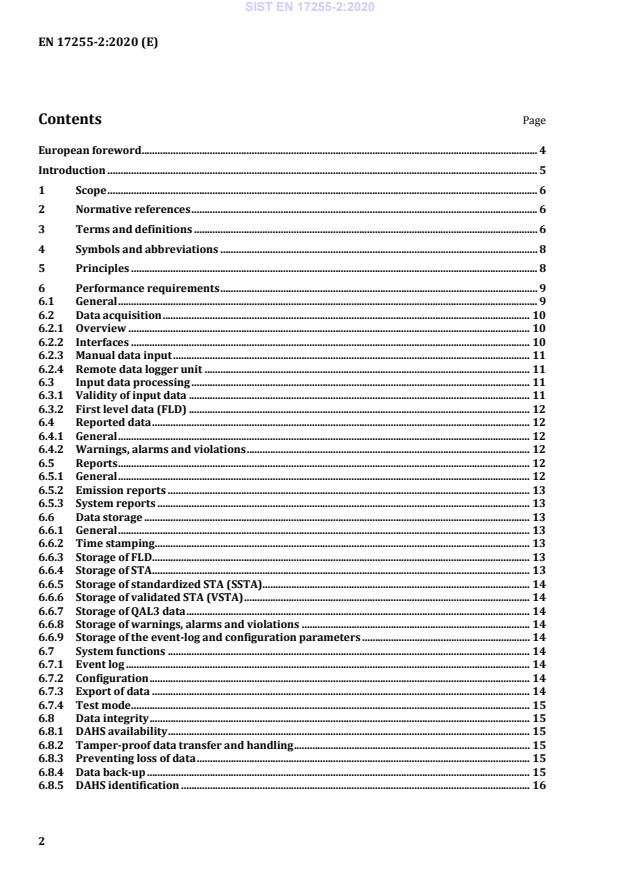
Contents Page
European foreword . 4
Introduction . 5
1 Scope . 6
2 Normative references . 6
3 Terms and definitions . 6
4 Symbols and abbreviations . 8
5 Principles . 8
6 Performance requirements . 9
6.1 General . 9
6.2 Data acquisition . 10
6.2.1 Overview . 10
6.2.2 Interfaces . 10
6.2.3 Manual data input . 11
6.2.4 Remote data logger unit . 11
6.3 Input data processing . 11
6.3.1 Validity of input data . 11
6.3.2 First level data (FLD) . 12
6.4 Reported data . 12
6.4.1 General . 12
6.4.2 Warnings, alarms and violations . 12
6.5 Reports . 12
6.5.1 General . 12
6.5.2 Emission reports . 13
6.5.3 System reports . 13
6.6 Data storage . 13
6.6.1 General . 13
6.6.2 Time stamping . 13
6.6.3 Storage of FLD . 13
6.6.4 Storage of STA . 13
6.6.5 Storage of standardized STA (SSTA). 14
6.6.6 Storage of validated STA (VSTA) . 14
6.6.7 Storage of QAL3 data . 14
6.6.8 Storage of warnings, alarms and violations . 14
6.6.9 Storage of the event-log and configuration parameters . 14
6.7 System functions . 14
6.7.1 Event log . 14
6.7.2 Configuration . 14
6.7.3 Export of data . 14
6.7.4 Test mode . 15
6.8 Data integrity . 15
6.8.1 DAHS availability . 15
6.8.2 Tamper-proof data transfer and handling . 15
6.8.3 Preventing loss of data . 15
6.8.4 Data back-up . 15
6.8.5 DAHS identification . 16
6.8.6 Time management . 16
6.9 Documentation . 16
Annex A (informative) Example list of configuration parameters . 17
A.1 Measurement channel configuration . 17
A.2 Data processing configuration . 18
A.3 Data storage configuration . 19
A.4 Report configuration . 19
Bibliography . 20
European foreword
This document (EN 17255-2:2020) has been prepared by Technical Committee CEN/TC 264 “Air
Quality”, the secretariat of which is held by DIN.
This document shall be given the status of a national standard, either by publication of an identical text
or by endorsement, at the latest by October 2020, and conflicting national standards shall be withdrawn
at the latest by October 2020.
Attention is drawn to the possibility that some of the elements of this document may be the subject of
patent rights. CEN shall not be held responsible for identifying any or all such patent rights.
This document is Part 2 of the EN 17255 series.
The EN 17255 series, published under the general title Stationary source emissions — Data acquisition
and handling systems, specifies:
— requirements for the handling and reporting of data;
— requirements on data acquisition and handling systems;
— requirements for the performance test of data acquisition and handling systems;
— requirements for the installation and on-going quality assurance and quality control of data
acquisition and handling systems.
According to the CEN-CENELEC Internal Regulations, the national standards organisations of the
following countries are bound to implement this document: Austria, Belgium, Bulgaria, Croatia, Cyprus,
Czech Republic, Denmark, Estonia, Finland, France, Germany, Greece, Hungary, Iceland, Ireland, Italy,
Latvia, Lithuania, Luxembourg, Malta, Netherlands, Norway, Poland, Portugal, Republic of North
Macedonia, Romania, Serbia, Slovakia, Slovenia, Spain, Sweden, Switzerland, Turkey and the United
Kingdom.
Introduction
This document forms part of a series of standards which, between them, govern the process for the
quality assurance of data received by a data acquisition and handling system (DAHS) from automated
measuring systems (AMS), being used for monitoring emissions from stationary sources and quality
ensured to EN 14181.
The input data can be either in analogue representation or in digital form directly from an AMS or via a
digital bus system. Inputs can include the data from the AMS, peripheral data needed for calculation of
the reported values and information on plant conditions needed to apply data selection criteria.
The data acquisition and handling system (DAHS) receives the raw data, as they are measured, averaged
and presented by the AMS, and converts, averages, stores and reports data as required by legislation.
This series of standards suggests that the process of data handling is best performed in a dedicated DAHS.
It does not preclude the use of other options for all or part of the process provided that it can be shown
to meet all of the requirements of the standard, particularly in relation to speed, accuracy, access, security
and validation.
This series of standards applies to all DAHS installed after the date of implementation of this document.
EN 17255-2 specifies the implementation of the calculations laid down in EN 17255-1 and the specific
requirements on functionality of the DAHS.
1 Scope
This document specifies the performance requirements on data acquisition and handling systems (DAHS)
regarding implementation of the procedures defined in EN 17255-1 including
— data acquisition;
— data processing;
— data storage;
— data output;
— generation of reports;
— system functions;
— data integrity;
— documentation.
This document supports the requirements of EN 14181 and legislation such as the IED and E-PRTR. It
does not preclude the use of additional features and functions provided the minimum requirements of
this document are met and that these features do not adversely affect data quality, clarity or access.
2 Normative references
The following documents are referred to in the text in such a way that some or all of their content
constitutes requirements of this document. For dated references, only the edition cited applies. For
undated references, the latest edition of the referenced document (including any amendments) applies.
EN 14181:2014, Stationary source emissions - Quality assurance of automated measuring systems
EN 17255-1, Stationary source emissions - Data acquisition and handling systems - Part 1: Specification of
requirements for the handling and reporting of data
IEEE 754, Floating-point arithmetic
3 Terms and definitions
For the purposes of this document, the terms and definitions given in EN 17255-1 and the following apply.
ISO and IEC maintain terminological databases for use in standardization at the following addresses:
— IEC Electropedia: available at http://www.electropedia.org/
— ISO Online browsing platform: available at https://www.iso.org/obp
3.1
warning signal
binary value or enumerated value signifying the need for action
Note 1 to entry: Warnings can be derived from measurement values or conditions, which are still within the
specified limits, but where the value is close to the specified limit. Warnings are for the benefit of the plant operator.
Note 2 to entry: Warnings can be conditions communicated to the plant operator as requiring attention.
Instrument conditions like operation exceeding the upper limit of the valid calibration range are also considered as
warnings.
3.2
alarm signal
binary value or enumerated value indicating an alarm state
Note 1 to entry: Examples of alarm signals are incidents where an ELV is exceeded,
Note 2 to entry: Examples of alarm signals from instruments include conditions such as out of operation, and
operation conditions like measurements outside the measurement range.
Note 3 to entry: A condition, which leads to an alarm, can lead to a violation, if it persists too long according to
directives, local permits or other standards.
Note 4 to entry: Alarms are conditions communicated to the plant operator indicating that the plant if it continues
in this state could enter into a condition where it is not any longer fulfilling the relevant directive conditions.
3.3
violation signal
binary value or enumerated value indicating presence of a condition where requirements of directives,
operating permits or other standards are exceeded
Note 1 to entry: Measured values above ELV at a duration exceeding the limit in the directives can cause a
violation signal.
Note 2 to entry: Instrument conditions like too many hours out of operation, and operation conditions like
exceeding the valid calibration range for too many time periods related to the short-term average can cause
violation signals.
3.4
data storage
electronic memory capacity to hold data for processing or documentation
Note 1 to entry: This document does not prescribe storage technology. It is always the responsibility of the plant
operator that the capacity and reliability of the chosen storage is sufficient.
3.5
permanent data storage
non-volatile data storage with the capacity to hold data for a period equal to or exceeding a required
minimum time period
3.6
event
occurrence that could affect the performance or processing of the DAHS
Note 1 to entry: Events can be caused by an operator, e.g. by adding or changing configuration data, peripheral
data, limit values, QAL2 data or basic information, or by the system itself, e.g. for watchdog restart, change to or
from DST, recovery from power cut, performing automatic backup, reporting lack of communication with AMS or
external data loggers, or generating reports.
4 Symbols and abbreviations
AMS automated measuring system
DAHS data acquisition and handling system
DST daylight saving time
ELV emission limit value
E-PRTR European pollutant release and transfer register
FLD first level data
IED industrial emissions directive
LTA long-term average
OPC open platform communication
QAL2 second quality assurance level
QAL3 third quality assurance level
SRM standard reference method
SSTA standardized short-term average
STA short-term average
UTC coordinated universal time
VSTA validated short-term average
5 Principles
This document specifies minimum requirements for the performance and functional capabilities of DAHS.
The minimum functional capabilities specified in this document are considered to be necessary to meet
the requirements of the relevant regulations (e.g. EU Directives) in terms of the provision of emissions
data for reporting. These functional capabilities also cover the traceability, security and ability to audit
reported data.
The DAHS provides the time stamp for input data.
Figure 1 shows the elements of the DAHS defined in this document.
Key
A DAHS
B1 AMS data interface
B2 peripheral data interface
B3 plant data interface
C input processing and production of FL
...