

EN 1793-6:2025
(Main)Road traffic noise reducing devices - Test method for determining the acoustic performance - Part 6: Intrinsic characteristics - Airborne sound insulation under direct sound field conditions
- Abstract
This document specifies a test method for measuring a quantity representative of the intrinsic characteristics of airborne sound insulation for road traffic noise reducing devices: the sound insulation index.
This document is applicable to:
— determination of the intrinsic characteristics of airborne sound insulation of noise reducing devices to be installed along roads, to be measured either on typical installations alongside roads or in laboratory conditions;
— determination of the intrinsic characteristics of airborne sound insulation of road traffic noise reducing devices in actual use;
— comparison of design specifications with actual performance data after the completion of the construction work;
— verification of the long-term performance of road traffic noise reducing devices (with a repeated application of the method);
— interactive design process of new products, including the formulation of installation manuals.
This document does not apply to:
— the determination of the intrinsic characteristics of airborne sound insulation of road traffic noise reducing devices to be installed in reverberant conditions, e.g. inside tunnels or deep trenches or under covers.
Results for the sound insulation index are expressed as a function of frequency in one-third octave bands, between 200 Hz and 5 kHz for qualification purposes. If it is not possible to get valid measurement results over the whole frequency range indicated, the results are given in a restricted frequency range and the reasons for the restriction(s) are clearly reported.
For indoor measurements, see Annex D.
- Status
- Published
- Publication Date
- 23-Dec-2025
- Technical Committee
- CEN/TC 226 - Road equipment
- Drafting Committee
- CEN/TC 226/WG 6 - Noise reducing devices
- Current Stage
- 6060 - Definitive text made available (DAV) - Publishing
- Start Date
- 24-Dec-2025
- Due Date
- 18-Jan-2023
- Completion Date
- 24-Dec-2025


Overview
EN 1793-6:2025, published by CEN (CEN/TC 226), specifies a test method to determine the intrinsic airborne sound insulation of road traffic noise reducing devices. The standard defines the sound insulation index as the key quantity and is applicable to both laboratory and in‑situ measurements under direct sound field conditions. Results are reported as a function of frequency in one-third octave bands (qualification range: 200 Hz to 5 kHz). The method supersedes EN 1793-6:2018+A1:2021 and introduces several technical updates to support consistent product qualification and verification.
Key Topics
- Measured quantity: The sound insulation index representing intrinsic airborne sound insulation of noise reducing devices.
- Measurement scope: Applicable to full-size test samples, typical installations alongside roads, and devices in actual use. Not intended for reverberant environments (e.g., tunnels, deep trenches or covers).
- Frequency range: Results expressed per one-third octave band between 200 Hz and 5 kHz; restricted ranges are permitted if valid results cannot be obtained across the full band, with reasons reported.
- Measurement technique: The scanning technique is now based on a nine-microphone grid; the previous single-microphone displaced method has been abandoned.
- Data handling & uncertainty: The document provides requirements for calibration, sampling, background-noise handling, temporal windowing (Adrienne window), and measurement uncertainty; annexes include reproducibility and repeatability guidance.
- Single-number rating: The formula for calculating global single-number rating (DL) has been updated and the use of rating categories is no longer permitted.
- Annexes: Practical supporting material includes low-frequency guidance (Annex A), measurement uncertainty (Annex B), a normative test report template (Annex C), and indoor measurement guidance for product qualification (Annex D).
Applications
EN 1793-6:2025 is intended to deliver practical value across the product lifecycle:
- Product qualification: Laboratory or purpose-built indoor/outdoor facilities can use the method to qualify noise reduction products prior to installation.
- In-situ verification: Verify that installed noise barriers and other noise reducing devices achieve their design performance under actual field conditions.
- Design and development: Support interactive product development and preparation of installation manuals by providing intrinsic airborne insulation data.
- Compliance & long-term monitoring: Compare post-construction performance to design specifications and perform repeated measurements to verify long-term performance and maintenance needs.
Related Standards
EN 1793-6:2025 is part of the EN 1793 series and should be read alongside:
- EN 1793-1:2023 - Sound absorption (diffuse field)
- EN 1793-2:2023 - Airborne sound insulation under diffuse sound field conditions (comparable but not identical results)
- EN 1793-3 / EN 1793-4 / EN 1793-5 - Related methods for traffic noise spectrum, sound diffraction and reflection
This standard provides a robust, repeatable basis for measuring airborne sound insulation of noise barriers and related devices under direct sound field conditions, enabling consistent verification, design support and long-term performance assessment.
Relations
- Effective Date
- 18-Jan-2023
- Effective Date
- 09-Feb-2026
- Effective Date
- 09-Feb-2026
- Effective Date
- 28-Jan-2026
- Refers
EN 14389:2023 - Road traffic noise reducing devices - Procedures for assessing long term performance - Effective Date
- 28-Jan-2026
- Effective Date
- 28-Jan-2026
- Effective Date
- 28-Jan-2026
- Effective Date
- 28-Jan-2026
- Effective Date
- 04-Nov-2020
Get Certified
Connect with accredited certification bodies for this standard

BSMI (Bureau of Standards, Metrology and Inspection)
Taiwan's standards and inspection authority.
Zavod za gradbeništvo Slovenije (ZAG) - Inšpekcija
ZAG inspection body for construction products, structures, and materials.
Sponsored listings
Frequently Asked Questions
EN 1793-6:2025 is a standard published by the European Committee for Standardization (CEN). Its full title is "Road traffic noise reducing devices - Test method for determining the acoustic performance - Part 6: Intrinsic characteristics - Airborne sound insulation under direct sound field conditions". This standard covers: This document specifies a test method for measuring a quantity representative of the intrinsic characteristics of airborne sound insulation for road traffic noise reducing devices: the sound insulation index. This document is applicable to: — determination of the intrinsic characteristics of airborne sound insulation of noise reducing devices to be installed along roads, to be measured either on typical installations alongside roads or in laboratory conditions; — determination of the intrinsic characteristics of airborne sound insulation of road traffic noise reducing devices in actual use; — comparison of design specifications with actual performance data after the completion of the construction work; — verification of the long-term performance of road traffic noise reducing devices (with a repeated application of the method); — interactive design process of new products, including the formulation of installation manuals. This document does not apply to: — the determination of the intrinsic characteristics of airborne sound insulation of road traffic noise reducing devices to be installed in reverberant conditions, e.g. inside tunnels or deep trenches or under covers. Results for the sound insulation index are expressed as a function of frequency in one-third octave bands, between 200 Hz and 5 kHz for qualification purposes. If it is not possible to get valid measurement results over the whole frequency range indicated, the results are given in a restricted frequency range and the reasons for the restriction(s) are clearly reported. For indoor measurements, see Annex D.
This document specifies a test method for measuring a quantity representative of the intrinsic characteristics of airborne sound insulation for road traffic noise reducing devices: the sound insulation index. This document is applicable to: — determination of the intrinsic characteristics of airborne sound insulation of noise reducing devices to be installed along roads, to be measured either on typical installations alongside roads or in laboratory conditions; — determination of the intrinsic characteristics of airborne sound insulation of road traffic noise reducing devices in actual use; — comparison of design specifications with actual performance data after the completion of the construction work; — verification of the long-term performance of road traffic noise reducing devices (with a repeated application of the method); — interactive design process of new products, including the formulation of installation manuals. This document does not apply to: — the determination of the intrinsic characteristics of airborne sound insulation of road traffic noise reducing devices to be installed in reverberant conditions, e.g. inside tunnels or deep trenches or under covers. Results for the sound insulation index are expressed as a function of frequency in one-third octave bands, between 200 Hz and 5 kHz for qualification purposes. If it is not possible to get valid measurement results over the whole frequency range indicated, the results are given in a restricted frequency range and the reasons for the restriction(s) are clearly reported. For indoor measurements, see Annex D.
EN 1793-6:2025 is classified under the following ICS (International Classification for Standards) categories: 17.140.30 - Noise emitted by means of transport; 93.080.30 - Road equipment and installations. The ICS classification helps identify the subject area and facilitates finding related standards.
EN 1793-6:2025 has the following relationships with other standards: It is inter standard links to EN 1793-6:2018+A1:2021, ISO/IEC Guide 98-3:2008, EN 61672-1:2013, EN 1793-3:2025, EN 14389:2023, EN 1793-4:2025, EN 1793-4:2015, EN 14388:2015, EN 1793-6:2018. Understanding these relationships helps ensure you are using the most current and applicable version of the standard.
EN 1793-6:2025 is available in PDF format for immediate download after purchase. The document can be added to your cart and obtained through the secure checkout process. Digital delivery ensures instant access to the complete standard document.
Standards Content (Sample)
SLOVENSKI STANDARD
01-februar-2026
Nadomešča:
SIST EN 1793-6:2018+A1:2021
Protihrupne ovire za cestni promet - Preskusna metoda za ugotavljanje akustičnih
lastnosti - 6. del: Bistvene značilnosti - Izoliranost pred zvokom v zraku pri
usmerjenem zvočnem polju
Road traffic noise reducing devices - Test method for determining the acoustic
performance - Part 6: Intrinsic characteristics - Airborne sound insulation under direct
sound field conditions
Lärmschutzvorrichtungen an Straßen - Prüfverfahren zur Bestimmung der akustischen
Eigenschaften - Teil 6: Produktspezifische Merkmale - Luftschalldämmung in gerichteten
Schallfeldern
Dispositifs de réduction du bruit du trafic routier - Méthode d'essai pour la détermination
de la performance acoustique - Partie 6 : Caractéristiques intrinsèques - Isolation au
bruit aérien dans des conditions de champ acoustique direct
Ta slovenski standard je istoveten z: EN 1793-6:2025
ICS:
17.140.30 Emisija hrupa transportnih Noise emitted by means of
sredstev transport
93.080.30 Cestna oprema in pomožne Road equipment and
naprave installations
2003-01.Slovenski inštitut za standardizacijo. Razmnoževanje celote ali delov tega standarda ni dovoljeno.
EN 1793-6
EUROPEAN STANDARD
NORME EUROPÉENNE
December 2025
EUROPÄISCHE NORM
ICS 17.140.30; 93.080.30 Supersedes EN 1793-6:2018+A1:2021
English Version
Road traffic noise reducing devices - Test method for
determining the acoustic performance - Part 6: Intrinsic
characteristics - Airborne sound insulation under direct
sound field conditions
Dispositifs de réduction du bruit du trafic routier - Lärmschutzvorrichtungen an Straßen - Prüfverfahren
Méthode d'essai pour la détermination de la zur Bestimmung der akustischen Eigenschaften - Teil
performance acoustique - Partie 6 : Caractéristiques 6: Produktspezifische Merkmale - Luftschalldämmung
intrinsèques - Isolation au bruit aérien dans des in gerichteten Schallfeldern
conditions de champ acoustique direct
This European Standard was approved by CEN on 17 November 2025.
CEN members are bound to comply with the CEN/CENELEC Internal Regulations which stipulate the conditions for giving this
European Standard the status of a national standard without any alteration. Up-to-date lists and bibliographical references
concerning such national standards may be obtained on application to the CEN-CENELEC Management Centre or to any CEN
member.
This European Standard exists in three official versions (English, French, German). A version in any other language made by
translation under the responsibility of a CEN member into its own language and notified to the CEN-CENELEC Management
Centre has the same status as the official versions.
CEN members are the national standards bodies of Austria, Belgium, Bulgaria, Croatia, Cyprus, Czech Republic, Denmark, Estonia,
Finland, France, Germany, Greece, Hungary, Iceland, Ireland, Italy, Latvia, Lithuania, Luxembourg, Malta, Netherlands, Norway,
Poland, Portugal, Republic of North Macedonia, Romania, Serbia, Slovakia, Slovenia, Spain, Sweden, Switzerland, Türkiye and
United Kingdom.
EUROPEAN COMMITTEE FOR STANDARDIZATION
COMITÉ EUROPÉEN DE NORMALISATION
EUROPÄISCHES KOMITEE FÜR NORMUNG
CEN-CENELEC Management Centre: Rue de la Science 23, B-1040 Brussels
© 2025 CEN All rights of exploitation in any form and by any means reserved Ref. No. EN 1793-6:2025 E
worldwide for CEN national Members.
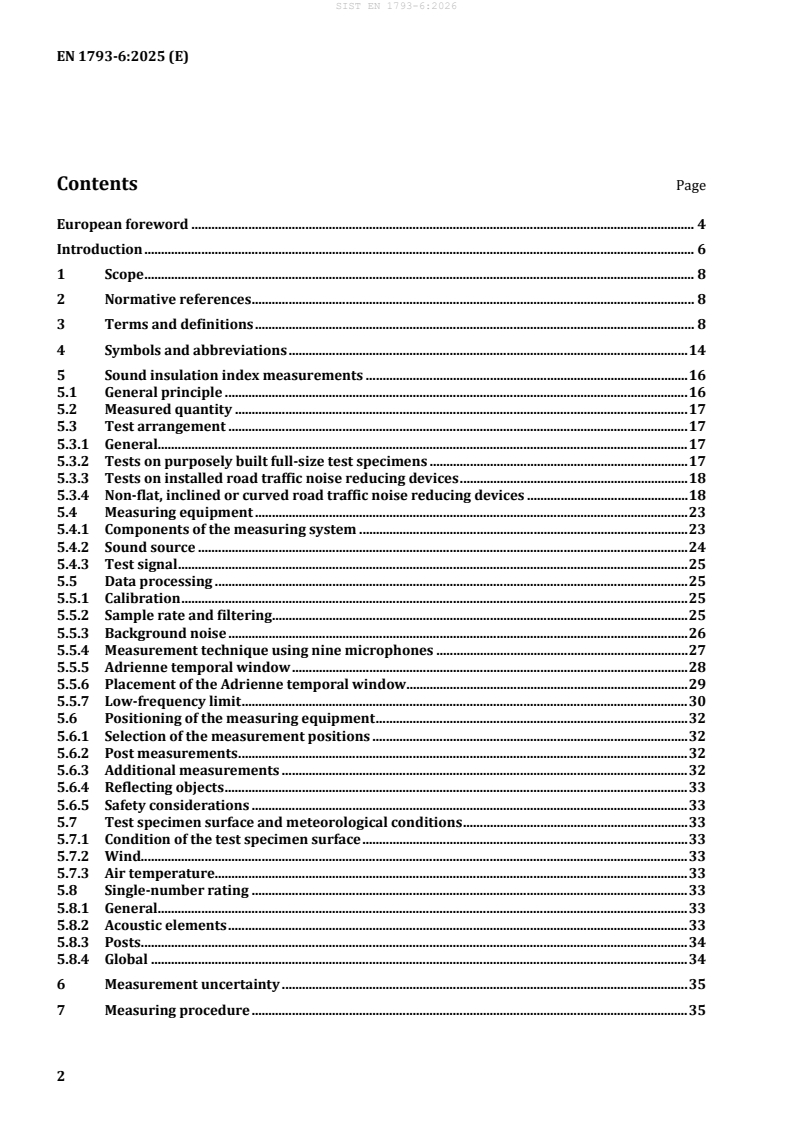
Contents Page
European foreword . 4
Introduction . 6
1 Scope . 8
2 Normative references . 8
3 Terms and definitions . 8
4 Symbols and abbreviations . 14
5 Sound insulation index measurements . 16
5.1 General principle . 16
5.2 Measured quantity . 17
5.3 Test arrangement . 17
5.3.1 General. 17
5.3.2 Tests on purposely built full-size test specimens . 17
5.3.3 Tests on installed road traffic noise reducing devices . 18
5.3.4 Non-flat, inclined or curved road traffic noise reducing devices . 18
5.4 Measuring equipment . 23
5.4.1 Components of the measuring system . 23
5.4.2 Sound source . 24
5.4.3 Test signal . 25
5.5 Data processing . 25
5.5.1 Calibration . 25
5.5.2 Sample rate and filtering. 25
5.5.3 Background noise . 26
5.5.4 Measurement technique using nine microphones . 27
5.5.5 Adrienne temporal window . 28
5.5.6 Placement of the Adrienne temporal window . 29
5.5.7 Low-frequency limit . 30
5.6 Positioning of the measuring equipment . 32
5.6.1 Selection of the measurement positions . 32
5.6.2 Post measurements . 32
5.6.3 Additional measurements . 32
5.6.4 Reflecting objects . 33
5.6.5 Safety considerations . 33
5.7 Test specimen surface and meteorological conditions . 33
5.7.1 Condition of the test specimen surface . 33
5.7.2 Wind. 33
5.7.3 Air temperature. 33
5.8 Single-number rating . 33
5.8.1 General. 33
5.8.2 Acoustic elements . 33
5.8.3 Posts . 34
5.8.4 Global . 34
6 Measurement uncertainty . 35
7 Measuring procedure . 35
8 Test report . 36
Annex A (informative) Low-frequency limit and window width . 38
Annex B (normative) Measurement uncertainty . 43
B.1 General . 43
B.2 Measurement uncertainty based upon reproducibility data . 43
B.3 Standard deviation of repeatability and reproducibility of the sound insulation
index . 43
Annex C (normative) Template of test report on airborne sound insulation of road traffic
noise reducing devices. 46
C.1 General . 46
C.2 Test setup (example) . 48
C.3 Test object and test situation (example) . 50
C.4 Results (example) . 52
C.4.1 Part 1 – Results for ‘element’ in tabular form . 52
C.4.2 Part 2 – Results for ‘element’ in graphic form . 53
C.4.3 Part 3 – Results for ‘post’ in tabular form . 54
C.4.4 Part 4 – Results for ‘post’ in graphic form . 55
C.5 Uncertainty (example) . 55
Annex D (normative) Indoor measurements for product qualification . 58
D.1 General . 58
D.2 Parasitic reflections . 58
D.3 Reverberation time of the room . 58
Bibliography . 59
European foreword
This document (EN 1793-6:2025) has been prepared by Technical Committee CEN/TC 226 “Road
equipment”, the secretariat of which is held by AFNOR.
This European Standard shall be given the status of a national standard, either by publication of an
identical text or by endorsement, at the latest by June 2026, and conflicting national standards shall be
withdrawn at the latest by June 2026.
Attention is drawn to the possibility that some of the elements of this document may be the subject of
patent rights. CEN shall not be held responsible for identifying any or all such patent rights.
This document supersedes EN 1793-6:2018+A1:2021.
6:2018+A1:2021:
— the definitions from 3.1 to 3.8 have been updated to be in accordance with all other parts of the
series of standards;
— the measurement technique is based on a nine-microphone grid; the use of a single microphone
displaced in nine positions has been abandoned;
— the formula to calculate the global single-number rating DL used in the previous version of this
SI,G
document has been changed;
— the use of categories of single-number rating is no longer permitted;
— one value for the standard deviation of reproducibility and repeatability in each one-third octave
frequency band has been retained, in place of three values (min, max and median) as before (see
Tables B.1 and B.2);
— the example in C.5 on the declaration of the measurement uncertainty has been updated
accordingly.
The EN 1793 series, under the general title Road traffic noise reducing devices — Test method for
determining the acoustic performance, consists of the following parts:
— Part 1: Intrinsic characteristics — Sound absorption under diffuse sound field conditions;
— Part 2: Intrinsic characteristics — Airborne sound insulation under diffuse sound field conditions;
— Part 3: Normalized traffic noise spectrum;
— Part 4: Intrinsic characteristics — Intrinsic sound diffraction;
— Part 5: Intrinsic characteristics — Sound absorption under direct sound field conditions;
— Part 6: Intrinsic characteristics — Airborne sound insulation under direct sound field conditions.
Any feedback and questions on this document should be directed to the users’ national standards body.
A complete listing of these bodies can be found on the CEN website.
According to the CEN-CENELEC Internal Regulations, the national standards organisations of the
following countries are bound to implement this European Standard: Austria, Belgium, Bulgaria,
Croatia, Cyprus, Czech Republic, Denmark, Estonia, Finland, France, Germany, Greece, Hungary, Iceland,
Ireland, Italy, Latvia, Lithuania, Luxembourg, Malta, Netherlands, Norway, Poland, Portugal, Republic of
North Macedonia, Romania, Serbia, Slovakia, Slovenia, Spain, Sweden, Switzerland, Türkiye and the
United Kingdom.
Introduction
Noise reducing devices alongside roads should provide adequate sound insulation so that sound
transmitted through the device is not significant compared with the sound diffracted over the top. This
document specifies a test method for assessing the intrinsic airborne sound insulation performance of
road traffic noise reducing devices designed for non-reverberant conditions. It can be applied indoors
or outdoors. Indoors, it can be applied in a purposely built test facility, e.g. inside a laboratory.
Outdoors, it can be applied in a purposely built test facility, e.g. near a laboratory or a factory, as well as
in situ, i.e. where the road traffic noise reducing devices are installed. The method can be applied
without damaging the surface of the road traffic noise reducing device.
The method can be used to qualify products to be installed along roads as well as to verify the
compliance of installed road traffic noise reducing devices to design specifications. Regular application
of the method can be used to verify the long-term performance of road traffic noise reducing devices.
The method requires the averaging of results of measurements taken at different points behind the
device under test. The method is able to investigate flat and non-flat products.
The method uses the same principles and equipment for measuring sound reflection (see EN 1793-
5:2025) and airborne sound insulation (the present document).
The measurement results of this method for airborne sound insulation are comparable but not identical
with the results of EN 1793-2:2025 method, mainly because the present method uses a directional
sound field, while EN 1793-2:2025 method assumes a diffuse sound field (where all angles of incidence
are equally probable). Research studies suggest that a good correlation exists between laboratory data,
measured according to EN 1793-2:2025 and field data, measured according to the method described in
the present document [4-9].
The test method described in this document should not be used to determine the intrinsic
characteristics of airborne sound insulation for road traffic noise reducing devices to be installed in
reverberant conditions, e.g. inside tunnels or deep trenches or under covers.
For the purpose of this document, reverberant conditions are defined based on the geometric envelope,
e, across the road formed by the barriers, trench sides or buildings (the envelope does not include the
road surface) as shown by the dashed lines in Figure 1. Conditions are defined as being reverberant
when the percentage of open space in the envelope is less than or equal to 25 %, i.e. reverberant
conditions occur when w/e ≤ 0,25, where e = (w+h +h ).
1 2
This document introduces a specific quantity, called sound insulation index, to define the airborne
sound insulation of a road traffic noise reducing device. This quantity should not be confused with the
sound reduction index used in building acoustics, sometimes also called transmission loss.
This method can be used to qualify noise reducing devices for other applications, e.g. to be installed
nearby industrial sites. In this case, the single-number ratings can preferably be calculated using an
appropriate spectrum.
a) Partial cover on both sides of the road; b) Partial cover on one side of the road;
envelope, e = w+h +h envelope, e = w+h ; h = 0
1 2 1 2
c) Deep trench; d) Tall barriers or buildings;
envelope, e = w+h +h envelope, e = w+h +h
1 2 1 2
Key
r road surface
w width of open space
h developed length of the construction, e.g. cover, trench side, barrier or building
h developed length of the construction, e.g. cover, trench side, barrier or building
NOTE Figure 1 is not to scale.
Figure 1 — Sketch of the reverberant condition check in four cases
1 Scope
This document specifies a test method for measuring a quantity representative of the intrinsic
characteristics of airborne sound insulation for road traffic noise reducing devices: the sound insulation
index.
This document is applicable to:
— determination of the intrinsic characteristics of airborne sound insulation of noise reducing devices
to be installed along roads, to be measured either on typical installations alongside roads or in
laboratory conditions;
— determination of the intrinsic characteristics of airborne sound insulation of road traffic noise
reducing devices in actual use;
— comparison of design specifications with actual performance data after the completion of the
construction work;
— verification of the long-term performance of road traffic noise reducing devices (with a repeated
application of the method);
— interactive design process of new products, including the formulation of installation manuals.
This document does not apply to:
— the determination of the intrinsic characteristics of airborne sound insulation of road traffic noise
reducing devices to be installed in reverberant conditions, e.g. inside tunnels or deep trenches or
under covers.
Results for the sound insulation index are expressed as a function of frequency in one-third octave
bands, between 200 Hz and 5 kHz for qualification purposes. If it is not possible to get valid
measurement results over the whole frequency range indicated, the results are given in a restricted
frequency range and the reasons for the restriction(s) are clearly reported.
For indoor measurements, see Annex D.
2 Normative references
The following documents are referred to in the text in such a way that some or all of their content
constitutes requirements of this document. For dated references, only the edition cited applies. For
undated references, the latest edition of the referenced document (including any amendments) applies.
EN 1793-3, Road traffic noise reducing devices — Test method for determining the acoustic performance
— Part 3: Normalized traffic noise spectrum
EN 14389:2023, Road traffic noise reducing devices — Procedures for assessing long term performance
EN 61672-1, Electroacoustics — Sound level meters — Part 1: Specifications (IEC 61672-1)
ISO/IEC Guide 98-3:2008, Uncertainty of measurement — Part 3: Guide to the expression of uncertainty
in measurement (GUM:1995)
3 Terms and definitions
For the purposes of this document, the following terms and definitions apply.
3.1
road traffic noise reducing device
RTNRD
device designed to reduce the propagation of traffic noise away from the road environment
Note 1 to entry: An RTNRD can comprise acoustic elements (3.2) only or both structural (3.3) and acoustic
elements.
Note 2 to entry: Applications of RTNRDs include noise barriers (3.5), claddings (3.6), covers (3.7) and added
devices (3.8).
3.2
acoustic element
element whose primary function is to provide the acoustic performance of the device
3.3
structural element
element whose primary function is to support or hold in place the parts of the RTNRD
3.4
self-supporting acoustic element
acoustic element including its own structural element to support itself
3.5
noise barrier
road traffic noise reducing device which obstructs the direct transmission of airborne sound emanating
from road traffic
3.6
cladding
road traffic noise reducing device which is attached to a wall or other structure and reduces the amount
of sound reflected
3.7
cover
road traffic noise reducing device which either spans or overhangs the road
3.8
added device
additional component that influences the acoustic performance of the original road traffic noise
reducing device
Note 1 to entry: The added device is acting primarily on the diffracted sound energy.
3.9
sound insulation index
quantity representing the amount of sound not transmitted through the device under test
Note 1 to entry: Formula (1) specifies how to calculate the sound insulation index.
Note 2 to entry: The sound insulation index values in one-third octave bands are the result of a test according to
the present document.
3.10
reference height
height h equal to half the height, h , of the road traffic noise reducing device under test: h = h /2
S B S B
Note 1 to entry: See Figures 2, 4, 6, 7 and 8
Note 2 to entry: When the height of the device under test is greater than 4 m and, for practical reasons, it is not
advisable to have a height of the source h = h /2, it is possible to have h = 2 m, accepting the corresponding
S B S
low-frequency limitation (see 5.5.7).
3.11
source reference surface for sound insulation index measurements
ideal, smooth surface facing the sound source side of the road traffic noise reducing device under test
and just touching the most protruding and significant parts of it within the tested area
Note 1 to entry: The reference surface is as smooth as possible, and follows the inclination or curve of the device
under test within the tested area. For vertical and flat road traffic noise reducing devices, the reference surface is a
vertical plane. For inclined and flat road traffic noise reducing devices, the reference surface is a plane with the
same inclination. For curve and flat road traffic noise reducing devices, the reference surface is a curve surface
with the same curvature.
Note 2 to entry: See Figures 2, 7 and 8.
3.12
microphone reference surface
ideal, smooth surface facing the receiver side of the road traffic noise reducing device under test and
just touching the most protruding and significant parts of it within the tested area
Note 1 to entry: The reference surface is as smooth as possible, and follows the inclination or curve of the device
under test within the tested area. For vertical and flat road traffic noise reducing devices, the reference surface is a
vertical plane. For inclined and flat road traffic noise reducing devices, the reference surface is a plane with the
same inclination. For curve road traffic noise reducing devices, the reference surface is a curve surface with the
same curvature.
Note 2 to entry: See Figures 2, 7 and 8.
3.13
source reference position
position facing the side to be exposed to noise when the device is in place, located at the reference
height h and placed so that its horizontal distance to the source reference surface is d = 1 m
S s
Note 1 to entry: See Figures 2, 4, 6, 7 and 8.
Note 2 to entry: The actual dimensions of the loudspeaker used for the background research on which this
document is based are: 0,40 m × 0,285 m × 0,285 m (length × width × height).
3.14
measurement grid for sound insulation index measurements
measurement grid constituted of nine equally spaced microphones in a 3×3 squared configuration
Note 1 to entry: The orthogonal spacing between two subsequent microphones, either vertically or horizontally,
is s = 0,40 m.
Note 2 to entry: See Figures 2, 3, 4, 6, 7, 8 and 5.5.4.
3.15
measurement grid reference position
position facing the receiver side of the device under test, located at the reference height h and placed
S
so that its horizontal distance to the microphone reference surface is d = 0,25 m
M
Note 1 to entry: See Figures 2, 6, 7 and 8.
3.16
barrier thickness for sound insulation index measurements
distance t between the source reference surface and the microphone reference surface at a height
B
equal to the reference height h
S
Note 1 to entry: See Figures 2, 6, 7 and 8.
3.17
free-field measurement for sound insulation index measurements
measurement taken with the loudspeaker and the measurement microphones in an acoustic free-field
in order to avoid reflections from any nearby object, including the ground and the noise reducing device
under test, keeping the same geometry as when measuring across the noise reducing device under test
Note 1 to entry: see Figure 4.
3.18
Adrienne temporal window
analysis window in the time domain to be used for the data processing according to the present
document
Note 1 to entry: The Adrienne temporal window is described in 5.5.5.
3.19
background noise
noise coming from sources other than the sound source emitting the test signal
3.20
signal-to-noise ratio
S/N
difference in decibels between the level of the test signal and the level of the background noise at the
moment of detection of the test signal (within the Adrienne temporal window)
3.21
impulse response
time signal at the output of a system when a Dirac function is applied to the input
Note 1 to entry: The Dirac function, also called δ function, is the mathematical idealisation of a signal infinitely
short in time that carries a unit amount of energy.
Note 2 to entry: It is impossible in practice to create and radiate true Dirac delta functions. Short transient sounds
can offer close enough approximations but are not very repeatable. An alternative measurement technique,
generally more accurate, is to use a period of deterministic, flat-spectrum signal, like maximum-length sequence
(MLS) or exponential sine sweep (ESS), and transform the measured response back to an impulse response.
Key
1 road traffic noise reducing device height, 5 loudspeaker front panel
h [m]
B
2 source reference surface 6 distance between the loudspeaker front panel and source
reference surface, d [m]
S
3 microphone reference surface 7 microphone grid
4 reference height, h [m] 8 distance between the microphone grid and the microphone
s
reference surface, dM [m]
Figure 2 — Sketch of the loudspeaker and the microphone grid close to a vertical road traffic
noise reducing device under test for sound insulation index measurements (not to scale)
Key
1 road traffic noise reducing device height h [m] 2 reference height h [m]
B S
3 orthogonal spacing between two subsequent microphones s [m] M1…M9 microphone positions
NOTE Figure not to scale.
Figure 3 — Measurement grid for sound insulation index measurements in front of a vertical
road traffic noise reducing device (sound source side)
Key
1 loudspeaker front panel 5 Road traffic noise reducing device thickness t at
B
height h [m]
S
2 measurement grid 6 horizontal distance microphone 5 - microphone
reference surface d at height h [m]
M S
3 reference height h [m] 7 Horizontal distance loudspeaker - microphone 5 d
S T
at height h [m]
S
4 horizontal distance loudspeaker - source
reference surface d at height h [m]
S S
NOTE 1 d= d++t d ; see Formula (5).
T SB M
NOTE 2 Figure not to scale.
Figure 4 — Sketch of the set-up for the reference “free-field” sound measurement for the
determination of the sound insulation index
4 Symbols and abbreviations
For the purposes of this document, the symbols and abbreviations in Table 1 apply.
Table 1 — Symbols and abbreviations
Symbol or Designation Unit
abbreviation
a , a , a , a Coefficient for the expression of the four-term full Blackman-Harris -
0 1 2 3
window
b Depth of the surface structure of the test specimen m
s
b Width of a portion of material of the test specimen m
m
c Speed of sound in air m/s
d Horizontal distance from the microphone reference surface to the m
M
measurement grid; it is equal to d = 0,25 m
M
d Horizontal distance from the front panel of the loudspeaker to the sound m
S
source reference surface; it is equal to: d = 1 m
S
Symbol or Designation Unit
abbreviation
d Horizontal distance from the front panel of the loudspeaker to the m
T
measurement grid; it is equal to: d + t + d
S B M
DL Single number rating of sound insulation dB
SI
δ Any input quantity to allow for uncertainty estimates -
i
Δf Width of the j-th one-third octave frequency band Hz
j
F Symbol of the Fourier transform -
f Frequency Hz
f Low-frequency limit of sound insulation index measurements Hz
min
f Sample rate Hz
s
f cut-off frequency of the anti-aliasing filter Hz
co
h Noise reducing device height m
B
h Reference height m
S
h (t) Incident reference component of the free-field impulse response at the k-th -
i,k
measurement point
h (t) Transmitted component of the impulse response at the k-th measurement -
t,k
point
h (t) Background noise component of the impulse response at the k-th -
n,k
measurement point;
j Index of the j-th one-third octave frequency band (between 100 Hz and -
5 kHz, where possible)
k Index of the k-th measurement point (k = 1 … n) -
k Coverage factor -
p
k Constant used for the anti-aliasing filter -
f
L Length of an acoustical element m
E
L Spatial period length of a non-homogeneous noise reducing device m
p
n Number of measurement points on which to average (n = 9) -
SI Sound insulation index in the j-th one-third octave frequency band -
j
s Orthogonal spacing between two subsequent microphones m
s Standard deviation of repeatability -
r
s Standard deviation of reproducibility -
R
S/N Signal to noise ratio dB
Standard deviation of reproducibility of the single-number rating for -
s
R,DL
SI,E
“elements”
Symbol or Designation Unit
abbreviation
Standard deviation of reproducibility of the single-number rating for -
s
R,DL
SI,P
“posts”
Standard deviation of reproducibility of the single-number rating for -
s
R,DL
SI,G
“global”
S/N Signal-to-noise-ratio at the k-th microphone dB
k
S/N Signal-to-noise-ratio at the k-th microphone in the j-th one-third frequency dB
j,k
band
t Time s
t Thickness of the noise reducing device under test at the height h m
B S
t Air temperature °C
C
T Length of the Blackman-Harris trailing edge of the Adrienne temporal s
W,BH
window
T Total length of the Adrienne temporal window s
W,ADR
u Standard uncertainty -
U Expanded uncertainty -
w (t) Time window (Adrienne temporal window) for the incident reference -
i,k
component of the free-field impulse response at the k-th measurement
point
w (t) Time window (Adrienne temporal window) for the transmitted component -
t,k
at the k-th measurement point
5 Sound insulation index measurements
5.1 General principle
The sound source emits a transient sound wave that travels toward the device under test and is partly
reflected, partly transmitted and partly diffracted by it. The microphone placed on the other side of the
device under test receives both the transmitted sound pressure wave travelling from the sound source
through the device under test, and the sound pressure wave diffracted by the top edge of the device
under test (for the test to be meaningful the diffraction from the lateral edges should be sufficiently
delayed). If the measurement is repeated without the device under test between the loudspeaker and
the microphone, the direct free-field wave can be acquired. The power spectra of the direct wave and
the transmitted wave give the basis for calculating the sound insulation index.
The sound insulation index shall be the logarithmic average of the values measured at nine points
placed on the measurement grid (measurement points). See Figure 3 and Formula (1).
The measurement shall take place in a sound field free from reflections within the Adrienne temporal
window. For this reason, the acquisition of an impulse response having peaks as sharp as possible is
recommended: in this way, the reflections coming from other surfaces can be identified from their delay
time and rejected.
For measurements carried out indoors or under geometric site conditions that may create a
reverberant field on the emission or reception side (tunnel exits, building facades, etc.), the
requirements of Annex D shall be verified.
5.2 Measured quantity
The expression used to compute the sound insulation index SI as a function of frequency, in one-third
octave bands, is:
F h t w t df
( ) ( )
t,k tk
∫
∆ f
n
1 j
SI =−⋅10 lg (1)
j
∑
k=1 2
n
F h t w t df
( ) ( )
∫ i,k ik
∆ f
j
where
h (t) is the incident reference component of the free-field impulse response at the k-th
i,k
measurement point;
h (t) is the transmitted component of the impulse response at the k-th measurement point;
t,k
w (t) is the time window (Adrienne temporal window) for the incident reference component
i,k
of the free-field impulse response at the k-th measurement point;
w (t) is the time window (Adrienne temporal window) for the transmitted component at the
t,k
k-th measurement point;
F is the symbol of the Fourier transform;
j is the index of the j-th one-third octave frequency band (between 100 Hz and 5 kHz,
where possible);
Δf is the width of the j-th one-third octave frequency band;
i
n = 9 is the number of measurement points.
5.3 Test arrangement
5.3.1 General
The test method can be applied either on road traffic noise reducing devices installed alongside roads
or on real-size test specimens purposely assembled to be tested (indoors or outdoors) using the method
described here.
5.3.2 Tests on purposely built full-size test specimens
For applications on full-size test specimens purposely built to be tested using the method described
here, e.g. in an outdoor test facility for the declaration of performance, the specimen shall be built as
follows (see Figure 5):
— a part, composed of acoustic elements, that extends at least 4 m and is at least 4 m high;
— a post 4 m high (if applicable for the specific noise reducing device under test);
— a part, composed of acoustic elements, that extends at least 2 m and is at least 4 m high.
The test specimen shall be mounted and assembled in the same manner as the manufactured device is
used in practice with the same connections and seals between component parts.
The tested area is a circle having a radius of 2 m centred on the middle of the measurement grid. The
test specimen shall be built large enough to completely include this circle for each measurement.
For qualifying the sound insulation index across posts only, it is only necessary to have acoustic
elements that extend 2 m or more on either side of the post (see Figure 5).
If the device under test has a post-to-post distance of less than 4 m, the distance between posts should
be reduced accordingly, but the overall minimum width of the construction should be the same as
shown in Figure 5.
5.3.3 Tests on installed road traffic noise reducing devices
For applications on noise reducing devices that are already installed along roads, the test specimen
shall be constructed as follows:
— for installed road traffic noise reducing devices using single acoustic elements to achieve full
height:
• the test specimen shall be constructed as a single element which is representative of the
specific application;
• where the test specimen cannot be constructed as a single element or where the installed road
traffic noise reducing device is lower than 4 m, the test specimen shall be centred on the
loudspeaker axis (at reference height h = 2 m above the ground) and built up to 4 m high
S
using smaller height acoustic elements at the base and top as appropriate;
— for installed road traffic noise reducing devices using stacked elements to achieve full height:
• the test specimen shall be constructed as used in the specific application.
For applications on road traffic noise reducing devices that are already installed along roads, if there is
a plinth under the road traffic noise reducing device, it shall be considered part of the “test specimen”.
5.3.4 Non-flat, inclined or curved road traffic noise reducing devices
For flat or curved, vertical or inclined road traffic noise reducing devices, Figures 7 and 8 apply. For
cases not covered by these figures, measurements should be carried out in accordance with the
following general principles:
— the plane of the microphone grid is parallel to the microphone reference surface;
— the axis loudspeaker-microphone 5 is horizontal and directed toward the sound source reference
surface;
— microphone 5 is as close as possible to the mid-height of the screen;
— the shortest distance of microphone 5 to the microphone reference surface is d = 0,25 m.
M
Road traffic noise reducing devices consisting of a horizontal or vertical juxtaposition of several distinct
types of screens (composition of shapes or structures of very large dimensions) shall be characterized
in detail: each shape or structure shall be specifically characterized under the conditions described in
this document.
For structures that do not allow the unequivocal application of these rules, measurements may be
carried out in strict compliance with the provisions of this Document. The responsibility for adapting
the method is left to the operator. A clear justification of all choices made shall be included in the test
report. However, the results obtained under these conditions may in no case be used for the declaration
of performance.
(a) Sound insulation index measurements across (b) Sound insulation index measurements
elements and posts across a post only
(c) Sound insulation index measurements in front of a test specimen having a post-to-post
distance smaller than 4 m
Key
Continuous circles: tested area for elements
Dashed circles: tested area for posts
L actual horizontal length of the acoustic elements having a post-to-post distance smaller than 4 m
L minimal horizontal length of the test specimen if the post-to-post distance is smaller than 4 m
tot
Figure 5 — Sketch of the minimum dimensions of full-size test specimens purposely built for
testing
Key
1 road traffic noise reducing device thickness, t [m] 2 loudspeaker
B
3 loudspeaker front panel 4 barrier height, h [m]
B
5 reference height, h [m] 6 horizontal distance loudspeaker – source reference
S
surface, d [m]
S
7 measurement grid 8 reference height, h [m]
S
9 horizontal distance microphone 5 – reference 10 horizontal distance loudspeaker – measurement
surface, d [m] grid, d [m]
M T
NOTE 1 d= d++t d ; see Formula (5).
T SB M
NOTE 2 Figure not to scale.
Figure 6 — Sketch of the set-up for the sound insulation index measurement on a vertical flat
road traffic noise reducing device (side view)
(a) across an inclined flat road traffic noise reducing device
(b) across a measurement technique using nine n inclined non-flat
...