

EN 17820:2023
(Main)Conservation of Cultural Heritage - Specifications for the management of moveable cultural heritage collections
- Abstract
This document specifies a framework and standards for managing cultural heritage collections. It is intended for use by collecting organisations such as archives, libraries, museums and galleries. It is applicable to all types of moveable cultural heritage, whether in physical or digital formats. It promotes core essential policies and procedures that all such organisations seek to apply as a minimum and encourages a cycle of continuous review and improvement.
- Status
- Published
- Publication Date
- 06-Jun-2023
- Technical Committee
- CEN/TC 346 - Conservation of cultural property
- Drafting Committee
- WG 19 - Management and protection of collections
- Current Stage
- 6060 - Definitive text made available (DAV) - Publishing
- Start Date
- 07-Jun-2023
- Due Date
- 08-Dec-2022
- Completion Date
- 07-Jun-2023

Overview
EN 17820:2023 - published by CEN - provides a European framework and operational specifications for the management of moveable cultural heritage collections. Applicable to archives, libraries, museums, galleries and other collecting organisations, it covers both physical and digital objects and promotes minimum core policies, documented procedures and a cycle of continuous review and improvement for conserving cultural heritage.
Key topics and technical requirements
EN 17820 sets out normative principles and annexed operational requirements. Major topics include:
- Governance and responsibilities
- Establishing a clear mission statement, governance roles and accountability for collections management.
- Policies and procedures
- Written, reviewed policies for accessioning, de‑accessioning (removal), collections care and access.
- Collections planning and review
- Regular planning, significance assessment, impact assessment and continuous improvement.
- Collections documentation and information management
- Requirements for catalogues, accession records and maintaining provenance and legal title information.
- Caring for collections
- Preventive conservation, condition recording and procedures for storage, handling and conservation decisions.
- Use and access
- Policies governing public access, loans, exhibitions and ethical use of collection resources.
- Risk, emergency and business continuity
- Risk assessment, emergency preparedness and planning to protect collections from threats.
- Rights management
- Documenting and administering legal and statutory rights associated with objects and reproductions.
Normative annexes define core procedures for developing collections (Annex A), managing collection information (Annex B), accessing collections (Annex C) and caring for collections (Annex D). Informative annexes summarise activities and rights management.
Practical applications and who should use it
EN 17820 is designed for practical, operational use by:
- Collection managers, registrars, conservators and digital curators
- Institutional leaders in museums, archives, libraries and galleries
- Policy-makers and procurement officers responsible for conservation services
- Risk managers and emergency planners working on cultural heritage resilience
Typical uses:
- Creating or updating collections management policy and procedural manuals
- Implementing accession/de-accession workflows and condition reporting
- Integrating digital object management with physical collections care
- Informing procurement of conservation services, transport and storage
- Developing emergency response and business continuity plans
Related standards
EN 17820 references and complements other standards such as EN 15946 (packing for transport), EN 16095 (condition recording), EN 16790 (IPM), EN 16853 (conservation process), EN 16893 (storage and building specifications) and EN 17429 (procurement of conservation services). These are important cross‑references when implementing practical conservation and collections management work.
Keywords: conservation of cultural heritage, collections management standard, moveable cultural heritage, museums, archives, libraries, preventive conservation, accession, risk assessment, emergency planning, rights management.
Relations
- Effective Date
- 25-Aug-2026
- Effective Date
- 18-Mar-2026
- Effective Date
- 28-Jan-2026
- Effective Date
- 28-Jan-2026
- Effective Date
- 28-Jan-2026
- Effective Date
- 28-Jan-2026
- Effective Date
- 28-Jan-2026
- Refers
EN 17429:2020 - Conservation of cultural heritage - Procurement of conservation services and works - Effective Date
- 28-Jan-2026
- Effective Date
- 28-Jan-2026
- Effective Date
- 28-Jan-2026
Frequently Asked Questions
EN 17820:2023 is a standard published by the European Committee for Standardization (CEN). Its full title is "Conservation of Cultural Heritage - Specifications for the management of moveable cultural heritage collections". This standard covers: This document specifies a framework and standards for managing cultural heritage collections. It is intended for use by collecting organisations such as archives, libraries, museums and galleries. It is applicable to all types of moveable cultural heritage, whether in physical or digital formats. It promotes core essential policies and procedures that all such organisations seek to apply as a minimum and encourages a cycle of continuous review and improvement.
This document specifies a framework and standards for managing cultural heritage collections. It is intended for use by collecting organisations such as archives, libraries, museums and galleries. It is applicable to all types of moveable cultural heritage, whether in physical or digital formats. It promotes core essential policies and procedures that all such organisations seek to apply as a minimum and encourages a cycle of continuous review and improvement.
EN 17820:2023 is classified under the following ICS (International Classification for Standards) categories: 97.195 - Items of art and handicrafts. Cultural property and heritage. The ICS classification helps identify the subject area and facilitates finding related standards.
EN 17820:2023 has the following relationships with other standards: It is inter standard links to ISO 21110:2019, EN 16853:2026, EN 16790:2016, EN 16648:2015, EN 16893:2018, EN 16095:2012, EN 15085-5:2023, EN 17429:2020, EN 15946:2011, EN 16853:2017. Understanding these relationships helps ensure you are using the most current and applicable version of the standard.
EN 17820:2023 is available in PDF format for immediate download after purchase. The document can be added to your cart and obtained through the secure checkout process. Digital delivery ensures instant access to the complete standard document.
Standards Content (Sample)
SLOVENSKI STANDARD
01-september-2023
Ohranjanje kulturne dediščine - Specifikacije za upravljanje premičnih zbirk
kulturne dediščine
Conservation of Cultural Heritage - Specifications for the management of moveable
cultural heritage collections
Erhaltung des kulturellen Erbes - Festlegungen für das Management von beweglichem
Kulturerbe
Conservation du patrimoine culturel - Spécifications pour la gestion des collections
relevant du patrimoine culturel mobilier
Ta slovenski standard je istoveten z: EN 17820:2023
ICS:
97.195 Umetniški in obrtniški izdelki. Items of art and handicrafts.
Kulturne dobrine in kulturna Cultural property and
dediščina heritage
2003-01.Slovenski inštitut za standardizacijo. Razmnoževanje celote ali delov tega standarda ni dovoljeno.
EN 17820
EUROPEAN STANDARD
NORME EUROPÉENNE
June 2023
EUROPÄISCHE NORM
ICS 97.195
English Version
Conservation of Cultural Heritage - Specifications for the
management of moveable cultural heritage collections
Conservation du patrimoine culturel - Spécifications Erhaltung des kulturellen Erbes - Festlegungen für das
pour la gestion des collections relevant du patrimoine Management von beweglichem Kulturerbe
culturel mobilier
This European Standard was approved by CEN on 7 May 2023.
CEN members are bound to comply with the CEN/CENELEC Internal Regulations which stipulate the conditions for giving this
European Standard the status of a national standard without any alteration. Up-to-date lists and bibliographical references
concerning such national standards may be obtained on application to the CEN-CENELEC Management Centre or to any CEN
member.
This European Standard exists in three official versions (English, French, German). A version in any other language made by
translation under the responsibility of a CEN member into its own language and notified to the CEN-CENELEC Management
Centre has the same status as the official versions.
CEN members are the national standards bodies of Austria, Belgium, Bulgaria, Croatia, Cyprus, Czech Republic, Denmark, Estonia,
Finland, France, Germany, Greece, Hungary, Iceland, Ireland, Italy, Latvia, Lithuania, Luxembourg, Malta, Netherlands, Norway,
Poland, Portugal, Republic of North Macedonia, Romania, Serbia, Slovakia, Slovenia, Spain, Sweden, Switzerland, Türkiye and
United Kingdom.
EUROPEAN COMMITTEE FOR STANDARDIZATION
COMITÉ EUROPÉEN DE NORMALISATION
EUROPÄISCHES KOMITEE FÜR NORMUNG
CEN-CENELEC Management Centre: Rue de la Science 23, B-1040 Brussels
© 2023 CEN All rights of exploitation in any form and by any means reserved Ref. No. EN 17820:2023 E
worldwide for CEN national Members.
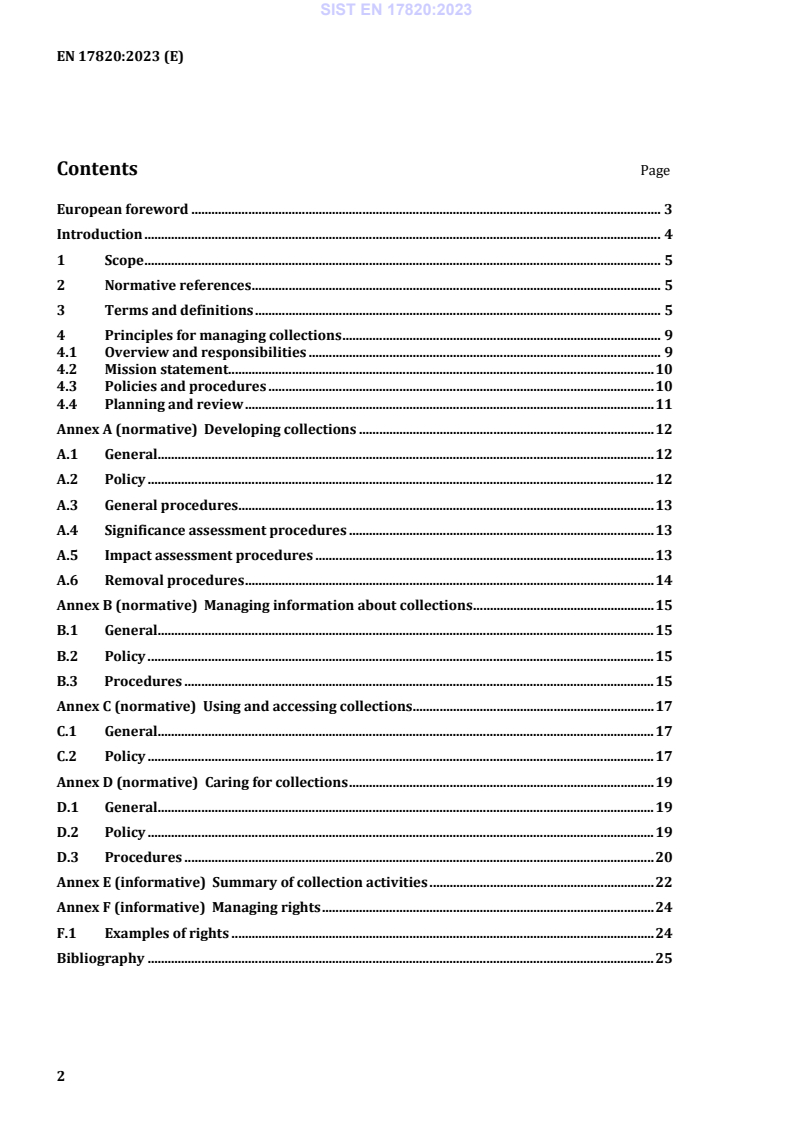
Contents Page
European foreword . 3
Introduction . 4
1 Scope . 5
2 Normative references . 5
3 Terms and definitions . 5
4 Principles for managing collections . 9
4.1 Overview and responsibilities . 9
4.2 Mission statement. 10
4.3 Policies and procedures . 10
4.4 Planning and review . 11
Annex A (normative) Developing collections . 12
A.1 General. 12
A.2 Policy . 12
A.3 General procedures . 13
A.4 Significance assessment procedures . 13
A.5 Impact assessment procedures . 13
A.6 Removal procedures . 14
Annex B (normative) Managing information about collections . 15
B.1 General. 15
B.2 Policy . 15
B.3 Procedures . 15
Annex C (normative) Using and accessing collections . 17
C.1 General. 17
C.2 Policy . 17
Annex D (normative) Caring for collections . 19
D.1 General. 19
D.2 Policy . 19
D.3 Procedures . 20
Annex E (informative) Summary of collection activities . 22
Annex F (informative) Managing rights . 24
F.1 Examples of rights . 24
Bibliography . 25
European foreword
This document (EN 17820:2023) has been prepared by Technical Committee CEN/TC 346 “Conservation
of Cultural Heritage”, the secretariat of which is held by UNI.
This European Standard shall be given the status of a national standard, either by publication of an
identical text or by endorsement, at the latest by December 2023, and conflicting national standards shall
be withdrawn at the latest by December 2023.
Attention is drawn to the possibility that some of the elements of this document may be the subject of
patent rights. CEN shall not be held responsible for identifying any or all such patent rights.
Any feedback and questions on this document should be directed to the users’ national standards body.
A complete listing of these bodies can be found on the CEN website.
According to the CEN-CENELEC Internal Regulations, the national standards organisations of the
following countries are bound to implement this European Standard: Austria, Belgium, Bulgaria, Croatia,
Cyprus, Czech Republic, Denmark, Estonia, Finland, France, Germany, Greece, Hungary, Iceland, Ireland,
Italy, Latvia, Lithuania, Luxembourg, Malta, Netherlands, Norway, Poland, Portugal, Republic of North
Macedonia, Romania, Serbia, Slovakia, Slovenia, Spain, Sweden, Switzerland, Türkiye and the United
Kingdom.
Introduction
All organisations that hold moveable cultural heritage collections, such as archives, libraries, museums
and galleries, have a responsibility to manage these collections in a planned and systematic manner so
that they continue to be preserved and accessible. This document sets out a framework for managing
collections, beginning with an organization’s purpose in holding them, followed by the policies it seeks to
meet and the core procedures that need to be established. It promotes ongoing evaluation and review of
these policies and procedures.
Many cultural heritage institutions have developed their own approaches to managing their collections.
Some countries regulate this in law for government institutions and other public organisations, setting
uniform quality levels and often referring to widely recognized codes of practice (for example the Code
of Ethics for Museums of the International Council of Museums). This document aims to complement these
regulations and codes by providing a framework and operational specifications for good practice. The
document is formed of an introductory normative Principles section followed by normative annexes
which contain the principal core policies and procedures that all cultural heritage institutions with
collections apply as a minimum, in addition to any local and national policies required of them.
1 Scope
This document specifies a framework and standards for managing cultural heritage collections. It is
intended for use by collecting organisations such as archives, libraries, museums and galleries. It is
applicable to all types of moveable cultural heritage, whether in physical or digital formats. It promotes
core essential policies and procedures that all such organisations seek to apply as a minimum and
encourages a cycle of continuous review and improvement.
2 Normative references
The following documents are referred to in the text in such a way that some or all of their content
constitutes requirements of this document. For dated references, only the edition cited applies. For
undated references, the latest edition of the referenced document (including any amendments) applies.
EN 15946, Conservation of cultural property - Packing principles for transport
EN 16095, Conservation of cultural property - Condition recording for movable cultural heritage
EN 16648, Conservation of cultural heritage - Transport methods
EN 16790, Conservation of cultural heritage - Integrated pest management (IPM) for protection of cultural
heritage
EN 16853, Conservation of cultural heritage - Conservation process - Decision making, planning and
implementation
EN 16893:2018, Conservation of Cultural Heritage - Specifications for location, construction and
modification of buildings or rooms intended for the storage or use of heritage collections
EN 17429, Conservation of cultural heritage - Procurement of conservation services and works
ISO 21110, Information and documentation — Emergency preparedness and response
3 Terms and definitions
For the purposes of this document, the following terms and definitions.
ISO and IEC maintain terminology databases for use in standardization at the following addresses:
— ISO Online browsing platform: available at https://www.iso.org/obp/
— IEC Electropedia: available at https://www.electropedia.org/
3.1
accessibility
opportunity to engage with an object physically and/or intellectually
[SOURCE: EN 15898:2019, definition 3.1.11]
3.2
accession
process of recording the inclusion of an object or group of objects into a collection
3.2.1
accession record
written record of the admission of an object or group of objects into a collection
Note 1 to entry: An accession record is often in the form of a register or a section of a documentation software
package which must be reviewed and updated and maintained permanently.
3.2.2
de-accession
process of recording the removal from the accession record of an object or group of objects
3.3
acquisition
process of obtaining legal title and/or responsibility for an object
3.4
appraisal
process of deciding whether an object or group of objects has continuing value in accordance with the
collecting organisation’s mission statement
Note 1 to entry: For example, an object can have value as evidence or as an historical resource, which would justify
its retention.
3.5
benefits sharing
fair and equitable sharing of benefits arising from the use of collection resources and related traditional
knowledge (see also 3.22 rights management)
[SOURCE: United Nations Convention on Biological Diversity (1992)]
3.6
business continuity
capability of the organization to continue delivery of products or services at acceptable levels following
a disruptive incident
[SOURCE: ISO 22300:2018, definition 2.3.10]
3.7
catalogue
structured list of information about or relating to objects within a collection, sometimes referred to as a
finding aid
3.8
collecting organisation
organisation that collects, cares for and provides access to cultural objects for education, learning,
entertainment, legal or evidential purposes
Note 1 to entry: For the purposes of this document, natural heritage collections are included.
3.9
collection
group of objects having shared or combined significance
Note 1 to entry: The term “collection” is mainly used within “moveable cultural heritage” and can often refer either
to the whole collection held by an organization or a sub-collection within it.
Note 2 to entry: It is the intention of the collecting organization to preserve and maintain the collection together.
[SOURCE: EN 15898:2019, definition 3.1.5 - note 1 modified, note 2 added]
3.10
competent person
someone who has the necessary training, knowledge, experience, expertise and skills, sufficient to
complete their allotted task
3.11
conservation
measures and actions aimed at safeguarding cultural heritage while respecting its significance, including
its accessibility to present and future generations
Note 1 to entry: Conservation includes preventive conservation, remedial conservation and restoration.
[SOURCE: EN 15898:2019, definition 3.3.1 modified — Notes 2 and 3 to entry have not been included.]
3.12
emergency preparedness
measures and actions taken in advance to mitigate the effects of possible destructive events and to
prepare for an effective response
Note 1 to entry: This includes drawing up a disaster response plan.
Note 2 to entry: The effective emergency response contains series of decisions and/or actions taken in context of
emergency, planned or not.
[SOURCE: EN 15898:2019, definition 3.4.6]
3.13
emergency planning
development, implementation and maintenance of agreed procedures to prevent, reduce, control,
mitigate and take other actions in the event of an emergency
3.14
impact assessment
means of measuring the effect of organisational activities against the overall mission and judging the
significance of changes brought about by those activities
3.15
object
single manifestation of tangible cultural heritage
Note 1 to entry: For the purposes of this document, the term object includes both physical and digital objects.
[SOURCE: EN 15898:2019, 3.1.3, modified — Note 1 to entry has been adjusted for this document.]
3.16
legal title
rights of ownership that are specified or recognized by law or that could be successfully defended in a
court of law
3.17
mission statement
strategic statement setting out an organisation’s purpose and objectives and how these are supported by
a cultural heritage collection
3.18
policy
overall intentions and direction of an organisation as formally expressed by the organisation’s governing
authorities
Note 1 to entry: A policy provides a framework for action and for the setting of objectives.
Note 2 to entry: A policy can be written in the form of a statement.
[SOURCE: EN ISO 9000:2005, definition 3.2.4 modified — “intentions” and “it’s top management” have
been replaced by “overall intentions” and “the organization’s governing authorities”]
3.19
procedure
specified way to carry out an activity or a process
Note 1 to entry: The procedures referred to in this standard should be written, maintained and reviewed
periodically.
3.20
provenance
history of an object covering its origins (including geography, creator, etc.), various owners and, if
relevant, its movement across borders
3.21
removal
permanent transfer of an object out of a collection
Note 1 to entry: Also referred to as disposal.
Note 2 to entry: Before an object can be permanently transferred from a collection it has to be de-accessioned.
3.22
rights management
documenting, protecting and administrating those rights that fall under legal and other statutory
requirements which are associated with objects, reproductions and information
Note 1 to entry: See also Annex F.
3.23
risk assessment
process of identification, analysis and evaluation of threats to objects or collections that might alter
significance, and the probability of their occurrence
[SOURCE: EN 15898:2019, definition 3.4.5 modified — Note 1 has been deleted, ‘to objects or collections’
added]
3.24
risk management
overall process of risk identification, risk analysis and risk evaluation
[SOURCE: ISO Guide 73:2009, definition 3.4.1]
3.25
significance
combination of the all the values assigned to an object, ensemble or collection
[SOURCE: EN 15898:2019, definition 3.1.7]
3.26
significance assessment
assessment of how important an object, group of objects or collection is to the organisation and other
stakeholders
3.27
user
individual who engages with the services of a collecting organisation or directly with a cultural heritage
object
3.28
value
aspect of importance that individuals, communities or society assign(s) to an object, ensemble or
collection in a particular context
Note 1 to entry: Values can be of different types, for example: artistic, symbolic, historical, social, economic,
scientific, educational, technological, functional, etc.
Note 2 to entry: The assigned value can change according to circumstance, e.g. how the judgement is made, the
context and the moment in time. Value should always be indicated by its qualifying type.
Note 3 to entry: Objects can have different values to different people and communities.
[SOURCE: EN 15898:2019, definition 3.1.6 modified — Notes 2 and 3 to entry added]
4 Principles for managing collections
4.1 Overview and responsibilities
a) An organization that wishes to hold, take responsibility for and provide access to cultural heritage
collections shall operate within a clear management framework as specified by this document. It shall
define its purpose in the form of a mission statement and from this set out its policies towards
developing its collections, managing information about them, using and accessing them and
protecting them from threats. It shall ensure that these policies are considered, written and approved
at the highest organisational level and develop systematic plans to achieve them, following specified
and documented procedures. It shall review its mission, policies and procedures periodically in order
to assess progress in achieving its objectives and commit to promoting its mission wherever
appropriate.
b) Ultimate responsibility for a cultural heritage collection resides with the legal trustees or governing
authorities of an organization, even where the collection is managed by a smaller operational
subsidiary or department (for example an art collection held by an educational organization such as
a university). These governing authorities are required to take up their responsibility to ensure their
collections are managed systematically and competently, as specified by this document.
c) It is a pre-requisite of any collecting organization that it shall be a legal entity with a clearly specified
route for decision-making and accountability for operations, including named roles with
responsibility for mission, policies and procedures. Clear responsibility shall be designated for
maintaining the organization’s resources and for seeking to maintain economic sustainability.
d) A collecting organization shall aim to pursue its operations in an environmentally sustainable
manner, seeking to minimize its environmental impact wherever possible, including minimizing its
use of energy and its carbon footprint. It shall keep under review the likely environmental impact of
all activities, including collecting, storage and maintenance of collections, visitor access, lending and
borrowing of collections and online access to collections.
e) Organisations that hold collections for the public good shall aim to operate in a manner that reflects
this social responsibility and make their collections publicly accessible, in physical and/or digital
forms. These organisations shall seek to play a constructive and co-operative role as a part of the
wider community of museums, galleries, libraries and archives, nationally and internationally.
f) Information about the mission, policies and procedures of a collecting organization shall be
maintained in a transparent manner and made available to all stakeholders wherever possible,
ensuring that legal, ethical and security considerations are observed.
g) Staff, volunteers, service providers and others involved in delivering the organization’s objectives
shall be trained and demonstrably competent to carry out their roles. Opportunities shall be sought
continuously to widen education and learning that involves both the collections and the
organization’s operations.
NOTE For informative purposes a summary of the different activities involved in managing collections is
provided in a Table E.1 in Annex E.
4.2 Mission statement
All organisations that aim to collect, maintain, use and provide access to collections of cultural heritage
shall set out their purpose in doing so in the form of a mission statement. This may be a part of a wider
mission (for example a department within a university) or specifically for the whole organization (for
example a public museum). The mission statement shall be published wherever there is reference to the
collection or to the organization’s role and responsibilities (such as on a website).
4.3 Policies and procedures
a) The organization shall define, approve and communicate a series of documented policies that
support its mission. These policies as a minimum shall cover the following areas:
1) developing its collections, in accordance with Annex A;
2) managing information about its collections, in accordance with Annex B;
3) using and accessing its collections, in accordance with Annex C;
4) caring for its collections, in accordance with Annex D.
b) In setting out its policies in all of these areas, the organization shall commit to meeting relevant legal
and ethical requirements.
c) Having set out its policies in these areas, the organization shall specify and undertake a range of
related procedures. All such procedures shall be documented.
d) The organization shall ensure that all procedures carried out on its behalf that have the potential to
cause an impact on the collections are performed by trained and competent persons.
4.4 Planning and review
a) The organization shall periodically review its policies and their implementation through the relevant
procedures. A cycle of review shall be maintained regularly, assessing whether policies continue to
be appropriate and procedures continue to be in line with the policies. Where procedures are not in
line with policies or do not achieve their objectives, a plan shall be developed to make changes and/or
improvements.
b) A review of the policies and procedures shall always be carried out following changes in relevant
legislation that affect the organization and/or its collection. Examples of other changes that shall
trigger a review include those which present a new opportunity or a risk to collections, to users or to
resources.
Annex A
(normative)
Developing collections
A.1 General
The development of collections involves defining the rationale for holding and using them. It also
establishes the processes by which decisions are made regarding whether or how a collection changes.
This involves both a growth in understanding of an existing collection and the further evolution of that
collection (e.g. increasing or reducing the number of objects in the collection; changing the balance of
types of material or how much is displayed, etc.). The organization shall have a policy covering the
development of its collections and a set of procedures that follow from it, in accordance with the following
specifications.
A.2 Policy
A.2.1 The organi
...