

EN 476:2022
(Main)General requirements for components used in drains and sewers
- Abstract
This document specifies general requirements to be respected in product standards for components such as pipes, fittings, inspection chambers and manholes with their respective joints intended for use in drains and sewers inside and outside buildings which operate as gravity systems allowing for a maximum pressure of 40 kPa.
It also specifies general requirements for components used in hydraulically and pneumatically pressurized pipes, drains and sewers.
NOTE 1 Where the term “inside buildings” is used in the context of components fixed inside buildings, it also includes pipes and fittings fixed on external surfaces of buildings.
NOTE 2 This document is not a product standard and therefore not intended for the direct evaluation of products.
This document covers components to be used in conveying in a satisfactory manner:
— domestic wastewater;
— rainwater and surface water;
— other wastewater acceptable for discharge into the system.
This document is applicable to components of circular and other cross sections.
This document is equally applicable to components which are factory-made and to those constructed on site, where applicable.
NOTE 3 This document does not apply to components used for trenchless construction according to EN 14457 and for components used for renovation of drains and sewers according to EN 13380.
This document does not supersede the functional requirements of a complete system as defined in EN 752.
- Status
- Published
- Publication Date
- 26-Apr-2022
- Withdrawal Date
- 30-Oct-2022
- Technical Committee
- CEN/TC 165 - Waste water engineering
- Drafting Committee
- CEN/TC 165/WG 1 - General requirements for pipes
- Current Stage
- 6060 - Definitive text made available (DAV) - Publishing
- Start Date
- 27-Apr-2022
- Due Date
- 07-Mar-2022
- Completion Date
- 27-Apr-2022


Overview
EN 476:2022 - General requirements for components used in drains and sewers (CEN) provides a framework of general requirements that product standards should respect for components used in drains and sewers. It is a meta-standard (not a product standard) that guides how product standards are written for pipes, fittings, inspection chambers, manholes and their joints, for gravity systems (up to 40 kPa) and for hydraulically or pneumatically pressurized systems. The document applies to factory-made and site-constructed components, circular and non‑circular cross sections, and covers conveyance of domestic wastewater, rainwater and other acceptable wastewaters.
Key topics and requirements
EN 476:2022 sets out the essential technical topics that product standards must address, including:
- Scope and applicability - components inside and outside buildings (includes elements fixed on external surfaces); exclusions for trenchless construction (EN 14457) and renovation standards (EN 13380).
- Dimensional requirements - nominal sizes, internal/external diameters, wall thicknesses, manhole and inspection chamber geometry.
- Performance requirements - mechanical load-bearing, crushing strength, longitudinal bending, tightness, continuity of invert, temperature and dimensional stability, surface smoothness and appearance.
- Joint requirements - sealing, joint deflection, shear and restrained-joint behaviour.
- Durability and resistance - chemical/corrosion resistance, abrasion resistance, resistance to cleaning operations.
- Reaction to fire - new clause addressing fire classification and test methods.
- Test methods and conformity - measurement, load tests, tightness tests and other referenced test procedures.
- Marking, labelling and packaging requirements to support traceability and safe transport/handling.
Practical applications and users
EN 476:2022 is used to ensure consistency and completeness when creating or applying product standards for drainage and sewer components. Typical users include:
- Standards writers and national bodies developing product standards based on EN 476.
- Manufacturers of pipes, fittings, manholes, seals and chambers for product development and compliance alignment.
- Consulting and design engineers specifying component performance and compatibility within gravity or pressurized sewer systems.
- Specifiers and procurement teams creating technical specifications and tender documents.
- Testing laboratories and certification bodies referencing test methods and performance criteria.
- Installers and asset owners seeking guidance on functional and dimensional expectations.
Related standards
Relevant cross-references include EN 752 (system functional requirements), EN 14457, EN 13380, EN 124, EN 681 series (seal materials), EN 13501-1 (reaction to fire), EN ISO 9969/9967 (ring stiffness/creep) among others. EN 476:2022 provides the umbrella requirements product standards should harmonize with for safe, durable and compatible drains and sewers components.
Relations
- Effective Date
- 04-May-2022
- Effective Date
- 09-Feb-2026
- Effective Date
- 04-Feb-2026
- Effective Date
- 28-Jan-2026
- Effective Date
- 28-Jan-2026
- Effective Date
- 28-Jan-2026
- Effective Date
- 28-Jan-2026
- Effective Date
- 28-Jan-2026
- Effective Date
- 28-Jan-2026
- Effective Date
- 28-Jan-2026
- Effective Date
- 28-Jan-2026
- Effective Date
- 28-Jan-2026
- Effective Date
- 28-Jan-2026
- Effective Date
- 28-Jan-2026
- Effective Date
- 28-Jan-2026
Get Certified
Connect with accredited certification bodies for this standard

Institut za varilstvo d.o.o. (Welding Institute)
Slovenia's leading welding institute since 1952. ISO 3834, EN 1090, pressure equipment certification, NDT personnel, welder qualification. Only IIW Au
Zavod za gradbeništvo Slovenije (ZAG) - Inšpekcija
ZAG inspection body for construction products, structures, and materials.
Sponsored listings
Frequently Asked Questions
EN 476:2022 is a standard published by the European Committee for Standardization (CEN). Its full title is "General requirements for components used in drains and sewers". This standard covers: This document specifies general requirements to be respected in product standards for components such as pipes, fittings, inspection chambers and manholes with their respective joints intended for use in drains and sewers inside and outside buildings which operate as gravity systems allowing for a maximum pressure of 40 kPa. It also specifies general requirements for components used in hydraulically and pneumatically pressurized pipes, drains and sewers. NOTE 1 Where the term “inside buildings” is used in the context of components fixed inside buildings, it also includes pipes and fittings fixed on external surfaces of buildings. NOTE 2 This document is not a product standard and therefore not intended for the direct evaluation of products. This document covers components to be used in conveying in a satisfactory manner: — domestic wastewater; — rainwater and surface water; — other wastewater acceptable for discharge into the system. This document is applicable to components of circular and other cross sections. This document is equally applicable to components which are factory-made and to those constructed on site, where applicable. NOTE 3 This document does not apply to components used for trenchless construction according to EN 14457 and for components used for renovation of drains and sewers according to EN 13380. This document does not supersede the functional requirements of a complete system as defined in EN 752.
This document specifies general requirements to be respected in product standards for components such as pipes, fittings, inspection chambers and manholes with their respective joints intended for use in drains and sewers inside and outside buildings which operate as gravity systems allowing for a maximum pressure of 40 kPa. It also specifies general requirements for components used in hydraulically and pneumatically pressurized pipes, drains and sewers. NOTE 1 Where the term “inside buildings” is used in the context of components fixed inside buildings, it also includes pipes and fittings fixed on external surfaces of buildings. NOTE 2 This document is not a product standard and therefore not intended for the direct evaluation of products. This document covers components to be used in conveying in a satisfactory manner: — domestic wastewater; — rainwater and surface water; — other wastewater acceptable for discharge into the system. This document is applicable to components of circular and other cross sections. This document is equally applicable to components which are factory-made and to those constructed on site, where applicable. NOTE 3 This document does not apply to components used for trenchless construction according to EN 14457 and for components used for renovation of drains and sewers according to EN 13380. This document does not supersede the functional requirements of a complete system as defined in EN 752.
EN 476:2022 is classified under the following ICS (International Classification for Standards) categories: 23.040.05 - Pipeline and its parts for external sewage systems; 93.030 - External sewage systems. The ICS classification helps identify the subject area and facilitates finding related standards.
EN 476:2022 has the following relationships with other standards: It is inter standard links to EN 476:2011, ISO 48-2:2018, EN ISO 11925-2:2026, EN 16000:2010, EN 124-4:2015, EN 681-1:1996, EN 124-3:2015, EN 124-5:2015, EN 681-4:2000, EN 124-6:2015, EN ISO 9969:2016, EN 13501-1:2018, EN 681-3:2000, EN 124-1:2015, EN 124-2:2015. Understanding these relationships helps ensure you are using the most current and applicable version of the standard.
EN 476:2022 is available in PDF format for immediate download after purchase. The document can be added to your cart and obtained through the secure checkout process. Digital delivery ensures instant access to the complete standard document.
Standards Content (Sample)
SLOVENSKI STANDARD
01-junij-2022
Nadomešča:
SIST EN 476:2011
Splošne zahteve za elemente za odvod odpadne vode in kanalizacijo
General requirements for components used in drains and sewers
Allgemeine Anforderungen an Bauteile für Abwasserleitungen und -kanäle
Exigences générales pour les composants utilisés pour les branchements et les
collecteurs d’assainissement
Ta slovenski standard je istoveten z: EN 476:2022
ICS:
13.060.30 Odpadna voda Sewage water
93.030 Zunanji sistemi za odpadno External sewage systems
vodo
2003-01.Slovenski inštitut za standardizacijo. Razmnoževanje celote ali delov tega standarda ni dovoljeno.
EN 476
EUROPEAN STANDARD
NORME EUROPÉENNE
April 2022
EUROPÄISCHE NORM
ICS 93.030; 23.040.05 Supersedes EN 476:2011
English Version
General requirements for components used in drains and
sewers
Exigences générales pour les composants utilisés pour Allgemeine Anforderungen an Bauteile für
les branchements et les collecteurs d'assainissement Abwasserleitungen und -kanäle
This European Standard was approved by CEN on 20 March 2022.
CEN members are bound to comply with the CEN/CENELEC Internal Regulations which stipulate the conditions for giving this
European Standard the status of a national standard without any alteration. Up-to-date lists and bibliographical references
concerning such national standards may be obtained on application to the CEN-CENELEC Management Centre or to any CEN
member.
This European Standard exists in three official versions (English, French, German). A version in any other language made by
translation under the responsibility of a CEN member into its own language and notified to the CEN-CENELEC Management
Centre has the same status as the official versions.
CEN members are the national standards bodies of Austria, Belgium, Bulgaria, Croatia, Cyprus, Czech Republic, Denmark, Estonia,
Finland, France, Germany, Greece, Hungary, Iceland, Ireland, Italy, Latvia, Lithuania, Luxembourg, Malta, Netherlands, Norway,
Poland, Portugal, Republic of North Macedonia, Romania, Serbia, Slovakia, Slovenia, Spain, Sweden, Switzerland, Turkey and
United Kingdom.
EUROPEAN COMMITTEE FOR STANDARDIZATION
COMITÉ EUROPÉEN DE NORMALISATION
EUROPÄISCHES KOMITEE FÜR NORMUNG
CEN-CENELEC Management Centre: Rue de la Science 23, B-1040 Brussels
© 2022 CEN All rights of exploitation in any form and by any means reserved Ref. No. EN 476:2022 E
worldwide for CEN national Members.
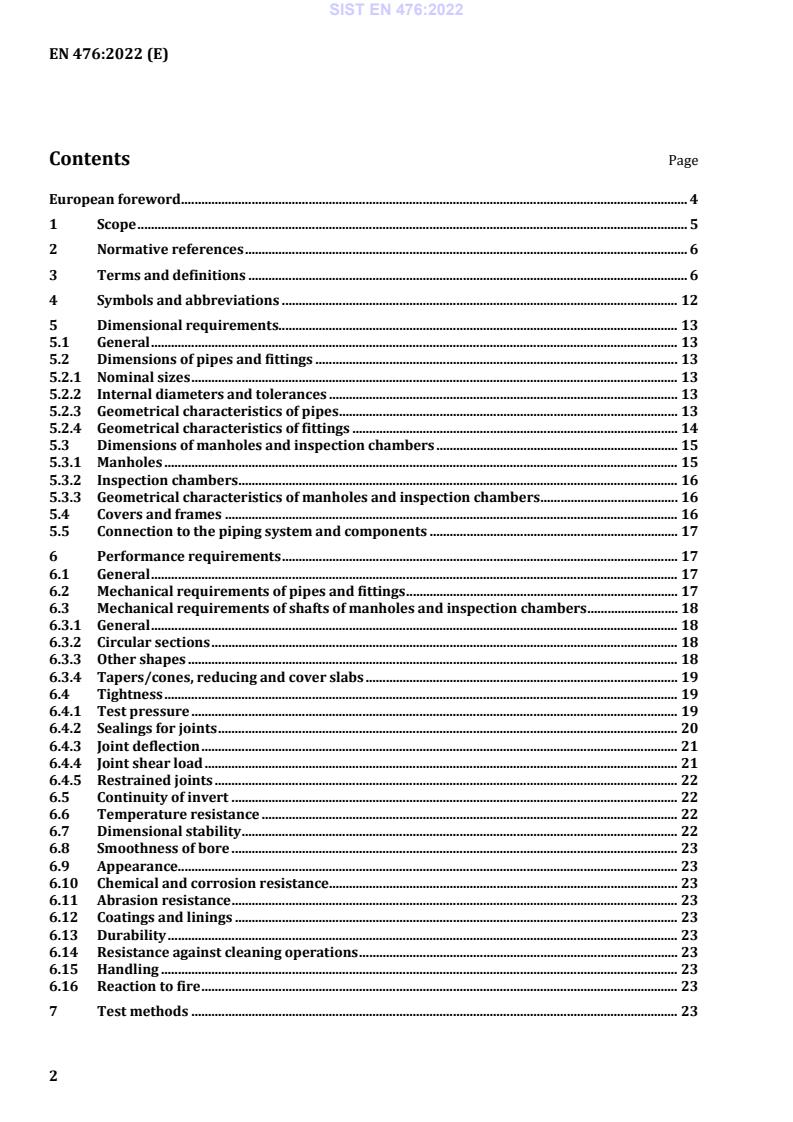
Contents Page
European foreword . 4
1 Scope . 5
2 Normative references . 6
3 Terms and definitions . 6
4 Symbols and abbreviations . 12
5 Dimensional requirements. 13
5.1 General . 13
5.2 Dimensions of pipes and fittings . 13
5.2.1 Nominal sizes . 13
5.2.2 Internal diameters and tolerances . 13
5.2.3 Geometrical characteristics of pipes . 13
5.2.4 Geometrical characteristics of fittings . 14
5.3 Dimensions of manholes and inspection chambers . 15
5.3.1 Manholes . 15
5.3.2 Inspection chambers . 16
5.3.3 Geometrical characteristics of manholes and inspection chambers . 16
5.4 Covers and frames . 16
5.5 Connection to the piping system and components . 17
6 Performance requirements . 17
6.1 General . 17
6.2 Mechanical requirements of pipes and fittings . 17
6.3 Mechanical requirements of shafts of manholes and inspection chambers . 18
6.3.1 General . 18
6.3.2 Circular sections . 18
6.3.3 Other shapes . 18
6.3.4 Tapers/cones, reducing and cover slabs . 19
6.4 Tightness . 19
6.4.1 Test pressure . 19
6.4.2 Sealings for joints . 20
6.4.3 Joint deflection . 21
6.4.4 Joint shear load . 21
6.4.5 Restrained joints . 22
6.5 Continuity of invert . 22
6.6 Temperature resistance . 22
6.7 Dimensional stability . 22
6.8 Smoothness of bore . 23
6.9 Appearance . 23
6.10 Chemical and corrosion resistance . 23
6.11 Abrasion resistance . 23
6.12 Coatings and linings . 23
6.13 Durability . 23
6.14 Resistance against cleaning operations . 23
6.15 Handling . 23
6.16 Reaction to fire . 23
7 Test methods . 23
7.1 Measurement of dimensions . 23
7.1.1 Internal diameter . 23
7.1.2 External diameter . 24
7.1.3 Spigots and sockets . 24
7.1.4 Wall thickness of pipes . 24
7.1.5 Deviation from straightness of pipes . 24
7.1.6 Deviation from squareness of the ends of the pipes . 24
7.2 Load bearing capacity tests . 24
7.2.1 Load bearing capacity tests for pipes . 24
7.2.2 Load bearing capacity tests for sections of manholes and shafts. 25
7.3 Longitudinal bending moment resistance test for pipes . 25
7.4 Tightness tests . 26
7.4.1 Tightness test of pipes, fittings, manholes and inspection chambers . 26
7.4.2 Tightness test of joints . 27
7.4.3 Test methods for drains and sewers components . 28
8 Marking, labelling and packaging . 28
Annex A (informative) Preferred nominal sizes . 29
Bibliography . 30
European foreword
This document (EN 476:2022) has been prepared by Technical Committee CEN/TC 165 “Waste water
engineering”, the secretariat of which is held by DIN.
This European Standard shall be given the status of a national standard, either by publication of an
identical text or by endorsement, at the latest by October 2022, and conflicting national standards shall
be withdrawn at the latest by October 2022.
Attention is drawn to the possibility that some of the elements of this document may be the subject of
patent rights. CEN shall not be held responsible for identifying any or all such patent rights.
This document supersedes EN 476:2011.
The specifications of this document are based on the requirements for wastewater systems specified in
EN 752 and EN 12056 (all parts). Significant technical differences between this edition and EN 476:2011
are as follows:
a) the Scope is clarified in the way that this document contains requirements for product standards;
b) Table 1 (Preferred nominal sizes DN/ID) and Table 2 (Preferred nominal sizes DN/OD), paragraph
5.2.1, are moved to the new Annex A;
c) the paragraphs under 5.3, Dimensions of manholes and inspection chambers, are completely
rewritten, with minimum internal dimension for different cross sections (always in compliance with
the national regulations in force at the place of installation);
d) for reaction to fire, a new 6.16 is added.
This document provides a framework for the development of product standards to be used in drain and
sewer systems inside and outside buildings. In Figure 1 the position of this document related to other
standards on this subject is given.
This document describes the general requirements to be taken into account in product standards.
Any feedback and questions on this document should be directed to the users’ national standards body.
A complete listing of these bodies can be found on the CEN website.
According to the CEN-CENELEC Internal Regulations, the national standards organisations of the
following countries are bound to implement this European Standard: Austria, Belgium, Bulgaria, Croatia,
Cyprus, Czech Republic, Denmark, Estonia, Finland, France, Germany, Greece, Hungary, Iceland, Ireland,
Italy, Latvia, Lithuania, Luxembourg, Malta, Netherlands, Norway, Poland, Portugal, Republic of North
Macedonia, Romania, Serbia, Slovakia, Slovenia, Spain, Sweden, Switzerland, Turkey and the United
Kingdom.
Figure 1 — Pyramid diagram
1 Scope
This document specifies general requirements to be respected in product standards for components such
as pipes, fittings, inspection chambers and manholes with their respective joints intended for use in
drains and sewers inside and outside buildings which operate as gravity systems allowing for a maximum
pressure of 40 kPa.
It also specifies general requirements for components used in hydraulically and pneumatically
pressurized pipes, drains and sewers.
NOTE 1 Where the term “inside buildings” is used in the context of components fixed inside buildings, it also
includes pipes and fittings fixed on external surfaces of buildings.
NOTE 2 This document is not a product standard and therefore not intended for the direct evaluation of
products.
This document covers components to be used in conveying in a satisfactory manner:
— domestic wastewater;
— rainwater and surface water;
— other wastewater acceptable for discharge into the system.
This document is applicable to components of circular and other cross sections.
This document is equally applicable to components which are factory-made and to those constructed on
site, where applicable.
NOTE 3 This document does not apply to components used for trenchless construction according to EN 14457
and for components used for renovation of drains and sewers according to EN 13380.
This document does not supersede the functional requirements of a complete system as defined in
EN 752.
2 Normative references
The following documents are referred to in the text in such a way that some or all of their content
constitutes requirements of this document. For dated references, only the edition cited applies. For
undated references, the latest edition of the referenced document (including any amendments) applies.
EN 124 (all parts), Gully tops and manhole tops for vehicular and pedestrian areas
EN 681-1, Elastomeric seals - Materials requirements for pipe joint seals used in water and drainage
applications - Part 1: Vulcanized rubber
EN 681-2, Elastomeric seals - Material requirements for pipe joint seals used in water and drainage
applications - Part 2: Thermoplastic elastomers
EN 681-3, Elastomeric seals - Material requirements for pipe joint seals used in water and drainage
applications - Part 3: Cellular materials of vulcanized rubber
EN 681-4, Elastomeric seals - Material requirements for pipe joint seals used in water and drainage
applications - Part 4: Cast polyurethane sealing elements
EN 13501-1, Fire classification of construction products and building elements - Part 1: Classification using
data from reaction to fire tests
EN 13823, Reaction to fire tests for building products - Building products excluding floorings exposed to the
thermal attack by a single burning item
EN 16000, Plastics piping systems - Systems within the building structure - Mounting and fixing of
components in the test apparatus to thermal attack by a single burning item
EN ISO 9967, Thermoplastics pipes - Determination of creep ratio (ISO 9967)
EN ISO 9969, Thermoplastics pipes - Determination of ring stiffness (ISO 9969)
EN ISO 11925-2, Reaction to fire tests - Ignitability of products subjected to direct impingement of flame -
Part 2: Single-flame source test (ISO 11925-2)
ISO 48-2, Rubber, vulcanized or thermoplastic — Determination of hardness — Part 2: Hardness between
10 IRHD and 100 IRHD
3 Terms and definitions
For the purposes of this document, the following terms and definitions are applicable.
ISO and IEC maintain terminological databases for use in standardization at the following addresses:
— ISO Online browsing platform: available at https://www.iso.org/obp/ui
— IEC Electropedia: available at https://www.electropedia.org/
3.1
crushing strength
load per unit length a rigid pipe is required to withstand in kN/m
3.2
external diameter
mean external dimension of the circular pipe barrel at any cross section where for pipes with external
profiles on the barrels, the external diameter is the maximum diameter when viewed in cross section
Note 1 to entry This definition can also be considered for other pipe shapes (e.g. egg shape).
3.3
flexible joint
joint which permits angular deflection
3.4
flexible pipe
pipe, the load carrying capacity of which is limited by diametral deformation under load to the ultimate
design criteria without breaking or overstressing
Note 1 to entry: Flexible pipes are manufactured from materials such as PVC, PP, PE, steel, etc.
3.5
hydraulically pressurised system
system where flow is caused by hydraulic pressure and where the pipe normally operates full
3.6
inspection chamber
chamber with a removable cover constructed on a drain or sewer that permits the introduction of
cleaning and inspection equipment from surface level, but does not provide access for personnel
[SOURCE: EN 16323:2014, 2.2.4.13]
Note 1 to entry: Examples are given in Figures 2 and 3.
Note 2 to entry: Terms may differentiate per type of material.
Key
1 adjusting unit
2 cover slab
3 shaft unit
4 base unit
NOTE Joint details have been omitted for clarity.
Figure 2 — Description of rigid inspection chamber components
Key
a cover 1 inlet
b near surface component 2 outlet
c telescopic adaptor 3 invert
e riser 4 inner diameter
f base 5 benching
g connection 6 channel
Figure 3 — Description of flexible inspection chamber components
3.7
internal diameter
mean internal dimension of the circular pipe barrel at any cross section
3.8
invert
lowest point of the internal surface of the barrel of a pipe or channel at any cross section
3.9
joint
connection between the adjacent ends of two components including the means of sealing
3.10
manhole
chamber with a removable cover constructed on a drain or sewer to permit entry by personnel
[SOURCE: EN 16323:2014, 2.2.4.15]
Note 1 to entry: Examples are given in Figures 4 and 5.
Note 2 to entry: Terms may differentiate per type of material.
Key
1 cover
2 adjusting unit
3 cover slab
4 shaft unit/cone
5 taper/cone
6 chamber unit
7 base unit
NOTE 1 Joint details have been omitted for clarity.
NOTE 2 Precast base slabs of structures can be integral with the base unit or a separate slab incorporating
construction joints.
Figure 4 — Description of rigid manhole components
Key
a cover 1 inlet
b near surface component 2 outlet
c telescopic adaptor 3 invert
d cone 4 inner diameter
e riser 5 benching
f base 6 channel
g connection
Figure 5 — Description of flexible manhole components
3.11
nominal size
DN
numerical designation of size of component, which is a convenient integer approximately equal to a
manufacturing dimension in millimetres and can apply to either the internal diameter (DN/ID) or the
external diameter (DN/OD)
Note 1 to entry: DN/OD pipes with solid or hollow spiral or annular profiled external surface and outside smooth
spigot jointing dimensions, and with larger external diameter than the spigot may be designated by the spigot
dimension.
3.12
pipe barrel
cylindrical part of the pipe with a uniform longitudinal profile excluding socket and spigot
3.13
pneumatically pressurized system
system where flow is caused by pneumatic pressure which can be applied either as compressed air
upstream or partial vacuum downstream and where the pipe normally operates full
3.14
restrained joint
joint in which a means is provided to prevent separation
3.15
rigid joint
joint that does not permit angular deflection
3.16
rigid pipe
pipe, the load carrying capacity of which is limited by breaking or overstressing, without significant
deformation of its cross section
Note 1 to entry: Rigid pipes are manufactured from materials such as concrete, clay, etc.
3.17
ring stiffness
resistance of a pipe to diametral deflection in response to external loading applied along one diametric
plane given as follows:
EI⋅
S=
D
m
3.18
test load
specified load which a component withstands where the related requirements of the product standard
are met
3.19
ultimate load
load which causes failure of a component (under test) which shall be as specified in product standards
4 Symbols and abbreviations
DN/ID nominal size related to the internal diameter
DN/OD nominal size related to the external diameter
PFA allowable operating pressure
PMA allowable maximum operating pressure
PEA allowable site test pressure
Dm diameter of the neutral axis of the pipe wall, in metres
E modulus of elasticity in flexure in the circumferential direction in kilonewtons per square
metre
I second moment of area of the pipe wall in the longitudinal direction, per unit length, in
metres to the fourth power per metre
S the ring stiffness of the pipe in kilonewtons per square metre
r radius for bends
α angle of bends
β angle of branches
5 Dimensional requirements
5.1 General
The requirements as defined in the following clauses (5.2 to 5.5) shall be respected in the product
standards.
5.2 Dimensions of pipes and fittings
5.2.1 Nominal sizes
For circular products nominal sizes DN shall be specified as DN/ID or DN/OD. Informative Annex A,
Table A.1 and A.2 contain sizes of preferred nominal sizes DN/ID and preferred nominal sizes DN/OD.
For non-circular products the relevant cross sections dimensions shall be specified.
5.2.2 Internal diameters and tolerances
For circular products:
— internal diameters and tolerances; or
— external diameters, wall thicknesses and tolerances; or
— minimum internal diameter
shall be specified.
Maximum tolerances on the internal diameter are listed in Table 1.
Table 1 — Maximum tolerances on internal diameters
Nominal size Gravity, hydraulically and pneumatically pressurized
systems
Tolerances on mean Tolerances on individual
internal diameter internal diameter
mm mm
DN ≤ 100 ±0,05 × DN ±0,1 × DN
100 < DN ≤ 250 ±5 ±10
250 < DN ≤ 600 ±0,02 × DN ±0,04 × DN
DN > 600 ±15 ±30
For non-circular products the internal dimensions and tolerances shall be specified.
5.2.3 Geometrical characteristics of pipes
Pipe straightness, including the tolerances, shall be specified (see 7.1.5).
When pipes are delivered in coils the minimum radius of the coils shall be specified instead of
straightness.
The angle between the planes of the end faces of the pipe and the relevant axis shall be 90° with a
tolerance such that the function of the pipe joint shall not be impaired (see 7.1.6).
Tolerances on pipe lengths shall be specified, even if the lengths themselves are not specified.
For pressurized systems, tolerances on the wall thickness shall be specified.
5.2.4 Geometrical characteristics of fittings
5.2.4.1 General
Angles of fittings shall be specified. Where applicable, tolerances on angles shall be specified.
5.2.4.2 Bends
Angles α for bends (see Figure 6) shall be specified. Angles α should preferably be selected from 11°15′,
15°, 20° to 22°30′, 30°, 45°, 60°, 67° to 70° and 87° to 90°. Other angles α may be specified.
Radii r for bends (e.g. swept and unswept) should be specified.
Key
α angle of bend
r radius of bend
Figure 6 — Illustrations of angle α and radius of bends r
5.2.4.3 Branches
Angles β for branches (see Figure 7) shall be specified. Angles β should preferably be selected from 45°,
60° to 70° or 87° to 90°.
Key
β angle of branches
Figure 7 — Illustrations of angle β of branches
5.3 Dimensions of manholes and inspection chambers
5.3.1 Manholes
The minimum dimensions of manholes deviate per country and local circumstances and should therefore
comply with the national regulations in force at the place of installation.
National or local safety regulations or the relevant authority might specify larger minimum dimensions
than specified below and design details, e.g. for the access and personal entry measures.
In the absence of national regulations, the clear opening of the manhole cover according to EN 124 series
shall be ≥ 600 mm and minimum internal dimensions of manholes (see Figure 8 a) and 8 b)) shall be as
follows:
— for circular sections the minimum internal diameter: 1 000 mm;
— for rectangular sections the minimum internal dimensions: 750 mm × 1 200 mm;
— for square sections the minimum internal dimensions: 1 000 mm × 1 000 mm;
— for elliptical sections the minimum internal dimensions: 900 mm × 1 100 mm.
For personnel access under exceptional circumstances, and only where national or local safety
regulations allow, manholes can have smaller dimensions according to Figure 8 c) with the following
typical minimum internal dimensions:
— for circular sections the minimum internal diameter: 800 mm;
— for rectangular sections the minimum internal dimensions; 750 mm × 1 000 mm;
— for square sections the minimum internal dimensions: 800 mm × 800 mm;
— for elliptical sections the minimum internal dimensions: 800 mm × 1 000 mm.
Manholes for personnel access under exceptional circumstances should not be seen as an invitation to
accept dangerous situations.
Dimensions in millimetres
a) b) c)
Key
a shaft depth
Figure 8 —Minimum dimensions of manholes in the absence of national regulations
NOTE The 450 mm shaft depth (including the straight part of the taper/cone, if applicable) is recommended to
allow the first step or rung to be in an accessible position.
5.3.2 Inspection chambers
The dimensions of inspection chambers and their clear opening deviate per country and local
circumstances and should therefore comply with the national regulations in force at the place of
installation.
In the absence of national regulations typica
...