

EN 13485:2023
(Main)Thermometers for measuring the ambient or internal temperature for the transport, storage and distribution of temperature sensitive goods - Tests, performance, suitability
- Abstract
This document specifies the technical and functional characteristics for all types of thermometers (electronic, mechanical, etc.) for equipping the means used for the transport, storage and distribution of temperature sensitive goods and for measuring the ambient or internal temperature of the products between −80 °C and +85 °C.
It specifies the test methods which allow the verification of the equipment's conformity to suitability and performance requirements.
It applies to the whole thermometer and indicating device(s). The temperature sensor(s) can be integrated into the thermometer or remote from it (wired or wireless external temperature sensor(s)).
It does not specify the location of the thermometer and its sensors with respect to types of usage such as transport, storage and distribution.
NOTE Examples for the transport, storage and distribution of temperature sensitive goods between −80 °C and +85 °C include chilled, frozen, deep frozen and quick-frozen food; ice cream; fresh and hot food; pharmaceuticals; blood and organs; chemicals; biologicals; electronic and mechanical devices; flowers, plants and bulbs; raw materials and liquids; animals; art and furnishings.
- Status
- Published
- Publication Date
- 12-Dec-2023
- Technical Committee
- CEN/TC 423 - Project Committee - Means of measuring and/or recording temperature in the cold chain
- Drafting Committee
- CEN/TC 423/WG 1 - Revision of EN 13485 and EN 13486
- Current Stage
- 6060 - Definitive text made available (DAV) - Publishing
- Start Date
- 13-Dec-2023
- Due Date
- 12-Oct-2023
- Completion Date
- 13-Dec-2023

Overview
EN 13485:2023 is the CEN European standard that defines technical and functional requirements, test methods and suitability criteria for thermometers used to measure ambient or internal temperature in the transport, storage and distribution of temperature‑sensitive goods. It covers all thermometer types (electronic, mechanical, wired or wireless sensors) with a measuring range of −80 °C to +85 °C and applies to the whole thermometer and indicating device(s). EN 13485:2023 supersedes EN 13485:2001 and adds updated clauses, new annexes (including battery life, life‑cycle and uncertainty guidance) and a new class (0,2).
Key topics and technical requirements
- Measuring range and metrological characteristics: standardizes requirements for accuracy, resolution and response time across −80 °C to +85 °C.
- Test methods for conformity: defined procedures for determining temperature measurement error, response time and the effects of influence quantities (electrical supply variation, ambient temperature, vibrations, shock).
- Environmental and mechanical robustness: tests for climatic environment, shock resistance and mechanical vibrations relevant to transport and storage.
- Electrical and EMC requirements (where applicable): electrical safety, dielectric strength and electromagnetic compatibility per referenced standards.
- Degree of protection (IP code): enclosure protection requirements to ensure suitability in operational environments.
- Operational aspects: locking of settings, load indicators, battery lifetime and minimum power supply guidance (Annex B), marking, designation and periodic verification requirements.
- Verification and uncertainty: guidance to determine conformity and expanded measurement uncertainty (Annexes E and F).
Practical applications and users
EN 13485:2023 is essential for stakeholders in cold chain management and temperature‑sensitive supply chains:
- Thermometer and sensor manufacturers - to design, test and declare conformity of products.
- Cold chain logistics providers - to select devices suitable for transport, warehousing and distribution of chilled, frozen or deep‑frozen goods.
- Food, pharmaceutical and biotech companies - to ensure accurate monitoring of products (food, vaccines, blood, organs, biologicals).
- Calibration and testing laboratories - to perform conformity testing and periodic verification.
- Quality assurance, procurement and regulatory teams - to specify compliant instrumentation and demonstrate traceability and risk mitigation across the cold chain.
Benefits include improved device reliability, consistent performance verification, regulatory alignment and reduced risk of spoilage or product loss due to temperature excursions.
Related standards
- EN 13486 (periodic verification for recorders and thermometers)
- EN 60068-2-27 (shock testing)
- EN 61010-1 (electrical safety for measurement equipment)
- EN IEC 61000-6-2 / 61000-6-3 (EMC immunity and emissions)
- ISO/IEC 17025 (laboratory competence)
- JCGM 200:2012 (VIM - metrology terminology)
Keywords: EN 13485:2023, thermometers, temperature sensitive goods, transport storage distribution, temperature measurement, cold chain, test methods, temperature sensors, calibration, metrological characteristics.
Relations
- Effective Date
- 18-Jan-2023
- Refers
ISO/IEC 17025:2017 - General requirements for the competence of testing and calibration laboratories - Effective Date
- 25-Aug-2026
- Effective Date
- 02-Jun-2026
- Effective Date
- 09-Feb-2026
- Effective Date
- 09-Feb-2026
- Effective Date
- 09-Feb-2026
- Effective Date
- 09-Feb-2026
- Effective Date
- 28-Jan-2026
- Effective Date
- 28-Jan-2026
- Effective Date
- 28-Jan-2026
- Effective Date
- 28-Jan-2026
Get Certified
Connect with accredited certification bodies for this standard

BSI Group
BSI (British Standards Institution) is the business standards company that helps organizations make excellence a habit.

Bureau Veritas
Bureau Veritas is a world leader in laboratory testing, inspection and certification services.

DNV
DNV is an independent assurance and risk management provider.
Sponsored listings
Frequently Asked Questions
EN 13485:2023 is a standard published by the European Committee for Standardization (CEN). Its full title is "Thermometers for measuring the ambient or internal temperature for the transport, storage and distribution of temperature sensitive goods - Tests, performance, suitability". This standard covers: This document specifies the technical and functional characteristics for all types of thermometers (electronic, mechanical, etc.) for equipping the means used for the transport, storage and distribution of temperature sensitive goods and for measuring the ambient or internal temperature of the products between −80 °C and +85 °C. It specifies the test methods which allow the verification of the equipment's conformity to suitability and performance requirements. It applies to the whole thermometer and indicating device(s). The temperature sensor(s) can be integrated into the thermometer or remote from it (wired or wireless external temperature sensor(s)). It does not specify the location of the thermometer and its sensors with respect to types of usage such as transport, storage and distribution. NOTE Examples for the transport, storage and distribution of temperature sensitive goods between −80 °C and +85 °C include chilled, frozen, deep frozen and quick-frozen food; ice cream; fresh and hot food; pharmaceuticals; blood and organs; chemicals; biologicals; electronic and mechanical devices; flowers, plants and bulbs; raw materials and liquids; animals; art and furnishings.
This document specifies the technical and functional characteristics for all types of thermometers (electronic, mechanical, etc.) for equipping the means used for the transport, storage and distribution of temperature sensitive goods and for measuring the ambient or internal temperature of the products between −80 °C and +85 °C. It specifies the test methods which allow the verification of the equipment's conformity to suitability and performance requirements. It applies to the whole thermometer and indicating device(s). The temperature sensor(s) can be integrated into the thermometer or remote from it (wired or wireless external temperature sensor(s)). It does not specify the location of the thermometer and its sensors with respect to types of usage such as transport, storage and distribution. NOTE Examples for the transport, storage and distribution of temperature sensitive goods between −80 °C and +85 °C include chilled, frozen, deep frozen and quick-frozen food; ice cream; fresh and hot food; pharmaceuticals; blood and organs; chemicals; biologicals; electronic and mechanical devices; flowers, plants and bulbs; raw materials and liquids; animals; art and furnishings.
EN 13485:2023 is classified under the following ICS (International Classification for Standards) categories: 17.200.20 - Temperature-measuring instruments; 67.260 - Plants and equipment for the food industry. The ICS classification helps identify the subject area and facilitates finding related standards.
EN 13485:2023 has the following relationships with other standards: It is inter standard links to EN 13485:2001, ISO/IEC 17025:2017, EN IEC 61000-6-3:2026, EN IEC 61000-6-3:2021, EN 61010-1:2010, EN 60068-2-27:2009, EN IEC 61000-6-2:2019, EN 12255-4:2023, EN 13486:2023, EN 17066-2:2025, EN 13486:2001. Understanding these relationships helps ensure you are using the most current and applicable version of the standard.
EN 13485:2023 is available in PDF format for immediate download after purchase. The document can be added to your cart and obtained through the secure checkout process. Digital delivery ensures instant access to the complete standard document.
Standards Content (Sample)
SLOVENSKI STANDARD
01-februar-2024
Termometri za merjenje temperature okolice ali notranje temperature pri prevozu,
skladiščenju in distribuciji toplotno občutljivega blaga - Preskusi, značilnosti,
ustreznost
Thermometers for measuring the ambient or internal temperature for the transport,
storage and distribution of temperature sensitive goods - Tests, performance, suitability
Thermometer zur Messung der Umgebungs- und Innentemperatur für den Transport, die
Lagerung und die Verteilung von temperaturempfindlichen Produkten - Prüfung,
Leistung, Gebrauchstauglichkeit
Thermomètres de mesure de la température ambiante ou interne pour le transport, le
stockage et la distribution des marchandises thermosensibles - Essais, performance,
aptitude à l’emploi
Ta slovenski standard je istoveten z: EN 13485:2023
ICS:
17.200.20 Instrumenti za merjenje Temperature-measuring
temperature instruments
67.260 Tovarne in oprema za Plants and equipment for the
živilsko industrijo food industry
2003-01.Slovenski inštitut za standardizacijo. Razmnoževanje celote ali delov tega standarda ni dovoljeno.
EN 13485
EUROPEAN STANDARD
NORME EUROPÉENNE
December 2023
EUROPÄISCHE NORM
ICS 17.200.20; 67.260 Supersedes EN 13485:2001
English Version
Thermometers for measuring the ambient or internal
temperature for the transport, storage and distribution of
temperature sensitive goods - Tests, performance,
suitability
Thermomètres de mesure de la température ambiante Thermometer zur Messung der Umgebungs- und
ou interne pour le transport, le stockage et la Innentemperatur für den Transport, die Lagerung und
distribution des marchandises thermosensibles - die Verteilung von temperaturempfindlichen
Essais, performance, aptitude à l'emploi Produkten - Prüfung, Leistung, Gebrauchstauglichkeit
This European Standard was approved by CEN on 20 November 2023.
CEN members are bound to comply with the CEN/CENELEC Internal Regulations which stipulate the conditions for giving this
European Standard the status of a national standard without any alteration. Up-to-date lists and bibliographical references
concerning such national standards may be obtained on application to the CEN-CENELEC Management Centre or to any CEN
member.
This European Standard exists in three official versions (English, French, German). A version in any other language made by
translation under the responsibility of a CEN member into its own language and notified to the CEN-CENELEC Management
Centre has the same status as the official versions.
CEN members are the national standards bodies of Austria, Belgium, Bulgaria, Croatia, Cyprus, Czech Republic, Denmark, Estonia,
Finland, France, Germany, Greece, Hungary, Iceland, Ireland, Italy, Latvia, Lithuania, Luxembourg, Malta, Netherlands, Norway,
Poland, Portugal, Republic of North Macedonia, Romania, Serbia, Slovakia, Slovenia, Spain, Sweden, Switzerland, Türkiye and
United Kingdom.
EUROPEAN COMMITTEE FOR STANDARDIZATION
COMITÉ EUROPÉEN DE NORMALISATION
EUROPÄISCHES KOMITEE FÜR NORMUNG
CEN-CENELEC Management Centre: Rue de la Science 23, B-1040 Brussels
© 2023 CEN All rights of exploitation in any form and by any means reserved Ref. No. EN 13485:2023 E
worldwide for CEN national Members.
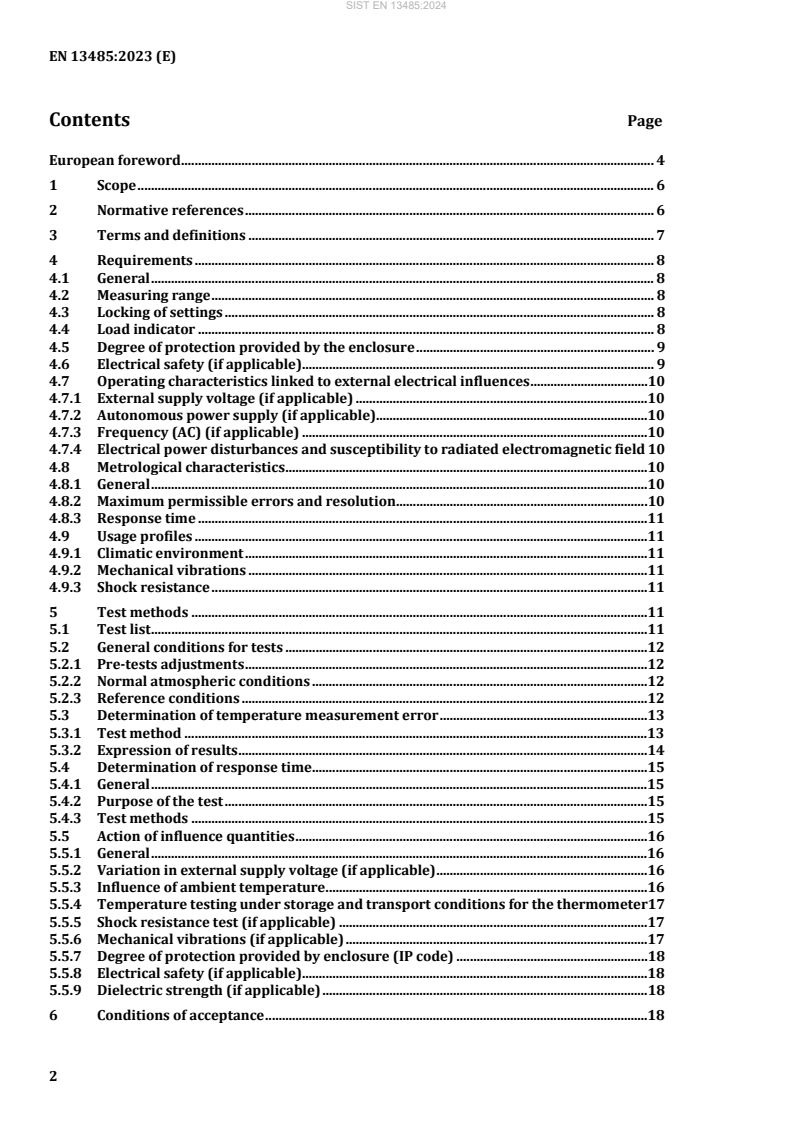
Contents Page
European foreword . 4
1 Scope . 6
2 Normative references . 6
3 Terms and definitions . 7
4 Requirements . 8
4.1 General . 8
4.2 Measuring range . 8
4.3 Locking of settings . 8
4.4 Load indicator . 8
4.5 Degree of protection provided by the enclosure . 9
4.6 Electrical safety (if applicable). 9
4.7 Operating characteristics linked to external electrical influences .10
4.7.1 External supply voltage (if applicable) .10
4.7.2 Autonomous power supply (if applicable).10
4.7.3 Frequency (AC) (if applicable) .10
4.7.4 Electrical power disturbances and susceptibility to radiated electromagnetic field 10
4.8 Metrological characteristics .10
4.8.1 General .10
4.8.2 Maximum permissible errors and resolution .10
4.8.3 Response time .11
4.9 Usage profiles .11
4.9.1 Climatic environment .11
4.9.2 Mechanical vibrations .11
4.9.3 Shock resistance .11
5 Test methods .11
5.1 Test list .11
5.2 General conditions for tests .12
5.2.1 Pre-tests adjustments .12
5.2.2 Normal atmospheric conditions .12
5.2.3 Reference conditions .12
5.3 Determination of temperature measurement error .13
5.3.1 Test method .13
5.3.2 Expression of results .14
5.4 Determination of response time .15
5.4.1 General .15
5.4.2 Purpose of the test .15
5.4.3 Test methods .15
5.5 Action of influence quantities .16
5.5.1 General .16
5.5.2 Variation in external supply voltage (if applicable) .16
5.5.3 Influence of ambient temperature .16
5.5.4 Temperature testing under storage and transport conditions for the thermometer 17
5.5.5 Shock resistance test (if applicable) .17
5.5.6 Mechanical vibrations (if applicable) .17
5.5.7 Degree of protection provided by enclosure (IP code) .18
5.5.8 Electrical safety (if applicable).18
5.5.9 Dielectric strength (if applicable) .18
6 Conditions of acceptance .18
6.1 Requirements . 18
6.2 Maximum permissible errors . 18
7 Designation . 18
8 Marking . 19
9 Periodic verification . 19
Annex A (informative) Example of data form describing suitability for use of equipment of a
specific series (to be filled in by the manufacturer) . 20
Annex B (normative) Expected operation time and storage capacity . 21
B.1 Battery lifetime dependent on usage . 21
B.2 Minimum power supply voltage . 21
Annex C (informative) Examples for temperature conditions . 22
Annex D (informative) Life cycle sheet . 23
Annex E (informative) Guidance to determine accordance with this document . 24
Annex F (informative) Guidance to determine the expanded uncertainty . 25
Bibliography . 27
European foreword
This document (EN 13485:2023) has been prepared by Technical Committee CEN/TC 423 “Means of
measuring and/or recording temperature in the cold chain”, the secretariat of which is held by DIN.
This European Standard shall be given the status of a national standard, either by publication of an
identical text or by endorsement, at the latest by June 2024, and conflicting national standards shall be
withdrawn at the latest by June 2024.
Attention is drawn to the possibility that some of the elements of this document may be the subject of
patent rights. CEN shall not be held responsible for identifying any or all such patent rights.
This document supersedes EN 13485:2001.
a) clarification of the scope;
b) complete revision of Clause 4;
c) addition of class 0,2 to the document;
d) revision of 5.1;
e) revision of 5.3 with examples to clarify the process;
f) revision of 5.5.1 and 5.5.3;
g) update of Clauses 7 and 8 according to the revised clauses;
h) revision of Clause 9;
i) addition of Annex B regarding expected operation time and storage capacity;
j) addition of Annex C regarding examples for temperature conditions;
k) addition of Annex D regarding example of a life cycle sheet;
l) addition of Annex E as guideline to the verification process;
m) addition of Annex F as guideline to determine the expanded uncertainty.
This document meets the objectives of the following directives:
— 92/1/EEC of January 15, 1992 of the Commission of the monitoring of temperatures in the means of
transport, warehousing and storage of quick-frozen foodstuffs intended for human consumption;
(Commission Regulation (EC) No 37/2005 of 12 January 2005 on the monitoring of temperatures in
the means of transport, warehousing and storage of quick-frozen foodstuffs intended for human
consumption with EEA relevance);
— 92/2/EEC of January 13, 1992 of the Commission laying down the sampling procedure and the
community method of analysis for the official control of the temperatures of quick-frozen foods
intended for human consumption;
— 93/43/EEC of June 14, 1993 of the Council of the hygiene of foodstuffs and in particular on
“temperature control criteria” (Regulation (EC) No 852/2004 of the European Parliament and of the
Council of 29 April 2004 on the hygiene of foodstuffs).
Any feedback and questions on this document should be directed to the users’ national standards body.
A complete listing of these bodies can be found on the CEN website.
According to the CEN-CENELEC Internal Regulations, the national standards organisations of the
following countries are bound to implement this European Standard: Austria, Belgium, Bulgaria, Croatia,
Cyprus, Czech Republic, Denmark, Estonia, Finland, France, Germany, Greece, Hungary, Iceland, Ireland,
Italy, Latvia, Lithuania, Luxembourg, Malta, Netherlands, Norway, Poland, Portugal, Republic of North
Macedonia, Romania, Serbia, Slovakia, Slovenia, Spain, Sweden, Switzerland, Türkiye and the United
Kingdom.
1 Scope
This document specifies the technical and functional characteristics for all types of thermometers
(electronic, mechanical, etc.) for equipping the means used for the transport, storage and distribution of
temperature sensitive goods and for measuring the ambient or internal temperature of the products
between −80 °C and +85 °C.
It specifies the test methods which allow the verification of the equipment's conformity to suitability and
performance requirements.
It applies to the whole thermometer and indicating device(s). The temperature sensor(s) can be
integrated into the thermometer or remote from it (wired or wireless external temperature sensor(s)).
It does not specify the location of the thermometer and its sensors with respect to types of usage such as
transport, storage and distribution.
NOTE Examples for the transport, storage and distribution of temperature sensitive goods between −80 °C and
+85 °C include chilled, frozen, deep frozen and quick-frozen food; ice cream; fresh and hot food; pharmaceuticals;
blood and organs; chemicals; biologicals; electronic and mechanical devices; flowers, plants and bulbs; raw
materials and liquids; animals; art and furnishings.
2 Normative references
The following documents are referred to in the text in such a way that some or all of their content
constitutes requirements of this document. For dated references, only the edition cited applies. For
undated references, the latest edition of the referenced document (including any amendments) applies.
EN 13486, Temperature recorders and thermometers for measuring the ambient or internal temperature
for the transport, storage and distribution of temperature sensitive goods — Periodic verification
EN 60068-2-27, Environmental testing — Part 2-27: Tests — Test Ea and guidance: Shock
EN 61010-1, Safety requirements for electrical equipment for measurement, control, and laboratory use —
Part 1: General requirements
EN IEC 61000-6-2, Electromagnetic compatibility (EMC) — Part 6-2: Generic standards — Immunity for
industrial environments
EN IEC 61000-6-3, Electromagnetic compatibility (EMC) — Part 6-3: Generic standards — Emission
standard for residential, commercial and light-industrial environments
ISO/IEC 17025, General requirements for the competence of testing and calibration laboratories
JCGM 200:2012, International Vocabulary of Metrology — Basic and general concepts and associated terms
(VIM)
Available at: https://www.bipm.org/en/committees/jc/jcgm/publications
3 Terms and definitions
For the purposes of this document, the terms and definitions given in the VIM (JCGM 200:2012) and the
following apply.
ISO and IEC maintain terminology databases for use in standardization at the following addresses:
— ISO Online browsing platform: available at https://www.iso.org/obp/
— IEC Electropedia: available at https://www.electropedia.org/
3.1
measurement
set of operations having the object of determining a value of a quantity
3.2
thermometer
any device to measure and display temperature
3.3
temperature sensor
element of a measuring instrument or measuring chain that is directly affected by the temperature
3.4
external temperature sensor
sensor which measures a temperature independent of the enclosure of the indicating device
3.5
internal temperature sensor
sensor which measures the temperature of the enclosure of the thermometer
3.6
storage and transport conditions
extreme conditions which a non-operational measuring instrument can withstand without damage and
without degradation of specified metrological characteristics when it is subsequently operated under its
rated operating conditions
3.7
chilled food
food which has been subjected to cooling (without freezing) and is intended to be maintained at low
temperature
3.8
frozen food
food which has been subjected to a freezing process specially designed to preserve the wholesomeness
and quality of the product
3.9
deep-frozen or quick-frozen food
food which has been subjected to a quick-freezing or deep-freezing process
3.10
verification
confirmation, through the provision of objective evidence, that specified requirements have been fulfilled
Note 1 to entry: The objective evidence needed for a verification can be the result of an inspection or of other forms
of determination such as performing alternative calculations or reviewing documents.
Note 2 to entry: The activities carried out for verification are sometimes called a qualification process.
Note 3 to entry: The word “verified” is used to designate the corresponding status.
[SOURCE: EN ISO 9000:2015, 3.8.12]
4 Requirements
4.1 General
Manufacturers shall make recommendations on the specification of ancillary equipment in order to meet
the performance requirements of this document.
The manufacturer shall specify the use of the transport, storage and operational conditions. Examples are
given in the informative Annex A and Tables C.1 and C.2 in Annex C.
NOTE Further information is included in EN IEC 60721-3-3 and EN 60721-2-3.
Manufacturers shall state the intended use and requirements of their applications. Examples are given in
Annex B.
If the system would have the possibilities to prevent and/or detect manipulation and to prove the validity
of the data, it can be validated according to the relevant chapters in EN 12830.
4.2 Measuring range
— The temperature sensor shall be able to measure the air and/or product temperature in the
measuring range that it is specified by the manufacturer;
— The thermometers shall be able to indicate the air and/or product temperature which is extended
twice the maximum permissible error for the maximum specified class of the temperature sensor
stated by the manufacturer in both directions, see 4.8.2;
EXAMPLE Measuring range −20 °C till +90 °C, accuracy 0,5. The indication range is at least from −21,0 °C to
+91,0 °C.
4.3 Locking of settings
The means for adjusting settings of the thermometer shall either:
— be protected against accidental or unauthorised modifications; and/or
— record each adjustment of any settings that remain accessible.
4.4 Load indicator
For devices with an autonomous power supply, this shall be indicated on the thermometers or on the
power supply or in the technical documentation, with the corresponding usage temperature.
The manufacturer shall install an indicating device, warning light or message on the device or remote,
warning the user that the power source needs replacing.
The manufacturer shall avoid any measurement when the charge of the battery is too low.
The manufacturer shall declare operational limitations as indicated in Annex B.
The battery lifetime shall be indicated by the manufacturer for relevant operation temperatures taking
into account typical operation of e.g. display, transmission of data, LEDs, number and kind of sensors.
The manufacturer shall indicate, if the battery is fixed or replaceable and/or rechargeable.
4.5 Degree of protection provided by the enclosure
The degree of protection provided by the enclosure (see Table 1) shall be:
— IP 20 for thermometers used in heated/air-conditioned closed premises or in the cabin of transport
vehicles;
— IP 55 for thermometers used inside cold enclosures (storage or transport vehicles), for external
sensor and portable apparatus;
— IP 65 for thermometers used outside the buildings or vehicles, with sensors inside the cold enclosure
or other operational requirements like hygienic and cleaning or maintenance aspects.
For multi-purpose devices, the highest level will be required.
Table 1 — Degree of protection
Product internal
Air temperature
temperature
Indicating Indicating
Sensor Sensor
device device
in heated/air-conditioned closed premises
NA IP 20 IP 65 IP 20
a
or in the cabin of transport vehicles
inside cold enclosures (storage or
IP 55 IP 55 IP 65 IP 55
a
transport vehicles)
outside the buildings or vehicles, with
IP 65 IP 65 IP 65 IP 65
b
sensors inside the cold enclosure
c
IP 67 NA IP 67 NA
Calibration in bath (liquid)
d
IP 65 IP 65 IP 65 IP 65
Liquid cleaning
a
Non-condensing humidity conditions.
b
Condensing humidity conditions.
c
Includes liquids like alcohol, glycol, oil, sand etc.
d
Disinfection.
NOTE 1 Further requirements regarding the degree of protection are provided in EN 60529.
NOTE 2 Additional requirements regarding the degree of protection are also provided in ISO 20653.
4.6 Electrical safety (if applicable)
The thermometer shall be in accordance with the requirements of EN 61010-1.
4.7 Operating characteristics linked to external electrical influences
4.7.1 External supply voltage (if applicable)
A thermometer which requires an external electrical supply shall be able to be connected to one of the
electrical supplies given in Table 2.
Table 2 — External supply voltage
Alternating current (AC) U +10 %, −15 %
n
Direct current (DC) U Rated operating conditions Limiting conditions
n
5 V 4,5 V to 5,5 V 0 V to 6 V
9 V 6 V to 12 V 0 V to 14 V
12 V 10 V to 16 V 0 V to 18 V
24 V 20 V to 32 V 0 V to 36 V
4.7.2 Autonomous power supply (if applicable)
The manufacturer shall specify the operating time without external power at a reference temperature.
4.7.3 Frequency (AC) (if applicable)
The manufacturer shall specify the operating frequency with a tolerance of ±3 Hz.
4.7.4 Electrical power disturbances and susceptibility to radiated electromagnetic field
The thermometer shall be in accordance with the requirements of EN IEC 61000-6-2 and
EN IEC 61000-6-3, or any other specific standard if applicable.
4.8 Metrological characteristics
4.8.1 General
The metrological characteristics of the thermometers result from usage profiles which determine the
operating criteria.
4.8.2 Maximum permissible errors and resolution
The thermometers under rated operating conditions shall conform to at least one of the classes indicated
in Table 3.
Table 3 — Accuracy classes of thermometers
Class 0,2 0,5 1 2
Maximum permissible errors ±0,2 °C ±0,5 °C ±1 °C ±2 °C
Resolution < 0,1 °C < 0,2 °C ≤ 0,5 °C ≤ 1 °C
4.8.3 Response time
4.8.3.1 Thermometers for measuring the air temperature
The response time shall be:
— for thermometers with external air sensors maximum 5 min;
— for thermometers with internal sensors maximum 20
...