

EN ISO 15223-1:2021
(Main)Medical devices - Symbols to be used with information to be supplied by the manufacturer - Part 1: General requirements (ISO 15223-1:2021)
- Abstract
This document specifies symbols used to express information supplied for a medical device. This document is applicable to symbols used in a broad spectrum of medical devices, that are available globally and need to meet different regulatory requirements.
These symbols can be used on the medical device itself, on its packaging or in the accompanying information. The requirements of this document are not intended to apply to symbols specified in other standards.
- Status
- Published
- Publication Date
- 28-Sep-2021
- Withdrawal Date
- 30-Mar-2022
- Current Stage
- 6060 - Definitive text made available (DAV) - Publishing
- Start Date
- 29-Sep-2021
- Completion Date
- 29-Sep-2021
- Directive
- 2017/745 - Regulation (EU) 2017/745 of the European Parliament and of the Council of 5 April 2017 on medical devices, amending Directive 2001/83/EC, Regulation (EC) No 178/2002 and Regulation (EC) No 1223/2009 and repealing Council Directives 90/385/EEC and 93/42/EECOJ Ref: L 1 OJ Date: 05-Jan-2022



Overview
EN ISO 15223-1:2021 (ISO 15223-1:2021) specifies graphical symbols for medical devices used to convey information supplied by the manufacturer. It sets general requirements for symbols that appear on the medical device itself, on packaging, or in accompanying information (instructions for use). This European adoption supersedes the 2017 edition and aligns with EU regulatory expectations (see Annex ZA mapping to Regulation (EU) 2017/745). The standard is intended for globally marketed devices that must meet different regulatory needs.
Key topics and requirements
- Standardized symbol set and use: Defines which symbols may be used to convey critical label and safety information (e.g., sterility, single-use, lot/serial number, date of manufacture/expiry, handling and storage conditions).
- Scope of application: Symbols may be applied directly to devices, packaging, or accompanying documentation; symbols specified in other standards are excluded from this document’s requirements.
- Labeling conventions: Guidance on when a symbol may be used alone versus when it must be accompanied by explanatory text in the instructions for use or other documentation.
- Regulatory alignment: Provides a voluntary means to meet certain General Safety and Performance Requirements of EU Regulation (EU) 2017/745 and supports harmonization across CEN/CENELEC member states.
- Normative references: Cross-references include ISO 15223-2 (symbol specifications), ISO 8601 (date/time formats), and ISO 3166-1 (country codes), which inform symbol application and auxiliary data formats.
Practical applications and who uses this standard
- Medical device manufacturers and labeling teams use ISO 15223-1 to select compliant symbols for product labels, packaging and instructions for use.
- Regulatory affairs professionals rely on it to demonstrate conformity with labeling requirements and to support CE marking activities under EU MDR.
- Design engineers and quality managers incorporate symbols into product artwork, packaging specifications and risk management documentation.
- Notified bodies, distributors, and procurement teams reference the standard when verifying that device information is clear, consistent and compliant.
- Useful for devices intended for global markets where concise, language-independent communication of safety and handling is essential.
Related standards
- ISO 15223-2 - Graphic symbols - Verification and validation of symbols (symbol specifications)
- ISO 8601-1 / ISO 8601-2 - Date and time formats
- ISO 3166-1 - Country codes
Using ISO 15223-1 helps ensure consistent, regulatory-aligned labelling of medical devices through recognized medical device symbols, improving user understanding and aiding global market access.
Relations
- Effective Date
- 06-Oct-2021
- Refers
ISO 8601-2:2019 - Date and time — Representations for information interchange — Part 2: Extensions - Effective Date
- 25-Aug-2026
- Refers
ISO 8601-1:2019 - Date and time — Representations for information interchange — Part 1: Basic rules - Effective Date
- 25-Aug-2026
- Effective Date
- 11-Feb-2026
- Effective Date
- 28-Jan-2026
- Effective Date
- 28-Jan-2026
- Effective Date
- 28-Jan-2026
- Effective Date
- 28-Jan-2026
- Effective Date
- 28-Jan-2026
- Effective Date
- 28-Jan-2026
- Effective Date
- 28-Jan-2026
- Effective Date
- 28-Jan-2026
- Effective Date
- 28-Jan-2026
- Effective Date
- 28-Jan-2026
- Effective Date
- 28-Jan-2026
Get Certified
Connect with accredited certification bodies for this standard

BSI Group
BSI (British Standards Institution) is the business standards company that helps organizations make excellence a habit.

TÜV Rheinland
TÜV Rheinland is a leading international provider of technical services.

TÜV SÜD
TÜV SÜD is a trusted partner of choice for safety, security and sustainability solutions.
Sponsored listings
Frequently Asked Questions
EN ISO 15223-1:2021 is a standard published by the European Committee for Standardization (CEN). Its full title is "Medical devices - Symbols to be used with information to be supplied by the manufacturer - Part 1: General requirements (ISO 15223-1:2021)". This standard covers: This document specifies symbols used to express information supplied for a medical device. This document is applicable to symbols used in a broad spectrum of medical devices, that are available globally and need to meet different regulatory requirements. These symbols can be used on the medical device itself, on its packaging or in the accompanying information. The requirements of this document are not intended to apply to symbols specified in other standards.
This document specifies symbols used to express information supplied for a medical device. This document is applicable to symbols used in a broad spectrum of medical devices, that are available globally and need to meet different regulatory requirements. These symbols can be used on the medical device itself, on its packaging or in the accompanying information. The requirements of this document are not intended to apply to symbols specified in other standards.
EN ISO 15223-1:2021 is classified under the following ICS (International Classification for Standards) categories: 01.080.20 - Graphical symbols for use on specific equipment; 11.040.01 - Medical equipment in general. The ICS classification helps identify the subject area and facilitates finding related standards.
EN ISO 15223-1:2021 has the following relationships with other standards: It is inter standard links to EN ISO 15223-1:2016, ISO 8601-2:2019, ISO 8601-1:2019, ISO 15223-2:2010, EN ISO 15877-5:2009/A2:2020, EN ISO 3166-1:2020, EN ISO 15877-3:2009/A2:2021, EN ISO 10535:2006, EN ISO 11979-4:2008, EN 455-3:2006, EN ISO 5362:2019, EN ISO 18113-3:2011, EN ISO 5361:2012, EN 1789:2007+A1:2010, EN 14180:2025. Understanding these relationships helps ensure you are using the most current and applicable version of the standard.
EN ISO 15223-1:2021 is associated with the following European legislation: EU Directives/Regulations: 2017/745, 2017/746; Standardization Mandates: M/565, M/575, M/575 Amd 2, M/MDR. When a standard is cited in the Official Journal of the European Union, products manufactured in conformity with it benefit from a presumption of conformity with the essential requirements of the corresponding EU directive or regulation.
EN ISO 15223-1:2021 is available in PDF format for immediate download after purchase. The document can be added to your cart and obtained through the secure checkout process. Digital delivery ensures instant access to the complete standard document.
Standards Content (Sample)
SLOVENSKI STANDARD
01-december-2021
Nadomešča:
SIST EN ISO 15223-1:2017
Medicinski pripomočki - Simboli za označevanje podatkov, ki jih mora podati
dobavitelj - 1. del: Splošne zahteve (ISO 15223-1:2021)
Medical devices - Symbols to be used with information to be supplied by the
manufacturer - Part 1: General requirements (ISO 15223-1:2021)
Medizinprodukte - Zu verwendende Symbole mit durch den Hersteller bereitgestellten
Informationen - Teil 1: Allgemeine Anforderungen (ISO 15223-1:2021)
Dispositifs médicaux - Symboles à utiliser avec les informations à fournir par le fabricant
- Partie 1: Exigences générales (ISO 15223-1:2021)
Ta slovenski standard je istoveten z: EN ISO 15223-1:2021
ICS:
01.080.20 Grafični simboli za posebno Graphical symbols for use on
opremo specific equipment
11.040.01 Medicinska oprema na Medical equipment in general
splošno
2003-01.Slovenski inštitut za standardizacijo. Razmnoževanje celote ali delov tega standarda ni dovoljeno.
EUROPEAN STANDARD EN ISO 15223-1
NORME EUROPÉENNE
EUROPÄISCHE NORM
September 2021
ICS 01.080.20; 11.040.01
Supersedes EN ISO 15223-1:2016
English version
Medical devices - Symbols to be used with information to
be supplied by the manufacturer - Part 1: General
requirements (ISO 15223-1:2021)
Dispositifs médicaux - Symboles à utiliser avec les Medizinprodukte - Zu verwendende Symbole mit
informations à fournir par le fabricant - Partie 1: durch den Hersteller bereitgestellten Informationen -
Exigences générales (ISO 15223-1:2021) Teil 1: Allgemeine Anforderungen (ISO 15223-1:2021)
This European Standard was approved by CEN on 4 June 2021.
This European Standard was corrected and reissued by the CEN-CENELEC Management Centre on 13 October 2021.
CEN and CENELEC members are bound to comply with the CEN/CENELEC Internal Regulations which stipulate the conditions for
giving this European Standard the status of a national standard without any alteration. Up-to-date lists and bibliographical
references concerning such national standards may be obtained on application to the CEN-CENELEC Management Centre or to
any CEN and CENELEC member.
This European Standard exists in three official versions (English, French, German). A version in any other language made by
translation under the responsibility of a CEN and CENELEC member into its own language and notified to the CEN-CENELEC
Management Centre has the same status as the official versions.
CEN and CENELEC members are the national standards bodies and national electrotechnical committees of Austria, Belgium,
Bulgaria, Croatia, Cyprus, Czech Republic, Denmark, Estonia, Finland, France, Germany, Greece, Hungary, Iceland, Ireland, Italy,
Latvia, Lithuania, Luxembourg, Malta, Netherlands, Norway, Poland, Portugal, Republic of North Macedonia, Romania, Serbia,
Slovakia, Slovenia, Spain, Sweden, Switzerland, Turkey and United Kingdom.
CEN-CENELEC Management Centre:
Rue de la Science 23, B-1040 Brussels
© 2021 CEN/CENELEC All rights of exploitation in any form and by any means Ref. No. EN ISO 15223-1:2021 E
reserved worldwide for CEN national Members and for
CENELEC Members.
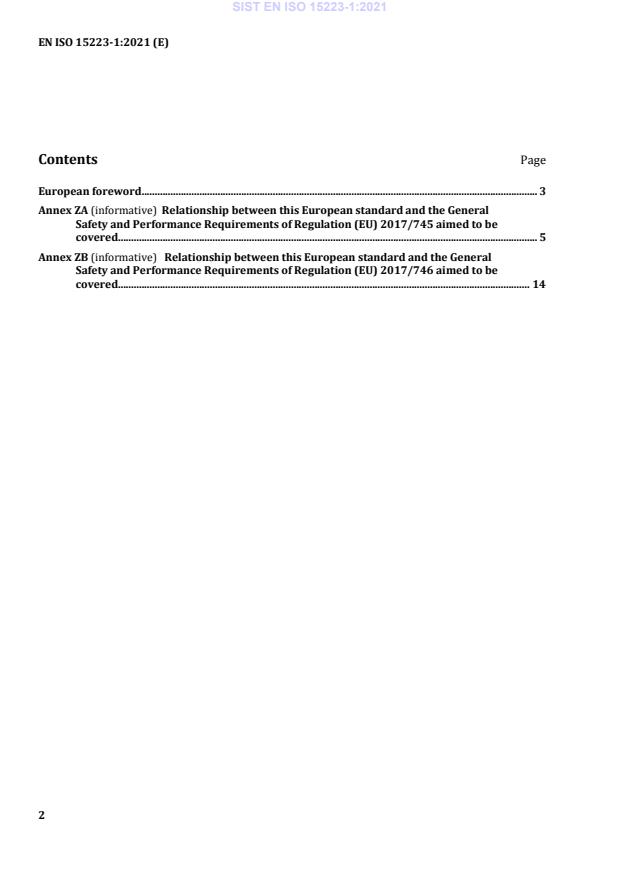
Contents Page
European foreword . 3
Annex ZA (informative) Relationship between this European standard and the General
Safety and Performance Requirements of Regulation (EU) 2017/745 aimed to be
covered. 5
Annex ZB (informative) Relationship between this European standard and the General
Safety and Performance Requirements of Regulation (EU) 2017/746 aimed to be
covered. 14
European foreword
This document (EN ISO 15223-1:2021) has been prepared by Technical Committee ISO/TC 210 "Quality
management and corresponding general aspects for medical devices" in collaboration with Technical
Committee CEN-CENELEC/ JTC 3 “Quality management and corresponding general aspects for medical
devices” the secretariat of which is held by NEN.
This European Standard shall be given the status of a national standard, either by publication of an
identical text or by endorsement, at the latest by March 2022, and conflicting national standards shall
be withdrawn at the latest by March 2022.
Attention is drawn to the possibility that some of the elements of this document may be the subject of
patent rights. CEN-CENELEC shall not be held responsible for identifying any or all such patent rights.
This document supersedes EN ISO 15223-1:2016.
This document has been prepared under a Standardization Request given to CEN and CENELEC by the
European Commission and the European Free Trade Association, and supports essential requirements
of EU Directive(s) / Regulation(s).
For the relationship with EU Directive(s) / Regulation(s), see informative Annex ZA and ZB, which is an
integral part of this document.
Any feedback and questions on this document should be directed to the users’ national standards
body/national committee. A complete listing of these bodies can be found on the CEN and CENELEC
websites.
This document is an adoption of an International Standard. The definitions in applicable regulatory
requirements differ from nation to nation and region to region. As a result, the definitions in this
document can differ in wording from those in European Regulations. For use in support of European
requirements, definitions in the European regulations for medical devices take precedence.
The following referenced documents are indispensable for the application of this document. For
undated references, the latest edition of the referenced document (including any amendments) applies.
For dated references, only the edition cited applies. However, for any use of this standard “within the
meaning of Annex ZA and Annex ZB”, the user should always check that any referenced document has
not been superseded and that its relevant contents can still be considered the generally acknowledged
state-of-art.
When an IEC or ISO standard is referred to in the ISO standard text, this shall be understood as a
normative reference to the corresponding EN standard, if available, and otherwise to the dated version
of the ISO or IEC standard, as listed below.
NOTE The way in which these references documents are cited in normative requirements determines the
extent (in whole or in part) to which they apply.
Table — Correlations between normative references and dated EN and ISO standards
Normative references as listed in
Equivalent dated standard
Clause 2 of the ISO standard
EN ISO or IEC
a
ISO 8601-1 -- ISO 8601-1:2019
a
ISO 8601-2 -- ISO 8601-2:2019
ISO 15223-2 -- ISO 15223-2:2010
ISO 3166-1 EN ISO 3166-1:2020 ISO 3166-1: 2020
According to the CEN-CENELEC Internal Regulations, the national standards organizations of the
following countries are bound to implement this European Standard: Austria, Belgium, Bulgaria,
Croatia, Cyprus, Czech Republic, Denmark, Estonia, Finland, France, Germany, Greece, Hungary, Iceland,
Ireland, Italy, Latvia, Lithuania, Luxembourg, Malta, Netherlands, Norway, Poland, Portugal, Republic of
North Macedonia, Romania, Serbia, Slovakia, Slovenia, Spain, Sweden, Switzerland, Turkey and the
United Kingdom.
Endorsement notice
The text of ISO 15223-1:2021 has been approved by CEN-CENELEC as EN ISO 15223-1:2021 without
any modification.
Annex ZA
(informative)
Relationship between this European standard and the General Safety and
Performance Requirements of Regulation (EU) 2017/745 aimed to be
covered
This European standard has been prepared under a Commission’s standardisation request to provide
one voluntary means of conforming to the General Safety and Performance Requirements of Regulation
(EU) 2017/745 of 5 April 2017 concerning medical devices [OJ L 117].
Once this standard is cited in the Official Journal of the European Union under that Regulation,
compliance with the normative clauses of this standard given in Table ZA.1 confers, within the limits of
the scope of this standard, a presumption of conformity with the corresponding General Safety and
Performance Requirements of that Regulation, and associated EFTA regulations.
NOTE 1 Where a reference from a clause of this standard to the risk management process is made, the risk
management process needs to be in compliance with Regulation (EU) 2017/745. This means that risks have to be
‘reduced as far as possible’, ‘reduced to the lowest possible level’, ‘reduced as far as possible and appropriate’,
‘removed or reduced as far as possible’, ‘eliminated or reduced as far as possible’, ’removed or minimized as far as
possible’, or ‘minimized’, according to the wording of the corresponding General Safety and Performance
Requirement.
NOTE 2 The manufacturer’s policy for determining acceptable risk must be in compliance with General Safety
and Performance Requirements 1, 2, 3, 4, 5, 8, 9, 10, 11, 14, 16, 17, 18, 19, 20, 21 and 22 of the Regulation.
NOTE 3 This Annex ZA is based on normative references according to the table of references in the European
Foreword, replacing the references in the core text.
NOTE 4 When a General Safety and Performance Requirement does not appear in Table ZA.1, it means that it is
not addressed by this European Standard.
Table ZA.1 – Correspondence between this European standard and Annex I of Regulation (EU)
2017/745 [OJ L 117]
General Safety and
Clause(s) / sub-clause(s)
Performance Requirements of Remarks / Notes
of this EN
Regulation (EU) 2017/745
4 (c) 5.2.6 Partially covered: used to draw user’s
attention on the label to the safety
5.2.7
information such as
5.2.8
warnings/precautions/contraindications
5.3.1
only for the aspects dealt with by these
5.3.2 symbols placed in the instructions for use
or accompanying information and of any
5.3.3
residual risks and need for training for
5.3.4
users.
5.3.5
5.3.6
Not covered: does not provide further
5.3.7
information for safety about
warning/precautions/contraindications
5.3.8
other than the ones dealt with by these
5.3.9
symbols, nor training.
5.4.1
5.4.2
5.4.3
5.4.4
5.4.5
5.4.6
5.4.7
5.4.8
5.4.9
5.4.10
5.4.11
5.4.12
10.4.5 5.4.3 Partially covered: used to draw user’s
attention on the label to the safety
5.4.10
information placed in the instructions for
use or accompanying information of the
presence of substances that are
carcinogenic, mutagenic, toxic to
reproduction and/or having endocrine-
disrupting properties.
11.3 5.2.1 Partially covered: used as part of the label
to identify sterile or non-sterile medical
5.2.2
devices.
5.2.3
5.2.4
Not covered: Design, manufacture, and
5.2.5
packaging.
5.2.7
5.2.10
11.8 5.2.1 Covered: used as part of the label to
distinguish between identical sterile and
5.2.3
non-sterile medical devices.
5.2.4
5.2.5
5.2.7
5.2.10
14.1 5.4.3 Partially covered: used to draw user’s
attention on the labelling to the safety
5.4.4
information in the instructions for use.
22.1 5 Partially covered: used to convey specific
label information in a format that is easy
for the intended user to understand.
Not covered: the design and manufacture
for appropriate performance, taking user’s
skills into account; the understanding and
application of the instructions for use.
23.1 (first sentence) 5.1.1 Partially covered: used to identify the
medical device and its manufacturer.
5.1.3
5.1.5
5.1.6
5.1.7
5.1.10
5.1.11
23.1 (a) 5 Partially covered: used to convey label
information in a format that is easy to
understand.
Not covered: the medium, format, content,
legibility and location of the label,
instructions for use, and accompanying
information; the technical knowledge,
experience, and training of the intended
user; understanding of the intended use,
drawings, or diagrams.
23.1 (b) 5 Partially covered: used to provide label
information directly on a medical device in
a symbol format that would be otherwise
impracticable by use of text.
Not covered: the information that is
required on the label and/or medical
device, but that can be placed on the
medical device or the packaging.
23.1 (c) 5 Partially covered: used to provide label
information in a human readable format
that would be otherwise impracticable by
use of text.
Not covered: machine-readable
information.
23.1 (g) 5.4.3 Partially covered: may be used to draw
user’s attention on the label to the safety
5.4.4
information concerning limitation, contra-
indications, precautions, or warnings.
Not covered: the residual risks required to
be communicated by way of limitations,
contra-indications, precautions, or
warnings.
23.1 (h) 4.2 Covered: symbols used to convey
information in combination with risk
management. Symbols addressed in 5 are
used on labels without a description of the
symbol required in the instructions for use
or accompanying information to convey
information.
Not covered: the use of other symbols will
require a description of the symbol in the
instructions for use or accompanying
information.
23.2 (b) 5.1.6 Partially covered: used as part of the label
information to identify the medical device
5.1.10
and the packaging contents.
5.7.10
Not covered: the intended purpose of the
medical device.
23.2 (c) 5.1.1 Partially covered: used as part of the label
information to identify the manufacturer
and registered place of business (address).
Not covered: the trade name or registered
trademark.
23.2 (d) 5.1.2 Covered: used as part of the label
information to identify the authorised
representative and registered place of
business (address).
23.2 (e) 5.4.6 Covered: used as part of the label
information to identify that the medical
5.4.7
device contains or incorporates a
5.4.8
medicinal substance, including a human
5.4.9
blood or plasma derivative; or tissues or
cells, or their derivatives, of human origin;
or tissues or cells of animal origin, or their
derivatives.
23.2 (f) 5.4.3 Partially covered: used to draw user’s
attention on the label to the safety
5.4.10
information placed in the instructions for
use or accompanying information of the
presence of substances that are
carcinogenic, mutagenic, toxic to
reproduction and/or have endocrine-
disrupting properties.
23.2 (g) 5.1.5 Covered: used on the label to replace the
words ‘LOT NUMBER’ and ‘SERIAL
5.1.7
NUMBER’
23.2 (h) 5.7.10 Partially covered: symbol used on the
label to indicate the UDI carrier
23.2 (i) 5.1.4 Covered: used on the label to indicate the
time limit for use or implant of the medical
device, accompanied by the date (to
include at least year and month).
23.2 (j) 5.1.3 Covered: used on the label to indicate the
date of manufacture for the medical
5.1.11
device, accompanied by the date (to
include at least year and month).
23.2 (k) 5.3.1 Covered: used on the label to indicate
information that the medical device is:
5.3.2
fragile.
5.3.3
needs protection from sunlight and other
5.3.4
light sources, or heat and radioactive
5.3.5
sources, or moisture.
5.3.6
5.3.7
Covered: used on the label to indicate that
5.3.8
for safe use and effectiveness the medical
5.3.9 device has:
an upper limit of temperature
accompanied by the temperature
value.
a lower limit of temperature accompanied
by the temperature value.
upper and lower limits of temperature
accompanied by the upper and lower
temperature values.
upper and lower limits of humidity
accompanied by the upper and lower
humidity values.
upper and lower limits of pressure
accompanied by the upper and lower
pressure values.
23.2 (l) 5.2.1 Covered: used on the label to specify an
indication of the medical device’s sterile
5.2.2
state and the method of sterilization.
5.2.3
5.2.4
5.2.5 If symbol 5.2.1 is used, the GSPR is only
partially covered as this symbol does not
5.2.10
indicate the method of sterilization.
23.2 (m) 5.2.6 Partially covered: used to draw user’s
attention on the label to the more detailed
5.2.7
warnings or precautions found in the
5.2.8
instructions for use or accompanying
5.3.1
information.
5.3.2
5.3.3
5.3.4
5.3.5
5.3.6
5.3.7
5.3.8
5.3.9
5.4.1
5.4.2
5.4.3
5.4.4
5.4.5
5.4.10
23.2 (n) 5.4.2 Covered: used to specify on the label that
the medical device is intended for single
use.
23.2 (q) 5.7.7 Covered: used to specify on the label that
the device is a medical device.
Not covered: for labelling of devices
intended for clinical investigation only.
23.2 (s) 5.1.5 Covered: used on the label to replace the
words ‘LOT NUMBER’ and ‘SERIAL
5.1.7
NUMBER’
23.3 (a) 5.2.11 Covered: used to specify on the packaging
that it is sterile packaging (sterile barrier
5.2.12
system).
5.2.13
5.2.14
23.3 (b) 5.2.1 Covered: used on the packaging to identify
the medical device is sterile.
5.2.2
5.2.3
5.2.4
5.2.5
5.2.10
23.3 (c) 5.2.2 Covered: used on the packaging to specify
the method of sterilization.
5.2.3
5.2.4
5.2.5
5.2.10
23.3 (d) 5.1.1 Covered: used on the packaging to identify
the manufacturer and registered place of
business (address).
23.3 (h) 5.1.3 Covered: used on the packaging to indicate
the date of manufacture for the medical
5.1.11
device, accompanied by the date (to
include at least year and month).
23.3 (i) 5.1.4 Covered: used on the packaging to indicate
the time limit for use or implant of the
medical device, accompanied by the date
(to include at least year and month).
23.3 (j) 5.2.8 Covered: used to draw user’s attention on
the packaging to the more detailed
5.4.3
warnings or precautions found in the
instructions for use or accompanying
information if the packaging is damaged or
opened.
23.4 (a) 5.1.1 Covered: used in the instructions for use
to identify that the medical device
5.2.1
contains or incorporates:
5.2.2
a medicinal substance, including a human
5.2.3
blood or plasma derivative (23.2 (e)).
5.2.4
tissues or cells, or their derivatives, of
5.2.5
human origin (23.2 (e)).
5.2.10
tissues or cells of animal origin, or their
5.3.1 derivatives (23.2 (e)).
5.3.2
5.3.3 Covered: used to indicate in the
instructions for use that the medical
5.3.4
device is:
5.3.5
fragile (23.2 (k)).
5.3.6
needs protection from sunlight and other
5.3.7
light sources, or heat and radioactive
5.3.8
sources, or moisture (23.2 (k)).
5.3.9
intended for single use (23.2 (n)).
5.4.2
5.4.3
Covered: used on the label to specify an
5.4.4 indication of the medical device’s non-
sterile or sterile state and the method of
5.4.6
sterilization.
5.4.7
5.4.8
If symbol 5.2.1 is used, the GSPR is only
5.4.9
partially covered as this symbol does not
5.4.10 indicate the method of sterilization (23.2
(l)).
Covered: used in the instructions for use
to indicate that for safe use and
effectiveness the medical device has:
an upper limit of temperature
accompanied by the temperature
value (23.2 (k)).
a lower limit of temperature accompanied
by the temperature value (23.2 (k)).
upper and lower limits of temperature
accompanied by the upper and lower
temperature values (23.2 (k)).
upper and lower limits of humidity
accompanied by the upper and lower
humidity values (23.2 (k)).
upper and lower limits of pressure
accompanied by the upper and lower
pressure values (23.2 (k)).
Partially covered: used in the instructions
for use to identify the manufacturer and
registered place of business (address)
(23.2 (c)).
Partially covered: used to draw user’s
attention to the safety information placed
in the instructions for use of the presence
of substances that are hazardous,
carcinogenic, mutagenic, toxic to
reproduction and/or have endocrine-
disrupting properties (23.2 (f)).
Not covered: the trade name or registered
trademark (23.2 (a)), (23.2 (c)).
23.4 (l) 5.2.8 Partially covered: used to draw user’s
attention to the more detailed warnings or
5.4.3
precautions found in the instructions for
use if the packaging is damaged or opened.
Not covered: instructions in the event of
damage or unintentional opening.
23.4 (p) 5.4.2 Partially covered: used in the instructions
for use to specify that the medical device is
intended for single use.
Not covered: information and technical
factors that could pose a risk if re-used.
23.4 (aa) 5.1.1 Partially covered: used on information
provided to the patient to draw attention
5.1.5
to the more detailed information
5.1.7
regarding the implanted medical device.
5.1.10
5.7.3
Not covered: specific information
5.7.4
regarding the implanted medical device.
5.7.5
5.7.6
5.7.7
5.7.10
WARNING 1: Presumption of conformity stays valid only as long as a reference to this European
standard is maintained in the list published in the Official Journal of the European Union. Users of this
standard should consult frequently the latest list published in the Official Journal of the European
Union.
WARNING 2: Other Union legislation may be applicable to the product(s) falling within the scope of this
standard.
Annex ZB
(informative)
Relationship between this European standard and the General Safety and
Performance Requirements of Regulation (EU) 2017/746 aimed to be
covered
This European standard has been prepared under a Commission’s standardisation request to provide
one voluntary means of conforming to the requirements of Regulation (EU) 2017/746 of 5 April 2017
concerning in vitro diagnostic medical devices [OJ L 117].
Once this standard is cited in the Official Journal of the European Union under that Regulation,
compliance with the normative clauses of this standard given in Table ZB.1 confers, within the limits of
the scope of this standard, a presumption of conformity with the corresponding General Safety and
Performance Requirements of that Regulation, and associated EFTA regulations.
NOTE 1 Where a reference from a clause of this standard to the risk management process is made, the risk
management process needs to be in compliance with Regulation (EU) 2017/746. This means that risks have to be
‘reduced as far as possible’, ‘reduced to a level as low as reasonably practicable’, ‘reduced to the lowest possible
level’, ‘reduced as far as possible and appropriate’, ‘removed or reduced as far as possible’, ‘eliminated or reduced
as far as possible’, ‘prevented’ or ‘minimized’, according to the wording of the corresponding General Safety and
Performance Requirement.
NOTE 2 The manufacturer’s policy for determining acceptable risk must be in compliance with General Safety
and Performance Requirements 1, 2, 3, 4, 5, 8, 10, 11, 13, 15, 16, 17, 18 and 19 of the Regulation.
NOTE 3 This Annex ZB is based on normative references according to the table of references in the European
Foreword, replacing the references in the core text.
NOTE 4 When a General Safety and Performance Requirement does not appear in Table ZB.1, it means that it is
not addressed by this European Standard.
Table ZB.1 – Correspondence between this European standard and Annex I of Regulation (EU)
2017/746 [OJ L 117]
Clause(s) / sub-
General Safety and Performance
clause(s)
Requirements of Regulation (EU) Remarks / Notes
2017/746
of this EN
4 (c) 5.2.6 Partially covered: used on the label to draw
user’s attention to the safety information
5.2.7
placed in the instructions for use or
5.2.8
accompanying information and of any
5.3.1
residual risks and need for training for
users.
5.3.2
5.3.3
5.3.4 Not covered: does not provide information
for safety nor training.
5.3.5
5.3.6
5.3.7
5.3.8
5.3.9
5.4.1
5.4.2
5.4.3
5.4.4
5.4.5
5.4.6
5.4.7
5.4.8
5.4.9
5.4.10
5.4.11
5.4.12
11.2 5.2.1 Partially covered: used as part of the label
to identify sterile or non-sterile in vitro
5.2.2
diagnostic medical devices.
5.2.3
5.2.4
Not covered: Design, manufacture, and
5.2.5
packaging.
5.2.7
5.2.10
11.6 5.2.1 Covered: used as part of the label to
distinguish between identical sterile and
5.2.7
non-sterile in vitro diagnostic medical
devices.
19.1 5 Partially covered: used to convey specific
label information in a format that is easy
for the intended user to understand.
Not covered: the design and manufacture
for appropriate performance, taking user’s
skills into account; the understanding and
application of the instructions for use.
20.1 (a) 5 Partially covered: used to convey label
information in a format that is easy to
understand.
Not covered: the medium, format, content,
legibility and location of the label,
instructions for use and accompanying
information; the technical knowledge,
experience, and training of the intended
user; understanding of the intended use,
drawings, or diagrams.
20.1 (b) 5 Partially covered: used to provide label
information directly on an in vitro
diagnostic medical device in a symbol
format that would be otherwise
impracticable by use of text.
Not covered: the information that is
required on the label and/or in vitro
diagnostic medical device but that can be
placed on the device or the packaging.
20.1 (c) 5 Partially covered: used to provide label
information in a human readable format
that would be otherwise impracticable by
use of text.
Not covered: machine-readable
information.
20.1 (g) 5.4.4 Partially covered: may be used to draw
user’s attention on the label to the safety
information concerning limitation, contra-
indications, precautions, or warnings.
Not covered: the residual risks required to
be communicated by way of limitations,
contra-indications, precautions, or
warnings.
20.1 (h) 4.2 Covered: symbols used to convey
information in combination with risk
management. Symbols addressed in 5.1
may be used on labels without a
description of the symbol required in the
instructions for use or accompanying
information to convey information.
Not covered: use of other symbols will
require a description of the symbol in the
instructions for use or accompanying
information.
20.2 (b) 5.1.6 Partially covered: used as part of the label
information to identify the in vitro
5.1.7
diagnostic medical device and the
5.7.10
packaging contents.
Not covered: the intended purpose of the in
vitro diagnostic medical device.
20.2 (c) 5.1.1 Partially covered: used as part of the label
information to identify the manufacturer
and registered place of business (address).
Not covered: the trade name or registered
trademark.
20.2 (d) 5.1.2 Covered: used as part of the label
information to identify the authorised
representative and registered place of
business (address).
20.2 (e) 5.5.1 Covered: used as part of the label
information to identify that the device is an
5.5.6
in vitro diagnostic medical device, or that
the in vitro diagnostic medical device is
intended for performance studies.
20.2 (f) 5.1.5 Covered: used on the label to replace the
words ‘LOT NUMBER’ and ‘SERIAL
5.1.7
NUMBER’.
20.2 (g) 5.7.10 Partially covered: used on the label to
indicate the UDI carrier.
20.2 (h) 5.1.4 Covered: used on the label to indicate the
time limit for use, accompanied by the date
(to include at least year and month, and if
relevant, day).
20.2 (i) 5.1.3 Covered: used on the label to indicate the
date of manufacture for the in vitro
diagnostic device, accompanied by the
clearly identifiable date.
20.2 (j) 5.5.5 Covered: used on the label to express the
net quantity of contents or numerical count.
Not covered: the contents by weight or
volume.
20.2 (k) 5.3.1 Covered: used on the label to indicate
information that the in vitro diagnostic
5.3.2
medical device is:
5.3.3
fragile.
5.3.4
needs protection from sunlight and other
5.3.5
light sources, or heat and radioactive
5.3.6
sources, or moisture.
5.3.7
5.3.8
Covered: used to indicate that for safe use
and effectiveness the in vitro diagnostic
5.3.9
medical device has:
an upper limit of temperature accompanied
by the temperature value.
a lower limit of temperature accompanied
by the temperature value.
upper and lower limits of temperature
accompanied by the upper and lower
temperature values.
upper and lower limits of humidity
accompanied by the upper and lower
humidity values.
per and lower limits of pressure
accompanied by the upper and lower
pressure values.
20.2 (l) 5.2.1 Covered: used on the label to specify an
indication of the in vitro diagnostic medical
5.2.2
device’s non-sterile or sterile state and the
5.2.3
method of sterilization.
5.2.4
5.2.5
If symbol 5.2.1 is used, the GSPR is only
5.2.7
partially covered as this symbol does not
5.2.10 indicate the method of sterilization.
20.2 (m) 5.2.6 Partially covered: used on the label to draw
user’s attention to the more detailed
5.2.7
warnings or precautions found in the
5.2.8
instructions for use or accompanying
5.3.1
information.
5.3.2
5.3.3
5.3.4
5.3.5
5.3.6
5.3.7
5.3.8
5.3.9
5.4.1
5.4.2
5.4.3
5.4.4
5.4.5
5.4.10
20.2 (n) 5.4.3 Partially covered: used on the label to draw
user’s attention to the electronic
instructions for use (eIFU).
20.2 (p) 5.4.2 Covered: used on the label to specify that
the in vitro diagnostic medical device is
intended for single use.
20.2 (t) 5.1.5 Covered: used on the label to replace the
words ‘LOT NUMBER’ and ‘SERIAL
5.1.7
NUMBER’ for each in vitro diagnostic
medical device and separate component.
20.3 (a) 5.2.11 Covered: used to specify on the packaging
of the in vitro diagnostic medical device
5.2.12
that the packaging is sterile packaging
5.2.13
(sterile barrier system).
5.2.14
20.3 (b) 5.2.1 Covered: used on the packaging to identify
the in vitro diagnostic medical device is
5.2.2
sterile.
5.2.3
5.2.4
5.2.5
5.2.10
20.3 (c) 5.2.2 Covered: used on the packaging to specify
the method of sterilization.
5.2.3
5.2.4
5.2.5
5.2.10
20.3 (d) 5.1.1 Covered: used on the packaging to identify
the manufacturer and registered place of
business (address).
20.3 (f) 5.1.3 Covered: used on the packaging to indicate
the date of manufacture for the in vitro
diagnostic medical device, accompanied by
the date (to include at least year and
month).
20.3 (g) 5.1.4 Covered: used on the packaging to indicate
the time limit for use, accompanied by the
date (to include at least year and month
and if relevant, day).
20.3 (h) 5.2.8 Covered: used to draw user’s attention on
the packaging to the more detailed
5.4.3
warnings or precautions found in the
instructions for use or accompanying
information if the packaging is damaged or
opened.
20.4.1 (b) 5.1.6 Partially covered: used in the instructions
for use to indicate details necessary to
5.7.10
uniquely identify the in vitro diagnostic
medical device
20.4.1 (d) 5.5.1 Covered: used in the instructions for use to
identify that the device is an in vitro
5.5.6
diagnostic medical device
Not covered: indication that in vitro
diagnostic medical device is for
performance study only.
20.4.1 (k) 5.3.1 Covered: used in the instructions for use to
indicate information that the in vitro
5.3.2
diagnostic medical device is:
5.3.3
fragile.
5.3.4
needs protection from sunlight and other
5.3.5
light sources, or heat and radioactive
5.3.6
sources, or moisture.
5.3.7
5.3.8
Covered: used in the instructions for use to
5.3.9 indicate that for safe use and effectiveness
the medical device has:
an upper limit of temperature accompanied
by the temperature value.
a lower limit of temperature accompanied
by the temperature value.
upper and lower limits of temperature
accompanied by the upper and lower
temperature values.
upper and lower limits of humidity
accompanied by the upper and lower
humidity values.
per and lower limits of pressure
accompanied by the upper and lower
pressure values
20.4.1 (l) 5.1.4 Covered: used in the instructions for use to
indicate the time limit for use, accompanied
5.3.1
by the date (to include at least year and
5.3.2
month and if relevant, day).
5.3.3
5.3.4
Covered: used in the instructions for use to
5.3.5
indicate information that the in vitro
5.3.6 diagnostic medical device is:
fragile.
5.3.7
5.3.8 needs protection from sunlight and other
light sources, or heat and radioactive
5.3.9
sources, or moisture.
Covered: used in the instructions for use to
indicate that for safe use and effectiveness
the medical device has:
an upper limit of temperature accompanied
by the temperature value.
a lower limit of temperature accompanied
by the temperature value.
upper and lower limits of temperature
accompanied by the upper and lower
temperature values.
upper and lower limits of humidity
accompanied by the upper and lower
humidity values.
per and lower limits of pressure
accompanied by the upper and lower
pressure values
20.4.1 (m) 5.2.1 Covered: used to draw user’s attention to
the more detailed warnings or precautions
5.2.2
found in the instructions for use if the
5.2.3
packaging is damaged or opened.
5.2.4
5.2.5
Covered: used in the instructions for use to
5.2.8
specify an indication of the in vitro
5.2.10 diagnostic medical device’s non-sterile or
sterile state and the method of sterilization.
If symbol 5.2.1 is used, the GSPR is only
partially covered as this symbol does not
indicate the method of sterilization.
20.4.1 (n) 5.4.2 Covered: used in the instructions for use to
indicate that the device is intended for
5.4.3
single use.
Partially covered: used to draw user’s
attention to the more detailed warnings or
precautions found in the instructions for
use.
Not covered: detailed warnings,
precautions, contraindications, measures to
be taken and limitations of use regarding
the in vitro diagnostic medical device.
20.4.1 (o) 5.4.1 Partially covered: used to draw user’s
attention to the more detailed warnings or
precautions found in the instructions for
use regarding potentially infectious
material.
Not covered: detailed warnings or
precautions.
20.4.1 (ad) 5.1.1 Partially covered: may be used as part of
the instructions for use to identify the
manufacturer and registered place of
business (address). This can also be
accompanied by the telephone/fax/website
information.
Not covered: the trade name or registered
trademark.
WARNING 1: Presumption of conformity stays valid only as long as a reference to this European
standard is maintained in the list published in the Official Journal of the European Union. Users of this
standard should consult frequently the latest list published in the Official Journal of the European
Union.
WARNING 2: Other Union legislation may be applicable to the product(s) falling within the scope of this
standard.
INTERNATIONAL ISO
STANDARD 15223-1
Fourth edition
2021-07
Medical devices — Symbols to be used
with information to be supplied by the
manufacturer —
Part 1:
General requirements
Dispositifs médicaux — Symboles à utiliser avec les informations à
fournir par le fabricant —
Partie 1: Exigences générales
Reference number
ISO 15223-1:2021(E)
©
ISO 2021
ISO 15223-1:2021(E)
© ISO 2021
All rights reserved. Unless otherwise specified, or required in the context of its implementation, no part of this publication may
be reproduced or utilized otherwise in any form or by any means, electronic or mechanical, including photocopying, or posting
on the internet or an intranet, without prior written permission. Permission can be requested from either ISO at the address
below or ISO’s member body in the country of the requester.
ISO copyright office
CP 401 • Ch. de Blandonnet 8
CH-1214 Vernier, Geneva
Phone: +41 22 749 01 11
Email: copyright@iso.org
Website: www.iso.org
Published in Switzerland
ii © ISO 2021 – All rights reserved
ISO 15223-1:2021(E)
Contents Page
Foreword .iv
Introduction .v
1 Scope . 1
2 Normative references . 1
3 Terms and definitions . 1
4 General requirements . 7
4.1 Future symbols . 7
4.2 Requirements for usage . 7
4.3 Other symbols . 7
5 Symbols . 7
Annex A (informative) Guidance and examples of symbol use, including multiple symbols .28
Annex B (informative) Use of general prohibition symbol and negation symbol .34
Bibliography .35
ISO 15223-1:2021(E)
Foreword
ISO (the International Organization for Standardization) is a worldwide federation of national standards
bodies (ISO member bodies). The work of preparing International Standards is normally carried out
through ISO technical committees. Each member body interested in a subject for which a technical
committee has been established has the right to be represented on that committee. International
organizations, governmental and non-governmental, in liaison with ISO, also take part in the work.
ISO collaborates closely with the International Electrotechnical Commission (IEC) on all matters of
electrotechnical standardization.
The procedures used to develop this document and those intended for its further maintenance are
described in the ISO/IEC Directives, Part 1. In particular, the different approval criteria needed for the
different types of ISO documents should be noted. This document was drafted in accordance with the
editorial rules of the ISO/IEC Directives, Part 2 (see www .iso .org/ directives).
Attention is drawn to the possibility that some of the elements of this document may be the subject of
patent rights. ISO shall not be held responsible for identifying any or all such patent rights. Details of
any patent rights identified during the development of the document will be in the Introduction and/or
on the ISO list of patent declarations received (see www .iso .org/ patents).
Any trade name used in this document is information given for the convenience of users and does not
constitute an endorsement.
For an explanation of the voluntary nature of standards, the meaning of ISO specific terms and
expressions related to conformity assessment, as well as information about ISO’s adherence to the
World Trade Organization (WTO) principles in the Technical Barriers to Trade (TBT), see www .iso .org/
iso/ foreword .html.
This document was prepared by Technical Committee ISO/TC 210, Quality management and
corresponding general aspects for medical devices, in collaboration with the European Committee for
Standardization (CEN) Technical Committee CEN/CLC/JTC 3, Quality management and corresponding
general aspects for medical devices, in accordance with the Agreement on technical cooperation between
ISO and CEN (Vienna Agreement).
This fourth edition cancels and replaces the third edition (ISO 15223-1:2016), which has been
technically revised.
The main changes compared to the previous edition are as follows:
— addition of 20 symbols that were validated as per ISO 15223-2;
— addition of 5 symbols previously published in ISO 7000, ISO 7001 and IEC 60417;
— deletion of the defined term “labelling”;
— inclusion of defined terms from ISO 20417, ISO 13485 and ISO 14971;
— expansion of the examples given in Annex A;
— information about European r
...