

EN ISO 16484-3:2005
(Main)Building automation and control systems (BACS) - Part 3: Functions (ISO 16484-3:2005)
- Abstract
ISO 16484-3:2005 specifies the requirements for the overall functionality and engineering services to achieve building automation and control systems. It defines terms, which shall be used for specifications and it gives guidelines for the functional documentation of project/application specific systems. It provides a sample template for documentation of plant/application specific functions, called BACS points list.
The informative function block examples explain a method to display the referenced functions in system documentation; they do not standardize the method for programming functions and applications.
ISO 16484-3:2005 covers requirements and definitions regarding BACS and application software, generic functions for plant/project specific applications and engineering functions for building controls and operations. It provides communication functions for the integration of other dedicated special system processes.
ISO 16484-3:2005 defines a method for specifying the procurement specifications containing all essential elements required for the operational functioning of a BACS. The successful installation and operation of a BACS requires that its procurement be based on a complete and accurate functional specification.
- Status
- Published
- Publication Date
- 30-Jun-2005
- Withdrawal Date
- 30-Jan-2006
- Technical Committee
- CEN/TC 247 - Controls for mechanical building services
- Drafting Committee
- CEN/TC 247/WG 4 - Open System Data Transmission
- Current Stage
- 6060 - Definitive text made available (DAV) - Publishing
- Start Date
- 01-Jul-2005
- Completion Date
- 01-Jul-2005

Overview
EN ISO 16484-3:2005 - Building automation and control systems (BACS) - Part 3: Functions (ISO 16484-3:2005) is a CEN-adopted international standard that specifies functional requirements and engineering services for building automation and control systems. The standard defines terminology, gives guidelines for project- and application-specific functional documentation, and supplies a BACS function list (BACS FL) template (normative) and informative function block examples. It clarifies what must be included in procurement specifications to ensure successful installation and operation of a BACS, while explicitly not standardizing programming methods.
Key topics and requirements
- Functional definitions and terminology: Unified terms to avoid ambiguity in specifications and contracts.
- BACS function list (BACS FL): A normative template for documenting plant- and application-specific functions and points (often called a BACS points list).
- Software and application requirements: Requirements for BACS application programs, system management, communication programs, human system interfaces, and operating systems.
- Function types: Classification of function categories including I/O function types, processing/control functions, management functions and operator functions.
- System engineering and commissioning: Guidance on engineering processes, hardware and control strategy configuration, commissioning tools and service/commissioning functions.
- Communication and integration: Communication function requirements to integrate dedicated special systems (lighting, security, energy plant, etc.) into the BACS.
- Procurement and specification method: A method to produce complete functional procurement specifications containing all essential elements required for operational functioning.
Applications
- Creating clear, complete functional specifications for procurement of BACS projects.
- Documenting and exchanging a standardized BACS points list for control, monitoring and integration tasks.
- Defining system scope and functional boundaries for system integrators, manufacturers and contractors during design, installation and retrofit projects.
- Supporting commissioning, testing and handover by providing standardized documentation and example function blocks.
- Planning system integration of HVAC, lighting, security and other building services using consistent functional definitions.
Who uses this standard
- Architects, consultants and design engineers
- Building automation manufacturers and system integrators
- Electrical/mechanical contractors and commissioning engineers
- Facility managers and building owners procuring BACS
- Educators and trainers in building services automation
Related standards
Part of the EN ISO 16484 series. See other parts for complementary guidance:
- Part 1: Overview and definitions
- Part 2: Hardware
- Part 4: Applications
- Part 5: Data communication (protocol)
- Part 6: Conformance testing
- Part 7: Project specification and implementation
Keywords: Building automation and control systems, BACS, ISO 16484-3:2005, BACS function list, function block, functional specification, system integration, commissioning.
Relations
- Effective Date
- 08-Mar-2023
- Effective Date
- 02-Sep-2026
- Effective Date
- 09-Feb-2026
- Effective Date
- 09-Feb-2026
- Effective Date
- 28-Jan-2026
- Effective Date
- 28-Jan-2026
- Effective Date
- 09-Feb-2026
- Effective Date
- 28-Jan-2026
- Effective Date
- 28-Jan-2026
- Effective Date
- 28-Jan-2026
- Effective Date
- 28-Jan-2026
- Consolidated By
ISO 16484-3:2005 - Building automation and control systems (BACS) — Part 3: Functions - Effective Date
- 12-Feb-2026
- Effective Date
- 14-Apr-2025
Get Certified
Connect with accredited certification bodies for this standard

BSI Group
BSI (British Standards Institution) is the business standards company that helps organizations make excellence a habit.

DIBt (Deutsches Institut für Bautechnik)
German Institute for Building Technology.
DIN CERTCO
DIN Group product certification.
Sponsored listings
Frequently Asked Questions
EN ISO 16484-3:2005 is a standard published by the European Committee for Standardization (CEN). Its full title is "Building automation and control systems (BACS) - Part 3: Functions (ISO 16484-3:2005)". This standard covers: ISO 16484-3:2005 specifies the requirements for the overall functionality and engineering services to achieve building automation and control systems. It defines terms, which shall be used for specifications and it gives guidelines for the functional documentation of project/application specific systems. It provides a sample template for documentation of plant/application specific functions, called BACS points list. The informative function block examples explain a method to display the referenced functions in system documentation; they do not standardize the method for programming functions and applications. ISO 16484-3:2005 covers requirements and definitions regarding BACS and application software, generic functions for plant/project specific applications and engineering functions for building controls and operations. It provides communication functions for the integration of other dedicated special system processes. ISO 16484-3:2005 defines a method for specifying the procurement specifications containing all essential elements required for the operational functioning of a BACS. The successful installation and operation of a BACS requires that its procurement be based on a complete and accurate functional specification.
ISO 16484-3:2005 specifies the requirements for the overall functionality and engineering services to achieve building automation and control systems. It defines terms, which shall be used for specifications and it gives guidelines for the functional documentation of project/application specific systems. It provides a sample template for documentation of plant/application specific functions, called BACS points list. The informative function block examples explain a method to display the referenced functions in system documentation; they do not standardize the method for programming functions and applications. ISO 16484-3:2005 covers requirements and definitions regarding BACS and application software, generic functions for plant/project specific applications and engineering functions for building controls and operations. It provides communication functions for the integration of other dedicated special system processes. ISO 16484-3:2005 defines a method for specifying the procurement specifications containing all essential elements required for the operational functioning of a BACS. The successful installation and operation of a BACS requires that its procurement be based on a complete and accurate functional specification.
EN ISO 16484-3:2005 is classified under the following ICS (International Classification for Standards) categories: 35.240.67 - IT applications in building and construction industry; 35.240.99 - IT applications in other fields; 91.040.01 - Buildings in general; 97.120 - Automatic controls for household use. The ICS classification helps identify the subject area and facilitates finding related standards.
EN ISO 16484-3:2005 has the following relationships with other standards: It is inter standard links to prEN ISO 16484-2, EN ISO 16484-5:2026, EN 60617-12:1998, EN 60617-13:1993, EN ISO 16484-2:2004, EN ISO 16484-5:2022, EN IEC 60730-1:2024, CEN/TS 15379:2006, CEN/TR 18081:2024, CEN/TR 15232-2:2016, EN 15232:2012, ISO 16484-3:2005, prEN ISO 16484-3. Understanding these relationships helps ensure you are using the most current and applicable version of the standard.
EN ISO 16484-3:2005 is available in PDF format for immediate download after purchase. The document can be added to your cart and obtained through the secure checkout process. Digital delivery ensures instant access to the complete standard document.
Standards Content (Sample)
SLOVENSKI STANDARD
01-marec-2005
Sistemi za avtomatizacijo in regulacijo stavb - 3. del: Funkcije (ISO 16484-3:2005)
Building automation and control systems (BACS) - Part 3: Functions (ISO 16484-3:2005)
Systeme der Gebäudeautomation (GA) - Teil 3: Funktionen (ISO 16484-3:2005)
Systemes de gestion technique du bâtiment (SGTB) - Partie 3: Fonctions (ISO 16484-
3:2005)
Ta slovenski standard je istoveten z: EN ISO 16484-3:2005
ICS:
35.240.67 Uporabniške rešitve IT v IT applications in building
gradbeništvu and construction industry
97.120 Avtomatske krmilne naprave Automatic controls for
za dom household use
2003-01.Slovenski inštitut za standardizacijo. Razmnoževanje celote ali delov tega standarda ni dovoljeno.
EUROPEAN STANDARD
EN ISO 16484-3
NORME EUROPÉENNE
EUROPÄISCHE NORM
July 2005
ICS 35.240.99; 97.120
English version
Building automation and control systems (BACS) - Part 3:
Functions (ISO 16484-3:2005)
Systèmes de gestion technique du bâtiment (SGTB) - Systeme der Gebäudeautomation (GA) - Teil 3: Funktionen
Partie 3: Fonctions (ISO 16484-3:2005) (ISO 16484-3:2005)
This European Standard was approved by CEN on 10 December 2003.
CEN members are bound to comply with the CEN/CENELEC Internal Regulations which stipulate the conditions for giving this European
Standard the status of a national standard without any alteration. Up-to-date lists and bibliographical references concerning such national
standards may be obtained on application to the Central Secretariat or to any CEN member.
This European Standard exists in three official versions (English, French, German). A version in any other language made by translation
under the responsibility of a CEN member into its own language and notified to the Central Secretariat has the same status as the official
versions.
CEN members are the national standards bodies of Austria, Belgium, Cyprus, Czech Republic, Denmark, Estonia, Finland, France,
Germany, Greece, Hungary, Iceland, Ireland, Italy, Latvia, Lithuania, Luxembourg, Malta, Netherlands, Norway, Poland, Portugal, Slovakia,
Slovenia, Spain, Sweden, Switzerland and United Kingdom.
EUROPEAN COMMITTEE FOR STANDARDIZATION
COMITÉ EUROPÉEN DE NORMALISATION
EUROPÄISCHES KOMITEE FÜR NORMUNG
Management Centre: rue de Stassart, 36 B-1050 Brussels
© 2005 CEN All rights of exploitation in any form and by any means reserved Ref. No. EN ISO 16484-3:2005: E
worldwide for CEN national Members.
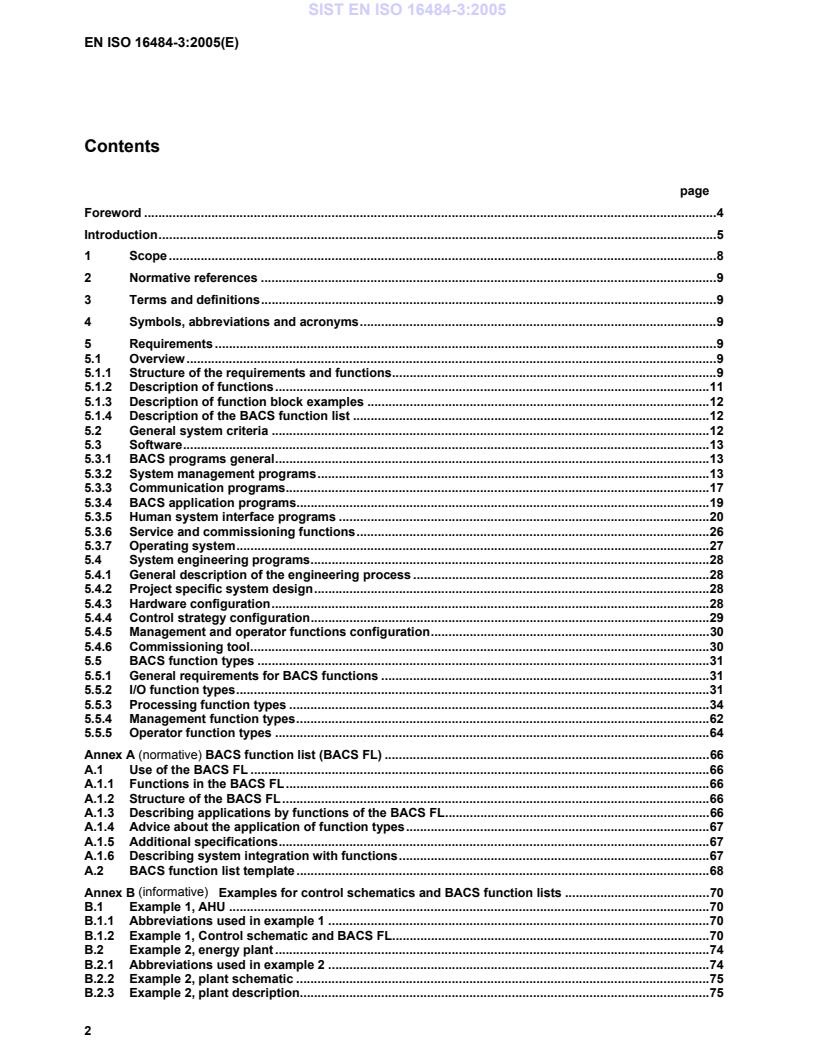
Contents
page
Foreword .4
Introduction.5
1 Scope.8
2 Normative references .9
3 Terms and definitions.9
4 Symbols, abbreviations and acronyms.9
5 Requirements.9
5.1 Overview.9
5.1.1 Structure of the requirements and functions.9
5.1.2 Description of functions.11
5.1.3 Description of function block examples .12
5.1.4 Description of the BACS function list .12
5.2 General system criteria .12
5.3 Software.13
5.3.1 BACS programs general.13
5.3.2 System management programs.13
5.3.3 Communication programs.17
5.3.4 BACS application programs.19
5.3.5 Human system interface programs .20
5.3.6 Service and commissioning functions.26
5.3.7 Operating system.27
5.4 System engineering programs.28
5.4.1 General description of the engineering process .28
5.4.2 Project specific system design.28
5.4.3 Hardware configuration.28
5.4.4 Control strategy configuration.29
5.4.5 Management and operator functions configuration.30
5.4.6 Commissioning tool.30
5.5 BACS function types .31
5.5.1 General requirements for BACS functions .31
5.5.2 I/O function types.31
5.5.3 Processing function types .34
5.5.4 Management function types.62
5.5.5 Operator function types .64
Annex A (normative) BACS function list (BACS FL) .66
A.1 Use of the BACS FL .66
A.1.1 Functions in the BACS FL.66
A.1.2 Structure of the BACS FL.66
A.1.3 Describing applications by functions of the BACS FL.66
A.1.4 Advice about the application of function types.67
A.1.5 Additional specifications.67
A.1.6 Describing system integration with functions.67
A.2 BACS function list template.68
(informative)
Annex B Examples for control schematics and BACS function lists .70
B.1 Example 1, AHU .70
B.1.1 Abbreviations used in example 1 .70
B.1.2 Example 1, Control schematic and BACS FL.70
B.2 Example 2, energy plant .74
B.2.1 Abbreviations used in example 2 .74
B.2.2 Example 2, plant schematic .75
B.2.3 Example 2, plant description.75
B.2.4 Example 2, controls description .76
B.2.5 Example 2, Control flow chart diagram .77
B.2.6 Example 2, BACS function list.80
Annex C (informative) Bibliography.82
Annex ZA (normative) Normative references to international publications with their corresponding
European publications .83
Foreword
This International Standard (EN ISO 16484-3:2005) has been prepared by Technical Committee CEN /TC 247,
"Building Automation, Controls and Building Management", the secretariat of which is held by the SNV, in
collaboration with ISO/TC 205 "Building Environment Design".
This International Standard shall be given the status of a national standard, either by publication of an identical
text or by endorsement, at the latest by January 2006, and conflicting national standards shall be withdrawn at
the latest by January 2006.
The EN ISO 16484-3 is part of the EN ISO 16484 series of International Standards under the general title
Building Automation and Control Systems (BACS), which will comprise the following parts:
Part 1: Overview and definitions
Part 2: Hardware
Part 3: Functions
Part 4: Applications
Part 5: Data communication protocol
Part 6: Data communication - Conformance testing
Part 7: Project specification and implementation
Annex A (normative): BACS function list, forms a normative part of this standard.
The Annex B (informative): Examples for plant-/control schematic and BACS function list, and
Annex C (informative): bibliography, are for information only.
The Annex ZA (normative): Normative references to international publications with the corresponding European
publications, is normative part of this International Standard.
NOTE National annexes may contain information provided for easier implementation of the standard, e.g. an alphabetical
index or national footnotes.
According to the CEN/CENELEC Internal Regulations, the national standards organizations of the following
countries are bound to implement this International Standard: Austria, Belgium, Cyprus, Czech Republic,
Denmark, Estonia, Finland, France, Germany, Greece, Hungary, Iceland, Ireland, Italy, Latvia, Lithuania,
Luxembourg, Malta, Netherlands, Norway, Poland, Portugal, Slovakia, Slovenia, Spain, Sweden, Switzerland
and United Kingdom.
Introduction
This series of standards is intended for design of new buildings and retrofit of existing buildings for an acceptable
indoor environment, practical energy conservation, and efficiency.
The application of this series of standards for BACS is envisaged as follows:
- the environmental design for all building types requires complex methods for automation and control. The
functional integration of services other than HVAC is a general task for all parties employed to develop an
integrated multi-application system. The Integration comprises, e.g. lighting and electric power distribution
control, security control, transportation, maintenance management, or facilities management. This system
integration allows the user to take advantage of synergies between the different applications. This standard will
give guidance to architects, consultants, and contractors as well as to users on how to share such resources;
- the innovation cycles between devices, systems, and networks vary. To make it possible to add and to change
existing devices, and extend the building automation and control network, several interfaces both proprietary and
standardized are defined between the BACS network and the other systems. A manufacturer can design a
product, both to meet his specific marketing objectives and to give the option to integrate that special device into
a multi-application BACS. Interfaces are also defined in appropriate parts of this standard along with the
necessary communications protocol and conformance test required to support the inter-working of devices;
- a manufacturer, a systems house, or an electrical or mechanical contractor can assemble an implementation of
a building automation and control system;
- the application of this standard is not to standardize the hardware and software design or the architecture of a
System, but to define the process for the creation of project specifications, where functionality and the quality of
the solution are clearly defined.
The purpose of this series of standards is intended for use by those involved in the design, manufacture,
engineering, installation, commissioning, operational maintenance and training of BACS when contracted, i.e.:
as a guide to the terminology of the building automation and control trade. Unambiguous terminology is
required for a complete and accurate conveyance of the intent and details of this standard;
in product development, to avoid unnecessary duplication of function or terminology, but should not place a
restraint on the evolution of new products, systems or applications;
as a basis for interfacing products and systems. In order to interoperate, the elements of a BACS require a
unified data communication protocol and information model;
as a basis for drawing up a project specification for the procurement of building automation and control
products for systems suppliers and customers;
as a code of practice for expertly commissioning prior to handover of a system;
by educational establishments wishing to train people in the field of building automation and control systems.
This entire series of BACS standards consists of the following contents:
Part 1: Overview and definitions (in preparation)
Part 1 of this standard describes the objectives and interrelationships of all parts of this standard. It provides an
overview and detailed information about the structure of the related series of standards for the BACS industry.
This part of the standard provides also the vocabulary with terms and definitions for the understanding of the
entire series of this standard and it contains a translation of the main terms in English, French, Russian, and
German in an informative annex.
This ongoing work is coordinated at expert level with standards work from ISO/TC 205 WG 3 and CEN/TC 247/
WG 3, WG 4 WG 5 and WG 6.
Part 2: Hardware
Part 2 of this standard specifies the requirements for the hardware to perform the tasks within a BACS. It
provides the terms, definitions, and abbreviations for the understanding of Part 2 and Part 3.
Part 2 relates only to physical items/devices, i.e.:
operator stations and other human system interface devices;
devices for management functions;
control devices, automation stations and application specific controllers;
field devices and their interfaces;
cabling and interconnection of devices;
engineering and commissioning tools.
This part of this standard shows a generic system model to which all-different types of BACS and their
interconnections (BACS network) can fit. A graphical concept of the BACS network in terms of LAN and inter-
network topology will be provided in Part 5 of this standard.
National annexes:
National annexes may specify the local requirements of physical and electrical characteristics, the verifications
for BACS devices and equipment, and the code of practice for the physical installation of systems. The annexes
shall refer to the regional implementations of the relevant IEC standards.
Part 3: Functions (refer to the scope of this part)
Part 4: Applications
Part 4 of this standard specifies the requirements for specific communicating applications/devices, e.g. for
general room automation and for sophisticated optimization of controls for heating, fan coil and induction units,
CAV, VAV and radiant cooling.
This work will be coordinated at expert level with standards work from ISO/TC 205 WG 3 and CEN/TC 247.
Part 5: Data Communication – Protocol
Part 5 of this standard specifies data communication services and objects for computer equipment and
controllers used for monitoring and control of HVAC&R and other systems of building services.
This protocol provides a comprehensive set of object types for conveying encoded binary, analog, and
alphanumeric data between devices including, but not limited to:
input measuring: analog input object;
output positioning/setpoint: analog output object;
binary input counting;
input state: binary input object, multi-state input;
output switching: binary output object, multi-state output;
values: analog value, binary value, multi-state value, accumulated value, averaging object, trend log object;
text string;
schedule information;
alarm and event information;
files; and
control programs and parameters respectively.
This protocol models each building automation and control system as a collection of data structures called object
types, the properties of which represent various aspects of the hardware, software, and operation of the device.
These objects provide a means of identifying and accessing information without requiring knowledge of the
details of the device's internal design or configuration.
NOTE An overview of possible integration with other systems in buildings, e.g. fire, security, access control, maintenance
and facilities management, is shown in Figure 1 of Part 2 of this standard.
Part 6: Data Communication – Conformance testing (in preparation)
Part 6 of this standard specifies the technical requirements of the conformance test suite and the methods for
testing the products for the conformance with the protocol. It provides a comprehensive set of procedures for
verifying the correct implementation of each capability claimed on a BACS network protocol implementation
conformance statement (PICS) including:
support of each claimed BACS network service, either as a client (initiator), server (executor), or both;
support of each claimed BACS network object-type, including both required properties and each claimed
optional property;
support of the BACS network layer protocol;
support of each claimed data link option, and
support of all claimed special functionality.
Part 7: Project implementation
Part 7 of this standard specifies methods for project specification and implementation of BACS and for
integration of other systems into the BACS. This standard defines terms to be used for project specifications and
gives guidelines for integration of other systems.
a) Project specification and implementation:
This clause of the standard describes the procedures (codes of practice) required for the following:
project specification:
These procedures also contain an example for a plant/system/customer premises wide unique
structured addressing system for data point identification;
engineering;
installation;
project handover.
b) System integration:
This clause of the standard describes the special requirements/procedures for the integration and
implementation of intersystem communication with foreign systems and the interconnection of other
units/devices with integrated communications interfaces, e.g. chillers, elevators.
1 Scope
This International Standard specifies the characteristics of software and functions used in Building automation
and control systems as well as a method for documentation of the design. It gives guidelines for the engineering.
It specifies a template for documentation of plant/application specific datapoints and functions, called BACS
function list in annex A.
The informative function block examples explain a method to display the referenced functions in system
documentation; they do not standardize the method for programming functions and applications.
This International Standard covers the following:
Requirements and definitions regarding BACS and application software, generic function types for plant/project
specific applications and engineering functions for building controls and operations. It provides communication
functions for the integration of other dedicated special system processes. The functional requirements in this part
of the standard are subdivided as follows:
System management and application software:
This clause describes the requirements for plant independent system and human system interface programs
related to a project, including the operating system. This standard does not dedicate the following system
functionality to any particular hardware, e.g.:
system diagnostics, watchdog, redundancy, time keeping, access control, log lists;
point identification, event message handling, print control;
database, statistics, data archiving, remote access;
system communications.
Human system interface (HSI), point information presentation, graphics, alarms, time scheduling
Engineering process and tool software:
This clause describes the requirements for configuring of the hardware and control strategies, the system
management, and the commissioning process.
BACS application processing programs and plant/application specific function types:
This clause describes the requirements for plant, application, and / or project specific functions and a method for
the documentation of a project. The functions are subdivided into the following types:
input and output functions;
processing functions;
management functions and required communications;
operator functions.
This International Standard defines a method for creating the procurement specifications containing all essential
elements required for the operational functioning of a BACS. The successful installation and operation of a
BACS requires that its procurement be based on a complete specification with accurate functions.
The standard provides a template called the ‘BACS function list’ that can be found in annex A (normative). Its
purpose is to determine and document the options for plant / application specific functionality. Further
explanations can be given in form of plant/control descriptions, control flow chart diagrams, and plant/control
schematics. Examples are given in annex B (informative). The exact specifications will be project-specific.
Information about the standardized functions is given in the form of informative examples as function-blocks,
textual, and graphical descriptions in 5.5.
It is recognized, that functions can be described and implemented in many different ways, depending on:
climatic differences;
cultural and regional differences;
national regulations.
2 Normative references
The following referenced documents are indispensable for the application of this International Standard. For
dated references, only the edition cited applies. For undated references, the latest edition of the referenced
document (including any amendments) applies.
EN ISO 10628:2000 Flow diagrams for process plants — General rules (ISO 10628:1997)
EN ISO 16484-2:2004
Building automation and control systems (BACS) — Part 2: Hardware (ISO 16484-
2:2004)
EN ISO 16484-5
Building automation and control systems (BACS) — Part 5: Data communication
protocol (ISO 16484-5:2003)
IEC 60617-12:1997 Graphical symbols for diagrams — Part 12: Binary logic elements (IEC 60617-
12:1997)
IEC 60617-13:1993 Graphical symbols for diagrams — Part 13: Analogue elements (IEC 60617-13:1993
3 Terms and definitions
For the purposes of this International Standard, the terms and definitions given in EN ISO 16484-2:2004 apply.
4 Symbols, abbreviations and acronyms
For the purposes of this standard, the symbols, abbreviations and acronyms given in EN ISO 16484-2:2004
apply.
NOTE The abbreviations used and explained within the tables for the function block examples are for information only.
5 Requirements
5.1 Overview
5.1.1 Structure of the requirements and functions
5.1.1.1 General
This standard does not dedicate the system functionality to any particular hardware. The functional requirements
in this part of the standard are subdivided as follows:
system application and management software:
describes the requirements for plant independent system programs and human system interface programs
related to a project in general;
engineering and commissioning tools:
describes the requirements for the configuration of hardware, of control strategies and management
functions,
and the commissioning process;
project/plant specific functions:
describes the requirements for plant applications and/or project specific functions and methods for the
functional documentation of project and/or application specific systems.
The functions of a BACS in general are structured into three levels. These levels indicate functions for
management,
automation/control as processing functions, and
input/output as interface to field devices.
Operator functions are not assigned to a specific level.
NOTE Requirements for the hardware and communication means to perform the BACS software and functions that are
specified in Part 2 of this standard.
5.1.1.2 Operator functions
Human system interface for plant operation, i.e. for supervision, alarm annunciation, state monitoring and human
interaction are not assigned to any functional level.
The range of functionality covers:
a) system management, event management and state management, parameter adjustment and manual on/off
control;
b) local room operation;
c) local override/indication device functions to provide restricted access for service operation;
d) system engineering and servicing, engineered operator functions are, e.g. dynamic display, event instruction
text, remote messaging (see 5.5.5).
NOTE Human system interface devices in a BACS are on different types of hardware, as specified in Part 2:
- direct acting elements, as switches and signal lights;
- local override and/or indication devices;
- handheld units;
- monitoring and operator units or panels;
- operator stations including visual display units and
- Internet based browsers.
A VDU can provide a graphical user interface.
5.1.1.3 Management functions
Management functions are performed by the software of a BACS. The plant/application specific management
functions are for the activity of a user taking decisions for supervision of plant and evaluating energy use and
operational costs. The required functionality at this level is:
a) communications with devices of the control network, and any attached foreign systems;
b) communications for data exchange with dedicated special, or foreign systems to provide for operator and
management functions within the BACS;
c) recording, archiving and statistical analysis;
d) decision support for e.g. energy management.
5.1.1.4 Processing function types
The plant/project specific application software and parameters provide all automatic functionality for building
services in real-time within self-contained controllers/automation stations. The required groups of processing
function types are:
a) monitoring;
b) interlocks;
c) closed loop and open loop control;
d) calculation/cross plant/system optimization;
e) room control functions, e.g. individual zone control, lighting control, shades/blinds control, details will be
given in Part 4.
5.1.1.5 I/O function types
The I/O functions provide the interface between processing functions and the field devices. These function types
are subdivided in
a) physical input and output functions, and
b) shared input and output functions for communication with foreign products.
5.1.1.6 Field devices
Field devices are generally sensors and actuators, coupling units and local override/indication devices that are
connected to input/output interfaces of controllers/automation stations. Field devices can be connected to
controllers via field network or direct wiring. The field devices perform connection to the physical items of plant
providing the necessary information about the conditions, states, and values of the processes and effect the
programmed operations. Functions supported by field devices are
a) Switching;
b) Positioning;
c) state monitoring;
d) counting, and
e) measuring.
NOTE For field device requirements see Part 2 of this standard.
5.1.2 Description of functions
The normative functional descriptions within this section are provided for use by the specifier, e.g. consultant, to
describe the project functionality. The descriptions in 5.5 contain no direct hardware related specifications, but
the number of input and output functions help to determine the required physical or communication inputs and
outputs of a BACS, the processor performance, and memory size.
NOTE For the required hardware components see Part 2 of this standard.
For each project the system programs and the plant/application specific functions are to be specified to
determine the required engineering services.
The plant specific functions can be documented in plant/control schematics, control flow chart diagrams and the
BACS function list, preferred as spreadsheet for further data processing, which is shown in annex A as a
template.
Some complex projects and/or sophisticated control algorithms for optimal control performance require additional
information and methods in order to describe the requirements clearly and completely. These additional
requirements include plant and control descriptions, control flow charts, psychrometric charts, reset schedules,
field device mounting instructions/illustrations.
Annex B provides informative examples to indicate methods for creation of accurate documentation for a design
project.
5.1.3 Description of function block examples
This standard has adopted (where appropriate) a function block (FB) method of describing BACS applications.
The FB examples are designed according to the graphical symbols for diagrams in IEC 60617-12, Binary logic
elements and in IEC 60617-13, Analog elements.
The information in the FB examples provides common wording and descriptions of BACS functions. The
terminology provided by these descriptions should be used in any discussions and documents that represent
BACS applications. This involves describing inputs, outputs, parameters and functions in a common textual and
graphic format. A complete application scheme can be engineered using a series of interconnected function
blocks as shown in the informative examples. The function block principle can be used to introduce new BACS
functions and can be referred to using the BACS FL.
5.1.4 Description of the BACS function list
5.1.4.1 Scope
The BACS FL shown in annex A is based on the definitions in 5.5, and it provides the following benefits:
the determination of functions is based on the plant/control schematic, the plant/control description and the
control flow chart diagram if necessary;
it allows one to determine the number of engineered function types for specific projects by using a spread
sheet program that provides for electronic data interchange;
it provides a common structured method for the plant/system design and specifying process;
it provides for the use of a unique structured point naming convention or addressing system, required
in 5.3.2.7;
the structured numbering scheme for the sections and columns of functions provides for the addition of
individually defined functions in the given categories, if required.
5.1.4.2 Purpose
The BACS FL allows a supplier-independent description of the controls requirements. It can be used for
tendering, costing, and billing purposes, although this aspect of its use is outside the scope of this standard. It
should be considered that the main expenditure when implementing a BACS is in the engineering. These efforts
are in direct relation to the number and type of functions required for the application.
BACS specifications shall contain all relevant detailed documents required to fully interpret the overall
functionality. This should enable comparable and thought through bids at tendering.
For each plant to be controlled and supervised a plant control schematic shall be drawn. The data points,
processing functions, and communication functions for complete control, as well as human system interface for
operation, energy, and maintenance management can be listed in a separate BACS FL by the specifier.
The control flow chart method or a state machine diagram can be used for description and documentation of
extensive control strategies and interlocks.
5.2 General system criteria
A BACS mainly consists of field and control devices, switchgear assembly, cabling, network, communication,
and computing devices (hardware), system software and functions achieved by engineering services.
Decisions regarding functionality are normally defined before determination of the structure and the hardware of
a BACS.
The following descriptions define the performance criteria and options to be specified and stated in each project
regarding the manufacturer specific and the project specific application software.
NOTE For Hardware requirements refer to Part 2 of this standard.
5.3 Software
5.3.1 BACS programs general
For this standard the software of a BACS is subdivided into
system management programs;
communication programs;
general application and optimization programs;
human system interface programs;
engineering programs.
5.3.2 System management programs
5.3.2.1 General
System management involves the initialization (see Part 2, 3.99), co-ordination, and maintenance of all
configuration information (see Part 2, 3.47) relating to the operation of the system as a whole including network
management. Each system function may be configured manually or automatically.
Remote system management and human system interface for system maintenance capabilities shall be
specified. These programs need not be mandatory due to system size and resources.
5.3.2.2 System time keeping
The management methods for time, date, and calendar within all management and control functions shall be
stated.
Performance criteria for system time keeping are:
1) internal/external clock, type of external clock;
2) system clock accuracy;
3) overall system time synchronization, e.g. by radio clock;
4) summer/winter time change handling for daylight savings;
5) change of time and date for local data processing device or server station;
6) change of time and date for networked and stand-alone devices.
5.3.2.3 Watchdog functions
Watchdog function requirements and system responses in case of a fault shall be specified for each project.
5.3.2.4 System diagnostics
Devices and functions of a BACS are supported by diagnostic tools to ensure constant operation, quality, and
performance. The system's diagnostic features monitor a variety of functions and report on failure situations, or
invoke corrective actions. Remote system diagnostics capabilities shall clearly be specified. The system
diagnostic features shall indicate:
a) memory usage and system resources;
b) failure percentage of communication activity on all system networks;
c) causes of system failures.
Further system diagnostic features shall be stated for a specific project.
5.3.2.5 Power down management and recovery
Any consequences due to loss of power shall be specified, i.e. for:
a) power down;
b) power return;
c) associated internal system functions;
Additionally, the requirements shall be specified for
d) operator initiated power on/off operation,
e) system power failure return method, and
f) uninterruptible power supply (UPS) options.
5.3.2.6 System activity logbook
A record of all system activity and events should be kept with date and time for subsequent displaying, printing,
and archiving. The full extent of system operations held within the system activity logbook is to be specified.
5.3.2.7 Point identification
For information accessing and processing within a BACS it is necessary to establish a project specific,
unambiguous naming convention for identification of all physical and virtual data points. Point addresses are
used for accessing and displaying information provided by functions throughout the system(s).
NOTE Point addresses used by an operator at the HSI are referred to as mnemonics or user addresses.
Point addresses within a BACS have to be unique and shall exist within a unique structure for a plant, a system,
or the entire customer premises. Associated descriptive text displayed with the information of data points should
be provided. The means by which the user interface navigates to the data point information shall be specified.
For point information presentation requirements refer to 5.3.5.9.
Typical elements of user addresses in a BACS addressing system are: site, building, part, location (e.g. floor),
plant type (e.g. HVAC), plant number, type of function, information number. There are also customer specific
data point designation systems according to established standards possible.
5.3.2.8 System access control
A number of access levels defined in profiles shall be provided to protect the system from misuse. The number
and relevance of these access levels have to be specified e.g.:
Table 1 — access control levels
Level Activity
No password: Read only, restricted access to specific information
Level 1: Routine daily operations only allowed
Level 2: Operator access to all non configurable functions
Level 3: Engineering access, required to configure the entire system.
A BACS shall provide for all dialog oriented operator interfaces an operator/user authentication for corroboration
that the operator logging on to a device is identified to be the entity claimed.
For user access control requirements refer to 5.3.5.5.
5.3.2.9 Operator activity logbook
The extent of operations held within the operator activity logbook for subsequent displaying, printing and
archiving is to be specified. This can include a record of all operators logging in and out, with name, date and
time, command, event acknowledgment, parameter, and password change.
5.3.2.10 Data usage and storage
Change of state or change of value data sent from I/O, processing or other management functions can be stored
and shall be provided with a date and time stamp for subsequent analysis. This program refers to the
management functions event storage/historical database, BACS FL, col. 7.3/7.4, as specified in 5.5.4.3.
The requirements are subdivided into system specific and project specific features.
5.3.2.10.1 System specific features for data storage
The features required shall be specified:
a) type of inputs into log files;
EXAMPLE A Log entry can be: event, alarm, state message, measured value, totalized value, system failure log, user
message log.
b) minimum required number of records of each log file or database;
c) post collection format of provided alarm/event/measure log/counter log and system information data;
d) the means of retrieving the data;
e) search facilities provided for querying each of the lists;
f) print facilities offered.
Performance criteria:
1) maximum number of log lists as files on the data storage;
2) maximum number of entries per log list;
3) maximum number and types of records managed.
5.3.2.10.2 Project specific features of the database
The features required shall be specified:
a) log lists for states and values (e.g. alarm and/or maintenance criteria);
b) historical database, e.g. for statistical analysis, quality control;
c) system documentation.
The supplier shall state the type of database management system (DBMS) software and original license provider
with respect to copyright laws.
Performance criteria if DBMS software is used:
1) maximum number of entries in database;
2) data storage space used for application software and parameters;
3) data storage space proposed for user data;
4) method of filtering employed;
EXAMPLE Selection by message type, by plant address, by function type etc.
5) accuracy of time stamping;
6) resolution of time stamp.
5.3.2.11 Data archiving
Data gathered by the function historical data, described in 5.5.4.3, and other system data can be permanently
archived using a data archiving method, e.g. file server, tape data storage, CD-ROM. For cross-reference see
also backup an
...