


CEN/TS 15502-3-3:2026
(Main)Gas-fired central heating boilers - Part 3-3: 100 % Hydrogen - Expansion of EN 15502-2-1:2022
Gas-fired central heating boilers - Part 3-3: 100 % Hydrogen - Expansion of EN 15502-2-1:2022
Shall be according to EN 15502-2-1:2022+A1:2023, Clause 1 with the following modifications:
Replace:
“This document covers gas-fired central heating boilers from the types C1 up to C(11) and the types B2, B3 and B5:”
By:
“This document covers gas-fired central heating boilers from the types C1, C3 up to C9 and the types B2, B3 and B5 :”
b) is replaced by:
b) that use combustible gases of gas group 4Y at the nominal pressure of 20 mbar;
Appliance category Pn Pmin Pmax
4th family 20 17 25
k) is not applicable.
Add at the end of the list, after k), following:
l) which are fully premixed appliances equipped with a Pneumatic Gas/Air Ratio controller (PGAR) or an Adaptive Combustion Control Function (ACCF) that are intended to be connected to hydrogen gas grids where the quality of the distributed hydrogen gas is likely expected to stay within a Wobbe index range of 42 to 46 MJ/m3.
Replace in the list following
“This document does not cover all the requirements for:”
ab), ag), ah) and al) by:
ab) appliances that are intended to be connected to gas grids where the quality of the distributed hydrogen gas is likely to vary outside the Wobbe index range of 42 to 46 MJ/m3;
ag) C(10) boilers;
ah) C(11) boilers;
al) Partially premixed appliances equipped with an adaptive combustion control function (ACCF).
and add an) and ao);
an) The conversion from natural gas to hydrogen.
ao) The risk of aeration of the gas supply to the appliance.
Heizkessel für gasförmige Brennstoffe - Teil 3-3: 100% Wasserstoff - Erweiterung der EN 15502-2-1:2022
Der Anwendungsbereich muss EN 15502 2 1:2022+A1:2023, Abschnitt 1 mit den folgenden Änderungen entsprechen:
Folgendes wird ersetzt:
„Dieses Dokument schließt gasbefeuerte Zentralheizungskessel der Bauarten C1 bis C(11) und der Bauarten B2, B3 und B5 ein:“
durch:
„Dieses Dokument schließt gasbefeuerte Zentralheizungskessel der Bauarten C1, C3 bis C9 und der Bauarten B2, B3 und B5 ein:“
b) wird ersetzt durch:
„b) die mit brennbaren Gasen der Gasgruppe 4Y beim Nenndruck von 20 mbar betrieben werden;
Gerätekategorie Pn Pmin Pmax
4. Gasfamilie 20 17 25
“
k) ist nicht anwendbar.
Am Ende der Liste, nach k), ist Folgendes hinzuzufügen:
l) die Geräte mit vollständiger Vormischung sind, ausgestattet mit einer pneumatischen Gas-/Luft-Verbundregelung (PGAR, en: Pneumatic Gas/Air Ratio controller) oder einer adaptiven Verbrennungsregel- und -steuerfunktion (ACCF, en: Adaptive Combustion Control Function), die zum Anschluss an Wasserstoffgasnetze bestimmt sind, bei denen die Beschaffenheit des verteilten Wasserstoffgases wahrscheinlich innerhalb eines Wobbe-Index-Bereiches von 42 MJ/m3 bis 46 MJ/m3 schwankt.
In der Liste nach
„Dieses Dokument behandelt nicht alle Anforderungen an:”
werden ab), ag), ah) und al) ersetzt durch:
ab) Geräte, die dafür ausgelegt sind, an ein Gasnetz angeschlossen zu werden, in dem die Beschaffenheit des verteilten Gases wahrscheinlich über den Wobbe-Index-Bereich von 42 MJ/m3 bis 46 MJ/m3 hinaus schwankt;
ag) C(10)-Kessel;
ah) C(11)-Kessel;
al) Geräte mit teilweiser Vormischung, die mit einer adaptiven Verbrennungsregel- und -steuerfunktion (ACCF) ausgestattet sind;
und an) und ao) hinzugefügt;
an) die Umwandlung von Erdgas in Wasserstoff;
ao) das Risiko, einer Luftzufuhr zur Gaszuleitung des Geräts.
Plinski kotli za centralno ogrevanje - Del 3-3: 100 % vodik - Razširitev EN 15502-2-1:2022
Biti mora v skladu z EN 15502-2-1:2022+A1:2023, člen 1 z naslednjimi spremembami:
Zamenjajte:
"Ta dokument zajema plinsko ogrevane centralne kotle tipov C1 do C(11) in tipov B2, B3 in B5:"
Z:
"Ta dokument zajema plinsko ogrevane centralne kotle tipov C1, C3 do C9 in tipov B2, B3 in B5:"
b) se nadomesti z:
b) ki uporabljajo gorljive pline plinske skupine 4Y pri nazivnem tlaku 20 mbar;
Kategorija naprave Pn Pmin Pmax
4. družina 20 17 25
k) ni uporabno.
Dodajte na konec seznama, po k), naslednje:
l) ki so popolnoma predmešane naprave, opremljene s pnevmatskim regulatorjem razmerja plin/zrak (PGAR) ali funkcijo prilagodljivega nadzora zgorevanja (ACCF), ki so namenjene za priključitev na vodikove plinske mreže, kjer se pričakuje, da bo kakovost distribuiranega vodikovega plina ostala znotraj območja Wobbe indeksa od 42 do 46 MJ/m3.
Zamenjajte na seznamu naslednje
"Ta dokument ne zajema vseh zahtev za:"
ab), ag), ah) in al) z:
ab) naprave, ki so namenjene za priključitev na plinske mreže, kjer se pričakuje, da bo kakovost distribuiranega vodikovega plina variirala zunaj območja Wobbe indeksa od 42 do 46 MJ/m3;
ag) kotli C(10);
ah) kotli C(11);
al) Delno predmešane naprave, opremljene s funkcijo prilagodljivega nadzora zgorevanja (ACCF).
in dodajte an) in ao);
an) Pretvorba iz zemeljskega plina v vodik.
ao) Tveganje prezračevanja plinskega dovoda do naprave.
General Information
- Status
- Published
- Publication Date
- 26-May-2026
- Technical Committee
- CEN/TC 109 - Central heating boilers using gaseous fuels
- Drafting Committee
- CEN/TC 109/WG 1 - Domestic central heating boilers using gaseous fuels
- Current Stage
- 6060 - Definitive text made available (DAV) - Publishing
- Start Date
- 27-May-2026
- Due Date
- 24-Apr-2026
- Completion Date
- 27-May-2026

Overview
CEN/TS 15502-3-3:2026 is a technical specification developed by the European Committee for Standardization (CEN) that details requirements for gas-fired central heating boilers designed to operate on 100% hydrogen. This document extends the scope of EN 15502-2-1:2022 to address the unique operational challenges of using hydrogen as the sole fuel. By providing guidance for the safe and efficient design, testing, and operation of hydrogen-fired boilers, this standard supports the transition to low-carbon heating solutions within hydrogen-ready infrastructures.
CEN/TS 15502-3-3:2026 focuses on fully premixed boilers, including those featuring Pneumatic Gas/Air Ratio controllers (PGAR) or Adaptive Combustion Control Functions (ACCF), that are intended for hydrogen supply networks with a Wobbe index range of 42 to 46 MJ/m³. It also specifies the categories of appliances covered and highlights additional requirements arising from the use of hydrogen as a fuel.
Key Topics
- Scope Extension: The specification covers gas-fired central heating boilers of types C1, C3 up to C9, and types B2, B3, and B5, specifically for 100% hydrogen operation.
- Fuel Composition: Applies exclusively to hydrogen fuel gases (gas group 4Y) delivered at a nominal pressure of 20 mbar. The document excludes boilers designed for gas quality variations beyond the specified Wobbe index range.
- Control Systems: Addresses requirements for appliances with advanced combustion control systems (PGAR and ACCF), which enable safe and efficient hydrogen combustion.
- Risk Assessment: Emphasizes the importance of managing hydrogen leakage risks, with guidelines on preventing dangerous accumulations of unburned hydrogen in appliance enclosures.
- Construction Requirements: Updates material considerations and design features specific to hydrogen, reflecting its different explosion and combustion properties compared to traditional gaseous fuels.
- Testing and Efficiency: Defines standard testing methods, operational efficiency, constructional features, and safety mechanisms necessary for certification.
- Marking and Documentation: Details requirements for appliance labeling and mandatory technical documentation supporting installation and maintenance.
Applications
CEN/TS 15502-3-3:2026 provides practical value for:
- Manufacturers: Ensures that central heating boilers intended for pure hydrogen supply meet robust safety, efficiency, and functional criteria. This includes incorporating advanced controls for combustion management.
- Installers and Designers: Guides the selection and setup of hydrogen-ready boiler systems, enabling safe connection to hydrogen gas grids.
- Gas Network Operators: Supports the secure integration of hydrogen-fired boilers within current or future hydrogen infrastructure, by specifying allowable Wobbe index ranges and supply pressures.
- Regulators and Inspectors: Supplies a harmonized framework for evaluating appliance conformity with key safety and performance benchmarks in the context of hydrogen as a new energy vector.
- End Users and Policy Makers: Fosters confidence in the safety and performance of hydrogen-based central heating-contributing to energy transition and decarbonization efforts.
Related Standards
For complete compliance and best practices in the field of gas-fired heating appliances and hydrogen technologies, refer to:
- EN 15502-1:2021+A1:2023: General requirements and tests for gas-fired heating boilers.
- EN 15502-2-1:2022+A1:2023: Specific requirements for type C appliances and B2, B3, B5 appliances up to 1,000 kW.
- EN 12067-2:2022: Control functions in electronic systems for burners and heating appliances, including ACCF.
- EN 88-1:2022+A1:2023 / EN 88-3:2022+A1:2024: Safety and control devices for gas burners, especially pressure regulators relevant for hydrogen and other gas families.
- EN 437:2021: Test gases, test pressures, and categories of appliances.
By adhering to CEN/TS 15502-3-3:2026, stakeholders ensure alignment with the latest requirements for hydrogen-based heating solutions, contributing to a safer and more sustainable energy landscape.
Keywords: hydrogen boilers, gas-fired central heating, hydrogen heating, CEN/TS 15502-3-3, hydrogen safety, appliance standards, ACCF, PGAR, Wobbe index, decarbonization, low-carbon heating, hydrogen gas grids, boiler testing, European standards.
Get Certified
Connect with accredited certification bodies for this standard

DNV
DNV is an independent assurance and risk management provider.

Lloyd's Register
Lloyd's Register is a global professional services organisation specialising in engineering and technology.

DIBt (Deutsches Institut für Bautechnik)
German Institute for Building Technology.
Sponsored listings
Frequently Asked Questions
CEN/TS 15502-3-3:2026 is a technical specification published by the European Committee for Standardization (CEN). Its full title is "Gas-fired central heating boilers - Part 3-3: 100 % Hydrogen - Expansion of EN 15502-2-1:2022". This standard covers: Shall be according to EN 15502-2-1:2022+A1:2023, Clause 1 with the following modifications: Replace: “This document covers gas-fired central heating boilers from the types C1 up to C(11) and the types B2, B3 and B5:” By: “This document covers gas-fired central heating boilers from the types C1, C3 up to C9 and the types B2, B3 and B5 :” b) is replaced by: b) that use combustible gases of gas group 4Y at the nominal pressure of 20 mbar; Appliance category Pn Pmin Pmax 4th family 20 17 25 k) is not applicable. Add at the end of the list, after k), following: l) which are fully premixed appliances equipped with a Pneumatic Gas/Air Ratio controller (PGAR) or an Adaptive Combustion Control Function (ACCF) that are intended to be connected to hydrogen gas grids where the quality of the distributed hydrogen gas is likely expected to stay within a Wobbe index range of 42 to 46 MJ/m3. Replace in the list following “This document does not cover all the requirements for:” ab), ag), ah) and al) by: ab) appliances that are intended to be connected to gas grids where the quality of the distributed hydrogen gas is likely to vary outside the Wobbe index range of 42 to 46 MJ/m3; ag) C(10) boilers; ah) C(11) boilers; al) Partially premixed appliances equipped with an adaptive combustion control function (ACCF). and add an) and ao); an) The conversion from natural gas to hydrogen. ao) The risk of aeration of the gas supply to the appliance.
Shall be according to EN 15502-2-1:2022+A1:2023, Clause 1 with the following modifications: Replace: “This document covers gas-fired central heating boilers from the types C1 up to C(11) and the types B2, B3 and B5:” By: “This document covers gas-fired central heating boilers from the types C1, C3 up to C9 and the types B2, B3 and B5 :” b) is replaced by: b) that use combustible gases of gas group 4Y at the nominal pressure of 20 mbar; Appliance category Pn Pmin Pmax 4th family 20 17 25 k) is not applicable. Add at the end of the list, after k), following: l) which are fully premixed appliances equipped with a Pneumatic Gas/Air Ratio controller (PGAR) or an Adaptive Combustion Control Function (ACCF) that are intended to be connected to hydrogen gas grids where the quality of the distributed hydrogen gas is likely expected to stay within a Wobbe index range of 42 to 46 MJ/m3. Replace in the list following “This document does not cover all the requirements for:” ab), ag), ah) and al) by: ab) appliances that are intended to be connected to gas grids where the quality of the distributed hydrogen gas is likely to vary outside the Wobbe index range of 42 to 46 MJ/m3; ag) C(10) boilers; ah) C(11) boilers; al) Partially premixed appliances equipped with an adaptive combustion control function (ACCF). and add an) and ao); an) The conversion from natural gas to hydrogen. ao) The risk of aeration of the gas supply to the appliance.
CEN/TS 15502-3-3:2026 is classified under the following ICS (International Classification for Standards) categories: 27.060.30 - Boilers and heat exchangers; 27.075 - Hydrogen technologies; 91.140.10 - Central heating systems. The ICS classification helps identify the subject area and facilitates finding related standards.
CEN/TS 15502-3-3:2026 is associated with the following European legislation: EU Directives/Regulations: 811/2013, 813/2013, 92/42/EEC. When a standard is cited in the Official Journal of the European Union, products manufactured in conformity with it benefit from a presumption of conformity with the essential requirements of the corresponding EU directive or regulation.
CEN/TS 15502-3-3:2026 is available in PDF format for immediate download after purchase. The document can be added to your cart and obtained through the secure checkout process. Digital delivery ensures instant access to the complete standard document.
Standards Content (Sample)
SLOVENSKI STANDARD
01-julij-2026
Plinski kotli za centralno ogrevanje - 3-3. del: 100-odstotni vodik - Razširitev
standarda EN 15502-2-1:2022
Gas-fired central heating boilers - Part 3-3: 100 % Hydrogen - Expansion of EN 15502-2-
1:2022
Heizkessel für gasförmige Brennstoffe - Teil 3-3: 100% Wasserstoff - Erweiterung der
EN 15502-2-1:2022
Ta slovenski standard je istoveten z: CEN/TS 15502-3-3:2026
ICS:
27.075 Tehnologija vodika Hydrogen technologies
91.140.10 Sistemi centralnega Central heating systems
ogrevanja
97.100.20 Plinski grelniki Gas heaters
2003-01.Slovenski inštitut za standardizacijo. Razmnoževanje celote ali delov tega standarda ni dovoljeno.
CEN/TS 15502-3-3
TECHNICAL SPECIFICATION
SPÉCIFICATION TECHNIQUE
May 2026
TECHNISCHE SPEZIFIKATION
ICS 27.060.30; 27.075; 91.140.10
English Version
Gas-fired central heating boilers - Part 3-3: 100 %
Hydrogen - Expansion of EN 15502-2-1:2022
Heizkessel für gasförmige Brennstoffe - Teil 3-3: 100%
Wasserstoff - Erweiterung der EN 15502-2-1:2022
This Technical Specification (CEN/TS) was approved by CEN on 6 April 2026 for provisional application.
The period of validity of this CEN/TS is limited initially to three years. After two years the members of CEN will be requested to
submit their comments, particularly on the question whether the CEN/TS can be converted into a European Standard.
CEN members are required to announce the existence of this CEN/TS in the same way as for an EN and to make the CEN/TS
available promptly at national level in an appropriate form. It is permissible to keep conflicting national standards in force (in
parallel to the CEN/TS) until the final decision about the possible conversion of the CEN/TS into an EN is reached.
CEN members are the national standards bodies of Austria, Belgium, Bulgaria, Croatia, Cyprus, Czech Republic, Denmark, Estonia,
Finland, France, Germany, Greece, Hungary, Iceland, Ireland, Italy, Latvia, Lithuania, Luxembourg, Malta, Netherlands, Norway,
Poland, Portugal, Republic of North Macedonia, Romania, Serbia, Slovakia, Slovenia, Spain, Sweden, Switzerland, Türkiye and
United Kingdom.
EUROPEAN COMMITTEE FOR STANDARDIZATION
COMITÉ EUROPÉEN DE NORMALISATION
EUROPÄISCHES KOMITEE FÜR NORMUNG
CEN-CENELEC Management Centre: Rue de la Science 23, B-1040 Brussels
© 2026 CEN All rights of exploitation in any form and by any means reserved Ref. No. CEN/TS 15502-3-3:2026 E
worldwide for CEN national Members.
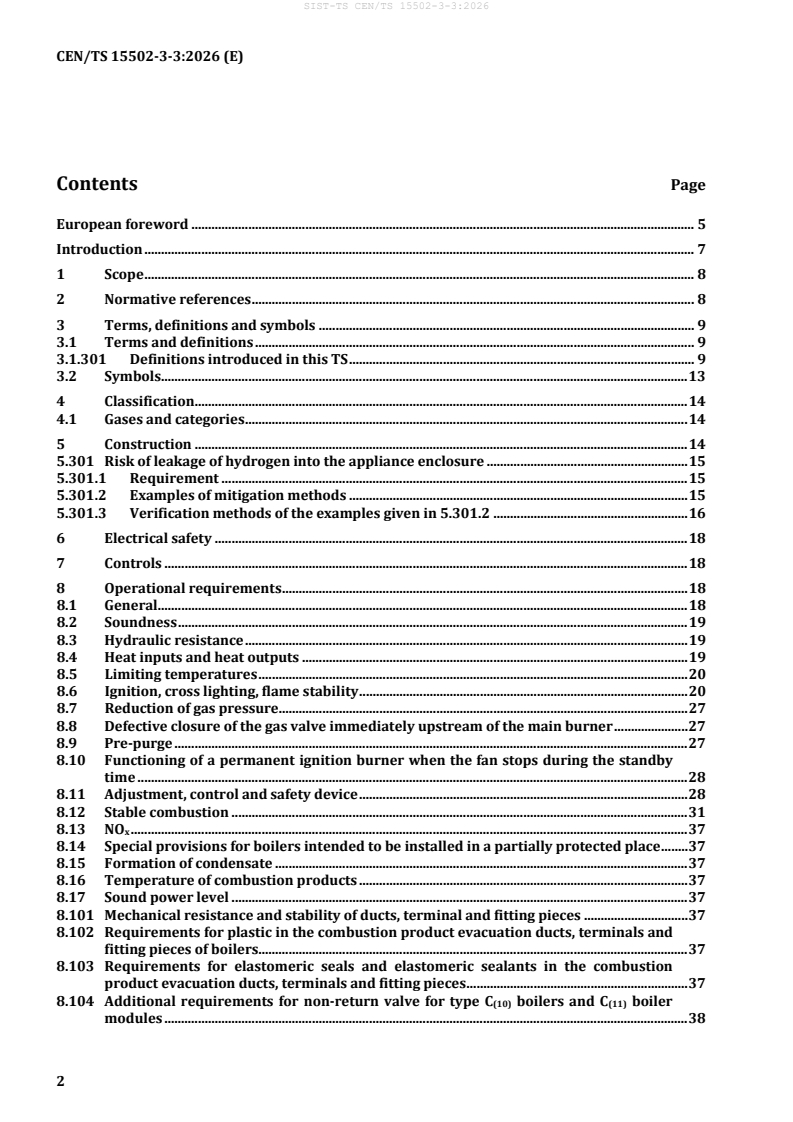
Contents Page
European foreword . 5
Introduction . 7
1 Scope . 8
2 Normative references . 8
3 Terms, definitions and symbols . 9
3.1 Terms and definitions . 9
3.1.301 Definitions introduced in this TS . 9
3.2 Symbols. 13
4 Classification . 14
4.1 Gases and categories . 14
5 Construction . 14
5.301 Risk of leakage of hydrogen into the appliance enclosure . 15
5.301.1 Requirement . 15
5.301.2 Examples of mitigation methods . 15
5.301.3 Verification methods of the examples given in 5.301.2 . 16
6 Electrical safety . 18
7 Controls . 18
8 Operational requirements . 18
8.1 General . 18
8.2 Soundness . 19
8.3 Hydraulic resistance . 19
8.4 Heat inputs and heat outputs . 19
8.5 Limiting temperatures . 20
8.6 Ignition, cross lighting, flame stability . 20
8.7 Reduction of gas pressure. 27
8.8 Defective closure of the gas valve immediately upstream of the main burner . 27
8.9 Pre-purge . 27
8.10 Functioning of a permanent ignition burner when the fan stops during the standby
time . 28
8.11 Adjustment, control and safety device . 28
8.12 Stable combustion . 31
8.13 NO . 37
x
8.14 Special provisions for boilers intended to be installed in a partially protected place . 37
8.15 Formation of condensate . 37
8.16 Temperature of combustion products . 37
8.17 Sound power level . 37
8.101 Mechanical resistance and stability of ducts, terminal and fitting pieces . 37
8.102 Requirements for plastic in the combustion product evacuation ducts, terminals and
fitting pieces of boilers. 37
8.103 Requirements for elastomeric seals and elastomeric sealants in the combustion
product evacuation ducts, terminals and fitting pieces . 37
8.104 Additional requirements for non-return valve for type C boilers and C boiler
(10) (11)
modules . 38
8.105 Additional requirements for the evaluation of the maximum heat input of the
common duct system of type C boilers . 38
(11)
9 Useful efficiencies . 38
10 Electric auxiliary energy . 38
11 Risk assessment . 38
12 Marking and instructions . 38
12.1 Boiler marking . 38
12.2 Instructions . 38
12.3 Presentation . 41
Figures . 41
Annexes . 41
Annex U (normative) Use of test gases . 42
U.1 Boilers within a range . 42
U.2 Guidance on the use of test gases . 42
Annex AB (informative) Variations in gas quality . 44
AB.1 Introduction. 44
AB.2 Considerations if boilers are intend to be used with larger variations in the gas quality
............................................................................................................................................................................. 44
AB.2.1 Specifications of acceptable variations. 44
AB.2.3 Impact on the declared values . 45
Annex HYA (normative) Specification of the normal operating conditions and settings for
boilers having an ACCF . 46
Annex HYB (informative) Example of detailed information in the technical documentation for
boilers having an ACCF . 50
Annex HYC (informative) Considerations on the use of limit gases for fully premixed ACCF and
PGAR H appliances . 54
HYC.1 General background for using limit gases . 54
HYC.2 Implications of using limit gases for appliances having an ACCF . 55
HYC.3 Avoiding using extreme air supply and water temperature conditions when testing
appliances. 56
HYC.4 Implications of using limit gases for PGAR H appliances . 58
HYC.4.1 General . 58
HYC.4.2 Non λ adjustable PGAR H appliances . 60
HYC.4.3 λ adjustable PGAR H appliances . 61
HYC.4.4 Stressing conditions for PGAR H appliances ensuring flame stability and ignition
HYC.5 Examples of gas composition specifications for ACCF appliances . 61
HYC.6 Examples of test gases to be used for ACCF appliances. 62
Annex HYD (informative) Methods for generating a slope change of the Wobbe index . 63
HYD.1 General . 63
HYD.2 The slope test using two bottles . 63
HYD.3 The slope test using mass flow controllers . 64
Annex HYE (informative) Determination of the average H level with an averaging time
interval of 60 min . 66
HYE.1 Problem definition . 66
HYE.2 Test methods . 66
HYE.2.1 General . 66
HYE.2.2 The continuous bottle averaging method. 66
HYE.2.3 Two analysers with different ranges method . 67
HYE.2.4 Sampling bag method . 68
HYE.2.5 The semi-static method . 69
Annex HYF (normative) HYF Summary of the test conditions for fully premixed H PGAR
appliances and H ACCF appliances . 70
Bibliography. 75
European foreword
This document (CEN/TS 15502-3-3:2026) has been prepared by Technical Committee CEN/TC 109
“Central heating boilers using gaseous fuels”, the secretariat of which is held by DIN.
Attention is drawn to the possibility that some of the elements of this document may be the subject of
patent rights. CEN shall not be held responsible for identifying any or all such patent rights.
This document contains an expansion of the scope of EN 15502-2-1:2022+A1:2023 and provides
requirements needed for this expansion.
EN 15502 consists of the following parts under the general title “Gas-fired heating boilers":
— Part 1: General requirements and tests;
— Part 2-1: Specific standard for type C appliances and type B2, B3 and B5 appliances of a nominal heat
input not exceeding 1 000 kW;
— Part 2-2: Specific standard for type B1 appliances;
— Part 2-3: Specific standard for hybrid units combining a gas-fired boiler and an electrical heat pump in
a product;
— Part 3-1: H2NG and ACCF — Expansion of EN 15502-2-1:2022;
— Part 3-2: H2NG — Expansion of prEN 15502-2-2:202x (under development);
— Part 3-3: Hydrogen — Expansion of EN 15502-2-1:2022.
Relationship between this document, EN 15502-2-1:2022+A1:2023 and EN 15502-1:2021+A1:2023 - the
reader needs to be aware of the following information:
a) this document (CEN/TS 15502-3-3) is to be used in conjunction with EN 15502-2-1:2022+A1:2023,
while EN 15502-2-1:2022+A1:2023 is to be used in conjunction with EN 15502-1:2021+A1:2023.
This means that this TS is to be used in conjunction with both EN 15502-2-1:2022+A1:2023 and
EN 15502-1:2021+A1:2023 and that all information in EN 15502-2-1:2022+A1:2023 and EN 15502-
1:2021+A1:2023 applies as well, unless stated otherwise (see under b)).
NOTE 1 To find the actual requirements or information in the (sub)clauses of EN 15502-2-1:2022+A1:2023
referred to in this TS, one might need to check EN 15502-1:2021+A1:2023 (as EN 15502-2-1:2022+A1:2023 is
to be used in conjunction with EN 15502-1:2021+A1:2023).
b) the numbering structure of this TS is using the numbering structure of EN 15502-2-1:2022+A1:2023
and expanding on it. Where this TS states: Shall be according to EN 15502-2-1:2022+A1:2023,
[clause number], the numbering, title and text of that clause of EN 15502-2-1:2022+A1:2023 is to be
used (incl. sub clauses and sub clause numbering, tables and table numbering, equations and
equation numbering, figures and figure numbering, lists and list numbering).
NOTE 2 The TS and its annexes can refer to (sub)clause numbers that are to be found either in this TS, or
EN 15502-2-1:2022+A1:2023, or EN 15502-1:2021+A1:2023.
c) The relevant text of EN 15502-2-1:2022+A1:2023 is to be adapted accordingly in all cases where this
TS states:
— shall be according to EN 15502-2-1:2022+A1:2023, [clause number] with the following
modification;
— shall be according to EN 15502-2-1:2022+A1:2023, [clause number] with the following
modification of [sub clause number(s)];
— shall be according to EN 15502-2-1:2022+A1:2023, [clause number] with the following addition;
— shall be according to EN 15502-2-1:2022+A1:2023, [clause number] with the addition of [sub
clause number(s)] at the end;
— EN 15502-2-1:2022+A1:2023, [clause number] is replaced by the following;
— the title of EN 15502-2-1:2022+A1:2023 [clause number] is replaced by the following;
— EN 15502-2-1:2022+A1:2023, [clause number] is not applicable.
d) Clauses or subclauses in this TS that are additional to the structure of EN 15502-2-1:2022+A1:2023
are numbered “30x” (e.g. 3.1.301, 8.4.301, Table 301, Equation (301), Figure 301) or designated as
Annex “HY” (e.g. Annex HYA, HYB, HYC, etc.). These additional (sub)clauses provide requirements
and information that is specific for the appliances that are covered in the scope of this TS.
NOTE 3 The additional (sub)clauses in this TS are not indicated as an addition to EN 15502-2-
1:2022+A1:2023.
Any feedback and questions on this document should be directed to the users’ national standards body.
A complete listing of these bodies can be found on the CEN website.
According to the CEN/CENELEC Internal Regulations, the national standards organisations of the
following countries are bound to announce this Technical Specification: Austria, Belgium, Bulgaria,
Croatia, Cyprus, Czech Republic, Denmark, Estonia, Finland, France, Germany, Greece, Hungary, Iceland,
Ireland, Italy, Latvia, Lithuania, Luxembourg, Malta, Netherlands, Norway, Poland, Portugal, Republic of
North Macedonia, Romania, Serbia, Slovakia, Slovenia, Spain, Sweden, Switzerland, Türkiye and the
United Kingdom.
Introduction
The introduction of EN 15502-2-1:2022+A1:2023 applies.
1 Scope
Shall be according to EN 15502-2-1:2022+A1:2023, Clause 1 with the following modifications:
Replace:
“This document covers gas-fired central heating boilers from the types C up to C and the types B , B
1 (11) 2 3
and B :”
By:
“This document covers gas-fired central heating boilers from the types C , C up to C and the types B , B
1 3 9 2 3
and B :”
b) is replaced by:
“b) that use combustible gases of gas group 4Y at the nominal pressure of 20 mbar;
Appliance category P P P
n min max
th
4 family 20 17 25
“
k) is not applicable.
Add at the end of the list, after k), the following:
l) which are fully premixed appliances equipped with a Pneumatic Gas/Air Ratio controller (PGAR) or an
Adaptive Combustion Control Function (ACCF) that are intended to be connected to hydrogen gas grids
where the quality of the distributed hydrogen gas is likely expected to stay within a Wobbe index range
of 42 to 46 MJ/m .
Replace in the list following
“This document does not cover all the requirements for:”
ab), ag), ah) and al) by:
ab) appliances that are intended to be connected to gas grids where the quality of the distributed
hydrogen gas is likely to vary outside the Wobbe index range of 42 to 46 MJ/m ;
ag) C boilers;
(10)
ah) C boilers;
(11)
al) partially premixed appliances equipped with an adaptive combustion control function (ACCF);
and add an) and ao);
an) the conversion from natural gas to hydrogen;
ao) the risk of aeration of the gas supply to the appliance.
2 Normative references
The following documents are referred to in the text in such a way that some or all of their content
constitutes requirements of this document. For dated references, only the edition cited applies. For
undated references, the latest edition of the referenced document (including any amendments) applies.
The normative references of EN 15502-2-1:2022+A1:2023 apply with the following additions:
EN 88-1:2022+A1:2023, Safety and control devices for gas burners and gas burning appliances — Part 3:
Pressure and/or flow rate regulators for inlet pressures up to and including 500 kPa, electronic types
EN 88-3:2022+A1:2024, Safety and control devices for gas burners and gas burning appliances — Part 3:
Pressure and/or flow rate regulators for inlet pressures up to and including 500 kPa, electronic types
EN 15502-2-1:2022+A1:2023, Gas-fired central heating boilers — Part 2-1: Specific standard for type C
appliances and type B2, B3 and B5 appliances of a nominal heat input not exceeding 1 000 kW
EN 12067-2:2022, Safety and control devices for burners and appliances burning gaseous or liquid fuels —
Control functions in electronic systems — Part 2: Fuel/air ratio control/supervision of the electronic type
3 Terms, definitions and symbols
3.1 Terms and definitions
For the purposes of this document, the terms and definitions given in EN 15502-2-1:2022+A1:2023 and
the following apply.
ISO and IEC maintain terminology databases for use in standardization at the following addresses:
— ISO Online browsing platform: available at https://www.iso.org/obp/
— IEC Electropedia: available at https://www.electropedia.org/
3.1.301 Definitions introduced in this TS
3.1.301.1
H grid
grid intended to supply gas to H appliances
3.1.301.2
H appliances
appliances that are intended to burn fourth family gases containing mainly hydrogen
3.1.301.3
gas group 4Y
gas group for hydrogen appliances for gases containing > 98 % hydrogen and Wobbe index range (W ) of
s
42 to 46 MJ/m
Note 1 to entry: Category I : appliances are using only gases of group Y of the fourth family at the prescribed supply
4Y
pressure.
Note 2 to entry: Category II2E 4Y: appliances are capable of using gases of group E of the second family and gases of
the fourth family. The second family gases are used under the same conditions as for category I . The fourth family
2E
gases are used under the same conditions as for category I .
4Y
Note 3 to entry: Other category II and III appliances are possible (e.g. Category III2H 3B/P 4Y).
3.1.301.4
reduced nominal heat input
Q
rn
nominal heat input obtained with the boiler set using the high Wobbe index reference gas at reference
conditions and operated using the low Wobbe index reference gas at reference conditions
Note 1 to entry: This is only used for expressing the reduction on the heat input due to the variation of the gas
composition supplied by (rededicated) H2 gas grids.
3.1.301.5
reduced nominal heat output
P
rn
nominal heat output obtained with the boiler set using the high Wobbe index reference gas at reference
conditions and operated using the low Wobbe index reference gas at reference conditions
Note 1 to entry: This is only used for expressing the reduction on the heat output due to the variation of the gas
composition supplied by (rededicated) H gas grids.
3.1.301.6
distributed gas
gaseous fuel used on the territory of the CEN members and affiliated members
Note 1 to entry: Corresponds to the one given in the Regulation (EU) 2016/426 on gas appliances (article 2.2).
[SOURCE: EN 437:2021, 3.2, modified]
3.1.301.7
Distribution Limit Gas
DLG
distribution gases that will most likely result in an undesired combustion phenomenon
Note 1 to entry: The DLG depends on the distributed gas and the combustion and mixing technology used in the
appliance and the undesired combustion phenomenon.
Note 2 to entry: The DLG is specifying the normal operating range of gases for which the appliance is suitable for,
as declared in the instructions for installation.
3.1.301.8
test gas
gas intended for the verification of the operational characteristics of gas appliances
Note 1 to entry: Test gases include reference gases and limit gases.
[SOURCE: EN 437:2021, 3.3]
3.1.301.9
reference gas
test gas with which appliances operate under nominal conditions when they are supplied at the
corresponding normal pressure
[SOURCE: EN 437:2021, 3.4]
Note 1 to entry: In this TS a new appliance category is used that have two reference gases, as this TS covers
appliances that are intended to be connected to H2 gas grids.
Note 2 to entry: Where in this TS reference gas is mentioned without specifying high or low Wobbe index, always
the high Wobbe index reference gas is intended.
3.1.301.10
low Wobbe index reference gas
reference gas containing the minimum amount of hydrogen with which appliances operate under
nominal low Wobbe index conditions when they are supplied at the corresponding normal pressure
Note 1 to entry: As an example, for a 4Y appliance with the reference gas G40, the low Wobbe index reference gas is
G40.1 with 98,74 % of hydrogen and 1,26 % of nitrogen. See Table HYF.2 in Annex HYF.
3.1.301.11
high Wobbe index reference gas
reference gas containing the maximum amount of hydrogen with which appliances operate under
nominal high Wobbe index conditions when they are supplied at the corresponding normal pressure
Note 1 to entry: As an example, for a 4Y appliance with reference gas G40, the high Wobbe index reference gas is
G40. See Table HYF.2 in Annex HYF.
3.1.301.12
limit gas
test gas representative of the extreme variations in the characteristics of the gases for which appliances
have been designed
[SOURCE: EN 437:2021, 3.5]
Note 1 to entry: A limit gas that is intended to be used as a test gas where the test conditions, other than the test
pressures, are not required to be at the extremes of the normal operating conditions of the appliance, is referred to
in this document as Extreme Limit Gas (ELG).
Note 2 to entry: A limit gas that is intended to be used as a test gas where the test conditions, including the test
pressures, are required to be at the extremes of the normal operating conditions of the appliance, is referred to in
this document as Distribution Limit Gas (DLG, see 3.1.301.7).
Note 3 to entry: Clause HYC.2 explains why the limit gases indicated in EN 437 are not suitable for ACCF appliances.
3.1.301.13
test pressure
gas pressure used to verify the operational characteristics of gas appliances, consisting of normal and
limit pressures
Note 1 to entry: Gas pressure is expressed in millibars (mbar) 1 mbar = 100 Pa.
[SOURCE: EN 437:2021, 3.6]
3.1.301.14
normal pressure
p
n
pressure under which the appliances operate in nominal conditions when they are supplied with the
corresponding reference gas
[SOURCE: EN 437:2021, 3.7]
3.1.301.15
limit pressure
p , p
max min
pressures representative of the extreme variations in the appliance supply conditions
Note1 to entry: Limit pressures comprise a maximum pressure pmax and a minimum pressure pmin.
[SOURCE: EN 437:2021, 3.8]
3.1.301.16
manual calibration of an ACCF appliance
calibration of an ACCF appliance that is started by the installer
Note 1 to entry: The instruction for installation may indicate instructions for performing a manual calibration.
These instructions may specify that the manual calibration shall only be performed while burning a gas of known
composition, or that a verification of combustion parameters after manual calibration shall be performed.
3.1.301.17
λ adjustment of a PGAR appliance
calibration and adjustment of the air factor λ of a PGAR appliance that is performed in the field by the
installer, according to the instructions for installation
Note 1 to entry: A calibration and adjustment can be initiated to detect, and if necessary compensate, for drift and
ageing etc and/or change in gas quality.
Note 2 to entry: In practice the λ adjustment for H appliances is based on the measured O concentration in the flue
2 2
(see 12.2.1.2).
Note 3 to entry: The instruction for installation may indicate that the λ adjustment shall only be performed while
burning a gas of known composition (see 12.2.1.2).
Note 4 to entry: A λ adjustment is also indicated as “throttle" adjustment in the EN 15502 series.
3.1.301.18
ΔP adjustment of a PGAR appliance
calibration and adjustment of the pressure difference between the gas and air of a PGAR appliance, that
is performed in the field by the installer, according to the instructions for installation
Note 1 to entry: A calibration and adjustment can be initiated to detect, and if necessary compensate, for drift and
ageing of the pressure regulating function of the PGAR.
Note 2 to entry: A ΔP adjustment is also indicated as “offset" adjustment in the EN 15502 series.
3.1.301.19
self-calibration of an ACCF appliance
automatically started calibration of an ACCF appliance
Note 1 to entry: A calibration can be initiated to detect and if necessary compensate for drift and ageing etc and
change in gas quality.
3.1.301.20
Pneumatic Gas Supply control
PGS
device where the gas supply rate is pneumatically driven by the external gas supply pressure or an
internal appliance pressure regulator
Note 1 to entry: Pneumatically driven means that the product of the density and square of the volume rate of the
gas is proportional to the pressure difference. This is according to the Bernoulli principle.
Note 2 to entry: The most common PGS controls consist of a nozzle or injector having a turbulent flow.
Note 3 to entry: The Wobbe index, as a key gas quality parameter, was defined having pneumatically driven gas
supply in mind, as this was the only technology used in the past.
Note 4 to entry: An appliance with an injector burner or an atmospheric appliance is called a PGS appliance.
3.1.301.21
Pneumatic Gas/Air Ratio control
PGAR
device where the gas supply rate is pneumatically driven by the air supply rate or vice versa
Note 1 to entry: Pneumatically driven means that the product of the density and the square of the volume rate of
the gas is proportional to the product of the density and the square of the volume rate of the air. This is according
to the Bernoulli principle.
Note 2 to entry: The most common PGAR controls consist of a nozzle with a turbulent flow for the gas rate where
the pressure difference over this nozzle is driven by a pressure difference resulting from a restriction in the
combustion air flow having a turbulent flow.
Note 3 to entry: PGAR systems can be driven either mechanically or electronically.
3.1.301.22
Adaptive Combustion Control Function
ACCF
control function, intended to maintain λ in a range Δλ relative to the nominal λ by adapting the flow of
gaseous fuel and/or the flow of air and/or other physical quantities to compensate changes in input
parameters relevant for the combustion process
Note 1 to entry: Changes in input parameters could be for example the composition of the fuel or the combustion
air temperature.
Note 2 to entry: Source: EN 12067-2:2022, 3.117.
3.1.301.23
permanent safe state
permanent safe state is a non-volatile lock-out of the appliance, that cannot be reset by the end customer,
but can be reset by a (qualified) installer
3.1.301.24
nominal λ
declared λ that is used as a target for the ACCF
Note 1 to entry: The declared λ may depend on operating parameters such as heat input.
3.2 Symbols
Shall be according to EN 15502-2-1:2022+A1:2023, 3.2 with the following addition at the end:
Table 301 — Additional symbols and abbreviations used
Definition Symbol / abbreviation
Reduced nominal heat input [kW] Q
rn
Reduced nominal heat output [kW] P
rn
Air factor λ
4 Classification
Shall be according to EN 15502-2-1:2022+A1:2023, Clause 4 with the following modification of 4.1.
4.1 Gases and categories
Shall be according to EN 15502-2-1:2022+A1:2023, 4.1 with the following addition at the end of 4.1:
“The new appliance category and test gases for H appliances are given in Annex HYF.
An example of new appliance category and test gases for ACCF appliances are given in Clauses HYC.5 and
HYC.6.
NOTE Annex HYF, Clauses HYC.5 and HYC.6 will be updated when EN 437 includes appliance category and test
appliances.”
gases for H2
5 Construction
Shall be according to EN 15502-2-1:2022+A1:2023, Clause 5 with the following modifications to 5.3.1.1,
5.4.5.1, 5.4.10 and 5.7.4 and the addition of 5.301 at the end.
5.3.1.1 General related to the use of materials in gas appliances
Shall be according to EN 15502-2-1:2022+A1:2023, 5.3.1.1 with the following insertion at the end of the
first paragraph:
“For a H appliance, the impact of hydrogen shall be taken into account.”
5.4.5.1 Soundness of the gas circuit
Shall be according to EN 15502-2-1:2022+A1:2023, 5.4.5.1 with the following addition at the end:
“
NOTE 1 For H appliances, the requirements are identical (see also CEN/TR 17924).
NOTE 2 5.301 covers the fact that a fourth family gas has other explosion related parameters than the first,
second and third family gases.”
5.4.10 Fan
Shall be according to EN 15502-2-1:2022+A1:2023, 5.4.10 with the following addition at the end:
“For hydrogen appliances, in case where a pre-mixed hydrogen/air mixture passes through the fan,
evidence shall be provided in the technical documentation that this does not present danger to persons,
domestic animals or property.”
5.7.4 Gas pressure regulator
Shall be according EN 15502-2-1:2022+A1:2023, 5.7.4 with the following modification.
Replace:
"Boilers intended to operate with first family gases shall have a gas pressure regulator in accordance with
EN 88-1:2011+A1:2016; boilers with heat inputs above 70 kW operating on second family gases shall
also be fitted with a gas pressure regulator according to EN 88-1:2011+A1:2016."
by:
"Boilers intended to operate with first family gases shall have a gas pressure regulator in accordance with
EN 88-1:2022+A1:2023 or EN 88-3:2022+A1:2024; boilers without ACCF with heat inputs above 70 kW
operating on second or fourth family gases shall also be fitted with a gas pressure regulator according to
EN 88-1:2022+A1:2023 or EN 88-3:2022+A1:2024."
5.301 Risk of leakage of hydrogen into the appliance enclosure
5.301.1 Requirement
The technical documentation shall contain an assessment of the risk that gas release at any state of
operation is limited in order to avoid a dangerous accumulation of unburned gas in the appliance. This
assessment shall consider the possibility that a reasonably foreseeable human error or a failure of a
component can occur as well as the result of the soundness test in 8.2.1.
This assessment shall provide evidence that this risk is sufficiently limited to ensure that the appliance
operates safely and that it presents no danger to persons, domestic animals or property when normally
used.
An example of an assessment methodology, based on a risk assessment, is given in Clause 11.
The accumulation of unburned gas is not dangerous if one of the requirements below are met:
— if it is assured that the hydrogen concentration in the appliance enclosure will not exceed 25 % LEL
(e.g. 10 000 ppm or 1 % by volume), or;
— if it is assured that there are no sources of ignition for any accumulation of gas in the appliance both
during normal operation and in case of a failure of a component, or;
— if the casing of the appliance is proven to be designed to withstand the maximum overpressure from
an ignition of a near stoichiometric atmosphere in the casing.
In case of multiple spaces in the appliance, each space needs to be protected.
An appliance may contain more than one functional enclosure. It must be ensured that each enclosed
volume of the appliance is considered and protected. Enclosed volumes that could be present in a product
include the air supply circuit, the gas-air way, and the combustion products circuit. There may also be an
enclosed volume that is outside the total combustion circuit of the appliance but still within the casing.
There are many technical ways to eliminate the risk sufficiently. Any method that ensures that the risk is
sufficiently mitigated can be used.
5.301.2 Examples of mitigation methods
Any method that ensures that the risk is sufficiently mitigated can be used.
Some examples of the mitigation methods are:
1. Eliminate mechanically a gas leakage into the appliance.
2. Assure sufficient ventilation of the casing for the worst-case gas leakage situation when normally
used. The ventilation can be either passive ventilation or supervised forced ventilation.
3. Using a valve proving system that supervises the leakage of gas from the gas circuit by means of a
pressure sensor that puts the appliance into a permanent safe state before a dangerous leakage rate
can occur.
4. Using a gas detector that detects the accumulation of gas in the appliance that puts the appliance into
a permanent safe state before a dangerous accumulation of gas occurs.
5. Using a gas detector that detects the accumulation of gas in the appliance that initiates purging of the
appliance when a threshold level is reached. If purging of the appliance does not result in keeping
the hydrogen concentration below 25 % LEL, the appliance shall go into a permanent safe state.
6. Eliminating the possibility of an accumulation of gas being ignited.
7. Confining a worst-case ignition of accumulated gas within the appliance enclosure.
The verification methods of these examples are indicated in the clauses below.
5.301.3 Verification methods of the examples given in 5.301.2
5.301.3.1 Eliminate mechanically a gas leakage into the appliance
The risk is sufficiently mitigated if the design of the appliance is such that no joints, screws or pressure
measurement points of the gas circuit, that could be disassembled by the installer, are located inside the
appliance enclosure. This means that all gas circuit joints located inside the appliance enclosure shall be
welded, soldered or brazed.
5.301.3.2 Assure sufficient ventilation (passive or supervised forced) of the casing for the worst
case gas leakage situation when normally used
The design principle to be applied is: Determine the maximum gas leakage rate that can occur when the
appliance is normally used, and ensure that the ventilation is sufficient to ensure no dangerous
accumulation of unburned gas in the appliance can occur. The ventilation can be either passive ventilation
or supervised forced ventilation.
The risk is sufficiently eliminated if:
— the ventilation shall ensure that hydrogen concentration in the appliance enclosure will not exceed
100 % LEL (e.g. 40 000 ppm or 4 % by volume);
NOTE A 100 % LEL is acceptable as the worst case leakage is considered.
and
— in case of supervised forced ventilation, the ventilation shall have a protective measure of class C.
That means that a primary and secondary protection layer is required (see Annex Q). The protective
measure puts the appliance in a permanent safe state, if supervised forced ventilation is no longer
ensured.
5.301.3.3 Using a valve proving system that supervises the leakage of gas from the gas circuit by
means of a pressure sensor
The valve proving system shall ensure that in case of a gas leak, the gas leakage is detected using the
pressure sensor before there is a dangerous accumulation of gas in the appliance.
The risk is sufficiently eliminated if:
— the protective measure puts the appliance in a permanent safe state before a dangerous
accumulation of gas in the appliance occurs;
and
— the protective measure is class C. That means that a primary and secondary protection layer is
required (see Annex Q);
and
— the system shall ensure that h
...