

EN 13148:2010
(Main)Copper and copper alloys - Hot-dip tinned strip
- Abstract
This European Standard specifies:
- the composition and tolerances on dimensions of strip produced by rolling in the thickness range from 0,10 mm up to and including 1,50 mm of copper and copper alloys to be tinned, with tin, a tin-lead alloy or other tin alloys;
- the composition of material normally used for the melt;
- the properties of strip before tinning;
- the properties of hot-dip tinned strip;
- the preferred thicknesses (mean values) and thickness ranges of coatings;
- the edgewise curvature of hot-dip tinned strip;
- the sampling procedure;
- the methods of test to be used for verification of conformity to the requirements of this European
Standard;
the delivery conditions.
- Status
- Published
- Publication Date
- 28-Sep-2010
- Withdrawal Date
- 30-Mar-2011
- Technical Committee
- CEN/TC 133 - Copper and copper alloys
- Drafting Committee
- CEN/TC 133/WG 2 - Rolled flat products
- Current Stage
- 9060 - Closure of 2 Year Review Enquiry - Review Enquiry
- Start Date
- 04-Jun-2026
- Completion Date
- 04-Jun-2026

Overview
EN 13148:2010 - issued by CEN and approved 21 August 2010 - is the European standard for hot-dip tinned strip made from copper and copper alloys (rolled strip thickness range 0.10 mm to 1.50 mm). The standard defines composition, dimensional tolerances, material condition, coating types (tin, Sn60Pb or other tin alloys), preferred coating thicknesses and ranges, edgewise curvature, sampling procedures, test methods and delivery/inspection documentation required to verify conformity.
Key topics and technical requirements
- Scope & materials
- Applies to strip produced by rolling (0.10–1.50 mm) intended for hot-dip tinning.
- Specifies base-material designations (symbols/numbers) and composition limits for copper and selected copper alloys.
- Coating types & composition
- Defines coatings from molten tin, tin‑lead alloy (Sn60Pb) or other tin alloys and lists typical melt compositions.
- Notes that coating composition can change by diffusion/solution during processing.
- Mechanical and metallurgical properties
- Requirements for tensile strength, hardness and average grain size of the strip before tinning.
- Material condition designations (R..., H..., G...) correspond to mandatory tensile, hardness or grain-size requirements.
- Dimensions & tolerances
- Thickness and width tolerances for strip before and after tinning; preferred coating mean thicknesses and ranges are provided.
- Edgewise curvature limits and definition are included to control coil/strip flatness.
- Testing & verification
- Sampling procedures and test methods for chemical analysis, tensile testing, hardness, grain size (EN ISO 2624), solderability (vertical dipping normative annex) and coating-thickness measurement (X‑ray per EN ISO 3497).
- Provisions for retests, rounding of results, declaration of conformity and inspection documentation (EN 1655, EN 10204 referenced).
- Delivery conditions
- Marking, packaging and labelling requirements and the form of inspection documents to accompany shipments.
Applications and who uses it
- Practical uses
- Protects copper strip against corrosion, improves solderability, reduces contact resistance, improves connector insertion/removal forces and helps prevent whisker growth in electronic assemblies.
- Primary users
- Manufacturers of rolled copper strip and hot-dip tinning lines
- Component and connector producers, electrical and electronics manufacturers
- QA/inspection laboratories, procurement and compliance teams specifying material acceptance criteria
- Design and production engineers specifying tinned strip for soldering or electrical contact applications
Related standards
- References and normative links include EN ISO 2624 (grain size), EN ISO 3497 (X‑ray coating thickness), EN ISO 6507-1 (Vickers hardness), EN ISO 6892-1 (tensile testing), EN 1655 (declarations of conformity) and EN 10204 (inspection documents). EN 13148:2010 supersedes EN 13148:2001.
Relations
- Effective Date
- 22-Dec-2008
- Effective Date
- 10-Jun-2026
- Effective Date
- 10-Jun-2026
- Effective Date
- 28-Jan-2026
- Effective Date
- 28-Jan-2026
- Effective Date
- 28-Jan-2026
- Refers
EN ISO 2624:1995 - Copper and copper alloys - Estimation of average grain size (ISO 2624:1990) - Effective Date
- 28-Jan-2026
- Effective Date
- 28-Jan-2026
- Effective Date
- 28-Jan-2026
- Effective Date
- 28-Jan-2026
- Effective Date
- 28-Jan-2026
- Effective Date
- 28-Jan-2026
Get Certified
Connect with accredited certification bodies for this standard

Element Materials Technology
Materials testing and product certification.

Inštitut za kovinske materiale in tehnologije
Institute of Metals and Technology. Materials testing, metallurgical analysis, NDT.
Sponsored listings
Frequently Asked Questions
EN 13148:2010 is a standard published by the European Committee for Standardization (CEN). Its full title is "Copper and copper alloys - Hot-dip tinned strip". This standard covers: This European Standard specifies: - the composition and tolerances on dimensions of strip produced by rolling in the thickness range from 0,10 mm up to and including 1,50 mm of copper and copper alloys to be tinned, with tin, a tin-lead alloy or other tin alloys; - the composition of material normally used for the melt; - the properties of strip before tinning; - the properties of hot-dip tinned strip; - the preferred thicknesses (mean values) and thickness ranges of coatings; - the edgewise curvature of hot-dip tinned strip; - the sampling procedure; - the methods of test to be used for verification of conformity to the requirements of this European Standard; the delivery conditions.
This European Standard specifies: - the composition and tolerances on dimensions of strip produced by rolling in the thickness range from 0,10 mm up to and including 1,50 mm of copper and copper alloys to be tinned, with tin, a tin-lead alloy or other tin alloys; - the composition of material normally used for the melt; - the properties of strip before tinning; - the properties of hot-dip tinned strip; - the preferred thicknesses (mean values) and thickness ranges of coatings; - the edgewise curvature of hot-dip tinned strip; - the sampling procedure; - the methods of test to be used for verification of conformity to the requirements of this European Standard; the delivery conditions.
EN 13148:2010 is classified under the following ICS (International Classification for Standards) categories: 77.150.30 - Copper products. The ICS classification helps identify the subject area and facilitates finding related standards.
EN 13148:2010 has the following relationships with other standards: It is inter standard links to EN 13148:2001, ISO 1811-2:1988, ISO 80000-1:2009, EN ISO 3497:2000, EN ISO 6507-1:2023, EN 1976:2012, EN ISO 2624:1995, EN ISO 7438:2005, EN 960:1994, EN 1655:1997, EN ISO 6892-1:2019, EN 10204:2004. Understanding these relationships helps ensure you are using the most current and applicable version of the standard.
EN 13148:2010 is available in PDF format for immediate download after purchase. The document can be added to your cart and obtained through the secure checkout process. Digital delivery ensures instant access to the complete standard document.
Standards Content (Sample)
2003-01.Slovenski inštitut za standardizacijo. Razmnoževanje celote ali delov tega standarda ni dovoljeno.Kupfer und Kupferlegierungen - Feuerverzinnte BänderCuivres et alliages de cuivre - Bandes étamées à chaudCopper and copper alloys - Hot-dip tinned strip77.150.30Bakreni izdelkiCopper productsICS:Ta slovenski standard je istoveten z:EN 13148:2010SIST EN 13148:2011en,fr,de01-maj-2011SIST EN 13148:2011SLOVENSKI
STANDARDSIST EN 13148:20041DGRPHãþD
EUROPEAN STANDARD NORME EUROPÉENNE EUROPÄISCHE NORM
EN 13148
September 2010 ICS 77.150.30 Supersedes EN 13148:2001English Version
Copper and copper alloys - Hot-dip tinned strip
Cuivres et alliages de cuivre - Bandes étamées à chaud
Kupfer und Kupferlegierungen - Feuerverzinnte Bänder This European Standard was approved by CEN on 21 August 2010.
CEN members are bound to comply with the CEN/CENELEC Internal Regulations which stipulate the conditions for giving this European Standard the status of a national standard without any alteration. Up-to-date lists and bibliographical references concerning such national standards may be obtained on application to the CEN Management Centre or to any CEN member.
This European Standard exists in three official versions (English, French, German). A version in any other language made by translation under the responsibility of a CEN member into its own language and notified to the CEN Management Centre has the same status as the official versions.
CEN members are the national standards bodies of Austria, Belgium, Bulgaria, Croatia, Cyprus, Czech Republic, Denmark, Estonia, Finland, France, Germany, Greece, Hungary, Iceland, Ireland, Italy, Latvia, Lithuania, Luxembourg, Malta, Netherlands, Norway, Poland, Portugal, Romania, Slovakia, Slovenia, Spain, Sweden, Switzerland and United Kingdom.
EUROPEAN COMMITTEE FOR STANDARDIZATION
COMITÉ EUROPÉEN DE NORMALISATION EUROPÄISCHES KOMITEE FÜR NORMUNG
Management Centre:
Avenue Marnix 17,
B-1000 Brussels © 2010 CEN All rights of exploitation in any form and by any means reserved worldwide for CEN national Members. Ref. No. EN 13148:2010: ESIST EN 13148:2011
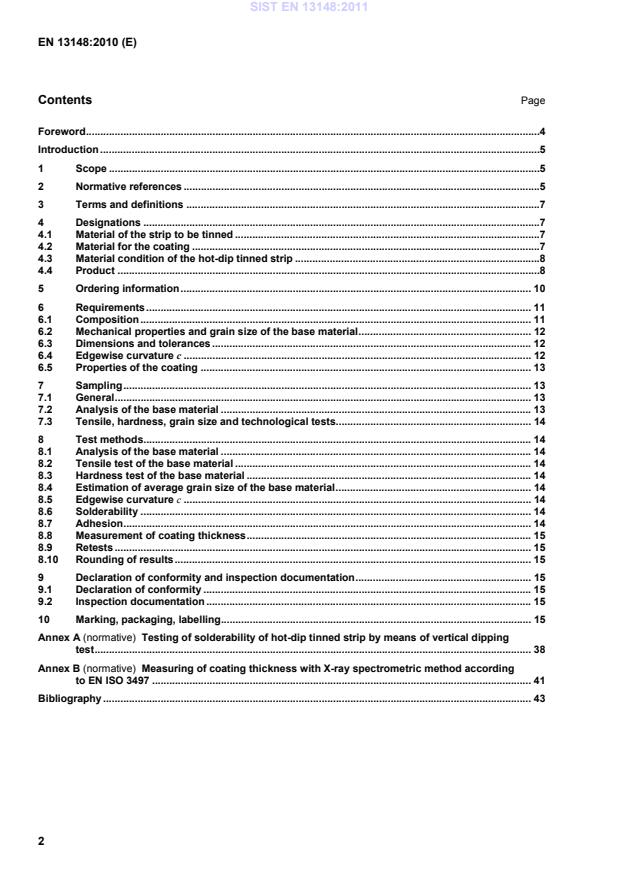
Testing of solderability of hot-dip tinned strip by means of vertical dipping test . 38Annex B (normative)
Measuring of coating thickness with X-ray spectrometric method according to EN ISO 3497 . 41Bibliography . 43SIST EN 13148:2011
Standard; the delivery conditions. 2 Normative references The following referenced documents are indispensable for the application of this document. For dated references, only the edition cited applies. For undated references, the latest edition of the referenced document (including any amendments) applies. EN 1655, Copper and copper alloys — Declarations of conformity EN 1976, Copper and copper alloys — Cast unwrought copper products SIST EN 13148:2011
(ISO 3497:2000) EN ISO 6507-1, Metallic materials — Vickers hardness test — Part 1: Test method (ISO 6507-1:2005) EN ISO 6892-1, Metallic materials — Tensile testing — Part 1: Method of test at room temperature
(ISO 6892-1:2009) EN ISO 7438:2005, Metallic materials — Bend test (ISO 7438:2005) ISO 1811-2, Copper and copper alloys — Selection and preparation of samples for chemical analysis — Part 2: Sampling of wrought products and castings ISO 80000-1, Quantities and units — Part 1: General SIST EN 13148:2011
longitudinal direction 3.5 base material (of a tinned strip) part of the strip which, after the tinning process, belongs neither to the metallic coating nor to an intermetallic phase and diffusion zone 4 Designations 4.1 Material of the strip to be tinned 4.1.1 General The material is designated either by symbol or number (see Tables 1 and 2). 4.1.2 Symbol The material symbol designation is based on the designation system given in ISO 1190-1. NOTE Although material symbol designations used in this European Standard might be the same as those in other standards using the designation system given in ISO 1190-1, the detailed composition requirements are not necessarily the same. 4.1.3 Number The material number designation is in accordance with the system given in EN 1412. 4.2 Material for the coating The coating is designated by the coating type (see Table 3) or for non-standardized coatings, by the supplier's designation. NOTE Due to solution and/or diffusion processes the composition of the coating can differ from that of the melt. SIST EN 13148:2011
Hot-dip tinned strip EN 13148 — CuSn6 — H180 — 0,50A × 200,00 — Sn60Pb — 2-5
or
Hot-dip tinned strip EN 13148 — CW452K — H180 — 0,50A × 200,00 — Sn60Pb — 2-5 Denomination Number of this European Standard Material designation of the strip to be tinned
Material condition designation
Nominal dimensions in millimetres and tolerance class for thickness
Material designation of the coating
Thickness range of the coating in micrometres
EXAMPLE 2 Differentially hot-dip tinned strip conforming to this European Standard, in material of the strip to be tinned designated either CuZn30 or CW505L, in material condition R350, nominal thickness 1,20 mm, tolerance Class B, nominal width 125,00 mm, coating type Sn, thickness (mean value) surface A 1,45 µm, thickness (mean value) surface B 3,5 µm, is designated as follows:
Differentially
hot dip
tinned strip EN 13148 — CuZn30 — R350 — 1,20B × 125,00 — Sn — A1,45 — B3,5
or
Differentially
hot-dip
tinned strip EN 13148 — CW505L — R350 — 1,20B × 125,00 — Sn — A1,45 — B3,5 Denomination
Number of this European Standard
Material designation of the strip to be tinned
Material condition designation
Nominal dimensions in millimetres and tolerance class for thickness
Material designation of the coating
Thickness of the coating surface A in micrometres
Thickness of the coating surface B in micrometres
Partially
hot dip
tinned strip EN 13148 — CuSn4— R610 — 0,60A × 54,00 — Sn60Pb — W38501
or
Partially
hot dip
tinned strip EN 13148 — CW450K — R610 — 0,60A × 54,00 — Sn60Pb — W38501 5 Ordering information In order to facilitate the enquiry, order and confirmation of order procedures between the purchaser and the supplier, the purchaser shall state on his enquiry and order the following information: a) quantity of product required (mass); b) denomination (hot-dip tinned strip or differentially hot-dip tinned strip or partially hot-dip tinned strip); c) number of this European Standard (EN 13148); d) material designation of the strip to be tinned (see Tables 1 and 2); e) material condition designation of the hot-dip tinned strip (see 4.3 and Table 4); f) nominal thickness of the strip before tinning. If nominal thickness of the tinned strip is required, it shall be subject to agreement between the purchaser and the supplier; g) tolerance class for the thickness of the strip before tinning (see Table 6); h) nominal width of the hot-dip tinned strip; i) coating type, Sn or Sn60Pb (see Table 3) or for non-standardized coatings the supplier's designation; j) thickness of the coating: 1) hot-dip tinned strip (see 3.2): mean value of coating thickness or thickness range (see Table 5); 2) differentially hot-dip tinned strip (see 3.3): mean value of coating thickness or thickness range (see Table 5) of each face, identified A and B, and the positions of those faces relative to the coil or spool; 3) partially hot-dip tinned strip (see 3.4): the number of a fully dimensioned and toleranced drawing which shall accompany the order. NOTE 1 It is recommended that the product designation, as described in 4.4, is used for items b) to j). In addition, the purchaser shall also state on the enquiry and order any of the following, if required: k) whether tinned edges are required (see 6.3.2) and if so, tolerances on width shall be agreed between the purchaser and the supplier; l) whether the strip shall meet edgewise curvature requirements (see 6.4 and Table 8); SIST EN 13148:2011
acceptance criteria shall be agreed between the purchaser and the supplier; p) coil size requirements: nominal inside diameter in millimetres and maximum outside diameter in
millimetres and either maximum mass in kilograms or approximate specific coil mass (mass per width) in kilogram per millimetre; q) spool size: type or dimensions; r) whether a declaration of conformity is required (see 9.1); s) whether an inspection document is required, and if so, which type (see 9.2); t) whether there are any special requirements for marking, packaging or labelling (see Clause 10). NOTE 2 To facilitate recycling it is recommended to use coating type Sn for the coating. EXAMPLE Ordering details for 1 200 kg hot-dip tinned strip conforming to EN 13148, in material of the strip to be tinned designated either CuZn37 or CW508L, in material condition R480, nominal thickness 0,40 mm, tolerance Class C, nominal width 160,00 mm, coating type Sn, mean value of thickness of the coating 1,45 µm, untinned edges, nominal inside diameter of coil 400 mm, maximum outside diameter of coil 950 mm, approximate specific coil mass (mass per width) 4,5 kg/mm:
1 200 kg Hot-dip tinned strip EN 13148 — CuZn37 — R480 — 0,40C ×××× 160,00 — Sn — 1,45
— nominal inside diameter of coil 400 mm
— maximum outside diameter of coil 950 mm
— approximate specific coil mass 4,5 kg/mm
or
1 200 kg Hot-dip tinned strip EN 13148 — CW508L — R480 — 0,40C ×××× 160,00 — Sn — 1,45
— nominal inside diameter of coil 400 mm
— maximum outside diameter of coil 950 mm
— approximate specific coil mass 4,5 kg/mm 6 Requirements 6.1 Composition 6.1.1 Strip to be tinned The composition of the strip shall conform to the requirements for the appropriate material given in Tables 1 and 2. Percentage content of the elements shown as "remainder" (Rem.) is usually calculated by difference from 100 %. 6.1.2 Material for the coating Unless otherwise specified, the composition of the material for the coating shall conform to the requirements for the appropriate material given in Table 3. Other material for the coating shall conform to the requirements agreed between the purchaser and the supplier [see 5 i)]. SIST EN 13148:2011
thickness of tinned strip shall conform to the appropriate combination of tolerances for the thickness of the strip given in Table 6 and the thickness range of the coatings ordered, for both faces, given in Table 5. NOTE The minimum thickness of the tinned strip is equal to the minimum thickness of the strip before tinning plus the minimum thickness of the coating on each face. The maximum thickness of the tinned strip is equal to the maximum
thickness of the strip before tinning plus the maximum thickness of the coating on each face. For partially hot-dip tinned strip it can be the case that in the non-coated parts max. 0,03 mm of the base
material is removed. 6.3.2 Tolerances on widths Generally the edges of a supplied strip are not tinned, because a strip is normally tinned in a larger width and slit to the ordered width after hot-dip tinning. In this case the same tolerances as for strip before tinning shall apply as given in Table 7. When strip with coated edges is ordered, the tolerance on width shall be agreed between the purchaser and the supplier. 6.4 Edgewise curvature c For the straightness of the longitudinal edge, which unless otherwise agreed between the purchaser and the supplier shall be based on a measuring length of 1 000 mm, the edgewise curvature c (see Figure 1) shall not exceed the values given in Table 8. If the purchaser and the supplier agree on a measuring length of 2 000 mm, the edgewise curvature c shall not exceed the values given in Table 8 multiplied by 4.
Key 1 measuring length 2 strip width c edgewise curvature Figure 1 — Edgewise curvature c SIST EN 13148:2011
combination of both. The appearance of the coating does not affect the suitability of the coating. If there are special requirements for appearance of the coating, they shall be agreed between the purchaser and the
supplier. 6.5.3 Solderability If solderability is required, the acceptance criteria shall be agreed between the purchaser and the supplier. The test shall be carried out in accordance with Annex A. 6.5.4 Adhesion If verification of the coating adhesion is required, the acceptance criteria shall be agreed between the
purchaser and the supplier. The tests shall be carried out in accordance with 8.7. 7 Sampling 7.1 General When required (e.g. if necessary in accordance with specified procedures of a supplier's quality system, or when the purchaser requests inspection documents with test results, or for use in cases of dispute), an
inspection lot shall be sampled in accordance with 7.2 and 7.3. 7.2 Analysis of the base material The sampling rate shall be in accordance with ISO 1811-2. A test sample, depending on the analytical
technique to be employed, shall be prepared from each sampling unit and used for the determination of the
composition. NOTE 1 When preparing the test sample, care should be taken to avoid contaminating or overheating the test sample. Carbide tipped tools are recommended; steel tools, if used, should be made of magnetic material to assist in the
subsequent removal of extraneous iron. If the test samples are in finely divided form (e.g. drillings, millings), they should be treated carefully with a strong magnet to remove any particles of iron introduced dur
...