

EN 18032:2025
(Main)Foodstuff - Quick Method for the Analysis of Multiple Highly Polar Pesticides and their Metabolites in Foodstuff Involving Extraction with Acidified Methanol and Measurement by LC- or IC-MS/MS (QuPPe-Method)
- Abstract
This document specifies a procedure for the analysis of residues of highly polar pesticides and metabolites, which are not amenable to common multiresidue methods, in various food commodities of plant and animal origin, including fruits, vegetables, cereals, pulses, oily seeds, nuts, milk, liver and honey. The method was developed at the EURL-SRM hosted at CVUA Stuttgart [1], [2], [3] and has been collaboratively studied on a large number of commodity/pesticide combinations. Guidelines for calibration are outlined in CEN/TS 17061:2019.
- Status
- Published
- Publication Date
- 07-Oct-2025
- Technical Committee
- CEN/TC 275 - Food analysis - Horizontal methods
- Drafting Committee
- CEN/TC 275/WG 3 - Pesticides and PCB's in foods of animal origin
- Current Stage
- 6060 - Definitive text made available (DAV) - Publishing
- Start Date
- 08-Oct-2025
- Due Date
- 26-Aug-2025
- Completion Date
- 08-Oct-2025

Overview
EN 18032:2025 - QuPPe-Method specifies a rapid, fit-for-purpose procedure for the analysis of highly polar pesticides and their metabolites in a wide range of food commodities. The method uses extraction with acidified methanol followed by measurement with LC‑MS/MS or IC‑MS/MS, covering plant and animal-origin foods such as fruits, vegetables, cereals, pulses, oily seeds, nuts, milk, liver and honey. Developed at the EURL‑SRM (CVUA Stuttgart) and validated across many commodity/pesticide combinations, the QuPPe protocol is intended for routine pesticide residue testing and regulatory monitoring.
Key Technical Topics and Requirements
- Extraction principle: Water adjustment of the homogenized test portion and extraction with acidified methanol; minimal steps and low material consumption.
- Sample preparation: Guidance on laboratory sampling, homogenization (including cryogenic milling), and analytical test portion selection to ensure representative results.
- Commodity-specific treatments:
- Addition of EDTA for cereals, pulses, nuts and animal products to complex metal ions (beneficial for analytes such as glyphosate and AMPA).
- Protein precipitation by dilution with acetonitrile for high-protein matrices.
- Dispersive SPE with C18 sorbent for high-lipid samples.
- Measurement: Options for LC‑MS/MS or IC‑MS/MS workflows and modular measurement methods for simultaneous analysis of multiple polar pesticides.
- Quantification and calibration:
- Preferential use of isotope-labelled internal standards (IL‑ISs) added at the start of sample preparation to correct recoveries and matrix effects.
- Calibration guidance referenced to CEN/TS 17061:2019; method validation and QC aligned with SANTE guidance.
- Documentation: Detailed annexes (reagents, apparatus, extraction/clean-up modules, measurement and quantification modules) and requirements for evaluation of results, validity and test reporting.
Practical Applications and Users
- Routine pesticide residue laboratories performing regulatory compliance testing and monitoring.
- National control authorities and food safety agencies implementing maximum residue limit (MRL) surveillance.
- Contract testing labs, research institutions and method developers working on polar pesticide analytics.
- Laboratories seeking a standardized, validated workflow for analytes not amenable to conventional multiresidue methods.
Related Standards and References
- CEN/TS 17061:2019 - Guidelines for calibration and quantitative determination of pesticide residues.
- SANTE/11312/2021v2 - Analytical quality control and method validation procedures for pesticide residues.
- Method provenance: Developed at EURL‑SRM (CVUA Stuttgart); adopted as EN 18032:2025 by CEN.
This standard provides a practical, modular QuPPe workflow for accurate detection and quantification of highly polar pesticide residues, supporting harmonized food safety testing across laboratories.
Relations
- Effective Date
- 28-Jan-2026
Get Certified
Connect with accredited certification bodies for this standard

BSI Group
BSI (British Standards Institution) is the business standards company that helps organizations make excellence a habit.

Bureau Veritas
Bureau Veritas is a world leader in laboratory testing, inspection and certification services.

DNV
DNV is an independent assurance and risk management provider.
Sponsored listings
Frequently Asked Questions
EN 18032:2025 is a standard published by the European Committee for Standardization (CEN). Its full title is "Foodstuff - Quick Method for the Analysis of Multiple Highly Polar Pesticides and their Metabolites in Foodstuff Involving Extraction with Acidified Methanol and Measurement by LC- or IC-MS/MS (QuPPe-Method)". This standard covers: This document specifies a procedure for the analysis of residues of highly polar pesticides and metabolites, which are not amenable to common multiresidue methods, in various food commodities of plant and animal origin, including fruits, vegetables, cereals, pulses, oily seeds, nuts, milk, liver and honey. The method was developed at the EURL-SRM hosted at CVUA Stuttgart [1], [2], [3] and has been collaboratively studied on a large number of commodity/pesticide combinations. Guidelines for calibration are outlined in CEN/TS 17061:2019.
This document specifies a procedure for the analysis of residues of highly polar pesticides and metabolites, which are not amenable to common multiresidue methods, in various food commodities of plant and animal origin, including fruits, vegetables, cereals, pulses, oily seeds, nuts, milk, liver and honey. The method was developed at the EURL-SRM hosted at CVUA Stuttgart [1], [2], [3] and has been collaboratively studied on a large number of commodity/pesticide combinations. Guidelines for calibration are outlined in CEN/TS 17061:2019.
EN 18032:2025 is classified under the following ICS (International Classification for Standards) categories: 67.050 - General methods of tests and analysis for food products. The ICS classification helps identify the subject area and facilitates finding related standards.
EN 18032:2025 has the following relationships with other standards: It is inter standard links to CEN/TS 17061:2019. Understanding these relationships helps ensure you are using the most current and applicable version of the standard.
EN 18032:2025 is available in PDF format for immediate download after purchase. The document can be added to your cart and obtained through the secure checkout process. Digital delivery ensures instant access to the complete standard document.
Standards Content (Sample)
SLOVENSKI STANDARD
01-december-2025
Živila - Hitra metoda za analizo več visokopolarnih pesticidov in njihovih
metabolitov v živilih z ekstrakcijo z zakisanim metanolom in merjenjem z LC- ali IC-
MS/MS (metoda QuPPe)
Foodstuff - Quick Method for the Analysis of Multiple Highly Polar Pesticides and their
Metabolites in Foodstuff Involving Extraction with Acidified Methanol and Measurement
by LC- or IC-MS/MS (QuPPe-Method)
Lebensmittel - Schnellmethode zur Bestimmung mehrerer hochpolarer Pestizide und
ihrer Metaboliten in Lebensmitteln nach Extraktion mit angesäuertem Methanol und
Messung mittels LC- oder IC-MS/MS (QuPPe-Methode)
Produit alimentaire - Méthode rapide pour l'analyse de plusieurs pesticides hautement
polaires et de leurs métabolites dans les aliments impliquant une extraction avec du
méthanol acidifié et une mesure par LC- ou IC-MS/MS (QuPPe-Methode)
Ta slovenski standard je istoveten z: EN 18032:2025
ICS:
67.050 Splošne preskusne in General methods of tests and
analizne metode za živilske analysis for food products
proizvode
2003-01.Slovenski inštitut za standardizacijo. Razmnoževanje celote ali delov tega standarda ni dovoljeno.
EN 18032
EUROPEAN STANDARD
NORME EUROPÉENNE
October 2025
EUROPÄISCHE NORM
ICS 67.050
English Version
Foodstuff - Quick Method for the Analysis of Multiple
Highly Polar Pesticides and their Metabolites in Foodstuff
Involving Extraction with Acidified Methanol and
Measurement by LC- or IC-MS/MS (QuPPe-Method)
Produits alimentaires - Méthode rapide pour l'analyse Lebensmittel - Schnellmethode zur Bestimmung
de plusieurs pesticides hautement polaires et de leurs mehrerer hochpolarer Pestizide und ihrer Metaboliten
métabolites dans les aliments impliquant une in Lebensmitteln nach Extraktion mit angesäuertem
extraction avec du méthanol acidifié et une analyse par Methanol und Messung mittels LC- oder IC-MS/MS
LC- ou CI-SM/SM (méthode QuPPe) (QuPPe-Methode)
This European Standard was approved by CEN on 11 August 2025.
CEN members are bound to comply with the CEN/CENELEC Internal Regulations which stipulate the conditions for giving this
European Standard the status of a national standard without any alteration. Up-to-date lists and bibliographical references
concerning such national standards may be obtained on application to the CEN-CENELEC Management Centre or to any CEN
member.
This European Standard exists in three official versions (English, French, German). A version in any other language made by
translation under the responsibility of a CEN member into its own language and notified to the CEN-CENELEC Management
Centre has the same status as the official versions.
CEN members are the national standards bodies of Austria, Belgium, Bulgaria, Croatia, Cyprus, Czech Republic, Denmark, Estonia,
Finland, France, Germany, Greece, Hungary, Iceland, Ireland, Italy, Latvia, Lithuania, Luxembourg, Malta, Netherlands, Norway,
Poland, Portugal, Republic of North Macedonia, Romania, Serbia, Slovakia, Slovenia, Spain, Sweden, Switzerland, Türkiye and
United Kingdom.
EUROPEAN COMMITTEE FOR STANDARDIZATION
COMITÉ EUROPÉEN DE NORMALISATION
EUROPÄISCHES KOMITEE FÜR NORMUNG
CEN-CENELEC Management Centre: Rue de la Science 23, B-1040 Brussels
© 2025 CEN All rights of exploitation in any form and by any means reserved Ref. No. EN 18032:2025 E
worldwide for CEN national Members.
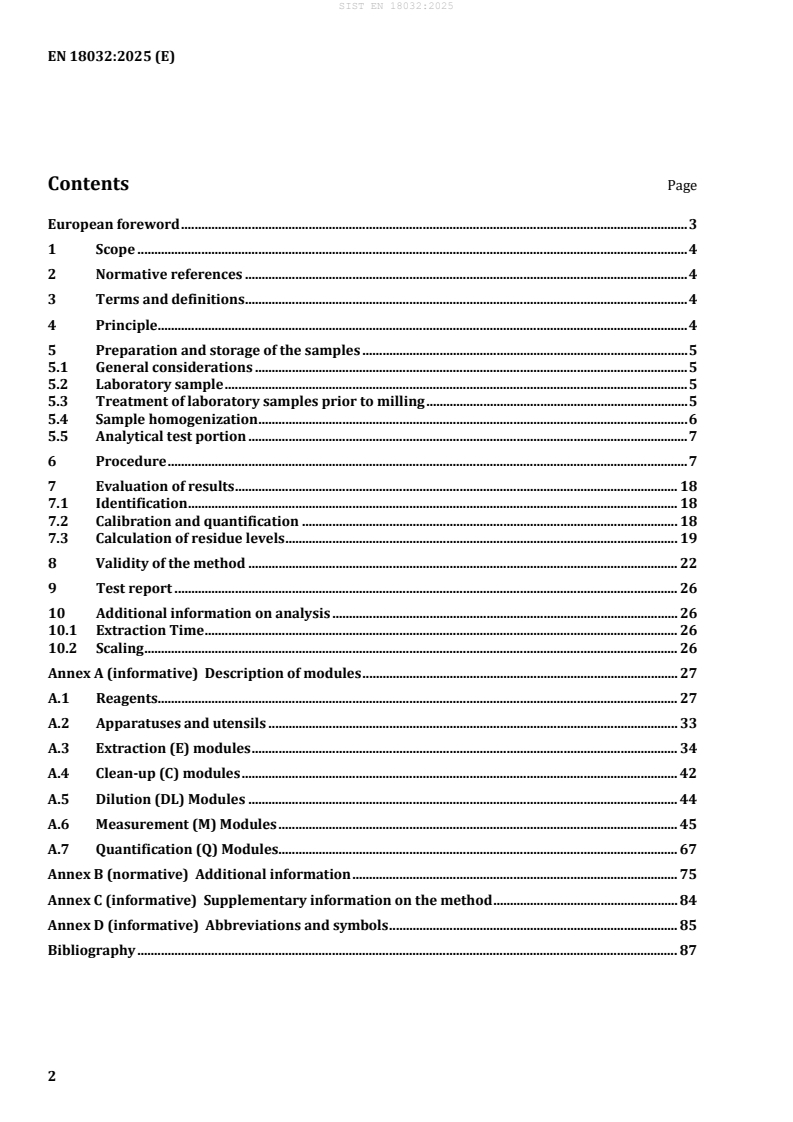
Contents Page
European foreword . 3
1 Scope . 4
2 Normative references . 4
3 Terms and definitions . 4
4 Principle . 4
5 Preparation and storage of the samples . 5
5.1 General considerations . 5
5.2 Laboratory sample . 5
5.3 Treatment of laboratory samples prior to milling . 5
5.4 Sample homogenization . 6
5.5 Analytical test portion . 7
6 Procedure . 7
7 Evaluation of results . 18
7.1 Identification . 18
7.2 Calibration and quantification . 18
7.3 Calculation of residue levels . 19
8 Validity of the method . 22
9 Test report . 26
10 Additional information on analysis . 26
10.1 Extraction Time . 26
10.2 Scaling . 26
Annex A (informative) Description of modules . 27
A.1 Reagents . 27
A.2 Apparatuses and utensils . 33
A.3 Extraction (E) modules . 34
A.4 Clean-up (C) modules . 42
A.5 Dilution (DL) Modules . 44
A.6 Measurement (M) Modules . 45
A.7 Quantification (Q) Modules. 67
Annex B (normative) Additional information . 75
Annex C (informative) Supplementary information on the method . 84
Annex D (informative) Abbreviations and symbols . 85
Bibliography . 87
European foreword
This document (EN 18032:2025) has been prepared by Technical Committee CEN/TC275 “Food analysis -
Horizontal methods”, the secretariat of which is held by DIN.
This European Standard shall be given the status of a national standard, either by publication of an identical
text or by endorsement, at the latest by April 2026, and conflicting national standards shall be withdrawn
at the latest by April 2026.
Attention is drawn to the possibility that some of the elements of this document may be the subject of
patent rights. CEN shall not be held responsible for identifying any or all such patent rights.
WARNING —The use of this document can involve hazardous materials, operations and equipment.
This document does not purport to address all the safety problems associated with its use. It is the
responsibility of the user of this document to establish appropriate safety and health practices and
determine the applicability of regulatory limitations prior to use.
Any feedback and questions on this document should be directed to the users’ national standards body. A
complete listing of these bodies can be found on the CEN website.
According to the CEN-CENELEC Internal Regulations, the national standards organisations of the following
countries are bound to implement this European Standard: Austria, Belgium, Bulgaria, Croatia, Cyprus,
Czech Republic, Denmark, Estonia, Finland, France, Germany, Greece, Hungary, Iceland, Ireland, Italy,
Latvia, Lithuania, Luxembourg, Malta, Netherlands, Norway, Poland, Portugal, Republic of North
Macedonia, Romania, Serbia, Slovakia, Slovenia, Spain, Sweden, Switzerland, Türkiye and the United
Kingdom.
1 Scope
This document specifies a procedure for the analysis of residues of highly polar pesticides and metabolites,
which are not amenable to common multiresidue methods, in various food commodities of plant and
animal origin, including fruits, vegetables, cereals, pulses, oily seeds, nuts, milk, liver and honey. The
method was developed at the EURL-SRM hosted at CVUA Stuttgart [1], [2], [3] and has been collaboratively
studied on a large number of commodity/pesticide combinations. Guidelines for calibration are outlined
in CEN/TS 17061:2019.
2 Normative references
The following documents are referred to in the text in such a way that some or all of their content
constitutes requirements of this document. For dated references, only the edition cited applies. For
undated references, the latest edition of the referenced document (including any amendments) applies.
CEN/TS 17061:2019, Foodstuffs - Guidelines for the calibration and quantitative determination of pesticide
residues and organic contaminants using chromatographic methods
SANTE/11312/2021v2, Analytical quality control and method validation procedures for pesticide residues
analysis in food and feed
3 Terms and definitions
For the purposes of this document, the terms and definitions given in SANTE/11312/2021v2 apply.
ISO and IEC maintain terminology databases for use in standardization at the following addresses:
— ISO Online browsing platform: available at https://www.iso.org/obp/
— IEC Electropedia: available at https://www.electropedia.org/
4 Principle
Residues are extracted from the homogeneous test portion following water adjustment and addition of
acidified methanol. In the case of fruits and vegetables, the mixture is centrifuged, filtered and directly
analysed by LC-MS/MS or IC-MS/MS. In the case of cereals, pulses, nuts, oily seeds and foods of animal
origin, EDTA is added for the complexation of metal ions, such as calcium and magnesium, which positively
affects the analysis of certain compounds (e.g. glyphosate and AMPA). As such commodities also contain a
substantial content of protein, they are additionally diluted with acetonitrile to precipitate proteins.
Samples with high lipid content are subjected to dispersive SPE with C18-sorbent. Various LC- and IC-
MS/MS methods, allowing simultaneous analysis of different combinations of pesticides, are provided in
this document. Quantification is performed employing isotope-labelled analogues of the target analytes as
internal standards (IL-ISs), so far these are available. When adding IL-ISs directly to the test portion at the
beginning of the procedure, they compensate for any factors having an influence on recovery-rates, such
as volume-deviations and analyte losses during sample preparation. Matrix-effects during measurement
are also corrected. The use of IL-ISs, ensures good accuracy and reproducibility. Quantification without IL-
ISs is possible, but careful water adjustment and other approaches for addressing recovery losses and
matrix effects are required in this case. The analytical procedure entails few working steps and involves
little material consumption. A brief overview of the method is shown in the flowcharts within the “On-line
Supplement” linked in Annex C. Abbreviations and symbols are listed in Annex D.
Version 2 of 2021. Implemented as of 01/01/2024.
Available at: https://www.eurl-pesticides.eu/docs/public/tmplt_article.asp?CntID=727
5 Preparation and storage of the samples
5.1 General considerations
Sample processing and storage procedures should be demonstrated to have no significant effect on the
residues present in the test sample (sometimes also called “analytical sample”). Processing should also
ensure, that the test sample is homogeneous enough so that sub-sampling (portion-to-portion) variability
is acceptable. If a single analytical portion is unlikely to be representative of the test sample, larger or
replicate portions shall be analysed, to provide a better estimate of the true value. The degree of
comminution should support a quantitative residue extraction, otherwise, extraction shall involve
supplementary comminution, e.g. through a homogenizing device (A.2.2) or grinding aids (e.g. metal balls
(A.2.3)).
5.2 Laboratory sample
A laboratory sample is the sample arriving to the laboratory for analysis and should ideally be sampled
according to international sampling protocols [4], [5]. A laboratory sample that is extensively spoiled or
degraded should not be analysed. Samples associated with a shelf life should be analysed within their
stated shelf life. If possible, process laboratory samples immediately after arrival and in any event, before
any significant physical or chemical changes have taken place. If a laboratory sample cannot be processed
without delay, it should be stored under appropriate conditions to keep it fresh and to minimize
deterioration.
If the laboratory sample is in a state that does not require milling prior to analysis (e.g. juices, milk, and
cereal flour), stir or shake the sample well and then withdraw the analytical test portions directly. Where
the homogeneity of the sample is, however, not sufficient or the extraction of residues is expected to be
significantly compromised due to the presence of larger particles, intensive comminution should be
performed using appropriate means.
5.3 Treatment of laboratory samples prior to milling
For preparation of the analytical sample, take only the portion of the laboratory sample to which the
maximum residue levels apply [6], [7]. If a reduction of the laboratory sample is required, out of practical
reasons, it shall be carried out in a way ensuring representativeness. This, for example, applies when
samples are made up of larger units, and the capacity of the available mixer is too small to process the
required number of units in one go. In this case, parts of the sample can be used, i.e. wedge-shaped sections
(e.g. melons) or cross sections (e.g. cucumbers) that include the skin (outer surface). Opposite sections
from each unit (e.g. quarters) should then be used for mixing (see e.g. [8]). For samples of small units (e.g.
small fruits such as berries, legumes, cereals), the sample shall be thoroughly mixed before taking any
aliquot for further processing.
Any parts that would cause difficulties with the homogenization process may be removed prior to milling
(e.g. in the case of stone fruits, the stones). The mass of the sample before and after removing the interfering
sample portions shall be recorded. Precautions should be taken to avoid any losses of juice or flesh. The
sample obtained in this way is referred to as the test sample. Calculation of the residue shall be based on
the mass of the original test sample (including the stones and assuming that these parts are residue free).
In case of cryogenic comminution using dry ice, cutting the samples coarsely (e.g. 3 × 3 cm) with a knife
and putting them into the freezer (e.g. at ≤ −18 °C overnight) prior to comminution facilitates processing.
5.4 Sample homogenization
5.4.1 General considerations
For fresh products (e.g. fruits and vegetables), homogenization at ambient or refrigerator temperature is
possible, but cryogenic milling is to be preferred in most cases, as it minimizes losses of susceptible
analytes, and usually results in smaller particle sizes and a higher degree of homogeneity. In the case of
fresh, non-frozen products, keep the time gap between homogenization and extraction as short as possible
to minimize degradation of susceptible target analytes.
Cryogenic milling (additionally assisted by dry ice or liquid nitrogen (A.1.12)) typically further improves
homogenization of commodities with tough skins (e.g. tomatoes or grapes). When test samples are
processed at low temperatures, take measures to minimize the condensation of humidity on the sample.
Residual carbon dioxide should be allowed to sufficiently dissipate, so that its contribution to the sample
weight will be negligible. For the homogenization using liquid nitrogen, the sample material (e.g. entire
units or coarsely cut units) is immersed into a suitable plastic container (e.g. PP or polystyrene) containing
liquid nitrogen. When completely frozen, it is transferred into a powerful knife mill and ground until a fine
powder is obtained. The frozen powder should be transferred quickly into a storage container. Make sure
that all liquid nitrogen is evaporated before tightly closing the storage container and placing it into the
freezer.
For dry commodities, the aim of milling is to produce particle sizes that are < 1 mm. Smaller particle sizes
will facilitate extraction. However, be aware that friction during milling can cause very high temperatures.
Cryo-milling involving addition of liquid nitrogen or dry ice helps to keep temperatures low. The use of
ultra-centrifugal mills with ring-filters helps to limit the maximum particle size. Milling by a knife mill
usually results in a broad particle distribution. A two-step milling typically helps to reduce the average
particle size further. When dealing with dry commodities of high oil content, extensive milling with a knife
mill and milling with ultra-centrifugal mills often leads to the formation of a paste due to the release of
liquid oil. Cryo-milling is to be preferred for such samples. Homogenates of dry commodities should be
optimally also stored in the freezer, although analyte stability under ambient conditions is typically much
better than in liquid homogenates.
NOTE Upon comminution (including the coarse cutting mentioned above) of non-frozen high moisture content
samples (e.g. fruits and vegetables) matrix-juices are released that can accelerate the degradation of certain
susceptible pesticides with which they come in contact. This includes pesticides located on the skin of products, which
get exposed to fruit juices when coarsely cut pieces (later used for cryo-milling) are mixed in a bag.
5.4.2 Preparation of homogenates of dried fruit and similar commodities
Dried fruits and similar commodities (≈15 % to 40 % moisture-content) can be processed as a slurry or in
deep frozen state without addition of water. For the processing as a slurry, weigh 500 g of frozen dried
fruits, add X g of cold water (A.1.1) (see Table 1 and Table B.1) and homogenize the mixture using a strong
mixer (A.2.1), if possible, with addition of dry ice (A.1.12) to prevent or slow-down any chemical and
enzymatic reactions. For extractions according to E3 (see Table 2), weigh Y g of homogenate (see Table 1
and Table B.1 corresponding to 5 g sample). Alternatively, immerse the sample material into a plastic or
polystyrene container containing liquid nitrogen. When completely frozen, transfer it into a powerful knife
mill and grind until a fine powder is obtained. Do not mill for too long and quickly transfer the frozen
powder into a storage container and place it into the freezer to avoid that it becomes clumpy and more
difficult to handle.
Table 1 — Dried fruits/water proportion during homogenization
Moisture content of product Amount of Water amount Weight of analytical portion
(Y g; corresponding to 5 g of
sample added
original dry sample)
% g X g g
≈15 to < 25 500 900 14
25 to < 35 500 850 13,5
≥ 35 to 40 500 800 13
Freeze-dried fruit and vegetables (typical moisture content 0,3 % to 4 %) are homogenized with a high
speed knife mill (A.2.1), preferably after adding dry ice or liquid nitrogen (A.1.12) to keep the material cool.
Thereof, 2 g sample is employed for analysis (as in the case of other dry extract-rich commodities such as
spices and dried herbs).
5.5 Analytical test portion
One or more individual test portions, each sufficient for one analysis, should be taken from the sample
homogenate, prepared as described above. If the test sample was stored prior to weighing the analytical
portions and it is noticed, that the homogeneity of the test sample has been compromised during storage,
the test sample shall be mixed again before taking test portions, to ensure that homogeneity has been re-
established.
If fresh products are homogenized in a non-frozen state, the test portions should be weighed and analysed
immediately after milling, unless it could be demonstrated, that no significant degradation of target
analytes occurs in the time period between comminution and start of analysis. If the test portions cannot
be analysed directly, they shall be frozen until required. Keep in mind that in such non-frozen liquid
homogenates a separation of flesh and juice can occur and potentially increase portion-to-portion
variability. Thus stir the homogenate well before weighing.
6 Procedure
The extraction is described in modules E1 to E7 (Table 2). Depending on the commodity, the centrifuged
raw extracts are either filtered and directly subjected to the measurement modules M1 to M5 (Table 5) or
cleaned-up prior to measurement by one or more of the clean-up modules C1 to C4 (Table 3). A dilution
module DL (Table 4) prior to measurement is either indicated or recommended, but this also depends on
the sensitivity of the instrumentation used. The residue concentrations in the samples can be calculated
using the quantification approaches described under Q1 to Q6 (see Table 6 with reference to calibration
procedures in CEN/TS 17061:2019). For the application of the Q-Modules a decision tree can be found
under [13]. Further calibration/quantification procedures can be found under CEN/TS 17061:2019.
Preferred combinations of modules for a multitude of raw and processed commodities, concerning the
extraction of samples and clean-up of raw extracts are listed in Table B.1.
Table 2 — Extraction modules
a b c c
Module Short description Preferred application and restrictions Examples / Remarks
E1 Extraction of 10 g sample without water addition Commodities with high water content (≥80 %) Fruit, vegetables, juices
E2 Extraction of 10 g sample after addition of, e.g. Commodities with average water content (>40 % I. Potato, parsley
to < 80 %)
I. Two ml water II. Banana, horseradish, fresh peas,
ginger
II. 2,5 ml water
III. Avocado, olive
III. Three ml water
IV. Garlic
IV. 3,5 ml water
E3 Extraction of e.g. 13,5 g homogenate that was prepared with Commodities with low water content (≈15 % to Dried fruits and similar products (e.g.
the addition of water, see Table 1 40 %) jams)
E4 Extraction of 5 g honey after addition of 7,5 ml water Honey
E5a Extraction of 2 g or 5 g sample after addition of 10 ml water Commodities with very low water content Low lipid content: Herbs, Refined cereals,
(<15 %). whole grain cereals, pseudo cereals,
pulses, skimmed milk powder.
Restrictions: Not recommended for pesticides
and metabolites containing a phosphonic acid High lipid content: Oilseeds, nuts, spices,
moiety (e.g. glyphosate, AMPA, MPPA) see E5b. milk powder, infant formula.
E5b Extraction of 2 g or 5 g sample after addition of 9 ml water, Commodities with very low water content
1 ml 10 % EDTA, 0,1 ml formic acid (<15 %).
Recommended for pesticides and metabolites
containing a phosphonic acid moiety (e.g.
glyphosate, AMPA, MPPA).
a b c c
Module Short description Preferred application and restrictions Examples / Remarks
E6a Extraction of 10 g sample after addition of, e.g. Commodities of animal origin with water content I. Skimmed milk (low lipid content)
(>30 %).
I. 1,0 ml water II. Whole fat milk
Restrictions: Not recommended for pesticides
II. 1,5 ml water III. Kidney, fish
and metabolites containing a phosphonic acid
III. 2,0 ml water IV. Egg, muscle
moiety (e.g. glyphosate, AMPA, MPPA) see E6b.
IV. 2,5 ml water V. Liver
V. 3,0 ml water In the case of processed meat products
increase the amount of water (e.g.: in the
E6b Extraction of 10 g sample after addition of water/10 % EDTA / Commodities of animal origin with water content
case of cured ham with 50 % moisture
formic acid, e.g. as follows: (>30 %).
add 5 ml of water or 4/1/0,1 ml of
I. 0/1/0,1 ml Recommended for pesticides and metabolites
water/10 % EDTA/formic acid to 10 g
containing a phosphonic acid moiety (e.g.
sample).
II. 0,5/1/0,1 ml
glyphosate, AMPA, MPPA).
III. 1/1/0,1 ml
IV. 1,5/1/0,1 ml
V. 2/1/0,1 ml
E7 Extraction of 5 g fat sample assisted by mechanical aids (e.g. Fats (lipids that have a non-liquid, e.g. solid, waxy Fats of animal and plant origin
metal balls) or pasty consistency at room temperature)
a
The modules are described in Annex A.
b
The indication “without water addition” refers to procedures where IL-IS is added before any aliquotation of the extract. Where IL-IS is not used or where it is added to an aliquot of the extract,
water adjustment is indicated up to a total volume of 10 ml (sample water + added water) to reduce the bias.
c
Water contents of the various commodities can be found in Table B.1 under column V and VI. For commodities where a freeze-out step and/or a cold centrifugation is recommended after the
extraction step column VIII of the same table contains the coding “F-O” (see also the Recommendations under 3.1).
Table 3 — Clean-up modules
a
Module Description Preferred applications Examples
C0 No clean-up Most fruits and vegetables
C1 Freeze-out for the precipitation of poorly Commodities, of which the extracts show difficulties Raw extracts of e.g. pineapples, potatoes, cereal
soluble co-extractives or to assist filtration in filtration or contain co-extractives that precipitate flours (especially if finely milled), avocado, olives,
at low temperatures (e.g. lipids, sugars, proteins) strawberries
C2 Dispersive SPE with C18-sorbent Commodities containing high lipid and low protein Avocado, olives
content
Refined cereals, pseudo cereals, pulses, skimmed
C3a Precipitation with acetonitrile for removal of Commodities containing high protein content
milk powder
proteins and other co-extractives with limited
solubility in acetonitrile
C3b Precipitation with acetonitrile combined with Commodities containing high protein and high lipid Oilseeds, nuts, cereals, liver, kidney, whole fat milk,
C18 sorbent for removal of proteins, lipids and content muscle
other co-extractives with limited solubility in
acetonitrile
C4 Ultrafiltration using cut-off filters of 5 kDa or Commodities with high protein content Oilseeds, nuts, pulses, cereals, pseudo cereals, liver,
10 kDa kidney, whole fat milk, muscle
a
The modules are described in Annex A.
Table 4 — Dilution modules - exemplary
a b c d
Module DLx Description of dilution Circumstances (indicative) Examples / Recommendations
DL1 Undiluted extracts • Measurement of undiluted extracts possible with
satisfactory performance
• Analyte sensitivity does not allow dilution, but matrix effects
(compared to calibration) are negligible (
sufficiently compensated (e.g. via IL-IS or matrix matching)
DL2 2-fold dilution (V + V , 1 + 1) • Considerable (non-negligible) matrix effects (e.g. • DL2 prior to analysis by M3a or M3b of
1 2
between ± 20 % and ± 40 %), that are not sufficiently sample extracts of E5b and E6b (with
compensated otherwise (e.g. via IL-IS or matrix matching) EDTA) following C3a or C3b
• See also general goals and preconditions below
DLx 5 to 10 5-fold dilution (V1 + V2, 1+4) • Strong matrix effects (e.g. between ± 40 % and ± 90 %) that • DL10 prior to analysis of chlorate,
are not sufficiently compensated otherwise (e.g. via IL-IS or perchlorate, phosphonic acid, by M3b
+ V , 1+9)
e.g. 10-fold (V1 2
matrix matching)
• DL5 when using IC-MS/MS (M4 or M5)
x = 5 (DL5);
• Heavy matrix load in extract, that affects performance or
• DL5 prior to analysis by M3a or M3b of
x = 10 (DL10)
robustness of measurement
sample extracts of E5b and E6b (with
• See also general goals and preconditions below EDTA) following C3a or C3b
DLx > 10 50-fold dilution (V1 + V2, 1+49) • Very strong matrix effects (e.g. > ± 90 %) that are not • DL50 prior to analysis of bromide (high
sufficiently compensated otherwise (e.g. via IL-IS or matrix MRLs and high background levels)
e.g.
matching)
x = 50 (DL50)
• Heavy matrix load in extract, that affects performance or
robustness of measurement
• See also general goals and preconditions below
a
The modules are described in Annex A. The module number “x” indicates the dilution factor and serves the documentation of the procedure. Any dilution factor can be used as long as preconditions
(see list after Table 4) are met.
b
Dilutions can be accomplished by mixing a certain volume of the extract (V ) with a certain volume of a water-miscible solvent (V ), which may be a LC-mobile phase eluent (see A.6). Dilution can
1 2
be part of the LC- or IC-injection process. In case the dilution induces a precipitation, filtration with syringe filter (A.2.11) is recommended after dilution. Dilutions with blank sample extracts are also
possible and sometimes reasonable (e.g. for keeping matrix effects similar).
c
Matrix effects are defined as in the SANTE document SANTE/11312/2021; e.g. a signal suppression by 90 % is expressed as −90 %
d
Dilution factors are exemplary and may be individually adjusted considering measurement sensitivity, analyte concentration as well as the purpose of analysis (i.e. screening or quantitative).
When applying Table 4, general goals of dilution are to:
— reduce matrix effects,
— reduce retention time shifts,
— improve peak shapes,
— improve chromatographic separation from interfering compounds,
— obtain a signal within the calibration range/ linear range,
— reduce exposure of measurement instrument to matrix (increase long term robustness and reduce
maintenance intervals).
Thereby, general preconditions for dilution are that:
— the signal intensities of analyte(s) and IL-IS(s) remain satisfactory after dilution,
— any shifts of matrix effects are adequately addressed by the calibration approach.
Table 5 — Measurement modules
a
Module Instrument details Exemplary Analytes Exemplary Columns
b
M1 LC-MS/MS Glyphosate, APPC
HILIC phase
b
Glufosinate, Torus DEA
ESI neg. mode
d
Fosetyl, Raptor Polar X
e
Chlorate, Obelisc N
c
Perchlorate, etc. Trinity Q1
f
Luna Polar Pesticides
b
LC-MS/MS
M2 Chlormequat, Amide BEH
HILIC phase
e
Mepiquat, Obelisc R
ESI pos. mode
c
Cyromazine, Trinity P1
Matrine,
Nicotine, etc.
c
M3 LC-MS/MS Glyphosate, Hypercarb
Porous graphitic carbon phase
Glufosinate,
ESI neg. mode
Fosetyl,
Chlorate,
Perchlorate, etc.
c
M4 IC-MS/MS Glyphosate, AS19
Anion exchange phase c
Glufosinate, AS24
ESI neg. mode
Fosetyl,
Chlorate,
Perchlorate, etc.
a
Module Instrument details Exemplary Analytes Exemplary Columns
c
M5 IC-MS/MS Chlormequat, CS17
Cation exchange column
Mepiquat,
ESI pos. mode
Cyromazine,
Matrine,
Nicotine, etc.
a
The modules are described in Annex A.
b
APPC, Torus DEA, Amide BEH are the trade names of products supplied by WATERS. This information is given for the
convenience of users of this document and does not constitute an endorsement by CEN or CENELEC of the product named.
Equivalent products may be used if they can be shown to lead to the same results.
c
Trinity Q1, Trinity P1, Hypercarb, AS19, AS24, CS17 are the trade names of products supplied by Thermo. This
information is given for the convenience of users of this document and does not constitute an endorsement by CEN or
CENELEC of the product named. Equivalent products may be used if they can be shown to lead to the same results.
d
Raptor Polar X is the trade name of a product supplied by Restek. This information is given for the convenience of users
of this document and does not constitute an endorsement by CEN or CENELEC of the product named. Equivalent products
may be used if they can be shown to lead to the same results.
e
Obelisc N, Obelisc R are the trade names of products supplied by Sielc. This information is given for the convenience of
users of this document and does not constitute an endorsement by CEN or CENELEC of the product named. Equivalent
products may be used if they can be shown to lead to the same results.
f
Luna Polar Pesticides is the trade name of a product supplied by Phenomenex. This information is given for the
convenience of users of this document and does not constitute an endorsement by CEN or CENELEC of the product named.
Equivalent products may be used if they can be shown to lead to the same results.
Table 6 — Quantification modules
g
Module Description Circumstances Effects Preconditions, Remarks and Reference within
Examples CEN/TS 17061:2019
Matching IL-IS This approach.
blank
(added at
corrects corrects reduces
matrix
beginning of
for poor for matrix impact of
a
b
used
d
procedure)
absolute effects interactions
c e
recovery in injector
Q1a Quantification using calibration No No No No No Preconditions: As this approach does 6.4.2 to 6.4.5
based on external standards in not correct for recovery or matrix
solvent effects, absolute recovery rates shall
be sufficient and matrix effects should
(solvent-based without IL-IS)
be negligible or sufficiently reduced
via dilution.
Example: Bromide (where blank
matrices can virtually not be found and
no IL-IS is available)
Q1b Quantification using calibration No Yes Yes Yes No Preconditions: The absence of matrix 6.5.3
based on external standards in (in the calibration solutions) does not
solvent and IL-IS dramatically affect the
f
chromatographic behaviour of the
(solvent-based using IL-IS )
target analyte.
Example: Chlorate in milk (where
blank matrices can virtually not be
found but IL-IS is available)
Q2a Quantification using calibration No No No No Yes Example: Where a lab analyses 6.4.2 to 6.4.5
based on external standards in multiple types of samples within the
same batch making it practically
extracts of generic residue-free
samples (preferably with low difficult to prepare matrix-matched
extract load), e.g. cucumber, standards
tomato without the use of IL-IS
(matrix-based without IL-IS)
g
Module Description Circumstances Effects Preconditions, Remarks and Reference within
Examples CEN/TS 17061:2019
Matching IL-IS This approach.
blank
(added at
corrects corrects reduces
matrix
beginning of
for poor for matrix impact of
a
b
used
d
procedure)
absolute effects interactions
c e
recovery in injector
Q2b Quantification using calibration No Yes Yes Yes Yes Example: Where a lab analyses 6.5.3
based on external standards in multiple types of samples within the
extracts of generic residue-free same batch making it practically
samples (preferably with low difficult to prepare matrix-matched
extract load), e.g. cucumber, standards
tomato and IL-IS
f
(matrix-based using IL-IS )
Quantification using calibration Precondition: The absolute recovery
Q3a Yes No No Yes Yes 6.4.2 to 6.4.5
based on external standards in rate of the analyte should be sufficient
extracts of residue-free (as this approach does not correct for
samples of the same matrix recovery losses).
type
(matrix-matched without IL-
IS)
Q3b Quantification using calibration Yes Yes Yes Yes Yes 6.5.3
based on external standards in
extracts of residue-free
samples of the same matrix
type, with IL-IS
f
(matrix-matched using IL-IS )
Q4a Quantification using external (Yes) No (Yes) (Yes) Yes Precondition: A matching matrix 6.7
standards spiked on sample should be used to correct for
Matching Inherent if Inherent if
portions of residue-free recoveries and matrix effects (as no
matrix matching matching
samples i.e. quantification by IL-IS is used).
preferable matrix used matrix used
calibration of the entire
Remark: Be aware that some analytes
procedure (preferably using a
show variable absolute recoveries
matching matrix)
even between different samples of the
(procedural without IL-IS)
same matrix type (e.g. different types
of rice).
g
Module Description Circumstances Effects Preconditions, Remarks and Reference within
Examples CEN/TS 17061:2019
Matching IL-IS This approach.
blank
(added at
corrects corrects reduces
matrix
beginning of
for poor for matrix impact of
a
b
used
d
procedure)
absolute effects interactions
c e
recovery in injector
Q4b Quantification using external (Yes) Yes Yes Yes Yes Remark: The IL-IS corrects for both 6.7
standards spiked on sample matrix effects and recovery rates and
Matching
portions of residue-free should be added at the beginning of
matrix
samples i.e. quantification by the procedure (procedural IL-IS) both
preferable
calibration of the entire to test portion of the sample to be
procedure (using IL-IS and analysed and the portions used for
preferably using a matching procedural calibration. If the same
matrix) type of matrix is used, matrix effects
f
(procedural using IL-IS ) and recovery rates are additionally
corrected via matrix-matching and the
procedural approach. If a matching
matrix is not available then a matrix
with a similar impact on recovery is to
be preferred.
Q5a/b Quantification using standard 6.6.2
No (Yes) No Yes Yes Any IS can be used here. The use of IL-
addition to the final extract IS will not correct for recovery.
(the identical Optional (inherent)
(optionally using IL-IS if
matrix is This approach is to be used for
available).
used) analytes having satisfactory absolute
If no IL-IS is used, Module Q5a recovery rates, but unacceptable
applies and if IL-IS is used, matrix effects not properly addressed
Module Q5b applies. For more by other means. It is assumed, that
information see decision tree each extract aliquot contains the whole
under [13]. residue originally contained in the
matrix fraction represented by this
(standard additions on
aliquot. It is thus important to make
extract aliquots)
sure to properly supplement water
(Table B.1), so that the total volume of
the extract is 20 mL water.
g
Module Description Circumstances Effects Preconditions, Remarks and Reference within
Examples CEN/TS 17061:2019
Matching IL-IS This approach.
blank
(added at
corrects corrects reduces
matrix
beginning of
for poor for matrix impact of
a
b
used
d
procedure)
absolute effects interactions
c e
recovery in injector
Q6a/b Quantification using standard No (Yes) Yes Yes Yes Example: cases where a matching 6.6.3
addition to separate test matrix, that could be used for
(the identical Optional (inherent) (inherent)
portions of the sample calibration, is not available and
matrix is
(optionally using IL-IS if correction of result recovery is needed.
used)
available). If no IL-IS is used,
Module Q6a applies and if IL-IS
is used, Module Q6b applies.
For more information see
decision tree under [13].
(standard additions on
sample portions)
a
Matching blank matrices with negligible levels of the target analyte (=that could be used for preparing calibration standards) are readily available and used “Yes” or not available “No”.
b
“Yes” indicates that a suitable IL-IS is available and used at the beginning of the procedure (before any aliquoting). “No” indicates that an IL-IS is not available or available but not used.
c
Where recovery losses during extraction are not negligible, procedures marked with “Yes” are recommended. Where correction for recovery is solely based on the use of IL-IS, the IL-IS needs to be
added to the samples at the beginning of the procedure (before any aliquoting).
d
Where matrix effects are not negligible, procedures marked with “Yes” are recommended.
e
Where the chromatographic performance is compromised in absence of (any) matrix (e.g. due to interactions of the analyte with the injector surfaces), procedures marked with “Yes” are
recommended.
f
In case of low recovery rates, the IL-IS should be added at the beginning of the procedure (= procedural IL-IS).
g
The modules are described in Annex A. For the application of the Q-Modules, a decision tree can be found under [13].
7 Evaluation of results
7.1 Identification
For identification, refer to the latest version of SANTE/11312/2021: Analytical quality control and method
validation procedures for pesticide residues analysis in food and feed. The identification process includes the
collection of a series of evidences, which will together solidify the decision about the identity of the analyte.
The process includes the comparison of retention tim
...