


EN 17487:2024
(Main)Protective clothing - Garments with permethrin as-treated articles supporting the protection against tick bites
General Information
- Abstract
This document specifies requirements for garments that support the protection against tick bites. The document applies to body covering garments (at least covering the torso, arms and legs) where protection against tick bites, which is provided by garments as physical barriers, is reinforced by industrial treatment with the biocide permethrin of the fabrics, fibres or yarns prior to confection. The specified requirements focus on prevention of bites by the nymph stage of the tick Ixodes ricinus, which is the most relevant stage and species for public and occupational health in Europe.
This document specifies requirements and the tests for garments containing permethrin to provide sufficient assistance in protection against tick bites, and to be durable and safe for the user.
NOTE 1 Non-permethrin containing garments covering the torso, arms and legs and feet offer some protection against tick bites, but are insufficient under high exposure to ticks, which can crawl over the fabric to reach bare skin and bite. Garments that comply with this document and cover at least torso, arms and legs to counter ticks from crawling over the fabric to reach bare skin and bite thereby provide substantial protection.
NOTE 2 The importance of following manufacturers laundering instructions to prevent early deterioration of the effect of permethrin treatment is stressed throughout the document.
- Status
- Published
- Publication Date
- 10-Dec-2024
- Withdrawal Date
- 31-Jan-2023
- Technical Committee
- CEN/TC 162 - Protective clothing including hand and arm protection and lifejackets
- Drafting Committee
- CEN/TC 162/WG 1 - General requirements for protective clothing
- Current Stage
- 6060 - Definitive text made available (DAV) - Publishing
- Start Date
- 11-Dec-2024
- Due Date
- 29-Aug-2020
- Completion Date
- 11-Dec-2024
- Directive
- Harmonized Standard2016/425 - Regulation (EU) 2016/425 of the European Parliament and of the Council of 9 March 2016 on personal protective equipment and repealing Council Directive 89/686/EECOJ Ref: 2025/895, OJ, OJ L, OJ L, 2025/895 OJ Date: 16-May-2025

Overview
EN 17487:2024 is a European standard from CEN that defines performance, safety and testing requirements for permethrin-treated protective clothing intended to support protection against tick bites. It applies to body-covering garments that at minimum cover the torso, arms and legs, where a physical barrier is reinforced by industrial treatment of fabrics, fibres or yarns with the biocide permethrin. The standard targets prevention of bites by the nymph stage of Ixodes ricinus, the primary tick hazard for public and occupational health in Europe, and specifies requirements to ensure the garments are durable, effective and safe for users.
Key topics and technical requirements
- Scope and design: Applies to garments covering torso, arms and legs (full body-covering); design considerations include closures, seams, pockets and fit to limit tick access to skin.
- Permethrin requirements: Specifies requirements for initial permethrin concentration, homogeneity, and retention after prescribed pre-treatment (including one wash cycle and ageing), plus guidance on transition of permethrin from fabrics.
- Bio-activity testing: Mandates laboratory testing of the treated textiles’ biological activity against ticks (Annex B) to confirm efficacy.
- Sampling and pre-treatment: Defines sampling methods for concentration testing, fabric mass determination and homogeneity assessments (Annex A).
- Mechanical properties and innocuousness: Addresses garment mechanical performance and user safety (skin innocuousness), including the importance of following manufacturer laundering instructions to preserve permethrin efficacy.
- Marking and information: Specifies required markings and manufacturer-supplied information for correct use, maintenance and safety.
- Supporting test methods: Includes normative and informative annexes on measuring permethrin (Annex A), bio-activity (Annex B), rationale and abrasion/transition evaluation (Annexes C and D).
Applications and who uses it
EN 17487:2024 is relevant for:
- Manufacturers and textile finishers producing permethrin-treated garments
- Test laboratories performing permethrin concentration and bio-activity tests
- Procurement officers in forestry, agriculture, utilities, outdoor work and public health sectors
- Occupational health & safety teams, military suppliers and outdoor apparel brands specifying tick-protective clothing
- Regulators and standards bodies ensuring compliant products and consumer safety
Practical benefits include standardized evidence of tick bite protection, clearer labeling and wash-care instructions, and improved durability and user safety for high-exposure environments.
Related standards and references
- Relationship to EU Regulation (EU) 2016/425 (personal protective equipment) is addressed in Annex ZA.
- Prepared by CEN/TC 162 (Protective clothing). Users should consult national adoption notices for implementation timelines (approved 4 Nov 2024; national adoption expected by mid‑2025).
Relations
- Effective Date
- 09-Feb-2026
- Effective Date
- 28-Jan-2026
- Effective Date
- 28-Jan-2026
- Effective Date
- 28-Jan-2026
- Effective Date
- 28-Jan-2026
- Effective Date
- 28-Jan-2026
- Effective Date
- 28-Jan-2026
- Effective Date
- 28-Jan-2026
- Effective Date
- 28-Jan-2026
- Effective Date
- 28-Jan-2026
Get Certified
Connect with accredited certification bodies for this standard

NSF International
Global independent organization facilitating standards development and certification.

CIS Institut d.o.o.
Personal Protective Equipment (PPE) certification body. Notified Body NB-2890 for EU Regulation 2016/425 PPE.

Kiwa BDA Testing
Building and construction product certification.
Sponsored listings
Frequently Asked Questions
EN 17487:2024 is a standard published by the European Committee for Standardization (CEN). Its full title is "Protective clothing - Garments with permethrin as-treated articles supporting the protection against tick bites". This standard covers: This document specifies requirements for garments that support the protection against tick bites. The document applies to body covering garments (at least covering the torso, arms and legs) where protection against tick bites, which is provided by garments as physical barriers, is reinforced by industrial treatment with the biocide permethrin of the fabrics, fibres or yarns prior to confection. The specified requirements focus on prevention of bites by the nymph stage of the tick Ixodes ricinus, which is the most relevant stage and species for public and occupational health in Europe. This document specifies requirements and the tests for garments containing permethrin to provide sufficient assistance in protection against tick bites, and to be durable and safe for the user. NOTE 1 Non-permethrin containing garments covering the torso, arms and legs and feet offer some protection against tick bites, but are insufficient under high exposure to ticks, which can crawl over the fabric to reach bare skin and bite. Garments that comply with this document and cover at least torso, arms and legs to counter ticks from crawling over the fabric to reach bare skin and bite thereby provide substantial protection. NOTE 2 The importance of following manufacturers laundering instructions to prevent early deterioration of the effect of permethrin treatment is stressed throughout the document.
This document specifies requirements for garments that support the protection against tick bites. The document applies to body covering garments (at least covering the torso, arms and legs) where protection against tick bites, which is provided by garments as physical barriers, is reinforced by industrial treatment with the biocide permethrin of the fabrics, fibres or yarns prior to confection. The specified requirements focus on prevention of bites by the nymph stage of the tick Ixodes ricinus, which is the most relevant stage and species for public and occupational health in Europe. This document specifies requirements and the tests for garments containing permethrin to provide sufficient assistance in protection against tick bites, and to be durable and safe for the user. NOTE 1 Non-permethrin containing garments covering the torso, arms and legs and feet offer some protection against tick bites, but are insufficient under high exposure to ticks, which can crawl over the fabric to reach bare skin and bite. Garments that comply with this document and cover at least torso, arms and legs to counter ticks from crawling over the fabric to reach bare skin and bite thereby provide substantial protection. NOTE 2 The importance of following manufacturers laundering instructions to prevent early deterioration of the effect of permethrin treatment is stressed throughout the document.
EN 17487:2024 is classified under the following ICS (International Classification for Standards) categories: 13.340.10 - Protective clothing; 61.020 - Clothes. The ICS classification helps identify the subject area and facilitates finding related standards.
EN 17487:2024 has the following relationships with other standards: It is inter standard links to ISO 3801:1977, EN ISO 13934-1:2013, EN ISO 13937-2:2000, EN ISO 139:2005/A1:2011, EN ISO 13688:2013/A1:2021, EN ISO 13688:2013, EN ISO 13938-1:2019, EN ISO 139:2005, EN ISO 13938-2:2019, EN ISO 13935-2:2014. Understanding these relationships helps ensure you are using the most current and applicable version of the standard.
EN 17487:2024 is associated with the following European legislation: EU Directives/Regulations: 2016/425; Standardization Mandates: M/031, M/571, M/571 Amd 1. When a standard is cited in the Official Journal of the European Union, products manufactured in conformity with it benefit from a presumption of conformity with the essential requirements of the corresponding EU directive or regulation.
EN 17487:2024 is available in PDF format for immediate download after purchase. The document can be added to your cart and obtained through the secure checkout process. Digital delivery ensures instant access to the complete standard document.
Standards Content (Sample)
SLOVENSKI STANDARD
01-marec-2025
Varovalna obleka - S permetrinom obdelana varovalna oblačila za zaščito pred
klopi
Protective clothing - Garments with permethrin as-treated articles supporting the
protection against tick bites
Schutzkleidung - Mit Permethrin behandelte Schutzkleidungsstücke zum Schutz gegen
Zeckenbisse
Habillement de protection - Vêtements de protection traités à la perméthrine favorisant la
protection contre les piqûres de tiques
Ta slovenski standard je istoveten z: EN 17487:2024
ICS:
13.340.10 Varovalna obleka Protective clothing
61.020 Oblačila Clothes
2003-01.Slovenski inštitut za standardizacijo. Razmnoževanje celote ali delov tega standarda ni dovoljeno.
EN 17487
EUROPEAN STANDARD
NORME EUROPÉENNE
December 2024
EUROPÄISCHE NORM
ICS 13.340.10; 61.020
English Version
Protective clothing - Garments with permethrin as-treated
articles supporting the protection against tick bites
Habillement de protection - Vêtements de protection Schutzkleidung - Mit Permethrin behandelte
traités à la perméthrine favorisant la protection contre Schutzkleidungsstücke zum Schutz gegen Zeckenbisse
les piqûres de tiques
This European Standard was approved by CEN on 4 November 2024.
CEN members are bound to comply with the CEN/CENELEC Internal Regulations which stipulate the conditions for giving this
European Standard the status of a national standard without any alteration. Up-to-date lists and bibliographical references
concerning such national standards may be obtained on application to the CEN-CENELEC Management Centre or to any CEN
member.
This European Standard exists in three official versions (English, French, German). A version in any other language made by
translation under the responsibility of a CEN member into its own language and notified to the CEN-CENELEC Management
Centre has the same status as the official versions.
CEN members are the national standards bodies of Austria, Belgium, Bulgaria, Croatia, Cyprus, Czech Republic, Denmark, Estonia,
Finland, France, Germany, Greece, Hungary, Iceland, Ireland, Italy, Latvia, Lithuania, Luxembourg, Malta, Netherlands, Norway,
Poland, Portugal, Republic of North Macedonia, Romania, Serbia, Slovakia, Slovenia, Spain, Sweden, Switzerland, Türkiye and
United Kingdom.
EUROPEAN COMMITTEE FOR STANDARDIZATION
COMITÉ EUROPÉEN DE NORMALISATION
EUROPÄISCHES KOMITEE FÜR NORMUNG
CEN-CENELEC Management Centre: Rue de la Science 23, B-1040 Brussels
© 2024 CEN All rights of exploitation in any form and by any means reserved Ref. No. EN 17487:2024 E
worldwide for CEN national Members.
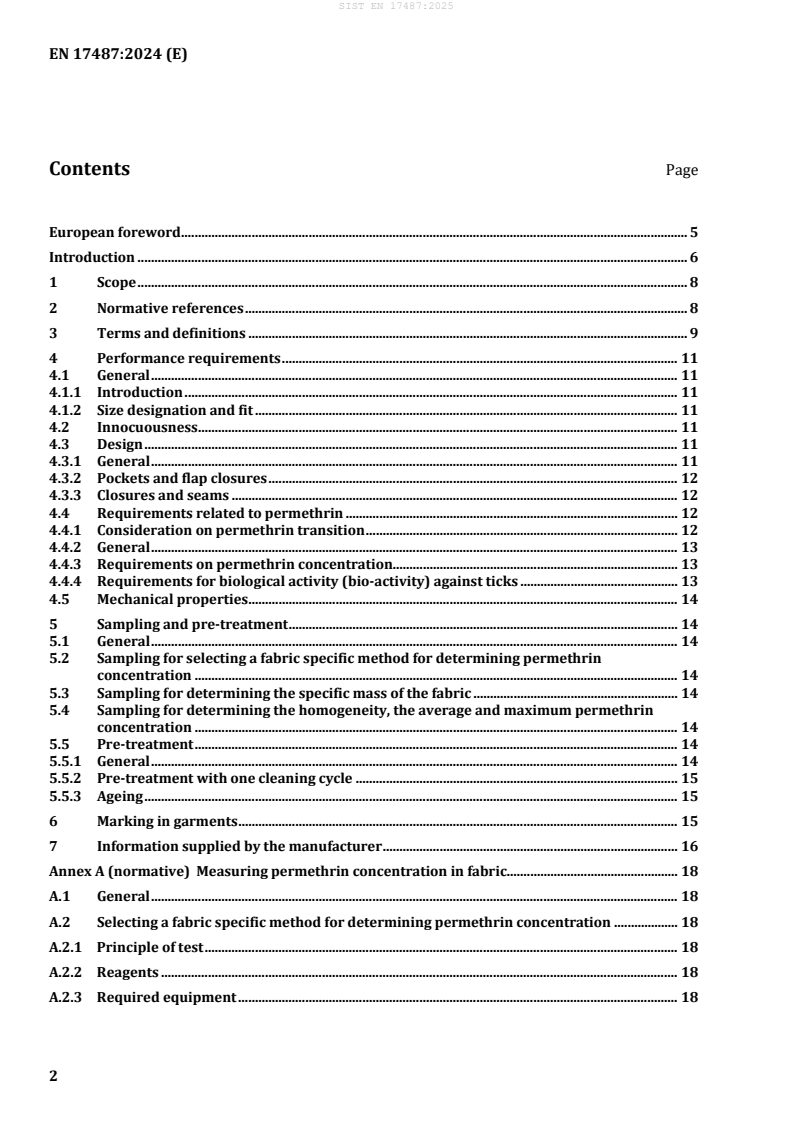
Contents Page
European foreword . 5
Introduction . 6
1 Scope . 8
2 Normative references . 8
3 Terms and definitions . 9
4 Performance requirements . 11
4.1 General . 11
4.1.1 Introduction . 11
4.1.2 Size designation and fit . 11
4.2 Innocuousness . 11
4.3 Design . 11
4.3.1 General . 11
4.3.2 Pockets and flap closures . 12
4.3.3 Closures and seams . 12
4.4 Requirements related to permethrin . 12
4.4.1 Consideration on permethrin transition . 12
4.4.2 General . 13
4.4.3 Requirements on permethrin concentration. 13
4.4.4 Requirements for biological activity (bio-activity) against ticks . 13
4.5 Mechanical properties . 14
5 Sampling and pre-treatment . 14
5.1 General . 14
5.2 Sampling for selecting a fabric specific method for determining permethrin
concentration . 14
5.3 Sampling for determining the specific mass of the fabric . 14
5.4 Sampling for determining the homogeneity, the average and maximum permethrin
concentration . 14
5.5 Pre-treatment . 14
5.5.1 General . 14
5.5.2 Pre-treatment with one cleaning cycle . 15
5.5.3 Ageing . 15
6 Marking in garments . 15
7 Information supplied by the manufacturer . 16
Annex A (normative) Measuring permethrin concentration in fabric. 18
A.1 General . 18
A.2 Selecting a fabric specific method for determining permethrin concentration . 18
A.2.1 Principle of test . 18
A.2.2 Reagents . 18
A.2.3 Required equipment . 18
A.2.4 Sample preparation . 18
A.2.5 Testing procedure . 18
A.2.6 Calculation and expression of results . 19
A.2.7 Reported values . 19
A.3 Determining the specific mass . 19
A.4 Determining the homogeneity, the average, and the maximum permethrin
concentration . 19
A.4.1 Principle of test . 19
A.4.2 Reagents . 19
A.4.3 Required equipment . 19
A.4.4 Test specimen preparation . 19
A.4.5 Testing procedure . 19
A.4.6 Calculation and expression of results . 19
A.4.7 Reported values . 20
A.5 Test report . 20
Annex B (normative) Bio-activity testing, activity of the permethrin in the fabric against
ticks. 21
Annex C (informative) Rationale . 22
C.1 Why permethrin? . 22
C.2 Why use body covering garments that are industrially treated with permethrin? . 22
C.3 Why is standardization needed for body covering garments with permethrin? . 23
C.4 What is known about the uptake of permethrin in the body and the effects of
permethrin on human health? . 23
C.4.1 General . 23
C.4.2 How does the body absorb permethrin? . 23
C.4.3 Is permethrin a CMR (carcinogenic, mutagenic or reprotoxic) substance? Is it, for
example, carcinogenic?. 24
C.4.4 Can allergic reactions occur? Are any allergic reactions known? . 24
C.4.5 Can chemicals in the textile be hazardous to health? . 24
C.4.6 Have the health of wearers of the garment and the possible long-term effects on
their health been studied? . 25
C.4.7 Are there any high-risk groups for permethrin? . 25
C.5 Risks other than permethrin . 26
C.6 How to achieve optimal protection? . 26
C.7 Washing and drying conditions for users of the garments . 26
C.8 Additional remarks on labelling . 26
C.9 Justification of test choices . 27
C.9.1 General . 27
C.9.2 Tests on permethrin concentration . 27
C.9.3 Tests on bio-activity against ticks . 27
C.9.4 User safety . 27
Annex D (informative) Evaluation of the transition of permethrin using a method based on
friction on the fabric surface . 28
D.1 General . 28
D.2 Principle of test . 28
D.3 Apparatus and materials . 28
D.4 Auxiliary materials . 28
D.5 Reagents . 29
D.6 Sampling and preparation of test specimens . 29
D.6.1 General . 29
D.6.2 Dimensions of specimens and auxiliary materials . 29
D.7 Preparation of the sweat solution . 29
D.8 Impregnation of the abradant with sweat solution . 30
D.9 Preparation of the abrasion machine . 30
D.10 Sample preparation and analysis . 30
D.10.1 Extraction of abradant . 30
D.10.2 GC-MS Determination . 30
D.11 Test report . 32
Annex ZA (informative) Relationship between this European Standard and the essential
requirements of Regulation (EU) 2016/425 aimed to be covered . 33
Bibliography . 35
European foreword
This document (EN 17487:2024) has been prepared by Technical Committee CEN/TC 162 “Protective
clothing including hand and arm protection and lifejackets”, the secretariat of which is held by DIN.
This European Standard shall be given the status of a national standard, either by publication of an
identical text or by endorsement, at the latest by June 2025, and conflicting national standards shall be
withdrawn at the latest by June 2025.
Attention is drawn to the possibility that some of the elements of this document may be the subject of
patent rights. CEN shall not be held responsible for identifying any or all such patent rights.
This document has been prepared under a standardization request addressed to CEN by the European
Commission. The Standing Committee of the EFTA States subsequently approves these requests for its
Member States.
For the relationship with EU Legislation, see informative Annex ZA, which is an integral part of this
document.
Any feedback and questions on this document should be directed to the users’ national standards body.
A complete listing of these bodies can be found on the CEN website.
According to the CEN-CENELEC Internal Regulations, the national standards organisations of the
following countries are bound to implement this European Standard: Austria, Belgium, Bulgaria, Croatia,
Cyprus, Czech Republic, Denmark, Estonia, Finland, France, Germany, Greece, Hungary, Iceland, Ireland,
Italy, Latvia, Lithuania, Luxembourg, Malta, Netherlands, Norway, Poland, Portugal, Republic of North
Macedonia, Romania, Serbia, Slovakia, Slovenia, Spain, Sweden, Switzerland, Türkiye and the United
Kingdom.
Introduction
By preventing tick bites, a range of tick-borne infectious diseases can be prevented. This document refers
to protection against all biting stages of the tick Ixodes ricinus, hereafter named wood tick, the tick species
with the largest occupational and public health relevance in Europe.
The most prevalent disease transmitted by the wood tick is Lyme borreliosis, but (until now incidentally)
also other diseases like tick-borne encephalitis. Lyme borreliosis can affect the skin, nervous system,
joints and heart. In some EU countries, Lyme borreliosis is regarded as an occupational disease.
Employers are then obliged to make the best possible effort to prevent occupational diseases among
employees. Employees are also obliged to reasonably abide by the measures offered.
The garments help protect people who can come into contact with ticks during their work. Wood ticks
lay in ambush in the lower vegetation and cling on to passers-by with whom they come in to contact. They
then crawl over skin or garment to find a site where they can consume a blood meal. The protective effect
of the garment against tick bites is primarily determined by the extent to which the garment covers the
skin, and this effect will increase as a larger part of the body is covered. It is important here that those
body parts (legs, waist, torso and arms) are covered that have contact with vegetation in which ticks can
be present (up to a height of 1,5 m). When wearing covering garments without permethrin, ticks are able
to crawl over the fabric for minutes up to several hours and reach bare skin to bite. In addition to the
protective effect of covering the body, the permethrin on or in the fabric offers extra protection. Ticks
that come in contact with permethrin are immobilized, and as a result they are no longer able to reach
bare skin and transfer pathogens through a bite. Protection against tick bites can be one of the functions
of a garment. Examples of other functions can be maintaining body heat, preventing exposure to UV light,
camouflage, preventing skin irritation or injury by plants or working conditions, or representation and
recognizability.
The body covering garments can also help other target groups such as volunteers and recreationists (such
as hunters) to offer protection against tick bites. However, the choice of using the garments is ideally
based on a professional risk assessment which includes exposure to ticks, and factors such as age and
pregnancy. Instructions for use and warnings for tick bite risks also apply to these users and it is
important that these are provided to these groups by the manufacturers of these garments.
The body covering garment industrially treated with permethrin or made with fabrics based on yarn
containing permethrin yarns, or other treated fabrics, can also help to protect against other arthropods
[6]
that can transmit diseases, such as different tick and mosquito species . However, this document only
applies to the protection against bites by the wood tick, and specifically the most relevant developmental
stage (nymphs). A detailed description of the requirements is given in Clause 4 of this document.
Garments can be treated with permethrin to prevent tick bites. In accordance with the Biocidal Products
Regulation (EU) 528/2012, such garments can be regarded either as ‘treated articles’ (if protection
against ticks is part of a set of functionalities such as protection against weather conditions, camouflage,
company representation, protection against stinging plants, etc.) or as ‘biocides’ (if the primary function
of the garment is protection against tick bites). This document is only focusing on garments to be
[3]
considered as treated articles .
The release rate of permethrin from the garment should be as minimal as possible in order protect the
environment and the human health, and is for example dependent on the way the permethrin has been
fixated on- or inside the fabric. The World Health Organization (WHO) states limits to the daily uptake of
permethrin by the human body. This document states requirements to ensure that these limits will not
be exceeded by wearing the protective garments and to safeguard that the additional protective effect of
the permethrin is maintained throughout the lifetime of the garment. Additional general information can
be found in Annex C. The importance of the manufacturers cleaning instructions to prevent early
deterioration of the effect of permethrin treatment is stressed throughout the document.
National requirements can be in place in different countries for the maximum permethrin concentration
in consumer products. Collection of relevant data can be helpful for a further assessment for conformity
of garments based on this document to those national requirements.
1 Scope
This document specifies requirements for garments that support the protection against tick bites. The
document applies to body covering garments (at least covering the torso, arms and legs) where
protection against tick bites, which is provided by garments as physical barriers, is reinforced by
industrial treatment with the biocide permethrin of the fabrics, fibres or yarns prior to confection. The
specified requirements focus on prevention of bites by the nymph stage of the tick Ixodes ricinus, which
is the most relevant stage and species for public and occupational health in Europe.
This document specifies requirements and the tests for garments containing permethrin to provide
sufficient assistance in protection against tick bites, and to be durable and safe for the user.
This document does not apply to garments which are re-treated with permethrin or other substances
after they are put on the market.
NOTE Non-permethrin containing garments covering the torso, arms and legs and feet offer some protection
against tick bites, but are insufficient under high exposure to ticks, which can crawl over the fabric to reach bare
skin and bite. Garments that comply with this document and cover at least torso, arms and legs to counter ticks from
crawling over the fabric to reach bare skin and bite thereby provide substantial protection.
2 Normative references
The following documents are referred to in the text in such a way that some or all of their content
constitutes requirements of this document. For dated references, only the edition cited applies. For
undated references, the latest edition of the referenced document (including any amendments) applies.
EN ISO 139:2005, Textiles - Standard atmospheres for conditioning and testing
EN ISO 13688:2013, Protective clothing — General requirements (ISO 13688:2013)
EN ISO 13934-1:2013, Textiles - Tensile properties of fabrics - Part 1: Determination of maximum force and
elongation at maximum force using the strip method (ISO 13934-1:2013)
EN ISO 13935-2:2014, Textiles - Seam tensile properties of fabrics and made-up textile articles - Part 2:
Determination of maximum force to seam rupture using the grab method (ISO 13935-2:2014)
EN ISO 13937-2:2000, Textiles - Tear properties of fabrics - Part 2: Determination of tear force of trouser-
shaped test specimens (Single tear method) (ISO 13937-2:2000)
EN ISO 13938-1:2019, Textiles - Bursting properties of fabrics - Part 1: Hydraulic method for determination
of bursting strength and bursting distension (ISO 13938-1:2019)
EN ISO 13938-2:2019, Textiles - Bursting properties of fabrics - Part 2: Pneumatic method for
determination of bursting strength and bursting distension (ISO 13938-2:2019)
ISO 3801:1977, Textiles — Woven fabrics — Determination of mass per unit length and mass per unit area
Document impacted by A1:2011.
Document impacted by A1:2021.
3 Terms and definitions
For the purposes of this document, the following terms and definitions apply.
ISO and IEC maintain terminological databases for use in standardization at the following addresses:
— IEC Electropedia: available at https://www.electropedia.org/
— ISO Online browsing platform: available at https://www.iso.org/obp
3.1
accepted daily intake
ADI
maximal allowed daily body intake of a substance (100 %) before adverse health effects can be expected
Note 1 to entry: In this document, the substance is permethrin.
Note 2 to entry: Based on the definition of the World Health Organization (WHO).
3.2
permethrin bio-activity
degree to which permethrin in the test fabric affects the test animals that came into contact with the fabric
in the test assay
Note 1 to entry: This value is determined by the degree to which the animal comes into contact with permethrin.
Note 2 to entry: Bio-activity is not by definition determined by the permethrin concentration in a fabric. It is
determined by the availability of permethrin present at contact surfaces of the fabric.
3.3
biocidal product
— any substance or mixture which, in the form in which it is supplied to the user, consists of, contains
or generates one or more active substances, with the purpose of destroying, deterring, rendering
harmless, preventing the action of, or otherwise exerting a controlling effect on a harmful organism by
any means other than mere physical or mechanical action
— any substance or mixture, generated from substances or mixtures which do not themselves fall under
the first indent, to be used with the intention of destroying, deterring, rendering harmless, preventing the
action of, or otherwise exerting a controlling effect on, any harmful organism by any means other than
mere physical or mechanical action
Note 1 to entry: The garments considered in this document are treated articles. A treated article that has a
primary biocidal function shall be considered a biocidal product. According to the definitions set by the EU, products
treated with permethrin can be considered as biocidal products or treated articles. This consideration could differ
per product and depends on the primary function of the product. If the product is primarily intended to control
harmful organisms or to prevent harmful effects, then the product is considered a biocide. If the biocidal effect
through treatment with permethrin is only an additional property to the basic function(s) of the product, such
[2]
product / object can be regarded as treated article .
[SOURCE: 528/2012 EU regarding biocidal products regulation, 2018-06-15]
3.4
cytotoxicity
effect of one or more components in a substance on growth of living cells in a cell culture
3.5
sensitization
effect of one or more components in a substance on expression of specific membrane proteins of cells in
a cell culture
3.6
knock-down time
time between first contact of the test animal with the permethrin-containing fabric, until the inability of
the test animal to move (immobilisation)
3.7
permethrin
approved active substance based on synthetic pyrethroïd variant 25:75 cis:trans isomere ratio, non-
racemic with CAS number 52645–53–1
3.8
permethrin migration rate
velocity of permethrin molecules migrating through a substrate
3.9
treated article
any substance, mixture or article that has been treated with, or intentionally incorporates, one or more
biocides
[SOURCE: EU 528/2012 regarding biocidal products regulation, Article 3, sub-Clause 1.a]
3.10
industrially treated
treatment procedure by which fibres, yarns and /or fabrics are treated during production with
permethrin on a large and mechanised scale before confection
3.11
permethrin containing yarn
yarn that contains fibres with permethrin either at the outside surface or incorporated inside the fibre
(for example by encapsulation)
3.12
partial body protection
protective garment item worn to protect one or more parts of the body, which are particularly exposed
to the risk
Note 1 to entry: Partial body protection can be used separately (for protection of specific parts of the body during
specific activities) or in combination with other garments treated with permethrin to increase the general
protection level of parts of the body. Examples of partial body protection are sleeves and gaiters. Separate partial
body protection items do not protect sufficiently in situations where torso, arms and/or legs need to be protected
in full.
4 Performance requirements
4.1 General
4.1.1 Introduction
This clause covers the health, technical and maintenance requirements for permethrin containing
garments that help to protect against tick bites.
This document is to be applied in conjunction with EN ISO 13688:2013.
The number of test specimens detailed in each requirement of this document shall be tested. In the event
that only one specimen fails, another set of specimens shall be tested. If compliant results are obtained
for the repeat test, then the sample will be deemed to meet the requirements. Otherwise, the sample is
considered to have failed the requirement and no further repeat testing shall be performed.
If a material exhibits differing behaviour for a property in the length and cross directions of the material,
the resultant property value shall be the value obtained in the lesser performing direction.
4.1.2 Size designation and fit
Garment sizes shall be in accordance with the requirements of EN ISO 13688:2013.
Where protection to the requirements of this document is provided by an outer two-piece suit, it shall be
determined that, when correctly sized for the wearer, an overlap between the jacket and trousers remains
when one standing wearer firstly fully extends both arms above the head and then bends over until the
fingertips touch the ground.
Conformity shall be checked by visual inspection including an assessment of fit and physical measuring
when the appropriate size of the garment is donned by a wearer. In addition, the wrists, lower arms, and
ankles shall also remain covered in an upright position; this shall also apply to one-piece suits.
Similar overlap requirements apply for other combinations of garments with the intention to keep the
skin of the wearer covered during all activities of his/her profession.
These requirements need to be covered in the manufacturer instructions and/or garment labels.
4.2 Innocuousness
In accordance with EN ISO 13688:2013, garment manufacturers shall ensure that traces of any substance
remaining in the garment fabric are not harmful to the health of the wearer.
Other chemicals and/or binder systems are often required for incorporation of permethrin into the fabric.
These compounds should not affect the health or hygiene of the user.
4.3 Design
4.3.1 General
Specifically, regarding the protective effect of permethrin in preventing ticks to reach bare skin to bite,
the following requirements are formulated:
a) The permethrin-free surface shall not be no more than 0,3 m and shall not be placed within 5 cm
around the openings of a garment.
NOTE Applications such as reflective striping (in accordance with EN ISO 20471:2013), name badges, etc. are
examples of permethrin-free surfaces which could affect the preventive function of the garment.
b) Trousers shall have long trouser legs, where coverage of underlying skin or other garments at the
openings at the end of the trouser-legs and the waist shall be retained during movement as described
in 4.1.
c) The upper body garment shall have long sleeves. Coverage of the underlying skin or other garment
at sleeve and waist openings shall be retained during movement as described in 4.1.2.
d) Partial body protection may be used separately or in combination with other garments to increase
the protection level of specific parts of the body.
EXAMPLE Gaiters.
4.3.2 Pockets and flap closures
Where garments are constructed with pockets, the pockets shall be constructed to the following design:
a) external opening pockets including pass-through openings shall have a covering flap except for:
— side pockets below the waist which do not extend more than 10° forward of the side seam;
— a single rule pocket with an opening not greater than 75 mm placed behind the side seam on one
or both legs and measured flat;
b) all flaps shall be at least 20 mm wider than the opening (at least 10 mm on each side) to prevent the
flap from being tucked into the pocket. They shall be stitched down on each side or capable of
covering the pocket opening by fastening. Flap materials shall made from permethrin containing
fabric. Conformity shall be checked by visual inspection and physical measurement.
These requirements need to be covered in the manufacturer instructions and/or garment labels.
4.3.3 Closures and seams
Closures shall be designed with a protective cover flap on the outside of the garment. The maximum
distance between buttonholes/press studs shall be 150 mm. If zippers are used, the slide fastener shall
be designed to lock when completely closed. Cuffs can be provided with closures to reduce their width.
The closure and any fold which it creates shall be on the underside of the cuff. Cuffs shall not have turn-
ups.
Neck openings shall be provided with closures.
Trousers or one-piece suits shall not have turn-ups. They can have side slits which shall have a means of
closure and the slit and closure shall be covered.
Conformity shall be checked by visual inspection. These requirements need to be covered in the
manufacturer instructions and/or garment labels.
4.4 Requirements related to permethrin
4.4.1 Consideration on permethrin transition
To ensure that the wearer of the garments is not exposed to doses exceeding the ADI of permethrin, a
maximum permethrin concentration has been set in 4.4.3, and a minimum permethrin concentration has
been set indirectly by the bio-activity performance requirement in 4.4.4. The bio-activity is determined
as an indicator how well the permethrin is fixated on or inside the fabric. An informative annex (Annex D)
specifies a concept methodology (to be further explored) for further approximation of permethrin
transition onto the skin.
NOTE 1 The ADI of permethrin has been determined by the WHO based on scientific research. The permethrin
[5]
ADI is (0 to 0,05) mg per kg body mass . If this 100 % -ADI is not exceeded, adverse health effects are not to be
expected. Several studies have led to an estimate of the percentage of permethrin that is transferred from the textile
to the skin: the transfer factor is seen to be 0,5 to 1 %; estimates for absorption (dermal uptake of the permethrin
[14], [15], [16], [17]
into the body via the skin) from 2 % up to 5,7 % .If the requirements in this document are met, it is
expected that 20 % -ADI is not exceeded during common professional use of the garments when covering the lower
[4]
and upper body (torso, arms and legs) during an 8-h working day .
NOTE 2 Garments made of industrially permethrin-treated fabrics have been tested in different setups involving
military personnel, forest workers. No adverse effects were monitored in the test-group wearing the treated
[6]
garments under normal temperate conditions . Some minor impairments mainly involving the skin were observed
in a similar experiment in a tropical region. Confounding factors, such as permethrin exposure by fogging and
[6]
spraying operations during deployment could however not be entirely excluded . A recent assessment also
[7]
concluded that a sensitizing effect of permethrin in humans is unlikely .
4.4.2 General
The garment shall be constructed with fabric containing permethrin.
4.4.3 Requirements on permethrin concentration
The active substance shall be: permethrin [m-phenoxylbenzyl 3-(2,2-dichlorovinyl)-2,2-dimethyl-
cyclopropanecarboxylate], CAS No. 52645-53-1. The cis:trans isomere ratio of the permethrin shall be
25:75.
[1]
NOTE 1 The suppliers of the active substance, permethrin, are included in the Article 95 list of ECHA , which is
updated on regular basis.
The average permethrin concentration on or inside the fabric of the garment shall not exceed
1 250 mg/m fabric after pre-treatment (5.5.2), and then, tested and calculated in accordance to A.4.
The maximum permethrin concentration on or inside the fabric of the garment shall not exceed
1 500 mg/m fabric after pre-treatment (5.5.2), and then, tested and calculated in accordance to A.4.
NOTE 2 These limits represent the average and maximum initial permethrin concentration respectively before
the first use.
Permethrin shall be homogeneously distributed over or inside the fabric of the garment. The
homogeneity shall not vary more than 20 % as tested and calculated in A.4.
NOTE 3 National requirements can be in place in different countries for the maximum permethrin concentration
in consumer products. Collection of relevant data can be helpful for a further assessment for conformity of garments
based on this document to those national requirements.
NOTE 4 Inhomogeneity could result in ticks moving towards and residing on areas of the garment with lower
permethrin concentration, thereby increasing tick-bite risk.
4.4.4 Requirements for biological activity (bio-activity) against ticks
In order to ensure the additional protective effect of the garment for the prevention of tick bites, the
average knock-down time for fabric(s) of the garment shall be less than or equal to 27,1 min as
determined on one test specimen by the assay described in Annex B after pre-treatment (5.5.2) and
ageing (5.5.3).
[12]
NOTE 1 The value 27,1 min has been selected based on the US criteria .
NOTE 2 Biological activity against ticks is represented by the 'knock-down' (KD) time experienced by nymphs of
the sheep tick Ixodes ricinus after contact with the treated fabric. The nymph stage is a good representative for all
active stages (larvae, nymphs and adult ticks). In addition, nymphs provide the most consistent test results, are
easier to collect and most often cause Lyme disease in humans.
4.5 Mechanical properties
Testing for fabric strength shall be performed on the fabric of the garment after ageing (5.5.3).
Tensile strength: using five specimens in the machine direction and five in the cross direction when tested
in accordance with EN ISO 13934-1:2013, the woven outer materials shall have a minimum tensile
strength of 250 N in both the machine and cross directions.
Tear strength: using five specimens in the machine direction and five in the cross direction when tested
in accordance with EN ISO 13937-2:2000, the woven outer materials shall have a minimum tear strength
of 20 N in both the machine and cross directions.
Burst strength of knitted materials and seams: using five specimens when tested in accordance with
EN ISO 13938-1:2019 or EN ISO 13938-2:2019, the knitted outer materials and structural seams in
knitted materials shall have a minimum burst strength of 100 kPa, when using 50 cm test area, or
200 kPa, when using a 7,3 cm test area.
Seam strength: when tested in accordance with EN ISO 13935-2:2014, five specimens of structural seams
of woven outer materials of the garment assembly, shall have a minimum seam strength of 225 N.
5 Sampling and pre-treatment
5.1 General
The size of the specimens subjected to the different test methods shall be in accordance with the
respective test standards specified in the requirements of Clause 4. Samples for testing shall be taken
from the original garment or shall be representative of the component assembly, as used in the finished
garment.
5.2 Sampling for selecting a fabric specific method for determining permethrin
concentration
A representative sample of permethrin containing fabric of the garment is taken for selecting the fabric
specific method, as described in A.2.
5.3 Sampling for determining the specific mass of the fabric
A representative sample of permethrin containing fabric is taken for determining the specific mass of the
fabric in kg/m , as described in A.3.
5.4 Sampling for determining the homogeneity, the average and maximum permethrin
concentration
Representative samples of permethrin conta
...