

EN 15767-3:2010
(Main)Portable equipment for projecting extinguishing agents supplied by fire fighting pumps - Portable monitors - Part 3: Foam devices
- Abstract
1.1 In addition to the requirements given in EN 15767-1, this part of this European standard applies to devices designed for aspirating air and projecting low expansion foam and, in some cases, inducting foam concentrate. It specifies requirements for safety, performance, classification and designation, as well as test methods, instructions for use and maintenance and marking.
1.2 This European Standard is only applicable to foam devices which are manufactured after its date of publication.
- Status
- Published
- Publication Date
- 07-Sep-2010
- Withdrawal Date
- 30-Mar-2011
- Technical Committee
- CEN/TC 192 - Fire service equipment
- Drafting Committee
- CEN/TC 192/WG 8 - Hand-held branchpipes for fire service use
- Current Stage
- 9092 - Decision on results of review/2YR ENQ - revise - Review Enquiry
- Start Date
- 01-Oct-2024
- Completion Date
- 07-Oct-2026

Overview
EN 15767-3:2010 is the CEN European standard that specifies requirements for portable foam devices used with fire fighting pumps. As Part 3 of the EN 15767 series, it covers devices designed to aspirate air and project low-expansion foam, and in some cases to induct foam concentrate. The standard sets rules for safety, performance, classification, designation, test methods, user/maintenance instructions and marking. It applies only to foam devices manufactured after the publication date.
Key topics and technical requirements
- Scope: Foam devices for low-expansion foam projection and optional concentrate induction; complements EN 15767‑1 (general requirements).
- Hydraulic characteristics
- Reference pressure (pR): 6 ± 0.1 bar (used for flow measurements and tests).
- Nominal pressure (pN): 16 bar.
- Flowrate measurement tolerance: indicated flowrates at pR shall be within −0 / +10% of the setting.
- Effective throw: minimum effective throw required for flowrate positions above 500 l/min (see standard charts).
- Spray angle: self-inducting nozzles must have a spray angle ≥ 100°.
- Mechanical & ergonomic
- Maximum mass limits tied to Qmax (e.g., up to 4 kg for Qmax <2 000 l/min; higher bands for larger flows).
- Maximum operating torques: levers 20 N·m, valve handles and rotating elements 15 N·m (up to nominal pressure).
- Clear marking for flow and jet adjustment positions.
- Materials and durability
- Devices must pass heat (24 h at 55 ± 2 °C) and frost (drain and −15 ± 2 °C for 30 min) sensitivity tests.
- Test methods
- Jet spray angle, flow and throw, and environmental tests performed with water (Annex A notes foam concentrate influences performance).
- Measurement conditions specified (e.g., nozzle 1.5 m above ground, wind < 2 m/s; throw measured at 30° inclination).
- Documentation & marking
- Each unit must include an instruction and maintenance handbook, datasheet (Annex C), and permanent marking: manufacturer ID, serial/batch & year, reference to EN 15767-3, Qmax, pN, jet/flow positions, etc.
Practical applications and users
- Intended for: manufacturers of portable monitors and foam devices, test and certification laboratories, procurement teams in fire services, fire engineering specifiers, and maintenance organizations.
- Use cases:
- Selection and procurement of portable foam monitors for municipal, industrial or marine firefighting.
- Factory and acceptance testing to verify flowrates, throw, spray angle and environmental resilience.
- Preparing user manuals, maintenance routines and compliance documentation for CE/National standard conformity.
Related standards
- EN 15767-1:2009 - Portable monitors: General requirements for portable monitor assemblies
- EN 15767-2 - Portable monitors: Water nozzles
- EN 1568 series - Foam concentrates and definitions referenced for foam terms and expansion classes
EN 15767-3:2010 helps ensure portable foam devices meet repeatable performance, safety and documentation standards for reliable firefighting operations using low-expansion foam.
Relations
- Effective Date
- 28-Jan-2026
- Effective Date
- 28-Jan-2026
- Effective Date
- 12-Aug-2026
- Effective Date
- 09-Feb-2026
- Effective Date
- 09-Feb-2026
- Referred By
EN 14215:2013 - Textile floor coverings - Classification of machine-made pile rugs and runners - Effective Date
- 28-Jan-2026
- Referred By
EN 14215:2003 - Textile floor coverings - Classification of machine-made pile rugs and runners - Effective Date
- 28-Jan-2026
- Effective Date
- 28-Jan-2026
- Effective Date
- 28-Jan-2026
- Effective Date
- 28-Jan-2026
- Referred By
EN 14215:2018 - Textile floor coverings - Classification of machine-made rugs and runners - Effective Date
- 28-Jan-2026
- Effective Date
- 28-Jan-2026
- Effective Date
- 28-Jan-2026
- Effective Date
- 28-Jan-2026
- Effective Date
- 28-Jan-2026
Get Certified
Connect with accredited certification bodies for this standard

CIS Institut d.o.o.
Personal Protective Equipment (PPE) certification body. Notified Body NB-2890 for EU Regulation 2016/425 PPE.

Kiwa BDA Testing
Building and construction product certification.
Kmetijski inštitut Slovenije
Agricultural Institute of Slovenia. Soil testing, plant health, agricultural product analysis.
Sponsored listings
Frequently Asked Questions
EN 15767-3:2010 is a standard published by the European Committee for Standardization (CEN). Its full title is "Portable equipment for projecting extinguishing agents supplied by fire fighting pumps - Portable monitors - Part 3: Foam devices". This standard covers: 1.1 In addition to the requirements given in EN 15767-1, this part of this European standard applies to devices designed for aspirating air and projecting low expansion foam and, in some cases, inducting foam concentrate. It specifies requirements for safety, performance, classification and designation, as well as test methods, instructions for use and maintenance and marking. 1.2 This European Standard is only applicable to foam devices which are manufactured after its date of publication.
1.1 In addition to the requirements given in EN 15767-1, this part of this European standard applies to devices designed for aspirating air and projecting low expansion foam and, in some cases, inducting foam concentrate. It specifies requirements for safety, performance, classification and designation, as well as test methods, instructions for use and maintenance and marking. 1.2 This European Standard is only applicable to foam devices which are manufactured after its date of publication.
EN 15767-3:2010 is classified under the following ICS (International Classification for Standards) categories: 13.220.10 - Fire-fighting. The ICS classification helps identify the subject area and facilitates finding related standards.
EN 15767-3:2010 has the following relationships with other standards: It is inter standard links to EN 15767-1:2009, EN 15767-2:2009, EN 15767-1:2026, EN 60312-1:2017, EN 60312-1:2013, EN 14215:2013, EN 14215:2003, EN 15398:2020, EN 15330-1:2013, EN 13297:2007, EN 14215:2018, EN 1307:2008, EN 1307:2014, EN 1307:2014+A1:2016, EN 15330-1:2007. Understanding these relationships helps ensure you are using the most current and applicable version of the standard.
EN 15767-3:2010 is available in PDF format for immediate download after purchase. The document can be added to your cart and obtained through the secure checkout process. Digital delivery ensures instant access to the complete standard document.
Standards Content (Sample)
2003-01.Slovenski inštitut za standardizacijo. Razmnoževanje celote ali delov tega standarda ni dovoljeno.Tragbare Geräte zum Ausbringen von Löschmitteln, welche mit Feuerlöschpumpen gefördert werden - Tragbare Werfer - Teil 3: SchaumdüsenEquipement portable de projection d’agents d’extinction alimenté par des pompes à usage incendie - Lances-canon portables - Partie 3: Dispositifs pour la moussePortable equipment for projecting extinguishing agents supplied by fire fighting pumps - Portable monitors - Part 3: Foam devices13.220.10Gašenje požaraFire-fightingICS:Ta slovenski standard je istoveten z:EN 15767-3:2010SIST EN 15767-3:2011en,fr,de01-januar-2011SIST EN 15767-3:2011SLOVENSKI
STANDARD
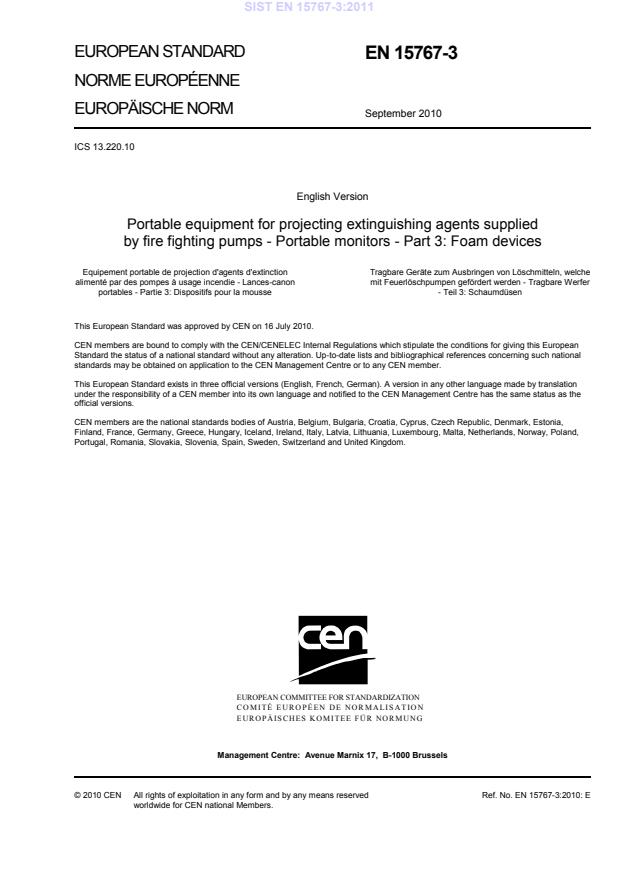
EUROPEAN STANDARD NORME EUROPÉENNE EUROPÄISCHE NORM
EN 15767-3
September 2010 ICS 13.220.10 English Version
Portable equipment for projecting extinguishing agents supplied by fire fighting pumps - Portable monitors - Part 3: Foam devices Equipement portable de projection d'agents d'extinction alimenté par des pompes à usage incendie - Lances-canon portables - Partie 3: Dispositifs pour la mousse
Tragbare Geräte zum Ausbringen von Löschmitteln, welche mit Feuerlöschpumpen gefördert werden - Tragbare Werfer - Teil 3: Schaumdüsen This European Standard was approved by CEN on 16 July 2010.
CEN members are bound to comply with the CEN/CENELEC Internal Regulations which stipulate the conditions for giving this European Standard the status of a national standard without any alteration. Up-to-date lists and bibliographical references concerning such national standards may be obtained on application to the CEN Management Centre or to any CEN member.
This European Standard exists in three official versions (English, French, German). A version in any other language made by translation under the responsibility of a CEN member into its own language and notified to the CEN Management Centre has the same status as the official versions.
CEN members are the national standards bodies of Austria, Belgium, Bulgaria, Croatia, Cyprus, Czech Republic, Denmark, Estonia, Finland, France, Germany, Greece, Hungary, Iceland, Ireland, Italy, Latvia, Lithuania, Luxembourg, Malta, Netherlands, Norway, Poland, Portugal, Romania, Slovakia, Slovenia, Spain, Sweden, Switzerland and United Kingdom.
EUROPEAN COMMITTEE FOR STANDARDIZATION
COMITÉ EUROPÉEN DE NORMALISATION EUROPÄISCHES KOMITEE FÜR NORMUNG
Management Centre:
Avenue Marnix 17,
B-1000 Brussels © 2010 CEN All rights of exploitation in any form and by any means reserved worldwide for CEN national Members. Ref. No. EN 15767-3:2010: ESIST EN 15767-3:2011
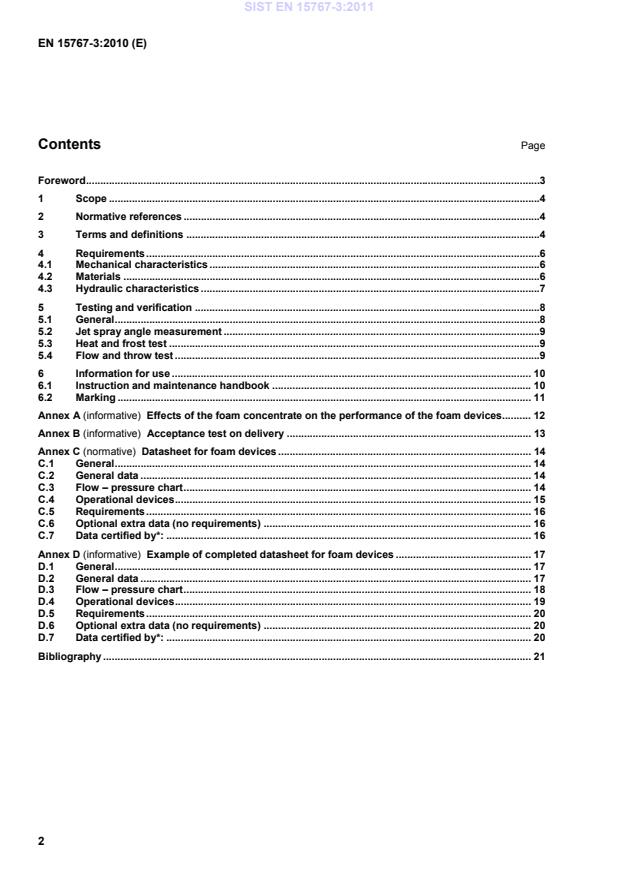
Effects of the foam concentrate on the performance of the foam devices. 12Annex B (informative)
Acceptance test on delivery . 13Annex C (normative)
Datasheet for foam devices . 14C.1 General . 14C.2 General data . 14C.3 Flow – pressure chart . 14C.4 Operational devices . 15C.5 Requirements . 16C.6 Optional extra data (no requirements) . 16C.7 Data certified by*: . 16Annex D (informative)
Example of completed datasheet for foam devices . 17D.1 General . 17D.2 General data . 17D.3 Flow – pressure chart . 18D.4 Operational devices . 19D.5 Requirements . 20D.6 Optional extra data (no requirements) . 20D.7 Data certified by*: . 20Bibliography . 21 SIST EN 15767-3:2011
Part 2: Water nozzles 3 Terms and definitions For the purposes of this document, the terms and definitions given in EN 15767-1:2009 and the following apply. 3.1 foam concentrate liquid which is diluted with water to produce foam solution [EN 1568-1:2008, 3.7] 3.2 foam solution solution of foam concentrate in water [EN 1568-1:2008, 3.8] 3.3 foam device device designed for aspirating air and projecting foam and, in some cases, inducting foam concentrate NOTE Several types of foam devices are described from 3.3.1 to 3.3.4. 3.3.1 foam cannon device that transforms the foam solution pressure into velocity and mixes air with the foam solution to produce a coherent stream of firefighting foam in a tube 3.3.2 self-inducting n
...