

EN 17272:2020/FprA1
(Amendment)Chemical disinfectants and antiseptics - Methods of airborne room disinfection by automated process - Determination of bactericidal, mycobactericidal, sporicidal, fungicidal, yeasticidal, virucidal and phagocidal activities
- Abstract
The test methods described are designed to determine the disinfectant activity of processes used in the 1) medical area, 2) veterinary area, 3) food, industrial, domestic and institutional area using automated processes for distributing chemicals by air diffusion with no operator manually applying the disinfectant. This document covers the disinfection of nonporous surfaces but not that of the air.
The objective of the described processes is to disinfect the surfaces of the overall area including the external surfaces of the equipment contained in such rooms. Air handling and products or processes specifically designed for the disinfection of medical devices are excluded from the scope of this document. The test methods and volumes described provide a defined challenge.
This document is applicable to processes for which activity is claimed against the following groups of microorganisms:
— vegetative bacteria,
— mycobacteria,
— bacterial spores,
— yeasts,
— fungal spores,
— viruses,
— bacteriophages.
This document does not cover processes for which the mode of action is based on immersing and/or circulation, flooding, spraying, wiping or other processes where the product is directly applied to the surfaces and not via air dispersion.
- Status
- Not Published
- Publication Date
- 04-May-2025
- Technical Committee
- CEN/TC 216 - Chemical disinfectants and antiseptics
- Drafting Committee
- CEN/TC 216 - Chemical disinfectants and antiseptics
- Current Stage
- 5060 - Closure of Vote - Formal Approval
- Start Date
- 06-Mar-2025
- Due Date
- 26-Sep-2024
- Completion Date
- 06-Mar-2025

Overview
EN 17272:2020/FprA1 is a CEN standard (amendment prA1) that defines test methods for airborne room disinfection by automated processes. It applies to procedures that distribute chemical disinfectants by air diffusion without manual surface application. The standard is intended to determine disinfectant activity on non-porous surfaces within rooms and equipment exteriors in a defined challenge environment. Air handling systems and products/processes designed specifically for medical device disinfection are excluded.
This amendment clarifies and updates the original EN 17272:2020 wording and structure. It preserves the technical scope while providing editorial and procedural refinements to aid consistent test execution and interpretation.
Key Topics
- Scope and exclusions: Applies to automated air-dispersed disinfectant processes for the medical, veterinary, food, industrial, domestic and institutional areas. Excludes direct application methods (immersion, flooding, spraying, wiping) and air-only disinfection claims.
- Objective: To assess the ability of automated airborne disinfection processes to inactivate microorganisms on non-porous surfaces and external equipment surfaces within a treated room.
- Microorganisms covered: Processes claiming activity against multiple groups are within scope, including:
- vegetative bacteria
- mycobacteria
- bacterial spores
- yeasts and fungal spores
- viruses
- bacteriophages
- Test framework: The document specifies standardized test methods and defined volumes/challenges to ensure reproducible measurement of bactericidal, mycobactericidal, sporicidal, fungicidal, yeasticidal, virucidal and phagocidal activity.
- Amendment focus: prA1 contains technical and editorial updates to clauses, annexes and figures to improve clarity and alignment with current laboratory practice.
Applications
EN 17272:2020/FprA1 is practical for organizations that design, validate or certify automated airborne disinfection systems and protocols. Typical applications include:
- Validation of room decontamination systems in healthcare facilities, including equipment exterior surfaces (not medical device internal disinfection)
- Performance evaluation for veterinary clinics, laboratories and animal housing
- Disinfection processes for food processing, industrial and institutional environments where airborne chemical dispersion is used
- Supporting claims for manufacturers of automated disinfection equipment and disinfectant formulations intended for air-dispersed use
Adoption of these standardized test methods supports regulatory compliance, consistent product claims, and robust evidence for microbial efficacy in realistic room-decontamination scenarios.
Related Standards
- Other CEN standards from Technical Committee CEN/TC 216 on chemical disinfectants and antiseptics
- National implementations and translations of EN 17272 and its amendments
For users, EN 17272:2020/prA1 provides a harmonized approach to assess automated airborne disinfection performance and enables consistent comparison across products and processes.
Relations
- Effective Date
- 17-Mar-2025
- Effective Date
- 17-Aug-2022
Get Certified
Connect with accredited certification bodies for this standard

BSI Group
BSI (British Standards Institution) is the business standards company that helps organizations make excellence a habit.

TÜV Rheinland
TÜV Rheinland is a leading international provider of technical services.

TÜV SÜD
TÜV SÜD is a trusted partner of choice for safety, security and sustainability solutions.
Sponsored listings
Frequently Asked Questions
EN 17272:2020/FprA1 is a draft published by the European Committee for Standardization (CEN). Its full title is "Chemical disinfectants and antiseptics - Methods of airborne room disinfection by automated process - Determination of bactericidal, mycobactericidal, sporicidal, fungicidal, yeasticidal, virucidal and phagocidal activities". This standard covers: The test methods described are designed to determine the disinfectant activity of processes used in the 1) medical area, 2) veterinary area, 3) food, industrial, domestic and institutional area using automated processes for distributing chemicals by air diffusion with no operator manually applying the disinfectant. This document covers the disinfection of nonporous surfaces but not that of the air. The objective of the described processes is to disinfect the surfaces of the overall area including the external surfaces of the equipment contained in such rooms. Air handling and products or processes specifically designed for the disinfection of medical devices are excluded from the scope of this document. The test methods and volumes described provide a defined challenge. This document is applicable to processes for which activity is claimed against the following groups of microorganisms: — vegetative bacteria, — mycobacteria, — bacterial spores, — yeasts, — fungal spores, — viruses, — bacteriophages. This document does not cover processes for which the mode of action is based on immersing and/or circulation, flooding, spraying, wiping or other processes where the product is directly applied to the surfaces and not via air dispersion.
The test methods described are designed to determine the disinfectant activity of processes used in the 1) medical area, 2) veterinary area, 3) food, industrial, domestic and institutional area using automated processes for distributing chemicals by air diffusion with no operator manually applying the disinfectant. This document covers the disinfection of nonporous surfaces but not that of the air. The objective of the described processes is to disinfect the surfaces of the overall area including the external surfaces of the equipment contained in such rooms. Air handling and products or processes specifically designed for the disinfection of medical devices are excluded from the scope of this document. The test methods and volumes described provide a defined challenge. This document is applicable to processes for which activity is claimed against the following groups of microorganisms: — vegetative bacteria, — mycobacteria, — bacterial spores, — yeasts, — fungal spores, — viruses, — bacteriophages. This document does not cover processes for which the mode of action is based on immersing and/or circulation, flooding, spraying, wiping or other processes where the product is directly applied to the surfaces and not via air dispersion.
EN 17272:2020/FprA1 is classified under the following ICS (International Classification for Standards) categories: 11.080.20 - Disinfectants and antiseptics; 71.100.35 - Chemicals for industrial and domestic disinfection purposes. The ICS classification helps identify the subject area and facilitates finding related standards.
EN 17272:2020/FprA1 has the following relationships with other standards: It is inter standard links to EN 17272:2020+A1:2025, EN 17272:2020. Understanding these relationships helps ensure you are using the most current and applicable version of the standard.
EN 17272:2020/FprA1 is available in PDF format for immediate download after purchase. The document can be added to your cart and obtained through the secure checkout process. Digital delivery ensures instant access to the complete standard document.
Standards Content (Sample)
SLOVENSKI STANDARD
SIST EN 17272:2020/oprA1:2023
01-december-2023
Kemična razkužila in antiseptiki - Metode za dezinfekcijo površin v prostorih z
delci v zraku z avtomatiziranim postopkom - Določevanje baktericidne,
mikobaktericidne, sporocidne, fungicidne, virucidne, tuberkulocidne in fagocidne
aktivnosti ter aktivnosti kvasovk - Dopolnilo A1
Chemical disinfectants and antiseptics - Methods of airborne room disinfection by
automated process - Determination of bactericidal, mycobactericidal, sporicidal,
fungicidal, yeasticidal, virucidal and phagocidal activities
Chemische Desinfektionsmittel und Antiseptika - Verfahren zur luftübertragenen
Raumdesinfektion durch automatisierte Verfahren - Bestimmung der bakteriziden,
mykobakteriziden, sporiziden, fungiziden, levuroziden, viruziden, tuberkuloziden, und
Phagen-Wirksamkeit
Antiseptiques et désinfectants chimiques - Méthodes de désinfection des pièces par voie
aérienne par des procédés automatisés - Détermination de l'activité bactéricide,
fongicide, levuricide, sporicide, tuberculocide, mycobactéricide, virucide et phagocid
Ta slovenski standard je istoveten z: EN 17272:2020/prA1
ICS:
11.080.20 Dezinfektanti in antiseptiki Disinfectants and antiseptics
71.100.35 Kemikalije za dezinfekcijo v Chemicals for industrial and
industriji in doma domestic disinfection
purposes
SIST EN 17272:2020/oprA1:2023 en,fr,de
2003-01.Slovenski inštitut za standardizacijo. Razmnoževanje celote ali delov tega standarda ni dovoljeno.
SIST EN 17272:2020/oprA1:2023
SIST EN 17272:2020/oprA1:2023
DRAFT
EUROPEAN STANDARD
EN 17272:2020
NORME EUROPÉENNE
EUROPÄISCHE NORM
prA1
November 2023
ICS
English Version
Chemical disinfectants and antiseptics - Methods of
airborne room disinfection by automated process -
Determination of bactericidal, mycobactericidal,
sporicidal, fungicidal, yeasticidal, virucidal and phagocidal
activities
Antiseptiques et désinfectants chimiques - Méthodes Chemische Desinfektionsmittel und Antiseptika -
de désinfection des pièces par voie aérienne par des Verfahren zur luftübertragenen Raumdesinfektion
procédés automatisés - Détermination de l'activité durch automatisierte Verfahren - Bestimmung der
bactéricide, fongicide, levuricide, sporicide, bakteriziden, mykobakteriziden, sporiziden,
tuberculocide, mycobactéricide, virucide et phagocid fungiziden, levuroziden, viruziden, tuberkuloziden, und
Phagen-Wirksamkeit
This draft amendment is submitted to CEN members for enquiry. It has been drawn up by the Technical Committee CEN/TC 216.
This draft amendment A1, if approved, will modify the European Standard EN 17272:2020. If this draft becomes an amendment,
CEN members are bound to comply with the CEN/CENELEC Internal Regulations which stipulate the conditions for inclusion of
this amendment into the relevant national standard without any alteration.
This draft amendment was established by CEN in three official versions (English, French, German). A version in any other
language made by translation under the responsibility of a CEN member into its own language and notified to the CEN-CENELEC
Management Centre has the same status as the official versions.
CEN members are the national standards bodies of Austria, Belgium, Bulgaria, Croatia, Cyprus, Czech Republic, Denmark, Estonia,
Finland, France, Germany, Greece, Hungary, Iceland, Ireland, Italy, Latvia, Lithuania, Luxembourg, Malta, Netherlands, Norway,
Poland, Portugal, Republic of North Macedonia, Romania, Serbia, Slovakia, Slovenia, Spain, Sweden, Switzerland, Türkiye and
United Kingdom.
Recipients of this draft are invited to submit, with their comments, notification of any relevant patent rights of which they are
aware and to provide supporting documentation.
Warning : This document is not a European Standard. It is distributed for review and comments. It is subject to change without
notice and shall not be referred to as a European Standard.
EUROPEAN COMMITTEE FOR STANDARDIZATION
COMITÉ EUROPÉEN DE NORMALISATION
EUROPÄISCHES KOMITEE FÜR NORMUNG
CEN-CENELEC Management Centre: Rue de la Science 23, B-1040 Brussels
© 2023 CEN All rights of exploitation in any form and by any means reserved Ref. No. EN 17272:2020/prA1:2023 E
worldwide for CEN national Members.
SIST EN 17272:2020/oprA1:2023
EN 17272:2020/prA1:2023 (E)
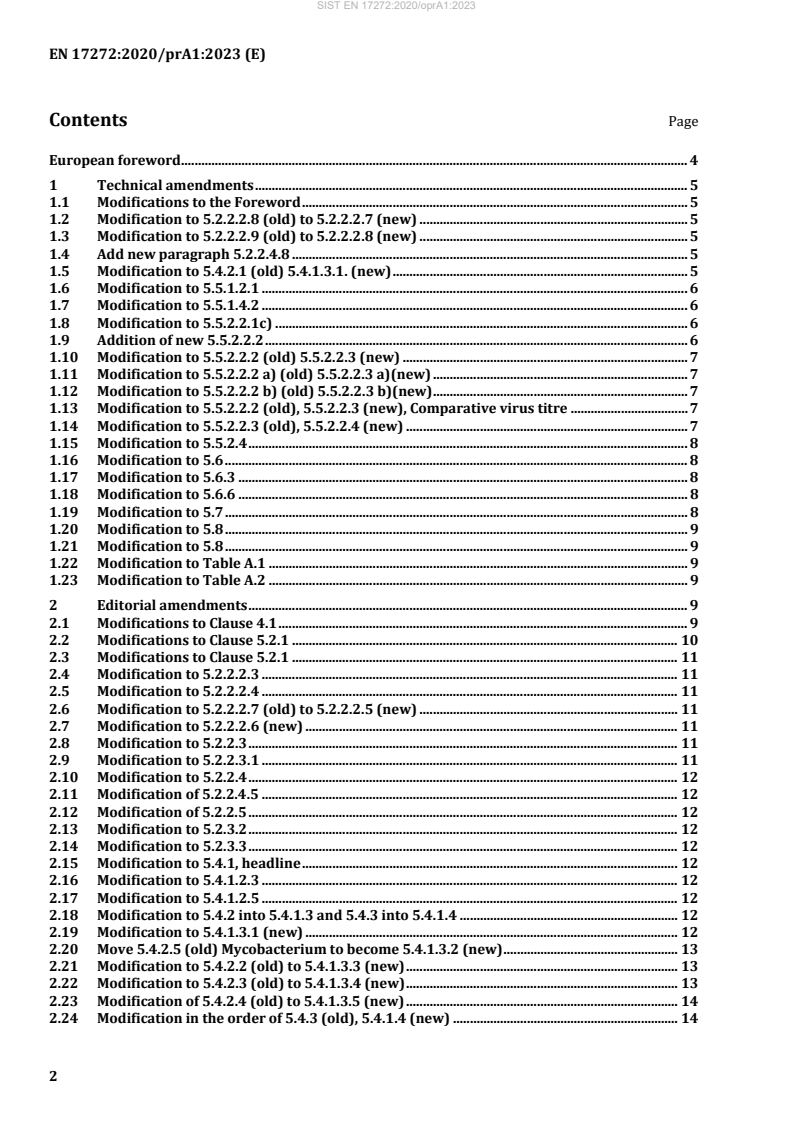
Contents Page
European foreword . 4
1 Technical amendments . 5
1.1 Modifications to the Foreword . 5
1.2 Modification to 5.2.2.2.8 (old) to 5.2.2.2.7 (new) . 5
1.3 Modification to 5.2.2.2.9 (old) to 5.2.2.2.8 (new) . 5
1.4 Add new paragraph 5.2.2.4.8 . 5
1.5 Modification to 5.4.2.1 (old) 5.4.1.3.1. (new) . 5
1.6 Modification to 5.5.1.2.1 . 6
1.7 Modification to 5.5.1.4.2 . 6
1.8 Modification to 5.5.2.2.1c) . 6
1.9 Addition of new 5.5.2.2.2 . 6
1.10 Modification to 5.5.2.2.2 (old) 5.5.2.2.3 (new) . 7
1.11 Modification to 5.5.2.2.2 a) (old) 5.5.2.2.3 a)(new) . 7
1.12 Modification to 5.5.2.2.2 b) (old) 5.5.2.2.3 b)(new) . 7
1.13 Modification to 5.5.2.2.2 (old), 5.5.2.2.3 (new), Comparative virus titre . 7
1.14 Modification to 5.5.2.2.3 (old), 5.5.2.2.4 (new) . 7
1.15 Modification to 5.5.2.4 . 8
1.16 Modification to 5.6 . 8
1.17 Modification to 5.6.3 . 8
1.18 Modification to 5.6.6 . 8
1.19 Modification to 5.7 . 8
1.20 Modification to 5.8 . 9
1.21 Modification to 5.8 . 9
1.22 Modification to Table A.1 . 9
1.23 Modification to Table A.2 . 9
2 Editorial amendments . 9
2.1 Modifications to Clause 4.1 . 9
2.2 Modifications to Clause 5.2.1 . 10
2.3 Modifications to Clause 5.2.1 . 11
2.4 Modification to 5.2.2.2.3 . 11
2.5 Modification to 5.2.2.2.4 . 11
2.6 Modification to 5.2.2.2.7 (old) to 5.2.2.2.5 (new) . 11
2.7 Modification to 5.2.2.2.6 (new) . 11
2.8 Modification to 5.2.2.3 . 11
2.9 Modification to 5.2.2.3.1 . 11
2.10 Modification to 5.2.2.4 . 12
2.11 Modification of 5.2.2.4.5 . 12
2.12 Modification of 5.2.2.5 . 12
2.13 Modification to 5.2.3.2 . 12
2.14 Modification to 5.2.3.3 . 12
2.15 Modification to 5.4.1, headline . 12
2.16 Modification to 5.4.1.2.3 . 12
2.17 Modification to 5.4.1.2.5 . 12
2.18 Modification to 5.4.2 into 5.4.1.3 and 5.4.3 into 5.4.1.4 . 12
2.19 Modification to 5.4.1.3.1 (new) . 12
2.20 Move 5.4.2.5 (old) Mycobacterium to become 5.4.1.3.2 (new) . 13
2.21 Modification to 5.4.2.2 (old) to 5.4.1.3.3 (new) . 13
2.22 Modification to 5.4.2.3 (old) to 5.4.1.3.4 (new) . 13
2.23 Modification of 5.4.2.4 (old) to 5.4.1.3.5 (new) . 14
2.24 Modification in the order of 5.4.3 (old), 5.4.1.4 (new) . 14
SIST EN 17272:2020/oprA1:2023
EN 17272:2020/prA1:2023 (E)
2.25 Modification to 5.4.3.1 (old) 5.4.1.4.1 (new) . 14
2.26 Modification 5.4.3.3 (old) to 5.4.1.4.3 (new) . 14
2.27 Modification of 5.4.3.4 (old), 5.4.1.4.4 (new) . 14
2.28 Modification to 5.4.4 (old) to 5.4.2 (new) . 15
2.29 Modification to 5.4.4.1 (old) to 5.4.2.1 (new) . 15
2.30 Modification to 5.4.4.2 (old), 5.4.2.2 (new) . 15
2.31 Modification to 5.4.4.3.3 (old), 5.4.2.3.3 (new) . 15
2.32 Modification to 5.4.5 (old) to 5.4.3 (new) . 15
2.33 Modification to 5.4.5.4 (old) to 5.4.3.4 (new) . 15
2.34 Modification to 5.4.5.5 (old) to 5.4.3.5 (new) . 15
2.35 Modification to 5.4.5.6 (old), 5.4.3.6 (new) . 15
2.36 Modification to 5.5.1 . 15
2.37 Modification to 5.5.1.2 . 16
2.38 Modification to 5.5.1.2.2 . 16
2.39 Modification to 5.5.1.2.3 . 16
2.40 Modification to 5.5.1.2.4 . 16
2.41 Modification to 5.5.1.3 . 17
2.42 Modification to 5.5.1.3.1 . 17
2.43 Modification to 5.5.1.3.2 . 17
2.44 Modification to 5.5.1.3.3 . 17
2.45 Modification to 5.5.1.3.4 . 18
2.46 Modification to 5.5.1.4 . 18
2.47 Modification to 5.5.1.4.1 . 18
2.48 Modification to 5.5.1.4.3 . 18
2.49 Modification to 5.5.1.4.4 . 18
2.50 Modification to 5.5.2.2 headline . 19
2.51 Modification to 5.5.2.2.1 . 19
2.52 Modification to 5.5.2.3.3 . 19
2.53 Modification to Annex A, Table A.1 . 19
2.54 Modification to Annex B, title . 19
2.55 Modification to Annex C. 19
2.56 Modification to Annex E, title . 19
2.57 Modification to Figure E.1 . 19
2.58 Modification to Figure E.5, figure title . 19
2.59 Modification to Figure E.6, figure title . 20
2.60 Modification to Figure E.7, figure title . 20
SIST EN 17272:2020/oprA1:2023
EN 17272:2020/prA1:2023 (E)
European foreword
This document (EN 17272:2020/prA1:2023) has been prepared by Technical Committee CEN/TC 216
“Chemical disinfectants and antiseptics”, the secretariat of which is held by AFNOR.
This document is currently submitted to the CEN-Enquiry
This document will supersede EN 17272:2020.
A significant number of the modifications listed in this amendment are editorial and the result of re-
ordering the text within the standard. To allow users to quickly ascertain and understand the key
technical amendments and / or clarifying text that have been introduced to EN 17272, the modifications
have been listed in two sections. The first section presents the sections with fundamental technical
changes driven by the amendment and the second section the solely editorial amendments.
SIST EN 17272:2020/oprA1:2023
EN 17272:2020/prA1:2023 (E)
1 Technical amendments
1.1 Modifications to the Foreword
Add in the end the following sentence:
“Results obtained using the 2020 version of the standard prior to the amendment remain valid.”
1.2 Modification to 5.2.2.2.8 (old) to 5.2.2.2.7 (new)
Replace the reference behind Tryptone salt with “(5.2.2.2.7)” and add in the last paragraph the following
sentence:
“In this case, water (5.2.2.2.1) can be used as diluent.”
Change “Bacteria, fungi, yeast and spores” to “Bacteria, yeast, fungi and spores”
1.3 Modification to 5.2.2.2.9 (old) to 5.2.2.2.8 (new)
Add in the list of composition 5,0 g polysorbate 80 and also in the preparation.
Add in the end a sentence for viruses. The whole modification reads as follows:
“Composition:
Tryptone, pancreatic digest of casein 1,0 g
Sodium chloride 8,5 g
Polysorbate 80 5,0 g
Water (see 5.2.2.2.1) to 1.000,0 ml
Preparation:
Dissolve the sodium chloride and tryptone in the water. Add polysorbate 80 and any neutralizing agent
specifically designed for the product under test.
Prepare the diluent in large-volume batches, then distribute into smaller adapted flasks. Sterilize in the
autoclave.
For mycobacteria, water (refer to 5.2.2.2.1) is used instead of diluents.
For viruses, preservation media (refer to 5.2.2.3.1) is used instead of diluents.”
1.4 Add new paragraph 5.2.2.4.8
Add the following new paragraph:
“5.2.2.4.8 Bacteriophage and virus recovery and rinsing liquid
For bacteriophage and virus, growth and preservation media (5.2.2.3.1) are used.”
1.5 Modification to 5.4.2.1 (old) 5.4.1.3.1. (new)
8 9
In the last paragraph replace “10 ” with “10 ”, to read:
“Increase the initial inoculum up to 5 × 10 and add to the interfering substance a 1/20 dilution rate of
skimmed milk.”
SIST EN 17272:2020/oprA1:2023
EN 17272:2020/prA1:2023 (E)
1.6 Modification to 5.5.1.2.1
Replace existing text with
“To be run in parallel with the efficacy and distribution tests”
1.7 Modification to 5.5.1.4.2
Replace
“Distribute the three carriers strain-by-strain at a height (H) in the range 1 to 1,5 m and at a distance (D)
as defined in the table in Annex B according to the volume of the enclosure.
Position of the carriers: vertical.
Orientation: microbial inoculum facing away from the release source.”
with
“Distribute the carriers strain-by-strain in accordance with Annexes A and B.
For the efficacy test:
Position of the carriers: vertical.
Orientation: microbial inoculum facing away from the release source.
For the distribution test:
Position and orientation of the carriers shall be in accordance with Annex A (also see Figures E.5, E.6 and
E.7)
NOTE The position of the diffusion device remains identical for the efficacy and distribution tests. The distance
from the diffusion device to each carrier in the distribution test is not expected to be equal.”
1.8 Modification to 5.5.2.2.1c)
Replace
“Once the ADC time and the ensuing aeration time, if applicable, have elapsed, recover the carriers and
transfer them to 20 ml of recovery liquid to neutralize the action of the product.
This gives the recovery solution S.
Neutralization by means of dilution effect or by adding a specific agent should be explained in the report.
Incomplete neutralization of the residue shall invalidate the tests.”
with
“Once the ADC time and the ensuing aeration time, if applicable, have elapsed, recover the carriers and
transfer them to 20 ml of recovery liquid (refer to 5.2.2.2.9) to neutralize the action of the product.
The quantity of recovery liquid may be reduced provided that its neutralizing potential remains adequate.
This gives the recovery solution S.”
1.9 Addition of new 5.5.2.2.2
Add after new 5.5.2.2.1 the following new paragraph:
“5.5.2.2.2 Cytotoxicity
Solution S is diluted from 10-1 to 10-4.
Cell treatment:
SIST EN 17272:2020/oprA1:
...