

EN 547-3:1996+A1:2008
(Main + Amendment)Safety of machinery - Human body measurements - Part 3: Anthropometric data
- Abstract
This European Standard specifies current requirements for human body measurements (anthropometric data) that are required by EN 547-1 and EN 547-2 for the calculation of access opening dimensions as applied to machinery.
The anthropometric data originate from static measurements of nude persons and do not take into account body movements, clothing, equipment, machinery operating conditions or environmental conditions.
The data are based on information from anthropometric surveys representative of population groups within Europe comprising at least three million people. Both men and women are taken into account.
Measurements are given, as required by EN 547-1 and EN 547-2, for the 5th, 95th and 99th percentiles of the relevant population group within Europe.
- Status
- Published
- Publication Date
- 23-Sep-2008
- Withdrawal Date
- 27-Dec-2009
- Technical Committee
- CEN/TC 122 - Ergonomics
- Drafting Committee
- CEN/TC 122/WG 1 - Anthropometry
- Current Stage
- 9093 - Decision to confirm - Review Enquiry
- Start Date
- 20-Sep-2022
- Completion Date
- 21-Oct-2026
- Directive
- 2006/42/EC - Directive 2006/42/EC of the European Parliament and of the Council of 17 May 2006 on machinery, and amending Directive 95/16/EC (recast)OJ Ref: C, C 214 OJ Date: 08-Sep-2009
98/37/EC - MachineryOJ Ref: C, C 22 OJ Date: 28-Jan-2009



Overview
EN 547-3:1996+A1:2008 (CEN) provides the anthropometric data required to determine safe access opening dimensions for machinery. It supplies human body measurements derived from static surveys of European populations and is intended to be used together with EN 547-1 and EN 547-2. The standard specifies how values for the 5th, 95th and 99th percentiles are selected and applied to calculate minimum access sizes.
Key points:
- Data originate from static measurements of nude persons and do not account for clothing, tools, dynamic movements, operating conditions or environment.
- Surveys are representative of European population groups (at least three million people) and include both men and women.
- Measurements are presented to support calculation methods in EN 547-1 and EN 547-2.
Key Topics
- Anthropometric dataset: Values for the 5th, 95th and 99th percentiles that represent combined female and male populations across Europe.
- Selection rules: When national surveys report separate male/female percentiles, EN 547-3 specifies how to combine or choose values (means for some cases; conservative selection rules for 5th and 95th/99th percentiles).
- Notation and descriptions: A consistent set of measurement notations and definitions (as referenced to prEN 979) and derivation rules where some values are obtained by addition, subtraction or fixed multipliers.
- Fixed values: Where variation is minimal, fixed measurements are provided and identified.
- Normative relationship: Provides data for formulas in EN 547-1 and EN 547-2 and includes informative annexes linking the standard to EU Directives.
Applications
EN 547-3 is practical for designers, safety engineers and compliance teams who need to apply ergonomics and anthropometry to machinery safety, including:
- Calculating minimum dimensions for whole-body and partial-body access openings.
- Verifying that maintenance, inspection and operator access complies with harmonized European ergonomics guidance.
- Supporting risk assessments and CE marking by providing data referenced in the Machinery Directive informative annexes (relationship with Directive 2006/42/EC and earlier directives is included).
Benefits:
- Enables consistent, data-driven sizing of access points across products and manufacturers.
- Reduces ambiguity by giving standardized percentile values and selection rules.
Related Standards
- EN 547-1: Principles for determining dimensions required for whole body access into machinery.
- EN 547-2: Principles for determining dimensions required for access openings (parts of the body).
- prEN 979: Definitions of human body measurements for technical design.
- EN 614-1: Ergonomic design principles (terminology and general principles).
Use EN 547-3 in conjunction with EN 547-1 and EN 547-2 to ensure access openings are dimensioned using harmonized anthropometric data and to support conformity with applicable EU machinery safety requirements.
Relations
- Merged From
EN 547-3:1996 - Safety of machinery - Human body measurements - Part 3: Anthropometric data - Effective Date
- 19-Jan-2023
- Effective Date
- 28-Jan-2026
- Effective Date
- 28-Jan-2026
- Effective Date
- 28-Jan-2026
- Effective Date
- 28-Jan-2026
- Effective Date
- 28-Jan-2026
- Effective Date
- 28-Jan-2026
- Effective Date
- 28-Jan-2026
- Effective Date
- 28-Jan-2026
- Effective Date
- 28-Jan-2026
- Referred By
EN 17863:2023 - Railway applications - Ground based services - Coach hygiene requirements - Effective Date
- 28-Jan-2026
- Effective Date
- 28-Jan-2026
- Effective Date
- 28-Jan-2026
- Effective Date
- 28-Jan-2026
- Effective Date
- 28-Jan-2026
Get Certified
Connect with accredited certification bodies for this standard

CIS Institut d.o.o.
Personal Protective Equipment (PPE) certification body. Notified Body NB-2890 for EU Regulation 2016/425 PPE.

Kiwa BDA Testing
Building and construction product certification.
Kmetijski inštitut Slovenije
Agricultural Institute of Slovenia. Soil testing, plant health, agricultural product analysis.
Sponsored listings
Frequently Asked Questions
EN 547-3:1996+A1:2008 is a standard published by the European Committee for Standardization (CEN). Its full title is "Safety of machinery - Human body measurements - Part 3: Anthropometric data". This standard covers: This European Standard specifies current requirements for human body measurements (anthropometric data) that are required by EN 547-1 and EN 547-2 for the calculation of access opening dimensions as applied to machinery. The anthropometric data originate from static measurements of nude persons and do not take into account body movements, clothing, equipment, machinery operating conditions or environmental conditions. The data are based on information from anthropometric surveys representative of population groups within Europe comprising at least three million people. Both men and women are taken into account. Measurements are given, as required by EN 547-1 and EN 547-2, for the 5th, 95th and 99th percentiles of the relevant population group within Europe.
This European Standard specifies current requirements for human body measurements (anthropometric data) that are required by EN 547-1 and EN 547-2 for the calculation of access opening dimensions as applied to machinery. The anthropometric data originate from static measurements of nude persons and do not take into account body movements, clothing, equipment, machinery operating conditions or environmental conditions. The data are based on information from anthropometric surveys representative of population groups within Europe comprising at least three million people. Both men and women are taken into account. Measurements are given, as required by EN 547-1 and EN 547-2, for the 5th, 95th and 99th percentiles of the relevant population group within Europe.
EN 547-3:1996+A1:2008 is classified under the following ICS (International Classification for Standards) categories: 13.110 - Safety of machinery; 13.180 - Ergonomics. The ICS classification helps identify the subject area and facilitates finding related standards.
EN 547-3:1996+A1:2008 has the following relationships with other standards: It is inter standard links to EN 547-3:1996, EN 547-2:1996+A1:2008, EN 547-1:1996+A1:2008, EN ISO 7250-1:2017, EN 614-1:2006+A1:2009, EN 14466:2005+A1:2008, EN 15955-2:2013, EN 15955-2:2025, EN 15954-2:2013, EN 617:2001+A1:2010, EN 17863:2023, EN 14033-3:2017, EN 1034-1:2000+A1:2010, EN 12321:2003+A1:2009, EN 12629-6:2004+A1:2010. Understanding these relationships helps ensure you are using the most current and applicable version of the standard.
EN 547-3:1996+A1:2008 is associated with the following European legislation: EU Directives/Regulations: 2006/42/EC, 98/37/EC; Standardization Mandates: M/079, M/396. When a standard is cited in the Official Journal of the European Union, products manufactured in conformity with it benefit from a presumption of conformity with the essential requirements of the corresponding EU directive or regulation.
EN 547-3:1996+A1:2008 is available in PDF format for immediate download after purchase. The document can be added to your cart and obtained through the secure checkout process. Digital delivery ensures instant access to the complete standard document.
Standards Content (Sample)
2003-01.Slovenski inštitut za standardizacijo. Razmnoževanje celote ali delov tega standarda ni dovoljeno.Sicherheit von Maschinen - Körpermaße des Menschen - Teil 3: KörpermaßdatenSécurité des machines - Mesures du corps humain - Partie 3: Données anthropométriquesSafety of machinery - Human body measurements - Part 3: Anthropometric data13.180ErgonomijaErgonomics13.110Varnost strojevSafety of machineryICS:Ta slovenski standard je istoveten z:EN 547-3:1996+A1:2008SIST EN 547-3:1998+A1:2008en,fr,de01-december-2008SIST EN 547-3:1998+A1:2008SLOVENSKI
STANDARD
EUROPEAN STANDARD NORME EUROPÉENNE EUROPÄISCHE NORM
EN 547-3:1996+A1
September 2008 ICS 13.110; 13.180 Supersedes EN 547-3:1996 English Version
Safety of machinery - Human body measurements - Part 3: Anthropometric data
Sécurité des machines - Mesures du corps humain -Partie 3: Données anthropométriques
Sicherheit von Maschinen - Körpermaße des Menschen - Teil 3: Körpermaßdaten This European Standard was approved by CEN on 15 November 1996 and includes Amendment 1 approved by CEN on 14 August 2008.
CEN members are bound to comply with the CEN/CENELEC Internal Regulations which stipulate the conditions for giving this European Standard the status of a national standard without any alteration. Up-to-date lists and bibliographical references concerning such national standards may be obtained on application to the CEN Management Centre or to any CEN member.
This European Standard exists in three official versions (English, French, German). A version in any other language made by translation under the responsibility of a CEN member into its own language and notified to the CEN Management Centre has the same status as the official versions.
CEN members are the national standards bodies of Austria, Belgium, Bulgaria, Cyprus, Czech Republic, Denmark, Estonia, Finland, France, Germany, Greece, Hungary, Iceland, Ireland, Italy, Latvia, Lithuania, Luxembourg, Malta, Netherlands, Norway, Poland, Portugal, Romania, Slovakia, Slovenia, Spain, Sweden, Switzerland and United Kingdom.
EUROPEAN COMMITTEE FOR STANDARDIZATION
COMITÉ EUROPÉEN DE NORMALISATION EUROPÄISCHES KOMITEE FÜR NORMUNG
Management Centre: rue de Stassart, 36
B-1050 Brussels © 2008 CEN All rights of exploitation in any form and by any means reserved worldwide for CEN national Members. Ref. No. EN 547-3:1996+A1:2008: ESIST EN 547-3:1998+A1:2008
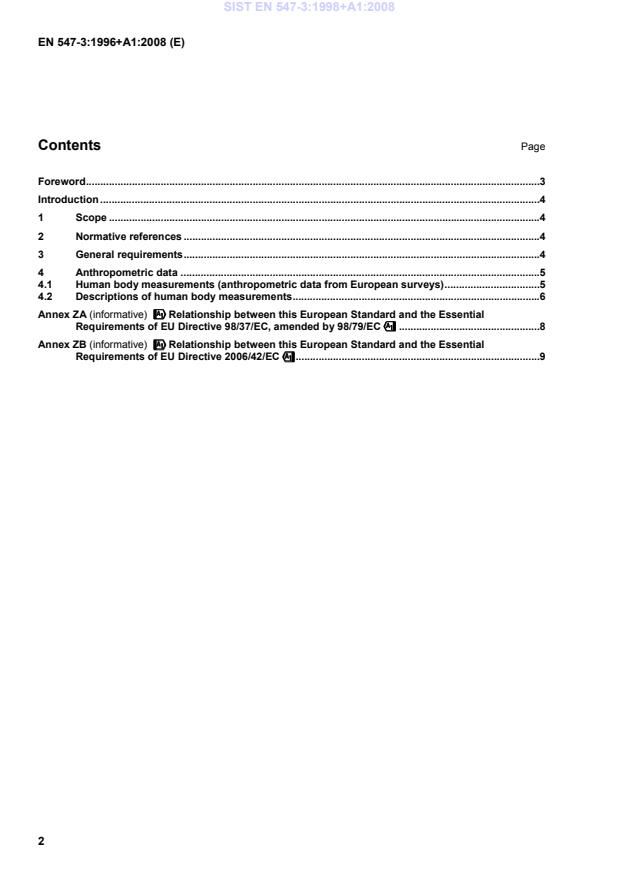
!!!!Relationship between this European Standard and the Essential Requirements of EU Directive 98/37/EC, amended by 98/79/EC"""".8 Annex ZB (informative)
!!!!Relationship between this European Standard and the Essential Requirements of EU Directive 2006/42/EC"""".9
...