

EN 16698:2015
(Main)Water quality - Guidance on quantitative and qualitative sampling of phytoplankton from inland waters
- Abstract
This European Standard specifies procedures for phytoplankton sampling in inland waters and describes methods of sampling techniques for phytoplankton in inland waters (e.g. rivers and channels, or lakes, ponds, reservoirs and other artificial water bodies, respectively).
This European Standard gives guidance for sampling of phytoplankton for qualitative and quantitative limnological investigations and monitoring of water quality, e.g. ecological status.
- Status
- Published
- Publication Date
- 06-Oct-2015
- Withdrawal Date
- 29-Apr-2016
- Technical Committee
- CEN/TC 230 - Water analysis
- Drafting Committee
- CEN/TC 230 - Water analysis
- Current Stage
- 9093 - Decision to confirm - Review Enquiry
- Start Date
- 09-Feb-2022
- Completion Date
- 14-Oct-2026

Overview
EN 16698:2015 (CEN) - "Water quality - Guidance on quantitative and qualitative sampling of phytoplankton from inland waters" provides harmonized procedures for collecting phytoplankton samples from inland waters (rivers, channels, lakes, ponds, reservoirs and artificial water bodies). The standard focuses on representative sampling for both qualitative (species presence) and quantitative (abundance, biomass) limnological investigations and water‑quality monitoring, including ecological status assessments.
Key points
- Guidance for sampling in rivers and lakes (polymictic, stratified, during circulation or summer stagnation).
- Emphasis on representative collection, sample preservation and subsequent microscopy (Utermöhl technique).
- Recommendations for sampling frequency, replicates, equipment, bottling, fixation, storage and transport.
- Annexes with practical methodology, examples of sampling devices, cleaning procedures, depth‑gradient assessment and a sampling protocol template.
- Safety and training: work around water is hazardous; samples should be collected by trained staff.
Key topics and technical requirements
- Site selection and sampling design: choose locations and depths to capture spatial and temporal variability; different approaches for rivers vs lakes.
- Sampling frequency & replicates: adapt to monitoring objectives and natural variability; examples provided in annexes.
- Equipment & preservatives: lists of suitable samplers (integrating samplers, hose/tube samplers, plankton nets), preservatives and handling instructions for quantitative vs qualitative work.
- Procedures for lakes:
- Polymictic (shallow) lakes: whole‑column or surface mixing approaches.
- Stratified lakes: separate strategies for circulation periods and summer stagnation (including handling of deep chlorophyll maximum - DCM defined where chlorophyll at least 1.5× epilimnion average).
- Methods to prepare mixed water‑column samples (integral samplers or stepwise sampling).
- Rivers: emphasis on representative cross‑section or longitudinal sampling using horizontal samplers where appropriate.
- Sample processing & microscopy: preservation and sedimentation for analysis by inverted microscopy (EN 15204 Utermöhl technique).
- Accompanying parameters: Secchi depth (euphotic depth ≈ 2.5× Secchi; humic lakes 0.8–2.1×), water temperature, dissolved oxygen, pH, chlorophyll‑a - all recommended for interpretation.
- Quality assurance: protocol templates, cleaning procedures and QA measures in annexes.
Applications and users
EN 16698 is intended for:
- Environmental agencies and regulatory monitoring programs assessing ecological status
- Water quality laboratories and limnologists conducting phytoplankton surveys
- Consultants involved in reservoir/lake management and impact assessments
- Research groups studying seasonal and spatial dynamics of phytoplankton
Practical uses include routine monitoring, bloom detection and species inventories, biomass calculations, and supporting chemical/physical water‑quality data.
Related standards
- EN 15204 - Enumeration of phytoplankton using inverted microscopy (Utermöhl)
- EN ISO 5814 / ISO 17289 - Dissolved oxygen methods
- EN ISO 7027 - Turbidity
- EN ISO 10523 - pH
Keywords: phytoplankton sampling, water quality, inland waters, lake sampling, river sampling, integrating sampler, Secchi depth, chlorophyll-a, Utermöhl technique, ecological status.
Relations
- Effective Date
- 03-Jun-2026
- Effective Date
- 28-Jan-2026
- Effective Date
- 28-Jan-2026
- Effective Date
- 28-Jan-2026
- Effective Date
- 28-Jan-2026
- Effective Date
- 28-Jan-2026
- Effective Date
- 28-Jan-2026
- Effective Date
- 28-Jan-2026
Get Certified
Connect with accredited certification bodies for this standard

CIS Institut d.o.o.
Personal Protective Equipment (PPE) certification body. Notified Body NB-2890 for EU Regulation 2016/425 PPE.

Kiwa BDA Testing
Building and construction product certification.
Kmetijski inštitut Slovenije
Agricultural Institute of Slovenia. Soil testing, plant health, agricultural product analysis.
Sponsored listings
Frequently Asked Questions
EN 16698:2015 is a standard published by the European Committee for Standardization (CEN). Its full title is "Water quality - Guidance on quantitative and qualitative sampling of phytoplankton from inland waters". This standard covers: This European Standard specifies procedures for phytoplankton sampling in inland waters and describes methods of sampling techniques for phytoplankton in inland waters (e.g. rivers and channels, or lakes, ponds, reservoirs and other artificial water bodies, respectively). This European Standard gives guidance for sampling of phytoplankton for qualitative and quantitative limnological investigations and monitoring of water quality, e.g. ecological status.
This European Standard specifies procedures for phytoplankton sampling in inland waters and describes methods of sampling techniques for phytoplankton in inland waters (e.g. rivers and channels, or lakes, ponds, reservoirs and other artificial water bodies, respectively). This European Standard gives guidance for sampling of phytoplankton for qualitative and quantitative limnological investigations and monitoring of water quality, e.g. ecological status.
EN 16698:2015 is classified under the following ICS (International Classification for Standards) categories: 13.060.70 - Examination of biological properties of water. The ICS classification helps identify the subject area and facilitates finding related standards.
EN 16698:2015 has the following relationships with other standards: It is inter standard links to ISO 17289:2014, EN ISO 5814:2012, EN 14243-1:2019, EN ISO 7027-2:2019, EN ISO 7027-1:2016, EN ISO 10523:2012, EN 15204:2006, EN 16695:2015. Understanding these relationships helps ensure you are using the most current and applicable version of the standard.
EN 16698:2015 is associated with the following European legislation: EU Directives/Regulations: 2000/60/EC; Standardization Mandates: M/424. When a standard is cited in the Official Journal of the European Union, products manufactured in conformity with it benefit from a presumption of conformity with the essential requirements of the corresponding EU directive or regulation.
EN 16698:2015 is available in PDF format for immediate download after purchase. The document can be added to your cart and obtained through the secure checkout process. Digital delivery ensures instant access to the complete standard document.
Standards Content (Sample)
2003-01.Slovenski inštitut za standardizacijo. Razmnoževanje celote ali delov tega standarda ni dovoljeno.Wasserbeschaffenheit - Anleitung für die quantitative und qualitative Probenahme von Phytoplankton aus BinnengewässernQualité de l'eau - Lignes directrices sur l'échantillonnage quantitatif et qualitatif du phytoplancton dans les eaux intérieuresWater quality - Guidance on quantitative and qualitative sampling of phytoplankton from inland waters13.060.70Preiskava bioloških lastnosti vodeExamination of biological properties of water13.060.10Voda iz naravnih virovWater of natural resourcesICS:Ta slovenski standard je istoveten z:EN 16698:2015SIST EN 16698:2016en,fr,de01-februar-2016SIST EN 16698:2016SLOVENSKI
STANDARD
EUROPEAN STANDARD NORME EUROPÉENNE EUROPÄISCHE NORM
EN 16698
October
t r s w ICS
s uä r x rä y r English Version
Water quality æ Guidance on quantitative and qualitative sampling of phytoplankton from inland waters Qualité de l 5eau æ Lignes directrices sur l 5échantillonnage quantitatif et qualitatif du phytoplancton dans les eaux intérieures
Wasserbeschaffenheit æ Anleitung für die quantitative und qualitative æ Probenahme von Phytoplankton aus Binnengewässern This European Standard was approved by CEN on
z August
t r s wä
egulations which stipulate the conditions for giving this European Standard the status of a national standard without any alterationä Upætoædate lists and bibliographical references concerning such national standards may be obtained on application to the CENæCENELEC Management Centre or to any CEN memberä
translation under the responsibility of a CEN member into its own language and notified to the CENæCENELEC Management Centre has the same status as the official versionsä
CEN members are the national standards bodies of Austriaá Belgiumá Bulgariaá Croatiaá Cyprusá Czech Republicá Denmarká Estoniaá Finlandá Former Yugoslav Republic of Macedoniaá Franceá Germanyá Greeceá Hungaryá Icelandá Irelandá Italyá Latviaá Lithuaniaá Luxembourgá Maltaá Netherlandsá Norwayá Polandá Portugalá Romaniaá Slovakiaá Sloveniaá Spainá Swedená Switzerlandá Turkey and United Kingdomä
EUROPEAN COMMITTEE FOR STANDARDIZATION COMITÉ EUROPÉEN DE NORMALISATION EUROPÄISCHES KOMITEE FÜR NORMUNG
CEN-CENELEC Management Centre:
Avenue Marnix 17,
B-1000 Brussels
t r s w CEN All rights of exploitation in any form and by any means reserved worldwide for CEN national Membersä Refä Noä EN
s x x { zã t r s w ESIST EN 16698:2016
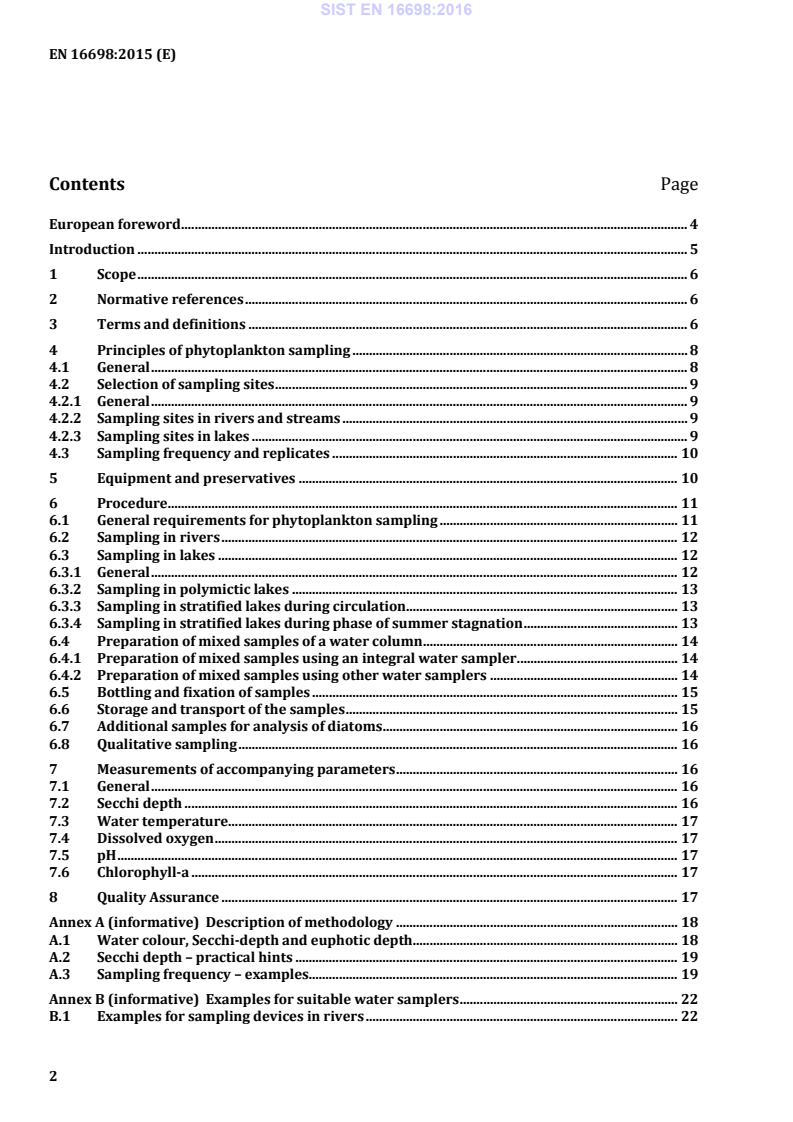
Description of methodology . 18 A.1 Water colour, Secchi-depth and euphotic depth . 18 A.2 Secchi depth – practical hints . 19 A.3 Sampling frequency – examples. 19 Annex B (informative)
Examples for suitable water samplers . 22 B.1 Examples for sampling devices in rivers . 22 SIST EN 16698:2016
Determination of the depth gradient . 30 Annex D (informative)
Example for a sampling protocol . 32 Bibliography . 34
Note 1 to entry: See Annex C. Note 2 to entry: Values > 1,5 indicate a thermally stable stratified lake. For further details see Annex C and [18]. 3.3 dimictic lake lake with uniform water temperature and holomictic conditions twice a year: during autumn (before ice cover) and during spring (after ice cover) 3.4 epilimnion zone of the water body between surface and thermocline in which the water temperature and density is approximately uniform, showing a temperature gradient of < 1 °C/m SIST EN 16698:2016
¶ 1,5) Note 1 to entry: See also [17]. 3.13 shallow lake in this European Standard shallow lakes are defined as polymictic lakes (3.12) – based on the depth gradient - independent of their mean or maximum depth SIST EN 16698:2016
See Annex B for examples of suitable samplers; B.1 for samplers for rivers and B.2 for samplers for lakes. 5.1.2 Electrochemical/photo-optical probe with depth sensor to measure water temperature and dissolved oxygen according to EN ISO 5814 or ISO 17289. 5.1.3 pH probe (optional), e.g. according to EN ISO 10523. 5.1.4 Secchi disk according to EN ISO 7027 (see A.2 for further information). 5.1.5 Chlorophyll fluorescent probe with depth sensor (optional). A probe for total chlorophyll measurement is sufficient. SIST EN 16698:2016
The size of the container depends on the sampled volumes. 5.1.11 Plankton net, generally for qualitative sampling only; mesh width from 5 µm to 25 µm, depending on the taxonomic target. 5.1.12 Sample bottles, according to EN 15204. 5.1.13 Lightproof closed containers, suitable for the transport of the sample bottles (e.g. cooling boxes). 5.2 Fixatives and preservatives: Lugol’s reagent is suitable for Utermöhl phytoplankton analysis, depending on pH (see EN 15204). See 5.2.1 and 5.2.2. for further specifications. 5.2.1 Alkaline Lugol's iodine, with sodium acetate for preservation of plankton from neutral or alkaline waters. 5.2.2 Acidic Lugol's iodine, with acetic acid for preservation of plankton from acidic waters. 5.2.3 Ethanol, C2H5OH, volume fraction 90 % to 96 %, for preservation of diatom or picoplankton samples. 5.2.4 Formaldehyde (optional). Formaldehyde is appropriate for preservation of diatom or picoplankton samples. 6 Procedure 6.1 General requirements for phytoplankton sampling A representative phytoplankton sample should be taken with a suitable water sampler (see Annex B for examples). The contact of the water sampler with the lake/river bed, macrophyte stands, the floor of the boat, mooring buoys or any surface from which sample contamination could occur, particularly benthic algae or sediment, should be avoided. The phytoplankton sample should be filled immediately or after mixing in sampling bottles and preserved for later investigation according to EN 15204. Sample bottles should be marked before sampling to avoid interchanging the samples. Waterproof marker pen or pencil should be used (ballpoint pens or regular marker pens are not appropriate). Writing directly on the glass is not recommended. Instead, water-resistant adhesive tape that can be labelled or water-resistant printed labels are recommended. SIST EN 16698:2016
...