

CEN/TS 17638:2021
(Main)Stationary source emissions - Manual method for the determination of the mass concentration of formaldehyde - Reference method
- Abstract
This document specifies the reference method for the determination of the concentration of formaldehyde in emissions from stationary sources. Waste gas samples are taken by absorption in water and subsequently analysed by spectrophotometry or HPLC. The method applies to waste gases in which the formaldehyde concentration is 2 mg/m3 to 60 mg/m3, on dry basis, at the reference conditions of 273 K and 101,3 kPa.
The specific components and the requirements for the measuring system are described. A number of performance characteristics with associated minimum performance criteria are specified for the measuring system.
- Status
- Published
- Publication Date
- 22-Jun-2021
- Technical Committee
- CEN/TC 264 - Air quality
- Drafting Committee
- CEN/TC 264/WG 40 - Measurement of formaldehyde emissions
- Current Stage
- 9093 - Decision to confirm - Review Enquiry
- Start Date
- 04-Dec-2024
- Completion Date
- 21-Oct-2026

Overview
CEN/TS 17638:2021 - "Stationary source emissions - Manual method for the determination of the mass concentration of formaldehyde - Reference method" - specifies a reference manual method for measuring formaldehyde emissions from stationary sources. The procedure uses waste gas sampling by absorption in water followed by laboratory analysis via spectrophotometry or HPLC. It applies to formaldehyde concentrations from 2 mg/m3 to 60 mg/m3 (dry basis) at reference conditions of 273 K and 101.3 kPa. The document is published as a Technical Specification and includes performance criteria and system requirements.
Key topics and requirements
- Sampling principle: capture formaldehyde by absorption into aqueous solution (wash bottles/absorbers) for subsequent lab analysis.
- Measurement range: applicable for 2–60 mg/m3 (dry basis) at standard reference conditions.
- Sampling strategies: descriptions of non‑isokinetic, isokinetic, and side‑stream sampling approaches.
- Sampling equipment: requirements for sampling probe, particle filter, absorbers, sampling pump, gas volume meter, temperature controller, and associated materials.
- Analytical methods: analysis options include spectrophotometry and HPLC (detailed in Annex A).
- Performance characteristics: specified performance criteria and minimum acceptance limits for the measuring system, including limits of quantification, analytical repeatability, and uncertainty estimates.
- Calibration & QA: procedures for calibration with formaldehyde standard solutions, validation tests, field blanks, leak tests, and documentation of measurement uncertainty (Annex B).
- Reporting: required content of the measurement report and parameters to record during sampling.
Applications and users
- Who uses it: environmental testing laboratories, air quality consultants, emissions monitoring teams, regulatory authorities, and industrial operators (e.g., energy/combustion plants, chemical and wood industries, food smoking plants).
- Typical uses: compliance testing against emission limit values (ELVs), periodic monitoring for permitting and BAT (Best Available Techniques) assessments, validating process controls, and supporting environmental impact assessments.
- Practical value: provides a harmonized reference method for reliable, comparable formaldehyde emission data where no EN/ISO standard currently exists.
Related standards
- EN 13284-1:2017 (dust gravimetric methods)
- EN 15259:2007 (requirements for measurement sections and sites)
- EN ISO 14956 (evaluation of measurement procedures vs required uncertainty)
- ISO/IEC Guide 98-3 (GUM: measurement uncertainty)
Keywords: CEN/TS 17638:2021, formaldehyde emissions, stationary source emissions, formaldehyde measurement, manual reference method, HPLC, spectrophotometry, emission monitoring, air quality.
Relations
- Effective Date
- 09-Feb-2026
- Effective Date
- 28-Jan-2026
- Effective Date
- 28-Jan-2026
- Effective Date
- 28-Jan-2026
- Effective Date
- 28-Jan-2026
- Effective Date
- 28-Jan-2026
Get Certified
Connect with accredited certification bodies for this standard

CIS Institut d.o.o.
Personal Protective Equipment (PPE) certification body. Notified Body NB-2890 for EU Regulation 2016/425 PPE.

Kiwa BDA Testing
Building and construction product certification.
Kmetijski inštitut Slovenije
Agricultural Institute of Slovenia. Soil testing, plant health, agricultural product analysis.
Sponsored listings
Frequently Asked Questions
CEN/TS 17638:2021 is a technical specification published by the European Committee for Standardization (CEN). Its full title is "Stationary source emissions - Manual method for the determination of the mass concentration of formaldehyde - Reference method". This standard covers: This document specifies the reference method for the determination of the concentration of formaldehyde in emissions from stationary sources. Waste gas samples are taken by absorption in water and subsequently analysed by spectrophotometry or HPLC. The method applies to waste gases in which the formaldehyde concentration is 2 mg/m3 to 60 mg/m3, on dry basis, at the reference conditions of 273 K and 101,3 kPa. The specific components and the requirements for the measuring system are described. A number of performance characteristics with associated minimum performance criteria are specified for the measuring system.
This document specifies the reference method for the determination of the concentration of formaldehyde in emissions from stationary sources. Waste gas samples are taken by absorption in water and subsequently analysed by spectrophotometry or HPLC. The method applies to waste gases in which the formaldehyde concentration is 2 mg/m3 to 60 mg/m3, on dry basis, at the reference conditions of 273 K and 101,3 kPa. The specific components and the requirements for the measuring system are described. A number of performance characteristics with associated minimum performance criteria are specified for the measuring system.
CEN/TS 17638:2021 is classified under the following ICS (International Classification for Standards) categories: 13.040.40 - Stationary source emissions. The ICS classification helps identify the subject area and facilitates finding related standards.
CEN/TS 17638:2021 has the following relationships with other standards: It is inter standard links to ISO/IEC Guide 98-3:2008, EN ISO 14956:2002, EN 15259:2007, EN 13284-1:2017, EN ISO 5912:2020, EN ISO 12402-7:2020. Understanding these relationships helps ensure you are using the most current and applicable version of the standard.
CEN/TS 17638:2021 is available in PDF format for immediate download after purchase. The document can be added to your cart and obtained through the secure checkout process. Digital delivery ensures instant access to the complete standard document.
Standards Content (Sample)
SLOVENSKI STANDARD
01-september-2021
Emisije nepremičnih virov - Določevanje masne koncentracije formaldehida -
Ročna metoda
Stationary source emissions - Determination of the mass concentration of formaldehyde
- Manual method
Emissionen aus stationären Quellen - Manuelles Verfahren zur Bestimmung der
Massenkonzentration von Formaldehyd - Referenzverfahren
Emissions de sources fixes - Détermination de la concentration massique en
formaldéhyde - Methode manuelle
Ta slovenski standard je istoveten z: CEN/TS 17638:2021
ICS:
13.040.40 Emisije nepremičnih virov Stationary source emissions
2003-01.Slovenski inštitut za standardizacijo. Razmnoževanje celote ali delov tega standarda ni dovoljeno.
CEN/TS 17638
TECHNICAL SPECIFICATION
SPÉCIFICATION TECHNIQUE
June 2021
TECHNISCHE SPEZIFIKATION
ICS 13.040.40
English Version
Stationary source emissions - Manual method for the
determination of the mass concentration of formaldehyde
- Reference method
Emissions de sources fixes - Méthode manuelle pour la Emissionen aus stationären Quellen - Manuelles
détermination de la concentration massique en Verfahren zur Bestimmung der Massenkonzentration
formaldéhyde - Méthode de référence von Formaldehyd - Referenzverfahren
This Technical Specification (CEN/TS) was approved by CEN on 16 May 2021 for provisional application.
The period of validity of this CEN/TS is limited initially to three years. After two years the members of CEN will be requested to
submit their comments, particularly on the question whether the CEN/TS can be converted into a European Standard.
CEN members are required to announce the existence of this CEN/TS in the same way as for an EN and to make the CEN/TS
available promptly at national level in an appropriate form. It is permissible to keep conflicting national standards in force (in
parallel to the CEN/TS) until the final decision about the possible conversion of the CEN/TS into an EN is reached.
CEN members are the national standards bodies of Austria, Belgium, Bulgaria, Croatia, Cyprus, Czech Republic, Denmark, Estonia,
Finland, France, Germany, Greece, Hungary, Iceland, Ireland, Italy, Latvia, Lithuania, Luxembourg, Malta, Netherlands, Norway,
Poland, Portugal, Republic of North Macedonia, Romania, Serbia, Slovakia, Slovenia, Spain, Sweden, Switzerland, Turkey and
United Kingdom.
EUROPEAN COMMITTEE FOR STANDARDIZATION
COMITÉ EUROPÉEN DE NORMALISATION
EUROPÄISCHES KOMITEE FÜR NORMUNG
CEN-CENELEC Management Centre: Rue de la Science 23, B-1040 Brussels
© 2021 CEN All rights of exploitation in any form and by any means reserved Ref. No. CEN/TS 17638:2021 E
worldwide for CEN national Members.
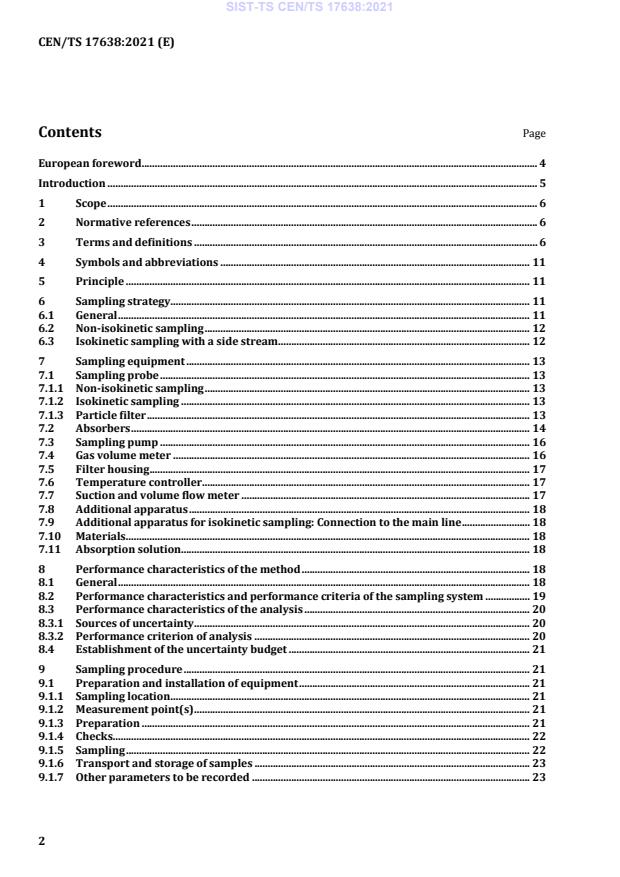
Contents Page
European foreword . 4
Introduction . 5
1 Scope . 6
2 Normative references . 6
3 Terms and definitions . 6
4 Symbols and abbreviations . 11
5 Principle . 11
6 Sampling strategy. 11
6.1 General . 11
6.2 Non-isokinetic sampling . 12
6.3 Isokinetic sampling with a side stream . 12
7 Sampling equipment . 13
7.1 Sampling probe . 13
7.1.1 Non-isokinetic sampling . 13
7.1.2 Isokinetic sampling . 13
7.1.3 Particle filter . 13
7.2 Absorbers . 14
7.3 Sampling pump . 16
7.4 Gas volume meter . 16
7.5 Filter housing . 17
7.6 Temperature controller . 17
7.7 Suction and volume flow meter . 17
7.8 Additional apparatus . 18
7.9 Additional apparatus for isokinetic sampling: Connection to the main line . 18
7.10 Materials . 18
7.11 Absorption solution. 18
8 Performance characteristics of the method . 18
8.1 General . 18
8.2 Performance characteristics and performance criteria of the sampling system . 19
8.3 Performance characteristics of the analysis . 20
8.3.1 Sources of uncertainty . 20
8.3.2 Performance criterion of analysis . 20
8.4 Establishment of the uncertainty budget . 21
9 Sampling procedure . 21
9.1 Preparation and installation of equipment . 21
9.1.1 Sampling location . 21
9.1.2 Measurement point(s) . 21
9.1.3 Preparation . 21
9.1.4 Checks . 22
9.1.5 Sampling . 22
9.1.6 Transport and storage of samples . 23
9.1.7 Other parameters to be recorded . 23
9.2 Validation of results . 23
9.2.1 Parameters depending on the stationary source . 23
9.2.2 Leak tests . 24
9.2.3 Field blank . 24
9.2.4 Other elements . 24
10 Analysis . 24
11 Calibration . 25
11.1 General . 25
11.2 Formaldehyde standard solution . 25
11.3 Formaldehyde calibration solution . 26
11.4 Determination of the calibration curve . 26
12 Expression of results . 27
13 Measurement report . 27
Annex A (normative) Analytical methods . 29
Annex B (informative) Measurement uncertainty . 37
Annex C (informative) Validation tests . 45
Bibliography . 46
European foreword
This document (CEN/TS 17638:2021) has been prepared by Technical Committee CEN/TC 264 “Air
quality”, the secretariat of which is held by DIN.
Attention is drawn to the possibility that some of the elements of this document may be the subject of
patent rights. CEN shall not be held responsible for identifying any or all such patent rights.
According to the CEN/CENELEC Internal Regulations, the national standards organisations of the
following countries are bound to announce this Technical Specification: Austria, Belgium, Bulgaria,
Croatia, Cyprus, Czech Republic, Denmark, Estonia, Finland, France, Germany, Greece, Hungary, Iceland,
Ireland, Italy, Latvia, Lithuania, Luxembourg, Malta, Netherlands, Norway, Poland, Portugal, Republic of
North Macedonia, Romania, Serbia, Slovakia, Slovenia, Spain, Sweden, Switzerland, Turkey and the United
Kingdom.
Introduction
Formaldehyde is a carcinogenic pollutant that is generated in different industrial sectors, like energy
industries (combustion plants (e.g. for wood and gas), combustion engines (gas engines and turbines)),
chemical industry (e.g. formaldehyde production), food industry (e.g. smoking plants), wood industry
(e.g. production of wood-based panels or wood pellets) and thus contained in emissions of these
processes.
Currently, no European (EN) or International (ISO) Standard exists for the continuous or periodic
measurement of formaldehyde emissions, which are being addressed, e.g. by the European Commission
in its implementing decision 2015/2119 [1] establishing best available techniques (BAT) conclusions,
under Directive 2010/75/EU [2], for the production of wood-based panels.
Instead, different national methods for formaldehyde measurements are currently applied, e.g. US
EPA M316 [3], VDI 3862 Part 4 [4], VDI 3862 Part 6 [5], and FD X43-319 [6], all of them based on sampling
in aqueous absorption solutions. Several comparison studies have shown that the equivalence of these
methods is not ensured.
This measurement method is specified as a Technical Specification because currently no sufficient
validation data are available. A comprehensive validation programme has been developed and will be
carried out as soon as the funding is ensured (see Annex C).
1 Scope
This document specifies the reference method for the determination of the concentration of
formaldehyde in emissions from stationary sources. Waste gas samples are taken by absorption in water
and subsequently analysed by spectrophotometry or HPLC. The method applies to waste gases in which
3 3
the formaldehyde concentration is 2 mg/m to 60 mg/m , on dry basis, at the reference conditions of
273 K and 101,3 kPa.
The specific components and the requirements for the measuring system are described. A number of
performance characteristics with associated minimum performance criteria are specified for the
measuring system.
2 Normative references
The following documents are referred to in the text in such a way that some or all of their content
constitutes requirements of this document. For dated references, only the edition cited applies. For
undated references, the latest edition of the referenced document (including any amendments) applies.
EN 13284-1:2017, Stationary source emissions - Determination of low range mass concentration of dust -
Part 1: Manual gravimetric method
EN 15259:2007, Air quality - Measurement of stationary source emissions - Requirements for measurement
sections and sites and for the measurement objective, plan and report
EN ISO 14956, Air quality – Evaluation of the suitability of a measurement procedure by comparison with a
required measurement uncertainty (ISO 14956)
ISO/IEC Guide 98-3:2008, Uncertainty of measurement - Part 3: Guide to the expression of uncertainty in
measurement (GUM:1995)
3 Terms and definitions
For the purposes of this document, the following terms and definitions apply.
3.1
absorber
device in which formaldehyde is absorbed into an absorption solution
Note 1 to entry: For formaldehyde absorption wash bottles are used as absorbers.
3.2
limit of quantification
lowest amount of an analyte that is quantifiable with a given confidence level
Note 1 to entry: For a manual method the limit of quantification is usually calculated as ten times the standard
deviation of blank measurements provided that the blank value is negligible. This corresponds to a confidence level
of 95 %.
3.3
analytical repeatability
closeness of the agreement between the results of successive measurements of the same measure and
carried out under the same conditions of measurement
Note 1 to entry: Analytical repeatability conditions include:
— the same measurement procedure;
— the same laboratory;
— the same sampling equipment, used under the same conditions and at the same location;
— repetition over a short period of time.
Note 2 to entry: Analytical repeatability may be expressed quantitatively in terms of the dispersion
characteristics of the results.
Note 3 to entry: In this document the analytical repeatability is expressed as a value with a level of confidence
of 95 %.
3.4
calibration
set of operations that establish, under specified conditions, the relationship between values of quantities
indicated by a measuring method or measuring system, and the corresponding values given by the
applicable reference
3.5
certified reference material
CRM
reference material, accompanied by documentation issued by an authoritative body and providing one
or more specified property values with associated uncertainties and traceabilities, using valid procedures
[SOURCE: ISO/IEC Guide 99:2007 [7]]
3.6
chemical blank
content of an unexposed sample of the absorption solution, plus reagents that are added to the solution
before analysis if necessary
3.7
combined uncertainty
standard uncertainty attached to the measurement result calculated by combination of several standard
uncertainties
Note 1 to entry: According to the principles laid down in ISO/IEC Guide 98-3.
3.8
emission limit value
ELV
limit value given in regulations such as EU Directives, ordinances, administrative regulations, permits,
licences, authorisations or consents
Note 1 to entry: ELV can be stated as concentration limits expressed as half-hourly, hourly and daily averaged
values, or mass flow limits expressed as hourly, daily, weekly, monthly or annually aggregated values.
3.9
expanded uncertainty
quantity defining a level of confidence about the result of a measurement that may be expected to
encompass a specific fraction of the distribution of values that could reasonably be attributed to a
measurand
U = k × uc
Note 1 to entry: In this document, the expanded uncertainty is calculated with a coverage factor of k = 2, and with
a level of confidence of 95 %.
Note 2 to entry: The expression overall uncertainty is sometimes used to express the expanded uncertainty.
3.10
field blank
value determined by a specific procedure used to ensure that no significant contamination has occurred
during all steps of the measurement and to check that the operator can achieve a quantification level
adapted to the task
3.11
isokinetic sampling
sampling at a rate such that the velocity and direction of the gas entering the sampling nozzle are the
same as the velocity and direction of the gas in the duct at the measurement point
[SOURCE: EN 13284-1:2017]
3.12
measurand
particular quantity subject to measurement
Note 1 to entry: The measurand is a quantifiable property of the stack gas under test, for example mass
concentration of a measured component, temperature, velocity, mass flow, oxygen content and water vapour
content.
[SOURCE: EN 15259:2007]
3.13
measurement method
method described in a written procedure containing all the means and procedures required to sample
and analyse, namely field of application, principle and/or reactions, definitions, equipment, procedures,
presentation of results, other requirements and measurement report
[SOURCE: EN 14793:2017 [8]]
3.14
measurement plane
plane normal to the centreline of the duct at the sampling position
Note 1 to entry: Measurement plane is also known as sampling plane.
[SOURCE: EN 15259:2007]
3.15
measurement point
position in the measurement plane at which the sample stream is extracted or the measurement data are
obtained directly
Note 1 to entry: Measurement point is also known as sampling point.
[SOURCE: EN 15259:2007]
3.16
measurement port
opening in the waste gas duct along the measurement line, through which access to the waste gas is
gained
Note 1 to entry: Measurement port is also known as sampling port or access port.
[SOURCE: EN 15259:2007]
3.17
measurement series
successive measurements carried out at the same measurement plane and at the same operating
conditions of the industrial process
[SOURCE: EN 13284-1:2017]
3.18
performance characteristic
one of the quantities (described by values, tolerances, range, etc.) assigned to equipment in order to
define its performance
3.19
reference method
RM
measurement method taken as a reference by convention, which gives the accepted reference value of
the measurand
Note 1 to entry: A reference method is fully described.
Note 2 to entry: A reference method can be a manual or an automated method.
Note 3 to entry: Alternative methods can be used if equivalence to the reference method has been demonstrated.
[SOURCE: EN 15259:2007]
3.20
repeatability in the field
closeness of the agreement between the results of simultaneous measurements of the same measurand
carried out with two sets of equipment under the same conditions of measurement
Note 1 to entry: These conditions include:
— the same measurement procedure;
— two sets of equipment, the performances of which are fulfilling the requirements of the reference method, used
under the same conditions;
— the same location;
— implemented by the same laboratory;
— typically calculated over short periods of time in order to avoid the effect of changes of influence parameters
(e.g. 30 min).
Note 2 to entry: Repeatability may be expressed quantitatively in terms of the dispersion characteristics of the
results.
Note 3 to entry: In this document the repeatability under field conditions is expressed as a value with a level of
confidence of 95 %.
3.21
reproducibility in the field
closeness of the agreement between the results of simultaneous measurements of the same measurand
carried out with several sets of equipment under the same conditions of measurement
Note 1 to entry: These conditions include:
— the same measurement procedure;
— several sets of equipment, the performance of which fulfils the requirements of the reference method, used
under the same conditions;
— the same location;
— implemented by several laboratories.
Note 2 to entry: Reproducibility may be expressed quantitatively in terms of the dispersion characteristics of the
results.
Note 3 to entry: In this document the reproducibility under field conditions is expressed as a value with a level of
confidence of 95 %.
3.22
standard uncertainty
uncertainty of the result of a measurement expressed as a standard deviation
[SOURCE: ISO/IEC Guide 98-3:2008 [9]]
3.23
uncertainty
parameter, associated with the result of a measurement, that characterizes the dispersion of the values
that could reasonably be attributed to the measurand
[SOURCE: ISO/IEC Guide 98-3:2008 [9]]
3.24
uncertainty budget
statement of a measurement uncertainty, of the components of that measurement uncertainty, and of
their calculation and combination
Note 1 to entry: An uncertainty budget should include the measurement model, estimates, and measurement
uncertainties associated with the quantities in the measurement model, covariances, type of applied probability
density functions, degrees of freedom, type of evaluation of measurement uncertainty, and any coverage factor.
[SOURCE: ISO/IEC Guide 99:2007 [7]]
3.25
waste gas
any gas leaving a process which is not a product (includes exhaust gas, off-gas and flue-gas)
4 Symbols and abbreviations
AHMT 4-Amino-3-hydrazino-5-mercapto-1,2,4-triazole
CRM Certified Reference Material
DNPH 2,4-Dinitrophenylhydrazine
HPLC High Performance Liquid Chromatography
PFA Perfluoroalkoxy Alkane
PTFE Polytetrafluoroethylene
5 Principle
A known volume of waste gas is extracted representatively from a duct or a stack during a certain period
of time at a controlled flow rate with a heated sampling probe. A heated filter removes the particulate
matter in the sampled volume, thereafter the gas stream is passed through a series of wash bottles
containing water as absorption solution. The samples are analysed using one of the four analysis methods
specified in Annex A.
6 Sampling strategy
6.1 General
The sampling programme shall be established following the advice and requirements of EN 15259. The
following points shall be considered when preparing the sampling programme:
— the nature of the plant process, e.g. steady-state or discontinuous;
— the homogeneity of the gas effluents at the sampling sections can be performed either by using an
, CO ). When droplets are present, it is not necessary to
automatic analyser or a surrogate gas (e.g. O2 2
perform a homogeneity test because a grid measurement is performed;
— the expected concentration to be measured and any required averaging period, both of which can
influence the measuring and sampling time. Sampling time shall be in accordance with EN 15259
requirements related to the representativeness of the sample;
— in some cases where waste gases are treated by a wet scrubber, they may be vapour saturated, thus
containing droplets that may have a high formaldehyde content. For example, this may occur when
sampling gases downstream a humid scrubber without subsequent reheating. Therefore, when
according to the boundary conditions (humidity, pressure, temperature) the occurrence of droplets
is suspected or known in the gas to be analysed, isokinetic sampling and grid measurement is
required according EN 15259;
— if no droplets are present, non-isokinetic sampling (see 6.2) may be used;
— isokinetic sampling (see 6.3) of formaldehyde shall only be carried out in a side stream.
NOTE Sampling in the main stream can lead to losses of formaldehyde due to the high flow rate.
6.2 Non-isokinetic sampling
Non-isokinetic sampling shall be carried out at one or several points in the sampling section, in
accordance with the result of the homogeneity test carried out according to EN 15259.
Sampling may be carried out using a straight heated probe, without nozzle. Particulate matter is removed
by a heated particle filter, and then formaldehyde is collected in wash bottles. An example of the sampling
system is shown in Figure 1.
Key
1 heated sampling probe
2 particle filter, in-stack or heated out-stack filter (alternatives)
3 wash bottle
4 guard bottle (optional)
5 cartridge with desiccant (optional)
6 pump
7 flow meter
8 gas meter
9 cooling system (e.g. water/ice bath)
Figure 1 — Example of a non-isokinetic sampling system
6.3 Isokinetic sampling with a side stream
Grid measurements according to EN 15259 shall be carried out when isokinetic sampling is required.
Because the probe nozzle diameter shall comply with EN 13284-1, isokinetic sampling often requires a
volume flow rate much higher than that, which can be admitted by the wash bottles used. Therefore,
downstream of the filter, only a part of the gases is drawn through the wash bottles through a side stream
line, the main line and the side stream line having their own gas metering systems and suction devices.
The flow in the main line can be measured by any appropriate device, placed before the volume meter
(see Figure 2).
If droplets are present the filter shall be positioned out-stack, in a heated filter housing.
If no droplets are present the filter may be positioned in-stack.
Key
1 heated sampling probe
2 particle filter, in-stack or heated out-stack filter (alternatives)
3 wash bottle
4 guard bottle (optional)
5 cartridge with desiccant (optional)
6 pump
7 flow meter
8 gas meter
9 cooling system (e.g. water/ice bath)
Figure 2 — Example of isokinetic sampling equipment with a side stream
7 Sampling equipment
7.1 Sampling probe
7.1.1 Non-isokinetic sampling
Straight tube of about 4 mm to 8 mm internal diameter. The sampling lines should be kept to a practicable
minimum.
7.1.2 Isokinetic sampling
The heated probe and entry nozzle shall be designed in accordance with EN 13284-1. The length of the
probe shall be enough to preheat the gas before entering the filter.
In order to access the representative measurement point(s) of the measurement plane, probes of
different lengths and inner diameters may be used, but the residence time of the sample gas in the probe
shall be minimized.
The probe may be marked before sampling in order to reach more easily the representative measurement
point(s) in the measurement plane.
7.1.3 Particle filter
Filters with the most suitable properties for this purpose are plane filters: convenient glass fibre and
quartz fibres filters of different diameters and certified efficiency are commercially available.
The plane filter efficiency shall be better than 99,5 % on a test aerosol with a mean particle diameter of
0,3 μm, at the maximum flow rate anticipated, or better than 99,9 % on a test aerosol of 0,6 μm mean
particle diameter. This efficiency shall be certified by the filter supplier.
Diameters of about 40 mm to 50 mm for non-isokinetic sampling and about 40 mm to 90 mm for
isokinetic sampling are generally convenient.
7.2 Absorbers
Wash bottles, e.g. made of glass, volume e.g. 100 ml for side-stream sampling. When the waste gas has a
high water content it is recommended to use wash bottles with a volume of 250 ml. The vertical inlet tube
of the wash bottle may be equipped with a frit or an impinger nozzle, in order to achieve fine bubbling of
gas into the absorption solution. Examples of suitable wash bottles are shown in Figure 3 and Figure 4.
NOTE Examples for impingers are the Greenburg Smith impinger and the Muencke impinger.
To achieve and control an efficient absorption, at least two wash bottles shall be placed in series.
Figure 3 — Example of a suitable wash bottle with impinger nozzle
Figure 4 — Example of a suitable wash bottle with a frit
A cooling system should be used to avoid evaporation of the absorption solution.
Downstream of the wash bottles, an extra empty bottle may be used as a liquid trap and as a protection
for the downstream equipment.
The absorber geometry and the quantity of water contained affect the absorption efficiency. The
absorption efficiency shall be such that:
— the quotient of the content in the first bottle and the total content in all bottles is ≥ 95 %; or
— the content in the last wash bottle corresponds to a concentration lower than the quantification limit.
The absorption efficiency shall be determined at least for each measurement series or at least once per
day by analysing the last bottle separately.
The absorption efficiency is determined as follows:
— Sampling is carried out under representative conditions.
— The wash bottles are removed from the sampling train. The sample solution from the last wash bottle
is transferred into a separate sample bottle. If a trap is used behind the wash bottles to collect any
solution carry-over, its content shall be combined with the sample of the downstream bottle. Each
wash bottle is rinsed with the absorption solution thoroughly and particularly the fritted glass
dividers, if they are used to recover the absorption solution trapped in it and the rinsing solutions
are added to the appropriate absorber sample. All unheated parts of the sampling system between
the filter and the first wash bottle are rinsed and the rinsing solution is added to the content of the
first bottle(s).
— The samples of the first wash bottle(s) and of the last wash bottle are analysed separately as
described in the analysis sections to determine the formaldehyde content. The content in the last
wash bottle shall be as required. The quotient of the content in the first bottle and the total content
in all bottles yields the absorption efficiency.
7.3 Sampling pump
Leak-free pump capable of sampling gas at a set flow rate.
A flowmeter (optional) facilitates the adjustment of the nominal sampling flow rate.
7.4 Gas volume meter
Any dry or wet gas volume meter may be used providing the volume is measured with a relative
uncertainty of calibration not exceeding 2 % at actual conditions.
The gas volume-meter shall be equipped with a temperature measuring device. The absolute pressure at
the gas volume meter can be determined from the pressure relative to atmospheric pressure and the
atmospheric pressure. The pressure relative to atmospheric pressure can be neglected if the gas volume
meter is the last component of the sampling chain.
When using a dry gas volume meter, a condenser and/or a gas drying system shall be used, which can
lead to a residual water vapour content of less than 10 g/m (equivalent to a dew point of 10,5 °C or a
volume content χ(H O) = 1,25 %).
NOTE For example a glass cartridge or absorption bottle packed with silica gel (1 mm to 3 mm particle size),
which has been previously dried at least at 110 °C for at least 2 h.
When using a wet gas volume meter, a correction shall be applied for water vapour, to obtain a dry gas
sampled volume.
For “dry” gas meter:
p− p
res
V= V⋅⋅ (1)
std T,p
T 101,3
For “wet” gas meter:
p− p()H O
V= V⋅⋅ (2)
std T,p
T 101,3
where
V is the volume under standard conditions and dry basis, in m ;
std
V is the volume under actual conditions of temperature and pressure, on dry basis
T,p
with “dry” gas meter or wet basis with “wet” gas meter, in m ;
T is the actual temperature, in K;
p is the total pressure (atmospheric pressure + static pressure) at the gas meter, in
kPa;
p (H O) is the saturated vapour pressure at the temperature of the gas meter, in kPa;
s 2
p is the residual vapour pressure, in kPa.
res
7.5 Filter housing
The filter housing is located directly behind the probe (out-stack filtration). It shall be connected to the
probe without any cold path between the two.
A stop valve after the filter housing can be useful to prevent back flush of absorption solution into the
probe or into the filter when sampling in flue gases under unfavourable conditions (e.g. high depression
in the duct).
In-stack filtration may be applied if droplets are not present in the sampled gas.
7.6 Temperature controller
A temperature controller is required for the probe and filter housing. It shall be capable of controlling
temperature within ± 2,5 K or better.
7.7 Suction and volume flow meter
The unit for suction and metering the volume flow rate in the main line shall have an adjustable volume
flow rate and flow meter, in order to comply with isokinetic criteria.
Various kinds of devices may be used, for instance water vapour removing device (condenser, dryer, etc.),
leak tight pump, flow meter and volume meter.
If the flow meter is placed just behind the filter, it shall be calibrated and data corrected (temperature,
pressure, humidity) to fulfil the isokinetic criterion. If the flow meter is placed just before the volume
meter, the volume flow rate in the secondary line (side stream) shall be taken into account in order to
calculate the total volume flow rate in the main line.
7.8 Additional apparatus
Guard bottle with a simple inlet tube that is positioned behind the last wash bottle to collect any reagent
carry over.
A cartridge filled with desiccant is located just before the unit for suction, in order to capture any
remaining moisture.
7.9 Additional apparatus for isokinetic sampling: Connection to the main line
A T-piece is used to divide the total flow in main and secondary line.
Care shall be taken to design the sampling system in such a way that no condensation occurs before the
wash bottles. If there is any condensation the condensate shall be added to the absorption solution.
A line connecting the heated separator to the wash bottle is made of borosilicate glass or PTFE.
7.10 Materials
All the parts of the sampling equipment, which are in contact with the gases to be analysed upstream of
the wash bottles, including probe nozzle, seals and flexible connections shall be resistant to corrosion and
temperature. They shall not adsorb or react with formaldehyde and other compounds in the gases being
sampled.
®1
Borosilicate glass and titanium are convenient, and e.g. PTFE, PFA, Viton may also be used (seals,
flexible connections, etc.).
Requirements are less stringent for parts of sampling system, which are downstream the absorbers
(pumps, flow rate meters, etc.), but the use of corrosion resistant materials is recommended.
7.11 Absorption solution
For all analytical methods: distilled or demineralized water.
8 Performance characteristics of the method
8.1 General
Table 1 and Table 2 give an overview of the performance characteristics and the associated performance
criteria of the whole measurement method.
The laboratory implementing the method shall demonstrate that:
— performance characteristics of the method given in Table 1 and Table 2 meet the specified
performance criteria;
— quantification limit is lower than 10 % of the daily ELV or the lowest limit value specified for the
plant by the local authorities;
— relative expanded uncertainty calculated by combining values of selected performance
characteristics by means of an uncertainty budget does not exceed 40,0 % of the daily emission limit
value (ELV) or the lowest limit value specified for the plant by the local authorities down to a value
3 3 3
of 5 mg/m . Below 5 mg/m the expanded uncertainty shall be not larger than 2 mg/m .
1 ®
Viton is an example of a suitable product available commercially. This information is given for the convenience
of users of this document and does not constitute an endorsement by CEN of this product.
The values of the selected performance characteristics shall be evaluated:
— for the sampling step by means of laboratory tests in order to determine uncertainty of the
calibration of the equipment and by means of field tests in order to determine other parameters;
— for analytical step by means of laboratory tests.
8.2 Performance characteristics and performance criteria of the sampling system
Table 1 shows the performance characteristics and performance criteria of the sampling system.
Table 1 — Performance characteristics of the sampling system to be determined
in the laboratory (L) and in the field (F) and associated performance criteria
Performance characteristic L F Performance criterion
Sampling
Determination of the volume of the X ≤ 1,0 % of the volume of solution
absorption solution
Gas volume meter:
b a a
— standard uncertainty of sample volume X ≤ 2,5 % of the volume of gas sampling
b a a
— standard uncertainty of temperature X ≤ 1,0 % of the absolute temperature
— standard uncertainty of absolute pressure a a
X ≤ 1,0 % of the absolute pressure
b
c X ≥ 95 %,
Absorption efficiency
or such that the content in the second
absorber corresponds to a
concentration lower than the
quantification limit of measurement
Leak in the sampling line X ≤ 2,0 % of the nominal flow rate
Field blank value X ≤ 10,0 % of ELV
a
Performance criteria corresponding to the uncertainty of calibration.
b
The uncertainty of the sampled volume is a combination of uncertainties due to calibration, drift (random
drift, drift between two calibrations) and resolution or reading.
The uncertainty of temperature and absolute pressure at the gas volume meter is a combination of
uncertainties due to calibration, drift (random drift, drift between two calibrations), resolution or reading,
and standard deviation of the mean when several values are used to get the result.
c
This characteristic is a quality assurance check to quantify the absorption efficiency in the first absorber; but
it does not quantify a possible loss of absorption, and therefore it is not included in calculation of expanded
uncertainty.
8.3 Performance characteristics of the analysis
8.3.1 Sources of uncertainty
Main possibly sources of uncertainty associated to analysis depending on the method are:
— performance characteristics of the analysis equipment;
— preparation of calibration standards: purity of stock standard solution, and ratio of dilutions;
— linearity of calibration curve depending on the extend of working range;
— measurement of volume of aliquot solution injected for analyse (ratio of the total absorption solution
volume and the volume of the aliquot taken for injection);
— if a dilution of the absorption solution is necessary before analysis: ratio of dilution;
— interferences;
— drift of retention time;
— repeatability.
8.3.2 Performance criterion of analysis
Since all the components of uncertainty attached to the analysis are difficult to identify and to estimate,
the laboratory can determine the standard deviation of repeatability calculated during an inter-
laboratory comparison. A maximum performance criterion is given in the following Table 2.
Table 2 — Performance characteristic of the analytical procedure to be determined in the
laboratory and associated performance criterion
Performance characteristic Performance criterion
Repeatability standard deviation of analysis ≤ 2,5 % of the measured value
for concentration > 5 mg/m : 20 %
Uncertainty of analysis
3 3
for concentrations ≤ 5 mg/m : 1,0 mg/m
In addition to demonstrating a repeatability standard deviation of ≤ 2,5 % of the measured value, the
analytical laboratory shall determine the uncertainty of analysis (including both random and systematic
uncertainty sources). This value shall be used in the uncertainty budget to evaluate whether or not the
method fulfils the requirements for a maximum allowable expanded uncertainty (see example in
Table B.4).
In order to estimate the contribution of analysis in the uncertainty budget there are t
...