

EN 13232-8:2023
(Main)Railway applications - Track - Switches and crossings for Vignole rails - Part 8: Expansion devices
- Abstract
This part of EN 13232 covers the following subjects: to establish a working terminology for expansion devices, for their constituent parts and for the types; to specify the minimum manufacturing requirements for expansion devices and their constituent parts; to formulate codes of practice for inspection and tolerances; to define the method by which expansion devices and their parts should be identified and traced.
- Status
- Published
- Publication Date
- 10-Oct-2023
- Technical Committee
- CEN/TC 256 - Railway applications
- Current Stage
- 6060 - Definitive text made available (DAV) - Publishing
- Start Date
- 11-Oct-2023
- Due Date
- 14-Apr-2021
- Completion Date
- 11-Oct-2023



Overview
EN 13232-8:2023 is a European standard developed by CEN for railway applications, specifically focusing on track switches and crossings for Vignole (flat-bottom) rails. This part of the EN 13232 series addresses expansion devices - essential components that accommodate longitudinal rail movement due to factors such as temperature fluctuations or structural shifts. EN 13232-8:2023 provides terminology, minimum manufacturing requirements, inspection practices, and traceability procedures for these critical railway infrastructure components.
Key Topics
- Expansion Devices: Definitions and classification of various expansion devices, including adjustment switches (bayonet type) and expansion switches, both with and without interruption of the running edge.
- Terminology: Establishes a unified vocabulary for expansion devices and their parts, promoting clear communication among stakeholders and suppliers.
- Design and Manufacturing Requirements:
- Information required from clients for correct specification, such as axle load, train speed, and expansion capacity.
- Minimum material and component specifications, compliance with relevant European standards for rail profiles and fastenings.
- Special design provisions for movement capacity, wheel/rail interaction, and structural requirements.
- Inspection and Tolerances: Codes of practice for verifying critical dimensions, including allowances for straightness, contact gaps, machining tolerances, and component flatness.
- Identification and Traceability: Guidelines for marking components and maintaining records, supporting long-term asset management and maintenance.
- Testing Procedures: Methods for testing longitudinal forces generated by rail expansion/contraction and acceptance testing for prototype designs.
Applications
EN 13232-8:2023 directly supports the safe and reliable operation of railways by standardizing how expansion devices are specified, manufactured, and maintained. Practical applications include:
- Continuously Welded Rails (CWR): Expansion devices allow for safe thermal expansion and contraction without introducing excessive stress or compromising the track geometry.
- Bridges and Structures: Accommodating movement between the track and supporting structures, such as abutments or viaducts, preventing damage and misalignment.
- Switches and Crossings: Ensuring that mechanical interfaces where trains change tracks can withstand dynamic forces while maintaining correct guidance and gauge.
- Asset Management: Enhanced traceability supports maintenance, lifecycle management, and compatibility with other railway infrastructure standard requirements.
Railway operators, infrastructure designers, and manufacturers benefit from consistent quality, improved safety, and interoperability across national and international railway networks.
Related Standards
EN 13232-8:2023 forms part of a comprehensive suite of standards governing switches and crossings for Vignole rails. Key related standards and references include:
- EN 13232-1:2023 – Definitions
- EN 13232-2:2023 – Geometric design requirements
- EN 13232-3:2023 – Wheel/rail interaction requirements
- EN 13232-9:2023 – Layouts and acceptance criteria
- EN 13674-1:2011+A1:2017 – Vignole railway rails
- EN 13146-1:2019 – Test methods for fastening systems
- EN 13715:2020 – Wheel tread specifications
By following EN 13232-8:2023 along with these related standards, railway stakeholders ensure the compatibility, reliability, and safety of expansion devices within the broader context of modern railway track systems.
Keywords: EN 13232-8:2023, railway expansion devices, Vignole rails, switches and crossings, track standards, rail manufacturing, rail inspection, railway infrastructure, CEN, European railway standards.
Relations
- Effective Date
- 31-Oct-2018
- Effective Date
- 28-Jan-2026
- Effective Date
- 28-Jan-2026
- Effective Date
- 28-Jan-2026
- Effective Date
- 28-Jan-2026
- Effective Date
- 28-Jan-2026
- Effective Date
- 28-Jan-2026
- Effective Date
- 28-Jan-2026
- Effective Date
- 28-Jan-2026
- Effective Date
- 28-Jan-2026
- Effective Date
- 28-Jan-2026
- Referred By
EN 13232-9:2006+A1:2011 - Railway applications - Track - Switches and crossings - Part 9: Layouts - Effective Date
- 28-Jan-2026
Get Certified
Connect with accredited certification bodies for this standard

Zavod za gradbeništvo Slovenije (ZAG) - Inšpekcija
ZAG inspection body for construction products, structures, and materials.
Sponsored listings
Frequently Asked Questions
EN 13232-8:2023 is a standard published by the European Committee for Standardization (CEN). Its full title is "Railway applications - Track - Switches and crossings for Vignole rails - Part 8: Expansion devices". This standard covers: This part of EN 13232 covers the following subjects: to establish a working terminology for expansion devices, for their constituent parts and for the types; to specify the minimum manufacturing requirements for expansion devices and their constituent parts; to formulate codes of practice for inspection and tolerances; to define the method by which expansion devices and their parts should be identified and traced.
This part of EN 13232 covers the following subjects: to establish a working terminology for expansion devices, for their constituent parts and for the types; to specify the minimum manufacturing requirements for expansion devices and their constituent parts; to formulate codes of practice for inspection and tolerances; to define the method by which expansion devices and their parts should be identified and traced.
EN 13232-8:2023 is classified under the following ICS (International Classification for Standards) categories: 93.100 - Construction of railways. The ICS classification helps identify the subject area and facilitates finding related standards.
EN 13232-8:2023 has the following relationships with other standards: It is inter standard links to EN 13232-8:2007+A1:2011, EN 13674-1:2011+A1:2017, EN 13715:2020, EN 13232-2:2023, EN 13232-1:2023, EN 13674-2:2019, EN 13232-3:2023, EN 13232-9:2023, EN 13146-1:2019, EN 13231-1:2023, EN ISO 20558-1:2019, EN 13232-9:2006+A1:2011. Understanding these relationships helps ensure you are using the most current and applicable version of the standard.
EN 13232-8:2023 is associated with the following European legislation: EU Directives/Regulations: 2008/57/EC, 2016/797/EU; Standardization Mandates: M/483, M/591. When a standard is cited in the Official Journal of the European Union, products manufactured in conformity with it benefit from a presumption of conformity with the essential requirements of the corresponding EU directive or regulation.
EN 13232-8:2023 is available in PDF format for immediate download after purchase. The document can be added to your cart and obtained through the secure checkout process. Digital delivery ensures instant access to the complete standard document.
Standards Content (Sample)
SLOVENSKI STANDARD
01-december-2023
Železniške naprave - Zgornji ustroj proge - Kretnice in križišča za Vignolove tirnice
- 8. del: Dilatacijske naprave
Railway applications - Track - Switches and crossings for Vignole rails - Part 8:
Expansion devices
Bahnanwendungen - Oberbau - Weichen und Kreuzungen für Vignolschienen - Teil 8:
Auszugsvorrichtungen
Applications ferroviaires - Infrastructure - Appareils de voie - Partie 8: Appareils de
dilatation
Ta slovenski standard je istoveten z: EN 13232-8:2023
ICS:
45.080 Tračnice in železniški deli Rails and railway
components
2003-01.Slovenski inštitut za standardizacijo. Razmnoževanje celote ali delov tega standarda ni dovoljeno.
EN 13232-8
EUROPEAN STANDARD
NORME EUROPÉENNE
October 2023
EUROPÄISCHE NORM
ICS 93.100 Supersedes EN 13232-8:2007+A1:2011
English Version
Railway applications - Track - Switches and crossings for
Vignole rails - Part 8: Expansion devices
Applications ferroviaires - Voie - Appareils de voie Bahnanwendungen - Oberbau - Weichen und
pour rails Vignole - Partie 8 : Appareils de dilatation Kreuzungen für Vignolschienen - Teil 8:
Auszugsvorrichtungen
This European Standard was approved by CEN on 2 January 2023.
CEN members are bound to comply with the CEN/CENELEC Internal Regulations which stipulate the conditions for giving this
European Standard the status of a national standard without any alteration. Up-to-date lists and bibliographical references
concerning such national standards may be obtained on application to the CEN-CENELEC Management Centre or to any CEN
member.
This European Standard exists in three official versions (English, French, German). A version in any other language made by
translation under the responsibility of a CEN member into its own language and notified to the CEN-CENELEC Management
Centre has the same status as the official versions.
CEN members are the national standards bodies of Austria, Belgium, Bulgaria, Croatia, Cyprus, Czech Republic, Denmark, Estonia,
Finland, France, Germany, Greece, Hungary, Iceland, Ireland, Italy, Latvia, Lithuania, Luxembourg, Malta, Netherlands, Norway,
Poland, Portugal, Republic of North Macedonia, Romania, Serbia, Slovakia, Slovenia, Spain, Sweden, Switzerland, Türkiye and
United Kingdom.
EUROPEAN COMMITTEE FOR STANDARDIZATION
COMITÉ EUROPÉEN DE NORMALISATION
EUROPÄISCHES KOMITEE FÜR NORMUNG
CEN-CENELEC Management Centre: Rue de la Science 23, B-1040 Brussels
© 2023 CEN All rights of exploitation in any form and by any means reserved Ref. No. EN 13232-8:2023 E
worldwide for CEN national Members.
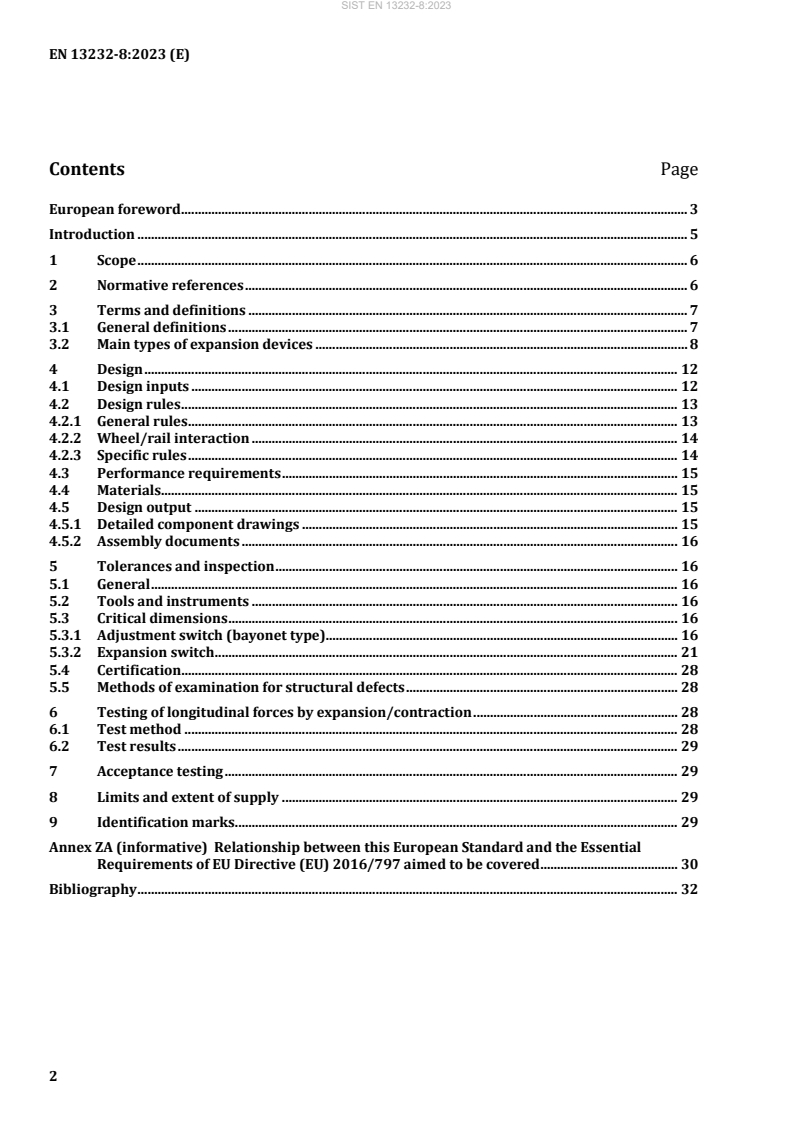
Contents Page
European foreword . 3
Introduction . 5
1 Scope . 6
2 Normative references . 6
3 Terms and definitions . 7
3.1 General definitions . 7
3.2 Main types of expansion devices . 8
4 Design . 12
4.1 Design inputs . 12
4.2 Design rules . 13
4.2.1 General rules . 13
4.2.2 Wheel/rail interaction . 14
4.2.3 Specific rules . 14
4.3 Performance requirements . 15
4.4 Materials . 15
4.5 Design output . 15
4.5.1 Detailed component drawings . 15
4.5.2 Assembly documents . 16
5 Tolerances and inspection . 16
5.1 General . 16
5.2 Tools and instruments . 16
5.3 Critical dimensions . 16
5.3.1 Adjustment switch (bayonet type). 16
5.3.2 Expansion switch . 21
5.4 Certification . 28
5.5 Methods of examination for structural defects . 28
6 Testing of longitudinal forces by expansion/contraction . 28
6.1 Test method . 28
6.2 Test results . 29
7 Acceptance testing . 29
8 Limits and extent of supply . 29
9 Identification marks. 29
Annex ZA (informative) Relationship between this European Standard and the Essential
Requirements of EU Directive (EU) 2016/797 aimed to be covered . 30
Bibliography . 32
European foreword
This document (EN 13232-8:2023) has been prepared by Technical Committee CEN/TC 256 “Railway
applications”, the secretariat of which is held by DIN.
This European Standard shall be given the status of a national standard, either by publication of an
identical text or by endorsement, at the latest by April 2024, and conflicting national standards shall be
withdrawn at the latest by April 2024.
Attention is drawn to the possibility that some of the elements of this document may be the subject of
patent rights. CEN shall not be held responsible for identifying any or all such patent rights.
This document supersedes EN 13232-8:2007+A1:2011.
This series of standards “Railway applications – Track – Switches and crossings for Vignole rails” covers
the design and quality of switches and crossings in flat bottomed rail. The list of Parts is as follows:
— Part 1: Definitions
— Part 2: Requirements for geometric design
— Part 3: Requirements for wheel/rail interaction
— Part 4: Actuation, locking and detection
— Part 5: Switches
— Part 6: Fixed common and obtuse crossings
— Part 7: Crossings with moveable parts
— Part 8: Expansion devices
— Part 9: Layouts
Part 1 contains terminology used throughout all parts of this series. Parts 2 to 4 contain basic design
guides and are applicable to all switch and crossing assemblies. Parts 5 to 8 deal with particular types of
equipment including their tolerances. These use Parts 1 to 4 as a basis. Part 9 defines the geometric and
non-geometrical acceptance criteria for inspection of layouts.
This document has been prepared under a standardisation request addressed to [the relevant ESO] by
the European Commission. The Standing Committee of the EFTA States subsequently approves these
requests for its Member States.
For the relationship with EU Legislation, see informative Annex ZA, which is an integral part of this
document.
Any feedback and questions on this document should be directed to the users’ national standards body.
A complete listing of these bodies can be found on the CEN website.
According to the CEN-CENELEC Internal Regulations, the national standards organisations of the
following countries are bound to implement this European Standard: Austria, Belgium, Bulgaria,
Croatia, Cyprus, Czech Republic, Denmark, Estonia, Finland, France, Germany, Greece, Hungary, Iceland,
Ireland, Italy, Latvia, Lithuania, Luxembourg, Malta, Netherlands, Norway, Poland, Portugal, Republic of
North Macedonia, Romania, Serbia, Slovakia, Slovenia, Spain, Sweden, Switzerland, Türkiye and the
United Kingdom.
Introduction
An expansion device is a device that permits longitudinal relative rail movement of two adjacent rails,
while maintaining correct guidance and support.
These longitudinal movements may be required in:
a) interrupted continuously welded rail (CWR);
b) structure movement;
c) or a combination of both.
1 Scope
This document
— establishes a working terminology for expansion devices, for their constituent parts and for the
types
— specifies the minimum manufacturing requirements for expansion devices and their constituent
parts
— formulates codes of practice for inspection and tolerances
— defines the method by which expansion devices and their parts should be identified.
2 Normative references
The following documents are referred to in the text in such a way that some or all of their content
constitutes requirements of this document. For dated references, only the edition cited applies. For
undated references, the latest edition of the referenced document (including any amendments) applies.
EN 13146-1:2019, Railway applications - Track - Test methods for fastening systems - Part 1:
Determination of longitudinal rail restraint
EN 13232-1:2023, Railway applications – Track — Switches and crossings for Vignole rails – Part 1:
Definitions
EN 13232-2:2023, Railway applications – Track — Switches and crossings for Vignole rails – Part 2:
Requirements for geometric design
EN 13232-3:2023, Railway applications – Track – Switches and crossings for Vignole rails – Part 3:
Requirements for wheel/rail interaction
EN 13232-9:2023, Railway applications – Track – Switches and crossings for Vignole rails – Part 9:
Layouts
EN 13715:2020, Railway applications – Wheelsets and bogies – Wheels – Wheels tread
EN 13674-1:2011+A1:2017, Railway applications – Track – Rail - Part 1: Vignole railway rails 46 kg/m
and above
EN 13674-2:2019, Railway applications – Track – Rail- Part 2: Switch and crossing rails used in
conjunction with Vignole railway rails 46 kg/m and above
3 Terms and definitions
For the purpose of this document the terms and definitions given in EN 13232-1:2023 and the following
apply.
ISO and IEC maintain terminological databases for use in standardization at the following addresses:
— ISO Online browsing platform: available at https://www.iso.org/obp
— IEC Electropedia: available at http://www.electropedia.org/
3.1 General definitions
3.1.1
hand of half set
identifies the left hand or right hand half set of the adjustment or expansion switch when viewed
standing in the centre of the track and facing the tips of the inside rails or switches
Note 1 to entry: With check rails, there may be two LH or two RH half sets, see Figure 6, or opposite hand half
sets.
Note 2 to entry: See 3.2.1 for definition of adjustment switch.
Note 3 to entry: See 3.2.2 for definition of expansion switch.
3.1.2
expansion capacity C
maximum permissible relative longitudinal movement between the two rails, where:
C = D – D
max min
Note 1 to entry: See Figures 1 and 2.
Key Key
D minimum gap D maximum gap
min max
Figure 1 — Closed position Figure 2 — Open position
3.1.3
relative displacement rail / support
maximum permissible relative longitudinal movement between the rail (switch or stock rail) and the
corresponding support (base plate or bearer)
3.1.4
mean position
position where the expansion capacity and the relative displacement of rails are half way, and the
bearers are in their nominal position (See Figure 3)
3.1.5
design position
nominal position where the expansion capacity and the relative displacement of rails are half way,
especially where shrinkage of concrete structures, for example, will shift the mean position
Key
Dmin minimum gap
D maximum gap
max
M mean position
Figure 3 — Mean position
3.2 Main types of expansion devices
3.2.1
adjustment switch
expansion device with interruption of the running edge sometimes called bayonet type
3.2.1.1
adjustment switch without check rails (both sides moveable)
Key
1 slide chair 4 moveable rails
2 low restrain fastening 5 bearer straps
3 standard fastening R reference point
Figure 4 — Adjustment switch – Both sides moveable
Note 1 to Entry Low restraint fastenings are not always used and therefore not mandatory, the figure
illustrates the location of the low restraint fastening for the situations where they are used. See also 4.2.1.2
3.2.1.2
adjustment switch without check rails with one side moveable
Key
1 slide chair 5 fixed rails
2 low restrain fastening 6 bearer straps
3 standard fastening R reference point
4 moveable rails
Figure 5 — Adjustment switch – One side moveable
Note 1 to Entry Low restraint fastenings are not always used and therefore not mandatory, the figure
illustrates the location of the low restraint fastening for the situations where they are used. See also 4.2.1.2
3.2.1.3
adjustment switch with check rails with both sides moveable
Key
1 slide chair 5 check rails
2 low restrain fastening 6 bearer strap
3 standard fastening R reference point
4 moveable rails
Figure 6 — Adjustment switch with check rails – Both sides moveable
Note 1 to Entry Low restraint fastenings are not always used and therefore not mandatory, the figure
illustrates the location of the low restraint fastening for the situations where they are used. See also 4.2.1.2
3.2.1.4
adjustment switch with check rails with one side moveable
Key
1 slide chair 5 fixed rails
2 low restrain fastening 6 check rails
3 standard fastening 7 bearer strap
4 moveable rails R reference point
Figure 7 — Adjustment switch with check rails – One side moveable
Note 1 to Entry Low restraint fastenings are not always used and therefore not mandatory, the figure
illustrates the location of the low restraint fastening for the situations where they are used. See also 4.2.1.2
3.2.2
expansion switch
expansion device without interruption of the running edge, with or without change of gauge
3.2.2.1
expansion switch with moveable stock rails
this arrangement allows for retention of the track gauge dimension
Key
1 slide chair 5 fixed switch rails
2 low restrain fastening 6 bearer strap
3 standard fastening R reference point
4 moveable stock rails
Figure 8 — Expansion switch – Moveable stock rails
Note 1 to Entry Low restraint fastenings are not always used and therefore not mandatory, the figure
illustrates the location of the low restraint fastening for the situations where they are used. See also 4.2.1.2
3.2.2.2
expansion switch with moveable switch rails
this arrangement does not allow for retention of the track gauge dimension
Key
1 slide chair 5 moveable switch rails
2 low restrain fastening 6 bearer strap
3 standard fastening R reference point
4 fixed stock rails
Figure 9 — Expansion switch – Moveable switch rails
Note 1 to Entry Low restraint fastenings are not always used and therefore not mandatory, the figure
illustrates the location of the low restraint fastening for the situations where they are used. See also 4.2.1.2
3.2.2.3
expansion switch both sides moveable
this arrangement does not allow for retention of the track gauge dimension
Key
1 slide chair 5 moveable switch rails
2 low restrain fastening 6 bearer strap
3 standard fastening R reference point
4 moveable stock rails
Figure 10 — Expansion switch – Both sides moveable
Note 1 to Entry Low restraint fastenings are not always used and therefore not mandatory, the figure
illustrates the location of the low restraint fastening for the situations where they are used. See also 4.2.1.2
4 Design
4.1 Design inputs
The following information shall be supplied by the customer to the supplier:
— axle load;
— gross annual tonnage;
— train speed;
— nominal track gauge;
— direction of traffic;
— track geometry.
In addition the customer shall decide:
— the type of expansion device to be applied;
— the expansion capacity of the expansion device as well as the maximum displacement rail/support.
If the latter is not provided, it shall be estimated to be half the expansion capacity of the device;
— the basic rail section and grade;
— the rail inclination to be applied through the expansion device;
— the fastening system to be applied;
— the nominal support spacing;
— type of support structure, e.g. bearer, slab track;
— special requirements, e.g. limits of vertical and horizontal end rotations, limits of local vertical and
horizontal radii of track, limits of uplift movements on rail supports adjacent to the gap between
the structure and the abutment or between the structures.
The following elements shall be agreed between customer and supplier:
— the special rail profiles to be applied for the construction (if applicable);
— the constructional length;
— the machining details of the rail sections;
— the maximum support spacing in service.
4.2 Design rules
4.2.1 General rules
4.2.1.1 Support panel
In the case where one side is moveable, a number of bearers shall be restrained from moving when laid
on ballast. This is normally a minimum of four bearers. The incoming rails may, for example, have low
resistance fastenings on the restrained bearers to permit movement of the moveable rails.
All restrained bearers shall be linked to each other. This can be achieved by the use of a bearer strap,
guard rail, continuous base plate etc.
In the case when both sides are moveable, the bearers shall be restrained from moving by means of a
steel strap. This is to ensure bearer distance does not change and prohibits the bearers from moving
from their nominal position during operation and/or maintenance.
4.2.1.2 Fastenings
The fastenings are dependent on the application of the expansion device; therefore the rail fastenings
shall be specified by the cust
...