

EN 13567:2002+A1:2007
(Main + Amendment)Protective clothing - Hand, arm, chest, abdomen, leg, genital and face protectors for fencers - Requirements and test methods
- Abstract
This European Standard specifies the general requirements for ergonomics, sizing, coverage and performance of protective clothing and equipment for use in the sport of fencing. Requirements for the marking of clothing and equipment and the information to be supplied by the manufacturer are given. Test methods are described and performance levels are defined.
- Status
- Published
- Publication Date
- 12-Jun-2007
- Withdrawal Date
- 30-Dec-2007
- Technical Committee
- CEN/TC 162 - Protective clothing including hand and arm protection and lifejackets
- Drafting Committee
- CEN/TC 162/WG 11 - Body protection for sports
- Current Stage
- 9092 - Decision on results of review/2YR ENQ - revise - Review Enquiry
- Start Date
- 01-Oct-2024
- Completion Date
- 21-Oct-2026
- Directive
- 2016/425 - Regulation (EU) 2016/425 of the European Parliament and of the Council of 9 March 2016 on personal protective equipment and repealing Council Directive 89/686/EECOJ Ref: C, C 113 OJ Date: 27-Mar-2018
89/686/EEC - Personal protective equipment (PPE)OJ Ref: C, C 205 OJ Date: 09-Jul-2011

Overview
EN 13567:2002+A1:2007 (CEN) is the European standard for protective clothing and equipment used in the sport of fencing. It specifies general requirements for ergonomics, sizing, coverage and performance of garments and devices that protect the hands, arms, chest, abdomen, legs, genitals and face. The standard also sets out marking, manufacturer information requirements and detailed test methods and performance levels to assess protection against typical fencing hazards (including blade impacts and broken blades).
Key Topics
- Scope and purpose
- Defines protective clothing and equipment for foil, épée and sabre disciplines and aims to reduce injury severity without impeding performance.
- Zones of protection and coverage
- Specifies protected body areas and minimum dimensions for protective zones on jackets, breeches, masks and other items.
- Ergonomics and sizing
- Requirements for fit, range of motion and sizing guidance to ensure useability and compliance across body dimensions.
- Materials and construction
- Expectations for construction details, seams and materials chosen for protection and wearer comfort.
- Performance requirements
- Penetration resistance (to reduce risk from broken blades), burst strength of seams, and other mechanical properties are defined and associated with performance levels.
- Test methods
- Describes conditioning, instrumentation and procedures for testing penetration, burst strength and other properties; includes mask-specific tests (bib attachments, lateral protection, joins).
- Marking and information
- Requirements for labeling, performance level marking, handedness, care instructions and manufacturer information.
Applications
- Manufacturers of fencing jackets, breeches, masks, gloves, breast and genital protectors use EN 13567 to design, test and label products for competition and training.
- Independent testing laboratories and certification bodies apply the test methods and performance-level criteria when issuing compliance reports.
- Sport federations, clubs and event organisers reference the standard when specifying allowable equipment for competitions and participant safety.
- Product designers and safety managers use the ergonomics and sizing guidance to balance protection with mobility in fencing apparel.
Related Standards
EN 13567 references and aligns with several standards used for testing and materials, for example:
- EN 166:2001 (eye protection), EN 388, EN 420 (glove standards)
- EN 1082-1:1996, EN 13546:2002, EN 13595-3:2002
- EN ISO 13938-1/-2, EN ISO 5084:1996, ISO 3758, ISO 6330, ISO 7500-1, ISO 8559:1989
Using EN 13567 helps ensure fencing equipment meets recognized European safety and performance benchmarks while maintaining the ergonomics athletes require.
Relations
- Effective Date
- 22-Dec-2008
- Effective Date
- 22-Dec-2008
- Effective Date
- 25-Aug-2026
- Effective Date
- 25-Aug-2026
- Effective Date
- 25-Aug-2026
- Effective Date
- 25-Aug-2026
- Effective Date
- 28-Jan-2026
- Effective Date
- 28-Jan-2026
- Effective Date
- 28-Jan-2026
- Effective Date
- 28-Jan-2026
- Refers
EN ISO 21420:2020 - Protective gloves - General requirements and test methods (ISO 21420:2020) - Effective Date
- 28-Jan-2026
- Effective Date
- 28-Jan-2026
- Effective Date
- 28-Jan-2026
- Effective Date
- 28-Jan-2026
- Refers
prEN 12390-6 - Testing hardened concrete - Part 6: Tensile splitting strength of test specimens - Effective Date
- 28-Jan-2026
Get Certified
Connect with accredited certification bodies for this standard

CIS Institut d.o.o.
Personal Protective Equipment (PPE) certification body. Notified Body NB-2890 for EU Regulation 2016/425 PPE.

Kiwa BDA Testing
Building and construction product certification.
Kmetijski inštitut Slovenije
Agricultural Institute of Slovenia. Soil testing, plant health, agricultural product analysis.
Sponsored listings
Frequently Asked Questions
EN 13567:2002+A1:2007 is a standard published by the European Committee for Standardization (CEN). Its full title is "Protective clothing - Hand, arm, chest, abdomen, leg, genital and face protectors for fencers - Requirements and test methods". This standard covers: This European Standard specifies the general requirements for ergonomics, sizing, coverage and performance of protective clothing and equipment for use in the sport of fencing. Requirements for the marking of clothing and equipment and the information to be supplied by the manufacturer are given. Test methods are described and performance levels are defined.
This European Standard specifies the general requirements for ergonomics, sizing, coverage and performance of protective clothing and equipment for use in the sport of fencing. Requirements for the marking of clothing and equipment and the information to be supplied by the manufacturer are given. Test methods are described and performance levels are defined.
EN 13567:2002+A1:2007 is classified under the following ICS (International Classification for Standards) categories: 13.340.10 - Protective clothing. The ICS classification helps identify the subject area and facilitates finding related standards.
EN 13567:2002+A1:2007 has the following relationships with other standards: It is inter standard links to EN 13567:2002/prA1, EN 13567:2002, ISO 6330:2000, ISO 7500-1:1999, ISO 3758:2005, ISO 8559:1989, EN 166:2001, EN 388:2016+A1:2018, EN 1082-1:1996, EN ISO 13938-2:1999, EN ISO 21420:2020, EN ISO 13938-1:1999, EN 13595-3:2002, EN ISO 5084:1996, prEN 12390-6. Understanding these relationships helps ensure you are using the most current and applicable version of the standard.
EN 13567:2002+A1:2007 is associated with the following European legislation: EU Directives/Regulations: 2016/425, 89/686/EEC, 93/68/EEC, 93/95/EEC, 96/58/EC; Standardization Mandates: M/031. When a standard is cited in the Official Journal of the European Union, products manufactured in conformity with it benefit from a presumption of conformity with the essential requirements of the corresponding EU directive or regulation.
EN 13567:2002+A1:2007 is available in PDF format for immediate download after purchase. The document can be added to your cart and obtained through the secure checkout process. Digital delivery ensures instant access to the complete standard document.
Standards Content (Sample)
2003-01.Slovenski inštitut za standardizacijo. Razmnoževanje celote ali delov tega standarda ni dovoljeno.Schutzkleidung - Hand-, Arm-, Brustkorb-, Unterleibs-, Bein-, Genital- und Gesichtsschützer für Fechter - Anforderungen und PrüfverfahrenVetements de protection - Protection des mains, des bras, de la piotrine, de l'abdomen, des jambes, génitales et de la face pour les escrimeurs - Exigences et méthodes d'essaiProtective clothing - Hand, arm, chest, abdomen, leg, genital and face protectors for fencers - Requirements and test methods97.220.30Oprema za dvoranske športeIndoor sports equipment13.340.10Varovalna oblekaProtective clothingICS:Ta slovenski standard je istoveten z:EN 13567:2002+A1:2007SIST EN 13567:2002+A1:2007en,fr,de01-november-2007SIST EN 13567:2002+A1:2007SLOVENSKI
STANDARD
EUROPEAN STANDARD NORME EUROPÉENNE EUROPÄISCHE NORM
EN 13567:2002+A1
June 2007 ICS 13.340.10 SupersedesEN 13567:2002English Version
Protective clothing - Hand, arm, chest, abdomen, leg, genital and face protectors for fencers - Requirements and test methods
Vêtements de protection - Protection des mains, des bras, de la piotrine, de l'abdomen, des jambes, génitales et de la face pour les escrimeurs - Exigences et méthodes d'essai Schutzkleidung - Hand-, Arm-, Brustkorb-, Unterleibs-, Bein-, Genital- und Gesichtsschützer für Fechter - Anforderungen und Prüfverfahren This European Standard was approved by CEN on 25 March 2002 and includes Amendment 1 approved by CEN on 10 May 2007.
CEN members are bound to comply with the CEN/CENELEC Internal Regulations which stipulate the conditions for giving this European Standard the status of a national standard without any alteration. Up-to-date lists and bibliographical references concerning such national standards may be obtained on application to the CEN Management Centre or to any CEN member.
This European Standard exists in three official versions (English, French, German). A version in any other language made by translation under the responsibility of a CEN member into its own language and notified to the CEN Management Centre has the same status as the official versions.
CEN members are the national standards bodies of Austria, Belgium, Bulgaria, Cyprus, Czech Republic, Denmark, Estonia, Finland, France, Germany, Greece, Hungary, Iceland, Ireland, Italy, Latvia, Lithuania, Luxembourg, Malta, Netherlands, Norway, Poland, Portugal, Romania, Slovakia, Slovenia, Spain, Sweden, Switzerland and United Kingdom.
EUROPEAN COMMITTEE FOR STANDARDIZATION
COMITÉ EUROPÉEN DE NORMALISATION EUROPÄISCHES KOMITEE FÜR NORMUNG
Management Centre: rue de Stassart, 36
B-1050 Brussels © 2007 CEN All rights of exploitation in any form and by any means reserved worldwide for CEN national Members. Ref. No. EN 13567:2002+A1:2007: ESIST EN 13567:2002+A1:2007
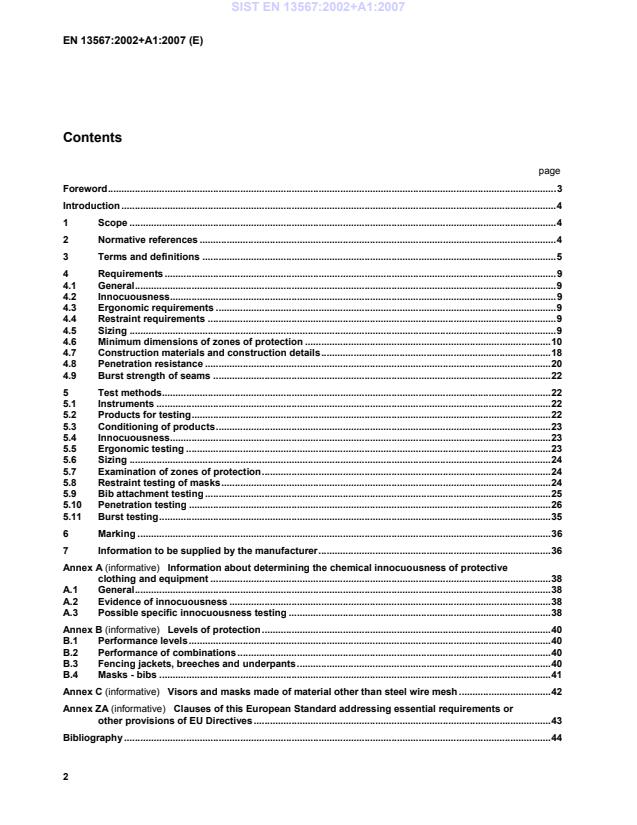
Information about determining the chemical innocuousness of protective clothing and equipment.38 A.1 General.38 A.2 Evidence of innocuousness.38 A.3 Possible specific innocuousness testing.38 Annex B (informative)
Levels of protection.40 B.1 Performance levels.40 B.2 Performance of combinations.40 B.3 Fencing jackets, breeches and underpants.40 B.4 Masks - bibs.41 Annex C (informative)
Visors and masks made of material other than steel wire mesh.42 Annex ZA (informative)
Clauses of this European Standard addressing essential requirements or other provisions of EU Directives.43 Bibliography.44
Foreword This document (EN 13567:2002+A1:2007) has been prepared by Technical Committee CEN/TC 162 "Protective clothing including hand and arm protection and lifejackets", the secretariat of which is held by DIN. This document shall be given the status of a national standard, either by publication of an identical text or by endorsement, at the latest by December 2007 and conflicting national standards shall be withdrawn at the latest by December 2007. This document includes Amendment 1, approved by CEN on 2007-05-10. This document supersedes EN 13567:2002. The start and finish of text introduced or altered by amendment is indicated in the text by tags ! ". This document has been prepared under a mandate given to CEN by the European Commission and the European Free Trade Association, and supports essential requirements of EU Directive(s). For relationship with EU Directive(s), see informative Annex ZA, which is an integral part of this document. According to the CEN/CENELEC Internal Regulations, the national standards organizations of the following countries are bound to implement this European Standard: Austria, Belgium, Bulgaria, Cyprus, Czech Republic, Denmark, Estonia, Finland, France, Germany, Greece, Hungary, Iceland, Ireland, Italy, Latvia, Lithuania, Luxembourg, Malta, Netherlands, Norway, Poland, Portugal, Romania, Slovakia, Slovenia, Spain, Sweden, Switzerland and United Kingdom.
Key ! a)
Front view b)
Side view " 1
Hard shell 2
Lateral protection 3
Bib 4
Visor (optional) Figure 1 — Component parts of a fencing mask SIST EN 13567:2002+A1:2007
Figure 2 — Illustration of the circumference of the head" SIST EN 13567:2002+A1:2007
Key ! a)
Front view
b) Side view
"
a/b The ratio of the vertical height of the lateral protection to the vertical height of the hard shell a Horizontal plane at the level of the mid point of dimension B c The internal circumference of the hard shell measured on the inner surface of the padding d The depth of the bib e The width of the lateral protection f The front to back internal depth of the hard shell g The minimum vertical height of the transparent area of a visor if present
h The minimum horizontal width of the transparent area of a visor if present
!deleted text" Figure !3" — Fencing mask - Dimensions of component parts SIST EN 13567:2002+A1:2007
a/b c d e f g h mm
mm mm mm mm mm mm i = imin to imax > 2/3 imax < c < (imax + 40) > 100 > 100 > 70 > 70 > 130 imin = minimum dimension of the vertical circumference of the head of the user imax = maximum dimension of the vertical circumference of the head of the user The difference between imax and imin shall be ≤ 80 mm. a Also dimension for the nominal size. " 4.6.3 Fencing clothing 4.6.3.1 General The specific zone of protection as well as the coverage provided by protective clothing for the trunk is determined by the particular discipline involved. It is also determined by whether the wearer is left or right handed. In all cases it is a requirement that each item of protective clothing shall be plainly marked with the particular fencing disciplines for which the clothing is suitable, as well as the ”handedness” for which it is intended (see clause 6). When the correct size of garment is worn the user should have certain areas of the body covered by protective material when making all normal fencing movements (see annex B): 4.6.3.2 Coverage by fencing jackets, breeches and underpants Jackets – From 30 mm above the neck line down to within 50 mm of the wrist, to the waist all round the torso, and in jackets for epee over the anterior surface of the abdomen (dimension D, Figure !4a"). Breeches – From at least 100 mm above the waist to at least 75 mm below the plane of the knee joint, all round the abdomen and thighs. Underpants – The anterior 50 % of the circumference of the abdomen and thighs from the waist to at least halfway down the thighs. 4.6.3.3 Dimensions of the zones of protection of fencing jackets, breeches and underpants The dimensions of the zones of protection shall be determined by the values given in the information supplied by the manufacturer for the relevant control dimensions of the largest user the garment is intended to fit. The dimensions of the zones of protection shall not be less than those defined by Table 2 and illustrated in Figure !4". SIST EN 13567:2002+A1:2007
Dimensions of the zones of protection as percentages of the control dimensions, or as a minimum value in millimetres Jacket Breeches Under pants
a % b % c mm d % e % f % g mm h % i % j %
Height - 29 - 9 29 - - 36 - 20 Control dimension Chest girth 51 - - - - - - - - -
Waist girth - - - - - 51 - - 51 - minimum value - - 30 - - - 100 - - - For with " - " characterized fields are not determined control dimensions or minimum values
Key a) Jacket b) Breeches c) Underpants
a Chest width of a jacket laid flat b Shoulder to waist length c Collar height d Height of abdominal protection e Sleeve length f Waist width of breeches laid flat
g Height of the zone of protection above the waist h Outer leg length from the lower edge of the waist band of breeches downwards i Waist width of underpants laid flat j Outer leg length from the lower edge of the waistband of under pants downwards
1 Cuffs. These are not included in the zones of protection 2 Waistband of underpants. This is not included in the zone of protection Figure !4" — Diagram of the dimensions of jackets, breeches and underpants to be measured on the garments laid out flat SIST EN 13567:2002+A1:2007
A % B % C % Height 28 20
Chest girth
Key
a Torso height from the lower edge to the top of the shoulder b Length from the neckline to the end of the sleeve c The minimum width of the anterior and posterior panels of the plastron Figure !5" — Diagram of the dimensions of an under plastron to be measured on the garment folded at the centre of the side and laid out flat
4.6.4 Gloves The zones of protection in gloves shall be on the back of the palm (hand) from the base of the fingers to at least 100 mm above the wrist. The dimensions of the zone of protection shall be at least those in Table 4. SIST EN 13567:2002+A1:2007
Table 4 — Minimum dimensions of the zones of protection in gloves Dimension mm Glove size according to EN 420
Width of the zone of protection measured across the glove Length of the zone of protection measured from the base of the crotch between the second and third fingers towards the wrist 6,5 75 196 7,0 80 200 7,5 80 204 8,0 85 208 8,5 95 212 9,0 100 216 9,5 100 220 10,0 100 224 10,5 110 228 11,0 110 232
4.6.5 Socks Socks shall be continuously protective throughout their length. !The socks shall cover all leg regions not covered by any other protective equipment and overlap the lower part of the protective zone of the breeches by at least
3 cm." !deleted text" SIST EN 13567:2002+A1:2007
hard shell Mask,
lateral protection Mask,
bib Performance level Low velocity test Impact test
energy, J Impact test
energy, J High velocity test 1 No penetration at 600 N 5,5 4,75 > 350 N 2 No penetration at 1 000 N 8,5 7 > 1 600 N " !The lower levels for impact test on the lateral protection should only apply to masks made with the same batch or specification of steel wire mesh for both the hard shell and the lateral protection." 4.8.3 Jackets The mean value of the penetration forces of the zones of protection of fencing jackets shall be higher than the values in Table !6" when tested as described in clause 5.10.5. No more than one individual result shall be less than 96 % of the value in the table. SIST EN 13567:2002+A1:2007
4.8.4 Breeches The mean value of the penetration forces of the zones of protection of fencing breeches shall be higher than the values in Table !7" when tested as described in 5.10.5. No more than one individual result shall be less than 96 % of the value in the table. Table !7" — Fencing breeches - Penetration force requirements Performance level Penetration force 1 > 350 N 2 > 800 N
4.8.5 Under pants The mean value of the penetration forces of the zones of protection of fencing under pants shall be higher than the values in Table !8" when tested as described in 5.10.5. No more than one individual result shall be less than 96 % of the value in the table. Table !8" — Under pants - Penetration force requirements Performance level Penetration force 1 > 350 N 2 > 800 N
4.8.6 Under plastrons The mean value of the penetration forces of the zones of protection of fencing under plastrons shall be higher than the values in Table !9" when tested as described in 5.10.5. No more than one individual result shall be less than 96 % of the value in the table. Table !9" — Under plastron - Penetration force requirements Performance level Penetration force 1 > 350 N 2 > 800 N
4.8.7 Gloves All gloves shall be at least 0,5 mm thick from the fingertips to the wrist, and at least 1,0 mm thick in the zone of protection and in the cuff. Glove thickness shall be measured according to the method in EN ISO 5084:1996. The mean value of the penetration forces of the zone of protection of fencing gloves shall be higher than the values in SIST EN 13567:2002+A1:2007
4.8.8 Socks Socks shall be at least 1,0 mm thick. Sock thickness shall be measured according to test methods described in EN ISO 5084:1997. 4.8.9 Breast protectors When tested by the method in clause 5.10.6 with an impact energy of (2,5 ± 0,05) J breast protectors shall not be penetrated, nor show other damage such as cracks or fractures. 4.8.10 Genital protectors When tested by the method in clause 5.10.6 with an impact energy of (2,5 ± 0,05) J genital protectors shall not be penetrated, nor show other damage such as cracks or fractures. 4.9 Burst strength of seams The seams between materials providing the mechanical properties of the zones of protection in jackets, breeches, under pants and under plastrons shall have a burst strength of at least 300 kPa when tested according to 5.11. 5 Test methods 5.1 Instruments Measuring instruments unless otherwise specified shall be an error limit of ± 2 % of the pass/fail level of the characteristic being measured. For each of the required sequences of measurements performed in accordance with this standard except those depending on a reference material, a corresponding estimate of the uncertainty of the final result shall be determined. This uncertainty (Um) shall be given in the test report in the form Um = ± X. It shall be used in determining whether a "Pass" performance has been achieved. If the final result minus Um is below the pass level when the requirement that a certain value shall be exceeded, the sample shall be deemed to have failed. 5.2 Products for testing Test items shall be supplied by manufacturers complete with labels and the information supplied by the manufacturer (see clause 7) that wil
...