

EN 17285:2020
(Main)Railway applications - Acoustics - Measuring of door audible warnings
- Abstract
This document specifies procedures to assess acoustic signals at passenger external doors applying to all kind of rolling stock. The following applies to this standard:
- this document refers to acoustical passenger information indicating the release, opening and closing of passenger doors;
- this document is applicable to tonal signals with defined frequency components levels and pulse sequences;
- this document is not applicable to spoken information or to signals comprising a sequence of impulses (such as a door finding signal).
NOTE Acoustic door signals are defined in EN 16584 2 "Design for PRM use".
- Status
- Published
- Publication Date
- 04-Aug-2020
- Withdrawal Date
- 27-Feb-2021
- Technical Committee
- CEN/TC 256 - Railway applications
- Drafting Committee
- CEN/TC 256/WG 3 - Noise emission
- Current Stage
- 9093 - Decision to confirm - Review Enquiry
- Start Date
- 05-Mar-2026
- Completion Date
- 14-Oct-2026


Overview
EN 17285:2020 - Railway applications: Acoustics - Measuring of door audible warnings is a CEN standard that defines procedures to assess acoustic door signals on passenger rolling stock. It applies to tonal door audible warnings that indicate door release, opening and closing and sets out measurement methods for interior, exterior and laboratory tests. The standard is intended for consistent, repeatable sound measurement of door signals across all types of rolling stock.
Key Topics and Requirements
- Scope and exclusions
- Applies to tonal signals with defined frequency components and pulse sequences.
- Not applicable to spoken announcements or signals consisting of sequences of impulses (e.g., door-finding signals).
- Instrumentation and calibration
- Measurement systems shall meet class 1 requirements (EN 61672-1/2); sound calibrators per EN IEC 60942.
- Use free-field microphones and appropriate windscreens; one-third octave filters per EN 61260 when required.
- Calibration checks: calibrator verification at least once a year; instrumentation system verification at least every 2 years.
- A pre/post measurement calibration check is required; if calibration drift > 0.5 dB, results must be rejected.
- Measurement procedures
- Defined procedures for interior tests (vestibule classification, environmental and vehicle conditions, measurement positions).
- Defined procedures for exterior tests (measurement positions, pulse rate, frequency properties).
- Measured quantities include sound pressure levels, pulse rate, frequency components and tonal prominence.
- Annexes and special tests
- Normative Annex A: tonal prominence assessment methodology.
- Annex B: tests for adaptive-level door warnings (background noise simulation and test examples).
- Annex C: laboratory test methods, mounting arrangements and modes of operation.
Applications and Who Uses It
- Rolling stock manufacturers and vehicle system integrators for design verification of door audible warnings.
- Acoustic engineers and test laboratories performing interior/exterior noise testing on passenger doors.
- Rail operators and procurement teams requiring compliance evidence for accessibility and safety features.
- Regulators and certification bodies assessing conformity with acoustic requirements.
- Accessibility (PRM) specialists, since door signals interact with passenger information needs (see EN 16584‑2).
Related Standards
- EN 16584-2 (“Design for PRM use”) - defines acoustic door signal roles for persons with reduced mobility.
- EN IEC 60942, EN 61672-1/2, EN 61260 - referenced electroacoustic instrument and calibration standards.
- ISO 1996-2:2017 and ISO 266 - environmental noise measurement and preferred frequencies.
EN 17285:2020 ensures consistent, repeatable measurement of door audible warnings across rolling stock fleets, supporting safety, accessibility and regulatory compliance in railway acoustics.
Relations
- Effective Date
- 11-Mar-2026
- Effective Date
- 11-Mar-2026
- Effective Date
- 09-Feb-2026
- Effective Date
- 09-Feb-2026
- Effective Date
- 09-Feb-2026
- Effective Date
- 09-Feb-2026
- Effective Date
- 09-Feb-2026
- Effective Date
- 09-Feb-2026
- Effective Date
- 09-Feb-2026
- Effective Date
- 28-Jan-2026
- Effective Date
- 28-Jan-2026
- Effective Date
- 28-Jan-2026
- Effective Date
- 28-Jan-2026
Get Certified
Connect with accredited certification bodies for this standard

IRIS Certification (UNIFE)
International Railway Industry Standard certification.

TÜV SÜD Rail GmbH
TÜV SÜD railway certification services.
BSMI (Bureau of Standards, Metrology and Inspection)
Taiwan's standards and inspection authority.
Sponsored listings
Frequently Asked Questions
EN 17285:2020 is a standard published by the European Committee for Standardization (CEN). Its full title is "Railway applications - Acoustics - Measuring of door audible warnings". This standard covers: This document specifies procedures to assess acoustic signals at passenger external doors applying to all kind of rolling stock. The following applies to this standard: - this document refers to acoustical passenger information indicating the release, opening and closing of passenger doors; - this document is applicable to tonal signals with defined frequency components levels and pulse sequences; - this document is not applicable to spoken information or to signals comprising a sequence of impulses (such as a door finding signal). NOTE Acoustic door signals are defined in EN 16584 2 "Design for PRM use".
This document specifies procedures to assess acoustic signals at passenger external doors applying to all kind of rolling stock. The following applies to this standard: - this document refers to acoustical passenger information indicating the release, opening and closing of passenger doors; - this document is applicable to tonal signals with defined frequency components levels and pulse sequences; - this document is not applicable to spoken information or to signals comprising a sequence of impulses (such as a door finding signal). NOTE Acoustic door signals are defined in EN 16584 2 "Design for PRM use".
EN 17285:2020 is classified under the following ICS (International Classification for Standards) categories: 17.140.30 - Noise emitted by means of transport; 45.060.20 - Trailing stock. The ICS classification helps identify the subject area and facilitates finding related standards.
EN 17285:2020 has the following relationships with other standards: It is inter standard links to ISO 266:1997, ISO 1996-2:2017, EN IEC 60942:2018, EN 61260-1:2014, EN 61260-2:2016, EN 61260-2:2016/A1:2017, EN 61260-3:2016, EN 61672-1:2013, EN 61672-2:2013, EN ISO 12217-1:2015, EN 27490:1991, EN 16584-2:2025, EN 14752:2025. Understanding these relationships helps ensure you are using the most current and applicable version of the standard.
EN 17285:2020 is associated with the following European legislation: EU Directives/Regulations: 2008/57/EC; Standardization Mandates: M/483. When a standard is cited in the Official Journal of the European Union, products manufactured in conformity with it benefit from a presumption of conformity with the essential requirements of the corresponding EU directive or regulation.
EN 17285:2020 is available in PDF format for immediate download after purchase. The document can be added to your cart and obtained through the secure checkout process. Digital delivery ensures instant access to the complete standard document.
Standards Content (Sample)
SLOVENSKI STANDARD
01-oktober-2020
Železniške naprave - Akustika - Merjenje zvočnih opozoril pri vratih
Railway applications - Acoustics - Measuring of door audible warnings
Bahnanwendung - Akustik - Messung akustischer Türsignale von Eisenbahnfahrzeugen
Application ferroviaires - Acoustique - Mesurage des signaux audibles d’avertissement
des portes
Ta slovenski standard je istoveten z: EN 17285:2020
ICS:
17.140.30 Emisija hrupa transportnih Noise emitted by means of
sredstev transport
45.060.20 Železniški vagoni Trailing stock
2003-01.Slovenski inštitut za standardizacijo. Razmnoževanje celote ali delov tega standarda ni dovoljeno.
EN 17285
EUROPEAN STANDARD
NORME EUROPÉENNE
August 2020
EUROPÄISCHE NORM
ICS 17.140.30; 45.060.20
English Version
Railway applications - Acoustics - Measuring of door
audible warnings
Application ferroviaires - Acoustique - Mesurage des Bahnanwendung - Akustik - Messung akustischer
signaux audibles d'avertissement des portes Türsignale von Eisenbahnfahrzeugen
This European Standard was approved by CEN on 29 June 2020.
CEN members are bound to comply with the CEN/CENELEC Internal Regulations which stipulate the conditions for giving this
European Standard the status of a national standard without any alteration. Up-to-date lists and bibliographical references
concerning such national standards may be obtained on application to the CEN-CENELEC Management Centre or to any CEN
member.
This European Standard exists in three official versions (English, French, German). A version in any other language made by
translation under the responsibility of a CEN member into its own language and notified to the CEN-CENELEC Management
Centre has the same status as the official versions.
CEN members are the national standards bodies of Austria, Belgium, Bulgaria, Croatia, Cyprus, Czech Republic, Denmark, Estonia,
Finland, France, Germany, Greece, Hungary, Iceland, Ireland, Italy, Latvia, Lithuania, Luxembourg, Malta, Netherlands, Norway,
Poland, Portugal, Republic of North Macedonia, Romania, Serbia, Slovakia, Slovenia, Spain, Sweden, Switzerland, Turkey and
United Kingdom.
EUROPEAN COMMITTEE FOR STANDARDIZATION
COMITÉ EUROPÉEN DE NORMALISATION
EUROPÄISCHES KOMITEE FÜR NORMUNG
CEN-CENELEC Management Centre: Rue de la Science 23, B-1040 Brussels
© 2020 CEN All rights of exploitation in any form and by any means reserved Ref. No. EN 17285:2020 E
worldwide for CEN national Members.
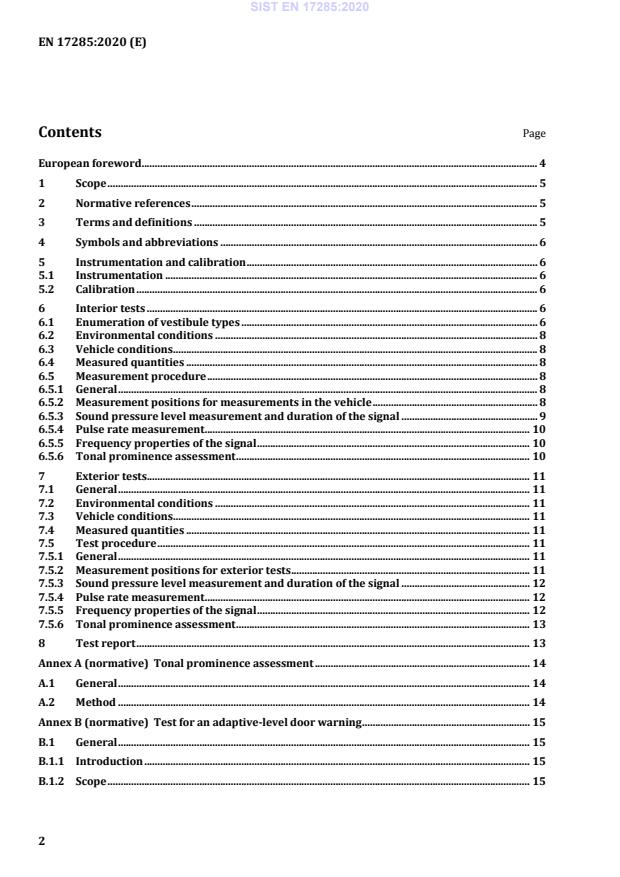
Contents Page
European foreword . 4
1 Scope . 5
2 Normative references . 5
3 Terms and definitions . 5
4 Symbols and abbreviations . 6
5 Instrumentation and calibration . 6
5.1 Instrumentation . 6
5.2 Calibration . 6
6 Interior tests . 6
6.1 Enumeration of vestibule types . 6
6.2 Environmental conditions . 8
6.3 Vehicle conditions . 8
6.4 Measured quantities . 8
6.5 Measurement procedure . 8
6.5.1 General . 8
6.5.2 Measurement positions for measurements in the vehicle . 8
6.5.3 Sound pressure level measurement and duration of the signal . 9
6.5.4 Pulse rate measurement . 10
6.5.5 Frequency properties of the signal . 10
6.5.6 Tonal prominence assessment . 10
7 Exterior tests. 11
7.1 General . 11
7.2 Environmental conditions . 11
7.3 Vehicle conditions . 11
7.4 Measured quantities . 11
7.5 Test procedure . 11
7.5.1 General . 11
7.5.2 Measurement positions for exterior tests . 11
7.5.3 Sound pressure level measurement and duration of the signal . 12
7.5.4 Pulse rate measurement . 12
7.5.5 Frequency properties of the signal . 12
7.5.6 Tonal prominence assessment . 13
8 Test report . 13
Annex A (normative) Tonal prominence assessment . 14
A.1 General . 14
A.2 Method . 14
Annex B (normative) Test for an adaptive-level door warning . 15
B.1 General . 15
B.1.1 Introduction . 15
B.1.2 Scope . 15
B.1.3 Approach . 15
B.2 Quantities specific to this annex . 15
B.3 Instrumentation . 17
B.4 Environmental and vehicle conditions . 17
B.5 Measurement positions and data sampling . 17
B.6 ‘Background’ noise to be generated for the test . 17
B.7 Procedure . 18
B.8 Reporting requirements . 20
B.9 Examples . 20
B.9.1 General . 20
B.9.2 Example 1 . 21
B.9.2.1 Description . 21
B.9.2.2 Procedure . 22
B.9.3 Example 2 . 25
B.9.3.1 Description . 25
B.9.3.2 Procedure . 26
B.9.4 Example 3 . 28
B.9.4.1 Description . 28
B.9.4.2 Procedure . 29
Annex C (normative) Laboratory tests . 32
C.1 General . 32
C.2 Mounting arrangements. 32
C.3 Modes of operation . 32
C.4 Instrumentation . 32
C.5 Background noise level . 33
C.6 Pulse rate estimation . 33
C.7 Frequency analysis . 33
C.8 Measurement of sound pressure level . 33
Bibliography . 36
European foreword
This document (EN 17285:2020) has been prepared by Technical Committee CEN/TC 256 “Railway
applications”, the secretariat of which is held by DIN.
This European Standard shall be given the status of a national standard, either by publication of an
identical text or by endorsement, at the latest by February 2021, and conflicting national standards shall
be withdrawn at the latest by February 2021.
Attention is drawn to the possibility that some of the elements of this document may be the subject of
patent rights. CEN shall not be held responsible for identifying any or all such patent rights.
According to the CEN-CENELEC Internal Regulations, the national standards organisations of the
following countries are bound to implement this European Standard: Austria, Belgium, Bulgaria, Croatia,
Cyprus, Czech Republic, Denmark, Estonia, Finland, France, Germany, Greece, Hungary, Iceland, Ireland,
Italy, Latvia, Lithuania, Luxembourg, Malta, Netherlands, Norway, Poland, Portugal, Republic of North
Macedonia, Romania, Serbia, Slovakia, Slovenia, Spain, Sweden, Switzerland, Turkey and the United
Kingdom.
1 Scope
This document specifies procedures to assess acoustic signals at passenger external doors applying to all
kind of rolling stock. The following applies to this standard:
— this document refers to acoustical passenger information indicating the release, opening and closing
of passenger doors;
— this document is applicable to tonal signals with defined frequency components levels and pulse
sequences;
— this document is not applicable to spoken information or to signals comprising a sequence of
impulses (such as a door finding signal).
NOTE Acoustic door signals are defined in EN 16584-2 “Design for PRM use”.
2 Normative references
The following documents are referred to in the text in such a way that some or all of their content
constitutes requirements of this document. For dated references, only the edition cited applies. For
undated references, the latest edition of the referenced document (including any amendments) applies.
EN IEC 60942, Electroacoustics — Sound calibrators
EN 61260 (series), Electroacoustics — Octave-band and fractional-octave-band filters
EN 61672-1, Electroacoustics — Sound level meters — Part 1: Specifications
EN 61672-2, Electroacoustics — Sound level meters — Part 2: Pattern evaluation tests
ISO 266, Acoustics — Preferred frequencies
ISO 1996-2:2017, Acoustics — Description, measurement and assessment of environmental noise — Part 2:
Determination of sound pressure levels
3 Terms and definitions
No terms and definitions are listed in this document.
ISO and IEC maintain terminological databases for use in standardization at the following addresses:
• IEC Electropedia: available at http://www.electropedia.org/
• ISO Online browsing platform: available at https://www.iso.org/obp/ui
4 Symbols and abbreviations
RMS sum The sum of the root mean squares of sound pressures
LL L
p1 p2 pi
10 10 10
RMS sum 10lg 10+ 10++. 10 dB
Where L , L , … L are a set of sound pressure levels
p1 p2 pi
RMS average average of the root mean square of sound pressures
L
p1 Lp2 LNp
10 10 10
10 + 10 ++. 10
RMS average = 10lg dB
N
Where LL, . L are a set of sound pressure levels
p1 p2 pN
5 Instrumentation and calibration
5.1 Instrumentation
Each component of the instrumentation system shall meet the requirements for a class 1 instrument
specified in EN 61672-1.
The sound calibrator shall meet the requirements of class 1 according to EN IEC 60942.
Microphones with free-field characteristics shall be used. A suitable microphone windscreen may be
used.
Where one-third octave frequency band analysis is required, the filters shall meet the requirements of
class 1, according to EN 61260.
The compliance of the calibrator with the requirements of EN IEC 60942 shall be verified at least once a
year. The compliance of the instrumentation system with the requirements of EN 61672-1 and
EN 61672-2 shall be verified at least every 2 years. The date of the last verification of the compliance with
the relevant European Standards shall be recorded.
5.2 Calibration
Before and after each series of measurements a sound calibrator meeting the requirements of class 1
according to EN IEC 60942 shall be applied to the microphone(s) for verifying the calibration of the entire
measuring system at one or more frequencies over the frequency range of interest. If the difference
between the two calibrations is more than 0,5 dB all the measurement results in between shall be
rejected.
6 Interior tests
6.1 Enumeration of vestibule types
All the vestibules of a vehicle shall be classified into a number of vestibule types. The list of vestibule
types is to be determined before measurements take place. For this purpose, the wavelength of sound in
air at the lowest primary tone of the audible warning signal, λ , shall be calculated.
c
=
To make the list, vestibule types shall be distinguished on the basis of any one, or combination of, the
following features.
a) Vestibules with single-panel or double-panel exterior doors are different types.
b) Regarding any solid wall, panel or partition adjacent to the body-side entrance doors that form the
vestibule area, their acoustic effect as ‘barriers’ (influencing the sound propagation) shall be
considered.
— A vestibule may have barriers or partial barriers on either side. Such a barrier is only considered
if it is immediately adjacent to the body-side door(s).
— A partial barrier is distinct from a full barrier if there is an opening in it for passenger access
(aisle).
— Two panels either side of an aisle shall be considered to constitute one partial barrier.
— Any internal door shall be considered closed.
— Any panel or wall not extending further than λc from the interior side walls surface in the main
passenger accommodation area of the vehicle shall not be considered.
— Any panel or wall extending no higher than the 1,2m shall not be considered.
A vestibule type can therefore have 0, 1 or 2 barriers, each of which can be full or partial. No other
property of the barrier than ‘full’ or ‘partial’ shall be considered.
c) A difference in the mounting of the sounder to the vehicle structure will cause a change in the point
mechanical impedance of the structure. Such a difference might be between a mounting mid-panel
or close to any structural component that would act as a stiffener.
d) The sounder location changes according to the following criteria.
The height above the floor changes by more than 30 cm,
The sounder location lies within or outside a distance of λ /4 from a junction of floor, ceiling or panel
c
surfaces. There are two separate cases of such a junction,
— it is mounted close to two surfaces or,
— it is mounted close to three surfaces.
No other criteria shall be used as they affect the sound pressure level less significantly.
A difference between vestibules in any of these features shall cause a new vestibule type to be added to
the list of types.
6.2 Environmental conditions
The door opening of the vehicle shall be at least 5 m away from reflecting walls or roof of any building.
There are no requirements on the external ground conditions or ground height.
Care shall be taken to ensure that noise from other sources, e.g. other vehicles or industrial plants and
due to external wind, does not influence the measurements significantly.
For fixed-level sounders, the background noise level L measured over T = 20 s of each measurement
pAeq,T
position shall be at least 10 dB below the level of the warning signal (L , L and, possibly, L ,
pAF pAFmax pAeq,T
see 6.4).
For adaptive-level sounders, the effective background noise is controlled under the measurement
procedure itself – see Annex B.
6.3 Vehicle conditions
The unit shall be at standstill.
Surfaces shall present their normal operational acoustic properties.
As long as the background noise level requirement in 6.2 is fulfilled, any operational condition of auxiliary
equipment shall be accepted.
6.4 Measured quantities
The measured acoustic quantities are L , L and, if required, L , with T as time of the sounder
pAF pAFmax pAeq,T
event duration. For the assessment of tones, narrow band frequency analysis shall be applied.
NOTE Such a requirement is generally specified by legislation or contract.
6.5 Measurement procedure
6.5.1 General
Separate procedures are defined below for measuring: the sound pressure level of the signal in the
vehicle, the duration of the signal, the pulse rate and the frequency content. The first of these procedures,
described in 6.5.3, shall be carried out in situ in the vehicle. The pulse rate (6.5.4) and frequency content
(6.5.5) may alternatively be determined from measurements made of the door sounder component
separately under prescribed laboratory conditions – see Annex C.
6.5.2 Measurement positions for measurements in the vehicle
For the interior tests two alternative microphone arrangements are allowed.
Arrangement 1 (preferred): A single microphone shall be located so as to maximize the measured sound
pressure level within the volume defined at the height of 1,5 m (±0,1 m) above the vehicle floor and
anywhere within a lateral distance of 0,25 m from a point on the mid-plane of the vestibule normal to the
centre-line of the door opening. That is, within the cylindrical volume indicated in Figure 1.
Key
1 mid way between the doors
2 height: 1,5 m
3 lateral distance: 0,25 m
4 range: ± 0,1 m
5 door openings
Figure 1 — Arrangement 1 with one microphone
Arrangement 2: Eight microphones shall be equally distributed in a circle of radius 0,25 m about a point
1,5 m in height above the vehicle floor and opposite the centre of the door opening and in the vertical
mid-plane of the vehicle. Measurements shall be made (1) for the circle in the horizontal orientation and
(2) for the circle in any vertical orientation.
6.5.3 Sound pressure level measurement and duration of the signal
For fixed level sounders, the whole of the following procedure shall be followed. For adaptive level
sounders the procedure shall be used only to measure the timing, pulse-rates and frequencies.
In a case of an adaptive level device, a measurement shall be carried out to ensure that the sounder level
is adapted to the ambient noise level. The measuring procedure for adaptive door sound devices is
described in Annex B.
For at least one measurement position the time history of L shall be produced for the whole door
pAF
opening signal and for the whole door closing signal. This shall be used to determine the timing and
duration of this time history in relation to the time at which the door operation was initiated.
For all measurement positions the following shall be produced while the door is stationary (fully open,
fully closed). The noise of the operation of the door itself is thereby omitted from the following results:
a) L for the door opening signal taken from the part of the signal with the door closed;
pAFmax
b) L for the door closing signal taken from the part of the signal with the door open;
pAFmax
c) If required, the L shall also be evaluated, where T is 5 pulses of the signal taken from the part of
pAeq,T
the signal with the door closed.
NOTE Such a requirement is generally specified by legislation or contract.
For microphone arrangement 2, the results of a), b) and c) shall be the RMS average over all the
microphone positions.
The results of a), b) and c) shall be used as the result for the measurement over the total duration of the
sound event. This method excludes contamination by noise generated by the door mechanism.
The requirements can involve testing the door for each of the cases in which the door is actuated and not
actuated.
6.5.4 Pulse rate measurement
This test may be performed on sound pressure measurements made on the door sounder component in
a suitable environment other than the vehicle (see Annex C).
To count the number of pulses per second a visual representation of the pulsing of the sounder noise shall
be produced.
NOTE A time history plot of LpAeq,T where T is 10 ms will present a clear pulse up to 10 pulses per second. A
plot of LAF will not. Alternatively, a spectrogram with a sufficient time resolution can be produced by many software
packages. This has been found to provide a clear representation of pulse count.
6.5.5 Frequency properties of the signal
This test may be performed on sound pressure measurements made on the door sounder component in
a suitable environment other than the vehicle (see Annex C).
To determine the frequency of tones within the signal a narrow band power spectrum shall be produced
that has a resolution of up to 20 Hz.
NOTE The frequency can also be found in a spectrogram produced for the purpose of pulse rate estimation in
6.5.4.
6.5.6 Tonal prominence assessment
If required, an assessment of the relative audibility of different tones shall be carried out as described in
Annex A.
NOTE Such a requirement is generally specified by legislation or contract.
7 Exterior tests
7.1 General
The test shall be carried out at one entrance door of the unit. If required, two additional measurements
shall be carried out at other entrance door locations.
7.2 Environmental conditions
The door opening of the vehicle shall be at least 5 m away from reflecting walls or roof of any building.
There are no requirements on the external ground conditions or ground height (with or without
platform).
Care shall be taken to ensure that the noise from other sources, e.g. other vehicles or industrial plants and
due to external wind, does not influence the measurements significantly.
For fixed-level sounders, the background noise level L measured over T = 20 s of each measurement
pAeq,T
position shall be at least 10 dB below the level of the warning signal (L , L and, possibly, L ,
pAF pAFmax pAeq,T
see 7.4).
For adaptive-level sounders, the effective background noise is controlled under the measurement
procedure itself – see Annex B.
7.3 Vehicle conditions
The unit shall be at standstill.
As long as the background noise level requirement in 7.2 is fulfilled, any operational condition of auxiliary
equipment shall be accepted.
Wherever equipment of the unit under test exceeds the background noise requirement it is permissible
to switch off the noise emitting components.
7.4 Measured quantities
The measured acoustic quantities are L , L and, if required, L , with T as time of the sounder
pAF pAFmax pAeq,T
event duration. For the assessment of tones, narrow band frequency analysis shall be applied.
NOTE Such a requirement is generally specified by legislation or contract.
7.5 Test procedure
7.5.1 General
Separate procedures are defined below for measuring the sound pressure level of the signal outside the
vehicle, the duration of the signal, the pulse rate and the frequency content. The procedures described in
7.5.3 shall be carried out in situ outside a vehicle. The pulse rate (7.5.4) and frequency content (7.5.5)
may alternatively be determined from measurements made of the door sounder component separately
under prescribed laboratory conditions – see Annex C.
7.5.2 Measurement positions for exterior tests
The measurement can be carried out either on a platform of any height or where there is no platform. For
the exterior tests two alternative microphone arrangements are allowed.
Arrangement 1 (preferred): A single microphone is located at the height of 1,5 m (±0,1 m) height above
the lowest platform height for operation and at a distance of 1,5 m from the door when closed.
Arrangement 2: Eight microphones equally distributed in a horizontal circle of radius 0,25 m about a
point 1,5 m (±0,1 m) in height above the lowest platform height for operation, normal to the centre-line
of the door opening. The measurement shall be carried out for the circle in the horizontal orientation in
1,5 m distance to the plane of the door.
7.5.3 Sound pressure level measurement and duration of the signal
For fixed level sounders, the whole of the following procedure shall be followed. For adaptive level
sounders the procedure shall be used only to measure for timing and frequency measurement.
In a case of an adaptive level device, a measurement shall be done to ensure that the sounder level is
adapted to the ambient noise level. The measuring procedure for adaptive door sound devices is
described in Annex B.
For at least one measurement position the time history of L shall be produced for the whole door
pAF
opening signal and for the whole door closing signal. This shall be used to determine the timing and
duration of this time history in relation the time at which the door operation was initiated.
For all measurement positions the following shall be produced while the door is stationary (fully open,
fully closed). The noise of the operation of the door itself is thereby omitted from the following results.
a) L for the door opening signal taken from the part of the signal with the door closed.
pAFmax
b) L for the door closing signal taken from the part of the signal with the door open.
pAFmax
c) If required, the L shall also be evaluated, where T is 5 pulses of the signal taken from the part of
pAeq,T
the signal with the door closed.
NOTE Such a requirement is generally specified by legislation or contract.
For microphone arrangement 2, the results of a), b) and c) at shall be the RMS average over all the
microphone positions.
The results of a), b) and c) shall be used as the result for the measurement over the total duration of the
sound event. This method excludes contamination by noise generated by the door mechanism
The requirements can involve testing the door for each of the cases in which the door is actuated and not
actuated.
7.5.4 Pulse rate measurement
This test may be performed on sound pressure measurements made on the door sounder component in
a suitable environment other than the vehicle (see Annex C).
To count the number of pulses per second a visual representation of the pulsing of the sounder noise shall
be produced.
NOTE A time history plot of LpAeq,T where T is 10 ms will present a clear pulse up to 10 pulses per second. A plot
of LAF will not. Alternatively, a spectrogram with a sufficient time resolution can be produced by many software
packages. This has been found to provide a clear representation of pulse count.
7.5.5 Frequency properties of the signal
This test may be performed on sound pressure measurements made on the door sounder component in
a suitable environment other than the vehicle (see Annex C).
To determine the frequency of tones within the signal a narrow band power spectrum shall be produced
that has a resolution of up to 20 Hz.
NOTE The frequency can also be found in a spectrogram produced for the purpose of pulse rate estimation in
7.5.4.
7.5.6 Tonal prominence assessment
If required, an assessment of the relative audibility of different tones shall be carried out as described in
Annex A.
NOTE Such a requirement is generally specified by legislation or contract.
8 Test report
There shall be a description of the nature of the test, the vehicle type to which it applies and the sounder
type to which it applies.
The test report shall contain the presentation of the results as specified in Clause 6 and Clause 7 and a
reference to this document.
The features which led to the identification of each different vestibule type shall be described. In addition,
the following shall be detailed:
a) description of the measuring site; acoustic environment;
b) number of types of selected vestibules for interior tests;
c) layout drawing with indication of selected vestibules;
d) photograph of the test setup at each sampled vestibule type;
e) sounder manufacturer and mounting positions;
f) description of the exact position of the microphones and sound sources;
g) time pattern of pulses (spectrograms or time history);
h) spectra information;
i) determined sound levels;
j) for adaptive-level sounders report all requested sound level indicators required in Annex B;
k) measuring equipment manufacturer, type, serial number or other means of identification, calibration
date.
l) software version in sounder (where applicable).
m) Parameters set in sounder configuration in a software version of sounder (where applicable).
NOTE Useful general requirements of test reports are presented in EN ISO/IEC 17025.
Annex A
(normative)
Tonal prominence assessment
A.1 General
If required, an assessment of the relative prominence of different tones shall be carried out as described
below.
This annex only applies where regulations or contract requires an assessment of the tonal prominence.
A.2 Method
The assessment of the audible signal of the door at closing and the opening shall be carried out using
ISO 1996-2:2017, Annex K.
According to ISO 1996-2, the prominence of the tone shall be assessed on the basis of the difference
between the A-weighted sound pressure level of the one-third octave band of interest and that of the
adjacent bands. The sound pressure level difference on both adjacent bands of the warning signal band
shall exceed the criterion of Δ ≥ 5 dB in the range 500 Hz to 10 kHz (band of interest including the
warning pulses).
NOTE For acoustic warning signals a range of 6 dB ≥ Δ ≥ 10 dB has been found as reasonable sound pressure
level difference, see [9]
Annex B
(normative)
Test for an adaptive-level door warning
B.1 General
B.1.1 Introduction
This annex defines a measurement procedure that shall be applied to an adaptive-level sounder system
that is designed to adjust the sound level of the door warning signal to a set sound level difference
compared with the ambient (or ‘background’) sound level. The specification for the performance of the
system is assumed to be stated elsewhere.
This procedure tests the sounder level and its adaptation only. It does not replace the tests for frequency
and time sequences in the main text.
B.1.2 Scope
The test procedure in this annex applies to the signal outside or inside the vehicle, for door opening or
door closing signals.
The sound level difference compared to the ambient level may be specified in terms of a number of
different level metrics: ‘fast’, ‘slow’ or short-term Leq; A-weighted or linear; and, possibly, over a limited
frequency band. The definition of the measured level difference is left open here in these terms being
referred to as ΔL. ΔL then takes on the same metric as the performance specification in the procedure
described in this annex.
There may be a tolerance specified on the sound level difference or not. There is also assumed to be a
designed maximum level of the door signal on which there may also be a tolerance.
B.1.3 Approach
The approach is to generate a set ambient noise level (‘test noise’) and to measure the one-third octave
spectrum of that generated noise alone and with the activated door sounder device. The process is
repeated for a small number of test noise levels.
The procedure consists of a series of steps in which the level of test noise is controlled. For this, the level
at the measurement position shall be measured in terms of the metric corresponding to the specification.
In the first place, the procedure is set out in generalized terms. Three specific example cases are then
presented to clarify how the procedure is applied in practice.
NOTE On first reading, it can be helpful to study the examples before working on the generalized statement of
the procedure.
B.2 Quantities specific to this annex
The specification of the adaptive system shall be interpreted in the following terms.
— L is the sound pressure level at which the door signal is specified to stop increasing with
d,max
increased background noise (i.e. without any tolerance applied).
— L is the tolerance allowed for in the specification of L . This should be stated in the form of a
tol d,max
single decibel value rounded to the nearest integer that may be added to L to produce the
d,max
maximum allowable sound pressure level of the door signal.
— ΔL is the specified minimum difference in sound pressure level of the door signal compared to the
background sound pressure level before the door sound pressure level reaches its specified
maximum, L . A specification may require ΔL to be calculated relative to a band-limited measure
d,max
of the ambient noise.
— ΔL is the tolerance in ΔL such that when added to ΔL it determines the maximum level difference
tol
compared with the ambient sound pressure level allowed by the specification.
The following terms are defined for the test procedure.
— S (f) S (f) and S (f) are one-third octave spectra of the measured test noise, where f denotes the
b1 , b2 , b3
centre frequency of a one-third octave band.
— S(f), is the one-third octave spectrum of the sound during the test with the test noise and the door
sounder operating. This shall assume the time window and weighting corresponding to the definition
of ΔL.
— S (f) S (f) and S (f), are the one-third octave spectra of the measured sound with the test noise and
1 , 2 , 3
sounder operating. Again, f denotes the centre frequency of a one-third octave band. They are results
of the one-third octave analysis method.
— f are the centre frequencies identifying the one-third octave bands containing the prescribed tones
e
of the sounder.
— f are the centre frequencies identifying the one-third octave bands in which the sounder level is to
m
be monitored as the reference specified for ΔL. In these bands the sounder is assumed to have a
negligible effect.
— L , L , L and L are overall sound pressure levels of sound generated by the sounder at the test
d d1 d2 d3
microphone position independently from L . L , L and L . These are results of the one-third octave
b b1 b2 b3
band analysis method. L values are estimated as the RMS sum of S (f .
di i e)
— L is the RMS sum of S (f ).
bm b m
— ΔL ΔL and ΔL are estimates of ΔL determined in the steps of the procedure when different levels
1, 2, 3
of test noise are applied. They are evaluated as the estimated L - L at the various steps of the
d bm
procedure. ΔL ΔL and ΔL are results of the one-third octave band analysis method.
1, 2, 3
All sound pressure levels measured shall be quoted and used in comparisons rounded to the nearest
integer in decibels.
NOTE In practical cases, the set f will comprise only one or two one-third octave bands and the set f will
e m
either be the same as fe, or octave bands containing fe, or ‘all bands’. The latter is the most common case, where the
sounder level is to be compared with the overall ambient noise level. In this case Lbm is merely the overall sound
level of the test noise. The example cases, taken from practice, make clear how the terms are interpreted from the
sound level meter’s one third octave output.
One-third octave and octave spectra should be in accordance with ISO 266.
B.3 Instrumentation
The following equipment is required in order to undertake the test of an adaptive door warning signal
sounder in situ:
— a sound level meter conforming to EN 61672-1 class 1 or equivalent instrumentation with the ability
to perform one-third octave spectrum analysis in real time;
— a noise source to produce band-limited random, ‘pink’ noise at a sound level of up to at least 10 dB
higher than the maximum level of the door sounder, i.e. a signal generator or recording, an amplifier
and loudspeaker. No special requirements are made on the quality of sound reproduction.
B.4 Environmental and vehicle conditions
In order to control the test noise at the required levels, the background noise shall be reduced as far as
possible, preferably L < 45 dB with T = 20 s. This condition applies for both in the interior and
pAeq,T
exterior measurement environments. To aid this, the vehicle traction and auxiliary equipment shall, as
far as possible, be switched off.
Otherwise the environmental and vehicle conditions specified in 6.2 and 6.3, for interior tests or 7.2 and
7.3, for exterior tests shall apply.
B.5 Measurement positions and data sampling
The test is applicable to the interior and exterior assessments. The microphone positions and the
measurement sampling shall be those defined in Clause 6 and Clause 7 in the main text of the standard
for fixed-level audible door warning signal systems.
If the eight-microphone ring is used, the test in this annex shall be conducted using only any one of these
microphone positions.
In either case, the measurement microphone position, once chosen, shall be fixed throughout the
procedure for either internal or external test of an individual door sounder.
B.6 ‘Background’ noise to be generated for the test
A test noise shall be generated to act as the ambient noise to which the adaptive door sounder should
react. The test noise shall be generated from a signal of pink noise having frequency components covering
the range of the 500 Hz, 1 kHz and 2 kHz octave bands. It shall be produced using loudspeaker equipment
placed at least 1,5 m away, and equidistant (within a tolerance of ± 0,2 m), from the measurement
microphone and the door sounder microphone. Th
...