

prEN 14033-2
(Main)Railway applications - Infrastructure - Railbound construction and maintenance machines - Part 2: Technical requirements for travelling and working
- Abstract
1.1 General
This document defines the specific technical railway requirements for travelling and working with railbound machines and other vehicles - referred to as machines - used for construction, maintenance and inspection of track, structures, track formation and fixed electric traction equipment as specified in prEN 14033 1:2024.
This document applies to all machines working exclusively on the railway (utilizing adhesion between the rail and rail wheels) and used for construction, maintenance and inspection of track, structures, infrastructure and fixed electric traction equipment.
This document applies to machines that are intended to operate signalling and control systems.
NOTE Other rail mounted railway maintenance and infrastructure inspection machines are dealt with in other European Standards, see Technical Report CEN/TR 17498:2020.
This document is applicable to 1 435 mm nominal track gauge. Some requirements may be applicable for working on infrastructures with nominal narrow track gauge or nominal broad track gauge lines, tramways, railways utilizing other than adhesion between the rail and rail wheels and underground infrastructures.
This document covers the safety requirements for the railway specific problems for travelling and working on different infrastructures. The application of these requirements will be the subject of a verification procedure, which is not part of this document. Annex I is included for information for the potential content of a verification procedure. In all cases an authorization to work is needed to access the infrastructure.
This document is also applicable for machines that in working position are partly supported on the ballast or the formation.
This document does not apply to:
- the requirements with regard to the quality of work, including the related measuring methods, and the performance of the machine; )
- the specific requirements established by each railway infrastructure manager for the use of machines which will be the subject of negotiation between the manufacturer and the machine keeper.
This document does not deal with the following additional requirements:
- working methods;
- operation in severe working conditions requiring special measures (e.g. work in tunnels or in cuttings, extreme environmental conditions such as corrosive conditions, tropical conditions, contaminating conditions, strong magnetic fields);
- operation subject to special rules (e.g. potentially explosive atmospheres);
- hazards due to errors in software;
- hazards occurring when used to handle suspended loads which may swing freely;
- hazards due to wind pressure greater than normal e.g. pressures caused by the passing of trains at speed in excess of 190 km/h.
1.2 Validity of this European Standard
This document applies to all machines that are ordered one year after the publication date of this European Standard.
- Status
- Not Published
- Publication Date
- 27-Jul-2025
- Technical Committee
- CEN/TC 256 - Railway applications
- Drafting Committee
- CEN/TC 256/SC 1/WG 5 - Track construction and maintenance machines
- Current Stage
- 4098 - Decision to abandon - Enquiry
- Start Date
- 21-Aug-2026
- Completion Date
- 14-Oct-2026

Overview
prEN 14033-2 (CEN) defines the specific technical railway requirements for travelling and working of railbound construction and maintenance machines. It applies primarily to machines that operate exclusively on the railway by adhesion (nominal track gauge 1 435 mm) and covers equipment used for construction, maintenance and inspection of track, structures, track formation and fixed electric traction equipment. The document forms Part 2 of the EN 14033 series and complements Part 1 (running) and Part 3 (general safety requirements).
Key characteristics:
- Applies to machines intended to operate signalling and control systems.
- Covers machines partly supported on ballast or formation when in working position.
- Excludes requirements on the quality of work, performance measurement methods and specific infrastructure manager rules.
- Requires an authorization to work and references a verification procedure (informative Annex I) - the verification itself is outside the standard's scope.
Key Topics
The standard organizes technical requirements around practical railway concerns. Major topics include:
- Interaction with the infrastructure and measures to protect track and structures
- Stability and derailment safety (methods and demonstration)
- Machine gauge and working clearance limits
- Working places, access and egress for operators
- Environmental protection and EMC requirements
- Protection from electric traction equipment and fire risks
- Lighting, visibility and warning systems for on-track operations
- Braking, recovery conditions and data recording for incident handling
- Electrical power and traction equipment, remote control and laser equipment
- Documentation, marking and instructions for use, maintenance and restrictions
Normative and informative annexes provide checklists for conformity, working gauge calculations, verification guidance, and a design specification for earthing pantographs where permitted on individual infrastructures (Annex L).
Applications
prEN 14033-2 is intended for manufacturers, machine keepers, infrastructure managers and safety assessors. Practical benefits include:
- Clear criteria for safe travelling and working modes of railbound machines
- A framework to support authorization to work on mainline infrastructure (1435 mm)
- Guidance to improve interoperability across European networks and reduce negotiation scope between manufacturers and infrastructure managers
- Reference material for conformity assessment, technical documentation and marking requirements
Note: the standard does not cover special working methods, extreme environmental or explosive atmospheres, software errors, swinging suspended loads or wind pressures caused by trains exceeding 190 km/h.
Related Standards
- prEN 14033-1:2024 (Part 1 - running)
- EN 14033-3 (Part 3 - general safety; harmonized with Directive 2006/42/EC)
- prEN 14033-4 (Part 4 - urban rail applications)
- CEN/TR 17498:2020 (other rail-mounted maintenance and inspection machines)
For design, conformity assessment and working authorization procedures consult the annexes (B, I, etc.) included in prEN 14033-2.
Relations
- Effective Date
- 19-Jan-2023
Get Certified
Connect with accredited certification bodies for this standard

IRIS Certification (UNIFE)
International Railway Industry Standard certification.

TÜV SÜD Rail GmbH
TÜV SÜD railway certification services.

Bureau Veritas Railway Certification
Railway and transportation certification.
Sponsored listings
Frequently Asked Questions
prEN 14033-2 is a draft published by the European Committee for Standardization (CEN). Its full title is "Railway applications - Infrastructure - Railbound construction and maintenance machines - Part 2: Technical requirements for travelling and working". This standard covers: 1.1 General This document defines the specific technical railway requirements for travelling and working with railbound machines and other vehicles - referred to as machines - used for construction, maintenance and inspection of track, structures, track formation and fixed electric traction equipment as specified in prEN 14033 1:2024. This document applies to all machines working exclusively on the railway (utilizing adhesion between the rail and rail wheels) and used for construction, maintenance and inspection of track, structures, infrastructure and fixed electric traction equipment. This document applies to machines that are intended to operate signalling and control systems. NOTE Other rail mounted railway maintenance and infrastructure inspection machines are dealt with in other European Standards, see Technical Report CEN/TR 17498:2020. This document is applicable to 1 435 mm nominal track gauge. Some requirements may be applicable for working on infrastructures with nominal narrow track gauge or nominal broad track gauge lines, tramways, railways utilizing other than adhesion between the rail and rail wheels and underground infrastructures. This document covers the safety requirements for the railway specific problems for travelling and working on different infrastructures. The application of these requirements will be the subject of a verification procedure, which is not part of this document. Annex I is included for information for the potential content of a verification procedure. In all cases an authorization to work is needed to access the infrastructure. This document is also applicable for machines that in working position are partly supported on the ballast or the formation. This document does not apply to: - the requirements with regard to the quality of work, including the related measuring methods, and the performance of the machine; ) - the specific requirements established by each railway infrastructure manager for the use of machines which will be the subject of negotiation between the manufacturer and the machine keeper. This document does not deal with the following additional requirements: - working methods; - operation in severe working conditions requiring special measures (e.g. work in tunnels or in cuttings, extreme environmental conditions such as corrosive conditions, tropical conditions, contaminating conditions, strong magnetic fields); - operation subject to special rules (e.g. potentially explosive atmospheres); - hazards due to errors in software; - hazards occurring when used to handle suspended loads which may swing freely; - hazards due to wind pressure greater than normal e.g. pressures caused by the passing of trains at speed in excess of 190 km/h. 1.2 Validity of this European Standard This document applies to all machines that are ordered one year after the publication date of this European Standard.
1.1 General This document defines the specific technical railway requirements for travelling and working with railbound machines and other vehicles - referred to as machines - used for construction, maintenance and inspection of track, structures, track formation and fixed electric traction equipment as specified in prEN 14033 1:2024. This document applies to all machines working exclusively on the railway (utilizing adhesion between the rail and rail wheels) and used for construction, maintenance and inspection of track, structures, infrastructure and fixed electric traction equipment. This document applies to machines that are intended to operate signalling and control systems. NOTE Other rail mounted railway maintenance and infrastructure inspection machines are dealt with in other European Standards, see Technical Report CEN/TR 17498:2020. This document is applicable to 1 435 mm nominal track gauge. Some requirements may be applicable for working on infrastructures with nominal narrow track gauge or nominal broad track gauge lines, tramways, railways utilizing other than adhesion between the rail and rail wheels and underground infrastructures. This document covers the safety requirements for the railway specific problems for travelling and working on different infrastructures. The application of these requirements will be the subject of a verification procedure, which is not part of this document. Annex I is included for information for the potential content of a verification procedure. In all cases an authorization to work is needed to access the infrastructure. This document is also applicable for machines that in working position are partly supported on the ballast or the formation. This document does not apply to: - the requirements with regard to the quality of work, including the related measuring methods, and the performance of the machine; ) - the specific requirements established by each railway infrastructure manager for the use of machines which will be the subject of negotiation between the manufacturer and the machine keeper. This document does not deal with the following additional requirements: - working methods; - operation in severe working conditions requiring special measures (e.g. work in tunnels or in cuttings, extreme environmental conditions such as corrosive conditions, tropical conditions, contaminating conditions, strong magnetic fields); - operation subject to special rules (e.g. potentially explosive atmospheres); - hazards due to errors in software; - hazards occurring when used to handle suspended loads which may swing freely; - hazards due to wind pressure greater than normal e.g. pressures caused by the passing of trains at speed in excess of 190 km/h. 1.2 Validity of this European Standard This document applies to all machines that are ordered one year after the publication date of this European Standard.
prEN 14033-2 is classified under the following ICS (International Classification for Standards) categories: 45.120 - Equipment for railway/cableway construction and maintenance; 93.100 - Construction of railways. The ICS classification helps identify the subject area and facilitates finding related standards.
prEN 14033-2 has the following relationships with other standards: It is inter standard links to EN 14033-2:2017. Understanding these relationships helps ensure you are using the most current and applicable version of the standard.
prEN 14033-2 is available in PDF format for immediate download after purchase. The document can be added to your cart and obtained through the secure checkout process. Digital delivery ensures instant access to the complete standard document.
Standards Content (Sample)
SLOVENSKI STANDARD
01-januar-2025
Železniške naprave - Infrastruktura - Težka tirna mehanizacija za gradnjo in
vzdrževanje - 2. del: Tehnične zahteve za vožnjo in delovanje
Railway applications - Infrastructure - Railbound construction and maintenance
machines - Part 2: Technical requirements for travelling and working
Bahnanwendungen - Oberbau - Schienengebundene Bau- und
Instandhaltungsmaschinen - Teil 2: Technische Anforderungen an die Versetzfahrt und
die Arbeitsstellung
Applications ferroviaires - Infrastructure - Machines de construction et de maintenance
empruntant exclusivement les voies ferrées - Partie 2 : Prescriptions techniques pour le
déplacement et le travail
Ta slovenski standard je istoveten z: prEN 14033-2
ICS:
45.120 Oprema za gradnjo in Equipment for
vzdrževanje železnic oz. railway/cableway
žičnic construction and
maintenance
93.100 Gradnja železnic Construction of railways
2003-01.Slovenski inštitut za standardizacijo. Razmnoževanje celote ali delov tega standarda ni dovoljeno.
DRAFT
EUROPEAN STANDARD
NORME EUROPÉENNE
EUROPÄISCHE NORM
November 2024
ICS 45.120; 93.100 Will supersede EN 14033-2:2017
English Version
Railway applications - Infrastructure - Railbound
construction and maintenance machines - Part 2:
Technical requirements for travelling and working
Applications ferroviaires - Infrastructure - Machines de Bahnanwendungen - Oberbau - Schienengebundene
construction et de maintenance empruntant Bau- und Instandhaltungsmaschinen - Teil 2:
exclusivement les voies ferrées - Partie 2 : Technische Anforderungen an die Versetzfahrt und die
Prescriptions techniques pour le déplacement et le Arbeitsstellung
travail
This draft European Standard is submitted to CEN members for enquiry. It has been drawn up by the Technical Committee
CEN/TC 256.
If this draft becomes a European Standard, CEN members are bound to comply with the CEN/CENELEC Internal Regulations
which stipulate the conditions for giving this European Standard the status of a national standard without any alteration.
This draft European Standard was established by CEN in three official versions (English, French, German). A version in any other
language made by translation under the responsibility of a CEN member into its own language and notified to the CEN-CENELEC
Management Centre has the same status as the official versions.
CEN members are the national standards bodies of Austria, Belgium, Bulgaria, Croatia, Cyprus, Czech Republic, Denmark, Estonia,
Finland, France, Germany, Greece, Hungary, Iceland, Ireland, Italy, Latvia, Lithuania, Luxembourg, Malta, Netherlands, Norway,
Poland, Portugal, Republic of North Macedonia, Romania, Serbia, Slovakia, Slovenia, Spain, Sweden, Switzerland, Türkiye and
United Kingdom.
Recipients of this draft are invited to submit, with their comments, notification of any relevant patent rights of which they are
aware and to provide supporting documentation.
Warning : This document is not a European Standard. It is distributed for review and comments. It is subject to change without
notice and shall not be referred to as a European Standard.
EUROPEAN COMMITTEE FOR STANDARDIZATION
COMITÉ EUROPÉEN DE NORMALISATION
EUROPÄISCHES KOMITEE FÜR NORMUNG
CEN-CENELEC Management Centre: Rue de la Science 23, B-1040 Brussels
© 2024 CEN All rights of exploitation in any form and by any means reserved Ref. No. prEN 14033-2:2024 E
worldwide for CEN national Members.
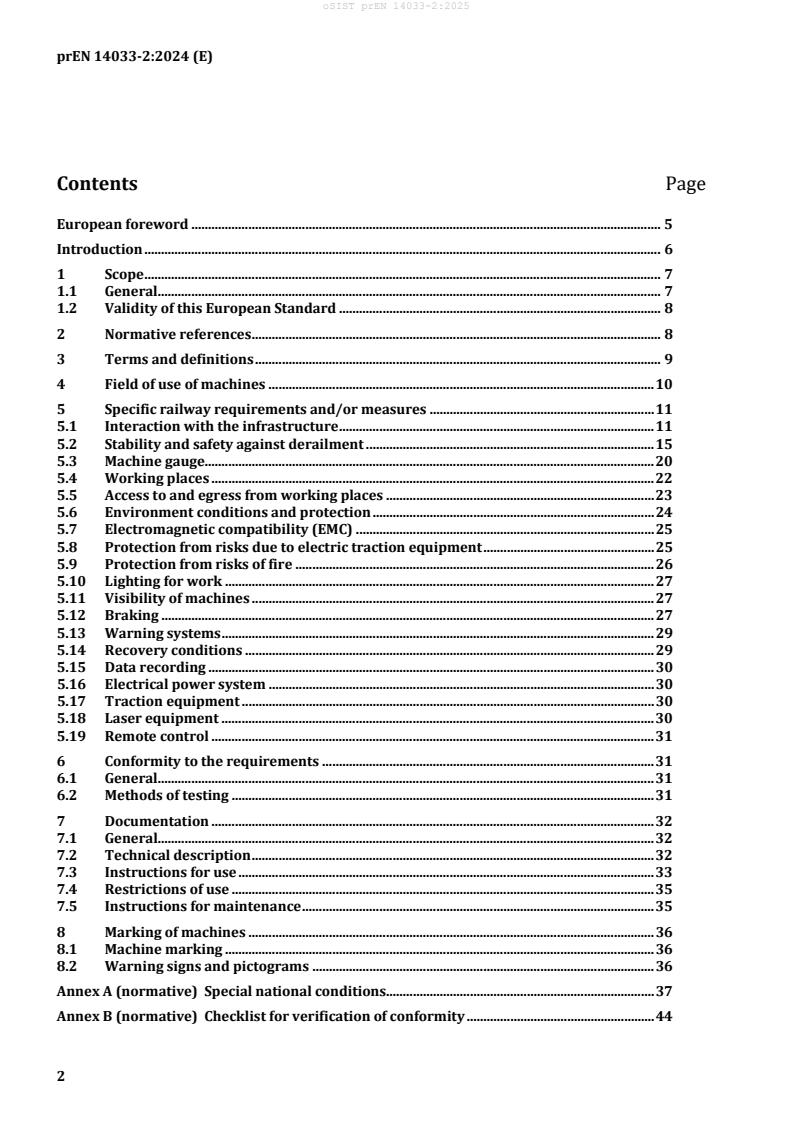
Contents Page
European foreword . 5
Introduction . 6
1 Scope . 7
1.1 General. 7
1.2 Validity of this European Standard . 8
2 Normative references . 8
3 Terms and definitions . 9
4 Field of use of machines . 10
5 Specific railway requirements and/or measures . 11
5.1 Interaction with the infrastructure . 11
5.2 Stability and safety against derailment . 15
5.3 Machine gauge . 20
5.4 Working places . 22
5.5 Access to and egress from working places . 23
5.6 Environment conditions and protection . 24
5.7 Electromagnetic compatibility (EMC) . 25
5.8 Protection from risks due to electric traction equipment . 25
5.9 Protection from risks of fire . 26
5.10 Lighting for work . 27
5.11 Visibility of machines . 27
5.12 Braking . 27
5.13 Warning systems . 29
5.14 Recovery conditions . 29
5.15 Data recording . 30
5.16 Electrical power system . 30
5.17 Traction equipment . 30
5.18 Laser equipment . 30
5.19 Remote control . 31
6 Conformity to the requirements . 31
6.1 General. 31
6.2 Methods of testing . 31
7 Documentation . 32
7.1 General. 32
7.2 Technical description . 32
7.3 Instructions for use . 33
7.4 Restrictions of use . 35
7.5 Instructions for maintenance . 35
8 Marking of machines . 36
8.1 Machine marking . 36
8.2 Warning signs and pictograms . 36
Annex A (normative) Special national conditions. 37
Annex B (normative) Checklist for verification of conformity . 44
Annex C (normative) Warning plate . 48
Annex D (informative) Working gauge . 49
D.1 General . 49
D.2 Determination of the horizontal working limit . 52
D.3 Calculation of the reductions for the limit line of Figure D.2, applicable to the critical
parts of the machine . 53
D.4 Determination of clearance of the working parts . 54
Annex E (informative) Demonstration of prevention of derailment in travelling and/or
working mode . 62
Annex F (normative) Limiting geometric parameters of the degraded working track . 63
Annex G (normative) Pictogram for ‘Working direction’ . 64
Annex H (informative) Method of calculating safety against derailment . 65
H.1 Calculation of the safety against derailment . 65
Annex I (informative) Procedure for working authorization . 71
I.1 General . 71
I.2 Validity and application of the authorization to work . 71
I.3 Applications for authorization to work . 72
I.4 Submission of the technical documentation . 72
I.5 Type testing . 72
I.6 Quality testing . 72
I.7 Type approval . 72
I.8 Examining the finished machine . 73
I.9 Authorization to work for machines identical to a machine that has received type
approval . 73
I.10 Refusal of working authorization . 73
I.11 Validity of working authorization . 73
I.12 Procedure for working agreement . 74
Annex J (informative) Basis of calculations . 76
J.1 Machines without load control devices . 76
J.2 Machines with load control devices . 76
Annex K (informative) Clause by clause comparison of EN 14033-2:2017 with 2024 versions
of EN 14033 series . 77
Annex L (normative) Design specification for earthing pantograph(s) where permitted on
individual infrastructures . 81
L.1 Object . 81
L.2 Position of the pantograph . 82
L.3 Maintaining contact between the equipotential contact strip and the contact wire . 82
L.4 Contact strip design . 82
L.5 Electrical connection between the equipotential pantograph head and the rail . 82
Bibliography . 84
European foreword
This document (prEN 14033-2:2024) has been prepared by Technical Committee CEN/TC 256 “Railway
applications”, the secretariat of which is held by DIN.
This document is currently submitted to the CEN Enquiry.
This document will supersede EN 14033-2:2017.
Amended clauses compared to EN 14033-2:2017 are shown in informative Annex K.
This series of standards EN 14033, Railway applications — Track — Railbound construction and
maintenance machines, consists of the following parts:
— Part 1: Technical requirements for running;
— Part 2: Technical requirements for travelling and working;
— Part 3: General safety requirements;
— Part 4: Technical requirements for running, travelling and working on urban rail.
Introduction
This document is the second of a series of four parts of the European Standard: Railway applications —
Track — Railbound construction and maintenance machines:
— Part 1 covers the safety and technical requirements for the machines in running mode;
— Part 2 covers the technical requirements for the machines in working and travelling modes;
— Part 3 covers the safety requirements for the machines in working and travelling modes; this is a
harmonized standard with the European Machinery Directive 2006/42/EC;
— Part 4 covers requirements for the machines in running, working and travelling modes when used
on urban rail.
For deviations or special national conditions, see Annex A.
The risks that exist in all mechanical, electrical, hydraulic, pneumatic and other components of machines
and that are dealt with in the relevant European Standards are not within the scope of this European
Standard. If necessary, references are made to appropriate standards of this type.
1 Scope
1.1 General
This document defines the specific technical railway requirements for travelling and working with
railbound machines and other vehicles – referred to as machines – used for construction, maintenance
and inspection of track, structures, track formation and fixed electric traction equipment as specified in
prEN 14033-1:2024.
This document applies to all machines working exclusively on the railway (utilizing adhesion between
the rail and rail wheels) and used for construction, maintenance and inspection of track, structures,
infrastructure and fixed electric traction equipment.
This document applies to machines that are intended to operate signalling and control systems.
NOTE Other rail mounted railway maintenance and infrastructure inspection machines are dealt with in other
European Standards, see Technical Report CEN/TR 17498:2020.
This document is applicable to 1 435 mm nominal track gauge. Some requirements may be applicable for
working on infrastructures with nominal narrow track gauge or nominal broad track gauge lines,
tramways, railways utilizing other than adhesion between the rail and rail wheels and underground
infrastructures.
This document covers the safety requirements for the railway specific problems for travelling and
working on different infrastructures. The application of these requirements will be the subject of a
verification procedure, which is not part of this document. Annex I is included for information for the
potential content of a verification procedure. In all cases an authorization to work is needed to access the
infrastructure.
This document is also applicable for machines that in working position are partly supported on the ballast
or the formation.
This document does not apply to:
— the requirements with regard to the quality of work, including the related measuring methods, and
1)
the performance of the machine;
— the specific requirements established by each railway infrastructure manager for the use of machines
which will be the subject of negotiation between the manufacturer and the machine keeper.
This document does not deal with the following additional requirements:
— working methods;
— operation in severe working conditions requiring special measures (e.g. work in tunnels or in
cuttings, extreme environmental conditions such as corrosive conditions, tropical conditions,
contaminating conditions, strong magnetic fields);
— operation subject to special rules (e.g. potentially explosive atmospheres);
— hazards due to errors in software;
— hazards occurring when used to handle suspended loads which may swing freely;
1) Parameters to evaluate the track quality are dealt with in EN 13231-1 and in the EN 13848 series.
— hazards due to wind pressure greater than normal e.g. pressures caused by the passing of trains at
speed in excess of 190 km/h.
1.2 Validity of this European Standard
This document applies to all machines that are ordered one year after the publication date of this
European Standard.
2 Normative references
The following documents are referred to in the text in such a way that some or all of their content
constitutes requirements of this document. For dated references, only the edition cited applies. For
undated references, the latest edition of the referenced document (including any amendments) applies.
EN 280-1:2022, Mobile elevating work platforms - Part 1: Design calculations - Stability criteria -
Construction - Safety - Examinations and tests
EN 280-2:2022, Mobile elevating work platforms - Part 2: Additional safety requirements for load lifting
appliances on the extending lifting structure and work platform
EN 1991-2:2023, Eurocode 1 - Actions on structures - Part 2: Traffic loads on bridges and other civil
engineering works
EN 12077-2:1998+A1:2008, Cranes safety - Requirements for health and safety - Part 2: Limiting and
indicating devices
EN 12999:2020, Cranes - Loader cranes
EN 13848-5:2017, Railway applications - Track - Track geometry quality - Part 5: Geometric quality levels
- Plain line, switches and crossings
prEN 14033-1:2024, Railway applications — Track — Railbound construction and maintenance machines
— Part 1: Technical requirements for running
prEN 14033-3:2024, Railway applications — Track — Railbound construction and maintenance machines
— Part 3: General safety requirements
EN 14363:2016+A2:2022, Railway applications - Testing and Simulation for the acceptance of running
characteristics of railway vehicles - Running Behaviour and stationary tests
EN 15273-2:2013+A1:2016, Railway applications - Gauges - Part 2: Rolling stock gauge
EN 15877-1:2012+A1:2018, Railway applications - Marking on railway vehicles - Part 1: Freight wagons
EN 17343:2023, Railway applications - General terms and definitions
EN 45545-1:2013, Railway applications - Fire protection on railway vehicles - Part 1: General
EN 45545-2:2020+A1:2023, Railway applications - Fire protection on railway vehicles - Part 2:
Requirements for fire behaviour of materials and components
EN 50121-3-1:2017, Railway applications — Electromagnetic compatibility — Part 3-1: Rolling stock —
Train and complete vehicle
EN 50121-3-2:2016, Railway applications — Electromagnetic compatibility — Part 3-2: Rolling stock —
Apparatus
EN 50125-1:2014, Railway applications - Environmental conditions for equipment - Part 1: Rolling stock
and on-board equipment
EN 50153:2014, Railway applications — Rolling stock — Protective provisions relating to electrical
hazards
EN 50317:2012, Railway applications — Current collection systems — Requirements for and validation of
measurements of the dynamic interaction between pantograph and overhead contact line
EN 60077 (series), Railway applications — Electrical equipment for rolling stock
EN ISO 7010:2020, Graphical symbols — Safety colours and safety signs — Registered safety signs
(ISO 7010:2011)
EN ISO 7731:2008, Ergonomics - Danger signals for public and work areas - Auditory danger signals (ISO
7731:2003)
ISO 4305:2014, Mobile cranes — Determination of stability
ISO 4310:2009, Cranes — Test code and procedures
ISO 16754:2008, Earth-moving machinery — Determination of average ground contact pressure for
crawler machines
3 Terms and definitions
For the purposes of this document, the terms and definitions in prEN 14033-1:2024, EN 17343:2023 and
the following apply.
ISO and IEC maintain terminology databases for use in standardization at the following addresses:
— ISO Online browsing platform: available at https://www.iso.org/obp/
— IEC Electropedia: available at https://www.electropedia.org/
3.1
working places
working cabs, combined working and driving cabs, operator's places situated outside cabs, welfare areas,
locations where staff are permitted on the machine and places situated at control or maintenance
locations
As impacted by EN 50121-3-1:2017/A1:2019.
As impacted by EN 50121-3-2:2016/A1:2019.
As impacted by EN 50153:2014/A1:2017 and EN 50143:2014/A2:2020.
As impacted by EN 50317:2012/A1:2022 and EN 50317:2012/AC:2012.
As impacted by EN ISO 7010:2020/A1:2020, EN ISO 7010:2020/A2:2022, EN ISO 7010:2012/A3:2022, EN ISO
7010:2012/A4:2023, EN ISO 7010:2012/A5:2023, EN ISO 7010:2012/A6:2023.
As impacted by ISO 4305:2014/A1:2016.
3.2
working gauge
limit in which a machine can work without interfering with the kinematic envelope of vehicles on
adjacent operating tracks
3.3
operating track
track corresponding to the criteria of the infrastructure manager on which vehicles may run under
normal signalling arrangements (with or without a speed limit)
3.4
track closed for work
track used only by machines and engineering trains under special operating conditions, closed for normal
passenger and freight trains
3.5
degraded working track
track that is being maintained for which one or several of the geometrical parameters may reach the
limiting values as specified in Annex F and for which special operational restrictions may apply
3.6
authorized acceptance body
organisation appointed by the infrastructure manager
3.7
authorization to work
authorization which is given by the infrastructure manager and which permits a machine to work on the
railway infrastructure in accordance with the specific requirements of the infrastructure manager
(method of work, quality, output)
3.8
working agreement
procedure that enables a machine to work on each railway infrastructure manager’s network
Note 1 to entry: This procedure consists of two parts:
1) the proof of conformity with the safety requirements, as specified in prEN 14033-3 (EC declaration of
conformity), given by the manufacturer;
2) the authorization to work that is given at the end of the working agreement. It is also permissible to give a
preliminary authorization to work if some requirements are not yet fulfilled or have yet to be proved that they
are fulfilled.
4 Field of use of machines
Machines shall in accordance with their proper use either:
— be designed to travel and work on all tracks within the geometric limits as specified in Annex F;
or
— travel and work on tracks within the geometric limits of the operating track only and shall then
display at each operating position the warning plate as shown in Annex C. This shall be shown in the
documentation, see 7.4, Table 12, line a).
5 Specific railway requirements and/or measures
5.1 Interaction with the infrastructure
5.1.1 General
The wheels, supports and working tools shall not generate harmful stresses in the infrastructure
components, e.g. rail, fastenings, sleepers, ballast, structures and formation.
Furthermore, it is necessary to take into consideration the maximum wheel load onto the rail, the
permissible bending of the rail, the transverse forces on the sleeper fastenings, the surface pressure on
the ballast as well as the load carrying ability of the formation and structures.
If the machine contains devices for levelling and lining of the track the maximum forces generated by
these devices shall be stated in the documentation, see 7.2 Table 10, line a).
5.1.2 Stress induced into the rails
Any tool shall not generate stresses in the rail higher than the following values given in Table 1 expressed
as a percentage of the minimum ultimate tensile strength of the rail.
The calculations shall be based on a 60E1 rail section with a maximum tensile strength of 880 N/mm
and a 49E1 rail section with a maximum tensile strength of 680 N/mm . The documentation shall state
the limitations of use for both these rail types, see 7.4, Table 12, line b).
The limits a) and b) in Table 1 are permitted to be exceeded in machines specifically designed for
straightening or bending rails.
Table 1 — Stress limit in the rails
Ultimate tensile
strength of the rail
Bending stress Measure points
%
(A)
middle of the head and middle of the
(B)
a) Maximum permissible foot of the rail
tensile bending stress
(C)
at the corner of the head of the rail 50
(D)
at the foot of the rail 60
b) Maximum permissible
compressive bending
(E) (D)
head and foot of the rail 65
stress
(A) (E)
to are shown diagrammatically in Figure 1.
The values above allow for safety in particular conditions, e.g. heavy rail use, joints with big gaps, non-
standard sleeper spacing, residual stresses in the rails.
Figure 1 — Cross section of rail showing stress points given in Table 1
5.1.3 Auxiliary wheels, auxiliary guides and working parts
The auxiliary wheels and guides referred to in this clause are for the support and guidance of assemblies
associated with the operation of the machine and not for running.
The construction and positioning of any auxiliary wheels and/or guides shall provide satisfactory
guidance on rails and shall not cause damage to the rail or any associated part of the railway
infrastructure.
The devices for the vertical and lateral positioning of the rails not placed on sleepers, e.g. guiding rollers,
rail hooks, shall be designed in order to prevent dangerous movements of rail in case of fracture of the
rails or fishplates.
Any additional supporting elements necessary to ensure stability or assist the work process shall also
comply with the above requirements.
5.1.4 Maximum wheel loads
5.1.4.1 General
The wheels referred to in this clause are the wheels used for travelling and working.
5.1.4.2 Machines without wheel load control devices
Wheel loads Qmax of the main wheels or auxiliary wheels in relation to the diameter of the wheel and the
rail material are given in Table 2 or are able to be calculated as shown in Annex J.
The calculation of the vertical loads applied to the wheels shall take into account all the factors that can
produce variations, i.e.:
a) due to the machine:
1) eccentricity of the centre of gravity;
2) torsional flexibility;
3) hysteresis of the suspension;
4) eccentric load;
5) application of an eccentric force;
b) due to the track:
1) maximum cant;
2) maximum twist.
Table 2 — Maximum wheel load with the machine in travelling and working mode for machines
without wheel load control devices
Q
max
kN
d
a b
mm
Rail with Rail with
2 2
σ = 880 N/mm σ = 680 N/mm
B B
ϕ ≥ 920 222 136
920 > ϕ ≥ 840 222 136
840 > ϕ ≥ 760 201 120
760 > ϕ ≥ 680 179 107
680 > ϕ ≥ 630 167 99
630 > ϕ ≥ 550 146 89
550 > ϕ ≥ 470 124 74
470 > ϕ ≥ 390 103 62
390 > ϕ ≥ 330 87 52
σ = maximum tensile strength of rail material
B
d = worn diameter limit
ϕ = wheel diameter
a 2
Corresponds e.g. to rails 60E1, 54E3, 49E1 (880 N/mm ).
b 2
Corresponds e.g. to rails 49E1 (680 N/mm ).
If, in working mode, the maximum static wheel load exceeds the values shown in Table 2 for rails with
σB = 680 N/mm , it shall be stated in the documentation, see 7.2, Table 10, line b) and 7.4, Table 12,
line b).
5.1.4.3 Machines that do not lift a load or lift a load with wheel load control devices
The maximum wheel loads Q for machines, notably railway cranes, for which the loads on the wheel
max
are controlled by means of a device, e.g. device for limiting of overturning moment, which prevents the
maximum value of the wheel load being exceeded, are given in Table 3 or are able to be calculated as
shown in Annex J.
Reductions of the maximum load shall be applied when the working conditions are imprecise or difficult
to determine, such as:
— lifting of the load from underneath;
— indeterminate break out forces;
— overload due to unequal distribution of the load within the lifting tackle;
— oblique lifting of the load;
— dynamic movements of the load, e.g. swinging or vertical movements of the load.
Table 3 — Maximum wheel load with the machine in working and travelling mode for machine
that do not lift a load or machine that lift a load with wheel load control devices
Q
max
kN
d
a b
mm
Rail with Rail with
2 2
σ = 880 N/mm σ = 680 N/mm
B B
ϕ ≥ 920 243 170
920 > ϕ ≥ 840 243 170
840 > ϕ ≥ 760 243 154
760 > ϕ ≥ 680 230 138
680 > ϕ ≥ 630 213 127
630 > ϕ ≥ 550 186 111
550 > ϕ ≥ 470 159 95
470 > ϕ ≥ 390 132 79
390 > ϕ ≥ 330 112 67
d = worn diameter limit
ϕ = wheel diameter
σ = maximum tensile strength of rail material
B
a 2
Corresponds e.g. to rails 60E1, 54E3, 49E1 (880 N/mm ).
b 2
Corresponds e.g. to rails 49E1 (680 N/mm ).
If, in working mode, the maximum static wheel load exceeds the values for rails with σ = 680 N/mm
B
given in Table 3 it shall be stated in the documentation, see 7.2, Table 10, line b) and 7.4, Table 12, line b).
5.1.5 Loads applied to the ballast
The surface pressure applied to the ballast shall not exceed 0,3 MN/m .
In the case of a tracked machine the surface pressure shall be calculated as specified in ISO 16754:2008.
5.1.6 Loads applied to the formation
The manufacturer shall declare in the documentation, see 7.2, Table 10, line c), the value of the maximum
force applied to the formation by any part of the machine in direct contact and additionally declare the
maximum pressure applied by the sets of stabilizers supplied with the machine.
NOTE A guide value of 0,1 MN/m pressure will suit the majority of infrastructures.
In the case of a tracked machine the surface pressure shall be calculated as specified in ISO 16754:2008.
5.1.7 Loads applied to structures
The load applied by machines in travelling mode, on bridges and at the approaches to bridges, shall not
exceed those resulting from load model 71 with a factor of 1,0 (relating to point loads only without taking
into consideration the cases of distributed loads) as specified in EN 1991-2:2023.
The loads generated by machines in their various working modes, on bridges and at the approaches to
bridges, should not exceed those resulting from load model 71 (relating to point loads only without taking
into consideration the cases of distributed loads) as specified in EN 1991-2:2023. If the loads are in excess
of load model 71 shown in EN 1991-2:2023, an analysis shall be carried out in each case for each load
configuration, and permission necessary from the responsible expert of the infrastructure manager
concerned. This is particularly necessary for work on bridges or lines having axle load restrictions.
The loading configurations of the possible and most unfavourable working configurations shall be
specified with loads and distances in the documentation, see 7.2 Table 10, line b).
5.2 Stability and safety against derailment
5.2.1 Proof of overturning stability, machine stationary
5.2.1.1 General
Stability is defined as prevention of overturning. Except as shown in 5.2.3.3, a machine is considered
stable if, even in the most unfavourable loading conditions and track parameters as detailed in 5.2.2 and
5.2.3, all the wheels remain in contact with the rails. The stability of a machine shall not depend on any
devices attaching to the rail.
Machines that lift loads shall be fitted with appropriate load limiting devices. Simple cantilever or knuckle
boom cranes shall, as minimum, be fitted with a rated capacity limiter (RCL) conforming to the
requirements of EN 12077-2:1998+A1:2008 where no combination of load and radius will cause
instability.
All other lifting equipment shall be fitted with a rated capacity indicator/rated capacity limiter (RCI/RCL)
in accordance with the requirements of EN 12077-2:1998+A1:2008. Where the RCI/RCL is capable of
being overridden, for example during set-up or recovery, the status of the RCI/RCL shall be recorded on
the data recorder. After the specific activity the RCI/RCL shall automatically return to normal operation.
There shall be a means to prevent the unintentional overriding of the RCI/RCL, for example by a separate
key switch or electronic devices. The arrangements for using the override shall be described in the
documentation, see 7.3 Table 11, Line a).
Note There are more specific requirements for cranes shown in EN 13000.
5.2.1.2 Proof of stability by calculation
For railway cranes other than loader cranes, or other types of machines which may have their centre of
gravity displaced or where the wheels can be unloaded, overturning stability shall be calculated in
accordance with the requirements given in Table 4. Calculations shall be in accordance with the
requirements of ISO 4305:2014 . In each case the calculated stabilizing moment shall be greater than the
calculated overturning moment.
Loader cranes mounted on railway vehicles shall meet the requirements of EN 12999:2020.
Table 4 — Load cases for calculating stability
Use of Load
Load case Cant Requirements Comments
machine coefficient
mm
on operating
track
with
1,25 P + 0,1 F
on degraded
stabilizers
working 200
track
on operating
180 1,33 P + 0,1 F
free on
track
wheels –
1,33 P + 0,1 F P > 12 t
verification
on degraded
across the
working 200 P + 4 t + 0,1 F 8 t < P < 12 t
track
tracks
15 % of the machine
1,50 P + 0,1 F P < 8 t
weight as minimal wheel
on operating surveillance of
forces in relation to the
tracks the allowable
tilting edge.
lifting load in
See
longitudinal
ISO 4305:2014+A1:2016,
direction by
Table 2
comparison of
on wheels
the boom
without
setting angle
propping–
of the crane
1,25 P + 0,1 F
on degraded
direction
with the
working 200
along the
position of the
tracks
track
boom angle in
the horizontal
(momentum
equilibrium at
the boom
pivot point)
backward
stability
no load on
should be
backward hook, pulley
- 0,15 P calculated
stability block on the
assuming no
ground
load on hook,
etc.
P = Load with lifting tackle in accordance with ISO 4310:2009
F = Mass of the jib, lifting ropes and the pulley block in accordance with ISO 4310:2009
The tilting edge should be taken as all the wheels on the track of the side affected by the load.
For machines with mobile elevating work platforms, the overturning safety calculations shall be done in
accordance with EN 280-1:2022 and EN 280-2:2022.
If the requirements of Table 4 are fulfilled with load 2 P+ 0,1 F, it is not necessary to prove stability in
accordance with the requirements of 5.2.1.3.
The maximum wheel loads and/or stabilizer pressure shall be stated in the documentation, see 7.2,
Table 10, line d).
5.2.1.3 Proof of stability by test
Proof of stability shall be proved as specified in ISO 4310:2009, before putting into service by load testing
in accordance with the requirements given in Table 5. All the possibilities of movement and unfavourable
positions of the load shall be considered in the most unfavourable track parameters as shown in Annex F.
Stability is considered proven if both the following parts are complied with:
a) under the rated load and the most unfavourable load position no wheel leaves the rail;
and
b) under the test load and the most unfavourable load position it does not overturn, but one or more
wheels may lift by no more than 5 mm.
Table 5 — Load cases for testing prevention of overturning
Working
Load conditions Standard Load coefficient
configuration
Static 1,25 P
Proof load ISO 4310:2009
Dynamic 1,10 P
P = Load + lifting tackle in accordance with the requirements of
ISO 4310:2009
NOTE For these proof tests higher wheel loads than those given in Table 3 may
have to be applied on the test track.
The requirements for the stabilizer's contact surface area and/or the maximum load of stabilizers shall
be indicated.
5.2.2 Prevention of derailment in travelling mode
The proof of the ability of machine to move without derailing in travelling mode shall be shown by using
the test methods set out in prEN 14033-1:2024, Clause 8, using the track geometry parameters either as
shown in Table 6 for degraded working track, or if the machine is not intended for use on degraded
working track the parameters specified for operating track. Where the machine is not intended for use
on degraded working track the actual track parameters permitted shall be recorded in the
documentation, see 7.2 Table 10, line e) and a limitation shall be stated in the documentation, see 7.4,
Table 12, line a).
5.2.3 Prevention of derailment during working movements
5.2.3.1 General
In the working conditions detailed in the documentation, see 7.2, Table 10, line e) a machine shall not
derail when moving so that persons on the machine or around adjacent tracks shall not be endangered
and/or the infrastructure damaged. Small forward / backward movements to adjust loads or close gaps
during a working movement with the whole machine are not intended as working movements in the
scope of the following sections because this can be considered as a nearly static situation. In this situation
the movement of the whole machine shall not exceed more than half of one revolution of the rail wheel.
Where the machine is moved in this exceptional condition there shall be an engineering control to limit
the distance moved.
A lifeguard is provided in running mode, see prEN 14033-1:2024, 7.9. Where the machine is intended to
move along the track in working mode with a foreseeable increased risk of obstacles on the track a means
of clearing the railhead shall be provided.
5.2.3.2 Verification of prevention of derailment
5.2.3.2.1 General
Safety against derailment shall be proven for travel on a track with the geometrical threshold parameters
corresponding to the field of use of machines (operating track or degraded working track).
If the machine is intended for use on degraded working track, it is necessary to apply the column
“Degraded working track EN14033” of the Table 6.
Where machines are only intended for use on operating track, the track parameters shall be as shown in
the column “Operating track EN 14363” of the Table 6.
Table 6 — Comparison of track parameters
Operating track Degraded working track
EN 14363:2016+A2:2022 prEN 14033-2:2024
Track twist EN 13848-5:2017, 7.6 prEN 14033-2:2024
limit
20 mm 20 mm
g min 7 ‰;+ 3 ‰ g min 10 ‰;+ 3 ‰
lim lim
2a 2a
For speed V ≤ 200 km/h
NOTE: EN 13848 replaces ‘2a’ by ‘l’
Method 1: EN 14363:2016+A2:2022, 6.1.5.1.2 prEN 14033-2:2024
+ +
Bogie test
g = 7 ‰ g = 10 ‰
+ +
lim lim
for 2a < 4m for 2a < 2,5m
twist
++ ++
ga2 ‰+ 20 mm / 2 ga2 ‰+ 20 mm / 2
lim lim
for for
+ +
2a ≥ 2,5m
2a ≥ 4m
Vehicle * *
g = 7 ‰ g = 10 ‰
* *
lim lim
for 2a < 4m for 2a < 2,5m
body test
twist
** **
ga2 ‰+ 20 mm / 2 ga2 ‰+ 20 mm / 2
lim lim
for for
*
*
4 m≤≤2a 20 m 2,5 m≤≤2a 20 m
* *
g = 3 ‰ g = 3 ‰
* *
lim lim
for 20 m<≤2a 30 m for 20 m<≤2a 30 m
** **
ga= 90 mm/ 2 ga= 90 mm/ 2
* *
lim lim
for 2a > 30 m for 2a > 30 m
Method 2: EN 14363:2016+A2:2022, 6.1.5.2.2.2 prEN 14033-2:2024
+ + + +
Bogie test
ga7 ‰− 5 mm / 2 g 10 ‰− 5 mm / 2a
lim lim
for for
twist
+ +
2a < 4m 2a < 2,5m
= =
= =
= =
= =
-----------
...