

EN 16941-1:2024
(Main)On-site non-potable water systems - Part 1: Systems for the use of rainwater
- Abstract
This document specifies the requirements and gives recommendations for the design, sizing, installation, identification, commissioning and maintenance of rainwater harvesting systems for the use of rainwater on-site as non-potable water. This document also specifies the minimum requirements for these systems.
Excluded from the scope of this document are
- the use as drinking water and for food preparation,
- the use for personal hygiene purposes,
- attenuation and
- infiltration.
NOTE Conformity with the document does not exempt from compliance with the obligations arising from local or national regulations.
- Status
- Published
- Publication Date
- 19-Mar-2024
- Technical Committee
- CEN/TC 165 - Waste water engineering
- Drafting Committee
- CEN/TC 165/WG 50 - Use of treated wastewater
- Current Stage
- 6060 - Definitive text made available (DAV) - Publishing
- Start Date
- 20-Mar-2024
- Due Date
- 28-Jul-2024
- Completion Date
- 20-Mar-2024

Overview
EN 16941-1:2024 - On-site non-potable water systems, Part 1: Systems for the use of rainwater (CEN) - sets out the requirements and recommendations for designing, sizing, installing, identifying, commissioning and maintaining on-site rainwater harvesting systems used as non‑potable water. It defines minimum requirements for collection, treatment, storage, distribution, pumping, back‑up supply, monitoring, metering and risk assessment while clarifying what is excluded (e.g., drinking water, food preparation and personal hygiene, attenuation and infiltration). Conformity with this standard does not replace local or national regulations.
Key topics and technical requirements
- Functional elements: collection surfaces and piping, preliminary treatment, storage device design and watertightness, overflow and internal connections.
- Treatment: guidance on preliminary, storage-related and possible additional treatment to maintain non‑potable quality.
- Storage and sizing: materials, dimensions, structural behaviour, capacity calculations (Annex A contains example methods).
- Back‑up supply & protection: requirements for alternative water sources and backflow prevention in accordance with referenced standards (e.g., EN 1717).
- Pumping & controls: submerged/non‑submerged pumps, expansion vessels, pump control units and system control with monitoring.
- Distribution & metering: layout, identification and metering of non‑potable circuits, plus commissioning checks (Annex C) and cross‑connection testing (Annex D).
- Risk assessment, commissioning & maintenance: mandatory commissioning procedures, inspection regimes and maintenance logs (Annex E provides templates).
- Normative references: aligns with EN 805, EN 806, EN 1717, pump and meter standards and more.
Practical applications and users
This standard is targeted at professionals and stakeholders involved in rainwater harvesting and on‑site water reuse:
- Designers and consulting engineers - for compliant system design and sizing.
- Installers and manufacturers - to meet installation, component and safety requirements.
- Building owners, facility managers and developers - for guidance on commissioning, operation and maintenance.
- Municipal authorities and specifiers - to evaluate compliance with European best practice. Use cases include toilet flushing, irrigation, laundry, cleaning, HVAC make‑up and other non‑potable applications in residential, commercial, industrial and public spaces.
Related standards
- EN 16941-2 (treated greywater systems)
- EN 1717 (backflow protection)
- EN 805 / EN 806 (water supply systems)
- Relevant pump and meter standards (EN 809, EN ISO 4064)
Keywords: EN 16941-1:2024, rainwater harvesting, on-site non-potable water systems, design, storage sizing, backflow protection, commissioning, maintenance.
Relations
- Replaces
EN 16941-1:2018 - On-site non-potable water systems - Part 1: Systems for the use of rainwater - Effective Date
- 18-Jan-2023
- Effective Date
- 01-Apr-2026
- Effective Date
- 09-Feb-2026
- Effective Date
- 28-Jan-2026
- Effective Date
- 28-Jan-2026
- Effective Date
- 28-Jan-2026
- Effective Date
- 28-Jan-2026
- Effective Date
- 28-Jan-2026
- Effective Date
- 28-Jan-2026
- Effective Date
- 28-Jan-2026
- Effective Date
- 28-Jan-2026
- Effective Date
- 28-Jan-2026
- Effective Date
- 28-Jan-2026
- Effective Date
- 28-Jan-2026
- Effective Date
- 28-Jan-2026
Get Certified
Connect with accredited certification bodies for this standard

Zavod za gradbeništvo Slovenije (ZAG) - Inšpekcija
ZAG inspection body for construction products, structures, and materials.
Sponsored listings
Frequently Asked Questions
EN 16941-1:2024 is a standard published by the European Committee for Standardization (CEN). Its full title is "On-site non-potable water systems - Part 1: Systems for the use of rainwater". This standard covers: This document specifies the requirements and gives recommendations for the design, sizing, installation, identification, commissioning and maintenance of rainwater harvesting systems for the use of rainwater on-site as non-potable water. This document also specifies the minimum requirements for these systems. Excluded from the scope of this document are - the use as drinking water and for food preparation, - the use for personal hygiene purposes, - attenuation and - infiltration. NOTE Conformity with the document does not exempt from compliance with the obligations arising from local or national regulations.
This document specifies the requirements and gives recommendations for the design, sizing, installation, identification, commissioning and maintenance of rainwater harvesting systems for the use of rainwater on-site as non-potable water. This document also specifies the minimum requirements for these systems. Excluded from the scope of this document are - the use as drinking water and for food preparation, - the use for personal hygiene purposes, - attenuation and - infiltration. NOTE Conformity with the document does not exempt from compliance with the obligations arising from local or national regulations.
EN 16941-1:2024 is classified under the following ICS (International Classification for Standards) categories: 93.025 - External water conveyance systems. The ICS classification helps identify the subject area and facilitates finding related standards.
EN 16941-1:2024 has the following relationships with other standards: It is inter standard links to EN 16941-1:2018, EN 1717:2025+A1:2026, EN IEC 60335-2-41:2021, EN 806-2:2005, EN 16323:2014, EN 12056-5:2000, EN 1295-1:2019, EN 1610:2015, EN 13564-1:2002, EN 806-5:2012, EN 13564-2:2002, EN 12566-3:2016, EN 1717:2025, EN 12056-1:2000, EN 476:2022. Understanding these relationships helps ensure you are using the most current and applicable version of the standard.
EN 16941-1:2024 is available in PDF format for immediate download after purchase. The document can be added to your cart and obtained through the secure checkout process. Digital delivery ensures instant access to the complete standard document.
Standards Content (Sample)
SLOVENSKI STANDARD
01-junij-2024
Sistemi za nepitno vodo, nameščeni na kraju samem - 1. del: Sistemi za uporabo
deževnice
On-site non-potable water systems - Part 1: Systems for the use of rainwater
Vor-Ort-Anlagen für Nicht-Trinkwasser - Teil 1: Anlagen für die Verwendung von
Regenwasser
Réseaux d’eau non potable sur site - Partie 1 : Systèmes pour l’utilisation de l’eau de
pluie
Ta slovenski standard je istoveten z: EN 16941-1:2024
ICS:
93.025 Zunanji sistemi za prevajanje External water conveyance
vode systems
2003-01.Slovenski inštitut za standardizacijo. Razmnoževanje celote ali delov tega standarda ni dovoljeno.
EN 16941-1
EUROPEAN STANDARD
NORME EUROPÉENNE
March 2024
EUROPÄISCHE NORM
ICS 93.025 Supersedes EN 16941-1:2018
English Version
On-site non-potable water systems - Part 1: Systems for
the use of rainwater
Réseaux d'eau non potable sur site - Partie 1 : Systèmes Vor-Ort-Anlagen für Nicht-Trinkwasser - Teil 1:
pour l'utilisation de l'eau de pluie Anlagen für die Verwendung von Regenwasser
This European Standard was approved by CEN on 15 January 2024.
CEN members are bound to comply with the CEN/CENELEC Internal Regulations which stipulate the conditions for giving this
European Standard the status of a national standard without any alteration. Up-to-date lists and bibliographical references
concerning such national standards may be obtained on application to the CEN-CENELEC Management Centre or to any CEN
member.
This European Standard exists in three official versions (English, French, German). A version in any other language made by
translation under the responsibility of a CEN member into its own language and notified to the CEN-CENELEC Management
Centre has the same status as the official versions.
CEN members are the national standards bodies of Austria, Belgium, Bulgaria, Croatia, Cyprus, Czech Republic, Denmark, Estonia,
Finland, France, Germany, Greece, Hungary, Iceland, Ireland, Italy, Latvia, Lithuania, Luxembourg, Malta, Netherlands, Norway,
Poland, Portugal, Republic of North Macedonia, Romania, Serbia, Slovakia, Slovenia, Spain, Sweden, Switzerland, Türkiye and
United Kingdom.
EUROPEAN COMMITTEE FOR STANDARDIZATION
COMITÉ EUROPÉEN DE NORMALISATION
EUROPÄISCHES KOMITEE FÜR NORMUNG
CEN-CENELEC Management Centre: Rue de la Science 23, B-1040 Brussels
© 2024 CEN All rights of exploitation in any form and by any means reserved Ref. No. EN 16941-1:2024 E
worldwide for CEN national Members.
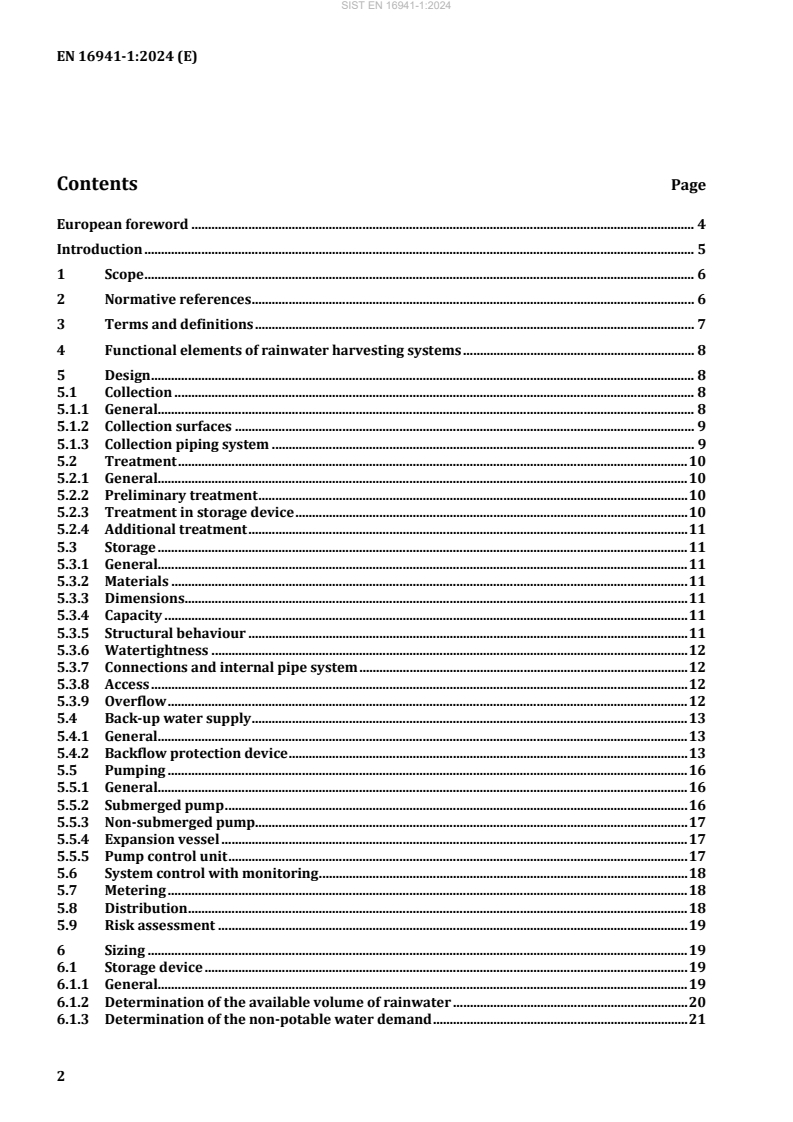
Contents Page
European foreword . 4
Introduction . 5
1 Scope . 6
2 Normative references . 6
3 Terms and definitions . 7
4 Functional elements of rainwater harvesting systems . 8
5 Design . 8
5.1 Collection . 8
5.1.1 General. 8
5.1.2 Collection surfaces . 9
5.1.3 Collection piping system . 9
5.2 Treatment . 10
5.2.1 General. 10
5.2.2 Preliminary treatment . 10
5.2.3 Treatment in storage device . 10
5.2.4 Additional treatment . 11
5.3 Storage . 11
5.3.1 General. 11
5.3.2 Materials . 11
5.3.3 Dimensions. 11
5.3.4 Capacity . 11
5.3.5 Structural behaviour . 11
5.3.6 Watertightness . 12
5.3.7 Connections and internal pipe system . 12
5.3.8 Access . 12
5.3.9 Overflow . 12
5.4 Back-up water supply . 13
5.4.1 General. 13
5.4.2 Backflow protection device . 13
5.5 Pumping . 16
5.5.1 General. 16
5.5.2 Submerged pump . 16
5.5.3 Non-submerged pump. 17
5.5.4 Expansion vessel . 17
5.5.5 Pump control unit . 17
5.6 System control with monitoring . 18
5.7 Metering . 18
5.8 Distribution . 18
5.9 Risk assessment . 19
6 Sizing . 19
6.1 Storage device . 19
6.1.1 General. 19
6.1.2 Determination of the available volume of rainwater . 20
6.1.3 Determination of the non-potable water demand . 21
6.1.4 Calculation methods . 22
6.2 Back-up water supply . 22
7 Installation . 23
8 Differentiation and identification . 24
9 Commissioning . 24
10 Quality of non-potable water . 25
11 Maintenance . 25
Annex A (informative) Examples of calculation methods for storage capacity. 26
A.1 General . 26
A.2 Examples of calculation methods . 26
A.2.1 Basic approach with annual time step . 26
A.2.2 Detailed approach . 27
Annex B (informative) Examples of rainwater harvesting systems with different back-up
supply arrangements . 31
Annex C (informative) Example for a commissioning sheet . 34
Annex D (informative) Example of dye testing for distribution pipework cross-connections . 36
Annex E (informative) Inspection and maintenance . 37
E.1 Inspection and maintenance instruction sheet . 37
E.2 Logbook . 38
Bibliography . 39
European foreword
This document (EN 16941-1:2024) has been prepared by Technical Committee CEN/TC 165 “Waste
water engineering”, the secretariat of which is held by DIN.
This European Standard shall be given the status of a national standard, either by publication of an
identical text or by endorsement, at the latest by September 2024, and conflicting national standards
shall be withdrawn at the latest by September 2024.
Attention is drawn to the possibility that some of the elements of this document may be the subject of
patent rights. CEN shall not be held responsible for identifying any or all such patent rights.
This document supersedes EN 16941-1:2018.
EN 16941-1:2018:
— necessary technical and editorial updates and alignments with EN 16941-2:2021.
EN 16941, On-site non-potable water systems consists of the following parts:
— Part 1: Systems for the use of rainwater
— Part 2: Systems for the use of treated greywater
Any feedback and questions on this document should be directed to the users’ national standards body.
A complete listing of these bodies can be found on the CEN website.
According to the CEN-CENELEC Internal Regulations, the national standards organisations of the
following countries are bound to implement this European Standard: Austria, Belgium, Bulgaria,
Croatia, Cyprus, Czech Republic, Denmark, Estonia, Finland, France, Germany, Greece, Hungary, Iceland,
Ireland, Italy, Latvia, Lithuania, Luxembourg, Malta, Netherlands, Norway, Poland, Portugal, Republic of
North Macedonia, Romania, Serbia, Slovakia, Slovenia, Spain, Sweden, Switzerland, Türkiye and the
United Kingdom.
Introduction
Ecological and sustainable water management is a goal of rainwater management. It is to be expected
that the natural water supplies, especially by precipitation, will change in the course of climate change.
Whereas evenly distributed seasonal rainwater supply over the year may decrease locally, as it was
recorded during recent years in many European areas, sudden rainstorm events with high intensity and
great volumes of water during short periods of time occur more often. To foster local resilience to water
scarcity it is feasible to harvest and collect rainwater for later use. Herein rainwater harvesting and
infiltration, as well as the decentralized detention of rainwater, are alternatives to the customary
drainage of rainwater. Rainwater harvesting also reduces the potable water demand and the discharge
of water.
To sustain the natural cycle of water, excess water from the rainwater harvesting system can be
infiltrated or otherwise evacuated in line with national or regional requirements.
On-site collection and use of rainwater covers a variety of non-potable applications like toilet flushing,
laundry, irrigation, climate control of buildings, cleaning, etc. at private and rented properties,
residential areas, community developments, industrial sites, hotels, streets, parks, golf courses, theme
parks, car parks, stadia, etc.
A generic flow chart of rainwater use on-site is presented in Figure 1.
Figure 1 — Generic flow chart of rainwater use
1 Scope
This document specifies the requirements and gives recommendations for the design, sizing,
installation, identification, commissioning and maintenance of rainwater harvesting systems for the use
of rainwater on-site as non-potable water. This document also specifies the minimum requirements for
these systems.
Excluded from the scope of this document are
— the use as drinking water and for food preparation,
— the use for personal hygiene purposes,
— attenuation and
— infiltration.
NOTE Conformity with the document does not exempt from compliance with the obligations arising from
local or national regulations.
2 Normative references
The following documents are referred to in the text in such a way that some or all of their content
constitutes requirements of this document. For dated references, only the edition cited applies. For
undated references, the latest edition of the referenced document (including any amendments) applies.
EN 476, General requirements for components used in drains and sewers
EN 805, Water supply — Requirements for systems and components outside buildings
EN 806 (all parts), Specification for installations inside buildings conveying water for human consumption
EN 809, Pumps and pump units for liquids — Common safety requirements
EN 1295-1, Structural design of buried pipelines under various conditions of loading — Part 1: General
requirements
EN 1610, Construction and testing of drains and sewers
EN 1717, Protection against pollution of potable water in water installations and general requirements of
devices to prevent pollution by backflow
EN 12050 (all parts), Wastewater lifting plants for buildings and sites
EN 12056-1, Gravity drainage systems inside buildings — Part 1: General and performance requirements
EN 12056-3, Gravity drainage systems inside buildings — Part 3: Roof drainage, layout and calculation
EN 12056-4, Gravity drainage systems inside buildings — Part 4: Wastewater lifting plants — Layout and
calculation
EN 12056-5, Gravity drainage systems inside buildings — Part 5: Installation and testing, instructions for
operation, maintenance and user
EN 12566-3, Small wastewater treatment systems for up to 50 PT — Part 3: Packaged and/or site
assembled domestic wastewater treatment plants
EN 13076, Devices to prevent pollution by backflow of potable water — Unrestricted air gap —
Family A — Type A
EN 13077, Devices to prevent pollution by backflow of potable water — Air gap with non-circular
overflow (unrestricted) — Family A — Type B
EN 13564 (all parts), Anti-flooding devices for buildings
EN 16323:2014, Glossary of wastewater engineering terms
EN 60335-2-41, Household and similar electrical appliances — Safety — Part 2-41: Particular
requirements for pumps (IEC 60335-2-41)
EN ISO 4064 (all parts), Water meters for cold potable water and hot water [ISO 4064 (all parts)]
3 Terms and definitions
For the purposes of this document, the terms and definitions given in EN 16323 and the following apply.
ISO and IEC maintain terminology databases for use in standardization at the following addresses:
— ISO Online browsing platform: available at https://www.iso.org/obp
— IEC Electropedia: available at https://www.electropedia.org/
3.1
rainwater
water arising from atmospheric precipitation, which has not yet collected matter from the surface
[SOURCE: EN 16323:2014, 2.1.1.1]
3.2
rainwater harvesting
accumulation and deposition of rainwater for reuse
[SOURCE: ISO 6707-3:2022, 3.4.9]
3.3
rainwater harvesting system
system for collecting rainwater from surfaces in order to be used, which consists of collection,
treatment, storage and distribution elements
3.4
storage device
unit for the storage of harvested rainwater
3.5
cistern
fixed container for holding water at atmospheric pressure for use as part of the plumbing system
3.6
non-potable water
water which has been made available for use, except for drinking, food preparation and personal
hygiene
3.7
non-return valve
device that prevents backflow of water
[SOURCE: EN 16323:2014, 2.2.5.12, modified: “wastewater” was changed to “water”]
3.8
hydraulic treatment efficiency coefficient
ratio of outcoming flow of the treated water to incoming flow of the collected rainwater
4 Functional elements of rainwater harvesting systems
Any rainwater harvesting system is described through four main functional elements:
— collection;
— treatment;
— storage;
— distribution.
Rainwater harvesting systems shall be designed, installed, marked, operated and maintained in such a
way that the required level of safety is ensured at any time and that the required servicing work can be
easily carried out.
Rainwater harvesting systems shall not cause local flooding and therefore shall include potential
bypasses and/or properly dimensioned overflows.
5 Design
5.1 Collection
5.1.1 General
The purpose of collection is to harvest rainwater and transport it to a storage device.
The following factors should be taken into account, as these can affect the quality and/or quantity of the
collected water:
— the local rainfall pattern;
— the size of the collection surface;
— the surface’s materials and their drainage characteristics;
— sizing and material of piping systems;
— the levels of air pollution and the pollution of the collection surface;
— the risk of contaminating the existing system.
5.1.2 Collection surfaces
5.1.2.1 Qualitative aspects
The characteristics of the collection surface (e.g. roofs and paved areas) shall be taken into
consideration depending on the intended use of the rainwater. Pollutants from other sources, e.g. traffic,
industry and animals have to be taken into account.
Common roof materials, e.g. glazed tiles and slate, do not cause any negative effect on the quality of
harvested rainwater.
Other roof collection surfaces may have the potential to negatively affect the quality of the water
harvested (see examples in Table 1).
Table 1 — Examples of potential water quality effects of collection surfaces on harvested
rainwater
Collection surface Potential effect
Green roof colouration
Bitumen containing material colouration
Cement with fibres emission of fibres in the long term
Copper, lead or zinc roofs increased concentrations of heavy metals
Weathered rough surfaces wash out of solids
Where paved areas or roof areas allowing human amenity are used for collection possible pollutants
due to the use of these areas shall be taken into account.
5.1.2.2 Quantitative aspects
Collection surfaces made of different materials have different characteristics regarding the drainage of
rainwater. The volume of the harvested rainwater is influenced by the surface yield coefficient (e).
Unless otherwise specified, typical values are given for different materials in 6.1.2, Table 2.
NOTE The surface yield coefficient differs from the run-off coefficient as specified in EN 12056-3, where it is
used for the hydraulic design of pipes. The surface yield coefficient aims to determine the average yield.
5.1.3 Collection piping system
Collection piping systems should allow the rainwater to flow from the collection surface to the storage
device by gravity or siphonic action. Access for inspection, maintenance and cleaning has to be planned
and installed.
Collection pipework from the roof within the rainwater harvesting system should not discharge into
open gullies because additional contamination could occur.
The non-pressure pipes and fittings shall meet the general requirements according to EN 476 and the
relevant product standards. The dimensioning shall be done in accordance with EN 12056-1 and
EN 12056-3. Underground rainwater pipes shall be designed according to EN 1295-1 and installed
according to EN 1610.
5.2 Treatment
5.2.1 General
The harvested rainwater quality and the intended use of the treated rainwater shall be considered in
order to determine which treatment is needed and which method is appropriate, e.g. physical, chemical
or biological or the combination of them.
The harvested rainwater shall be treated to a quality for the intended use.
Treatment shall be done upstream, within and potentially downstream of the storage device.
Treatment covers several operations:
— removal of coarse particles upstream of the storage (see 5.2.2);
— retention of fine particles by sedimentation and flotation in the storage device (see 5.2.3);
— filtering downstream of the storage device, depending on the intended use.
Disinfection, deodorization, discolouration and/or biological treatment may be required additionally
(see 5.2.3).
A rainwater harvesting system shall provide water suitable for flushing toilets, laundry and garden
watering in most residential, industrial and commercial situations without the necessity of additional
treatment (see 5.2.4) unless identified by risk assessment referred to in 5.9.
The treatment system shall
— be water resistant and durable,
— be accessible for maintenance (see Clause 11),
— not affect the hydraulic operation of the overall drainage system and
— withstand the maximum stresses and loads exerted during its handling, installation, use and
maintenance.
The flow section of the overflow of the treatment device shall be designed for the discharge of
maximum flow.
5.2.2 Preliminary treatment
Preliminary treatment (e.g. filters, separators) shall be designed and located upstream of the storage
device and may consist of more than one device. The type and dimensioning of preliminary treatment
shall be selected according to the nature and size of the collection surface.
The purpose of preliminary treatment is to prevent the inflow of most coarse solids and organic matter
into the storage device. The maximum particle size entering the storage device shall be equal or less
than 1 mm for in-house use. If solids are retained, they shall be removed regularly or during a manual
intervention.
The preliminary treatment system shall have a hydraulic treatment efficiency coefficient of at least 0,9.
5.2.3 Treatment in storage device
The incoming rainwater is treated in the storage device by separation of coarse particles from the
incoming rainwater (sedimentation and/or flotation processes). Biological degradation of organic
substances may occur.
5.2.4 Additional treatment
Additional treatment (e.g. filtration, disinfection, biological treatment) of the stored rainwater shall be
included if the intended use demands higher quality.
5.3 Storage
5.3.1 General
The rainwater harvesting system shall, at a minimum, include one storage device which may be
positioned either above or below ground.
The purpose of the storage device is
— to conserve a suitable volume of rainwater for the intended use and the collection possibilities,
— to treat the incoming water (sedimentation, flotation) and
— to protect the quality of this water from risks of deterioration.
The storage device shall be protected against frost, extreme temperatures, and direct sunlight, for
instance buried underground.
The structural behaviour shall be considered when positioning the storage device.
5.3.2 Materials
The materials used shall not have a negative effect on the quality of the stored water and the
environment of the installation.
The materials [e.g. concrete, steel, Polyvinyl chloride (unplasticized) (PVC-U), Polyethylene (PE),
Polypropylene (PP), Glass Reinforced Polyester (GRP-UP)] used for prefabricated factory built storage
devices shall meet the conditions described in EN 12566-3.
The material shall be non-translucent and/or UV stable. Where translucent or non-UV stable material is
used, the storage device shall not be exposed to direct sunlight.
The materials constituting the submerged components shall be corrosion resistant.
5.3.3 Dimensions
When prefabricated components are used, the overall dimensions, access and connection dimensions
and tolerances shall be stated by the manufacturer. Individual storage devices may be connected to
each other.
5.3.4 Capacity
The nominal capacity is the maximum volume of water that can be retained within the storage device
and shall be stated by the manufacturer or designer.
The capacity can be determined by testing or calculation.
5.3.5 Structural behaviour
Storage devices shall withstand the maximum stresses and loads exerted during its handling,
installation, use and maintenance. This shall be assessed either by calculation or testing.
Above-ground storage devices shall withstand the action of hydrostatic pressure without generating
excessive deformation adversely affecting their function.
5.3.6 Watertightness
The storage device shall be watertight at the level of
— the walls including the base constituting it,
— the couplings ensuring the hydraulic connections and
— penetrations through the storage device wall used for the possible passage of electric cables.
5.3.7 Connections and internal pipe system
The nominal diameters of the inlet and outlet fittings of the storage device shall be stated by the
designer of the system.
The inlets, outlets and other connections of the storage device shall be equipped with fittings
(i.e. sockets, spigots) of standardized dimensions equipped with seals and enabling assembly using
standardized pipes.
The inflow pipe of the harvested rainwater is terminated below the minimum water level of the storage
device to prevent the disturbance of any material at surface level. A calmed inlet (see Figure 4) shall be
installed to prevent re-suspension of the solids that may have accumulated on the bottom.
Protection against the entry of small animals shall be provided.
5.3.8 Access
The storage device shall be equipped with an access to permit regular inspection and maintenance. The
access shall be secured e.g. by a cover with a locking feature or sufficient weight.
For the access of a person, the dimensions given in EN 476 shall be considered. When access of a person
is not intended, an opening with a dimension (i.e. width for a square section or diameter for a circular
section) not less than 400 mm minimum shall be used.
Shafts and access covers shall prevent unintentional contamination of the storage device.
5.3.9 Overflow
Storage devices shall be equipped with an overflow to allow excess water to be discharged. Excess
water should be infiltrated or otherwise evacuated into surface water bodies. Discharge into the sewer
system should only occur if unavoidable (see EN 12056-3).
Where the overflow is connected to a sewer system, the overflow shall be equipped with an odour trap.
Where there is a risk of backflow from the sewer system, the overflow shall be equipped with an anti-
flooding device according to EN 13564 (all parts). The anti-flooding device shall remain accessible for
servicing.
Every overflow shall have provisions to avoid pollution. Any protection provided shall not reduce the
effective cross-sectional area of the overflow. Overflows fitted to above ground storage devices should
be screened.
During overflow a siphonage of the storage device shall be avoided.
The overflow pipe shall be dimensioned to evacuate the possible maximum inflow of the storage device.
5.4 Back-up water supply
5.4.1 General
The rainwater harvesting system shall incorporate a back-up water supply where continuous
availability of water is needed. The back-up water may be introduced into
a) a break cistern prior to its pump, for delivery to the distribution pipework, e.g. purpose-designed
module or
b) an intermediate cistern, usually located at high level, e.g. gravity supply or
c) the storage device, either directly or by discharging into the collection pipework, but not before
treatment.
NOTE Annex B gives examples of typical systems with different back-up supply arrangements.
In the case of back-up water supply using potable water, the potable water supply system shall be
protected with an appropriate protection unit (see 5.4.2).
The possibility of a flooding of the back-up water supply device (e.g. via reflux) shall be eliminated, e.g.
by installing the back-up water supply device above the backwater level.
When the water level in the storage device is below a given minimum, the back-up water supply control
shall automatically ensure the operational reliability of the system. This can also be achieved by a
control system (see 5.6).
The back-up water supply shall be fitted with a control mechanism which ensures that the amount of
water supplied is minimized to that needed for immediate use. It should be provided from a make-up
module or an intermediate cistern.
The design of the system shall ensure that there are no dead legs upstream, e.g. on the potable water
supply and suitable turnover of water is achieved, to avoid water to become stagnant.
In order to prevent wasting potable water, the storage device with valve-controlled water inputs shall
have a warning system so any failure is readily noticeable.
5.4.2 Backflow protection device
To prevent non-potable water entering the potable or public water supply, the back-up water supply
shall be fitted with a protection unit that can provide protection against contamination by category 5
fluids (an air gap) in accordance with EN 1717, such as described:
— In EN 13076, for family A, type A, “AA unrestricted air gap”, disconnectors (see Figure 2):
An “AA” air gap is a visible unobstructed and complete air gap placed permanently and vertically
between the lowest point of the inlet feed orifice and any surface of the receiving vessel that
determines the maximum operational level at which the device overflows.
Key
1 feed pipe A air gap (double the inner diameter of the feed orifice
with a minimum of 20 mm)
2 feed orifice D internal diameter of feed pipe (bore)
3 receiving vessel H maximum water level
4 spillover level
5 15° maximum from the vertical
Figure 2 — Unrestricted Type AA air gap according to EN 13076
— In EN 13077, for family A type B, “AB air gap with non-circular overflow” disconnectors (see
Figure 3): An “AB” air gap is a permanent and vertical distance between the lowest point of the feed
orifice and the critical water level. The overflow shall be of non-circular design and shall be able to
evacuate the maximum flow of water in the event of overpressure.
Key
1 feed pipe 7 critical water level (distance )
h
2 feed orifice 8 2D Minimum radial clearance
3 receiving vessel air gap (distance)
A
4 spillover level internal diameter of feed pipe (bore)
D
5 optional warning pipe maximum water level
H
(internal vertical surface)
6 Uh≥ 5
w
a
15° maximum from the vertical (validation by test or calculation)
b
30° maximum from the vertical (validation by test only)
Figure 3 — Unrestricted Type AB air gap with non-circular overflow according to EN 13077
Flow rates, head loss and installation requirements shall be taken into account when selecting the
backflow prevention device.
Where the backflow prevention device is to provide water to the storage device directly and there is a
risk of odours venting back into the building an odour trap shall be installed.
5.5 Pumping
5.5.1 General
For systems, other than those which distribute the collected rainwater by gravity, one or more pumps
shall be used to ensure its continual availability.
NOTE 1 The operational safety and hydraulic demand will dictate whether a single pump or multiple-pump
system is needed.
The flow rate and the required pressure head of the pump shall be determined in accordance with
EN 12056-4, EN 12050 (all parts), EN 806-2 and/or EN 806-3, as applicable.
The pump shall be selected and arranged such that
— energy use and noise are minimized,
— using renewable energy whenever possible (e.g. solar water pumps),
— air is not introduced into the suction lines,
— it is protected against freezing and
— it is provided with isolation valves for maintenance and repair.
The pump shall be equipped with dry-run protection, which may be part of the pump or provided by an
external control device (see 5.6).
Surges, water hammer and hunting from the pump shall be absorbed and prevented from causing
undue high pressures, e.g. by the incorporation of expansion vessels or pressure controls, in order to
prevent bursting and excessive draw off.
The pump shall comply with either EN 60335-2-41 for a domestic installation or EN 809 for other types
of installations.
Multiple-pump systems shall conform to EN 12056-4 or EN 12050 (all parts) with a standby pump if
necessary.
NOTE 2 Several pumps can operate alternately to equalize their operating time.
The pump shall ensure the distribution of water under the conditions stated in 5.8 of this document.
A non-return valve shall be provided to prevent back-flow.
5.5.2 Submerged pump
Where a submerged pump is used, it shall comply with the following:
— a minimum water level shall be maintained above the suction point to ensure that neither air,
sediment nor floating debris are sucked in;
— the pump shall be installed in a way to prevent it from unintended movement, e.g. keeping the
suction line in the correct positioning;
— it shall be possible to remove and replace the pump without needing special tools or to enter the
tank, e.g. for maintenance.
5.5.3 Non-submerged pump
Where a non-submerged pump is used, it shall comply with the following:
— the suction lines shall be airtight;
— the suction lines shall be installed in a way to minimize hydraulic friction loss;
— the suction lines shall be laid in a steady gradient towards the pump;
— the water intake shall be constructed so as to avoid suction of the sediments, air or floating debris.
Self-priming pumps should be used, because of ease of operation (e.g. easy commissioning, overcoming
of potential air bubbles in suction lines).
An example for a floating suction device on a non-submerged pump is shown in Figure 4.
Key
1 indicator/sensor
2 overflow with odour trap
3 floating suction device
4 calmed inlet
5 minimum water level
6 maximum water level
Figure 4 — Example of a floating suction device on a non-submerged pump
The pump shall be placed in a well-ventilated location with sound and vibration free mountings.
5.5.4 Expansion vessel
An expansion vessel may be required to prevent the pump from starting too frequently if the system has
a risk of low extraction or leaks.
The expansion vessel shall be sized according to the type of controls used (e.g. fixed or variable speed)
and installed in a manner which prevents any deterioration of water quality within the vessel, e.g. in the
vertical orientation.
NOTE Using an expansion vessel can allow the pump to be used less and therefore improve the energy
balance.
5.5.5 Pump control unit
Pumps shall be equipped with a pump control unit to automatically control the pumps with a manual
override. The control shall permit manual operation.
The pump control unit shall
— control pumps and minimize operational wear and energy use and
— protect the pumps from running dry.
5.6 System control with monitoring
A control and monitoring system should be incorporated in the rainwater system to ensure, as a
minimum, that users are aware of whether the system is operating.
The system control shall inform the user of
— the source of water supply (non-potable water or back-up water) and
— any malfunctions, e.g. pump failure, back-up supply failure.
Other monitoring may also be included, e.g. water metering, water level, the overflow, tank temperature
and other parameters.
The control unit should permit manual override. Data may be monitored and stored.
The system control may be linked to a building management system.
The system shall be provided with an audible and/or visible alarm to indicate operational failure.
5.7 Metering
When meters are required to quantify the volumes of non-potable water used inside the building and
discharged into the public sewer system, reference shall be made to the specifications of EN ISO 4064-1
to EN ISO 4064-5.
5.8 Distribution
The purpose of distribution is to feed the points of use with non-potable water and the possibility of
back-up water supply. The distribution performed shall ensure the integrity and protection of public
and private potable water distribution systems.
The treated rainwater/non-potable water shall be distributed by
a) pumping it from the storage device directly to the point of use or
b) pumping it from the storage device to an intermediate cistern/tank near the point of use or
c) using a gravity cistern or
d) using a full gravity system.
Cross-connection of non-potable water distribution pipes with other piping systems shall not occur.
Domestic type water distribution systems (e.g. for toilet flushing) used for the distribution of non-
potable water shall be designed according to the applicable European Standards such as EN 805,
EN 806 (all parts).
For the identification of pipes for conveying rainwater, see Clause 8 and the relevant product standards.
Rainwater, non-potable water and drinking water usually have different chemical characteristics (pH
for instance). The materials constituting the pressure pipe shall be chosen considering the risk of
corrosion.
5.9 Risk assessment
Risk assessment shall be carried out to determine whether the system is safe and fit for purpose. This
should take place when the system is being designed.
The risk assessment shall consider the effects of exposure to, and the potential impacts of, the system
on people, the environment, and physical assets.
The risk assessment shall consider the design, installation, testing and commissioning, operation and
maintenance of the system, including water quality, structural stability, electrical safety and access
provision.
6 Sizing
6.1 Storage device
6.1.1 General
The sizing of the volume of the rainwater storage device results from an analysis of the relationship
between the rainwater that can be harvested and the demand of the non-potable water for the intended
use requirements.
The following factors shall be considered in order to be able to calculate the size of the storage device:
— the rainfall data (amount, intensity, pattern of rainfall, dry periods);
— the size and type of the collection surface;
— the number and type of intended applications, both present and future;
— the hydraulic efficiency of equipment used (e.g. filters).
Other factors may influence the choice of the size of the storage device (e.g. available area, groundwater
level).
The nominal capacity as shown in Figure 5 consists of:
— the volume of useable rainwater;
— the volume of non-useable rainwater.
...