

EN 12259-1:1999 + A1:2001
(Main)Fixed firefighting systems - Components for sprinkler and water spray systems - Part 1: Sprinklers
- Abstract
This European Standard specifies requirements for construction and performance of sprinklers which are operated by a change of state of an element or bursting of a glass bulb under the influence of heat, for use in automatic sprinkler systems conforming to EN 12845 Automatic sprinkler systems : Design and installation. Test methods and a recommended test schedule for type approval testing are also given.
NOTE All pressure data in this European standard are given as gauge pressures in bar
- Status
- Published
- Publication Date
- 19-Jun-2001
- Withdrawal Date
- 30-Mar-2003
- Technical Committee
- CEN/TC 191 - Fixed firefighting systems
- Drafting Committee
- CEN/TC 191/WG 5 - Sprinkler systems
- Current Stage
- 9093 - Decision to confirm - Review Enquiry
- Start Date
- 30-Nov-2011
- Completion Date
- 30-Nov-2011
- Directive
- 305/2011 - Regulation (eu) No 305/2011 of the European Parliament and of the Council of 9 march 2011 laying down harmonised conditions for the marketing of construction products and repealing council directive 89/106/eecOJ Ref: C, C 259 OJ Date: 08-Aug-2014
89/106/EEC - Construction productsOJ Ref: C 13, C 139, C 319, C 40 OJ Date: 14-Feb-2002

Overview
EN 12259-1:1999 + A1:2001 is a European Standard developed by CEN (European Committee for Standardization) for fixed firefighting systems, focusing on components used in sprinkler and water spray systems-specifically, the requirements for sprinklers. This standard establishes criteria for the construction, performance, testing, and marking of sprinklers activated by heat, such as those utilizing fusible elements or glass bulbs. It is intended for sprinklers installed in automatic sprinkler systems in compliance with EN 12845, which covers the design and installation of such systems.
Key Topics
Scope and Purpose
- Specifies construction and performance requirements for heat-activated sprinklers
- Applies to sprinklers fitted in automatic sprinkler systems per EN 12845
- Addresses type approval, test methods, and test schedules
Sprinkler Types Covered
- Glass bulb sprinklers
- Fusible link sprinklers
- Concealed, recessed, pendent, upright, and sidewall pattern sprinklers
- Coated sprinklers for corrosive environments
Performance and Construction Criteria
- Water flow and distribution
- Operating temperature ranges and thermal response
- Strength and leak resistance
- Resistance to heat, corrosion, vibration, impact, and low temperatures
- Marking and identification requirements
Testing Procedures
- Methods for verifying operating temperature and sensitivity (RTI and C factor)
- Water flow and distribution tests
- Functional, strength, leak, and durability tests under various environmental conditions
- Instructions for type approval and ongoing conformity
Applications
Sprinklers certified to EN 12259-1 are essential components in automatic fire sprinkler systems for a wide range of fire protection applications, including:
- Commercial and Industrial Buildings: Warehouses, factories, retail centers, and office buildings rely on compliant sprinklers for early fire suppression and property protection.
- Residential and Public Sector: Hospitals, schools, and multi-residential complexes use these systems to enhance occupant safety.
- Special and Hazardous Environments: Sprinkler types covered by the standard include options for corrosive or challenging settings, extending their use beyond typical indoor areas.
Adhering to EN 12259-1 ensures that installed sprinklers are robustly tested for thermal, mechanical, and hydraulic performance, providing peace of mind for building owners, fire protection engineers, facility managers, and regulatory authorities. Consistent application of this standard supports legal compliance, especially for systems within the European Economic Area, by fulfilling Construction Products Directive requirements.
Related Standards
- EN 12845 - Automatic sprinkler systems: Design and installation (companion standard for system design)
- ISO 7-1 - Pipe threads for pressure-tight joints (used for dimensioning threaded sprinkler connections as referenced in EN 12259-1)
- ISO 49 - Malleable cast iron threaded fittings
- ISO 65 - Carbon steel tubes suitable for screwing
Further, EN 12259 is part of a broader series covering fixed firefighting systems:
- Part 2: Wet alarm valve assemblies
- Part 3: Dry alarm valve assemblies
- Part 4: Water motor alarms
- Part 5: Water flow detectors
- Additional parts address pipe couplings, hangers, pressure switches, deluge valves, and sprayers
Practical Value
Using EN 12259-1 certified sprinklers ensures high reliability and effectiveness of automatic sprinkler systems, which are vital for life safety and fire risk management. This standard gives manufacturers, specifiers, and installers a clear framework to demonstrate compliance, perform quality assurance, and select the right sprinkler type for varied fire safety projects. Regular type testing and factory production control, as specified, enable continued conformity and safe operation throughout the product lifecycle.
For those involved in fire protection systems-whether designing, specifying, installing, or inspecting-compliance with EN 12259-1 is a critical step toward robust, trustworthy fire safety solutions.
Relations
- Effective Date
- 22-Dec-2008
- Effective Date
- 12-Aug-2026
- Effective Date
- 22-Jul-2026
- Effective Date
- 28-Jan-2026
- Effective Date
- 28-Jan-2026
- Effective Date
- 28-Jan-2026
- Effective Date
- 28-Jan-2026
- Effective Date
- 28-Jan-2026
- Effective Date
- 28-Jan-2026
- Effective Date
- 28-Jan-2026
- Effective Date
- 28-Jan-2026
- Effective Date
- 28-Jan-2026
- Effective Date
- 28-Jan-2026
- Effective Date
- 28-Jan-2026
- Effective Date
- 28-Jan-2026
Get Certified
Connect with accredited certification bodies for this standard

CIS Institut d.o.o.
Personal Protective Equipment (PPE) certification body. Notified Body NB-2890 for EU Regulation 2016/425 PPE.

Kiwa BDA Testing
Building and construction product certification.
Kmetijski inštitut Slovenije
Agricultural Institute of Slovenia. Soil testing, plant health, agricultural product analysis.
Sponsored listings
Frequently Asked Questions
EN 12259-1:1999 + A1:2001 is a standard published by the European Committee for Standardization (CEN). Its full title is "Fixed firefighting systems - Components for sprinkler and water spray systems - Part 1: Sprinklers". This standard covers: This European Standard specifies requirements for construction and performance of sprinklers which are operated by a change of state of an element or bursting of a glass bulb under the influence of heat, for use in automatic sprinkler systems conforming to EN 12845 Automatic sprinkler systems : Design and installation. Test methods and a recommended test schedule for type approval testing are also given. NOTE All pressure data in this European standard are given as gauge pressures in bar
This European Standard specifies requirements for construction and performance of sprinklers which are operated by a change of state of an element or bursting of a glass bulb under the influence of heat, for use in automatic sprinkler systems conforming to EN 12845 Automatic sprinkler systems : Design and installation. Test methods and a recommended test schedule for type approval testing are also given. NOTE All pressure data in this European standard are given as gauge pressures in bar
EN 12259-1:1999 + A1:2001 is classified under the following ICS (International Classification for Standards) categories: 13.220.20 - Fire protection. The ICS classification helps identify the subject area and facilitates finding related standards.
EN 12259-1:1999 + A1:2001 has the following relationships with other standards: It is inter standard links to EN 12259-1:1999, EN 14972-2:2026, EN 12845:2015+A2:2026, EN 12259-14:2020, EN 12845:2015, EN 14972-3:2021, EN 12101-13:2022, EN 12259-13:2022, EN 12259-15:2025, EN 12845:2015+A1:2019, CEN/TS 12101-11:2022, EN 13565-2:2018, EN 13565-1:2019+A1:2025, EN 12845:2004+A2:2009, EN 12259-14:2020+A1:2022. Understanding these relationships helps ensure you are using the most current and applicable version of the standard.
EN 12259-1:1999 + A1:2001 is associated with the following European legislation: EU Directives/Regulations: 305/2011, 89/106/EEC; Standardization Mandates: M/109. When a standard is cited in the Official Journal of the European Union, products manufactured in conformity with it benefit from a presumption of conformity with the essential requirements of the corresponding EU directive or regulation.
EN 12259-1:1999 + A1:2001 is available in PDF format for immediate download after purchase. The document can be added to your cart and obtained through the secure checkout process. Digital delivery ensures instant access to the complete standard document.
Standards Content (Sample)
2003-01.Slovenski inštitut za standardizacijo. Razmnoževanje celote ali delov tega standarda ni dovoljeno.Ortsfeste Löschanlagen - Bauteile für Sprinkler- und Sprühwasseranlagen - Teil 1: SprinklerInstallations fixes de lutte contre l'incendie - Composants des systemes d'extinction du type Sprinkleur et a pulvérisation d'eau - Partie 1: SprinkleursFixed firefighting systems - Components for sprinkler and water spray systems - Part 1: Sprinklers13.220.10Gašenje požaraFire-fightingICS:Ta slovenski standard je istoveten z:EN 12259-1:1999 + A1:2001SIST EN 12259-1:2000 + A1:2001en01-oktober-2001SIST EN 12259-1:2000 + A1:2001SLOVENSKI
STANDARDSIST EN 12259-1:20001DGRPHãþD
EUROPEAN STANDARDNORME EUROPÉENNEEUROPÄISCHE NORMEN 12259-1:199 + A1June 2001ICS 13.220.20Supersedes EN 12259-1:1999English versionFixed firefighting systems - Components for sprinkler and waterspray systems - Part 1: SprinklersInstallations fixes de lutte contre l'incendie - Composantsdes systèmes d'extinction du type Sprinkleur et àpulvérisation d'eau - Partie 1: SprinkleursOrtsfeste Löschanlagen - Bauteile für Sprinkler- undSprühwasseranlagen - Teil 1: SprinklerThis European Standard was approved by CEN on 20 January 2001.CEN members are bound to comply with the CEN/CENELEC Internal Regulations which stipulate the conditions for giving this EuropeanStandard the status of a national standard without any alteration. Up-to-date lists and bibliographical references concerning such nationalstandards may be obtained on application to the Management Centre or to any CEN member.This European Standard exists in three official versions (English, French, German). A version in any other language made by translationunder the responsibility of a CEN member into its own language and notified to the Management Centre has the same status as the officialversions.CEN members are the national standards bodies of Austria, Belgium, Czech Republic, Denmark, Finland, France, Germany, Greece,Iceland, Ireland, Italy, Luxembourg, Netherlands, Norway, Portugal, Spain, Sweden, Switzerland and United Kingdom.EUROPEAN COMMITTEE FOR STANDARDIZATIONCOMITÉ EUROPÉEN DE NORMALISATIONEUROPÄISCHES KOMITEE FÜR NORMUNGManagement Centre: rue de Stassart, 36
B-1050 Brussels© 2001 CENAll rights of exploitation in any form and by any means reservedworldwide for CEN national Members.Ref. No. EN 12259-1:1999 + A1:2001 ESIST EN 12259-1:2000 + A1:2001
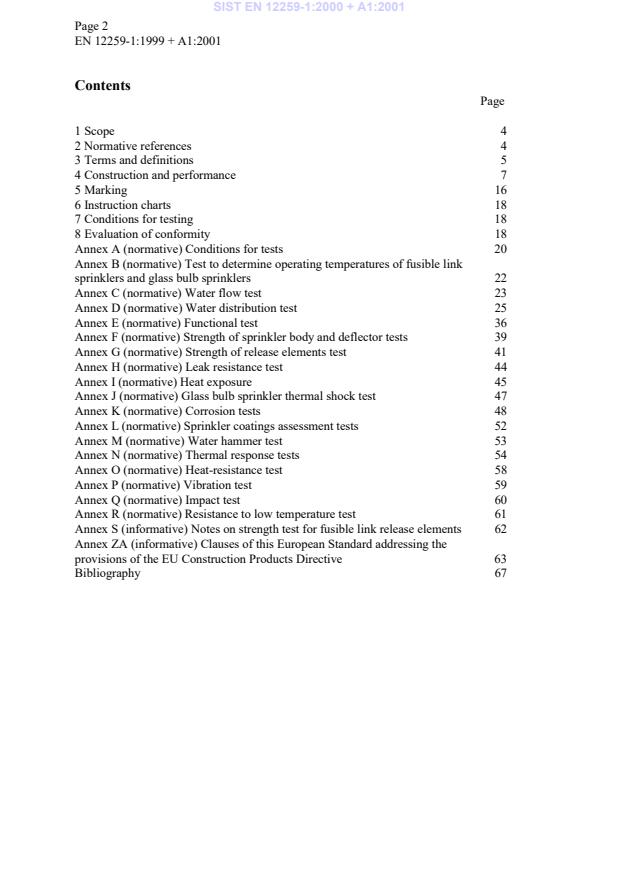
Page 2EN 12259-1:199 + A1:2001ContentsPage1 Scope42 Normative references43 Terms and definitions54 Construction and performance75 Marking166 Instruction charts187 Conditions for testing188 Evaluation of conformity18Annex A (normative) Conditions for tests20Annex B (normative) Test to determine operating temperatures of fusible linksprinklers and glass bulb sprinklers22Annex C (normative) Water flow test23Annex D (normative) Water distribution test25Annex E (normative) Functional test36Annex F (normative) Strength of sprinkler body and deflector tests39Annex G (normative) Strength of release elements test41Annex H (normative) Leak resistance test44Annex I (normative) Heat exposure45Annex J (normative) Glass bulb sprinkler thermal shock test47Annex K (normative) Corrosion tests48Annex L (normative) Sprinkler coatings assessment tests52Annex M (normative) Water hammer test53Annex N (normative) Thermal response tests54Annex O (normative) Heat-resistance test58Annex P (normative) Vibration test59Annex Q (normative) Impact test60Annex R (normative) Resistance to low temperature test61Annex S (informative) Notes on strength test for fusible link release elements62Annex ZA (informative) Clauses of this European Standard addressing theprovisions of the EU Construction Products Directive63Bibliography67SIST EN 12259-1:2000 + A1:2001
Page 3EN 12259-1:1999 + A1:2001ForewordThis European Standard EN 12259-1:1999 + A1:2001 has been prepared by Technical CommitteeCEN/TC 191 "Fixed firefighting systems", the secretariat of which is held by BSI.This European Standard replaces EN 12259-1:1999.This European Standard shall be given the status of a national standard, either by publication of anidentical text or by endorsement, at the latest by December 2001, and conflicting national standardsshall be withdrawn at the latest by March 2003.This European Standard has been prepared under a mandate given to CEN by the EuropeanCommission and the European Free Trade Association, and supports essential requirements of EUDirective(s).For relationship with EU Directive(s), see informative Annex ZA, which is an integral part of thisstandard.It forms one Part of EN 12259, covering components for automatic sprinkler systems and is included ina series of European Standards planned to cover:a)automatic sprinkler systems (EN 12259 )1b)Gaseous extinguishing systems (EN 12094) 1c)powder systems (EN 12416) 1d)explosion protection systems (EN 26 184)e)foam systems (EN 13565)f)hydrant and hose reel systems (EN 671)g)smoke and heat control systems (EN 12101) 1h)water spray systems 1EN 12259 has the general title “Fixed fire fighting systems - Components for sprinkler and water spraysystems” and will subdivided as follows:Part 1:Sprinklers.Part 2:Wet alarm valve assembliesPart 3:Dry alarm valve assembliesPart 4:Water motor alarms.Part 5:Water flow detectors.Part 6:Pipe couplings.
1 In preparationSIST EN 12259-1:2000 + A1:2001
Page 4EN 12259-1:199 + A1:2001Part 7:Pipe hangers.Part 8:Pressure switches.Part 9Deluge alarm valve assemblies.Part 10 Multiple controls.Part 11 Medium and high velocity water sprayers.Part 12 Sprinkler pump sets.Where reference is made to the application of components having imperial dimensions it has beennecessary to use imperial units where appropriate.According to the CEN/CENELEC Internal Regulations, the national standards organizations of thefollowing countries are bound to implement this European Standard: Austria, Belgium, CzechRepublic, Denmark, Finland, France, Germany, Greece, Iceland, Ireland, Italy, Luxembourg,Netherlands, Norway, Portugal, Spain, Sweden, Switzerland and the United Kingdom.1 ScopeThis European Standard specifies requirements for construction and performance of sprinklers whichare operated by a change of state of an element or bursting of a glass bulb under the influence of heat,for use in automatic sprinkler systems conforming to EN 12845
Automatic sprinkler systems : Designand installation. Test methods and a recommended test schedule for type approval testing are alsogiven.NOTEAll pressure data in this European standard are given as gauge pressures in bar2.2 Normative referencesThis European standard incorporates by dated or undated reference, provisions from other publications.These normative references are cited at the appropriate places in the text and the publications are listedhereafter. For dated references, subsequent amendments to or revisions of any of these publicationsapply to this European standard only when incorporated in it by amendment or revision. For undatedreferences the latest edition of the publication referred to applies (including amendments).ISO 7-1-Pipe threads where pressure-tight joints are made on the threads - Part 1: Dimensions, tolerances and designation.ISO 49-Malleable cast iron fittings threaded to ISO 7-1.ISO 65-Carbon steel tubes suitable for screwing in accordance withISO 7-1
2) bar = 105 PaSIST EN 12259-1:2000 + A1:2001
Page 5EN 12259-1:1999 + A1:20013 Terms and definitionsFor the purposes of this European Standard, the following terms and definitions apply.3.1conductivity factor [C]measure of the conductance between the sprinkler's heat responsive element and the waterfilled fitting, expressed in (meters/second)½ (m/s)½.3.2response time index [RTI]measure of the thermal sensitivity of the sprinkler expressed in (meters seconds)½ (ms)½.3.3automatic sprinklernozzle with a thermally sensitive sealing device which opens to discharge water for firefighting.3.4ceiling (or flush) pattern sprinklerpendent sprinkler for fitting partly above, but with the temperature sensitive element below, thelower plane of the ceiling.3.5coated sprinklersprinkler with a coating applied for the purpose of reducing the effects of corrosive environments,excluding decorative paint or painted finishes.3.6concealed sprinklerrecessed sprinkler with a cover plate that disengages when heat is applied.3.7conventional pattern sprinklersprinkler which gives a spherical pattern of water discharge.3.8design lower tolerance limit (DLTL)glass bulb supplier’s specified and assured lowest lower tolerance limit (LTL).3.9design upper tolerance limit (DUTL)sprinkler supplier’s specified and assured highest upper tolerance limit (UTL).3.10dry pendent sprinklersprinkler and dry drop pipe with a valve, at the head of the pipe, held closed by a device maintained inposition by the sprinkler head valve.SIST EN 12259-1:2000 + A1:2001
Page 6EN 12259-1:199 + A1:20013.11dry upright sprinklersprinkler and dry rise pipe with a valve, at the base of the pipe, held closed by a device maintained inposition by the sprinkler head valve.3.12flat spray pattern sprinklersprinkler that is similar to a spray pattern sprinkler but with a pattern of water discharge with aproportion of the discharge directed above the level of the deflector.3.13fusible link sprinklersprinkler which opens when an element provided for that purpose melts.3.14glass bulb sprinklersprinkler which opens when a liquid-filled glass bulb bursts.3.15mean design service loadsprinkler supplier’s specified and assured highest mean service load for any batch of 10 or moresprinklers.3.16 mean design strengthglass bulb supplier’s specified and assured lowest mean bulb strength for any batch of 55 or morebulbs.3.17pintlemetal extension rod extending from the deflector.3.18horizontal sprinklersprinkler in which the nozzle directs the water horizontally.3.19lower tolerance limit (LTL)glass bulb lowest strength determined by test and statistical analysis of a batch of 55 or more bulbs.3.20pendent sprinklersprinkler in which the nozzle directs the water downwards.3.21recessed sprinklersprinkler in which all or part of the thermally sensitive element is above the plane of the ceiling.3.22sidewall pattern sprinklersprinkler that gives an outward half paraboloid pattern of water discharge.SIST EN 12259-1:2000 + A1:2001
Page 7EN 12259-1:1999 + A1:20013.23spray pattern sprinklersprinkler that gives a downward paraboloid pattern of water discharge.3.24suppliercompany responsible for the design, manufacture and quality assurance of
a product3.25upper tolerance limit (UTL).highest service load determined by test and statistical analysis of a batch of 20 or more sprinklers.3.26upright sprinklersprinkler in which the nozzle directs the water upwards.3.27sprinkler yoke (arms)part of a sprinkler that maintains the thermally sensitive element in load bearing contact with thesprinkler head valve.4 Construction and performance4.1 Product assemblySprinklers shall only be assembled in such a way that adjustment or dismantling will result indestruction of an element of construction.4.2
Dimensions4.2.1 The nominal diameter of the orifice of the sprinklers and the corresponding thread size ofthe sprinklers, except dry and flush sprinklers, shall be suitable for use with pipe threads givenin Table 1. Dry and flush sprinklers may have larger thread sizes.
Nominal thread sizes shall besuitable for fittings threaded in accordance with ISO 7-1.4.2.2 It shall be possible for a sphere of
8 0010, mm diameter to pass through each waterpassage in the sprinkler.Table 1 — Orifice and thread dimensionsNominal diameter of orificemmNominal pipe thread sizeinches103/815 and 20½20¾SIST EN 12259-1:2000 + A1:2001
Page 8EN 12259-1:199 + A1:20014.2.3 Sprinklers having a 20 mm nominal diameter orifice in combination with a ½ inchnominal thread size (normally used for retrofitting purposes), shall have a pintle, (10 ± 2) mmlong and having a diameter of (5 ± 2) mm, permanently attached at the deflector foridentification purposes.4.3 Nominal operating temperature4.3.1 The nominal operating temperatures of glass bulb sprinklers are given in Table 2column 1.4.3.2 The nominal operating temperature ranges of fusible link sprinklers are given in Table 2column 3.4.3.3 Glass bulb sprinklers and
non-plated and non-coated fusible link sprinklers shall becolour coded according to the nominal operating temperature as given in Table 2, columns 2 or4 as appropriate.Table 2 — Nominal operating temperatures and colour codesGlass bulb sprinklersFusible link sprinklersColumn 1Nominal operatingtemperatureo CColumn 2Liquidcolour codeColumn 3Nominal operatingtemperature withinrangeo CColumn 4Yoke armscolour code57687993100121141163182204227260286343orangeredyellowgreengreenbluebluemauvemauveblackblackblackblackblack57 to 7780 to 107121 to 149163 to 191204 to 246260 to 302320 to 343uncolouredwhiteblueredgreenorangeblack4.4 Operating temperatures4.4.1 When tested in accordance with annex B, fusible link sprinklers shall operate at atemperature within the range:SIST EN 12259-1:2000 + A1:2001
Page 9EN 12259-1:1999 + A1:2001[t ± (0,035 t +0,62)] o Cwhere t is the nominal operating temperature.4.4.2 When tested in accordance with annex B, glass bulbs and glass bulb sprinklers shalloperate within the temperature range specified in Table 3.Table 3 — Operating temperatures for glass bulbs and glass bulb sprinklersNominaloperatingtemperatureoCLowestoperatingtemperatureoCTemperature at or below whichat leastHighestoperatingtemperatureoC25 of the50 specimensoperateoC40 of the50 specimensoperateoC5768799310012114116318220422726028634354657690971181381601792012242572833406374871011081291491711902122352682943516879921061131341551771962182422753013597486991131201411631862062282522863133724.5 Water flow and distribution4.5.1 K-factorThe K-factor of the sprinklers shall be within the range given in Table 4, when determined inaccordance with annex C.SIST EN 12259-1:2000 + A1:2001
Page 10EN 12259-1:199 + A1:2001Table 4 — K-factorsNominal diameter of orificemmK-factorl · min-1 · bar-1/2Sprinklers other thandry typesDry sprinklers101520 57 ± 3 80 ± 4115 ± 6 57 ± 5 80 ± 6115 ± 94.5.2 Water distribution4.5.2.1 Conventional, spray, flat spray and dry sprinklersWhen sprinklers are tested in accordance with D.1, using the parameters given in columns 2, 3and 4 of Table 5, the number of containers in which the quantity of water corresponds to lessthan 50% of the water coverage specified in column 5 of Table 5 shall not be more than theappropriate maximum specified in column 6 of Table 5.Table 5 — Water distribution parametersColumn1Column2Column3Column4Column5Column6Nominaldiameter oforificemmFlow ratepersprinklerl/minMeasurementaream2SprinklerspacingmWatercoveragemm/minMaximumnumber ofcontainers with alower content ofwater101515202050,661,3135,090,0187,520,2512,259,009,006,254,53,53,03,02,52,55,015,010,030,0854434.5.2.2 Sidewall pattern sprinklersWhen sprinklers are tested in accordance with D.2, not more than 10% of the containers shallcontain a quantity of water corresponding to less than 1,125 mm/min water coverage, andwetting of adjacent and opposite walls shall be to a level within 1 m below the level of thesprinkler deflector.4.5.2.3 Water discharge below the deflectorWhen sprinklers are tested in accordance with D.3, the proportion of the water discharge belowthe deflector shall be within the appropriate limits given in Table 6.SIST EN 12259-1:2000 + A1:2001
Page 11EN 12259-1:199 + A1:2001Table 6 — Water discharge downwards from the deflectorType of sprinklerProportion of water discharged below thedeflectorConventional pattern sprinklerSpray pattern sprinklerFlat spray sprinkler40%
to
60%80%
to
100%85%
to
100%4.6 Function4.6.1 When tested in accordance with E.1 the sprinkler shall open and within 5 s of release ofthe thermally sensitive element shall operate satisfactorily. Any lodgement of released partsshall be cleared within 60 s of the release of the thermally sensitive element. After testing inaccordance with E.1 the sprinkler shall conform to the requirements of 4.5.1 and 4.5.2.4.6.2 After testing in accordance with E.2 the deflector and its supporting parts shall conformto the requirements of 4.5.2.NOTE
In most instances visual examination of the equipment will be sufficient to establishconformity with the requirements of
4.5.2.4.7 Strength of sprinkler body and deflector4.7.1 The sprinkler body shall not show permanent elongation of more than 0,2 % between theload-bearing parts when subjected to twice the average service load when tested in accordancewith F.1.4.7.2 The sprinkler deflector and its supporting parts shall withstand an applied force of 70 Nwithout permanent deformation when tested in accordance with F.2.4.8 Strength of release element4.8.1
Glass bulb sprinklersWhen evaluated and tested in accordance with G.1, glass bulb sprinklers shall have: a)
a mean design bulb strength of at least six times the mean design service load; b)
a mean bulb strength not less than the mean design bulb strength; c)
a mean service load not more than the mean design service load; d)
a design lower tolerance limit (DLTL) on the distribution curve of at least two timesthe design upper tolerance limit (DUTL) of the service load distribution curve; e)
an upper tolerance limit (UTL) less than or equal to the design upper tolerance limit(DUTL); f)
a lower tolerance limit (LTL) greater than or equal to the design lower tolerance limit(DLTL) see Figure 1.SIST EN 12259-1:2000 + A1:2001
Page 12EN 12259-1:199 + A1:20014.8.2 Fusible link sprinklersIt shall be determined that:the temperature sensitive elements withstand a load of 15 times the maximum design load for aperiod of 100 h, without failure; orthe estimated time to failure of temperature sensitive elements is not less than 876 600 h at thedesign load, when tested in accordance with G.2.4.9 Leak resistanceThe sprinklers shall not show any sign of failure when hydraulically pressure-tested inaccordance with annex H.KeyA
Number of samplesB
Strength (N)1
Service load distribution curve2
Bulb strength distribution curve3
Mean service load4
Mean bulb strength5
Upper tolerance limit (UTL)6
Lower tolerance limit (LTL)Figure 1 - Graph of service load and bulb strength distribution curvesSIST EN 12259-1:2000 + A1:2001
Page 13EN 12259-1:199 + A1:20014.10 Heat
exposure4.10.1 Uncoated sprinklersWhen tested in accordance with I.1 the sprinklers shall not operate during the exposure period. After the exposure period four sprinklers shall be tested in accordance with E.3; the sprinklersshall operate such that the waterway is cleared.
Any lodgements shall be disregarded.
Foursprinklers shall be tested in accordance with annex H and shall comply with 4.9.
Foursprinklers shall be tested in accordance with annex B and shall comply with 4.4.4.10.2 Coated sprinklersThe uncoated version of each coated sprinkler shall conform to 4.10.1.
When coated sprinklersare tested in accordance with I.2, the coating shall show no visible evidence of damage.4.10.3 Glass bulb sprinklersThere shall be no damage to the glass bulb when sprinklers are tested in accordance with I.3.4.11 Thermal shockWhen glass bulb sprinklers are tested in accordance with annex J, the glass bulbs shall either:— break correctly on cooling such that the waterway is cleared; or— remain intact.
After immersion when subjected to a function test in accordancewith E.3, operate such that the waterway is cleared; any lodgements shall bedisregarded.4.12 Corrosion4.12.1 Stress corrosionSprinklers shall be subjected to a stress corrosion test as described in K.1.
Those sprinklers inwhich cracks, delamination or failure of an operating part is observed shall show no evidenceof leakage in the leak resistance test described in K.1.
After exposure, when subjected to afunction test in accordance with E.3 the sprinkler shall operate such that the waterway iscleared; any lodgements shall be disregarded.Those sprinklers which show evidence of cracking, delamination or failure of a non-operatingpart shall show no visible evidence of separation of permanently attached parts when subjectedto the flowing test described in K.1.SIST EN 12259-1:2000 + A1:2001
Page 14EN 12259-1:199 + A1:20014.12.2 Sulphur dioxide corrosionSprinklers shall be subjected to a sulphur dioxide corrosion test in accordance with K.2.
Afterexposure, when subjected to a function test in accordance with E.3 the sprinkler shall operatesuch that the waterway is cleared; any lodgements shall be disregarded.4.12.3Salt mist corrosionSprinklers shall be subjected to a salt mist corrosion test in accordance with K.3.
Afterexposure, when subjected to a function test in accordance with E.3, the sprinkler shall operatesuch that the waterway is cleared; any lodgements shall be disregarded.4.12.4Moist air exposureSprinklers shall be subjected to moist air exposure in accordance with K.4.
After exposure,when subjected to a function test in accordance with E.3, the sprinkler shall operate such thatthe waterway is cleared; any lodgements shall be disregarded.4.13 Integrity of sprinkler coatings4.13.1 Volatile matter in wax and bitumen coating materialsWaxes and bitumens used for coating sprinklers shall not contain volatile matter in sufficientquantities to cause loss in mass exceeding 5 % of the mass of the original sample when testedin accordance with L.1.4.13.2 Coating resistance to low temperatureAny coating (wax, bitumen, paint or metallic) on the sprinkler shall not crack or flake when thecoated sprinkler is tested in accordance with L.2.4.14 Water hammerSprinklers shall not leak when subjected to pressure surges in accordance with annex M. Afterthe test, when subjected to a function test in accordance with E.3, the sprinkler shall operatesuch that the waterway is cleared; any lodgements shall be disregarded.4.15
Thermal response4.15.1 Response in the standard orientationWhen tested in accordance with annex N, in the standard orientation, (see Figure N.1.a) uprightand pendent sprinklers, other than recessed arrangements, shall fall within one of the followingcategories with regard to their response time index (RTI) and conductivity factor (C) as shownin Figure 2:—
quick response; or—
special response; or—
standard response A; or—
standard response B.SIST EN 12259-1:2000 + A1:2001
Page 15EN 12259-1:199 + A1:20014.15.2 Response in the unfavourable orientationIn the unfavourable orientation the influence of any yoke arm shadow effect shall be limited toa nominal angle of 25o each side of the yoke arm (e.g. maximum 104o of the 360o) as shown inFigure N.1.b). When tested in accordance with annex N in the unfavourable orientation theaverage RTI values shall not exceed 110 % of the relevant limits given in figure 2. Whencalculating the RTI in the unfavourable orientation the C factor from the standard orientationtest shall be used.Key1
Standard response B2
Standard response A3
Special response4
Quick responseFigure 2 — Standard orientation RTI and C factor limits4.16 Resistance to heatWhen tested in accordance with annex O, the sprinkler body, deflector and its supporting partsshall show no significant deformation or breakage.SIST EN 12259-1:2000 + A1:2001
Page 16EN 12259-1:199 + A1:20014.17 Resistance to vibrationAfter being subjected to a vibration test in accordance with annex P, the sprinkler shall show novisible evidence of damage, and shall conform to 4.8 and 4.9, and shall function satisfactorilywhen tested in accordance with E.3.
Any lodgements shall be disregarded.4.18 Resistance to impactAfter being subjected to the impact test in accordance with annex Q, the sprinkler shallconform to 4.9 and shall function satisfactorily when tested in accordance with E.3.4.19 Resistance to low temperatureThe sprinkler shall not operate before the function test, when tested in accordance with annexR. After the test the sprinkler shall show no visible evidence of damage.
Followingexamination, when subjected to a function test in accordance with E.3 the sprinkler shalloperate such that the waterway is cleared; any lodgements shall be disregarded.5 Marking5.1 GeneralSprinklers shall be marked with the following: a)
name or trade mark of supplier;
and b)
model number, catalogue designation or equivalent marking; and c)
factory of origin, if manufacture is at two or more factories; and d)
letters indicating the type of sprinkler and the mounting position in accordance withTable 7. e)
nominal operating temperature, which shall be stamped, cast, engraved or colour-coded in such a way that the nominal operating temperature is recognisable even ifthe sprinkler has operated. In countries where colour-coding of yoke arms of glassbulb sprinklers is required, the colour code given in Table 2 for fusible link sprinklersshall be used; and NOTE
In addition to any colour coding indicating the nominal operating temperature(see
4.3 and Table 2) the nominal operating temperature should be stamped or caston the fusible element of the fusible link sprinklers. f)
year of manufacture.NOTE
Which should be given in a full form, "2000" or a short form "00" and mayinclude the last three months of the preceding year and the first six months of thefollowing year.Where the requirements of Annex ZA.3 give the same information as above, the requirementsof this clause (5) shall be considered to have been met.SIST EN 12259-1:2000 + A1:2001
Page 17EN 12259-1:199 + A1:2001Table 7 — Marking letters for types of sprinklers and mounting positionsType of sprinkler and mounting positionType marking aMountingpositionmarkingConcealed sprinklerConventional pattern sprinklerDry pattern sprinklerFlat spray pattern sprinklerFlush pattern sprinklerRecessed sprinklerSidewall pattern sprinklerSpray pattern sprinklerHorizontal sprinklerPendent sprinklerUpright sprinklerCCCDFLRWSHPUa
Type marking shall precede the mounting position marking.5.2 Sidewall Sprinklers5.2.1 GeneralThe deflectors of sidewall sprinklers shall be marked with a clear indication of their intendedorientation, relative to the direction of flow.
If an arrow is employed, it shall be accompaniedby the word "flow".5.2.2 Horizontal sidewall sprinklersHorizontal sidewall sprinklers shall have the word "top" marked on the deflector to indicatetheir orientation.5.3 Concealed sprinklersThe cover plate of a concealed sprinkler shall be impressed with the words "Do not paint".5.4 Removable recessed housingRecessed housings shall be marked to indicate the sprinkler with which they shall be usedunless the housing is a non-removable part of the sprinkler.SIST EN 12259-1:2000 + A1:2001
Page 18EN 12259-1:199 + A1:20016 Instruction chartsAn instruction chart, giving the recommended method of installation and instructions on careand replacement, shall be available with each type of sprinkler.7 Conditions for testingSee annex A.8 Evaluation of conformity8.1 GeneralThe compliance of a sprinkler with the requirements of this standard shall be demonstrated by:- initial type testing- factory production control by the manufacturer.- audit testing8.2 Initial type testingInitial type testing shall be performed on first application of this standard. Tests previouslyperformed in accordance with the provisions of this standard (same product, characteristics, test method,
sampling regime, system of attestation of conformity, etc.)
may be taken intoaccount. In addition, initial type testing shall be performed at the beginning of the production ofa product type or at the beginning of a new method of production (where these may affect thestated properties).All characteristics given in clause 4 shall be subject to initial type testing.8.3 Factory production control (FPC)The supplier shall establish, document and maintain an FPC system to ensure that the productsplaced on the market conform with the stated performance characteristics.The FPC system shall consist of procedures, regular inspections and tests and/or assessmentsand the use of the results to control raw and other incoming materials or components,equipment, the production process and the product. It shall be sufficiently detailed to ensurethat the conformity of the product is apparent, ensuring detection of irregularities at the earliestpossible stage.An FPC system conforming with the requirements of the relevant part(s) of EN ISO 9000, andmade specific to the requirements of this standard, shall be considered to satisfy the aboverequirements.SIST EN 12259-1:2000 + A1:2001
Page 19EN 12259-1:199 + A1:2001The results of inspections, tests or assessments requiring action shall be recorded, as shall anyaction taken. The action to be taken when control values or criteria are not met shall berecorded.The production control procedure shall be recorded in a manual, which shall be made availableif requested.The supplier shall carry out and record the results of production tests as part of the productioncontrol. These records shall be available if requested.SIST EN 12259-1:2000 + A1:2001
Page 20EN 12259-1:199 + A1:2001Annex A (normative)Conditions for testsExcept where specified otherwise carry out tests at (20 + 10)oC. Examine sprinklers for visuallyobvious defects before testing.NOTE
The schedule of Figure A.1 should be used for type approval testing.SIST EN 12259-1:2000 + A1:2001
Page 21EN 12259-1:199 + A1:20014441012124455>=106655551310434.94.64.44.10.14.10.24.10.34.114.7.14.8.14.8.24.12.14.12.24.12.34.12.44.13.24.144.7.24.6.24.154.194.174.184.13.1H / Leak resistanceE1 / Functional test1414.5.14.5.14.5.2.3C / Water flowC / Water flowD3 / Water dischargebelow deflector1414.5.2.14.5.2.24.16D1 /Water distributions for conventional,spray, flat spray and dry pattern sprinklersD2 /Water distribution - sidewall sprinklersO / Resistance to heatA /ExaminationB / Operating temperature, 10 fusible element sprinklers, 10 glass bulb sprinklers plus 40 glass44444.44.9B / Operating temperatureH / Leak resistanceE3 / Functional testI1 / Heat exposure,uncoated sprinklersI2 / Heat exposure, coated sprinklersI3 / Heat exposure, glass bulb sprinklersJ / Thermal shock, glass bulb sprinklersF1 / Strength of sprinkler bodyG1 / Strength of glass bulbsG2 / Strength of fusible elementsK1 / Stress corrosion64.9H / Leak resistance6E3 / Functional testK2 / Sulphur dioxide corrosion6E3 / Functional testK3 / Salt mist corrosion5E3 / Functional testK4 / Moist air exposure5E3 / Functional testL2 / Coating resistance to low temperatureM / Water hammer5E3 / Functional testF2 / Strength of deflectorE2 / Pressure resistance of deflectorN / Thermal responseR / Resistance
to low temperatureL1 / Coating evaporation testP / Resistance to vibrationQ / Resistance to impact1E3 / Functional test14.9H / Leak resistance14.8G /Strength of release element64.9H / Leak resistance5E3 / Functional testxx.xX / TestE3 / Functional test5Test descriptionAnnex notationRequirement clause numberNumber of specimens evaluatedFigure A.1 —Summary test schedule for type approval testingSIST EN 12259-1:2000 + A1:2001
Page 22EN 12259-1:199 + A1:2001Annex B (normative)Test to determine operating temperatures of fusible link sprinklers and glass bulbsprinklersNOTE
See 4.4.10 glass bulb sprinklers plus 40 additional separate bulbs or 10 fusible link sprinklers.Carry out the test in a liquid bath.
Use water (preferably distilled water) for sprinklers andseparate glass bulbs having nominal operating temperatures less than or equal to 80 oC.
Use asuitable oil for higher rated release elements.Ensure that the temperature deviation within the test zone in the liquid bath does not exceed +0,5% of the nominal operating temperature (in degrees Celsius)
of the sprinklers or
+ 0,5 oC,whichever is the greater.Place the sprinklers or separate glass bulbs in the liquid bath and heat them from roomtemperature to (20 20) oC below their nominal operating temperature, at a rate of increase oftemperature not more than 20 oC/min.
Maintain this temperature for at least 10 min.
Thenincrease the temperature at a rate between 0,4 oC/min to 0,7 oC/min until the fusible link fuses orthe glass bulb bursts. Measure the temperature of
operation of each to
within ± 1,5 % of thenominal operating temperature.SIST EN 12259-1:2000 + A1:2001
Page 23EN 12259-1:199 + A1:2001Annex C (normative)Water flow testNOTE 1
See 4.5.1.Mount the sprinkler on a supply pipe together with a means of pressure measurement (see figureC.1).
Bleed the air from the pipe assembly using the bleed valve. Measure the flow rate, bydirect measurement of flow rate or by collecting and measuring the weight or volume of waterdischarged, for
water pressures of 0,5 bar to 6,5 bar at the sprinkler head at intervals of (1 ± 2%)bar.The maximum permissible error of the flow measuring device shall be ± 2% of the valuemeasured.Calculate the K-factor for each pressure interval from the equation (1):K
=
QPwhereP is the pressure in bar (bar)Q is the flow rate in litres per minute (l/min)NOTE 2
During the test, pressures should be corrected for difference in height betweenthe gauge and the outlet orifice of the sprinkler.SIST EN 12259-1:2000 + A1:2001
Page 24EN 12259-1:199 + A1:2001Key1
deburred orifice2
steel tube nominal internal diameter 40 mm, medium weight (in accordance with ISO 65)3
fitting 10 mm, 25 mm, 20 mm or 32 mm (in accordance with ISO 49)4
pressure gauge5
air bleed valve6
plug or capNOTE
Accuracies : Pressure gauge + 2 %, weighing machine + 1 %Figure C.1 — Water flow test apparatusSIST EN 12259-1:2000 + A1:2001
Page 25EN 12259-1:199 + A1:2001Annex D (normative)Water distribution testNOTE
See 4.5.2D.1 Conventional, spray, flat spray pattern sprinklers (including dry types)Install, in a test chamber of dimensions shown in Figures D.1 to D.4, four sprinklers of the same type,arranged in a square, on piping prepared for this purpose.
Use the arrangement of the piping, sprinklersand containers shown in Figures D.1 to D.4. Ensure the yoke arms of the sprinklers are parallel to thesupply pipes.Position upright sprinklers with a distance of (50 ± 5) mm and pendent sprinklers with a distance of (275± 5) mm between the ceiling and the deflector.Mount flush pattern, concealed and recessed sprinklers in a false ceiling of dimensions not less than(5
x 5) m, arranged symmetrically in the test chamber. Fit the sprinklers directly into the horizontalpipework by means of "tee" or "elbow" fittings.Collect the water for a period
which ensures a satisfactory time average measurement has been achievedin each of the designated collection areas. Measure or calculate the volume or mass of water distributedover the measurement area between the four sprinklers by means of square measuring containers with thesides of (500 ± 10) mm, positioned with a distance of (2,7 ± 0,025) m between the ceiling and the upperedge of the measuring containers.
Additionally, test the flat spray sprinklers with a distance of (0,3 ±0,025) m between the deflector and the upper edge of the measuring containers. Position the measuringcontainers centrally in the room, beneath the four sprinklers as shown in Figures D.1 to D.4.SIST EN 12259-1:2000 + A1:2001
Page 26EN 12259-1:199 + A1:2001Dimensions in millimetresKey1
sprinkler2
measuring container3
water flowFigure D.1 — Lay out of water distribution test chamber(measurement area 20,25 m2)SIST EN 12259-1:2000 + A1:2001
Page 27EN 12259-1:199 + A1:2001Dimensions in millimetres1,7501,7502,2503,500 5,000 DN 65 DN 25123 7000
,7000 + 1,000
0 + 1,000
0Key1
sprinkler2
measuring container3
water flowFigure D.2 — Lay out of water distribution test chamber(measurement area 12,25 m2)SIST EN 12259-1:2000 + A1:2001
Page 28EN 12259-1:199 + A1:2001Dimensions in millimetresDN 25
,70001,5001,5002,5003,0005,000DN 65
,700231
0 + 1,000
0 + 1,000Key1
sprinkler2
measuring container3
water flowFigure D.3 — Lay out of water distribution test chamber (measurement area 9 m2)SIST EN 12259-1:2000 + A1:2001
Page 29EN 12259-1:199 + A1:2001Dimensions in millimetres1,2501,2502,2502,5005,000123DN 25DN 65
,7000
0 + 1,000
,7000
0 + 1,000Key1
sprinkler2
measuring container3
water flowFigure D.4 — Lay out of water distribution test chamber(measurement area 6,25 m2)Determine the number of containers in which the quantity of water corresponds to less than 50%of the water coverage given in Table 5 (column 5).SIST EN 12259-1:2000 + A1:2001
Page 30EN 12259-1:199 + A1:2001D.2 Sidewall pattern sprinklersInstall, in a test chamber of minimum dimensions (3,2 030,) mhigh and of plan area shown in Figure D.5, one sprinkler on a distribution pipe passing throughone wall.
Ensure that the vertical sprinkler centre line is situated
(50 ± 5) mm from that wall.Mount upright or horizontal sprinklers so the deflector is (100 ± 5) mm below the ceiling andpendent sprinklers so that the deflector is 150 50mm below the ceiling. Ensure that
thehorizontal sprinkler deflector is (75
25) mm from that wall. Ensure that the centre line ofsprinklers is at (1750
25) mm from the adjacent wall. All dimensions are shown in figures D5and D6.Collect the water for a period of at least 120 s in square measuring containers with sides of(500 ± 10) mm arranged in the form of a nominal 3 m x 5 m array with its edges (1,0 ± 0,025) mfrom the adjacent wall and 10 mm to 30 mm from the sprinkler mounting wall.With the sprinkler discharging water at a nominal flow rate of 60 l/min, collect and measure thewater in each measuring container and measure the height of the boundary at the lowest point,between the wetted and unwetted parts of the adjacent and opposite walls.Calculate the water distribution and wall wetting profiles which would be produced by twosprinklers nominally 3,5 m apart by overlapping two identical distributions and wall wettingprofiles obtained from one test using a single sprinkler.SIST EN 12259-1:2000 + A1:2001
Page 31EN 12259-1:199 + A1:2001Dimensions in millimetres1,750 ± 25DN 25DN 6510
0 1,000 ± 251235,0003,200
03,000
+ 300
7,000
0 + 1,000
+ 20
Key1
sprinkler (for detail see Figure D.6)2
wall3
measuring containerFigure D.5 — Lay out of water distribution test chamber for sidewall sprinklersSIST EN 12259-1:2000 + A1:2001
Page 32EN 12259-1:199 + A1:2001Dimensions in millimetres100 ± 575 ± 251234a) sidewall sprinkler, horizontal150 ± 5100 ± 550 ± 51234b) sidewall sprinkler, upright and pendantKey1
Ceiling2
DN 25 designation (according to ISO 65)3
Sidewall sprinkler4
WallFigure D.6 — Sidewall sprinkler positioning for water distribution testsSIST EN 12259-1:2000 + A1:2001
Page 33EN 12259-1:199 + A1:2001D.3 Water distribution above and below the deflectorD.3.1 GeneralInstall sprinklers horizontally in the testing apparatus, the important features of which are shownin figure D.7.
Position the sprinklers in accordance with D.3.2 or D.3.3, as appropriate.
Test thesprinkler at the flow rates given in Table D.1.
Run the test for at least 60 s and measure thevolume of water collected in each measuring container of the test apparatus.Table D.1 — Water flow parametersNominal diameter of orificemmSprinkler water flow ratel/min101520506090SIST EN 12259-1:2000 + A1:2001
Page 34EN 12259-1:199 + A1:2001Dimensions in millimetres15 ± 1400 ± 5123Plan of sprinkler position(for flat spray sprinkler position see Figure D.8)Dimensions in millimetres1231
partition (15 mm + 1 mm thick)2
circular hole (400mm + 5 mm diameter), edges chamfered3
sprinkler, central in hole with deflector in line with centre positionFigure D.7 — Water discharge below the deflector test apparatusSIST EN 12259-1:2000 + A1:2001
Page 35EN 12259-1:199 + A1:2001D.3.2 All sprinklers except flat spray sprinklersPosition the deflector within the apparatus so that the theoretical dividing line between the twocollecting volumes intersects a point on the axis of the sprinkler where the water spray travel issubstantially parallel to the plane of the partition.D.3.3 Flat spray sprinklersPosition the deflector of flat spray sprinklers as shown in Figure D.8.Dimensions in millimetres 15 ± 117 ± 115 ± 117 ± 1DN 400 ± 5DN 400 ± 5123321a) Flat spray sprinkler : Pendantb) Flat spray sprinkler : UprightKey1
partition2
circular hole3
sprinklerFigure D.8 — Flat spray sprinkler positioning for water discharge below the deflectortestsSIST EN 12259-1:2000 + A1:2001
Page 36EN 12259-1:199 + A1:2001Annex E (normative)Functional testNOTE
See 4.6E.1 Heat the sprinklers, including dry sprinklers that can be accommodated, in the functional testoven shown in Figure E.1.
Whilst being heated, subject the inlet to water pressure as given inTable E.1.
Increase the temperature at the sprinkler at a rate equivalent to (400 ± 20)o C in notmore than 3 min.Heat sprinklers having higher nominal operating temperatures than can be accommodated in thefunctional test oven, and other dry sprinklers, using a suitable heat source.
Continue heating until thesprinkler has operated.Test every sprinkler type and size in each normal mounting position and at the pressure given in TableE.1. Not less than 11 sprinklers of each temperature rating shall be tested.Table E.1 — Functional test parametersTest PressurebarMinimumquantitytestedMinimumfor eachoperatingtemperatureMaximum lodgement rate0,35 ± 0,051231 per 123,5 ± 0,112,0 ± 0,11616441 per 32Ensure that the flowing pressure is at least 75% of initial operating pressure. Measure the oventemperature local to the sprinkler.Lodgement is considered to have occurred when one or more of the released parts lodge in thedeflector frame assembly in such a way as to cause the water distribution to be significantlyimpeded for a period of more than 1 min.E.2 To check the strength of the deflector, submit sprinklers to a flow test at a pressure of(12 ± 0,1) bar. Allow the water to flow at a running pressure of (12 ± 0,1) bar for a period of45 10min.SIST EN 12259-1:2000 + A1:2001
Page 37EN 12259-1:199 + A1:2001E.3 Verification functional testHeat sprinklers, including dry sprinklers that can be accommodated in the functional test ovenshown in Figure E.1.
Increase the temperature at the sprinkler at a rate equivalent to (400 ± 20)oC in not more than 3 min.Heat dry sprinklers that cannot be accommodated in the test oven using a suitable heat source.Continue heating until the sprinkler has operated.Whilst the sprinkler is being heated, subject the sprinkler inlet to a water pressure of(0,35 ± 0,05) bar unless stipulated otherwise in the appropriate test procedure.Test the type, size and number of sprinklers specified in the appropriate test procedure andestablish that the pass criteria are achieved.SIST EN 12259-1:2000 + A1:2001
Page 38EN 12259-1:199 + A1:2001Dimensions in millimetres1234678910552025025016061011Key1
vent2
vent3
sliding or swinging door4
threaded connection for sprinklers5
gauge pipe6
detachable pipe for upright sprinklers7
window8
heat source9
water supply10
water discharge11
sliding or swinging doorFigure E.1 — Example of functional test ovenSIST EN 12259-1:2000 + A1:2001
Page 39EN 12259-1:199 + A1:2001Annex F (normative)Strength of sprinkler body and deflector testsNOTE
See 4.7F.1 Measure the service load by securely installing the sprinkler in a tensile/compression testmachine and apply an equivalent of a hydraulic pressure of (12 ± 0,1) bar at the inlet.Use an indicator capable of reading deflection to an accuracy of
0,001 mm to measure any change inlength of the sprinkler body between the load bearing points. Preferably avoid or take into accountmovement of the sprinkler shank thread in the threaded bush of the test machine.Zero the deflection measuring indicator, see Figure F.1.Release the hydraulic pressure and remove the heat responsive element of the sprinkler by a suitablemethod. When the sprinkler is at room temperature, make a second measurement using the indicator.Then apply an increasing mechanical load to the sprinkler, at a rate not exceeding 5000 N/min, until theindicator reading at the deflector end of the sprinkler returns to the
zero value achieved under thehydrostatic load. Record the mechanical load necessary to achieve this as the service load. Conduct thistest on five sprinklers and take the arithmetic mean of the results as the average service load.Increase the applied load progressively at a rate not exceeding 5000 N/min until twice the averageservice load has been applied. Maintain this load for (15 ± 5) s.Remove the load and measure any permanent elongation of the sprinkler body.F.2 Apply a force of
70 100 N to the deflector by means of a flat metal plate, having a
contactedge of at least 15 50 mm, and examine the deflector for permanent deformation.NOTE
This force should not be applied exclusively to the tines.SIST EN 12259-1:2000 + A1:2001
Page 40EN 12259-1:199 + A1:2001Dimensions in millimetres406060200100bar123Key1
Deflector gauge2
Sprinkler3
Sprinkler fixture ( Sprinkler inlet pressure 12 bar + 0,1 bar)Figure F.1 — Ex
...