

EN 13981-3:2006
(Main)Aluminium and aluminium alloys - Products for structural railway applications - Technical conditions for inspection and delivery - Part 3: Castings
- Abstract
This document specifies requirements for castings which contribute to the structural properties of the railcar bodyshell and other major structural components.
It specifies particular requirements regarding qualification, quality control, material properties and dimensional tolerances and gives guide-lines for application and use.
- Status
- Published
- Publication Date
- 12-Sep-2006
- Withdrawal Date
- 30-Mar-2007
- Technical Committee
- CEN/TC 132 - Aluminium and aluminium alloys
- Drafting Committee
- WG 33 - Specific applications
- Current Stage
- 9093 - Decision to confirm - Review Enquiry
- Start Date
- 02-Dec-2023
- Completion Date
- 21-Oct-2026

Overview
EN 13981-3:2006 - published by CEN - defines the technical conditions for inspection and delivery of aluminium castings used in structural railway applications. It applies to cast components that contribute to the load‑carrying capability of railcar bodyshells and other major structural parts. The standard sets requirements for qualification, quality control, material properties, dimensional tolerances and provides guidelines for application and use.
Key Topics and Requirements
- Scope and ordering information: Specifies what must be included in orders (alloy/temper per EN 1706, drawings with X‑ray areas and surface acceptance criteria, quantities, certificates).
- Material and alloy selection: Lists permitted alloys (e.g., EN AC‑21000, EN AC‑43000, EN AC‑51300, and EN AC‑AlZn10Si8Mg - chemical composition of the latter in Annex A). Lead is limited to ≤ 0.05%. Notes on stress‑corrosion susceptibility and recommended tempers for certain alloys are given.
- Quality assurance and production control: Manufacturer responsibilities include a QA system (at least equivalent to EN ISO 9001), inspection plans, process control and purchaser approval when required.
- Mechanical properties: Tensile strength, yield and elongation requirements reference EN 1706; reductions allowed by EN 1706 clause are explicitly not permitted for these castings.
- Welding and welded joints: Properties and qualification of welded joints are to be agreed between supplier and purchaser; welding procedure and welder qualification follow referenced EN ISO standards.
- Fatigue and cyclic loading: Guidance on fatigue properties is provided (see EN 1706 and Annex B guidance).
- Defect control and inspection: Requirements for internal defects, surface imperfections and finishing welding; non‑destructive testing methods include radiography (ASTM‑E155, EN 444/EN 12681), dye penetrant and visual inspection.
- Dimensional tolerances & traceability: Tolerances follow ISO/EN casting tolerance systems; full traceability, marking, inspection certificates (EN 10204) and record keeping are required.
Applications
- Use EN 13981-3 when procuring, manufacturing or inspecting aluminium castings for rail vehicles, including bodyshell structural parts, brackets, and other major load‑bearing components.
- Practical benefits: improved safety and reliability, harmonized acceptance criteria (radiographic and surface), documented traceability and consistent quality across suppliers.
Who should use this standard
- Railway rolling stock designers and engineers
- Casting manufacturers and foundries supplying rail components
- Quality and inspection engineers (NDT personnel)
- Purchasing and compliance teams for rail operators and OEMs
- Welding engineers and procedure qualifiers
Related standards
- EN 1706 (aluminium castings chemical & mechanical)
- EN 1371-1 (surface acceptance)
- EN 444 / EN 12681 / ASTM‑E155 (radiographic testing)
- EN ISO 9606-2, EN ISO 15614-4 (welding qualifications)
- EN 10204 (inspection documents)
- ISO 8062 (casting tolerances)
Keywords: EN 13981-3, aluminium castings, railway structural applications, inspection and delivery, quality control, radiographic testing, welding qualification, dimensional tolerances, EN 1706.
Relations
- Effective Date
- 25-Aug-2026
- Effective Date
- 25-Aug-2026
- Effective Date
- 28-Jan-2026
- Effective Date
- 28-Jan-2026
- Effective Date
- 28-Jan-2026
- Effective Date
- 28-Jan-2026
- Effective Date
- 28-Jan-2026
- Effective Date
- 28-Jan-2026
- Refers
EN 12258-1:1998 - Aluminium and aluminium alloys - Terms and definitions - Part 1: General terms - Effective Date
- 28-Jan-2026
- Effective Date
- 28-Jan-2026
- Effective Date
- 28-Jan-2026
- Effective Date
- 28-Jan-2026
- Effective Date
- 28-Jan-2026
- Effective Date
- 28-Jan-2026
- Refers
EN 12801:2000 - Footwear - Test methods for insoles, lining and insocks - Perspiration resistance - Effective Date
- 28-Jan-2026
Get Certified
Connect with accredited certification bodies for this standard

Element Materials Technology
Materials testing and product certification.

Inštitut za kovinske materiale in tehnologije
Institute of Metals and Technology. Materials testing, metallurgical analysis, NDT.
Sponsored listings
Frequently Asked Questions
EN 13981-3:2006 is a standard published by the European Committee for Standardization (CEN). Its full title is "Aluminium and aluminium alloys - Products for structural railway applications - Technical conditions for inspection and delivery - Part 3: Castings". This standard covers: This document specifies requirements for castings which contribute to the structural properties of the railcar bodyshell and other major structural components. It specifies particular requirements regarding qualification, quality control, material properties and dimensional tolerances and gives guide-lines for application and use.
This document specifies requirements for castings which contribute to the structural properties of the railcar bodyshell and other major structural components. It specifies particular requirements regarding qualification, quality control, material properties and dimensional tolerances and gives guide-lines for application and use.
EN 13981-3:2006 is classified under the following ICS (International Classification for Standards) categories: 77.150.10 - Aluminium products. The ICS classification helps identify the subject area and facilitates finding related standards.
EN 13981-3:2006 has the following relationships with other standards: It is inter standard links to ISO 8062:1994, ISO 5579:1998, EN 10204:2004, EN 1559-4:2015, EN ISO 19232-1:2013, EN ISO 9606-2:2004, EN 1559-1:2011, EN 12681-1:2017, EN 12258-1:1998, EN ISO 15614-4:2005, EN 1011-4:2000, EN ISO 3452-1:2021, EN ISO 5579:2013, EN ISO 4136:2022, EN 12801:2000. Understanding these relationships helps ensure you are using the most current and applicable version of the standard.
EN 13981-3:2006 is available in PDF format for immediate download after purchase. The document can be added to your cart and obtained through the secure checkout process. Digital delivery ensures instant access to the complete standard document.
Standards Content (Sample)
2003-01.Slovenski inštitut za standardizacijo. Razmnoževanje celote ali delov tega standarda ni dovoljeno.Aluminium and aluminium alloys - Products for structural railway applications - Technical conditions for inspection and delivery - Part 3: CastingsAluminium et alliages d'aluminium - Produits pour applications ferroviaires structurales - Conditions techniques de contrôle et de livraison - Partie 3 : Pieces mouléesAluminium und Aluminiumlegierungen - Erzeugnisse für tragende Anwendungen im Schienenfahrzeugbau - Technische Lieferbedingungen - Teil 3: GussstückeTa slovenski standard je istoveten z:EN 13981-3:2006SIST EN 13981-3:2006en77.150.1045.040ICS:SLOVENSKI
STANDARDSIST EN 13981-3:200601-november-2006
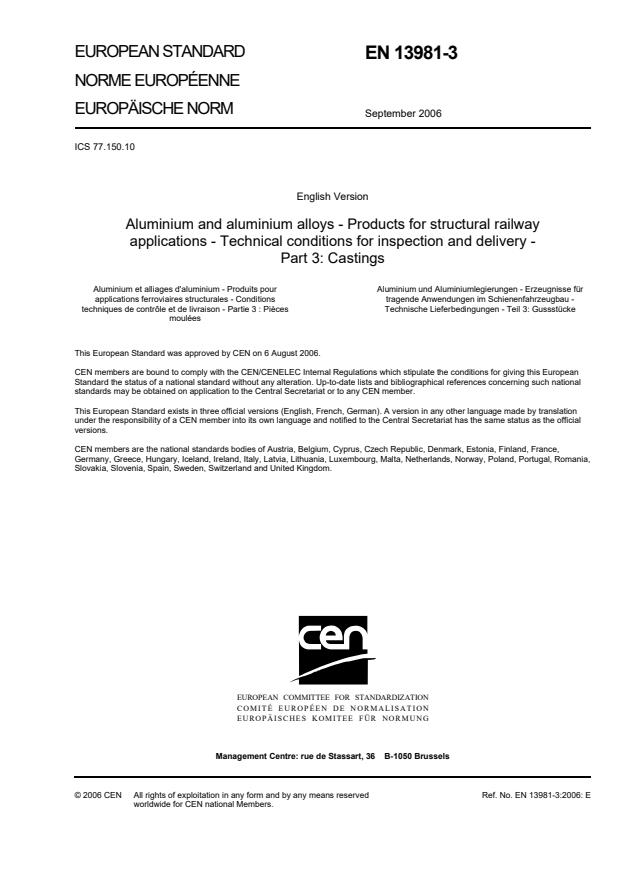
EUROPEAN STANDARDNORME EUROPÉENNEEUROPÄISCHE NORMEN 13981-3September 2006ICS 77.150.10 English VersionAluminium and aluminium alloys - Products for structural railwayapplications - Technical conditions for inspection and delivery -Part 3: CastingsAluminium et alliages d'aluminium - Produits pourapplications ferroviaires structurales - Conditionstechniques de contrôle et de livraison - Partie 3 : PiècesmouléesAluminium und Aluminiumlegierungen - Erzeugnisse fürtragende Anwendungen im Schienenfahrzeugbau -Technische Lieferbedingungen - Teil 3: GussstückeThis European Standard was approved by CEN on 6 August 2006.CEN members are bound to comply with the CEN/CENELEC Internal Regulations which stipulate the conditions for giving this EuropeanStandard the status of a national standard without any alteration. Up-to-date lists and bibliographical references concerning such nationalstandards may be obtained on application to the Central Secretariat or to any CEN member.This European Standard exists in three official versions (English, French, German). A version in any other language made by translationunder the responsibility of a CEN member into its own language and notified to the Central Secretariat has the same status as the officialversions.CEN members are the national standards bodies of Austria, Belgium, Cyprus, Czech Republic, Denmark, Estonia, Finland, France,Germany, Greece, Hungary, Iceland, Ireland, Italy, Latvia, Lithuania, Luxembourg, Malta, Netherlands, Norway, Poland, Portugal, Romania,Slovakia, Slovenia, Spain, Sweden, Switzerland and United Kingdom.EUROPEAN COMMITTEE FOR STANDARDIZATIONCOMITÉ EUROPÉEN DE NORMALISATIONEUROPÄISCHES KOMITEE FÜR NORMUNGManagement Centre: rue de Stassart, 36
B-1050 Brussels© 2006 CENAll rights of exploitation in any form and by any means reservedworldwide for CEN national Members.Ref. No. EN 13981-3:2006: E
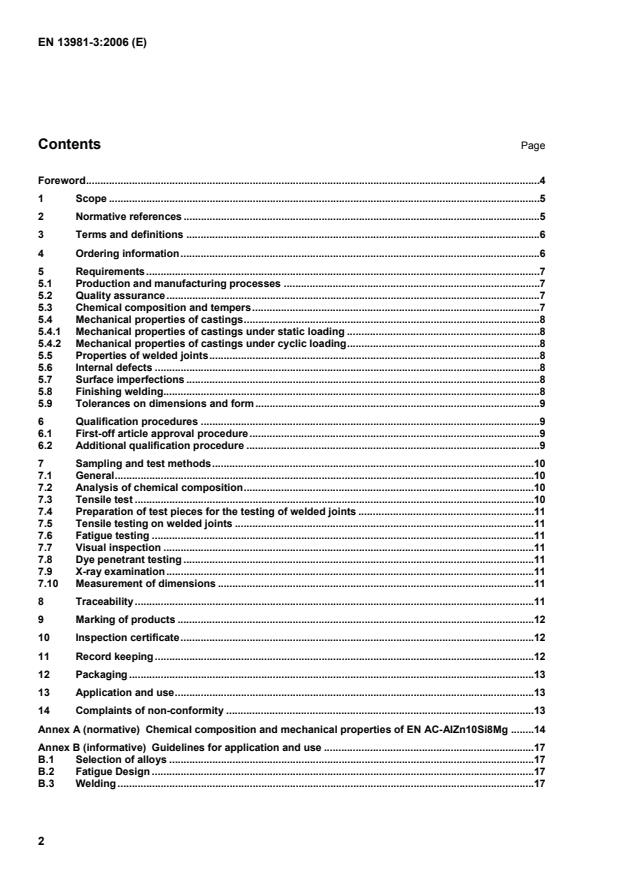
Chemical composition and mechanical properties of EN AC-AIZn10Si8Mg.14 Annex B (informative)
Guidelines for application and use.17 B.1 Selection of alloys.17 B.2 Fatigue Design.17 B.3 Welding.17
...