

EN 14647:2005
(Main)Calcium aluminate cement - Composition, specifications and conformity criteria
- Abstract
This European Standardt gives a general definition of calcium aluminate cement and its composition. It includes requirements for the mechanical, physical and chemical properties and also states the conformity criteria and the related rules.
Calcium aluminate cement used as a constituent material of formulated mixes for specific applications (e.g. dry mixes) is outside the scope of this European Standard.
NOTE Guidance for the correct use of calcium aluminate cement in concrete and mortars is given in Annex A.
- Status
- Published
- Publication Date
- 18-Oct-2005
- Withdrawal Date
- 30-Jul-2007
- Technical Committee
- CEN/TC 51 - Cement and building limes
- Drafting Committee
- CEN/TC 51/WG 6 - Definitions and terminology of cement
- Current Stage
- 9093 - Decision to confirm - Review Enquiry
- Start Date
- 04-Sep-2023
- Completion Date
- 21-Oct-2026
- Directive
- 305/2011 - Regulation (eu) No 305/2011 of the European Parliament and of the Council of 9 march 2011 laying down harmonised conditions for the marketing of construction products and repealing council directive 89/106/eecOJ Ref: C, C 259 OJ Date: 08-Aug-2014
89/106/EEC - Construction productsOJ Ref: C, C 304 OJ Date: 13-Dec-2006

Overview
EN 14647:2005 - published by CEN - defines calcium aluminate cement (CAC): its composition, required mechanical/physical/chemical properties, and the conformity criteria and evaluation rules. The standard covers CAC produced from calcium aluminate clinker (with limited grinding aids) and establishes how manufacturers and certification bodies should test and verify product compliance. It excludes calcium aluminate cement used only as a constituent in formulated mixes (e.g., dry mixes). Guidance for correct use in concrete and mortars (including conversion and long‑term strength considerations) is provided in Annex A.
Key topics and requirements
- Definition and composition: CAC is a hydraulic binder whose main phase is monocalcium aluminate. CAC for EN 14647 must be composed only of calcium aluminate clinker (plus permitted grinding aids).
- Grinding aids: maximum 0.2% by mass (dry basis); they must not corrode reinforcement or impair cement/concrete properties.
- Mechanical / physical requirements:
- Compressive strength (EN 196-1 mortar test): ≥ 18.0 MPa at 6 h, ≥ 40.0 MPa at 24 h (water/cement = 0.40; demould at ~6 h).
- Initial setting time (EN 196-3): ≥ 90 minutes.
- Note: 28‑day strengths are not used for CAC assessment; hydration and strength development differ from Portland cement because of conversion.
- Chemical limits (EN 196-2):
- Al2O3: 35 % ≤ Al2O3 ≤ 58 %
- Sulfide (S2−): ≤ 0.10 %
- Chloride: ≤ 0.10 %
- Alkalis (Na2O eq.): ≤ 0.4 %
- Sulfate (SO3): ≤ 0.5 %
- Designation: “Calcium aluminate cement EN 14647 CAC”.
- Conformity & testing: Continuous autocontrol testing by the manufacturer; conformity assessment and certification follow EN 197-2. Test methods referenced include EN 196-1, -2, -3, -7.
Practical applications
- Use where rapid hardening, high‑temperature resistance, or sulfate resistance is required (e.g., refractory precast elements, rapid repair mortars).
- Annex A gives practical guidance on design, production, admixtures, and a method to estimate minimum long‑term strength after conversion - critical for avoiding premature failures due to the conversion phenomenon.
- The standard is essential when specifying CAC for performance, production control, procurement, or regulatory compliance in the EU market.
Who uses this standard
- Cement manufacturers and quality managers
- Test laboratories and certification bodies
- Concrete and mortar designers, precast manufacturers, and construction specifiers
- Regulatory authorities and procurement teams verifying CE/Conformity requirements
Related standards
- EN 196-1, -2, -3, -7 (methods of testing cement)
- EN 197-2 (conformity evaluation)
- Annex ZA in EN 14647 links to EU Construction Products Directive requirements
Keywords: EN 14647:2005, calcium aluminate cement, CAC, composition specifications conformity criteria, compressive strength, initial setting time, conversion, EN 196, EN 197-2.
Relations
- Effective Date
- 28-Jan-2026
- Refers
EN 196-3:2016 - Methods of testing cement - Part 3: Determination of setting times and soundness - Effective Date
- 28-Jan-2026
- Effective Date
- 28-Jan-2026
- Effective Date
- 28-Jan-2026
- Effective Date
- 28-Jan-2026
- Effective Date
- 28-Jan-2026
- Effective Date
- 28-Jan-2026
- Referred By
CEN/TR 14245:2014 - Cement - Guidelines for the application of EN 197-2 Conformity Evaluation - Effective Date
- 28-Jan-2026
- Effective Date
- 28-Jan-2026
- Corrected By
EN 14647:2005/AC:2006 - Calcium aluminate cement - Composition, specifications and conformity criteria - Effective Date
- 22-Dec-2008
Get Certified
Connect with accredited certification bodies for this standard

DIBt (Deutsches Institut für Bautechnik)
German Institute for Building Technology.
DIN CERTCO
DIN Group product certification.

Aboma Certification B.V.
Specialized in construction, metal, and transport sectors.
Sponsored listings
Frequently Asked Questions
EN 14647:2005 is a standard published by the European Committee for Standardization (CEN). Its full title is "Calcium aluminate cement - Composition, specifications and conformity criteria". This standard covers: This European Standardt gives a general definition of calcium aluminate cement and its composition. It includes requirements for the mechanical, physical and chemical properties and also states the conformity criteria and the related rules. Calcium aluminate cement used as a constituent material of formulated mixes for specific applications (e.g. dry mixes) is outside the scope of this European Standard. NOTE Guidance for the correct use of calcium aluminate cement in concrete and mortars is given in Annex A.
This European Standardt gives a general definition of calcium aluminate cement and its composition. It includes requirements for the mechanical, physical and chemical properties and also states the conformity criteria and the related rules. Calcium aluminate cement used as a constituent material of formulated mixes for specific applications (e.g. dry mixes) is outside the scope of this European Standard. NOTE Guidance for the correct use of calcium aluminate cement in concrete and mortars is given in Annex A.
EN 14647:2005 is classified under the following ICS (International Classification for Standards) categories: 91.100.10 - Cement. Gypsum. Lime. Mortar. The ICS classification helps identify the subject area and facilitates finding related standards.
EN 14647:2005 has the following relationships with other standards: It is inter standard links to EN 196-7:2007, EN 196-3:2016, EN 196-2:2025, EN 197-2:2000, EN 196-1:2016, EN 197-2:2014, EN 197-2:2020, CEN/TR 14245:2014, CEN/TR 14245:2020, EN 14647:2005/AC:2006. Understanding these relationships helps ensure you are using the most current and applicable version of the standard.
EN 14647:2005 is associated with the following European legislation: EU Directives/Regulations: 305/2011, 89/106/EEC; Standardization Mandates: M/114. When a standard is cited in the Official Journal of the European Union, products manufactured in conformity with it benefit from a presumption of conformity with the essential requirements of the corresponding EU directive or regulation.
EN 14647:2005 is available in PDF format for immediate download after purchase. The document can be added to your cart and obtained through the secure checkout process. Digital delivery ensures instant access to the complete standard document.
Standards Content (Sample)
2003-01.Slovenski inštitut za standardizacijo. Razmnoževanje celote ali delov tega standarda ni dovoljeno.Calcium aluminate cement - Composition, specifications and conformity criteriaKalcijev aluminatni cement – Sestava, zahteve in merila skladnostiCiment d'aluminates de calcium - Composition, spécifications et criteres de conformitéTonerdezement - Zusammensetzung, Anforderungen und KonformitätskriterienTa slovenski standard je istoveten z:EN 14647:2005SIST EN 14647:2005en91.100.10ICS:SLOVENSKI
STANDARDSIST EN 14647:200501-december-2005
EUROPEAN STANDARDNORME EUROPÉENNEEUROPÄISCHE NORMEN 14647October 2005ICS 91.100.10 English VersionCalcium aluminate cement - Composition, specifications andconformity criteriaCiment d'aluminates de calcium - Composition,spécifications et critères de conformitéTonerdezement - Zusammensetzung, Anforderungen undKonformitätskriterienThis European Standard was approved by CEN on 22 July 2005.CEN members are bound to comply with the CEN/CENELEC Internal Regulations which stipulate the conditions for giving this EuropeanStandard the status of a national standard without any alteration. Up-to-date lists and bibliographical references concerning such nationalstandards may be obtained on application to the Central Secretariat or to any CEN member.This European Standard exists in three official versions (English, French, German). A version in any other language made by translationunder the responsibility of a CEN member into its own language and notified to the Central Secretariat has the same status as the officialversions.CEN members are the national standards bodies of Austria, Belgium, Cyprus, Czech Republic, Denmark, Estonia, Finland, France,Germany, Greece, Hungary, Iceland, Ireland, Italy, Latvia, Lithuania, Luxembourg, Malta, Netherlands, Norway, Poland, Portugal, Slovakia,Slovenia, Spain, Sweden, Switzerland and United Kingdom.EUROPEAN COMMITTEE FOR STANDARDIZATIONCOMITÉ EUROPÉEN DE NORMALISATIONEUROPÄISCHES KOMITEE FÜR NORMUNGManagement Centre: rue de Stassart, 36
B-1050 Brussels© 2005 CENAll rights of exploitation in any form and by any means reservedworldwide for CEN national Members.Ref. No. EN 14647:2005: E
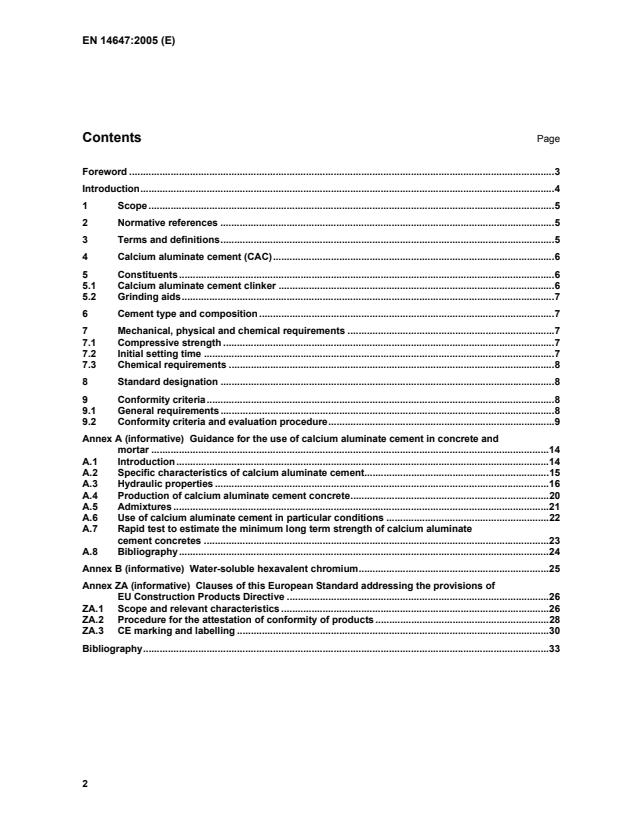
Guidance for the use of calcium aluminate cement in concrete and mortar.14 A.1 Introduction.14 A.2 Specific characteristics of calcium aluminate cement.15 A.3 Hydraulic properties.16 A.4 Production of calcium aluminate cement concrete.20 A.5 Admixtures.21 A.6 Use of calcium aluminate cement in particular conditions.22 A.7 Rapid test to estimate the minimum long term strength of calcium aluminate cement concretes.23 A.8 Bibliography.24 Annex B (informative)
Water-soluble hexavalent chromium.25 Annex ZA (informative)
Clauses of this European Standard addressing the provisions of EU Construction Products Directive.26 ZA.1 Scope and relevant characteristics.26 ZA.2 Procedure for the attestation of conformity of products.28 ZA.3 CE marking and labelling.30 Bibliography.33
24 h ± 15 min. 7.2 Initial setting time The initial setting time, determined in accordance with EN 196-3, shall not be less than 90 min (see also Table 1). Other methods than EN 196-3 may be used provided that they give results correlated and equivalent to those obtained with EN 196-3. Table 1 — Mechanical and physical requirements given as characteristic values Compressive strength (MPa) Initial setting time at 6 h at 24 h (min) ≥ 18,0 ≥ 40,0 ≥ 90 NOTE 1 Calcium aluminate cements are very rapid hardening so 28 day strengths at 20 °C are not relevant. It is traditional to test conformity for strength at these early ages. NOTE 2 Values obtained from these tests should not be used for design purposes for concrete. An explanation of the strength development of calcium aluminate cement concretes and a method for predicting their minimum long term strength is given in Annex A.
8 Standard designation Calcium aluminate cement conforming to this European Standard shall be identified by: Calcium aluminate cement EN 14647 CAC The notation CAC covers definition (Clause 4), composition (Clauses 5 and 6) and requirements (Clauses 7 and 9). NOTE 1 European cements are normally identified by type and a figure indicating the strength class. With calcium aluminate cement, care must be taken when assessing strength, due to the difference that is seen in cement hydration and hence strength development. Consequently it is normal that the designation of calcium aluminate cement does not refer to a strength class. NOTE 2 A more extensive description of the strength development of calcium aluminate cement in concrete and mortar is given in Annex A. 9 Conformity criteria 9.1 General requirements Conformity of calcium aluminate cement to this European Standard shall be continually evaluated on the basis of testing of spot samples. The properties, test methods and the minimum testing frequencies for the autocontrol testing by the manufacturer are specified in Table 3. Concerning testing frequencies for cement not being dispatched continuously and other details, see EN 197-2. For certification of conformity by an approved certification body, conformity of cement with this European Standard shall be evaluated in accordance with EN 197-2. NOTE This European Standard does not deal with acceptance inspection at delivery.
Minimum testing Statistical assessment procedure Property Test frequency Inspection by
method a b Routine Initial variables d attributs e
situation period
Strength
EN 196-1 2/week 4/week x
Initial setting time EN 196-3 2/week 4/week x
Alumina content EN 196-2 2/month 1/week
x Chloride content EN 196-2 2/month c 1/week
x Alkali content EN 196-2 1/month 1/week
x Sulfate content EN 196-2 1/month 1/week
x Sulfide content EN 196-2 1/month 1/week
x a Where allowed in the relevant part of EN 196, other methods than those indicated may be used provided they give results correlated and equivalent to those obtained with the reference method. b Methods used to take and prepare samples shall be in accordance with EN 196-7. c When none of the test results within a period of 12 months exceeds 50 % of the characteristic value, the frequency may be reduced to one per month. d If the data are not normally distributed, then the method of assessment may be decided on a case by case basis. e If the number of samples is at least one per week during the control period, the assessment may be made by variables.
9.2 Conformity criteria and evaluation procedure 9.2.1 General Conformity of calcium aluminate cement with this European Standard is assumed if the conformity criteria specified in 9.2.2 and 9.2.3 are met. Conformity shall be evaluated on the basis of continual sampling using spot samples taken at the point of release and on the basis of the test results obtained on all autocontrol samples taken during the control period. 9.2.2 Statistical conformity criteria 9.2.2.1 General Conformity shall be formulated in terms of a statistical criterion based on: specified characteristic values for mechanical, physical and chemical properties as given in 7.1, 7.2 and 7.3; percentile Pk, on which the specified characteristic value is based, as given in Table 4; allowable probability of acceptance CR, as given in Table 4.
Table 4 — Required values for Pk and CR
Mechanical requirements Physical and
6 h strength 24 h strength chemical
(Lower limit) (Lower limit) requirements The percentile Pk on which the
characteristic 10 % 5 % 10 % value is based
Allowable probability
of acceptance CR 5 %
NOTE Conformity evaluation by a procedure based on a finite number of test results can only produce an approximate value for the proportion of results outside the specified characteristic value in a population. The larger the sample size (number of test results), the better the approximation. The selected probability of acceptance CR controls the degree of approximation by the sampling plan. Conformity with the requirements of this European Standard shall be verified either by variables or by attributes as described in 9.2.2.2 and 9.2.2.3 as specified in Table 3. The control period shall be 12 months. 9.2.2.2 Inspection by variables For this inspection the test results are assumed to be normally distributed. Conformity is verified when the following Equation(s) (1) and (2), as relevant, are satisfied: x
-
kA
x
s ≥
L (1) and x +
kA
x
s ≤
U (2) where x is the arithmetic mean of the totality of the autocontrol test results in the control period;
s is the standard deviation of the totality of the autocontrol test results in the control period;
kA is the acceptability constant;
L is the specified lower limit given in Tables 1 and 2 referred to in 7.1 and 7.3;
U is the specified upper limit given in Table 2 referred to in 7.3. The acceptability constant kA depends on the percentile PK on which the characteristic value is based, on the allowable probability of acceptance CR and the number n of the test results. Values of kA are listed in Table 5.
kA a Number of test for PK = 5 % for PK = 10 % results n (24 h strength, lower limit) (other properties) 20 to 21 2,40 1,93 22 to 23 2,35 1,89 24 to 25 2,31 1,85 26 to 27 2,27 1,82 28 to 29 2,24 1,80 30 to 34 2,22 1,78 35 to 39 2,17 1,73 40 to 44 2,13 1,70 45 to 49 2,09 1,67 50 to 59 2,07 1,65 60 to 69 2,02 1,61 70 to 79 1,99 1,58 80 to 89 1,97 1,56 90 to 99 1,94 1,54 100 to 149 1,93 1,53 150 to 199 1,87 1,48 200 to 299 1,84 1,45 300 to 399 1,80 1,42 > 400 1,78 1,40 NOTE Values given in this table are valid for CR = 5 %. a Values of
kA
valid for intermediate values of n may also be used.
9.2.2.3 Inspection by attributes The number cD of test results outside the characteristic value shall be counted and compared with an acceptable number cA, calculated from the number n of autocontrol test results and the percentile PK as specified in Table 6. Conformity is verified when the Equation (3) is satisfied: cD
≤
cA (3)
Values given in this table are valid for CR = 5 %. a If the number of test results is n < 20 (for PK = 10 %) a statistically based conformity criterion is not possible. Despite this, a criterion of cA = 0 shall be used in cases where n < 20.
9.2.3 Single result conformity criteria In addition to the statistical conformity criteria, conformity of test results to the requirements of this document requires that it shall be verified that each test result remains within the single result limit values specified in Table 7.
Strength (MPa) 6 h 15,0
lower limit value 24 h 38,0
Initial setting time (min)
lower limit value
Alumina content (%) a
lower limit value 33
upper limit value 60
Sulfide content (%) a
upper limit value 0,15
Chloride content (%) a
upper limit value 0,10
Alkali content (%) a b
upper limit value 0,5
Sulfate content (%) a
upper limit value 0,6 a By mass of the final cement. b Expressed as Na2O equivalent (Na2O + 0,658 K2O).
(informative)
Guidance for the use of calcium aluminate cement in concrete and mortar A.1 Introduction Calcium aluminate cement that is produced in conformity to this European Standard can be used, provided it is permitted by national regulations, in construction applications that require the special properties of concretes and mortars made with this cement. The purpose of this annex is to provide guidance for the use of calcium aluminate cement in concrete and mortar. NOTE Applying this annex A does not imply compliance with provisions valid in the place of use of the CAC concrete. To ensure that requirements of stability and durability are met, it is essential to take into account the conversion phenomenon. For design purpose, only strength after conversion shall be considered.
As for any conventional concrete, final performance depends on water/cement ratio, aggregate type and grading, mix proportions, production and placement. Special care has to be taken on the impact of water/cement ratio on strength level after conversion.
For historical reasons, for structural use of calcium aluminate cement based concrete, a total water/cement ratio not greater than 0,40 (corresponding to an effective water/cement ratio of about 0,33 to 0,36) is recommended to achieve satisfactory converted strength. At this level of water/cement ratio, when admixture is not used, the minimum cement content to ensure a paste volume compatible with a good workability is 400 kg/m3. However, any mix design should be chosen in order to meet strength and durability requirements for the intended application. For non-structural applications, it is possible to obtain appropriate converted strength and durability with a total water/cement ratio greater than 0,40. For any use of calcium aluminate cement based concrete, converted strength shall always be estimated with appropriate procedure to ensure conformity with design specifications (see A.7). Furthermore proper attention should also be given to durability of concrete. Calcium aluminate cement is not intended to be used as a general replacement for the common cements in EN 197-1. Its use will be in specialised areas which stem from its special properties: - normal setting time but rapid hardening; - resistance to temperature, abrasion and chemical attack; - normal hardening rate in cold weather (see A.6.1).
If concrete is made in accordance with the principles given in this annex, it does not imply any conformity to national or international codes for design.
However meeting this specification does not preclude verifying that the mix design meets any other performance requirement. Figure A.1 gives two examples of the effect of temperature on conversion.
For this figure, the time to achieve conversion is defined by the time to reach minimum strength.
Key 1 Samples were pre-cured for 24 h at 20°C and then cured at the given temperature under water. 2 Samples were placed directly under water (without pre-curing) at the given curing temperature. Y Time to reach minimum strength (days-log scale) X Curing Temperature (°C) Figure A.1 – Time to reach minimum strength after conversion at different curing temperatures A.2.3 Hydration in presence of lime In presence of calcium hydroxide, the setting rate is strongly accelerated, hardening is slowed down, and final strengths are lowered. Because of this sensitivity, precautions must be taken to ensure that lime or Portland based cement will not be mixed by accident when manufacturing concrete. Mixes of calcium aluminate cement and Portland based cement and/or lime can be used however to produce rapid setting mixes (see A.8 [1]). These mi
...