

EN 1932:2013
(Main)External blinds and shutters - Resistance to wind loads - Method of testing and performance criteria
- Abstract
The European Standard specifies the test methods to evaluate the wind resistance of external blinds and shutters to be fitted to buildings, in front of windows, doors or façades and delivered as a complete unit.
This European Standard applies to:
- shutters: roller shutter, external venetian blind, wing shutter, venetian shutter, concertina shutter, flat closing concertina shutter and sliding panel shutter (including those with projection systems);
- external blinds: folding arm awning, trellis arm awning, pivot arm awning, marquisolette, vertical awning, façade awning, conservatory awning, roof window awning, Pergola awning and insect screen
whatever the nature of the constituent materials, under normal operating conditions and installed in compliance with the manufacturer's installations instructions.
This European Standard does not cover non retractable shutters, external blinds and awnings such as Dutch awnings and brise-soleil as well as the structural part of Pergolas.
NOTE The wind resistance of such products can be evaluated by calculations.
- Status
- Published
- Publication Date
- 18-Jun-2013
- Withdrawal Date
- 09-Dec-2014
- Technical Committee
- CEN/TC 33 - Doors, windows, shutters and building hardware
- Drafting Committee
- CEN/TC 33/WG 3 - Blinds and shutters
- Current Stage
- 9093 - Decision to confirm - Review Enquiry
- Start Date
- 04-Jun-2024
- Completion Date
- 14-Oct-2026


Overview
EN 1932:2013 (CEN) defines standardized test methods and performance criteria to evaluate the wind resistance of external blinds and shutters delivered as a complete unit and fitted in front of windows, doors or façades. The standard covers a wide range of products - including roller shutters, external venetian blinds, wing and venetian shutters, concertina and sliding panel shutters, and many external blinds and awnings (folding-arm, trellis-arm, pivot-arm, marquisolette, vertical, façade, conservatory, roof-window, pergola awnings and insect screens) - when installed in accordance with the manufacturer’s instructions and under normal operating conditions.
EN 1932:2013 reproduces positive and negative wind pressures to verify that the unit as a whole meets safety, usability and visual-acceptance requirements defined in associated performance standards.
Key topics
- Scope and exclusions: Applies to retractable external blinds/shutters; excludes non-retractable devices (e.g., Dutch awnings, brise-soleil) and the structural parts of pergolas (these can be evaluated by calculation).
- Test conditions: Sample dimensions, positioning, and laboratory environmental requirements.
- Methods of loading:
- Method No.1: suspended weights
- Method No.2: uniformly distributed weight (e.g., mattress)
- Method No.3: pneumatic device (now used for External Venetian Blinds)
- Test loads and sequences: Defined loading levels, staged application and measurement points to replicate wind actions.
- Measurements and performance criteria: Vertical/horizontal displacements, permanent deformation, loss of function, visual defects and safety-related failures.
- Test reporting: Structured test report requirements for reproducibility and certification.
Applications
- Validates product wind resistance for design, certification and market compliance.
- Used in type testing during product development, quality control and third‑party certification.
- Supports specification of blinds/awnings for buildings in wind-exposed locations and façade engineering decisions.
- Useful for manufacturers documenting compliance and for test laboratories performing standardized wind tests.
Who uses this standard
- Product manufacturers and designers of external blinds and shutters
- Independent testing laboratories and certification bodies
- Architects, façade and structural engineers, specifiers and procurement teams
- Regulatory authorities and compliance officers overseeing safety and performance
Related standards
- EN 13561 - External blinds and awnings: performance requirements
- EN 13659 - Shutters and external venetian blinds: performance requirements
- EN 12216 - Terminology for external blinds and shutters
- EN 13330 - Shutters: hard body impact and prevention of access - test methods
Keywords: EN 1932:2013, external blinds, shutters, wind resistance testing, performance criteria, CEN, awnings, external venetian blind, roller shutter, wind loads, test methods.
Relations
- Effective Date
- 06-May-2009
- Refers
EN 14500:2021 - Blinds and shutters - Thermal and visual comfort - Test and calculation methods - Effective Date
- 28-Jan-2026
- Effective Date
- 28-Jan-2026
- Refers
EN 12216:2018 - Shutters, external blinds, internal blinds - Terminology, glossary and definitions - Effective Date
- 28-Jan-2026
- Effective Date
- 28-Jan-2026
- Refers
EN 13659:2015 - Shutters and external venetian blinds - Performance requirements including safety - Effective Date
- 28-Jan-2026
- Effective Date
- 28-Jan-2026
- Effective Date
- 28-Jan-2026
- Referred By
EN 12833:2001 - Skylight and conservatory roller shutters - Resistance to snow load - Test method - Effective Date
- 28-Jan-2026
- Effective Date
- 28-Jan-2026
- Effective Date
- 28-Jan-2026
- Referred By
EN ISO 21531:2009 - Dentistry - Graphical symbols for dental instruments (ISO 21531:2009) - Effective Date
- 28-Jan-2026
- Effective Date
- 28-Jan-2026
- Effective Date
- 28-Jan-2026
Get Certified
Connect with accredited certification bodies for this standard

DIBt (Deutsches Institut für Bautechnik)
German Institute for Building Technology.
DIN CERTCO
DIN Group product certification.

Aboma Certification B.V.
Specialized in construction, metal, and transport sectors.
Sponsored listings
Frequently Asked Questions
EN 1932:2013 is a standard published by the European Committee for Standardization (CEN). Its full title is "External blinds and shutters - Resistance to wind loads - Method of testing and performance criteria". This standard covers: The European Standard specifies the test methods to evaluate the wind resistance of external blinds and shutters to be fitted to buildings, in front of windows, doors or façades and delivered as a complete unit. This European Standard applies to: - shutters: roller shutter, external venetian blind, wing shutter, venetian shutter, concertina shutter, flat closing concertina shutter and sliding panel shutter (including those with projection systems); - external blinds: folding arm awning, trellis arm awning, pivot arm awning, marquisolette, vertical awning, façade awning, conservatory awning, roof window awning, Pergola awning and insect screen whatever the nature of the constituent materials, under normal operating conditions and installed in compliance with the manufacturer's installations instructions. This European Standard does not cover non retractable shutters, external blinds and awnings such as Dutch awnings and brise-soleil as well as the structural part of Pergolas. NOTE The wind resistance of such products can be evaluated by calculations.
The European Standard specifies the test methods to evaluate the wind resistance of external blinds and shutters to be fitted to buildings, in front of windows, doors or façades and delivered as a complete unit. This European Standard applies to: - shutters: roller shutter, external venetian blind, wing shutter, venetian shutter, concertina shutter, flat closing concertina shutter and sliding panel shutter (including those with projection systems); - external blinds: folding arm awning, trellis arm awning, pivot arm awning, marquisolette, vertical awning, façade awning, conservatory awning, roof window awning, Pergola awning and insect screen whatever the nature of the constituent materials, under normal operating conditions and installed in compliance with the manufacturer's installations instructions. This European Standard does not cover non retractable shutters, external blinds and awnings such as Dutch awnings and brise-soleil as well as the structural part of Pergolas. NOTE The wind resistance of such products can be evaluated by calculations.
EN 1932:2013 is classified under the following ICS (International Classification for Standards) categories: 91.060.50 - Doors and windows. The ICS classification helps identify the subject area and facilitates finding related standards.
EN 1932:2013 has the following relationships with other standards: It is inter standard links to EN 1932:2001, EN 14500:2021, EN ISO 2439:2008, EN 12216:2018, EN 13561:2015, EN 13659:2015, EN ISO 11192:2005, EN 13561:2004+A1:2008, EN 12833:2001, EN 13659:2004+A1:2008, EN ISO 9687:2015, EN ISO 21531:2009, EN ISO 11192:2018, EN ISO 7010:2012. Understanding these relationships helps ensure you are using the most current and applicable version of the standard.
EN 1932:2013 is available in PDF format for immediate download after purchase. The document can be added to your cart and obtained through the secure checkout process. Digital delivery ensures instant access to the complete standard document.
Standards Content (Sample)
2003-01.Slovenski inštitut za standardizacijo. Razmnoževanje celote ali delov tega standarda ni dovoljeno.Abschlüsse und Markisen - Widerstand gegen Windlast - Prüfverfahren und
NachweiskriterienFermetures pour baies équipées de fenêtres et stores extérieurs - Résistance aux charges de vent - Méthodes d'essai et critères de performanceExternal blinds and shutters - Resistance to wind loads - Method of testing and performance criteria91.060.50Vrata in oknaDoors and windowsICS:Ta slovenski standard je istoveten z:EN 1932:2013SIST EN 1932:2013en,fr01-september-2013SIST EN 1932:2013SLOVENSKI
STANDARDSIST EN 1932:20011DGRPHãþD
EUROPEAN STANDARD NORME EUROPÉENNE EUROPÄISCHE NORM
EN 1932
June 2013 ICS 91.060.50 Supersedes EN 1932:2001English Version
External blinds and shutters - Resistance to wind loads - Method of testing and performance criteria
Fermetures pour baies équipées de fenêtres et stores extérieurs - Résistance aux charges de vent - Méthodes d'essai et critères de performance
Abschlüsse und Markisen - Widerstand gegen Windlast - Prüfverfahren und
Nachweiskriterien This European Standard was approved by CEN on 14 December 2012.
CEN members are bound to comply with the CEN/CENELEC Internal Regulations which stipulate the conditions for giving this European Standard the status of a national standard without any alteration. Up-to-date lists and bibliographical references concerning such national standards may be obtained on application to the CEN-CENELEC Management Centre or to any CEN member.
This European Standard exists in three official versions (English, French, German). A version in any other language made by translation under the responsibility of a CEN member into its own language and notified to the CEN-CENELEC Management Centre has the same status as the official versions.
CEN members are the national standards bodies of Austria, Belgium, Bulgaria, Croatia, Cyprus, Czech Republic, Denmark, Estonia, Finland, Former Yugoslav Republic of Macedonia, France, Germany, Greece, Hungary, Iceland, Ireland, Italy, Latvia, Lithuania, Luxembourg, Malta, Netherlands, Norway, Poland, Portugal, Romania, Slovakia, Slovenia, Spain, Sweden, Switzerland, Turkey and United Kingdom.
EUROPEAN COMMITTEE FOR STANDARDIZATION
COMITÉ EUROPÉEN DE NORMALISATION EUROPÄISCHES KOMITEE FÜR NORMUNG
Management Centre:
Avenue Marnix 17,
B-1000 Brussels © 2013 CEN All rights of exploitation in any form and by any means reserved worldwide for CEN national Members. Ref. No. EN 1932:2013: ESIST EN 1932:2013
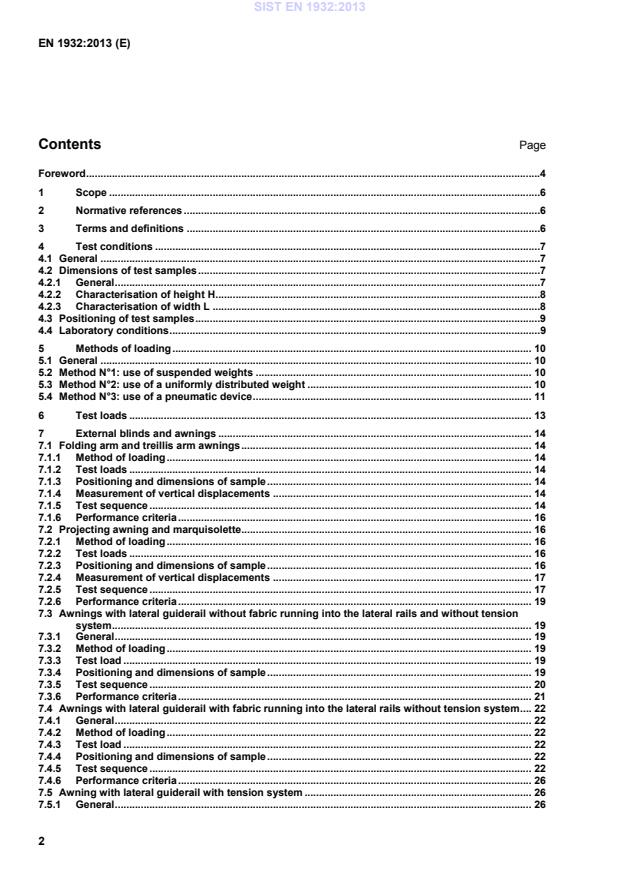
Page Foreword .4 1 Scope .6 2 Normative references .6 3 Terms and definitions .6 4 Test conditions .7 4.1 General .7 4.2 Dimensions of test samples .7 4.2.1 General .7 4.2.2 Characterisation of height H .8 4.2.3 Characterisation of width L .8 4.3 Positioning of test samples .9 4.4 Laboratory conditions .9 5 Methods of loading . 10 5.1 General . 10 5.2 Method N°1: use of suspended weights . 10 5.3 Method N°2: use of a uniformly distributed weight . 10 5.4 Method N°3: use of a pneumatic device . 11 6 Test loads . 13 7 External blinds and awnings . 14 7.1 Folding arm and treillis arm awnings . 14 7.1.1 Method of loading . 14 7.1.2 Test loads . 14 7.1.3 Positioning and dimensions of sample . 14 7.1.4 Measurement of vertical displacements . 14 7.1.5 Test sequence . 14 7.1.6 Performance criteria . 16 7.2 Projecting awning and marquisolette. 16 7.2.1 Method of loading . 16 7.2.2 Test loads . 16 7.2.3 Positioning and dimensions of sample . 16 7.2.4 Measurement of vertical displacements . 17 7.2.5 Test sequence . 17 7.2.6 Performance criteria . 19 7.3 Awnings with lateral guiderail without fabric running into the lateral rails and without tension system . 19 7.3.1 General . 19 7.3.2 Method of loading . 19 7.3.3 Test load . 19 7.3.4 Positioning and dimensions of sample . 19 7.3.5 Test sequence . 20 7.3.6 Performance criteria . 21 7.4 Awnings with lateral guiderail with fabric running into the lateral rails without tension system . 22 7.4.1 General . 22 7.4.2 Method of loading . 22 7.4.3 Test load . 22 7.4.4 Positioning and dimensions of sample . 22 7.4.5 Test sequence . 22 7.4.6 Performance criteria . 26 7.5 Awning with lateral guiderail with tension system . 26 7.5.1 General . 26 SIST EN 1932:2013
Example of a test apparatus for the method of loading N°3 . 44
The European Standard specifies the test methods to evaluate the wind resistance of external blinds and shutters to be fitted to buildings, in front of windows, doors or façades and delivered as a complete unit. This European Standard applies to: shutters: roller shutter, external venetian blind, wing shutter, venetian shutter, concertina shutter, flat closing concertina shutter and sliding panel shutter (including those with projection systems); external blinds: folding arm awning, trellis arm awning, pivot arm awning, marquisolette, vertical awning, façade awning, conservatory awning, roof window awning, Pergola awning and insect screen whatever the nature of the constituent materials, under normal operating conditions and installed in compliance with the manufacturer's installations instructions. This European Standard does not cover non retractable shutters, external blinds and awnings such as Dutch awnings and brise-soleil as well as the structural part of Pergolas. NOTE The wind resistance of such products can be evaluated by calculations. 2 Normative references The following documents, in whole or in part, are normatively referenced in this document and are indispensable for its application. For dated references, only the edition cited applies. For undated references, the latest edition of the referenced document (including any amendments) applies. EN 12216, Shutters, external blinds, internal blinds Terminology, glossary and definitions EN 13561, External blinds and awnings Performance requirements including safety EN 13659, Shutters and external venetian blinds Performance requirements including safety EN 14500, Blinds and shutters Thermal and visual comfort Test and calculation methods EN ISO 2439, Flexible cellular polymeric materials Determination of hardness (indentation technique) (ISO 2439) 3 Terms and definitions For the purposes of this document, the terms and definitions given in EN 12216, EN 13561 and EN 13659 and the following apply. 3.1 test pressure
p pressure exerted on the external or internal face of the test sample which represents the differential pressure (difference in pressure between the two faces) exerted by the wind on the external blind/awning or the shutter
3.2 nominal pressure
pN test pressure under which the test sample does not sustain deformation or deterioration detrimental to its correct operation 3.3 safety pressure
pS test pressure under which no deterioration which may be dangerous for the persons is observed SIST EN 1932:2013
pN and pS are defined in the classification specified in EN 13561 and EN 13659. 3.4 nominal load
FN load applied to the test sample allowing the reproduction of the effects due to the uniform nominal pressure pN exerted on the test sample 3.5 safety load
FS load applied to the test sample allowing the reproduction of the effects due to the uniform safety pressure pS exerted on the test sample 4 Test conditions 4.1 General The tests shall be carried out with the maximum dimensions defined by the manufacturer with the exception of External Venetian Blinds (see 8.2.3) in the most unfavourable configuration for each product type (see 4.2). The test results obtained can then be applied to all more favourable configurations and to all smaller dimensions in the particular product design. NOTE For example, for the same dimensions, a conservatory awning with relieving rollers could be considered a better configuration than without relieving rollers, for the same product design. 4.2 Dimensions of test samples 4.2.1 General The dimensional technical limits are the maximum dimensions for the width and height (Lmax and Hmax) associated with the maximum surface area (Smax) specified by the manufacturer.
Figure 1 — Dimensions of test samples To be representative of a range, the samples submitted for test shall be of the following dimensions (see
Figure 1): SIST EN 1932:2013
4.2.2 Characterisation of height H In the case of awnings, H is the distance between the axis of the roller tube and the extremity of the front or bottom bar (see Figure 2 and Figure 3). In the case the projection of the awning is made of two parts (e.g. for marquisolette), the height H is the sum of the vertical and the projected part: H = H1 + H2 (see Figure 3). In the case of roller shutters and external venetian blinds, H is the height of the visible part of the curtain including the bottom lath (see Figure 4 and Figure 5). In the case of others shutters, H is the height of the curtain. In the case of conservatory blind with relieving roller(s), the height to be considered is either the distance between the roller tube and the first relieving roller, or between two relieving rollers, or between the last relieving rollers and the front profile, whichever is the maximum distance. 4.2.3 Characterisation of width L In the case of awnings, L is the width of the fabric. In the case of shutters, L is the visible width of the curtain.
Figure 2 — Dimensions — Example of folding arm awning SIST EN 1932:2013
Figure 3 — Dimensions — Example of projection awning and marquisolette
Figure 4 — Dimensions — Example of roller shutter
Figure 5 — Dimensions — Example of External venetian blind 4.3 Positioning of test samples The test samples shall be fixed on a rigid frame by their brackets according to the manufacturer's installation instructions. 4.4 Laboratory conditions The tests are carried out at room temperature of 23 °C ± 5 °C. SIST EN 1932:2013
The total weight applied shall be the test load reduced by the weight of the curtain. In the case the missing weight is applied of punctual loads, at least nine loads per m² shall be distributed at regular intervals on the mattress.
Key 1. rigid frame 2. awning 3. mattress Figure 6 — Example of method of loading N°2 for a guided awning The mattress width and height shall be 20 cm smaller than the width and the height of the visible part of the curtain in order to avoid blocks to the free movements of the curtain (see Figure 7). SIST EN 1932:2013
Figure 7 — Dimensions of mattress The mattress used shall have the following characteristics: mass per unit area: 3 kg/m² ± 5 %, mass per unit volume: 30 kg/m3 ± 2 kg/m3, hardness: 170 ± 20 A40 according to EN ISO 2439. 5.4 Method N°3: use of a pneumatic device The test pressures are obtained by using a pneumatic pressure equipment able to withstand the pressure of the class foreseen. The test apparatus shall be as follows (see Annex A): a solid wall with a frame allowing installation of the shutter; an opening shall allow the introduction or extraction of air, a device applying a controlled air pressure over the shutter, with an accuracy of ± 5 % of the measured pressure. If specified, the test pressures may be achieved using an airtight non-elastic film, with a maximum friction coefficient of 0,50, which shall not contribute to the resistance of the test specimen. The film shall be sealed around the edges of the frame, loosely enough so that it will not be fully deployed once the pressure is applied. In case of External Venetian Blinds, the dimensions of the film shall be determined as follows: the height Hf of the film shall fulfil the following condition:
Hf ≥ H H1 250 +2x the width Lf of the film shall fulfil the following condition:
Lf ≥ L H1 000 +2x where H is the height and L the width of the External Venetian Blind, x is the distance between the fixing edge of the film and the axis of the curtain (see Figure 8). SIST EN 1932:2013
Key 1. external venetian blind 2. film 3. fixing edge of the film Figure 8 — Dimensions of the film in case of External Venetian Blinds In case of External Venetian Blinds using guide rails, a lateral protective frame shall be provided to prevent any pressure being applied to the guide rails (see Figure 9).
Key 1. bottom bar 2. guiderail 3. lateral protective frame Figure 9 — Protection of the guiderail of External Venetian Blinds In case the test pressure is obtained using an airtight film, the positive and negative pressures shall be obtained by reversing the sample. If such measurements are required, a measuring tool shall be used to measure the displacement of the curtain on a horizontal axis, (see Figure 10). SIST EN 1932:2013
Key 1. external venetian blind 2. film 3. pressure chamber 4. measuring tool Figure 10 — Example of method of loading N°3 for external venetian blinds 6 Test loads In case the test loads are reproduced by applying punctual or distributed weights over the curtain of the external blind or the shutter, the test loads shall be calculated according to Table 1 for external blinds and awnings and to Table 2 for shutters. Table 1 — External blinds and awnings — Calculation of test loads Nominal load Safety load FN = β x pN x L x H FS = γ x FN , with γ = 1,2
Table 2 — Shutters — Calculation of test loads
Nominal load Safety load Non projected position FN = pN x L x H FS = γ x FN , with γ = 1,5 Projected position
FN = 2 x pN x L x H
with: a) L, H: respectively width and height of the test specimen as defined in Clause 3; b) pN: threshold value of nominal test pressure in N/m2 corresponding to the class considered (see EN 13561 for external blinds and awnings and EN 13659 for shutters); c) β: coefficient of conversion from distributed loads to test loads; it depends on the type of external blinds or awnings: 1) β = 0,5 in the case of folding arm awning, treillis arm awning, projecting awning and marquisolette, SIST EN 1932:2013
Direct half nominal load : 2 x FN /4
Check of the horizontal positioning
Sequence 2 Reference at H
No load applied Zl0 Zr0 Measure of the reference: - Zl0 - Zr0
Sequence 3 Direct nominal loading
Direct nominal load: (2 x FN /4) + (4 x FN /8) Zl1 Zr1 Measure of the vertical displacement after loads are released: - Zl1 - Zl0 - Zr1 - Zr0 - ( Zl1 - Zl0) – (Zr1 - Zr0) Examination of the awning: - correct closing of the boxa:
yes
no Sequence 4 Reverse nominal loading
Reverse nominal load: - FN /2 on each arm Zl2 Zr2 Measure of the vertical displacement after loads are released: - Zl2 - Zl0 - Zr2 - Zr0 - ( Zl2 - Zl0) – (Zr2 - Zr0) Examination of the awning: - correct closing of the box(1):
yes
no SIST EN 1932:2013
Direct safety load: FS /2 on each arm
Examination of the awning: - any breaking:
yes
no
a For folding arm awnings with box only.
7.1.6 Performance criteria All following performance criteria shall be fulfilled by the awnings: a) After application of the direct nominal load (Sequence 3), all following criteria shall be fulfilled: 1) | Zl1 - Zl0 | ≤ 15 % H; 2) | Zr1 - Zr0 | ≤ 15 % H; 3) | (Zl1 - Zl0) - (Zr1 - Zr0) | ≤ 1 % L; 4) In case of folding arm awning with box, the correct closing of the box shall be ensured. b) After application of the reverse nominal load (Sequence 4), all following criteria shall be fulfilled: 1) | Zl2 - Zl0 | ≤ 15 % H; 2) | Zr2 - Zr0 | ≤ 15 % H; 3) | (Zl2 - Zl0) - (Zr2 - Zr0) | ≤ 1 % L; 4) In case of folding arm awning with box, the correct closing of the box shall be ensured. c) After application of the direct safety load (Sequence 5): 1) There shall be no breakage. 7.2 Projecting awning and marquisolette 7.2.1 Method of loading The method of loading N°1 (see 5.2) shall be used. Loads and application points are specified in Table 4 for each test sequence. 7.2.2 Test loads The nominal and safety loads FN and FS shall be calculated according to Clause 6. 7.2.3 Positioning and dimensions of sample Dimensions of the test sample shall fulfil 4.2. The fixing of the test sample shall fulfil 4.3. The drop arms shall be perpendicular to the frame. SIST EN 1932:2013
FN /4 on each arm Zl0 Zr0 Measure of the reference after loads are released: - Zl0 - Zr0
Sequence 2 Direct nominal loading
FN /2 on each arm
Examination of the awning: - tearing in fabric:
yes
no - any breaking (stitching, frame,…):
yes
no
Sequence 3 Reverse nominal loading
- FN /2 on each arm Zl2 Zr2 Measure of the vertical displacement after loads are released: - Zl2 - Zl0 - Zr2 - Zr0 - (Zl2 - Zl0) – (Zr2 - Zr0) Examination of the awning: - tearing in fabric:
yes
no - any breaking (stitching, frame,…):
yes
no
Sequence 4 Direct safety loading
FS /2 on each arm
Examination of the awning: - tearing in fabric:
yes
no - any breaking (stitching, frame, …):
yes
no
- FS /2 on each arm
Examination of the awning: - tearing in fabric:
yes
no - any breaking (stitching, frame,…):
yes
no
Key 1. reference plane 2. articulation blocked
7.2.6 Performance criteria All following performance criteria shall be fulfilled by the awnings: a) After application of nominal loads (direct and reverse) and safety loads (direct or reverse), respectively Sequences 2, 3, 4 and 5, all following criteria shall be fulfilled: 1) There shall be no tearing in fabric, 2) There shall be no breakage (stitching, frame,…). b) After application of the reverse nominal load (Sequence 3), all following criteria shall be fulfilled: 1) | Zl2 - Zl0 | ≤ 2 % H or 2 % H2; 2) | Zr2 - Zr0 | ≤ 2 % H or 2 % H2; 3) | (Zl2 - Zl0) - (Zr2 - Zr0) | ≤ 1 % L. NOTE H2 is the height of the projected part of the awning, in case the projection is made of two parts (see Figure 3). 7.3 Awnings with lateral guiderail without fabric running into the lateral rails and without tension system 7.3.1 General Awnings covered by this clause are for example vertical, façade and conservatory awnings. This clause is applicable when guiding is performed only by the bottom rail. 7.3.2 Method of loading The method of loading N°1 (see 5.2) shall be used with a test bar. Loads and application points are specified in Table 5 for each test sequence. 7.3.3 Test load The nominal load FN shall be calculated according to Clause 6. 7.3.4 Positioning and dimensions of sample Dimensions of the test sample shall fulfil 4.2. The fixing of the test sample shall fulfil 4.3. SIST EN 1932:2013
FN/2 on each end of the test bar Examination of the awning: - tearing in fabric:
yes
no - any breaking (stitching, guiding pins,…):
yes
no - permanent deformation:
yes
no - exit from guide rails:
yes
no
Sequence 2 Drop test
Examination of the awning: - tearing in fabric:
yes
no - any breaking (stitching, guiding pins,…):
yes
no - permanent deformation:
yes
no - exit from guide rails:
yes
no
Key 1. test bar 2. end of the bottom bar blocked 3. end of the bottom bar released
7.3.6 Performance criteria After application of the direct nominal load and after having carried out the drop tests (respectively Sequences 1 and 2), all following criteria shall be fulfilled: there shall be no tearing in fabric; there shall be no breakage (stitching, frame, guiding pins,…); there shall be no permanent deformation (profiles, rails, roller tube,…); there shall be no exit from guide rails. SIST EN 1932:2013
nominal load calculated according to Clause 6; Co
openness coefficient of the fabric. The safety load FS-Co>20% is then equal to FS-Co>20% = γ x FN-Co>20%, where γ is the value defined in Clause 6. In case the method of loading N°3 is used, the same principle shall be applied. 7.4.4 Positioning and dimensions of sample Dimensions of the test sample shall fulfil 4.2. The fixing of the test sample shall fulfil 4.3. The awning shall be in the fully extended position. If the product has a bottom bar blocking system, the bottom bar shall be blocked with its system. If the product has a free hanging bottom bar without a bottom blocking system, the bottom bar shall be blocked in at least two points to carry out the test. 7.4.5 Test sequence The test sequence is the following: a) Sequence 1: the safety load FS (or FS-Co>20% if the openness coefficient of the fabric is higher than 20 %) / pressure pS is applied on one side of the awning. SIST EN 1932:2013
Direct safety load FS (or FS-Co>20% if the openness coefficient of the fabric is higher than 20 %). Examination of the awning: - tearing in fabric:
yes
no - any breaking (stitching, guiding pins,…):
yes
no - permanent deformation (bottom bar, guide rail,…):
yes
no - exit from guide rails:
yes
no
Sequence 2 Reverse safety loading
Reverse safety load -FS (or -FS-Co>20% if the openness coefficient of the fabric is higher than 20 %). Examination of the awning: - tearing in fabric:
yes
no - any breaking (stitching, guiding pins,…):
yes
no - permanent deformation (bottom bar, guide rail,…):
yes
no - exit from guide rails:
yes
no
Sequence 3 Drop test
Examination of the awning: - tearing in fabric:
yes
no - any breaking (stitching, guiding pins,…):
yes
no - permanent deformation (bottom bar, guide rail,…):
yes
no - exit from guide rails:
yes
no
Key 1. end of the bottom bar blocked 2. end of the bottom bar released
...