

EN 14133:2009
(Main)Foodstuffs - Determination of ochratoxin A in wine and beer - HPLC method with immunoaffinity column clean-up
- Abstract
This European Standard specifies a method for the determination of ochratoxin A content in wine and beer using immunoaffinity column clean up and high performance liquid chromatography (HPLC), see [2] and [3]. This method has been validated in an interlaboratory study according to AOAC International Guidelines [4] for collaborative study procedures to validate characteristics of a method of analysis for the determination of ochratoxin A in wine and beer via the analysis of naturally contaminated and spiked samples of wine and beer at
levels ranging from 0,1 ng/ml to 3 ng/ml.
- Status
- Published
- Publication Date
- 26-May-2009
- Withdrawal Date
- 29-Nov-2009
- Technical Committee
- CEN/TC 275 - Food analysis - Horizontal methods
- Drafting Committee
- CEN/TC 275/WG 5 - Biotoxins
- Current Stage
- 9060 - Closure of 2 Year Review Enquiry - Review Enquiry
- Start Date
- 04-Jun-2026
- Completion Date
- 04-Jun-2026

Overview
EN 14133:2009 (CEN) specifies a validated laboratory method for the determination of ochratoxin A in wine and beer using immunoaffinity column clean‑up followed by HPLC (high performance liquid chromatography) with fluorescence detection. The method was validated in an interlaboratory study following AOAC collaborative study guidelines and is intended for routine control of ochratoxin A at low concentration levels (validated range ~0.1 ng/ml to 3 ng/ml).
Key topics and requirements
- Scope and validation: Method validated for naturally contaminated and spiked wine and beer; precision and reproducibility data are provided (see Annex A).
- Sample preparation:
- Dilution with a solution containing polyethylene glycol (PEG) and sodium hydrogen carbonate to improve recoveries and chromatographic cleanliness.
- Degassing of sparkling wines and beers; filtration when necessary.
- Clean-up: Use of immunoaffinity columns with antibodies specific for ochratoxin A; columns must meet minimum capacity and recovery criteria (≥85% recovery for specified challenge).
- HPLC analysis:
- Reversed‑phase column (e.g., C18) and isocratic mobile phase (acetonitrile/water/acetic acid).
- Fluorescence detection (excitation ~333 nm, emission ~460 nm); method sensitivity allows detection at low nanogram levels.
- Daily calibration with multiple calibrants; calibration curve may be forced through zero for accurate low-level quantification.
- Quantification and calculation: External standard calibration and formulae provided to convert HPLC response to ng/ml in the original sample.
- Safety and reagents: Warnings about ochratoxin A toxicity (IARC Group 2B), and hazards of solvents such as acetonitrile and toluene; work in fume hood with appropriate PPE.
- Apparatus: Typical analytical lab equipment plus HPLC system, fluorescence detector, evaporation apparatus, microbalance and immunoaffinity column manifold.
Applications and users
This standard is intended for:
- Food control and public health laboratories performing regulatory monitoring of ochratoxin A in alcoholic beverages.
- Quality assurance teams in wineries and breweries integrating mycotoxin testing into their HACCP/QA programs.
- Contract analytical laboratories offering mycotoxin testing services.
- Regulatory agencies and compliance auditors requiring a harmonized, validated method for enforcement and surveillance.
Practical benefits include reliable low‑level detection, standardized clean‑up to reduce matrix interference, and interlaboratory‑validated precision suitable for compliance testing.
Related standards
- EN ISO 3696 (water for analytical laboratory use) - referenced for reagent water quality.
- AOAC International guidelines - used for collaborative validation procedures.
Keywords: EN 14133:2009, ochratoxin A, HPLC method, immunoaffinity column, wine testing, beer testing, mycotoxin analysis, food safety, CEN standard.
Relations
- Effective Date
- 08-Jun-2022
- Effective Date
- 30-May-2009
- Effective Date
- 28-Jan-2026
Get Certified
Connect with accredited certification bodies for this standard

BSI Group
BSI (British Standards Institution) is the business standards company that helps organizations make excellence a habit.

Bureau Veritas
Bureau Veritas is a world leader in laboratory testing, inspection and certification services.

DNV
DNV is an independent assurance and risk management provider.
Sponsored listings
Frequently Asked Questions
EN 14133:2009 is a standard published by the European Committee for Standardization (CEN). Its full title is "Foodstuffs - Determination of ochratoxin A in wine and beer - HPLC method with immunoaffinity column clean-up". This standard covers: This European Standard specifies a method for the determination of ochratoxin A content in wine and beer using immunoaffinity column clean up and high performance liquid chromatography (HPLC), see [2] and [3]. This method has been validated in an interlaboratory study according to AOAC International Guidelines [4] for collaborative study procedures to validate characteristics of a method of analysis for the determination of ochratoxin A in wine and beer via the analysis of naturally contaminated and spiked samples of wine and beer at levels ranging from 0,1 ng/ml to 3 ng/ml.
This European Standard specifies a method for the determination of ochratoxin A content in wine and beer using immunoaffinity column clean up and high performance liquid chromatography (HPLC), see [2] and [3]. This method has been validated in an interlaboratory study according to AOAC International Guidelines [4] for collaborative study procedures to validate characteristics of a method of analysis for the determination of ochratoxin A in wine and beer via the analysis of naturally contaminated and spiked samples of wine and beer at levels ranging from 0,1 ng/ml to 3 ng/ml.
EN 14133:2009 is classified under the following ICS (International Classification for Standards) categories: 67.160.10 - Alcoholic beverages. The ICS classification helps identify the subject area and facilitates finding related standards.
EN 14133:2009 has the following relationships with other standards: It is inter standard links to EN 14133:2003, EN 14133:2003/AC:2006, EN ISO 3696:1995. Understanding these relationships helps ensure you are using the most current and applicable version of the standard.
EN 14133:2009 is available in PDF format for immediate download after purchase. The document can be added to your cart and obtained through the secure checkout process. Digital delivery ensures instant access to the complete standard document.
Standards Content (Sample)
2003-01.Slovenski inštitut za standardizacijo. Razmnoževanje celote ali delov tega standarda ni dovoljeno.Lebensmittel - Bestimmung von Ochratoxin A in Wein und Bier - HPLC-Verfahren mit Reinigung an einer ImmunoaffinitätssäuleProduits alimentaires - Dosage de l'ochratoxine A dans le vin et la bière - Méthode par purification sur colonne d'immuno-affinité suivie d'une analyse par chromatographie liquide haute performance (CLHP)Foodstuffs - Determination of ochratoxin A in wine and beer - HPLC method with immunoaffinity column clean-up67.160.10Alcoholic beveragesICS:Ta slovenski standard je istoveten z:EN 14133:2009SIST EN 14133:2009en,fr,de01-december-2009SIST EN 14133:2009SLOVENSKI
STANDARDSIST EN 14133:2003/AC:2007SIST EN 14133:20031DGRPHãþD
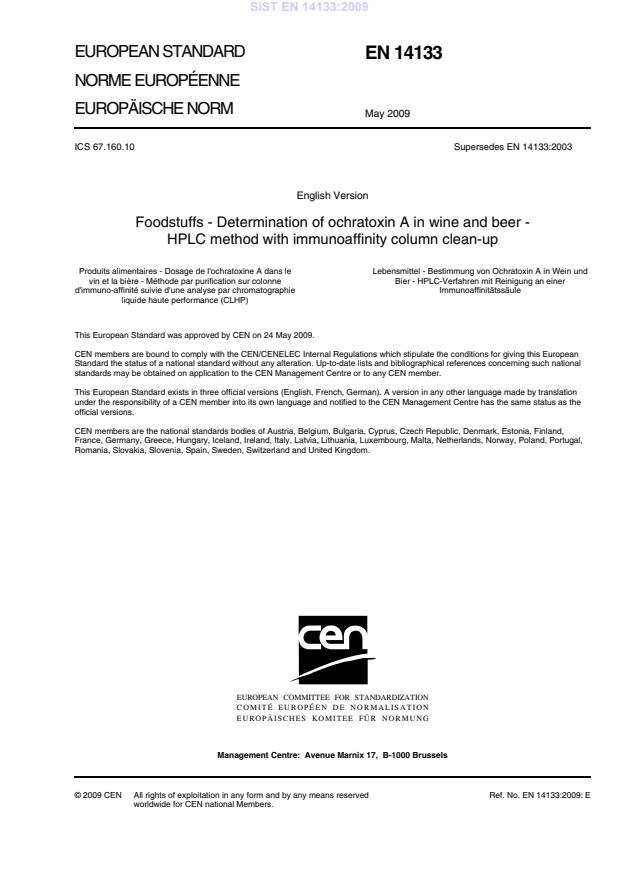
EUROPEAN STANDARDNORME EUROPÉENNEEUROPÄISCHE NORMEN 14133May 2009ICS 67.160.10Supersedes EN 14133:2003
English VersionFoodstuffs - Determination of ochratoxin A in wine and beer -HPLC method with immunoaffinity column clean-upProduits alimentaires - Dosage de l'ochratoxine A dans levin et la bière - Méthode par purification sur colonned'immuno-affinité suivie d'une analyse par chromatographieliquide haute performance (CLHP)Lebensmittel - Bestimmung von Ochratoxin A in Wein undBier - HPLC-Verfahren mit Reinigung an einerImmunoaffinitätssäuleThis European Standard was approved by CEN on 24 May 2009.CEN members are bound to comply with the CEN/CENELEC Internal Regulations which stipulate the conditions for giving this EuropeanStandard the status of a national standard without any alteration. Up-to-date lists and bibliographical references concerning such nationalstandards may be obtained on application to the CEN Management Centre or to any CEN member.This European Standard exists in three official versions (English, French, German). A version in any other language made by translationunder the responsibility of a CEN member into its own language and notified to the CEN Management Centre has the same status as theofficial versions.CEN members are the national standards bodies of Austria, Belgium, Bulgaria, Cyprus, Czech Republic, Denmark, Estonia, Finland,France, Germany, Greece, Hungary, Iceland, Ireland, Italy, Latvia, Lithuania, Luxembourg, Malta, Netherlands, Norway, Poland, Portugal,Romania, Slovakia, Slovenia, Spain, Sweden, Switzerland and United Kingdom.EUROPEAN COMMITTEE FOR STANDARDIZATIONCOMITÉ EUROPÉEN DE NORMALISATIONEUROPÄISCHES KOMITEE FÜR NORMUNGManagement Centre:
Avenue Marnix 17,
B-1000 Brussels© 2009 CENAll rights of exploitation in any form and by any means reservedworldwide for CEN national Members.Ref. No. EN 14133:2009: ESIST EN 14133:2009
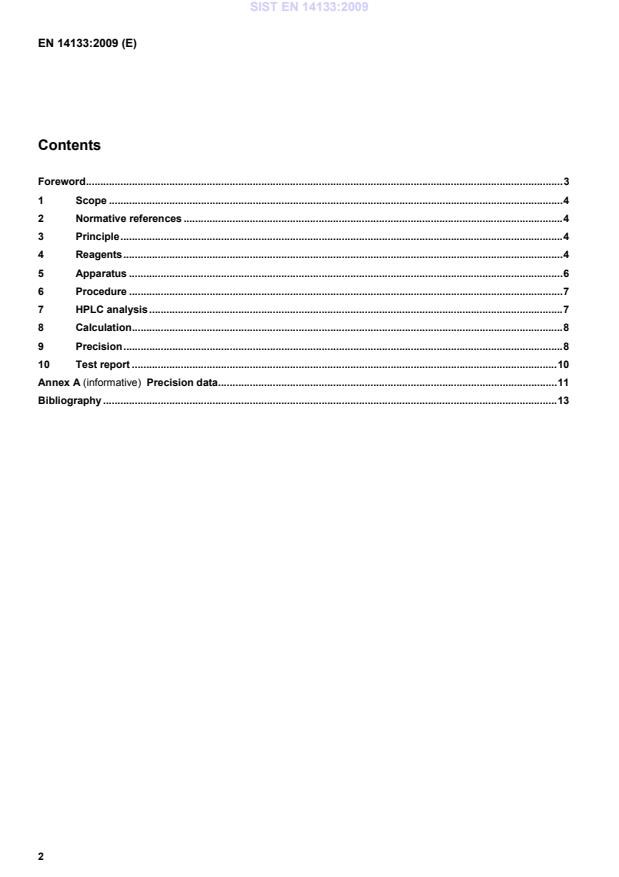
Precision data . 11 Bibliography . 13
Pipette 0,5 ml of the 2 µg/ml ochratoxin A standard solution (4.15) into a 10 ml volumetric flask (5.3) and evaporate the solvent under a stream of nitrogen. Redissolve in 10 ml of mobile phase (4.11). This gives a mass concentration of 100 ng/ml ochratoxin A.
Prepare six HPLC calibrants in separate 5 ml volumetric flasks (5.3) according to Table 1. Dilute each solution to 5 ml with HPLC mobile phase (4.11). SIST EN 14133:2009
Table 1 — Preparation of calibration solutions
Std 1 Std 2 Std 3 Std 4 Std 5 Std 6 µl of filtered mobile phase (4.11) 4970 4900 4700 4000 3000 2000 µl of 100 ng/ml OTA solution
30 100 300 1000 2000 3000 OTA mass concentration (ng/ml) 0,6 2,0 6,0 20 40 60 injected ng OTA
0,06 0,20 0,60 2,00 4,00 6,00
Prepare the calibration solutions at the beginning of every day of the analysis.
4.17 Immunoaffinity columns The immunoaffinity column shall contain antibodies raised against ochratoxin A. The column shall have a total capacity of not less than 100 ng of ochratoxin A and shall give a recovery of not less than 85 % when a diluted wine solution containing 100 ng of ochratoxin A is applied.
5 Apparatus Usual laboratory equipment and, in particular, the following: 5.1 Microbalance, capable to measure 0,01 mg 5.2 Glass vials, approximately 4 ml, with polytetrafluoroethylene (PTFE)-lined screw cap, or appropriate sealable screw cap. Certain types of vials can lead to losses of ochratoxin A during evaporation. To avoid this, silanization can be applied. Prepare vials by filling them with silanizing reagent and leave this reagent in the vial for 1 min. Rinse the vial twice with appropriate solvent (toluene, acetone or hexane) followed by water (twice) and dry the vial. 5.3 Volumetric flasks, 5 ml and 10 ml volume 5.4 Vacuum manifold, to accommodate immunoaffinity columns 5.5 Reservoirs and attachments, to fi
...