

EN 15313:2024
(Main)Railway applications - In-service wheelset operation requirements - In-service and off-vehicle wheelset maintenance
- Abstract
To ensure safety and interoperability, this document gives:
- the limits for in-service and off-vehicle wheelsets;
- the operations to be carried out for which the specific values (and/or criteria) remain to be defined in the maintenance plan.
This document applies to wheelsets and axleboxes complying with the following European standards:
- EN 13103-1:2017+A1:2022;
- EN 13260:2020, EN 13261:2020, EN 13262:2020;
- EN 13979-1:2023;
- EN 13715:2020;
- EN 13749:2021+A1:2023;
that comprise:
- the axle fitted with wheels of diameters greater than or equal to 330 mm;
- axleboxes with bearings and grease.
This document is also applicable to wheelsets:
- fitted with brake discs, final drive, transmission or noise-damping systems, as appropriate;
- not complying with the above European standards, but complying with the international requirements in force, for example in UIC leaflets, before the approval of these standards;
- with tyred wheels;
- with resilient wheels.
For equipment not covered by Directive (EU) 2016/797, this European Standard can be applied, noting that different values can be used.
All dimensions in this document are in millimetres (mm).
It is necessary to describe in a specific document the tasks to be performed in order to maintain wheelsets within the limits defined therein.
NOTE The specific values and criteria are defined in an appropriate maintenance plan.
- Status
- Published
- Publication Date
- 08-Oct-2024
- Technical Committee
- CEN/TC 256 - Railway applications
- Drafting Committee
- CEN/TC 256/SC 2/WG 11 - Wheels - Wheelsets
- Current Stage
- 6060 - Definitive text made available (DAV) - Publishing
- Start Date
- 09-Oct-2024
- Due Date
- 28-Dec-2022
- Completion Date
- 09-Oct-2024
2016/797/EU - Directive (EU) 2016/797 of the European Parliament and of the Council of 11 May 2016 on the interoperability of the rail system within the European Union (Text with EEA relevance)OJ Ref: 2025/424, OJ L OJ Date: 06-Mar-2025
2016/797/EU - Directive (EU) 2016/797 of the European Parliament and of the Council of 11 May 2016 on the interoperability of the rail system within the European Union (Text with EEA relevance)OJ Ref: 2025/424, OJ L, OJ L, 2025/424 OJ Date: 06-Mar-2025
2016/797/EU - Directive (EU) 2016/797 of the European Parliament and of the Council of 11 May 2016 on the interoperability of the rail system within the European Union (Text with EEA relevance)OJ Ref: 2025/424, OJ L, OJ L, 2025/424 OJ Date: 06-Mar-2025
2016/797/EU - Directive (EU) 2016/797 of the European Parliament and of the Council of 11 May 2016 on the interoperability of the rail system within the European Union (Text with EEA relevance)OJ Ref: 2025/424, OJ L OJ Date: 06-Mar-2025
2016/797/EU - Directive (EU) 2016/797 of the European Parliament and of the Council of 11 May 2016 on the interoperability of the rail system within the European Union (Text with EEA relevance)OJ Ref: 2025/424, OJ L, OJ L, 2025/424 OJ Date: 06-Mar-2025
2016/797/EU - Directive (EU) 2016/797 of the European Parliament and of the Council of 11 May 2016 on the interoperability of the rail system within the European Union (Text with EEA relevance)OJ Ref: 2025/424, OJ L, OJ L, 2025/424 OJ Date: 06-Mar-2025
2016/797/EU - Directive (EU) 2016/797 of the European Parliament and of the Council of 11 May 2016 on the interoperability of the rail system within the European Union (Text with EEA relevance)OJ Ref: 2025/424, OJ L, OJ L, 2025/424 OJ Date: 06-Mar-2025
2016/797/EU - Directive (EU) 2016/797 of the European Parliament and of the Council of 11 May 2016 on the interoperability of the rail system within the European Union (Text with EEA relevance)OJ Ref: 2025/424, OJ L, OJ L, 2025/424 OJ Date: 06-Mar-2025
2016/797/EU - Directive (EU) 2016/797 of the European Parliament and of the Council of 11 May 2016 on the interoperability of the rail system within the European Union (Text with EEA relevance)OJ Ref: 2025/424, OJ L, OJ L, 2025/424 OJ Date: 06-Mar-2025
2016/797/EU - Directive (EU) 2016/797 of the European Parliament and of the Council of 11 May 2016 on the interoperability of the rail system within the European Union (Text with EEA relevance)OJ Ref: 2025/424, OJ L, OJ L, 2025/424 OJ Date: 06-Mar-2025
2016/797/EU - Directive (EU) 2016/797 of the European Parliament and of the Council of 11 May 2016 on the interoperability of the rail system within the European Union (Text with EEA relevance)OJ Ref: 2025/424, OJ L, OJ L, 2025/424 OJ Date: 06-Mar-2025
2016/797/EU - Directive (EU) 2016/797 of the European Parliament and of the Council of 11 May 2016 on the interoperability of the rail system within the European Union (Text with EEA relevance)OJ Ref: 2025/424, OJ L, OJ L, 2025/424 OJ Date: 06-Mar-2025
2016/797/EU - Directive (EU) 2016/797 of the European Parliament and of the Council of 11 May 2016 on the interoperability of the rail system within the European Union (Text with EEA relevance)OJ Ref: 2025/424, OJ L, OJ L, 2025/424 OJ Date: 06-Mar-2025

Overview
EN 15313:2024 - Railway applications - In-service wheelset operation requirements - In-service and off-vehicle wheelset maintenance (CEN) defines safety and interoperability requirements for the maintenance of wheelsets and axleboxes. The standard sets the limits for in-service and off-vehicle wheelsets, specifies required operations, and requires that specific values and decision criteria be defined in a maintenance plan. All dimensions are given in millimetres (mm).
Key topics and requirements
- Scope and applicability
- Applies to axle/wheel combinations with wheel diameters ≥ 330 mm and axleboxes with bearings and grease.
- Also applicable to wheelsets with brake discs, final drives, transmissions, noise-damping systems, tyre wheels and resilient wheels, and to equipment complying with relevant international requirements (e.g., UIC) prior to standard approval.
- Can be used for equipment outside Directive (EU) 2016/797, noting values may differ.
- Maintenance framework
- Requirement for a maintenance organization plan and a vehicle/wheelset-specific maintenance plan where the specific limit values and criteria are recorded.
- Staff competence, certification and qualification of maintenance undertakings.
- Traceability, storage and transportation rules; annexes define minimum database content for freight and passenger/locomotive wheelsets.
- Inspection and operations
- Limits for in-service dimensions and positions; reprofiling operations and post-reprofiling dimensional limits (e.g., front-to-front, diameter differences, run-out).
- Detection and assessment methods for tread, flange, hub, web and axle defects, including non-destructive testing (NDT) intervals and procedures.
- Damage acceptance limits for axles and criteria for axleboxes and whole wheelsets.
- Incident response
- Prescribed actions after incidents: hot axlebox detection, derailment, short-circuit exposure, overheating, overload, lubricant loss and other irregularities.
Applications
- Used to develop and document wheelset maintenance plans, inspection regimes and repair acceptance criteria.
- Guides day-to-day in-service wheelset monitoring, depot/off-vehicle maintenance, reprofiling and NDT scheduling.
- Supports vehicle manufacturers, maintainers, fleet operators, infrastructure managers and safety assessors in ensuring safe, interoperable wheelset operation.
Who should use this standard
- Rolling stock maintenance organizations and workshops
- Railway operators and fleet managers
- Component manufacturers (wheels, axles, axleboxes)
- Infrastructure managers and safety/regulatory authorities
- Consultants developing maintenance plans or compliance documentation
Related standards
- EN 13103-1:2017+A1:2022; EN 13260:2020; EN 13261:2020; EN 13262:2020; EN 13979-1:2023; EN 13715:2020; EN 13749:2021+A1:2023 - referenced in EN 15313:2024 for component requirements.
Keywords: EN 15313:2024, wheelset maintenance, in-service wheelset, off-vehicle maintenance, railway standards, axlebox, wheel inspection, reprofiling, NDT, CEN.
Relations
- Effective Date
- 18-Jan-2023
- Effective Date
- 28-Jan-2026
- Refers
EN 13260:2020 - Railway applications - Wheelsets and bogies - Wheelsets - Product requirements - Effective Date
- 28-Jan-2026
- Effective Date
- 28-Jan-2026
- Effective Date
- 28-Jan-2026
- Effective Date
- 28-Jan-2026
- Effective Date
- 28-Jan-2026
- Effective Date
- 28-Jan-2026
- Effective Date
- 28-Jan-2026
- Effective Date
- 28-Jan-2026
- Effective Date
- 28-Jan-2026
- Effective Date
- 28-Jan-2026
- Effective Date
- 28-Jan-2026
- Effective Date
- 28-Jan-2026
- Effective Date
- 28-Jan-2026
Get Certified
Connect with accredited certification bodies for this standard

IRIS Certification (UNIFE)
International Railway Industry Standard certification.

TÜV SÜD Rail GmbH
TÜV SÜD railway certification services.

Bureau Veritas Railway Certification
Railway and transportation certification.
Sponsored listings
Frequently Asked Questions
EN 15313:2024 is a standard published by the European Committee for Standardization (CEN). Its full title is "Railway applications - In-service wheelset operation requirements - In-service and off-vehicle wheelset maintenance". This standard covers: To ensure safety and interoperability, this document gives: - the limits for in-service and off-vehicle wheelsets; - the operations to be carried out for which the specific values (and/or criteria) remain to be defined in the maintenance plan. This document applies to wheelsets and axleboxes complying with the following European standards: - EN 13103-1:2017+A1:2022; - EN 13260:2020, EN 13261:2020, EN 13262:2020; - EN 13979-1:2023; - EN 13715:2020; - EN 13749:2021+A1:2023; that comprise: - the axle fitted with wheels of diameters greater than or equal to 330 mm; - axleboxes with bearings and grease. This document is also applicable to wheelsets: - fitted with brake discs, final drive, transmission or noise-damping systems, as appropriate; - not complying with the above European standards, but complying with the international requirements in force, for example in UIC leaflets, before the approval of these standards; - with tyred wheels; - with resilient wheels. For equipment not covered by Directive (EU) 2016/797, this European Standard can be applied, noting that different values can be used. All dimensions in this document are in millimetres (mm). It is necessary to describe in a specific document the tasks to be performed in order to maintain wheelsets within the limits defined therein. NOTE The specific values and criteria are defined in an appropriate maintenance plan.
To ensure safety and interoperability, this document gives: - the limits for in-service and off-vehicle wheelsets; - the operations to be carried out for which the specific values (and/or criteria) remain to be defined in the maintenance plan. This document applies to wheelsets and axleboxes complying with the following European standards: - EN 13103-1:2017+A1:2022; - EN 13260:2020, EN 13261:2020, EN 13262:2020; - EN 13979-1:2023; - EN 13715:2020; - EN 13749:2021+A1:2023; that comprise: - the axle fitted with wheels of diameters greater than or equal to 330 mm; - axleboxes with bearings and grease. This document is also applicable to wheelsets: - fitted with brake discs, final drive, transmission or noise-damping systems, as appropriate; - not complying with the above European standards, but complying with the international requirements in force, for example in UIC leaflets, before the approval of these standards; - with tyred wheels; - with resilient wheels. For equipment not covered by Directive (EU) 2016/797, this European Standard can be applied, noting that different values can be used. All dimensions in this document are in millimetres (mm). It is necessary to describe in a specific document the tasks to be performed in order to maintain wheelsets within the limits defined therein. NOTE The specific values and criteria are defined in an appropriate maintenance plan.
EN 15313:2024 is classified under the following ICS (International Classification for Standards) categories: 45.040 - Materials and components for railway engineering. The ICS classification helps identify the subject area and facilitates finding related standards.
EN 15313:2024 has the following relationships with other standards: It is inter standard links to EN 15313:2016, EN ISO 9934-1:2016, EN 13260:2020, EN ISO 9934-2:2015, EN 13261:2020, EN 13262:2020, EN 15085-2:2020+A1:2023, EN 13979-1:2023, EN ISO 9712:2022, EN ISO 9934-3:2015, EN 13715:2020, EN 16452:2015+A1:2019, EN 13103-1:2017, EN 16452:2015, CEN/TS 13103-2:2020. Understanding these relationships helps ensure you are using the most current and applicable version of the standard.
EN 15313:2024 is associated with the following European legislation: EU Directives/Regulations: 2016/631, 2016/797/EU, 2016/797/EU, 2016/797/EU, 2016/797/EU, 2016/797/EU, 2016/797/EU, 2016/797/EU, 2016/797/EU, 2016/797/EU, 2016/797/EU, 2016/797/EU, 2016/797/EU, 2016/797/EU; Standardization Mandates: M/483, M/591. When a standard is cited in the Official Journal of the European Union, products manufactured in conformity with it benefit from a presumption of conformity with the essential requirements of the corresponding EU directive or regulation.
EN 15313:2024 is available in PDF format for immediate download after purchase. The document can be added to your cart and obtained through the secure checkout process. Digital delivery ensures instant access to the complete standard document.
Standards Content (Sample)
SLOVENSKI STANDARD
01-december-2024
Železniške naprave - Zahteve za kolesne dvojice med vožnjo - Vzdrževanje
kolesnih dvojic v vgrajenem in razstavljenem stanju
Railway applications - In-service wheelset operation requirements - In-service and off-
vehicle wheelset maintenance
Bahnanwendungen - Radsätze und Drehgestelle - Radsatzinstandhaltung
Applications ferroviaires - Exploitation des essieux en service - Maintenance des essieux
en exploitation ou déposés
Ta slovenski standard je istoveten z: EN 15313:2024
ICS:
45.040 Materiali in deli za železniško Materials and components
tehniko for railway engineering
2003-01.Slovenski inštitut za standardizacijo. Razmnoževanje celote ali delov tega standarda ni dovoljeno.
EN 15313
EUROPEAN STANDARD
NORME EUROPÉENNE
October 2024
EUROPÄISCHE NORM
ICS 45.040 Supersedes EN 15313:2016
English Version
Railway applications - In-service wheelset operation
requirements - In-service and off-vehicle wheelset
maintenance
Applications ferroviaires - Exploitation des essieux en Bahnanwendungen - Radsätze und Drehgestelle -
service - Maintenance des essieux en exploitation ou Radsatzinstandhaltung
déposés
This European Standard was approved by CEN on 12 August 2024.
CEN members are bound to comply with the CEN/CENELEC Internal Regulations which stipulate the conditions for giving this
European Standard the status of a national standard without any alteration. Up-to-date lists and bibliographical references
concerning such national standards may be obtained on application to the CEN-CENELEC Management Centre or to any CEN
member.
This European Standard exists in three official versions (English, French, German). A version in any other language made by
translation under the responsibility of a CEN member into its own language and notified to the CEN-CENELEC Management
Centre has the same status as the official versions.
CEN members are the national standards bodies of Austria, Belgium, Bulgaria, Croatia, Cyprus, Czech Republic, Denmark, Estonia,
Finland, France, Germany, Greece, Hungary, Iceland, Ireland, Italy, Latvia, Lithuania, Luxembourg, Malta, Netherlands, Norway,
Poland, Portugal, Republic of North Macedonia, Romania, Serbia, Slovakia, Slovenia, Spain, Sweden, Switzerland, Türkiye and
United Kingdom.
EUROPEAN COMMITTEE FOR STANDARDIZATION
COMITÉ EUROPÉEN DE NORMALISATION
EUROPÄISCHES KOMITEE FÜR NORMUNG
CEN-CENELEC Management Centre: Rue de la Science 23, B-1040 Brussels
© 2024 CEN All rights of exploitation in any form and by any means reserved Ref. No. EN 15313:2024 E
worldwide for CEN national Members.
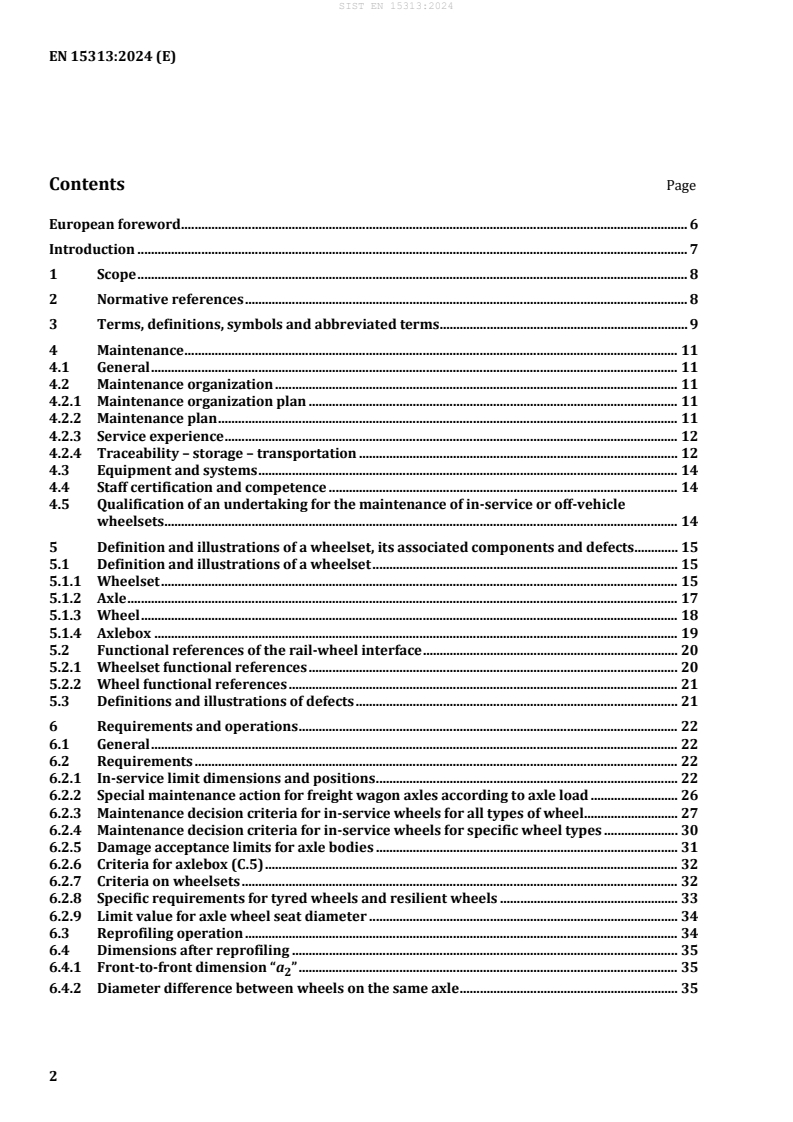
Contents Page
European foreword . 6
Introduction . 7
1 Scope . 8
2 Normative references . 8
3 Terms, definitions, symbols and abbreviated terms . 9
4 Maintenance . 11
4.1 General . 11
4.2 Maintenance organization . 11
4.2.1 Maintenance organization plan . 11
4.2.2 Maintenance plan . 11
4.2.3 Service experience . 12
4.2.4 Traceability – storage – transportation . 12
4.3 Equipment and systems . 14
4.4 Staff certification and competence . 14
4.5 Qualification of an undertaking for the maintenance of in-service or off-vehicle
wheelsets . 14
5 Definition and illustrations of a wheelset, its associated components and defects . 15
5.1 Definition and illustrations of a wheelset . 15
5.1.1 Wheelset . 15
5.1.2 Axle . 17
5.1.3 Wheel . 18
5.1.4 Axlebox . 19
5.2 Functional references of the rail-wheel interface . 20
5.2.1 Wheelset functional references . 20
5.2.2 Wheel functional references . 21
5.3 Definitions and illustrations of defects . 21
6 Requirements and operations . 22
6.1 General . 22
6.2 Requirements . 22
6.2.1 In-service limit dimensions and positions . 22
6.2.2 Special maintenance action for freight wagon axles according to axle load . 26
6.2.3 Maintenance decision criteria for in-service wheels for all types of wheel . 27
6.2.4 Maintenance decision criteria for in-service wheels for specific wheel types . 30
6.2.5 Damage acceptance limits for axle bodies . 31
6.2.6 Criteria for axlebox (C.5) . 32
6.2.7 Criteria on wheelsets . 32
6.2.8 Specific requirements for tyred wheels and resilient wheels . 33
6.2.9 Limit value for axle wheel seat diameter . 34
6.3 Reprofiling operation . 34
6.4 Dimensions after reprofiling . 35
6.4.1 Front-to-front dimension “a ” . 35
6.4.2 Diameter difference between wheels on the same axle . 35
6.4.3 Limit values of radial run-out as a function of the maximum operating speed
authorized for the vehicle . 35
6.4.4 Wheel axial run-out as a function of the maximum operating speed authorized for
the vehicle . 35
6.4.5 Parts of the tread that are not re-profiled . 35
6.4.6 Radial marks and radial defects on the internal side of the rim . 36
6.5 Maintenance operations, examinations and inspections . 36
6.5.1 General . 36
6.5.2 Detection of tread defects . 36
6.5.3 Detection of thermal damage on the wheel rim or tyre . 36
6.5.4 Detection of wheel tread roll-over . 37
6.5.5 Detection of damage to chamfered corner and flange . 37
6.5.6 Detection of damage resulting from identification markings . 37
6.5.7 Detection of defects on the external and internal face of the rim . 37
6.5.8 Verification of web integrity . 37
6.5.9 Verification of hub integrity . 37
6.5.10 Verification of rim integrity - Detection of deep sub-surface tread defects . 38
6.5.11 Detection of thermal defects on the web of a wheel used as a braking surface . 38
6.5.12 Detection of overheating affecting the wheel rim-web transition on monobloc
wheels . 38
6.5.13 Verification of axle surface integrity . 38
6.5.14 Detection of damage caused by corrosion . 41
6.5.15 Detection of circumferential defects around the whole circumference . 41
6.5.16 Detection of circumferential defects in a singular section of the circumference . 41
6.5.17 Detection of notches and impact damage . 41
6.5.18 Detection of longitudinal defects on axles . 41
6.5.19 Detection of damage in interference fit zones . 41
6.5.20 Verification after rectification . 41
6.5.21 Verification of residual magnetism . 41
6.5.22 Lubrication operation . 41
6.5.23 Checking for axlebox defects . 42
6.5.24 Verification of wheelset electrical resistance after heavy maintenance of wheelsets . 42
6.6 Requirements for additional maintenance equipment and operations . 42
7 In-service wheelset maintenance . 42
7.1 Maintenance plan . 42
7.2 Wheelset protection during vehicle and bogie cleaning . 42
8 Off-vehicle wheelset maintenance . 43
8.1 Maintenance plan . 43
8.2 Key operations for off-vehicle wheelset maintenance . 43
8.3 Off-vehicle wheelset cleaning . 44
8.4 NDT Interval . 44
9 Action to be taken on any wheelset after an incident in service or when not covered
by the maintenance plan . 44
9.1 Wheelset bearings subject to water ingress . 44
9.2 Wheelsets having been subjected to a short circuit current (e.g. from falling
overhead line equipment, etc.) . 44
9.3 Detection of a wheel circularity defect by a trackside facility or an onboard
monitoring system . 44
9.4 Wheelsets loaded over the allowed limit . 44
9.5 Hot axlebox detection . 45
9.5.1 General . 45
9.5.2 Technical procedure . 45
9.6 Derailment . 45
9.7 Head-on collision . 46
9.8 Lubricant leakage or loss from the axlebox . 46
9.9 Thermal overloaded wheels, brake incident (detection of seized brake or
discoloration) . 46
9.10 Reporting after detection of a wheelset irregularity outside the maintenance plan . 46
10 Equipment not subject to Directive (EU) 2016/797 . 46
11 Summary table of requirements of this document . 46
Annex A (normative) Minimum database content for freight wagon wheelset traceability . 47
A.1 Data categories for storage time . 47
A.2 Minimum data to be collected . 47
A.3 Measures to be applied resulting from lack of traceability . 52
Annex B (informative) Database content for the traceability of wheelsets of vehicles in the
scope of TSI “Rolling stock - Locomotive and passenger rated vehicles” (TSI Loc and
Pas) . 54
B.1 Data categories for storage time . 54
B.2 Minimum data to be collected . 54
B.3 Measures to be applied resulting from lack of traceability . 59
Annex C (normative) Definition and illustration of defects . 61
C.1 General . 61
C.2 Defects for all types of wheel . 61
C.3 Defects specific to wheel types . 83
C.4 Axle defects. 87
C.5 Axlebox defects . 92
C.6 Wheelset defects . 93
Annex D (normative) Freight stock . 96
Annex E (informative) Rim size without roll-over for equipment not subject to
Directive (EU) 2016/797 . 97
Annex F (normative) Definitions of Type A and B axles . 98
Annex G (informative) Permissible circularity defects . 101
Annex H (informative) Tyred wheels and resilient wheels . 102
H.1 General . 102
H.2 Marking of tyred wheels and resilient wheels . 102
H.3 Tyre thickness of tyred wheels . 103
H.4 Defects specific to tyred wheels . 104
H.5 Verification of the electrical resistance during medium and heavy maintenance . 104
Annex I (normative) Reference images for axle surface condition limits for off-vehicle
wheelset maintenance . 105
I.1 General . 105
I.2 Local and severe defect . 105
I.3 Large and heavily corroded areas, strongly and uniformly pitted surface . 106
I.4 Corrosion defects in abutment area and transition radii . 106
Annex J (informative) NDT interval . 108
J.1 General . 108
J.2 Axle . 108
J.3 Wheel . 108
Annex K (informative) Summary of the requirements of this standard for in-service boxed
wheelsets . 109
Annex L (informative) Characteristics of narrow gauge wheelsets . 111
Annex M (informative) Characteristics of Spanish and Portuguese gauge wheelsets . 112
Annex N (informative) Characteristics of Finnish and Baltic country gauge wheelsets . 113
Annex ZA (informative) Relationship between this European Standard and the Essential
Requirements of EU Directive (EU) 2016/797 aimed to be covered . 114
Bibliography . 116
European foreword
This document (EN 15313:2024) has been prepared by Technical Committee CEN/TC 256 “Railway
applications”, the secretariat of which is held by DIN.
This European Standard shall be given the status of a national standard, either by publication of an
identical text or by endorsement, at the latest by April 2025, and conflicting national standards shall be
withdrawn at the latest by April 2025.
Attention is drawn to the possibility that some of the elements of this document may be the subject of
patent rights. CEN shall not be held responsible for identifying any or all such patent rights.
This document supersedes EN 15313:2016.
In comparison with the previous edition, the following technical modifications have been made:
— a clearer definition of the signs to identify thermal overload of wheels and associated pictures;
— the maintenance requirements to be followed when thermal overloading of a wheel is identified.
This document has been prepared under a standardization request addressed to CEN by the European
Commission. The Standing Committee of the EFTA States subsequently approves these requests for its
Member States.
For the relationship with EU Legislation, see informative Annex ZA, which is an integral part of this
document.
Any feedback and questions on this document should be directed to the users’ national standards body.
A complete listing of these bodies can be found on the CEN website.
According to the CEN-CENELEC Internal Regulations, the national standards organisations of the
following countries are bound to implement this European Standard: Austria, Belgium, Bulgaria, Croatia,
Cyprus, Czech Republic, Denmark, Estonia, Finland, France, Germany, Greece, Hungary, Iceland, Ireland,
Italy, Latvia, Lithuania, Luxembourg, Malta, Netherlands, Norway, Poland, Portugal, Republic of North
Macedonia, Romania, Serbia, Slovakia, Slovenia, Spain, Sweden, Switzerland, Türkiye and the United
Kingdom.
Introduction
The objectives of this amendment to EN 15313:2016 are to:
— incorporate the appropriate results of the ERA Joint Network Secretariat “broken wheels” and Joint
Sector Group task force.
1 Scope
To ensure safety and interoperability, this document gives:
— the limits for in-service and off-vehicle wheelsets;
— the operations to be carried out for which the specific values (and/or criteria) remain to be defined
in the maintenance plan.
This document applies to wheelsets and axleboxes complying with the following European standards:
— EN 13103-1:2017+A1:2022;
— EN 13260:2020, EN 13261:2020, EN 13262:2020;
— EN 13979-1:2023;
— EN 13715:2020;
— EN 13749:2021+A1:2023;
that comprise:
— the axle fitted with wheels of diameters greater than or equal to 330 mm;
— axleboxes with bearings and grease.
This document is also applicable to wheelsets:
— fitted with brake discs, final drive, transmission or noise-damping systems, as appropriate;
— not complying with the above European standards, but complying with the international
requirements in force, for example in UIC leaflets, before the approval of these standards;
— with tyred wheels;
— with resilient wheels.
For equipment not covered by Directive (EU) 2016/797, this European Standard can be applied, noting
that different values can be used.
All dimensions in this document are in millimetres (mm).
It is necessary to describe in a specific document the tasks to be performed in order to maintain wheelsets
within the limits defined therein.
NOTE The specific values and criteria are defined in an appropriate maintenance plan.
2 Normative references
The following documents are referred to in the text in such a way that some or all of their content
constitutes requirements of this document. For dated references, only the edition cited applies. For
undated references, the latest edition of the referenced document (including any amendments) applies.
EN 13260:2020, Railway applications — Wheelsets and bogies — Wheelsets — Product requirements
EN 13261:2020, Railway applications — Wheelsets and bogies — Axles — Product requirements
EN 13262:2020, Railway applications — Wheelsets and bogies — Wheels — Product requirements
EN 13715:2020, Railway applications — Wheelsets and bogies — Wheels — Tread profile
EN 13979-1:2023, Railway applications — Wheelsets and bogies — Monobloc wheels — Technical
approval procedure — Part 1: Forged and rolled wheels
EN 15085-2:2020+A1:2023, Railway applications — Welding of railway vehicles and components —
Part 2: Requirements for welding manufacturer
EN ISO 9712:2022, Non-destructive testing — Qualification and certification of NDT personnel
(ISO 9712:2021)
EN ISO 9934-1:2016, Non-destructive testing — Magnetic particle testing — Part 1: General principles
(ISO 9934-1:2016)
EN ISO 9934-2:2015, Non-destructive testing — Magnetic particle testing — Part 2: Detection media
(ISO 9934-2:2015)
EN ISO 9934-3:2015, Non-destructive testing — Magnetic particle testing — Part 3: Equipment (ISO 9934-
3:2015)
3 Terms, definitions, symbols and abbreviated terms
For the purposes of this document, the following terms and definitions apply.
ISO and IEC maintain terminology databases for use in standardization at the following addresses:
• ISO Online browsing platform: available at https://www.iso.org/obp
• IEC Electropedia: available at https://www.electropedia.org/
3.1
technical expert
person(s) competent in the maintenance of wheelsets
3.2
ECM
Entity in Charge of Maintenance
3.3
wheelset maintenance levels
maintenance of wheelsets is divided into 3 maintenance levels:
— reprofiling;
— medium wheelset maintenance;
— heavy wheelset maintenance
Note 1 to entry: Reprofiling is a maintenance level that corresponds to reprofiling of wheels (in-service or off-
vehicle) and depends mainly on the wear of the wheel or the tread defects.
Note 2 to entry: Medium wheelset maintenance corresponds to off-vehicle overhaul of wheelset (revision of
bearing and reprofiling of wheels).
Note 3 to entry: Heavy wheelset maintenance corresponds to the off-vehicle replacement of the wheels. This
maintenance level is in principle defined by the wear limit of the wheel.
3.4
maintenance plan
structured and documented set of tasks comprising the activities, instructions, resources and the length
of time necessary in order to perform the maintenance (see also definitions in EN 13306:2017;
Maintenance — Maintenance terminology and EN 17018:2019; Railway applications — Rolling stock
maintenance — Terms and definitions)
3.5
in-service wheelset maintenance
maintenance of in-service wheelsets comprises all of the operations which are performed on wheelsets
between medium and/or heavy maintenance levels
3.6
NDT
non-destructive testing
3.7
MT
magnetic particle testing
3.8
UT
ultrasonic testing
3.9
VT
visual testing
3.10
resilient wheels
wheels that contain rubber elements between the tyre and the web
3.11
witness mark
area of unmachined material which can remain after reprofiling to demonstrate that the minimum of
material has been removed
3.12
wagon overhaul
planned heavy maintenance operation on a wagon
4 Maintenance
4.1 General
Maintenance involves:
— maintenance of in-service wheelsets/axleboxes;
— maintenance of off-vehicle wheelsets/axleboxes;
— special maintenance attention after in-service incidents (e.g. overloads, hot axlebox detection,
wheelset bearings subject to water ingress, etc.).
An in-service wheelset shall be maintained by a maintenance undertaking qualified in this type of
wheelset.
For maintenance of wheelsets, as a minimum, the following shall be utilized:
— a maintenance plan;
— service experience;
— an organization for component and production management;
— specific wheelset maintenance tools;
— qualified staff for non-destructive testing and welding.
4.2 Maintenance organization
4.2.1 Maintenance organization plan
The general maintenance of the wheelsets is organized as shown in Figure 1.
Figure 1 — General maintenance organization
4.2.2 Maintenance plan
For wheelset maintenance, it is necessary to have a maintenance plan for the wheelsets when in-service
and off-vehicle.
The maintenance plan shall specify:
— the actions to be performed to meet the requirements and mandatory operations listed in this
document;
— the maintenance intervals;
— any specific measures to be implemented.
The maintenance plan shall be written by an organization having recognized experience in the wheelset
maintenance field and approved by the technical expert for the owner undertaking.
4.2.3 Service experience
The maintenance plan shall be reviewed to include:
— the service experience based on the performance of parts in service;
— the corrective actions necessary for dealing with defects;
— remedial actions for criteria detected outside of the limits specified in the maintenance plan;
— corrective actions for limits based on data from in-line monitoring devices.
The principle for revising the maintenance plan based on service experience is presented in Figure 2.
Figure 2 — Service experience
4.2.4 Traceability – storage – transportation
4.2.4.1 Wheelset identification
In order to ensure traceability, in-service wheelsets shall have marks complying with the requirements
of EN 13260:2020, EN 13261:2020 and EN 13262:2020.
It is recommended to have:
— the owner’s mark on the wheel (e.g. on the hub, with the same requirement as for the other marks,
as specified in EN 13262:2020 and/or painted on the web, etc.);
— external identification on wheelset with axleboxes fitted (e.g. tag or metal plate on the axlebox, collar
on the axle, radio frequency identification (RFID), etc.).
None of the external identification marks shall adversely affect the axle or its components.
All the identification marks shall be described in a specific document to support the management of the
wheelsets during their service lives.
The markings are to be applied to the wheelsets when the latter are subject to medium and heavy
maintenance.
It is recommended, where possible, for these markings to be applied retrospectively, even when the
wheelset components were not manufactured in accordance with EN 13261:2020 or EN 13262:2020.
NOTE When transponders are used for identification, the procedures and instructions are given in Chapter 4
“Guideline for MRO identification” of the document “RFID in RAIL – European Guideline for the Identification of
Railway Assets using GS1 Standards”.
4.2.4.2 Traceability of operations and transfers
The traceability shall be ensured throughout the life of the in-service wheelset and its components by
recording its maintenance life history (e.g. various operations and property transfers).
4.2.4.3 Database
4.2.4.3.1 General
The traceability of the original data and maintenance life history shall be recorded in a database.
The contents of the database and process for capturing information shall be described in a specific
procedure.
The consistency of the records shall be checked on a regular basis.
4.2.4.3.2 Freight wagons
For freight wagon wheelsets, the minimum content of the database, the time period to store the data and
the measures resulting from lack of traceability are given in Annex A. The data shall be recorded in an
electronic database.
For new freight wagon wheelsets, the data in Tables A.1 to A.6 shall be collected before the wheelset is
placed in service.
For in-service freight wagon wheelsets, the data shall be collected at the earliest opportunity according
to the maintenance plan (see 7.1).
Collected maintenance data are identified in categories I, II and III in Annex A, according to the minimum
time for retaining the information.
In the event of a change of owner and/or ECM, all available wheelset data shall be transferred to the new
owner and/or ECM.
4.2.4.3.3 Non-freight vehicles
For non-freight vehicles, the content of Annex B may be taken into consideration in ensuring adequate
traceability.
4.2.4.4 Storage
Component parts, equipment, consumables, etc. are to be protected against damage, as well as against
environmental degradation according to manufacturer’s recommendations, if applicable.
For wheelsets stored, the bearings fitted to the wheelsets shall be rotated at a frequency based on service
experience. 24 months maximum is recommended.
4.2.4.5 Handling and transportation conditions for new or maintained wheelsets
The processes and means of handling, transporting and storing shall not be the cause of damage to
wheelsets, their components and their protective covers. The handling, transportation and storage shall
not damage the most stressed areas, such as the wheel seat transitions.
The bearings, journals and other exposed equipment shall be protected against corrosion and mechanical
damage.
Written procedures specifying how these objectives will be reached shall be available.
4.3 Equipment and systems
All railway-specific tools, gauges and systems for wheelset maintenance (e.g. checking for circularity
defect, stresses in the wheel rim, non-destructive testing, etc.) shall be approved to ensure that
requirements of this standard are met.
A reference file shall be created for all railway-specific equipment in order to ensure that it meets the
requirements.
This file shall indicate that the equipment or railway-specific system has the appropriate levels of
sensitivity and repeatability in line with the desired objective. Performance sustainability shall be
demonstrated by means of calibrated reference equipment.
In addition, when new methods are used, it shall be ensured that the results achieved with the new
equipment or system are at least equivalent to those obtained with the former (e.g. differentiation
between parts with or without defects, etc.).
4.4 Staff certification and competence
Certification is necessary for staff carrying out:
a) non-destructive testing:
the staff shall be qualified according to EN ISO 9712:2022 (Industrial Sector: Railway Maintenance)
or equivalent and authorized to work on specific processes;
NOTE EN 16910-1 gives guidance for the training of operators.
b) welding operations:
the staff shall be qualified according to EN 15085-2:2020+A1:2023 or equivalent for components
where welding is authorized.
4.5 Qualification of an undertaking for the maintenance of in-service or off-vehicle
wheelsets
The qualification principle shown in Figure 3 applies to each of the following activities:
a) maintenance of in-service wheelsets;
b) maintenance of off-vehicle wheelsets;
c) maintenance activity component (example: reprofiling).
The qualification shall be reviewed before its extension to a new type of wheelset/axlebox.
Figure 3 — Flow chart for qualification of a maintenance undertaking
5 Definition and illustrations of a wheelset, its associated components and
defects
5.1 Definition and illustrations of a wheelset
5.1.1 Wheelset
The various components of a wheelset are shown in Figures 4 a) and 4 b).
Key
1 axle
2 monobloc wheel
3 wheel centre
4 tyre
5 retaining ring
a) Wheelset - principal components
Key
1 bearings
2 brake disc, transmission or final drive
3 wheel-fitted brake disc
4 axlebox with bearings
b) Wheelset - other components
Figure 4 — Wheelset
5.1.2 Axle
The axle for all types of wheelset is shown in Figure 5.
Key
1 journal
2 abutment
3 wheel seat
4 axle body
5 seat for brake disc, transmission or final drive
6 transition zone between seats
7 axle bore
Figure 5 — Axle
NOTE Axles can be solid or hollow.
5.1.3 Wheel
The monobloc wheel is shown in Figure 6.
Key
1 rim
2 web
3 hub
L1 hub lenght
Figure 6 — Monobloc wheel
5.1.4 Axlebox
The basic axlebox is shown in Figure 7.
Key
1 front cover
2 end cap bolt and locking device
3 end cap
4 front cover bolt and locking device
5 axlebox body
6 outer bearing
7 internal spacer
8 lubrication point
9 external spacer
10 inner bearing
11 rear cover
12 rear cover bolt and locking device
13 abutment ring
Components 6 – 7 – 9 and 10 may be replaced by a “cartridge” bearing.
The different types of sealing system are to be added as a function of the type of bearing.
Figure 7 — Basic axlebox
5.2 Functional references of the rail-wheel interface
5.2.1 Wheelset functional references
The essential dimensional references of the interface are defined in Figure 8.
The tread profile is defined in EN 13715:2020.
Dimensions in millimetres
Key
a back-to-back dimension
a front-to-front dimension (a + e + e )
2 1 1 2
D0 location of the wheel tread, 70 mm from its internal face. (1) wheel 1, (2) wheel 2
e , e flange thicknesses
1 2
h flange height
H2 finishing point of the flange, on the internal face of the wheel
L rim nominal width
Z1 internal zone of flange (H – S)
FEJ external face of the rim
FIJ internal face of the rim
S connection at the tip of the flange
d , d wheel diameters
1 2
Figure 8 — Interface dimensions – Wheelset functional references
5.2.2 Wheel functional references
The essential dimensional references of the wheel are defined in Figure 9.
Dimensions in millimetres
Key
d wheel diameter
D0 location of the wheel tread, 70 mm from its internal face
h flange height
L rim nominal width
e flange thickness
qR flange angle dimension between P1 and P2
5 × 45° nominal chamfer
Figure 9 — qR value and wheel functional references
NOTE The terms listed in Figures 8 and 9 conform to EN 13715:2020 (Tread profile) and EN 13260:2020
(Wheelsets).
5.3 Definitions and illustrations of defects
Definitions and illustrations of defects are given in Annex C.
6 Requirements and operations
6.1 General
As indicated in the Introduction, this standard defines:
a) requirements for all owners/undertakings (e.g. maximum and minimum dimensions, rail interface
dimensions, etc.);
b) maintenance to be carried out. The acceptance criteria are to be specified in the maintenance plan on
the basis of service experience.
The requirements defined in 6.2 and 6.4 shall be assessed in accordance with the maintenance plan.
The tread profile and wheel dimensions after reprofiling shall be defined on the basis of:
c) the results of vehicle acceptance testing (e.g. stability verification, etc.);
d) the service experience.
The criteria shall be either as defined in 6.2 and 6.4 (allowable limits for safe operation) or as defined in
the maintenance plan based on service experience.
The detection method for defects shall include:
e) manual;
f) visual; or
g) automatic.
6.2 Requirements
6.2.1 In-service limit dimensions and positions
6.2.1.1 General
The maximum and minimum values are given in Tables 1 to 6. The different interface dimensions are
given in Figure 8.
In the case of wheels where the actual diameter passes from one category to another, it is permissible to
use either of the values. This shall be documented in the maintenance plan.
6.2.1.2 Flange h
...