

EN 1992-1-2:2023
(Main)Eurocode 2 - Design of concrete structures - Part 1-2: Structural fire design
General Information
- Abstract
1.1 Scope of prEN 1992 1 2
(1) This document deals with the design of concrete structures for the accidental situation of fire exposure and is intended to be used in conjunction with prEN 1992 1 1 and EN 1991 1 2. This document identifies differences from, or supplements to, normal temperature design.
(2) This document applies to concrete structures required to fulfil a loadbearing function, separating function or both.
(3) This document gives principles and application rules for the design of structures for specified requirements in respect of the aforementioned functions and the levels of performance.
(4) This document applies to structures, or parts of structures, that are within the scope of prEN 1992 1 1 and are designed accordingly.
(5) The methods given in this document are applicable to normal weight concrete up to strength class C100/115 and lightweight concrete up to strength class LC50/60.
1.2 Assumptions
(1) In addition to the general assumptions of prEN 1990 the following assumptions apply:
- the choice of the relevant design fire scenario is made by appropriate qualified and experienced personnel or is given by the relevant national regulation;
- any fire protection measure taken into account in the design will be adequately maintained.
- Status
- Published
- Publication Date
- 21-Nov-2023
- Technical Committee
- CEN/TC 250 - Structural Eurocodes
- Drafting Committee
- CEN/TC 250/SC 2 - Eurocode 2: Design of concrete structures
- Current Stage
- 6060 - Definitive text made available (DAV) - Publishing
- Start Date
- 22-Nov-2023
- Due Date
- 03-Feb-2023
- Completion Date
- 22-Nov-2023


Overview
EN 1992-1-2:2023 (Eurocode 2 - Part 1‑2) sets out rules and application guidance for the structural fire design of concrete structures. Intended to be used together with EN 1992-1-1 (normal‑temperature concrete design) and EN 1991-1-2 (actions on structures exposed to fire), this standard covers the accidental situation of fire exposure for concrete elements fulfilling load‑bearing and/or separating functions. Methods apply to normal weight concrete up to strength class C100/115 and lightweight concrete up to LC50/60. The standard also defines key assumptions (e.g., selection of design fire scenario by qualified personnel and maintenance of fire protection measures).
Key Topics
- Basis of design: nominal and physically based fire exposure, design actions and verification methods, global and member analysis.
- Material properties: thermal (conductivity, specific heat, density, emissivity) and mechanical properties of concrete, reinforcing and prestressing steel at elevated temperatures.
- Tabulated design data: prescriptive tables and rules for columns, walls, beams, slabs and tensile members for common fire exposure cases.
- Design methods:
- Simplified methods - temperature profiles, reduced section sizing, basic checks for bending, axial load, shear and torsion.
- Advanced methods - coupled thermal and mechanical analysis and validation requirements.
- Detailing and connections: reinforcement detailing, joints, connections and fire protection systems for durable fire performance.
- Spalling rules and protective layers: guidance on risk and mitigation of explosive spalling and use of protective coatings or applied insulation.
- Annexes: specific provisions for lightweight aggregate concrete, steel‑fibre reinforced concrete, recycled aggregates and column buckling under fire conditions.
Practical Applications
- Design and verification of fire resistance for reinforced and prestressed concrete elements in buildings and infrastructure.
- Selection and specification of passive fire protection (insulation thickness, sprayed protection, encasement).
- Input for performance‑based fire engineering studies where advanced thermal‑structural modelling is required.
- Preparation of documentation for building control and compliance with national fire safety regulations.
Who Uses This Standard
- Structural engineers and designers performing fire resistance calculations.
- Fire safety engineers and consultants conducting performance‑based assessments.
- Architects specifying fire resistance requirements.
- Contractors, manufacturers of fire protection systems and regulatory authorities responsible for approvals and inspections.
Related Standards
- EN 1992-1-1 (Design of concrete structures - general rules at normal temperature)
- EN 1991-1-2 (Actions on structures exposed to fire)
- EN 1990 (Basis of structural design)
- Relevant national regulations and guidance for fire scenarios and maintenance of fire protection
Using EN 1992-1-2:2023 ensures consistent, codified approaches to structural fire design for concrete, aligning fire resistance performance with Eurocode principles and national regulatory frameworks.
Relations
- Effective Date
- 29-Nov-2023
- Effective Date
- 29-Nov-2023
- Effective Date
- 18-Jan-2023
- Effective Date
- 28-Jan-2026
- Effective Date
- 28-Jan-2026
- Effective Date
- 28-Jan-2026
- Effective Date
- 24-Jun-2026
- Effective Date
- 24-Jun-2026
- Effective Date
- 19-May-2026
- Referred By
EN 1991-1-6:2026 - Eurocode 1 - Actions on structures - Part 1-6: Actions during execution - Effective Date
- 29-Apr-2026
- Effective Date
- 28-Jan-2026
- Effective Date
- 28-Jan-2026
- Effective Date
- 28-Jan-2026
- Effective Date
- 28-Jan-2026
- Effective Date
- 28-Jan-2026
Get Certified
Connect with accredited certification bodies for this standard

DIBt (Deutsches Institut für Bautechnik)
German Institute for Building Technology.
DIN CERTCO
DIN Group product certification.

Aboma Certification B.V.
Specialized in construction, metal, and transport sectors.
Sponsored listings
Frequently Asked Questions
EN 1992-1-2:2023 is a standard published by the European Committee for Standardization (CEN). Its full title is "Eurocode 2 - Design of concrete structures - Part 1-2: Structural fire design". This standard covers: 1.1 Scope of prEN 1992 1 2 (1) This document deals with the design of concrete structures for the accidental situation of fire exposure and is intended to be used in conjunction with prEN 1992 1 1 and EN 1991 1 2. This document identifies differences from, or supplements to, normal temperature design. (2) This document applies to concrete structures required to fulfil a loadbearing function, separating function or both. (3) This document gives principles and application rules for the design of structures for specified requirements in respect of the aforementioned functions and the levels of performance. (4) This document applies to structures, or parts of structures, that are within the scope of prEN 1992 1 1 and are designed accordingly. (5) The methods given in this document are applicable to normal weight concrete up to strength class C100/115 and lightweight concrete up to strength class LC50/60. 1.2 Assumptions (1) In addition to the general assumptions of prEN 1990 the following assumptions apply: - the choice of the relevant design fire scenario is made by appropriate qualified and experienced personnel or is given by the relevant national regulation; - any fire protection measure taken into account in the design will be adequately maintained.
1.1 Scope of prEN 1992 1 2 (1) This document deals with the design of concrete structures for the accidental situation of fire exposure and is intended to be used in conjunction with prEN 1992 1 1 and EN 1991 1 2. This document identifies differences from, or supplements to, normal temperature design. (2) This document applies to concrete structures required to fulfil a loadbearing function, separating function or both. (3) This document gives principles and application rules for the design of structures for specified requirements in respect of the aforementioned functions and the levels of performance. (4) This document applies to structures, or parts of structures, that are within the scope of prEN 1992 1 1 and are designed accordingly. (5) The methods given in this document are applicable to normal weight concrete up to strength class C100/115 and lightweight concrete up to strength class LC50/60. 1.2 Assumptions (1) In addition to the general assumptions of prEN 1990 the following assumptions apply: - the choice of the relevant design fire scenario is made by appropriate qualified and experienced personnel or is given by the relevant national regulation; - any fire protection measure taken into account in the design will be adequately maintained.
EN 1992-1-2:2023 is classified under the following ICS (International Classification for Standards) categories: 91.010.30 - Technical aspects; 91.080.40 - Concrete structures. The ICS classification helps identify the subject area and facilitates finding related standards.
EN 1992-1-2:2023 has the following relationships with other standards: It is inter standard links to EN 1992-1-2:2004/A1:2019, EN 1992-1-2:2004/AC:2008, EN 1992-1-2:2004, EN 1991-1-7:2025, EN 1992-1-1:2023, EN 1363-2:1999, EN 1994-1-1:2026, EN 16432-4:2026, CLC/TS 50711:2026, EN 1991-1-6:2026, EN 1991-2:2003, EN 13814:2004, EN 1991-2:2023, EN 1993-4-2:2007, EN 16727-1:2018. Understanding these relationships helps ensure you are using the most current and applicable version of the standard.
EN 1992-1-2:2023 is associated with the following European legislation: Standardization Mandates: M/515. When a standard is cited in the Official Journal of the European Union, products manufactured in conformity with it benefit from a presumption of conformity with the essential requirements of the corresponding EU directive or regulation.
EN 1992-1-2:2023 is available in PDF format for immediate download after purchase. The document can be added to your cart and obtained through the secure checkout process. Digital delivery ensures instant access to the complete standard document.
Standards Content (Sample)
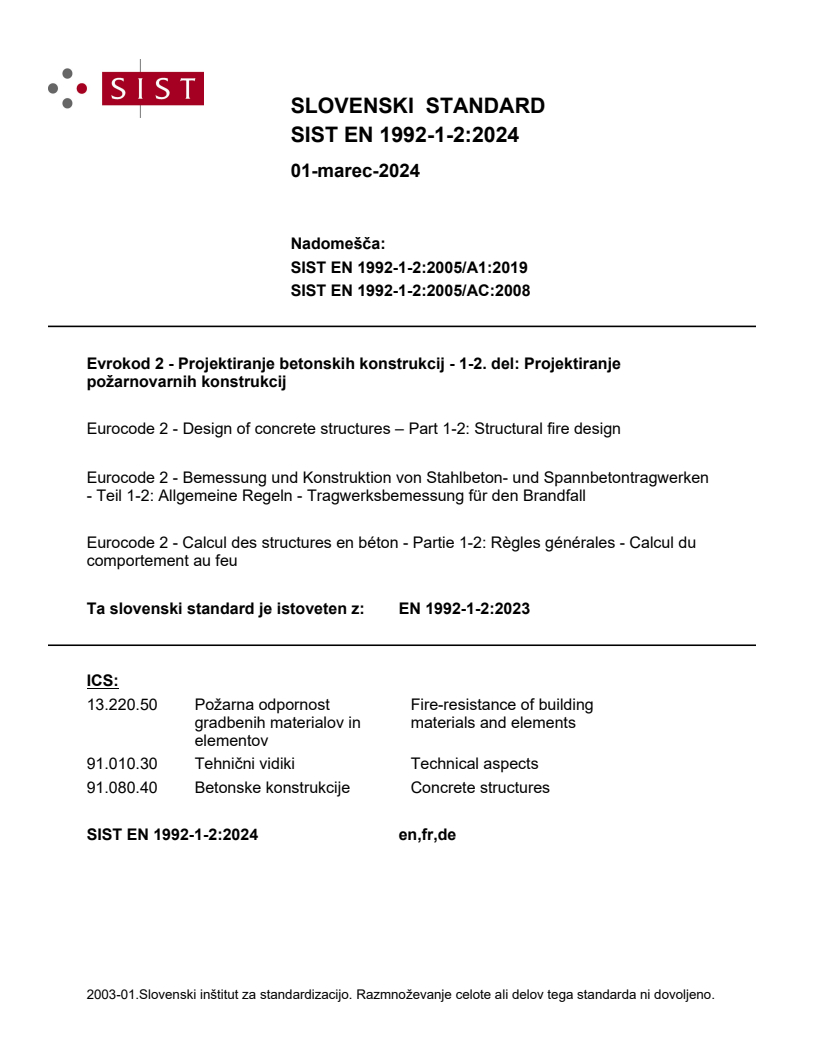
SLOVENSKI STANDARD
SIST EN 1992-1-2:2024
01-marec-2024
Nadomešča:
SIST EN 1992-1-2:2005/A1:2019
SIST EN 1992-1-2:2005/AC:2008
Evrokod 2 - Projektiranje betonskih konstrukcij - 1-2. del: Projektiranje
požarnovarnih konstrukcij
Eurocode 2 - Design of concrete structures – Part 1-2: Structural fire design
Eurocode 2 - Bemessung und Konstruktion von Stahlbeton- und Spannbetontragwerken
- Teil 1-2: Allgemeine Regeln - Tragwerksbemessung für den Brandfall
Eurocode 2 - Calcul des structures en béton - Partie 1-2: Règles générales - Calcul du
comportement au feu
Ta slovenski standard je istoveten z: EN 1992-1-2:2023
ICS:
13.220.50 Požarna odpornost Fire-resistance of building
gradbenih materialov in materials and elements
elementov
91.010.30 Tehnični vidiki Technical aspects
91.080.40 Betonske konstrukcije Concrete structures
SIST EN 1992-1-2:2024 en,fr,de
2003-01.Slovenski inštitut za standardizacijo. Razmnoževanje celote ali delov tega standarda ni dovoljeno.
SIST EN 1992-1-2:2024
SIST EN 1992-1-2:2024
EN 1992-1-2
EUROPEAN STANDARD
NORME EUROPÉENNE
November 2023
EUROPÄISCHE NORM
ICS 91.010.30; 91.080.40 Supersedes EN 1992-1-2:2004
English Version
Eurocode 2 - Design of concrete structures - Part 1-2:
Structural fire design
Eurocode 2 - Calcul des structures en béton - Partie 1- Eurocode 2 - Bemessung und Konstruktion von
2: Règles générales - Calcul du comportement au feu Stahlbeton- und Spannbetontragwerken - Teil 1-2:
Allgemeine Regeln - Tragwerksbemessung für den
Brandfall
This European Standard was approved by CEN on 23 July 2023.
CEN members are bound to comply with the CEN/CENELEC Internal Regulations which stipulate the conditions for giving this
European Standard the status of a national standard without any alteration. Up-to-date lists and bibliographical references
concerning such national standards may be obtained on application to the CEN-CENELEC Management Centre or to any CEN
member.
This European Standard exists in three official versions (English, French, German). A version in any other language made by
translation under the responsibility of a CEN member into its own language and notified to the CEN-CENELEC Management
Centre has the same status as the official versions.
CEN members are the national standards bodies of Austria, Belgium, Bulgaria, Croatia, Cyprus, Czech Republic, Denmark, Estonia,
Finland, France, Germany, Greece, Hungary, Iceland, Ireland, Italy, Latvia, Lithuania, Luxembourg, Malta, Netherlands, Norway,
Poland, Portugal, Republic of North Macedonia, Romania, Serbia, Slovakia, Slovenia, Spain, Sweden, Switzerland, Türkiye and
United Kingdom.
EUROPEAN COMMITTEE FOR STANDARDIZATION
COMITÉ EUROPÉEN DE NORMALISATION
EUROPÄISCHES KOMITEE FÜR NORMUNG
CEN-CENELEC Management Centre: Rue de la Science 23, B-1040 Brussels
© 2023 CEN All rights of exploitation in any form and by any means reserved Ref. No. EN 1992-1-2:2023 E
worldwide for CEN national Members.
SIST EN 1992-1-2:2024
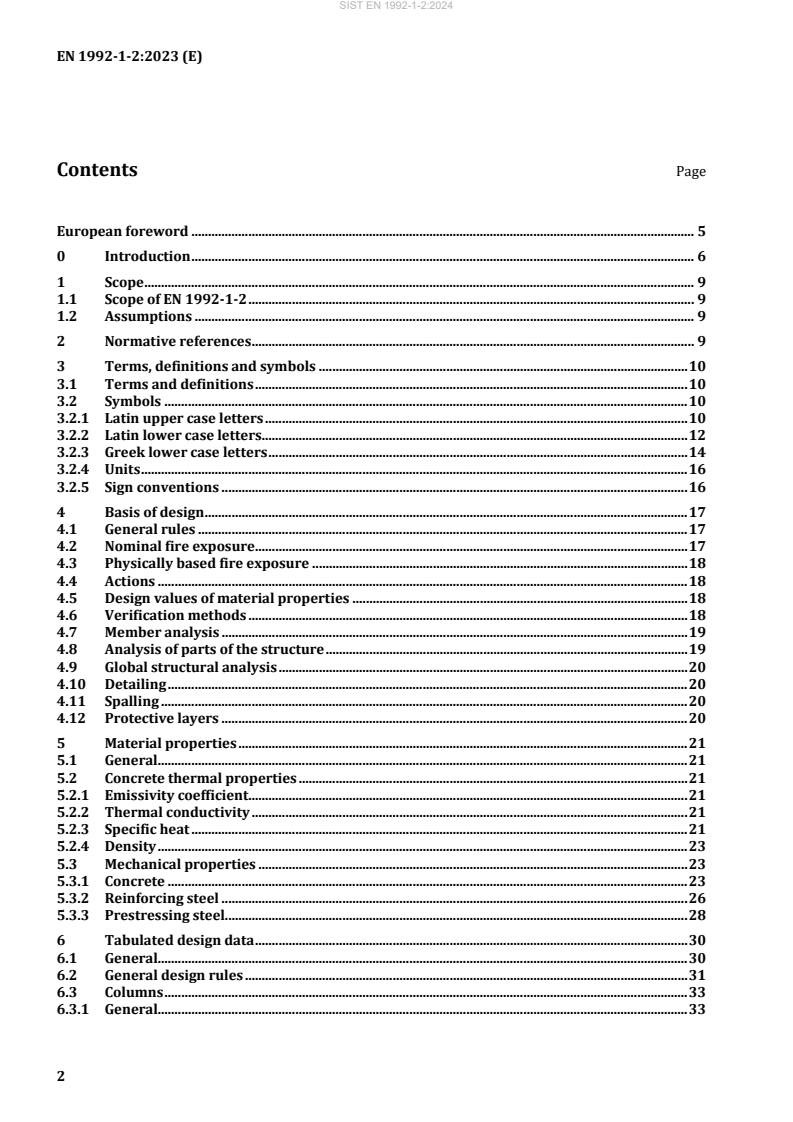
Contents Page
European foreword . 5
0 Introduction . 6
1 Scope . 9
1.1 Scope of EN 1992-1-2 . 9
1.2 Assumptions . 9
2 Normative references . 9
3 Terms, definitions and symbols . 10
3.1 Terms and definitions . 10
3.2 Symbols . 10
3.2.1 Latin upper case letters . 10
3.2.2 Latin lower case letters . 12
3.2.3 Greek lower case letters . 14
3.2.4 Units . 16
3.2.5 Sign conventions . 16
4 Basis of design . 17
4.1 General rules . 17
4.2 Nominal fire exposure . 17
4.3 Physically based fire exposure . 18
4.4 Actions . 18
4.5 Design values of material properties . 18
4.6 Verification methods . 18
4.7 Member analysis . 19
4.8 Analysis of parts of the structure . 19
4.9 Global structural analysis . 20
4.10 Detailing . 20
4.11 Spalling . 20
4.12 Protective layers . 20
5 Material properties . 21
5.1 General. 21
5.2 Concrete thermal properties . 21
5.2.1 Emissivity coefficient . 21
5.2.2 Thermal conductivity . 21
5.2.3 Specific heat . 21
5.2.4 Density . 23
5.3 Mechanical properties . 23
5.3.1 Concrete . 23
5.3.2 Reinforcing steel . 26
5.3.3 Prestressing steel . 28
6 Tabulated design data . 30
6.1 General. 30
6.2 General design rules . 31
6.3 Columns . 33
6.3.1 General. 33
SIST EN 1992-1-2:2024
6.3.2 Method A . 33
6.3.3 Method B . 37
6.4 Walls . 37
6.4.1 Non load-bearing walls (partitions) . 37
6.4.2 Load-bearing solid walls . 37
6.5 Tensile members . 39
6.6 Beams . 39
6.6.1 General . 39
6.6.2 Simply supported beams exposed to fire on one, two or three sides . 41
6.6.3 Continuous beams exposed to fire on one, two or three sides . 42
6.6.4 Beams exposed on all sides . 44
6.7 Slabs . 44
6.7.1 General . 44
6.7.2 Simply supported slabs . 45
6.7.3 Continuous solid slabs . 46
6.7.4 Flat slabs . 46
6.7.5 Ribbed slabs. 46
7 Simplified design methods . 49
7.1 General . 49
7.2 Temperature profiles . 49
7.2.1 General . 49
7.2.2 Basic solution for one side exposure . 49
7.2.3 Walls, slabs and rectangular cross-sections . 51
7.2.4 Circular cross-sections . 53
7.3 Structural analysis . 54
7.3.1 General . 54
7.3.2 Reduction of cross-section . 54
7.3.3 Bending . 56
7.3.4 Bending and axial load . 59
7.3.5 Shear and torsion . 63
8 Advanced design methods . 66
8.1 General . 66
8.2 Thermal analysis . 66
8.3 Mechanical analysis . 66
8.4 Validation of advanced design methods . 67
9 Detailing . 68
9.1 General . 68
9.2 Detailing of reinforcing and prestressing steel . 68
9.3 Detailing of members . 68
9.4 Joints. 69
9.5 Connections . 70
9.6 Fire protection systems . 70
10 Rules for spalling . 71
Annex A (normative) Lightweight aggregate concrete structures . 73
A.1 Use of this annex . 73
A.2 Scope and field of application . 73
A.3 Material properties . 73
A.4 Tabulated design data . 74
SIST EN 1992-1-2:2024
A.5 Rules for spalling . 74
Annex B (informative) Steel fibre reinforced concrete structures . 75
B.1 Use of this annex . 75
B.2 Scope and field of application . 75
B.3 Design rules . 75
Annex C (informative) Recycled aggregates concrete structures . 76
C.1 Use of this annex . 76
C.2 Scope and field of application . 76
C.3 Design rules . 76
Annex D (normative) Buckling of columns under fire conditions . 77
D.1 Use of this annex . 77
D.2 Scope and field of application . 77
Annex E (informative) Load-bearing solid walls — complementary tables . 85
E.1 Use of this annex . 85
E.2 Scope and field of application . 85
E.3 Complementary tables . 85
Bibliography . 87
SIST EN 1992-1-2:2024
European foreword
This document (EN 1992-1-2:2023) has been prepared by Technical Committee CEN/TC 250 “Structural
Codes”, the secretariat of which is held by BSI. CEN/TC 250 is responsible for all Structural Eurocodes
and has been assigned responsibility for structural and geotechnical design matters by CEN.
This European Standard shall be given the status of a national standard, either by publication of an
identical text or by endorsement, at the latest by September 2027, and conflicting national standards shall
be withdrawn at the latest by March 2028.
Attention is drawn to the possibility that some of the elements of this document may be the subject of
patent rights. CEN shall not be held responsible for identifying any or all such patent rights.
This document supersedes EN 1992-1-2:2004 and its amendments and corrigenda.
The first generation of EN Eurocodes was published between 2002 and 2007. This document forms part
of the second generation of the Eurocodes, which have been prepared under Mandate M/515 issued to
CEN by the European Commission and the European Free Trade Association.
The Eurocodes have been drafted to be used in conjunction with relevant execution, material, product
and test standards, and to identify requirements for execution, materials, products and testing that are
relied upon by the Eurocodes.
The Eurocodes recognize the responsibility of each Member State and have safeguarded their right to
determine values related to regulatory safety matters at national level through the use of National
Annexes.
The main changes compared to the previous edition are listed below:
• simplified design methods were improved and amended and provisions were updated in tabulated
data to ensure consistency between tabulated design data, simplified and advanced design methods;
• simplified analytical formulae were added for the determination of temperature profiles in members;
• specific rules for spalling were integrated;
• informative annexes provide guidance for fire design of steel fibre reinforced concrete structures and
of recycled aggregates concrete structures;
• the number of alternative design rules was reduced;
• the structure and table of contents was harmonized with other fire parts.
Any feedback and questions on this document should be directed to the users’ national standards body.
A complete listing of these bodies can be found on the CEN website.
According to the CEN-CENELEC Internal Regulations, the national standards organisations of the
following countries are bound to implement this European Standard: Austria, Belgium, Bulgaria, Croatia,
Cyprus, Czech Republic, Denmark, Estonia, Finland, France, Germany, Greece, Hungary, Iceland, Ireland,
Italy, Latvia, Lithuania, Luxembourg, Malta, Netherlands, Norway, Poland, Portugal, Republic of North
Macedonia, Romania, Serbia, Slovakia, Slovenia, Spain, Sweden, Switzerland, Türkiye and the United
Kingdom.
SIST EN 1992-1-2:2024
0 Introduction
0.1 Introduction to the Eurocodes
The Structural Eurocodes comprise the following standards generally consisting of a number of Parts:
— EN 1990, Eurocode: Basis of structural and geotechnical design
— EN 1991, Eurocode 1: Actions on structures
— EN 1992, Eurocode 2: Design of concrete structures
— EN 1993, Eurocode 3: Design of steel structures
— EN 1994, Eurocode 4: Design of composite steel and concrete structures
— EN 1995, Eurocode 5: Design of timber structures
— EN 1996, Eurocode 6: Design of masonry structures
— EN 1997, Eurocode 7: Geotechnical design
— EN 1998, Eurocode 8: Design of structures for earthquake resistance
— EN 1999, Eurocode 9: Design of aluminium structures
— New Eurocodes under development, e.g. Eurocode for design of structural glass
The Eurocodes are intended for use by designers, clients, manufacturers, constructors, relevant
authorities (in exercising their duties in accordance with national or international regulations),
educators, software developers, and committees drafting standards for related product, testing and
execution standards.
NOTE Some aspects of design are most appropriately specified by relevant authorities or, where not specified,
can be agreed on a project-specific basis between relevant parties such as designers and clients. The Eurocodes
identify such aspects making explicit reference to relevant authorities and relevant parties.
0.2 Introduction to EN 1992 (all parts)
(1) EN 1992 applies to the design of buildings, bridges and civil engineering structures in plain,
reinforced and prestressed concrete. It complies with the principles and requirements for the safety and
serviceability of structures, the basis of their design and verification that are given in EN 1990.
(2) EN 1992 is only concerned with the requirements for resistance, serviceability, durability and fire
resistance of concrete structures. Other requirements, e.g. concerning thermal or sound insulation, are
not considered.
(3) EN 1992 is subdivided into various parts:
— EN 1992-1-1, Design of concrete structures — Part 1-1: General rules and rules for buildings, bridges
and civil engineering structures,
— EN 1992-1-2, Design of concrete structures —Part 1-2: Structural fire design,
— EN 1992-4, Design of concrete structures —Part 4: Design of fastenings for use in concrete.
SIST EN 1992-1-2:2024
0.3 Introduction to EN 1992-1-2
(1) EN 1992-1-2 describes the requirements and rules for the structural design of buildings and civil
engineering works exposed to fire.
(2) EN 1992-1-2 is intended for clients (e.g. for the formulation of their specific requirements),
designers, contractors and relevant authorities.
(3) The general objectives of fire protection are to limit risks with respect to the individual and society,
neighbouring property, and where required, environment or directly exposed property, in the case of fire.
(4) The fire parts of the Structural Eurocodes deal with specific aspects of passive fire protection in
terms of designing structures and parts thereof for adequate loadbearing resistance and for limiting fire
spread as relevant.
(5) Required functions and levels of performance can be specified either in terms of nominal
(standard) fire resistance rating, generally given in national fire regulations or by referring to fire safety
engineering for assessing passive and active measures, see EN 1991-1-2:— .
(6) Supplementary requirements concerning, e.g.:
— the possible installation and maintenance of sprinkler systems;
— conditions on occupancy of building or fire compartment;
— the use of approved insulation and coating materials, including their maintenance;
are not given in this standard, because they are subject to specification by the competent authority.
0.4 Verbal forms used in the Eurocodes
The verb “shall” expresses a requirement strictly to be followed and from which no deviation is permitted
in order to comply with the Eurocodes.
The verb “should” expresses a highly recommended choice or course of action. Subject to national
regulation and/or any relevant contractual provisions, alternative approaches could be used/adopted
where technically justified.
The verb “may” expresses a course of action permissible within the limits of the Eurocodes.
The verb “can” expresses possibility and capability; it is used for statements of fact and clarification of
concepts.
0.5 National annex for EN 1992-1-2
National choice is allowed in this standard where explicitly stated within notes. National choice includes
the selection of values for Nationally Determined Parameters (NDPs).
The national standard implementing EN 1992-1-2 can have a National Annex containing all national
choices to be used for the design of buildings and civil engineering works to be constructed in the relevant
country.
When no national choice is given, the default choice given in this standard is to be used.
When no national choice is made and no default is given in this standard, the choice can be specified by a
relevant authority or, where not specified, agreed for a specific project by appropriate parties.
SIST EN 1992-1-2:2024
National choice is allowed in EN 1992-1-2 through the following clauses:
4.5(1) 9.2(1) 10(10)
National choice is allowed in EN 1992-1-2 on the application of the following informative annexes:
Annex B Annex C Annex E
The National Annex can contain, directly or by reference, non-contradictory complementary information
for ease of implementation, provided it does not alter any provisions of the Eurocodes.
SIST EN 1992-1-2:2024
1 Scope
1.1 Scope of EN 1992-1-2
(1) This document deals with the design of concrete structures for the accidental situation of fire
exposure and is intended to be used in conjunction with EN 1992-1-1 and EN 1991-1-2:— . This
document identifies differences from, or supplements to, normal temperature design.
(2) This document applies to concrete structures required to fulfil a loadbearing function, separating
function, insulation function or all of them.
(3) This document gives principles and application rules for the design of structures for specified
requirements in respect of the aforementioned functions and the levels of performance.
(4) This document applies to structures, or parts of structures, that are within the scope of
EN 1992-1-1 and are designed accordingly.
1.2 Assumptions
(1) In addition to the general assumptions of EN 1990 the following assumptions apply:
— the choice of the relevant design fire scenario is made by appropriate qualified and experienced
personnel or is given by the relevant national regulation;
— any fire protection measure taken into account in the design shall be adequately maintained for the
duration of the intended use of the construction.
2 Normative references
The following documents are referred to in the text in such a way that some or all of their content
constitutes requirements of this document. For dated references, only the edition cited applies. For
undated references, the latest edition of the referenced document (including any amendments) applies.
NOTE See the Bibliography for a list of other documents cited that are not normative references, including those
referenced as recommendations (i.e. in ‘should’ clauses), permissions (‘may’ clauses), possibilities ('can' clauses),
and in notes.
EN 1363-2, Fire resistance tests - Part 2: Alternative and additional procedures
EN 1990, Eurocode - Basis of structural design
EN 1991-1-2:— , Eurocode 1 — Actions on structures — Part 1-2: Actions on structures exposed to fire
EN 1992-1-1:2023, Eurocode 2 — Design of concrete structures — Part 1-1: General rules and rules for
buildings, bridges and civil engineering structures
EN 1991-1-7:— , Eurocode 1 — Actions on structures — Part 1-7: Accidental actions
Under preparation. Stage at the time of publication: FprEN 1991-1-2:2023.
Under preparation. Stage at the time of publication: prEN 1991-1-7:2023.
SIST EN 1992-1-2:2024
3 Terms, definitions and symbols
3.1 Terms and definitions
For the purposes of this document, the terms and definitions given in EN 1990, EN 1991-1-2:— and
EN 1992-1-1 and the following apply.
3.1.1
axis distance
distance between the axis of the reinforcing bar and the nearest surface of concrete
3.1.2
critical temperature of reinforcement
temperature of reinforcement at which loadbearing failure of the member under fire conditions is
expected to occur at a given stress level
3.1.3
maximum stress level
for a given temperature, the stress level at which the stress-strain relationship of steel is truncated to
provide a yield plateau
3.1.4
part of structure
isolated part of a structure with appropriate support and boundary conditions
3.1.5
fire protection material
any material or combination of materials applied to a structural member for the purpose of increasing its
fire resistance
3.1.6
reduced cross-section
cross-section of the member used in structural fire design when parts of the cross-section with assumed
zero strength and stiffness are removed
3.1.7
spalling
fire induced spalling of concrete consists of the breaking off of layers or fragments of concrete from the
surface of a structural member
Note 1 to entry: Depending on the severity of the phenomenon, it can influence the performance of the
structural member.
3.2 Symbols
3.2.1 Latin upper case letters
For the purposes of this document, the following symbols and units apply.
A Cross-sectional area of concrete
c
A Elemental concrete area for refined assessment of members subjected to bending and
cij
axial load
A Cross-sectional area of steel reinforcement
s
SIST EN 1992-1-2:2024
A Cross-sectional area of longitudinal reinforcement at axis distance a from the most
s0
compressed side of the column
A Cross-sectional area of longitudinal reinforcement at axis distance a from the
s1
tensile/least compressed side of the column
A Cross-sectional area of steel reinforcement i
s,i
A Provided cross-sectional area of longitudinal reinforcement
s,prov
A Required cross-sectional area of longitudinal reinforcement for the design at ambient
s,req
temperature according to EN 1992-1-1
E Integrity
E Design effect of actions
d
E Design effect of actions under fire conditions
d,fi
E Slope of the linear elastic range in the stress-strain relationship of prestressing steel
p
E Slope of the linear elastic range in the stress-strain relationship of prestressing steel at
p,θ
temperature θ
E Slope of the linear elastic range in the stress-strain relationship of reinforcing steel
s
E Slope of the linear elastic range in the stress-strain relationship of reinforcing steel at
s,θ
temperature θ
F Resisting compression force of longitudinal reinforcement at axis distance a from the
sd,0c,fi
most compressed side of the column
F Resisting tensile force of longitudinal reinforcement at axis distance a from the tensile
sd,1t,fi
side of the column
F Resisting compression force of longitudinal reinforcement at axis distance a from the
sd,1c,fi
least compressed side of the column
I Insulation
M Design value of the bending moment at ambient temperature
Ed
M Design value of the bending moment under fire conditions
Ed,fi
M Ultimate moment capacity in the fire situation
Rd,fi
M Design value of first order moment under fire conditions including the effect of
0Ed,fi
imperfections
M Ultimate first order moment in the fire situation
0Rd,fi
M Nominal second order moment in the fire situation
2fi
N Design value of the axial load in the fire situation
Ed.fi
N Design value of axial resistance
Rd
R Design resistance
R Loadbearing function / capacity
RXXX Fire resistance time in minutes (15 ≤ X ≤ 240)
R , R Coefficients to determine loadbearing capacity R
a b
R Design resistance in the fire situation at time t
d,fi,t
R , R , R Coefficients to determine loadbearing capacity R
μfi n n
SIST EN 1992-1-2:2024
X Design value of a strength or stiffness property at temperature θ
d,θ
X Characteristic value of a strength or stiffness property
k
3.2.2 Latin lower case letters
a Nominal axis distance measured between the centre of the reinforcement and the
exposed surface
a Dimension of corner zone affected by two-sided heat transfer
c
a Increased nominal axis distance
eff
a Reduced axis distance of the reinforcement
fi
a Nominal axis distance for the reinforcement “i”
i
a Average axis distance
m
a Nominal axis distance measured between the centre of the reinforcement and lateral
sd
surface exposed to fire
a Thickness of rim zone
z
b Minimum member width/minimum beam width
min
Increased minimum width of tensile member or tensile zone of beams
bmod
b Web width
w
b Minimum web width
w,min
c Curvature
c Curvature distribution factor
1/r
c Specific heat of concrete
p
c Specific heat (peak value)
p,peak
d Effective depth of a cross-section
d , d Height of section element
1 2
deff Effective height of the bottom flange of I-shaped beams
d Reduced effective depth of a cross-section under fire conditions
fi
e Total first order eccentricity
e Additional eccentricity due to imperfections
e Eccentricity due to deformation of compression member
e Maximum distance between the compression resultant and the deformed axis of the
d
compression member
e Eccentricity attributed to thermal effects
thermal
f Characteristic value of cylinder compressive strength of concrete at temperature θ
c,θ
f Characteristic compressive concrete strength
ck
Characteristic value of tensile strength of concrete at temperature θ
fct,θ
f Characteristic tensile strength of concrete
ctk,0,05
f Mean tensile strength of concrete
ctm
SIST EN 1992-1-2:2024
f Stress at 0,5/l strain
Ft1,ef cs
f Stress at the ultimate strain
Ft3,ef
f Strength between the proportional limit and the yield strength at temperature θ
pe,θ
f Proportionality limit of prestressing steel at temperature θ
pp,θ
f Maximum stress level of prestressing steel at temperature θ
py,θ
f Characteristic 0,1 % proof-stress of prestressing steel
pθ,1k
f Design strength of reinforcing steel at temperature θ
sd,θ
Strength between the proportional limit and the yield strength at temperature θ
f
se,θ
fsp,θ Proportionality limit of reinforcing steel at temperature θ
f Maximum stress level of reinforcing steel at temperature θ
sy,θ
f Maximum stress level of reinforcing steel at the reference temperature θ
sy,θp P
f Characteristic value of yield strength of reinforcement or, if yield phenomenon is not
yk
present, the characteristic value of 0,2 % proof strength
h Depth of cross-section
h′ Depth of T-beam and I-beam webs for the evaluation of shear resistance
h , h , h Thickness of section element
1 2 i
h Overall reduced depth of a cross-section used under fire conditions
fi
h Wall thickness
w
k Coefficient for one-dimensional heat transfer
k Temperature-dependent reduction factor for concrete compressive strength
c,θ
k Temperature-dependent reduction factor for concrete tensile strength
ct,θ
k Temperature-dependent reduction factor for reinforcing steel
Es,θ
k Coefficient for anchorage length
lb
k Temperature-dependent reduction factor for prestressing steel
pe,θ
k Content of monofilament fibres
pp
k Temperature-dependent reduction factor for prestressing steel
pp,θ
k , k Temperature-dependent reduction factor for reinforcing steel
py,θ se,θ
k Temperature-dependent reduction factor for reinforcing steel
sy,θ
k Temperature-dependent reduction factor
θ
l Length of an element
l Effective length of column at ambient temperature
l ' Modified effective length of column
l Effective length of a column or wall for the fire design situation
0,fi
l Maximum effective length of a column or wall for the fire design situation
0,max
l Anchorage length
bd
l Anchorage length under fire conditions
bd,fi
SIST EN 1992-1-2:2024
l Anchorage length l , over which the tendon force, in the ultimate limit state is fully
pbd bpd
anchored in concrete
l Anchorage length l , over which the tendon force, in the ultimate limit state is fully
pbd,fi bpd
anchored in concrete under fire conditions
l Transmission length for prestressing force
pt
l Transmission length for prestressing force under fire conditions
pt,fi
l Lap length
sd
l Lap length under fire conditions
sd,fi
lx and ly Spans of a two-way slab (two directions at right angles) where ly is the longer span
n Number of reinforcing bars in the cross-section or number of zones on reduced cross-
section methods
n Number of effective reinforcing bars in the compression zone
sc
n Number of effective reinforcing bars in the tension reinforcing layer
st
r Radius of curvature
t Time
t Duration of the standard fire
u Moisture content
w Reduced cross-section depending on the fire exposure
x Location variable, coordinate
x Effective depth of concrete in compression under fire conditions
e,fi
x Reduced depth of concrete in compression under fire conditions
fi
y Location variable, coordinate
y′ Local coordinate for evaluating the temperature at corners of sections exposed to fire on
two sides
y Distance of centroid of compression zone of concrete to neutral axis under fire conditions
fi
y Coordinate of the center of gravity (or centroid) of the concrete element along the y-axis
ij
y Coordinate of reference point T
T
z Location variable, coordinate
z′ Local coordinate for evaluating the temperature at corners of sections exposed to fire on
two sides
z Coordinate of the center of gravity (or centroid) of the concrete element along the z-axis
ij
3.2.3 Greek lower case letters
α Substitution rate of recycled aggregates
RA
𝛾𝛾S Partial factor for reinforcing steel
𝛾𝛾 Partial factor for reinforcing or prestressing steel under fire
S,fi
conditions
Δt Temperature increase in circular sections
SIST EN 1992-1-2:2024
Δθ Local temperature increase at corners of members expose on two
sides
Δθ Temperature increase in circular sections
M
ε Concrete strain
c
ε (θ ) Concrete thermal strain due to thermal expansion
c c
ε Concrete strain in elemental zone
c,ij
ε Concrete strain at the member’s most compressed side
c0
Concrete strain at maximum stress at temperature θ
ε
c1,θ
εcreep Creep strain
ε Thermal strain in concrete
cth
ε Concrete ultimate strain
cu
ε Ultimate limit concrete strain at temperature θ
cu1,θ
ε Strain in the bottom fibre of the cross-section
inf
ε (θ ) Prestressing steel thermal strain due to thermal expansion
p s
ε Prestressing steel strain corresponding to the proportional limit at
pp,θ
temperature θ
ε
pt,θ Prestressing steel strain corresponding to the maximal stress level at
the end of the plastic plateau at temperature θ
ε Ultimate strain of the prestressing steel
pu,θ
ε Compressive strain in the longitudinal reinforcement in the
s0
compression zone
ε Strain in the longitudinal reinforcement in the compression zone
s1,c
ε Strain in the longitudinal reinforcement in the tension zone
s1,t
ε Steel strain corresponding to the proportional limit at temperature θ
sp,θ
ε Steel strain corresponding to the maximal stress level at the end of the
st,θ
plastic plateau at temperature θ
ε (θ ) Reinforcing steel thermal strain due to thermal expansion
sth s
Ultimate steel strain at temperature θ
εsu,θ
ε Strain in the upper fiber of the cross-section
sup
ε Steel strain corresponding to the maximal stress level at the
sy,θ
beginning of the plastic plateau at temperature θ
ε Thermal strain
th
ε Transient state strain
tr
εθ Instantaneous stress-dependent strain
η Reference load level
η Reference load level under fire conditions
fi
θ Temperature increase in rectangular sections exposed to fire on one
side
SIST EN 1992-1-2:2024
θ Temperature increase in rectangular sections exposed to fire on two
sides
θ Temperature in concret
...