

EN 17999:2025
(Main)Accessible systems for living independently - Requirements and recommendations
- Abstract
This document specifies requirements, recommendations, and guidance on aspects of accessible systems for living independently (ASLI) in relation to technical solutions, service design, provision, and information. This includes adapting design and functionality of systems, to allow ease of use by any user, regardless of their abilities.
This document does not cover system-to-system communication.
This document is not applicable to household and similar electrical appliances covered by EN IEC 63008 [10].
- Status
- Published
- Publication Date
- 06-May-2025
- Technical Committee
- CEN/TC 293 - Technical aids for disabled persons
- Drafting Committee
- CEN/TC 293/WG 12 - Accessibility
- Current Stage
- 6060 - Definitive text made available (DAV) - Publishing
- Start Date
- 07-May-2025
- Due Date
- 23-Jan-2025
- Completion Date
- 07-May-2025

Overview
EN 17999:2025 is a European Standard developed by CEN that outlines the requirements and recommendations for Accessible Systems for Living Independently (ASLI). The aim is to enhance quality of life by ensuring systems and services are accessible, supporting independence and full participation in society for users of all abilities. The standard covers technical solutions, service design, provision, and user information, with specific attention to accessible design and usability for diverse users. It is relevant to a wide array of stakeholders, including manufacturers, service designers, caregivers, regulators, and end users.
This standard applies to ASLI used in private residences, care homes, and public spaces, but does not cover system-to-system communication or household electrical appliances under EN IEC 63008.
Key Topics
- Comprehensive Accessibility: EN 17999:2025 stresses the importance of adapting product design, service provision, and information delivery so users with varying abilities can easily interact with ASLI.
- Multiple Interaction Modalities: The standard mandates that products and services support various means of input and output, including visual, auditory, and haptic feedback, enabling equal access to all users.
- User-Centered Approach: The design and development process should involve consultation with a wide range of users and stakeholders from the earliest stages, leading to systems that reflect the true diversity of user needs.
- Accessible Information and Support: User manuals, instructions, and customer support must be available in plain language and accessible formats. ASLI must ensure information is clear, concise, and tailored to different user preferences and abilities.
- Interoperability: ASLI should be compatible with mainstream products and assistive technologies, supporting integration and ease of use across different settings, devices, and environments.
- Continuous Training and Evaluation: Service providers and installers should be trained in communication with diverse users, and mechanisms should be in place for ongoing evaluation and feedback.
- Safety, Security, and User Privacy: ASLI must be secure, respect user privacy, and be adaptable to user-owned smart devices and common communication protocols.
Applications
EN 17999:2025 has broad practical applications wherever accessible living is required:
- Smart Home Solutions: Ensuring lighting, security, and environmental controls are usable for individuals with varying physical, sensory, or cognitive abilities.
- Healthcare and Assisted Living: Implementation in care homes to guarantee residents' access to essential controls, alarms, and support services, improving autonomy and reducing dependency on others.
- Public and Commercial Spaces: Facilitating independent access in hotels, offices, and public buildings, supporting users with disabilities and the elderly.
- Product Design: Guiding manufacturers to create devices and systems that can be easily used, configured, and maintained by people with diverse needs.
- Accessible Information Services: Crafting user documentation and support resources in accessible formats (e.g., large print, audio, digital, braille) and plain language, making information universally understandable.
Organizations can use this standard to demonstrate their commitment to inclusivity, comply with accessibility legislation, and reach wider markets by designing for all.
Related Standards
EN 17999:2025 builds on several other international and European standards that address accessibility:
- EN 17161:2019 - Design for All; accessibility in products and services
- EN 301549:2021 - Accessibility requirements for ICT products and services
- ISO/IEC 20071-5 - Accessible user interfaces for accessibility settings on information devices
- ISO 20282-1 - Ease of operation for everyday products
- CEN ISO/TR 22411:2021 - Ergonomics data for accessibility applications
By aligning with these standards, EN 17999:2025 ensures a harmonized approach to accessible design, maximizing its impact and practical value in promoting independent living for users of all abilities.
Relations
- Effective Date
- 20-May-2026
- Effective Date
- 09-Feb-2026
- Effective Date
- 28-Jan-2026
- Effective Date
- 28-Jan-2026
- Effective Date
- 28-Jan-2026
- Effective Date
- 28-Jan-2026
- Effective Date
- 28-Jan-2026
- Effective Date
- 28-Jan-2026
- Effective Date
- 28-Jan-2026
- Effective Date
- 28-Jan-2026
Get Certified
Connect with accredited certification bodies for this standard

BSI Group
BSI (British Standards Institution) is the business standards company that helps organizations make excellence a habit.

TÜV Rheinland
TÜV Rheinland is a leading international provider of technical services.

TÜV SÜD
TÜV SÜD is a trusted partner of choice for safety, security and sustainability solutions.
Sponsored listings
Frequently Asked Questions
EN 17999:2025 is a standard published by the European Committee for Standardization (CEN). Its full title is "Accessible systems for living independently - Requirements and recommendations". This standard covers: This document specifies requirements, recommendations, and guidance on aspects of accessible systems for living independently (ASLI) in relation to technical solutions, service design, provision, and information. This includes adapting design and functionality of systems, to allow ease of use by any user, regardless of their abilities. This document does not cover system-to-system communication. This document is not applicable to household and similar electrical appliances covered by EN IEC 63008 [10].
This document specifies requirements, recommendations, and guidance on aspects of accessible systems for living independently (ASLI) in relation to technical solutions, service design, provision, and information. This includes adapting design and functionality of systems, to allow ease of use by any user, regardless of their abilities. This document does not cover system-to-system communication. This document is not applicable to household and similar electrical appliances covered by EN IEC 63008 [10].
EN 17999:2025 is classified under the following ICS (International Classification for Standards) categories: 11.180.01 - Aids for disabled and handicapped persons in general; 13.180 - Ergonomics; 97.180 - Miscellaneous domestic and commercial equipment. The ICS classification helps identify the subject area and facilitates finding related standards.
EN 17999:2025 has the following relationships with other standards: It is inter standard links to ISO 20282-1:2006, ISO/IEC 20071-5:2022, EN 2240-049:2010, CEN ISO/TR 22411:2021, EN 17161:2019, EN ISO/ASTM 52926-3:2023, EN ISO/ASTM 52926-4:2023, EN ISO/ASTM 52904:2024, EN ISO/ASTM 52926-5:2023, EN ISO/ASTM 52926-2:2023. Understanding these relationships helps ensure you are using the most current and applicable version of the standard.
EN 17999:2025 is available in PDF format for immediate download after purchase. The document can be added to your cart and obtained through the secure checkout process. Digital delivery ensures instant access to the complete standard document.
Standards Content (Sample)
SLOVENSKI STANDARD
01-julij-2025
Dostopni sistemi za samostojno življenje - Zahteve in priporočila
Accessible systems for living independently - Requirements and recommendations
Barrierefreie Systeme für ein selbstständiges Leben - Anforderungen und Empfehlungen
Systèmes accessibles permettant une vie autonome - Exigences et recommandations
Ta slovenski standard je istoveten z: EN 17999:2025
ICS:
11.180.01 Pripomočki za Aids for disabled and
onesposobljene in handicapped persons in
hendikepirane osebe na general
splošno
97.180 Razna oprema za dom in Miscellaneous domestic and
trgovino commercial equipment
2003-01.Slovenski inštitut za standardizacijo. Razmnoževanje celote ali delov tega standarda ni dovoljeno.
EN 17999
EUROPEAN STANDARD
NORME EUROPÉENNE
May 2025
EUROPÄISCHE NORM
ICS 13.180; 11.180.01
English Version
Accessible systems for living independently -
Requirements and recommendations
Systèmes accessibles permettant une vie autonome - Barrierefreie Systeme für ein selbstständiges Leben -
Exigences et recommandations Anforderungen und Empfehlungen
This European Standard was approved by CEN on 10 February 2025.
CEN members are bound to comply with the CEN/CENELEC Internal Regulations which stipulate the conditions for giving this
European Standard the status of a national standard without any alteration. Up-to-date lists and bibliographical references
concerning such national standards may be obtained on application to the CEN-CENELEC Management Centre or to any CEN
member.
This European Standard exists in three official versions (English, French, German). A version in any other language made by
translation under the responsibility of a CEN member into its own language and notified to the CEN-CENELEC Management
Centre has the same status as the official versions.
CEN members are the national standards bodies of Austria, Belgium, Bulgaria, Croatia, Cyprus, Czech Republic, Denmark, Estonia,
Finland, France, Germany, Greece, Hungary, Iceland, Ireland, Italy, Latvia, Lithuania, Luxembourg, Malta, Netherlands, Norway,
Poland, Portugal, Republic of North Macedonia, Romania, Serbia, Slovakia, Slovenia, Spain, Sweden, Switzerland, Türkiye and
United Kingdom.
EUROPEAN COMMITTEE FOR STANDARDIZATION
COMITÉ EUROPÉEN DE NORMALISATION
EUROPÄISCHES KOMITEE FÜR NORMUNG
CEN-CENELEC Management Centre: Rue de la Science 23, B-1040 Brussels
© 2025 CEN All rights of exploitation in any form and by any means reserved Ref. No. EN 17999:2025 E
worldwide for CEN national Members.
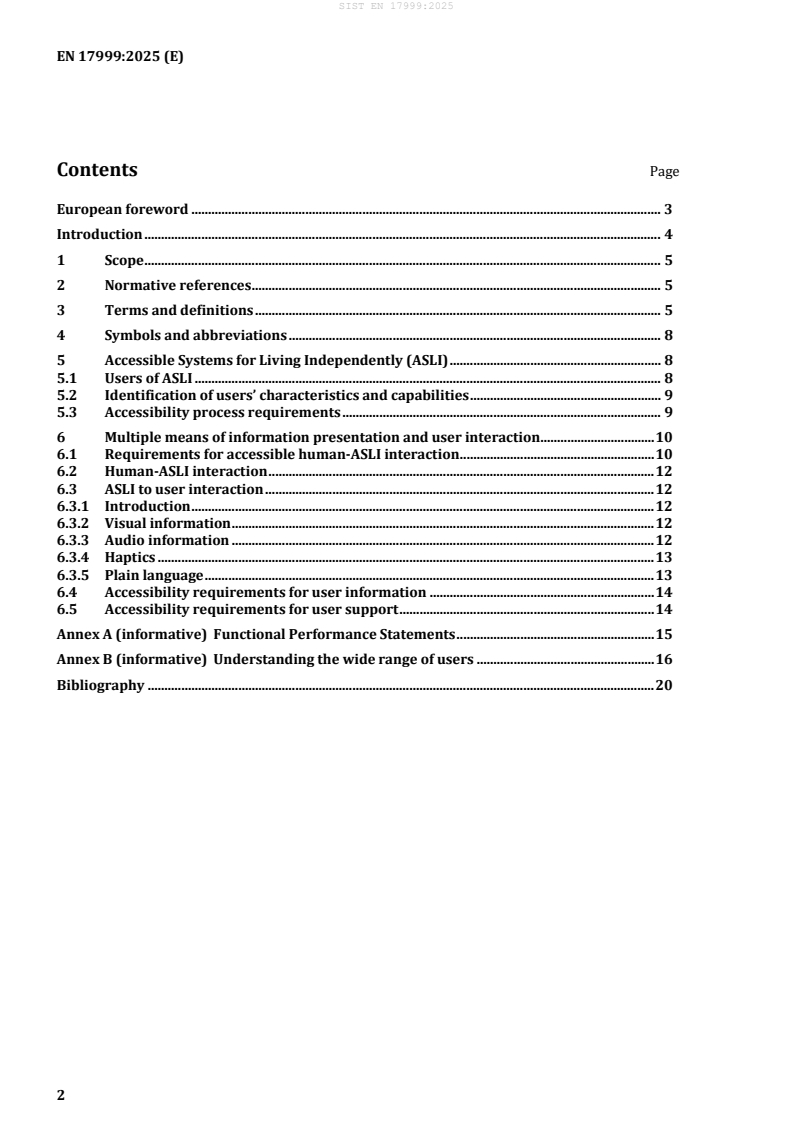
Contents Page
European foreword . 3
Introduction . 4
1 Scope . 5
2 Normative references . 5
3 Terms and definitions . 5
4 Symbols and abbreviations . 8
5 Accessible Systems for Living Independently (ASLI) . 8
5.1 Users of ASLI . 8
5.2 Identification of users’ characteristics and capabilities . 9
5.3 Accessibility process requirements . 9
6 Multiple means of information presentation and user interaction . 10
6.1 Requirements for accessible human-ASLI interaction . 10
6.2 Human-ASLI interaction . 12
6.3 ASLI to user interaction . 12
6.3.1 Introduction . 12
6.3.2 Visual information . 12
6.3.3 Audio information . 12
6.3.4 Haptics . 13
6.3.5 Plain language . 13
6.4 Accessibility requirements for user information . 14
6.5 Accessibility requirements for user support . 14
Annex A (informative) Functional Performance Statements . 15
Annex B (informative) Understanding the wide range of users . 16
Bibliography . 20
European foreword
This document (EN 17999:2025) has been prepared by Technical Committee CEN/TC 293 “Assistive
products and accessibility”, the secretariat of which is held by SIS.
This European Standard shall be given the status of a national standard, either by publication of an
identical text or by endorsement, at the latest by November 2025, and conflicting national standards shall
be withdrawn at the latest by November 2025.
Attention is drawn to the possibility that some of the elements of this document may be the subject of
patent rights. CEN shall not be held responsible for identifying any or all such patent rights.
Any feedback and questions on this document should be directed to the users’ national standards body.
A complete listing of these bodies can be found on the CEN website.
According to the CEN-CENELEC Internal Regulations, the national standards organisations of the
following countries are bound to implement this European Standard: Austria, Belgium, Bulgaria, Croatia,
Cyprus, Czech Republic, Denmark, Estonia, Finland, France, Germany, Greece, Hungary, Iceland, Ireland,
Italy, Latvia, Lithuania, Luxembourg, Malta, Netherlands, Norway, Poland, Portugal, Republic of North
Macedonia, Romania, Serbia, Slovakia, Slovenia, Spain, Sweden, Switzerland, Türkiye and the United
Kingdom.
Introduction
Accessible systems for living independently (ASLI) can enable all users to control individual situations or
surroundings and engage in social activities inside and outside the home. Accessibility refers to making
systems for living independently accessible by adapting the design and functionality of products, and the
design and deployment of services, treated as a whole system. This is done to allow ease of use by any
user, regardless of characteristics, capabilities, preferences and accessibility needs or circumstances in
diverse contexts of use.
ASLI cover the products itself, services for installation and maintenance and accessible information.
The objective of this document is to enhance the quality of life for everyone by ensuring satisfactory
accessibility of systems in everyday life and by improving both independence and full participation in
society. Accessible design is a sign of the times. This document can be used as a tool for accessible design
for ASLI.
Users normally move between different places, different rooms, the home, the car, public transport, the
workplace or educational places, shops and outdoor activities during a day. This requires interoperability
between mainstream solutions and ASLI products and services. See Annex B for more information.
Systems for living independently include solutions related to security, comfort, care, and for the control
of surroundings. This document covers ASLI used in homes including care homes and for participation in
society.
The focus of this document is on:
— ASLI products and ASLI services;
— ASLI that requires interoperability with mainstream systems;
— Accessible user information, instructions and support for ASLI;
— Services for ASLI installation and maintenance.
Easily accessible ASLI will benefit all users and other stakeholders like family members, caregivers and
service providers.
The target groups of this document are:
— users;
— manufacturers and suppliers;
— developers, technologists and engineers;
— designers;
— regulators (authorities);
— procurers and distributors;
— insurance companies, public authorities and others financing ASLI;
— installation services, service providers;
— health professionals and providers (therapists);
— professional caregivers, informal carers and care assistants.
1 Scope
This document specifies requirements, recommendations, and guidance on aspects of accessible systems
for living independently (ASLI) in relation to technical solutions, service design, provision, and
information. This includes adapting design and functionality of systems, to allow ease of use by any user,
regardless of their abilities.
This document does not cover system-to-system communication.
This document is not applicable to household and similar electrical appliances covered by EN IEC 63008
[10].
2 Normative references
The following documents are referred to in the text in such a way that some or all of their content
constitutes requirements of this document. For dated references, only the edition cited applies. For
undated references, the latest edition of the referenced document (including any amendments) applies.
EN 17161:2019, Design for All — Accessibility following a Design for All approach in products, goods and
services — Extending the range of users
EN 301549:2021, Accessibility requirements for ICT products and services
ISO/IEC 20071-5, Information technology — User interface component accessibility — Part 5: Accessible
user interfaces for accessibility settings on information devices
ISO 20282-1, Ease of operation of everyday products — Part 1: Design requirements for context of use and
user characteristics
CEN ISO/TR 22411:2021, Ergonomics data for use in the application of ISO/IEC Guide 71:2014
(ISO/TR 22411:2021)
3 Terms and definitions
For the purposes of this document, the following terms and definitions apply.
ISO and IEC maintain terminology databases for use in standardization at the following addresses:
— IEC Electropedia: available at https://www.electropedia.org/
— ISO Online browsing platform: available at https://www.iso.org/obp
3.1
accessibility
extent to which products, systems, services, environments and facilities can be used by people from a
population with the widest range of user needs, characteristics and capabilities to achieve identified goals
in identified contexts of use (3.7)
Note 1 to entry: Context of use includes direct use or use supported by assistive technologies.
Note 2 to entry: The context in which the ASLI is used might affect its overall accessibility. This context could include
other products and services with which the ASLI might interact.
[SOURCE: EN ISO 9241-112:2017, 3.15, modified – Added Note 2 to entry from EN 301549:2021, 3.1
definition “Accessibility” Note 1, modified.]
3.2
system
product, service, or any combination of them with which the user interacts
[SOURCE: ISO/IEC Guide 71:2014, 2.1, modified – Built environment is excluded in the definition as it is
not included in ASLI.]
3.3
accessible systems for living independently
ASLI
product or service designed to meet multiple user needs in an interconnected way, in identified contexts
of use (3.7), that facilitates the performance of activities for users
Note 1 to entry: ASLI also refers to design of accessible service environments. This includes accessing, interacting
and using information about ASLI, as well as the ASLI itself.
Note 2 to entry: ASLI are not assistive technology (3.4) and not assistive products (3.5) but support interoperability
with them.
Note 3 to entry: ASLI are accessible if they are detectable, accessible and usable for persons with disabilities in the
usual way, without particular difficulties, and, as a rule, without help from others. An ASLI can be used with assistive
technologies.
3.4
assistive technology
AT
equipment, product, system, hardware, software or service that is used to increase, maintain or improve
capabilities of individuals
Note 1 to entry: Assistive technology is an umbrella term that is broader than assistive products.
Note 2 to entry: Assistive technology can include assistive services, and professional services needed for
assessment, recommendation, and provision.
Note 3 to entry: Where information and communication technologies (ICT) do not support directly connected
assistive technology, but which can be operated by a system connected over a network or other remote connection,
such a separate system (with any included assistive technology) can also be considered assistive technology.
[SOURCE: EN 17161:2019, 3.2, modified – Note 3 to entry is added and copied from EN 301549:2021, 3.1
definition “Assistive Technologies” note 3.]
3.5
assistive product
AP
product which optimizes a person’s functioning and reduces disability
Note 1 to entry: Assistive products include devices, instruments, equipment, and software.
Note 2 to entry: Assistive products can be especially produced or generally available items.
[SOURCE: EN ISO 9999:2022, 3.3, modified – Original Note 1 to entry is omitted.]
3.6
plain language
communication in which wording, structure and design are so clear that intended readers can easily
— find what they need,
— understand what they find, and
— use that information
[SOURCE: ISO 24495-1:2023, 3.1]
3.7
context of use
physical and social environments in which a system is used, including users, tasks, equipment and
materials
[SOURCE: ISO/IEC Guide 71:2014, 2.7]
3.8
interoperability
ability of two or more systems or components to exchange information and to use the information that
has been exchanged
[SOURCE: ISO/TS 27790:2009, 3.39]
3.9
equal access
principle to ensure that users can access and interact with a system using different methods and on equal
terms
Note 1 to entry: The system can be used by all users with different modalities, according to their individual
preference.
3.10
user interaction
user-system interaction
exchange of information between a user (3.11) and an interactive system via the user interface to
complete the intended task
Note 1 to entry: User-system interaction represents a subset of human-system interaction that only focusses on
intended users and not other humans who can be affected by the interactive system.
[SOURCE: EN ISO 9241-110:2020, 3.11]
3.11
user of ASLI
person who uses and interacts with an accessible system for living independently (ASLI) (3.3)
[SOURCE: EN 17161:2019, 3.12, modified – ASLI is added to the term.]
3.12
carer
caregiver
person who provides care for other persons
Note 1 to entry: A carer can be a healthcare professional or an informal carer (3.13).
[SOURCE: EN ISO 13131:2022, 3.2.1]
3.13
informal carer
individual such as a family member, friend or other significant person who is giving assistance to a person
who is dependent on assistance
Note 1 to entry: This term defines carers who are not professional or hired to provide care. Hence it does not include
trained care providers affiliated with home care agencies or municipalities.
4 Symbols and abbreviations
For the purpose of this document, the following symbols and abbreviations apply.
ICT Information and Communication Technologies
ASLI Accessible Systems for Living Independently
5 Accessible Systems for Living Independently (ASLI)
5.1 Users of ASLI
Systems and technologies that should be made accessible for living independently, include but are not
limited to:
— Emergency warning or security systems (alarms etc.);
— Robot technology;
— Smart home technology (remote control for light and curtains etc.);
— Interactive systems;
— Domestic appliances;
EXAMPLES: Multifunctional bathroom storage systems and shower rail.
— Technical solutions.
An ASLI strengthens a user’s independence, gives them more control of their surroundings and increases
their ability to engage in social activities. It is independent of age and abilities. The term includes i.e.:
security technology, comfort related technology, technology for social interaction and for control of
surroundings and care technology. Systems for living independently will benefit all.
Accessibility in this document refers to adapting the design and functionality of products and services,
and the design and deployment of related information and services to enable living independently.
This will provide ease of use to any user, from a population with the widest range of user needs,
characteristics and capabilities to achieve identified goals in identified contexts of use.
Accessibility provides all users with options for accessing, understanding and using ASLI. This enables
users to take control over their individual situations and strengthen their independence and participation
in activities both at home and in society in general.
Making systems accessible depends on two main areas of interdependent activity:
a) Providing multiple means of information presentation and user interactions (see Subclause 8.2 in
ISO/IEC Guide 71:2014 [17]).
NOTE ISO/IEC Guide 71:2014 [17] is adopted as CEN-CENELEC Guide 6 [16].
b) Ensuring that the widest range of users and stakeholders are consulted at the earliest opportunity in
the design and development of ASLI and related information, as well as deployment of such systems,
see Clause 4 in EN 17161:2019.
5.2 Identification of users’ characteristics and capabilities
Solutions that support accessibility shall be based on the understanding and adaption to relevant specific
user abilities and characteristics in accordance with CEN ISO/TR 22411. See EN ISO 9241-20 [2] for more
guidance.
NOTE 1 ISO/IEC Guide 71:2014 [17] (adopted as CEN-CENELEC Guide 6[16]) can be used to help identify and
document users' characteristics and abilities. These can then be used to identify the relevant ‘Functional
Performance Statements’ of EN 301549:2021, Clause 4, see Annex A of this document.
NOTE 2 For more information about the relation between ergonomics and accessibility, see also EN ISO 9241-
11 [1] and EN ISO 26800 [9].
5.3 Accessibility process requirements
ASLI shall ensure accessibility in accordance with EN 17161. Thus, it shall be demonstrated that:
a) There is an internal organization-wide view of accessibility stated in policies and strategies, which
address accessibility in the design, procurement, manufacture, supply or deployment of the products
and services that make up ASLI;
b) Diverse user characteristics, capabilities, preferences, accessibility needs and contexts of use have
been fundamental in designing or providing systems, in such a way that the design, manufacture,
supply or deployment of ASLI:
— provide multiple means of user interaction;
— provide information in accessible formats;
— ensure the ASLI is based on recorded results from tests and evaluations of products and services
by potential users and stakeholders.
c) Design shall follow the applicable requirements specified in EN 301549 and ISO 20282-1.
NOTE Additional information can be found in Subclause 8.2 in ISO/IEC Guide 71:2014 [17] and
CEN ISO/TR 22411.
It should be demonstrated that the ASLI includes functions supporting accessibility or that it is
interoperable with assistive technology.
For technological systems to be accessible, consideration shall be made of interaction modes of ASLI. The
following shall be ensured:
d) mainstream products are adaptable to ASLI considerations or requirements;
e) other technology components necessary for the use of ASLI are added;
f) connected and integrated solutions for operation of the ASLI are available;
g) communication and interoperability with the user's personal assistive devices is provided.
ASLI shall include accessible service environments for alleviating the access to and use of information
about ASLI, in conjunction with the service provider.
The following shall be undertaken, as relevant:
h) ensure that ASLI is secure for use when it has an interface with other systems;
i) ensure that ASLI takes into account users’ ownership of, and familiarity with existing smart
information and communication devices. This can include adapting similar interaction modes in the
ASLI;
EXAMPLE: Examples for smart technologies are smartphones, smart TVs, tablets, smart homes and Internet of
Things. Examples of interaction modalities are voice recognition or gestures as input-to-system, or output as a
virtual or augmented reality display.
j) offer the possibility for human interaction with service providers if information is not available or
accessible;
k) ensure continuous training, support and evaluation of service and customer support providers. This
includes use of means and modes to communicate in an accessible way with users and help them
achieve necessary service-oriented tasks (for instance installation, updates, maintenance and
financial concerns);
l) ensure that service providers, who make site visits to users (for instance for installing hardware,
checking installations, etc.), are trained in the different modes of operation;
m) ensure evaluation mechanisms for both users' feedback and service provider performance;
n) facilitate communication between service providers and second line service staff, or manufacturer,
enabling the exchange of experiences to build a common accessibility awareness. Based on
knowledge gained, the service provider should introduce new or improved services.
6 Multiple means of information presentation and user interaction
6.1 Require
...