

EN 15609:2021
(Main)LPG equipment and accessories - LPG propulsion systems for boats, yachts and other watercraft - Installation requirements
- Abstract
This document specifies the installation requirements for LPG propulsion systems on watercraft with hull lengths less than or equal to 24 m, as defined in EN ISO 8666 [11]. This document does not cover appliances with directly attached gas cylinders, such as portable self-contained camping stoves and portable gas lamps.
- Status
- Published
- Publication Date
- 14-Dec-2021
- Withdrawal Date
- 29-Jun-2022
- Technical Committee
- CEN/TC 286 - Liquefied petroleum gas equipment and accessories
- Drafting Committee
- CEN/TC 286/WG 9 - LPG propulsion systems for recreational craft
- Current Stage
- 6060 - Definitive text made available (DAV) - Publishing
- Start Date
- 15-Dec-2021
- Due Date
- 06-Nov-2021
- Completion Date
- 15-Dec-2021
- Directive
- 2013/53/EU - Directive 2013/53/EU of the European Parliament and of the Council of 20 November 2013 on recreational craft and personal watercraft and repealing Directive 94/25/ECOJ Ref: L, L 172 OJ Date: 29-Jun-2022

Overview
EN 15609:2021 is a CEN European standard that specifies installation requirements for LPG propulsion systems on boats, yachts and other watercraft with hull lengths ≤ 24 m (as defined in EN ISO 8666). Published December 2021 and superseding EN 15609:2012, the standard covers safe installation, commissioning and documentation for marine LPG propulsion systems (excluding portable, directly-attached gas appliances).
Key topics and technical requirements
The standard addresses the full installation lifecycle and related safety measures, including:
- Components: requirements for LPG containers/cylinders (fixed and transportable), pressure regulators/vaporizers and other fuel-system components.
- Container fittings: remote-controlled service valves, excess flow devices, pressure relief valves, fusible plugs, filler valves, overfill protection and level indicators.
- Mounting and securing: fixing requirements for containers and cylinders, locker design and multiple-container installations (normative annexes provide detailed guidance).
- Gas distribution: permitted gas pipes, hoses, fittings and gas connections between system components.
- Electrical installation: rules to reduce ignition risk in accordance with marine electrical protection standards.
- Gas detection & ventilation: sensor positioning, alarm locations and powered ventilation requirements (including purging of engine or container spaces).
- Fire protection & commissioning: fire-extinguishing equipment, tightness testing, initial filling procedures, system tests and water trials before operation.
- Documentation: owner’s manual content, commissioning certificate and installation records (included example certificate in Annex F).
- Updates in 2021 edition: added fusible plug requirements, outboard engine and generator set requirements, liquid-phase fixed container provisions for liquid LPG injection systems, new definitions and expanded informative Annex G on LPG propulsion system types.
Practical applications and users
EN 15609:2021 is intended for professionals involved with designing, fitting, testing and certifying marine LPG systems, including:
- Naval architects and boat builders specifying LPG propulsion options
- Marine gas system installers and service technicians
- Classification societies, surveyors and certification bodies verifying compliance
- Yacht yards, OEM engine manufacturers and marine equipment suppliers
- Boat owners planning conversion to or operation of LPG propulsion
Applying this standard helps ensure safe, regulatory-compliant installations, reduce leak/ignition risks and provide consistent commissioning and owner documentation.
Related standards
Relevant references cited in EN 15609:2021 include EN ISO 8666 (vessel dimensions), EN 12979 (basis for the document), CEN/TS 16765 (environmental considerations) and various LPG component standards (e.g., EN 12805, EN 1442, EN ISO 8846). Compliance with EN 15609 supports conformity with applicable EU requirements for small craft.
Relations
- Effective Date
- 22-Dec-2021
- Effective Date
- 25-Aug-2026
- Effective Date
- 09-Feb-2026
- Effective Date
- 09-Feb-2026
- Effective Date
- 28-Jan-2026
- Effective Date
- 28-Jan-2026
- Effective Date
- 28-Jan-2026
- Effective Date
- 28-Jan-2026
- Effective Date
- 28-Jan-2026
- Effective Date
- 28-Jan-2026
- Effective Date
- 28-Jan-2026
- Effective Date
- 28-Jan-2026
- Effective Date
- 28-Jan-2026
- Effective Date
- 28-Jan-2026
- Effective Date
- 28-Jan-2026
Get Certified
Connect with accredited certification bodies for this standard

DNV
DNV is an independent assurance and risk management provider.

Lloyd's Register
Lloyd's Register is a global professional services organisation specialising in engineering and technology.

FSC International
Forest Stewardship Council certification.
Sponsored listings
Frequently Asked Questions
EN 15609:2021 is a standard published by the European Committee for Standardization (CEN). Its full title is "LPG equipment and accessories - LPG propulsion systems for boats, yachts and other watercraft - Installation requirements". This standard covers: This document specifies the installation requirements for LPG propulsion systems on watercraft with hull lengths less than or equal to 24 m, as defined in EN ISO 8666 [11]. This document does not cover appliances with directly attached gas cylinders, such as portable self-contained camping stoves and portable gas lamps.
This document specifies the installation requirements for LPG propulsion systems on watercraft with hull lengths less than or equal to 24 m, as defined in EN ISO 8666 [11]. This document does not cover appliances with directly attached gas cylinders, such as portable self-contained camping stoves and portable gas lamps.
EN 15609:2021 is classified under the following ICS (International Classification for Standards) categories: 47.020.20 - Marine engines and propulsion systems; 47.080 - Small craft. The ICS classification helps identify the subject area and facilitates finding related standards.
EN 15609:2021 has the following relationships with other standards: It is inter standard links to EN 15609:2012, ISO 20826:2006, EN 60529:1991/A1:2000, EN 60529:1991, EN 12805:2002, EN 14043:2014, EN 14140:2014, EN 13110:2012+A1:2017, EN ISO 12217-2:2017, EN ISO 898-1:2013, EN ISO 12217-3:2017, EN ISO 13297:2018, EN ISO 12217-1:2017, EN 16129:2013, EN ISO 10239:2017. Understanding these relationships helps ensure you are using the most current and applicable version of the standard.
EN 15609:2021 is associated with the following European legislation: EU Directives/Regulations: 2013/53/EU; Standardization Mandates: M/075, M/542. When a standard is cited in the Official Journal of the European Union, products manufactured in conformity with it benefit from a presumption of conformity with the essential requirements of the corresponding EU directive or regulation.
EN 15609:2021 is available in PDF format for immediate download after purchase. The document can be added to your cart and obtained through the secure checkout process. Digital delivery ensures instant access to the complete standard document.
Standards Content (Sample)
SLOVENSKI STANDARD
01-februar-2022
Nadomešča:
SIST EN 15609:2012
Oprema in pribor za utekočinjeni naftni plin (UNP) - Pogonski sistemi na UNP za
čolne, jahte in druga vodna plovila - Zahteve za vgradnjo
LPG equipment and accessories - LPG propulsion systems for boats, yachts and other
watercraft - Installation requirements
Flüssiggas (LPG) Geräte und Ausrüstungsteile - Flüssiggas (LPG) Antriebssysteme für
Boote, Jachten und andere Wasserfahrzeuge
Equipements pour gaz de pétrole liquéfié et leurs accessoires - Systèmes de propulsion
GPL des bateaux, yachts et autres navires
Ta slovenski standard je istoveten z: EN 15609:2021
ICS:
23.020.20 Posode in vsebniki, montirani Vessels and containers
na vozila mounted on vehicles
47.020.01 Splošni standardi v zvezi z General standards related to
ladjedelništvom in shipbuilding and marine
konstrukcijami na morju structures
2003-01.Slovenski inštitut za standardizacijo. Razmnoževanje celote ali delov tega standarda ni dovoljeno.
EN 15609
EUROPEAN STANDARD
NORME EUROPÉENNE
December 2021
EUROPÄISCHE NORM
ICS 47.020.20; 47.080 Supersedes EN 15609:2012
English Version
LPG equipment and accessories - LPG propulsion systems
for boats, yachts and other watercraft - Installation
requirements
Équipements pour gaz de pétrole liquéfié et leurs Flüssiggas-Geräte und Ausrüstungsteile -
accessoires - Systèmes de propulsion GPL des bateaux, Flüssiggas(LPG)-Antriebsanlagen für Boote, Jachten
yachts et autres navires - Exigences d'installation und andere Wasserfahrzeuge - Einbauvorschriften
This European Standard was approved by CEN on 24 October 2021.
CEN members are bound to comply with the CEN/CENELEC Internal Regulations which stipulate the conditions for giving this
European Standard the status of a national standard without any alteration. Up-to-date lists and bibliographical references
concerning such national standards may be obtained on application to the CEN-CENELEC Management Centre or to any CEN
member.
This European Standard exists in three official versions (English, French, German). A version in any other language made by
translation under the responsibility of a CEN member into its own language and notified to the CEN-CENELEC Management
Centre has the same status as the official versions.
CEN members are the national standards bodies of Austria, Belgium, Bulgaria, Croatia, Cyprus, Czech Republic, Denmark, Estonia,
Finland, France, Germany, Greece, Hungary, Iceland, Ireland, Italy, Latvia, Lithuania, Luxembourg, Malta, Netherlands, Norway,
Poland, Portugal, Republic of North Macedonia, Romania, Serbia, Slovakia, Slovenia, Spain, Sweden, Switzerland, Turkey and
United Kingdom.
EUROPEAN COMMITTEE FOR STANDARDIZATION
COMITÉ EUROPÉEN DE NORMALISATION
EUROPÄISCHES KOMITEE FÜR NORMUNG
CEN-CENELEC Management Centre: Rue de la Science 23, B-1040 Brussels
© 2021 CEN All rights of exploitation in any form and by any means reserved Ref. No. EN 15609:2021 E
worldwide for CEN national Members.
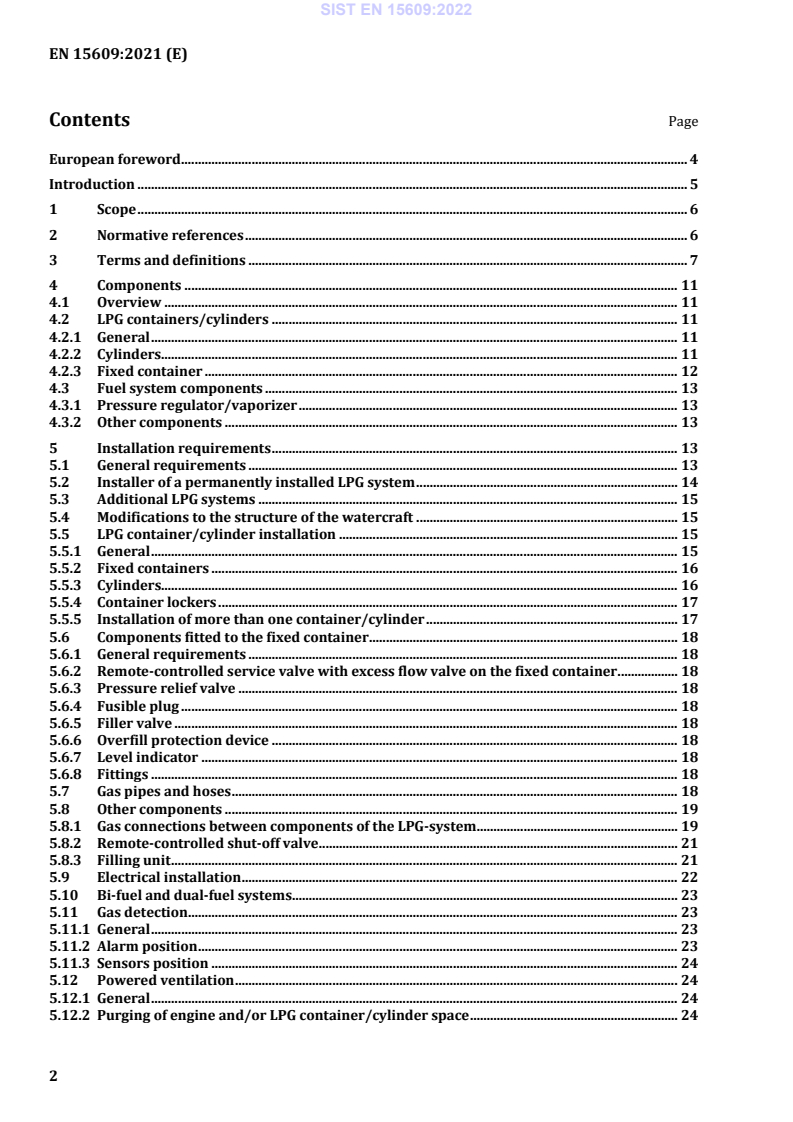
Contents Page
European foreword . 4
Introduction . 5
1 Scope . 6
2 Normative references . 6
3 Terms and definitions . 7
4 Components . 11
4.1 Overview . 11
4.2 LPG containers/cylinders . 11
4.2.1 General . 11
4.2.2 Cylinders. 11
4.2.3 Fixed container . 12
4.3 Fuel system components . 13
4.3.1 Pressure regulator/vaporizer . 13
4.3.2 Other components . 13
5 Installation requirements . 13
5.1 General requirements . 13
5.2 Installer of a permanently installed LPG system . 14
5.3 Additional LPG systems . 15
5.4 Modifications to the structure of the watercraft . 15
5.5 LPG container/cylinder installation . 15
5.5.1 General . 15
5.5.2 Fixed containers . 16
5.5.3 Cylinders. 16
5.5.4 Container lockers . 17
5.5.5 Installation of more than one container/cylinder . 17
5.6 Components fitted to the fixed container . 18
5.6.1 General requirements . 18
5.6.2 Remote-controlled service valve with excess flow valve on the fixed container . 18
5.6.3 Pressure relief valve . 18
5.6.4 Fusible plug . 18
5.6.5 Filler valve . 18
5.6.6 Overfill protection device . 18
5.6.7 Level indicator . 18
5.6.8 Fittings . 18
5.7 Gas pipes and hoses . 18
5.8 Other components . 19
5.8.1 Gas connections between components of the LPG-system . 19
5.8.2 Remote-controlled shut-off valve . 21
5.8.3 Filling unit . 21
5.9 Electrical installation . 22
5.10 Bi-fuel and dual-fuel systems . 23
5.11 Gas detection. 23
5.11.1 General . 23
5.11.2 Alarm position . 23
5.11.3 Sensors position . 24
5.12 Powered ventilation . 24
5.12.1 General . 24
5.12.2 Purging of engine and/or LPG container/cylinder space . 24
6 Fire-extinguishing equipment . 24
7 Owner's manual . 24
8 Commissioning . 24
8.1 Tightness test – fixed containers . 24
8.2 Initial filling of the container and the system with LPG. 25
8.3 LPG system test . 25
8.4 Water trial . 25
Annex A (normative) Fixing requirements for containers/cylinders . 26
Annex B (normative) Cylinder securing requirements. 28
Annex C (normative) Instructions to be included in the owner's manual . 31
Annex D (normative) Additional test requirements for vaporizers . 35
Annex E (informative) Installation of more than one container . 37
Annex F (informative) Example of installation certificate . 39
Annex G (informative) Types of LPG Propulsion systems . 40
Annex ZA (informative) Relationship between this European Standard and the essential
requirements of Directive 2013/53/EU aimed to be covered . 43
Bibliography . 45
European foreword
This document (EN 15609:2021) has been prepared by Technical Committee CEN/TC 286 “Liquefied
petroleum gas equipment and accessories”, the secretariat of which is held by NSAI.
This European Standard shall be given the status of a national standard, either by publication of an
identical text or by endorsement, at the latest by June 2022, and conflicting national standards shall be
withdrawn at the latest by June 2022.
Attention is drawn to the possibility that some of the elements of this document may be the subject of
patent rights. CEN shall not be held responsible for identifying any or all such patent rights.
This document supersedes EN 15609:2012.
This document has been prepared under a Standardization Request given to CEN by the European
Commission and the European Free Trade Association and supports essential requirements of
EU Directive(s) / Regulation(s).
For relationship with EU Directive(s) / Regulation(s), see informative Annex ZA, which is an integral part
of this document.
The main changes with respect to the previous edition include:
— Addition of fusible plug requirements;
— Addition of requirements for Outboard engines;
— Addition of LPG generator sets;
— Addition of Informative Annex G - Types of LPG propulsion systems;
— Addition of requirements for Fixed container - liquid phase for liquid LPG injection fuel system;
— Addition of new definitions;
— Updated text to paragraphs 4.2.3, 5.1, 5.2, 5.12.2;
— Update to Annex ZA, Relationship between this European Standard and the essential requirements
of Directive 2013/53/EU [1] aimed to be covered;
— Removal of Environmental annex, references now made to CEN/TS 16765 [2].
Any feedback and questions on this document should be directed to the users’ national standards body.
A complete listing of these bodies can be found on the CEN website.
According to the CEN-CENELEC Internal Regulations, the national standards organisations of the
following countries are bound to implement this European Standard: Austria, Belgium, Bulgaria, Croatia,
Cyprus, Czech Republic, Denmark, Estonia, Finland, France, Germany, Greece, Hungary, Iceland, Ireland,
Italy, Latvia, Lithuania, Luxembourg, Malta, Netherlands, Norway, Poland, Portugal, Republic of North
Macedonia, Romania, Serbia, Slovakia, Slovenia, Spain, Sweden, Switzerland, Turkey and the United
Kingdom.
Introduction
This document specifies requirements for the installation of equipment for the use of Liquefied
Petroleum Gas (LPG) in the propulsion systems of small watercraft.
This document calls for the use of substances and procedures that can be injurious to health if adequate
precautions are not taken.
Protection of the environment is a key political issue in Europe and elsewhere. For TC 286 this is covered
in CEN/TS 16765 [2] LPG equipment and accessories - Environmental considerations for CEN/TC 286
standards, and this Technical Specification should be read in conjunction with this document. The
Technical Specification provides guidance on the environmental aspects to be considered regarding
equipment and accessories produced for the LPG industry and the following is addressed:
a) design;
b) manufacture;
c) packaging;
d) use and operation; and
e) disposal.
It has been assumed in the drafting of this document that the execution of its provisions is entrusted to
appropriately qualified and experienced persons.
This document is based on EN 12979 [3].
1 Scope
This document specifies the installation requirements for LPG propulsion systems on watercraft with
hull lengths less than or equal to 24 m, as defined in EN ISO 8666 [11]. This document does not cover
appliances with directly attached gas cylinders, such as portable self-contained camping stoves and
portable gas lamps.
2 Normative references
The following documents are referred to in the text in such a way that some or all of their content
constitutes requirements of this document. For dated references, only the edition cited applies. For
undated references, the latest edition of the referenced document (including any amendments) applies.
EN 3-7:2004+A1:2007, Portable fire extinguishers - Part 7: Characteristics, performance requirements and
test methods
EN 1442:2017, LPG equipment and accessories - Transportable refillable welded steel cylinders for LPG -
Design and construction
EN 10025-2:2019, Hot rolled products of structural steels - Part 2: Technical delivery conditions for non-
alloy structural steels
EN 12805:2002, Automotive LPG components - Containers
EN 12806:2003, Automotive liquefied petroleum gas components - Other than containers
EN 13110:2012+A1:2017, LPG equipment and accessories - Transportable refillable welded aluminium
cylinders for liquefied petroleum gas (LPG) - Design and construction
EN 14140:2014, LPG equipment and accessories - Transportable refillable welded steel cylinders for LPG -
Alternative design and construction
EN 14291:2004, Foam producing solutions for leak detection on gas installations
EN 14427:2014, LPG equipment and accessories - Transportable refillable fully wrapped composite
cylinders for LPG - Design and construction
EN 16129:2013, Pressure regulators, automatic change-over devices, having a maximum regulated
pressure of 4 bar, with a maximum capacity of 150 kg/h, associated safety devices and adaptors for butane,
propane, and their mixtures
EN 60529:1991, Degrees of protection provided by enclosures (IP Code) (IEC 60529:1989)
EN ISO 898-1:2013, Mechanical properties of fasteners made of carbon steel and alloy steel - Part 1: Bolts,
screws and studs with specified property classes - Coarse thread and fine pitch thread (ISO 898-1:2013)
EN ISO 8846:2017, Small craft - Electrical devices - Protection against ignition of surrounding flammable
gases (ISO 8846:1990)
As impacted by EN 14140:2014/AC:2015.
As impacted by EN 60529:1991/A1:2000.
EN ISO 9094:2017, Small craft - Fire protection (ISO 9094:2015)
EN ISO 10133:2017, Small craft - Electrical systems - Extra-low-voltage d.c. installations (ISO 10133:2012)
EN ISO 10239:2017, Small craft - Liquefied petroleum gas (LPG) systems (ISO 10239:2014)
EN ISO 11105:2020, Small craft - Ventilation of petrol engine and/or petrol tank compartments
(ISO 11105:2020)
EN ISO 12217-1:2017, Small craft - Stability and buoyancy assessment and categorization - Part 1: Non-
sailing boats of hull length greater than or equal to 6 m (ISO 12217-1:2015)
EN ISO 12217-2:2017, Small craft - Stability and buoyancy assessment and categorization - Part 2: Sailing
boats of hull length greater than or equal to 6 m (ISO 12217-2:2015)
EN ISO 12217-3:2017, Small craft - Stability and buoyancy assessment and categorization - Part 3: Boats
of hull length less than 6 m (ISO 12217-3:2015)
EN ISO 13297:2018, Small craft - Electrical systems - Alternating current installations (ISO 13297:2014)
ISO 20826:2006, Automotive LPG components — Containers
3 Terms and definitions
For the purposes of this document, the terms and definitions given in EN 12806 and the following apply.
ISO and IEC maintain terminological databases for use in standardization at the following addresses:
— ISO Online browsing platform: available at https://www.iso.org/obp
— IEC Electropedia: available at https://www.electropedia.org/
NOTE The definition for watercraft can be found in Directive 2013/53/EU.
3.1
liquefied petroleum gas
LPG
low pressure liquefied gas composed of one or more light hydrocarbons which are assigned to either
UN 1011, UN 1075, UN 1965, UN 1969 or UN 1978 only, and which consist mainly of propane, propene,
butane, butane isomers and butene with traces of other hydrocarbon gases
Note 1 to entry: For automotive LPG specification, see EN 589 [4].
3.2
LPG system
assembly of components enabling a watercraft to use LPG in its propulsion system
3.3
interconnected LPG system
ICS
engine that is hydraulically interconnected with a petrol or diesel fuelling system
3.4
outboard engine
engine used for propulsion of the watercraft that is mounted so that the engine is outside the hull of the
watercraft
EXAMPLE long tail engines or other engines designed to be removable
3.5
competent person
person who by combination of appropriate qualification, training, experience, and resources, is able to
make objective judgments on the subject
3.6
pressure vessel
assembly of the pressure envelope (including the openings and their closures) and non-pressure-
retaining parts attached directly to it
3.7
cylinder
transportable pressure receptacle with a water capacity not exceeding 150 l
3.8
contents gauge
device to indicate the liquid level or contents in a pressure vessel
3.9
pressure relief valve
PRV
self-closing valve which automatically, without the assistance of any energy other than that of the vapour
concerned, discharges vapour at a predetermined pressure, and operates with a pop action
3.10
overfill protection device
device designed to automatically reduce the filling rate to a minimal flow when the fill level reaches a
predetermined amount
Note 1 to entry: In marine applications, the predetermined amount is 80 % of the water capacity.
3.11
filler valve
valve system for liquid fill service
3.12
fusible plug
component protecting the pressure vessel from bursting by venting the LPG content at a pre-set
temperature
3.13
excess flow valve
valve designed to close automatically, with a small residual flow, when the fluid flow passing through it
exceeds a predetermined value, and to re-open when the pressure differential across the valve has been
restored below a certain value
3.14
non-return valve
valve designed to close automatically to restrict reverse flow
3.15
fuel system
installation required to supply LPG to the engine
3.16
pressure regulator
vaporizer
device that vaporizes LPG, reduces and/or regulates the outlet pressure to a pre-set value independent
of variations of the inlet pressure and/or the flow rate
Note 1 to entry: The shut-off valve can be integrated in the vaporizer/regulator.
3.17
hydrostatic relief valve
self-closing valve which automatically, without the assistance of any energy other than that of the fluid
concerned, discharges fluid at a predetermined pressure
3.18
ventilation system
assembly of ducts and an electrical ventilator that is capable of extracting hydrocarbons from the inside
of the watercraft and allowing the entrance of fresh air
3.19
container housing
ventilated enclosure intended solely for storage of one or more LPG containers, pressure regulators and
safety devices, and located on the exterior of the boat where any leakage would flow overboard
3.20
container locker
gas-tight (to the craft) enclosure with an overboard drain, where any leakage would flow overboard,
intended solely for storage of one or more LPG containers in a cockpit or recess in the watercraft
3.21
permanently installed
securely fastened so that tools have to be used for removal
3.22
accessible
capable of being reached for inspection, removal or maintenance without the removal of permanent
watercraft structures
Note 1 to entry: Hatches are not regarded as permanent watercraft structures in this sense, even if tools such as
wrenches or screwdrivers are needed to open them.
3.23
readily accessible
capable of being reached for operation, inspection or maintenance without the removal of any watercraft
structure, the use of any tools or the removal of any item of portable equipment stowed in places intended
for storage of portable equipment such as lockers, drawers or shelves
Note 1 to entry: Hatches are not regarded as permanent watercraft structures in this sense.
3.24
installer
person or organisation who, due to qualifications, training, experience and resources, can assume
technical responsibility for the installation of the LPG propulsion system
3.25
appliance
appliance that is designed for heating, cooking, lighting, refrigeration, hot water production or electricity
production (fuel cell or generator), using LPG as its energy source
3.26
cockpit
area within the watercraft that can retain water, however briefly, due to rain, waves, boat heeling, etc
Note 1 to entry: Cockpits are normally designed for the accommodation of people but, for the purpose of this
document, the term “cockpit” is used either for a proper cockpit or for any other type of recess. This means that
bulwarks can create a large cockpit, cockpit(s) can be situated anywhere in the boat and a cockpit can open aft to
the sea. Open boats can effectively comprise the whole watercraft is a deck.
3.27
venting tube
duct that connects the gas-tight housing to the atmosphere
3.28
shut-off valve
valve that provides a leak-tight seal which is operated either manually, remotely or is self-closing
3.29
gas detection
revealing of the presence of LPG due to exposure outside the LPG containment system
3.30
bi-fuel system
engine designed to operate two separate fuel systems and to run either on LPG or an alternative fuel
Note 1 to entry: For the purpose of this document, the fuels are LPG and petrol.
3.31
dual-fuel system
engine with two independent fuel systems that can run on one fuel alone or both fuels simultaneously
Note 1 to entry: For the purpose of this document, the fuels are LPG and diesel.
Note 2 to entry: Both fuels are metered separately.
Note 3 to entry: The consumed amount of one fuel relative to the other can vary depending on the operation.
3.32
electronic control unit
ECU
device that controls the LPG supply to the engine
3.33
inspection body
independent inspection and testing body approved by the competent authority
3.34
liquid LPG injection system
fuel system that feeds the engine by injecting liquid LPG directly into the intake manifold or directly in
the combustion chamber, where it vaporises, and not use a reducer/vaporizer device
3.35
quick-connector
coupling used to provide a fast, make-or-break connection of fluid
Note 1 to entry: In the case of LPG, pressurized-transfer lines.
4 Components
4.1 Overview
The LPG system shall be designed by a competent person.
Individual components of the system, and the system as a whole, shall be designed to withstand the
combined conditions of pressure, vibration, shocks, corrosion and movement encountered under normal
operation.
All materials used in LPG systems shall be compatible with LPG and with other liquids or compounds
with which it might come into contact under normal operating conditions, e.g. grease, lubricating oil, bilge
solvents, fresh water and sea water.
Efforts should be made to prevent grease, lubricating oil, bilge solvents and other chemicals from
contaminating the marine environment.
4.2 LPG containers/cylinders
4.2.1 General
The LPG container(s) shall be protected from corrosion in the marine environment by an adequate
surface treatment system, or be constructed from materials suited to the marine environment.
For the purpose of this document, two types of LPG pressure vessels are identified:
— cylinders; and
— fixed containers.
4.2.2 Cylinders
LPG cylinders can be used in the liquid or gas/vapour phase to fuel the engine of a watercraft depending
on the choice of technology and the required power.
The cylinders used on watercraft shall comply with one of the following:
a) EN 1442:2017;
b) EN 13110:2012+A1:2017;
c) EN 14140:2014 ;
d) EN 14427:2014; or
e) an equivalent recognized standard.
The quantity of LPG fuel on board shall be indicated by the use of cylinders fitted with contents gauges or
by the provision of additional reserve cylinder(s).
A PRV shall be fitted to any cylinder greater than 17 l water capacity.
4.2.3 Fixed container
4.2.3.1 General
Fixed containers shall comply with EN 12805:2002, ISO 20826:2006 or an equivalent standard.
Consideration should be given to the potential of liquid movement within the fixed container and
measures put in place. e.g. appropriate design by installing a number of baffles inside.
4.2.3.2 Components fitted to the fixed container
4.2.3.2.1 General
The fixed container shall be equipped with the following components, which can be either separate or
combined (e.g. multivalve):
a) overfill protection device;
b) filler valve;
c) contents gauge;
d) pressure relief valve(s); and
e) remotely controlled service valve with excess flow valve or equivalent function with an electronically
controlled system.
The filler valve shall incorporate a double non-return valve which shall comply with EN 12806:2003,
Annex G.
4.2.3.2.2 Optional components
The fixed container can be equipped with a:
a) gas-tight housing;
b) electric power/signal feed through for actuators, sensors and LPG fuel pump;
c) LPG fuel pump inside the fixed container;
d) non-return valve in the return circuit of liquid LPG injection system; and
e) fusible plug.
All components fitted to the fixed container shall comply with EN 12806:2003.
4.3 Fuel system components
4.3.1 Pressure regulator/vaporizer
Pressure regulators/vaporizers shall comply with EN 12806:2003 and shall be suitable for use in the
marine environment with anticorrosion treatment and stainless-steel bolts.
The materials of the pressure regulators/vaporizer, which are in contact with the engine coolant, shall be
compatible with the coolant and shall be designed to withstand a pressure of 200 kPa of the heat
exchange medium.
Pressure regulators/vaporizers shall be tested for corrosion resistance in accordance with Annex D.
4.3.2 Other components
The following components of the fuel system, where used, shall comply with EN 12806:2003 and shall be
suitable for use in the marine environment:
a) shut-off valve;
b) gas injection device or injector;
c) gas mixing unit;
d) gas dosage unit;
e) flexible fuel hoses and gas pipes;
f) hydrostatic relief valve;
g) LPG filter unit;
h) pressure and/or temperature sensor;
i) service coupling;
j) electronic control unit;
k) fuel rail;
l) filler unit;
m) fuel pump;
n) quick-connector.
Additional equipment required for the effective operation of the engine, not covered by EN 12806:2003,
shall only be installed in parts of the LPG system where the pressure is less than 20 kPa.
5 Installation requirements
5.1 General requirements
5.1.1 LPG systems, including LPG generator sets and range-extenders shall be installed by a competent
person, taking into account the manufacturer's instructions in addition to each of the requirements in 5.1.
See Annex G for types of LPG propulsion systems.
5.1.2 All parts of the LPG system, with the exception of the cylinder(s), shall be permanently installed.
5.1.3 LPG container(s)/cylinder(s) shall be in a specific compartment with its own overboard drain.
5.1.4 A fire-fighting system shall be provided for the engine compartment.
5.1.5 All parts of the LPG system shall be securely fastened.
5.1.6 The completed LPG system shall be adequately protected against corrosion.
5.1.7 All valves and other components intended to be manually operated or observed during the
normal operation of the watercraft, or for emergency purposes, shall be readily accessible.
5.1.8 All other components of the LPG system shall be accessible.
5.1.9 No component of the LPG system shall be located within 100 mm of the exhaust or similar heat
source, unless adequate shielding against heat is provided.
5.1.10 Clearance between dry exhaust components and an LPG container/cylinder shall not be less than
250 mm, unless an equivalent thermal barrier is provided.
5.1.11 LPG containers/cylinders and components of LPG systems shall not be installed directly above
batteries, unless the batteries are protected against the effects of fuel leakage.
5.1.12 The LPG system shall function in such a manner that the pressure for which it has been designed
and approved cannot be exceeded.
5.1.13 The LPG system shall be adequately protected against damage.
5.1.14 No component of the LPG system shall obstruct the field of vision from the steering position.
NOTE Steering position is defined in ISO 11591 [10]
5.1.15 Permanent and clearly visible labels indicating LPG shall be fixed on one or more of the following
locations:
— on or close to the engine(s);
— on or adjacent to the container housing(s);
— on or close to container lockers(s); and
— on the exterior of the watercraft.
NOTE See EN 16942 [8] for examples of suitable labels.
5.2 Installer of a permanently installed LPG system
5.2.1 The installer shall possess the competence and expertise necessary for the proper installation of
the LPG system and have a quality control system that ensures that the installation of the system meets
the requirements of this document.
5.2.2 The installer shall install all components in accordance with the manufacturer's instructions or
other limitations.
5.2.3 The installer shall maintain records of the commissioning tests as detailed in Clause 8.
5.2.4 The installer shall issue a signed installation certificate incorporating a certificate of conformity
to this document upon satisfactory completion of the LPG system installation and commissioning.
NOTE An example of an installation certificate is given in Annex F.
5.3 Additional LPG systems
5.3.1 The installation of other LPG systems (e.g. for cooking and heating appliances) shall comply with
EN ISO 10239:2017.
5.3.2 The operation of the propulsion system shall not be affected by the introduction of additional LPG
systems.
5.4 Modifications to the structure of the watercraft
5.4.1 Any alteration or modification to any watercraft resulting from the installation of LPG equipment
shall be carried out in compliance with the relevant marine standards.
5.4.2 The installation of LPG containers/cylinders shall not adversely affect the stability and buoyancy
of the watercraft, when evaluated in accordance with EN ISO 12217-1:2017, EN ISO 12217-2:2017 and
EN ISO 12217-3:2017.
5.4.3 Where any substantial modification is made to the watercraft structure to facilitate the
installation of the LPG system, a written authorization accompanied by a detailed drawing shall be
obtained from the builder of the watercraft.
5.5 LPG container/cylinder installation
5.5.1 General
5.5.1.1 The LPG container/cylinder shall:
— be stowed in a container locker;
— not be stowed in accommodation spaces;
— be securely fastened to the watercraft;
— be installed in the correct orientation according to the container/cylinder manufacturer instructions;
— be installed in such a manner that it does not form an obstruction;
— be installed in such a way that provisions for escape in the event of fire and/or inversion are not
negatively affected; and
— allow drainage from their surfaces when the watercraft is in its static flotation position.
5.5.1.2 No provision shall be made in a container locker or container housing for the storage of loose
components that could damage the container/cylinder, pressure regulator, piping or hose installation or
obstruct the locker drain.
5.5.1.3 LPG containers/cylinders shall be installed and fixed so that a 3 g acceleration can be
absorbed without any damage in any direction of movement while the container/cylinder is full.
5.5.1.4 LPG containers/cylinders shall not be directly in contact with the floor and shall be spaced a
minimum of 20 mm from the floor.
5.5.1.5 The container/cylinder shall be installed so that there is no metal-to-metal contact, other than
at any of the permanent fixing points.
5.5.2 Fixed containers
5.5.2.1 Fixed containers shall be permanently installed in such a manner that they do not support
decks, bulkheads or other watercraft structures, unless they are designed for that purpose.
5.5.2.2 Fixed containers shall not be integral with the hull.
5.5.2.3 Fixed containers shall be installed in a manner that allows inspection and maintenance of
fittings, hose connections, etc.
Hatches for inspection or maintenance of fuel tanks and LPG containers may be covered by uncut carpet,
provided that all tank and container fittings can be inspected and maintained through other openings.
5.5.2.4 Where the fixed container is secured to the watercraft by a frame and/or straps, the fixed
container shall be installed according to the requirements of Annex A.
Supports, chocks or hangers shall be separated from the surface of metal fixed containers by a non-
metallic, non-hygroscopic, non-abrasive material unless welded to the fixed container.
5.5.2.5 Foam shall not be the sole means used to secure fixed containers in place. Where foam is in
contact with the fixed container, due care shall be taken to avoid corrosion.
NOTE Foam filling the locker that contains the LPG fixed container can be a problem. It does not allow
inspection of the container for corrosion. The foam could absorb small LPG leaks and in case of fire could interfere
with the operation and efficiency of the fire-fighting system.
5.5.2.6 Metallic fixed containers within the hull shall be installed with the container bottom no less
than 25 mm above the normal maximum bilge water level.
5.5.3 Cylinders
Cylinders shall be securely fastened by a dedicated system to the structure of the watercraft. This
requirement also applies to unconnected cylinders.
Where the cylinders are fixed to the watercraft by container straps, the cylinder shall be fixed in
accordance with the requirements of Annex B.
Cylinders shall be installed so that they are readily accessible.
Cylinders designed to be used on their sides (e.g. forklift truck type) shall be secured at the correct
rotational angle (to ensure correct liquid off-take and pressure relief valve position).
For cylinders working on a vapour/gas phase, the pressure regulator shall be in accordance with
EN 16129:2013 and installed directly after the cylinder’s valve outlet. For applications requiring a higher
flow rate than the pressure regulator can supply, a high-pressure hose may be utilized to supply LPG to
the engine mounted fuel system, but shall incorporate an excess flow valve installed directly after or
integral with the cylinder’s outlet valve.
5.5.4 Container lockers
Container lockers openable from inside the cockpit shall be opened only from the top.
Powered ventilation shall comply with the requirements of 5.12.
Lockers, when closed, shall be gas-tight to the watercraft interior and vented at the bottom by a drain of
not less than DN/ID 19 (or the equivalent area if not circular) for containers having a combined capacity
of up to 15 kg. The cross-sectional area of the drain shall be enlarged pro rata for larger storage.
The locker drain shall be run overboard, i.e. to the outside of the watercraft; and shall not be fitted with
sumps which can retain water. It shall either:
a) have an outlet at a level lower than the locker bottom and as high as is practicable, but not less than
75 mm above the at-rest waterline in the fully loaded ready-for-use condition; or
b) be fitted with powered ventilation meeting the following requirements:
— a gas sensor is fitted in the locker at the lowest level where gas could accumulate;
— the ventilation system is explosion proof;
— the ventilation fan is flameproof and run for a minimum of 60 seconds before the engine can be
started; and
— have at least one outlet duct situated at the base of the locker.
The outlet duct shall be:
— remote (at least 250 mm) from the engine exhaust system;
— protected from blockage by virtue of its position or other means; and
— located at least 500 mm from any hull opening to the interior of the watercraft.
All hoses or metal piping penetrating the locker walls shall be sealed at the wall so as to maintain gas
tightness in the watercraft interior.
5.5.5 Installation of more than one container/cylinder
5.5.5.1 Where more than one container/cylinder is connected to the engine fuel line, the
containers/cylinders shall be installed so that no hydrostatic pressure build-up can take place in the fuel
line and that LPG cannot flow from one container/cylinder into another.
This can be achieved by installing a non-return valve downstream of the remote-controlled service valve
or manually operated valve on each container/cylinder and a hydrostatic relief valve in the delivery tube,
downstream of the non-return valves. An adequate filter system shall be placed upstream of the non-
return valves to prevent the fouling of the non-return valves (see Annex E, Figure E.1).
5.5.5.2 A non-return valve and a hydrostatic relief valve are not required where the back-flow
pressure of the remote-controlled service valve or the manually operated valve in the closed position
exceed 5 bar (see Annex E, Figure E.2). In this case, the power supply to the remote-controlled service
valves shall be wired so that no more than one remote-controlled service valve on the container/cylinder
can be open at any one time. The overlap time to allow switching from one container/cylinder to another
shall be less than 2 min.
5.5.5.3 Each container/cylinder shall be provided with its own overfill protection device.
5.6 Components fitted to the fixed container
5.6.1 General requirements
The components on and in the fixed container shall be installed under the responsibility of the holder of
the bonfire test certificate as described in EN 12805:2002 or ISO 20826:2006.
5.6.2 Remote-controlled service valve with excess flow valve on the fixed container
The remote-controlled service valve with excess flow valve shall be installed directly on the fixed
container without any intervening fittings.
The remote-controlled service valve with excess flow valve shall be controlled so that it automa
...