

EN 478:2025
(Main)Plastics - Poly(vinyl chloride) (PVC) based profiles - Determination of the appearance after exposure at 150 °C
- Abstract
This document specifies a method for determining the effect of heat on unplasticized poly(vinyl chloride) (PVC-U) profiles, to be carried out in air at 150 °C.
It is also applicable to PVC-based profiles at specified temperatures/test conditions.
- Status
- Published
- Publication Date
- 11-Mar-2025
- Technical Committee
- CEN/TC 249 - Plastics
- Drafting Committee
- CEN/TC 249/WG 21 - Profiles for windows and doors
- Current Stage
- 6060 - Definitive text made available (DAV) - Publishing
- Start Date
- 12-Mar-2025
- Due Date
- 20-Apr-2026
- Completion Date
- 12-Mar-2025

Overview
EN 478:2025 is a European standard developed by CEN that specifies a widely accepted method for determining the effect of heat on unplasticized poly(vinyl chloride) (PVC-U) profiles. The standard outlines a precise test procedure, where PVC-based profiles are exposed to air at a temperature of 150 °C. After exposure, the appearance of the profiles is assessed for any visible defects or alterations. This testing method is essential for manufacturers, quality control laboratories, and suppliers across the plastics and construction sectors to ensure consistent product quality and performance of PVC materials under elevated temperature conditions.
Key Topics
- Heat Resistance Assessment: The standard defines a rigorous method for testing the resistance of PVC-U profiles to heat exposure, offering clear steps for specimen preparation, test setup, and evaluation.
- Visual Inspection Criteria: Detailed evaluation guidelines are provided, focusing on the identification of surface defects such as blisters, cavities, cracks, and delamination after heating.
- Testing Apparatus Requirements: EN 478:2025 requires the use of a ventilated, thermostatically controlled oven, ensuring uniform temperature distribution and accurate simulation of high-temperature conditions.
- Sample Specifications: The minimum length for test specimens and correct positioning within the oven are prescribed to guarantee reliable and repeatable results.
- Reporting Protocol: The standard stipulates comprehensive documentation requirements, including the test conditions, full identification of the profile, results, and any deviations from the method.
Applications
EN 478:2025 is a valuable resource for several practical applications within the plastics and construction industries:
- Profile Manufacturing: Producers of PVC-U window frames, door profiles, and construction elements use this standard to validate product performance and identify suitable materials for high-temperature environments.
- Quality Assurance: Laboratories and industrial QC teams employ the method as part of routine testing to ensure manufactured profiles meet stringent quality and safety benchmarks.
- Product Certification: The standard supports compliance evaluation for CE marking and other certification processes, demonstrating that products meet European market requirements related to thermal stability and appearance.
- R&D Material Selection: Engineering and research teams rely on EN 478:2025 to compare materials during the development of new PVC profiles, ensuring resistance to heat-related defects.
Related Standards
Professionals involved with PVC-based profiles and other polymeric materials may also consider relevant related standards, including:
- EN 12608 - Specifies requirements for PVC-U profiles used in windows and doors, including dimensional and mechanical performance.
- EN ISO 1163 - Covers the classification and specifications for PVC-U compounds.
- EN ISO 11357 - Addresses thermal analysis of polymers, providing methods for differential scanning calorimetry (DSC).
- EN 20105 - General methods for the determination of colour fastness and appearance for plastics and textiles under various conditions.
Summary
EN 478:2025 plays a key role in ensuring the durability, quality, and conformity of unplasticized PVC profiles when subjected to temperatures up to 150 °C. By following this standardized procedure, manufacturers benefit from reliable assessment tools, ultimately resulting in safer and more consistent products for end-users and the construction industry as a whole. Incorporating this standard into regular testing routines strengthens product credibility and supports compliance with European regulations for plastics.
Relations
- Effective Date
- 17-Jan-2024
- Effective Date
- 28-Jan-2026
- Effective Date
- 28-Jan-2026
- Effective Date
- 28-Jan-2026
- Effective Date
- 28-Jan-2026
- Effective Date
- 28-Jan-2026
- Effective Date
- 28-Jan-2026
- Effective Date
- 28-Jan-2026
- Effective Date
- 28-Jan-2026
Get Certified
Connect with accredited certification bodies for this standard

DIN CERTCO
DIN Group product certification.

Smithers Quality Assessments
US management systems and product certification.
Sponsored listings
Frequently Asked Questions
EN 478:2025 is a standard published by the European Committee for Standardization (CEN). Its full title is "Plastics - Poly(vinyl chloride) (PVC) based profiles - Determination of the appearance after exposure at 150 °C". This standard covers: This document specifies a method for determining the effect of heat on unplasticized poly(vinyl chloride) (PVC-U) profiles, to be carried out in air at 150 °C. It is also applicable to PVC-based profiles at specified temperatures/test conditions.
This document specifies a method for determining the effect of heat on unplasticized poly(vinyl chloride) (PVC-U) profiles, to be carried out in air at 150 °C. It is also applicable to PVC-based profiles at specified temperatures/test conditions.
EN 478:2025 is classified under the following ICS (International Classification for Standards) categories: 83.080.20 - Thermoplastic materials; 97.220.30 - Indoor sports equipment; 97.220.40 - Outdoor and water sports equipment. The ICS classification helps identify the subject area and facilitates finding related standards.
EN 478:2025 has the following relationships with other standards: It is inter standard links to EN 478:2018, EN 13245-3:2010, EN 13245-3:2025, EN 13245-1:2025, EN 13245-1:2010, EN 12608:2003, EN 12608-2:2023, EN 12608-1:2016, EN 12608-1:2016+A1:2020. Understanding these relationships helps ensure you are using the most current and applicable version of the standard.
EN 478:2025 is available in PDF format for immediate download after purchase. The document can be added to your cart and obtained through the secure checkout process. Digital delivery ensures instant access to the complete standard document.
Standards Content (Sample)
SLOVENSKI STANDARD
01-maj-2025
Polimerni materiali - Profili na osnovi polivinilklorida (PVC) - Ugotavljanje videza
po izpostavitvi temperaturi 150 °C
Plastics - Poly(vinyl chloride) (PVC) based profiles - Determination of the appearance
after exposure at 150 °C
Kunststoffe - Profile auf Basis von Polyvinylchlorid (PVC) - Bestimmung des
Erscheinungsbildes nach Lagerung bei 150 °C
Plastiques - Profilés à base de poly(chlorure de vinyle) (PVC) - Caractérisation de
l'aspect après conditionnement à 150 °C
Ta slovenski standard je istoveten z: EN 478:2025
ICS:
83.140.99 Drugi izdelki iz gume in Other rubber and plastics
polimernih materialov products
2003-01.Slovenski inštitut za standardizacijo. Razmnoževanje celote ali delov tega standarda ni dovoljeno.
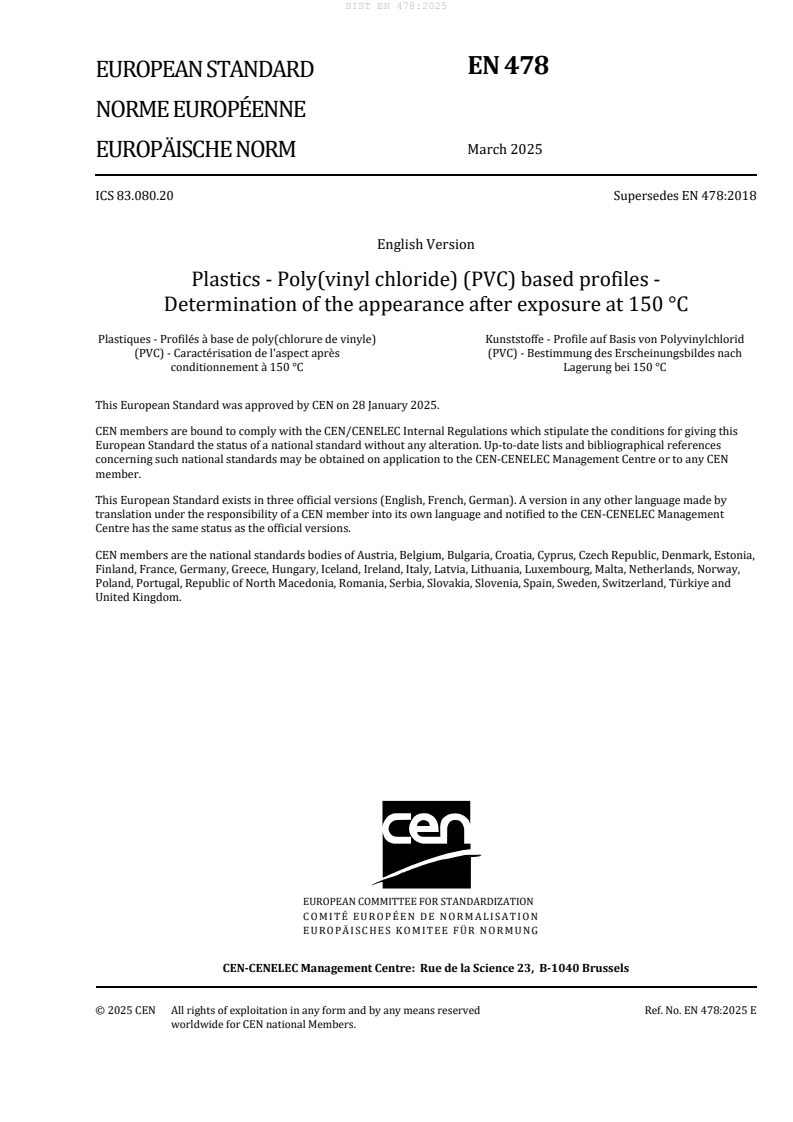
EN 478
EUROPEAN STANDARD
NORME EUROPÉENNE
March 2025
EUROPÄISCHE NORM
ICS 83.080.20 Supersedes EN 478:2018
English Version
Plastics - Poly(vinyl chloride) (PVC) based profiles -
Determination of the appearance after exposure at 150 °C
Plastiques - Profilés à base de poly(chlorure de vinyle) Kunststoffe - Profile auf Basis von Polyvinylchlorid
(PVC) - Caractérisation de l'aspect après (PVC) - Bestimmung des Erscheinungsbildes nach
conditionnement à 150 °C Lagerung bei 150 °C
This European Standard was approved by CEN on 28 January 2025.
CEN members are bound to comply with the CEN/CENELEC Internal Regulations which stipulate the conditions for giving this
European Standard the status of a national standard without any alteration. Up-to-date lists and bibliographical references
concerning such national standards may be obtained on application to the CEN-CENELEC Management Centre or to any CEN
member.
This European Standard exists in three official versions (English, French, German). A version in any other language made by
translation under the responsibility of a CEN member into its own language and notified to the CEN-CENELEC Management
Centre has the same status as the official versions.
CEN members are the national standards bodies of Austria, Belgium, Bulgaria, Croatia, Cyprus, Czech Republic, Denmark, Estonia,
Finland, France, Germany, Greece, Hungary, Iceland, Ireland, Italy, Latvia, Lithuania, Luxembourg, Malta, Netherlands, Norway,
Poland, Portugal, Republic of North Macedonia, Romania, Serbia, Slovakia, Slovenia, Spain, Sweden, Switzerland, Türkiye and
United Kingdom.
EUROPEAN COMMITTEE FOR STANDARDIZATION
COMITÉ EUROPÉEN DE NORMALISATION
EUROPÄISCHES KOMITEE FÜR NORMUNG
CEN-CENELEC Management Centre: Rue de la Science 23, B-1040 Brussels
© 2025 CEN All rights of exploitation in any form and by any means reserved Ref. No. EN 478:2025 E
worldwide for CEN national Members.
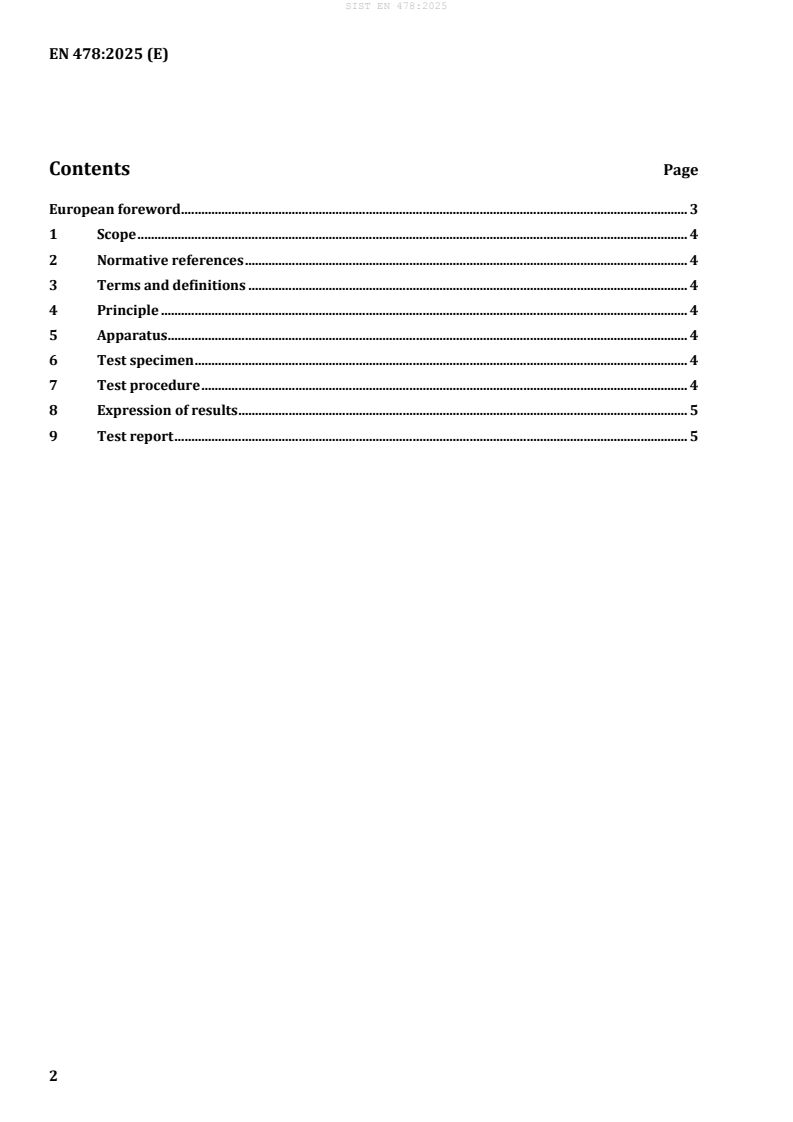
Contents Page
European foreword . 3
1 Scope . 4
2 Normative references . 4
3 Terms and definitions . 4
4 Principle . 4
5 Apparatus . 4
6 Test specimen . 4
7 Test procedure . 4
8 Expression of results . 5
9 Test report . 5
--------------------
...