

CEN/TS 17876:2024
(Main)Child care articles - Tricycles - Safety requirements and test methods
- Abstract
This Technical Report specifiesthe safety requirements and test methods applicable for tricyclelike vehicles providing a transportation function.
When a product includes some combination of the belowpushchairfeatures this leads to consider a tricycle offers a transportationfunction
-A minimum height of the backrest of 340 mm -(a high backrest for the child)
-A harness for the child, bumper bar
-Possibility to disengage child steering
-Possibility to semi-recline or recline the child’s seat
-Padded seat
-Reversible child’s seat
-Possibility is provided to affix bags, backpacks and other accessories,
-Footrest
NOTE: A learner tricycle, unlike a convertible tricycle stroller, has basic features such as a —
(a)handle for parental control and assistance;
(b)handlebar for use by the child tolearn to steer with the pedals disengaged; and
(c)waist and crotch harness on a seathaving a low back support;
- Status
- Published
- Publication Date
- 22-Oct-2024
- Technical Committee
- CEN/TC 252 - Child use and care articles
- Drafting Committee
- CEN/TC 252/WG 3 - Wheeled transportation
- Current Stage
- 6060 - Definitive text made available (DAV) - Publishing
- Start Date
- 23-Oct-2024
- Completion Date
- 23-Oct-2024

Overview
CEN/TS 17876:2024 - "Child care articles - Tricycles - Safety requirements and test methods" is a CEN Technical Specification that defines safety requirements and standardized test methods for tricycle‑type child conveyances that provide a passive transportation function. It was approved for provisional application in 2024 (initial validity limited to three years) and is intended to guide designers, manufacturers, test laboratories and regulators in assessing the safety of tricycles used to transport children.
The Technical Specification clarifies when a tricycle is considered to have a transportation function (e.g. provision of a pushing handle and a supportive backrest) and addresses hazards that overlap with wheeled child conveyances while adding tricycle‑specific requirements.
Key topics and requirements
- Scope and definitions - clear definitions for terms such as convertible tricycle pushchair (CTP), chassis, seat, protected volume and junction line.
- Criteria for transportation function - a tricycle is classed as providing a passive transportation function when it includes a pushing handle and a minimum backrest length (specified in the document), and/or features such as bumper bar, semi‑recline/recline seat, reversible seat, footrest or a system to override child steering.
- Mechanical hazards - identification and test methods for shearing, crushing, entrapment and other moving‑part hazards specific to tricycles.
- Stability and structural integrity - tests and acceptance criteria to ensure the tricycle remains stable under normal use and retains structural integrity after endurance and impact tests.
- Restraint systems and anchorage - requirements for harnesses, crotch restraints and points for attaching additional child restraints.
- Test equipment and masses - defined test masses and probes (e.g., Test mass A, B, D with specified dimensions and masses) and tolerances for forces, dimensions and environmental conditioning.
- Marking, durability and product information - labeling, instructions and durability checks to ensure safety information remains legible and accurate.
- Annexes and rationale - informative annexes explain test rationales, examples of rigging for irregular surface tests and moving canopy parts.
Applications and users
- Manufacturers and product designers - to design tricycles that meet recognised safety and test requirements.
- Test laboratories and conformity assessment bodies - to perform repeatable mechanical, stability and restraint tests using the specified equipment and procedures.
- Regulators and standards committees - for market surveillance and harmonization of safety rules across Europe.
- Importers, retailers and procurement teams - to verify compliance before market placement.
- Child safety engineers and compliance teams - to interpret requirements and integrate them into risk assessments and user instructions.
Related standards
- EN 1888 series (pushchairs/wheeled child conveyances) - referenced and adapted where appropriate for transportation‑type tricycles.
- EN 71‑1 (Safety of toys - mechanical and physical properties) - referenced where toy functions overlap.
Keywords: CEN/TS 17876:2024, tricycle safety standard, child care articles, tricycles safety requirements, test methods, convertible tricycle pushchair, protected volume, mechanical hazards.
Relations
- Effective Date
- 28-Jan-2026
Frequently Asked Questions
CEN/TS 17876:2024 is a technical specification published by the European Committee for Standardization (CEN). Its full title is "Child care articles - Tricycles - Safety requirements and test methods". This standard covers: This Technical Report specifiesthe safety requirements and test methods applicable for tricyclelike vehicles providing a transportation function. When a product includes some combination of the belowpushchairfeatures this leads to consider a tricycle offers a transportationfunction -A minimum height of the backrest of 340 mm -(a high backrest for the child) -A harness for the child, bumper bar -Possibility to disengage child steering -Possibility to semi-recline or recline the child’s seat -Padded seat -Reversible child’s seat -Possibility is provided to affix bags, backpacks and other accessories, -Footrest NOTE: A learner tricycle, unlike a convertible tricycle stroller, has basic features such as a — (a)handle for parental control and assistance; (b)handlebar for use by the child tolearn to steer with the pedals disengaged; and (c)waist and crotch harness on a seathaving a low back support;
This Technical Report specifiesthe safety requirements and test methods applicable for tricyclelike vehicles providing a transportation function. When a product includes some combination of the belowpushchairfeatures this leads to consider a tricycle offers a transportationfunction -A minimum height of the backrest of 340 mm -(a high backrest for the child) -A harness for the child, bumper bar -Possibility to disengage child steering -Possibility to semi-recline or recline the child’s seat -Padded seat -Reversible child’s seat -Possibility is provided to affix bags, backpacks and other accessories, -Footrest NOTE: A learner tricycle, unlike a convertible tricycle stroller, has basic features such as a — (a)handle for parental control and assistance; (b)handlebar for use by the child tolearn to steer with the pedals disengaged; and (c)waist and crotch harness on a seathaving a low back support;
CEN/TS 17876:2024 is classified under the following ICS (International Classification for Standards) categories: 97.190 - Equipment for children. The ICS classification helps identify the subject area and facilitates finding related standards.
CEN/TS 17876:2024 has the following relationships with other standards: It is inter standard links to EN 71-1:2014+A1:2018. Understanding these relationships helps ensure you are using the most current and applicable version of the standard.
CEN/TS 17876:2024 is associated with the following European legislation: Standardization Mandates: M/264. When a standard is cited in the Official Journal of the European Union, products manufactured in conformity with it benefit from a presumption of conformity with the essential requirements of the corresponding EU directive or regulation.
CEN/TS 17876:2024 is available in PDF format for immediate download after purchase. The document can be added to your cart and obtained through the secure checkout process. Digital delivery ensures instant access to the complete standard document.
Standards Content (Sample)
SLOVENSKI STANDARD
01-julij-2025
Izdelki za otroke - Tricikli - Varnostne zahteve in preskusne metode
Child care articles - Tricycles - Safety requirements and test methods
Artikel für Säuglinge und Kleinkinder - Dreiräder - Sicherheitstechnische Anforderungen
und Prüfverfahren
Articles de puériculture - Tricycles - Exigences de sécurité et méthodes d'essai
Ta slovenski standard je istoveten z: CEN/TS 17876:2024
ICS:
97.190 Otroška oprema Equipment for children
2003-01.Slovenski inštitut za standardizacijo. Razmnoževanje celote ali delov tega standarda ni dovoljeno.
CEN/TS 17876
TECHNICAL SPECIFICATION
SPÉCIFICATION TECHNIQUE
October 2024
TECHNISCHE SPEZIFIKATION
ICS 97.190
English Version
Child care articles - Tricycles - Safety requirements and
test methods
Articles de puériculture - Tricycles - Exigences de Artikel für Säuglinge und Kleinkinder - Dreiräder -
sécurité et méthodes d'essai Sicherheitstechnische Anforderungen und
Prüfverfahren
This Technical Specification (CEN/TS) was approved by CEN on 5 August 2024 for provisional application.
The period of validity of this CEN/TS is limited initially to three years. After two years the members of CEN will be requested to
submit their comments, particularly on the question whether the CEN/TS can be converted into a European Standard.
CEN members are required to announce the existence of this CEN/TS in the same way as for an EN and to make the CEN/TS
available promptly at national level in an appropriate form. It is permissible to keep conflicting national standards in force (in
parallel to the CEN/TS) until the final decision about the possible conversion of the CEN/TS into an EN is reached.
CEN members are the national standards bodies of Austria, Belgium, Bulgaria, Croatia, Cyprus, Czech Republic, Denmark, Estonia,
Finland, France, Germany, Greece, Hungary, Iceland, Ireland, Italy, Latvia, Lithuania, Luxembourg, Malta, Netherlands, Norway,
Poland, Portugal, Republic of North Macedonia, Romania, Serbia, Slovakia, Slovenia, Spain, Sweden, Switzerland, Türkiye and
United Kingdom.
EUROPEAN COMMITTEE FOR STANDARDIZATION
COMITÉ EUROPÉEN DE NORMALISATION
EUROPÄISCHES KOMITEE FÜR NORMUNG
CEN-CENELEC Management Centre: Rue de la Science 23, B-1040 Brussels
© 2024 CEN All rights of exploitation in any form and by any means reserved Ref. No. CEN/TS 17876:2024 E
worldwide for CEN national Members.
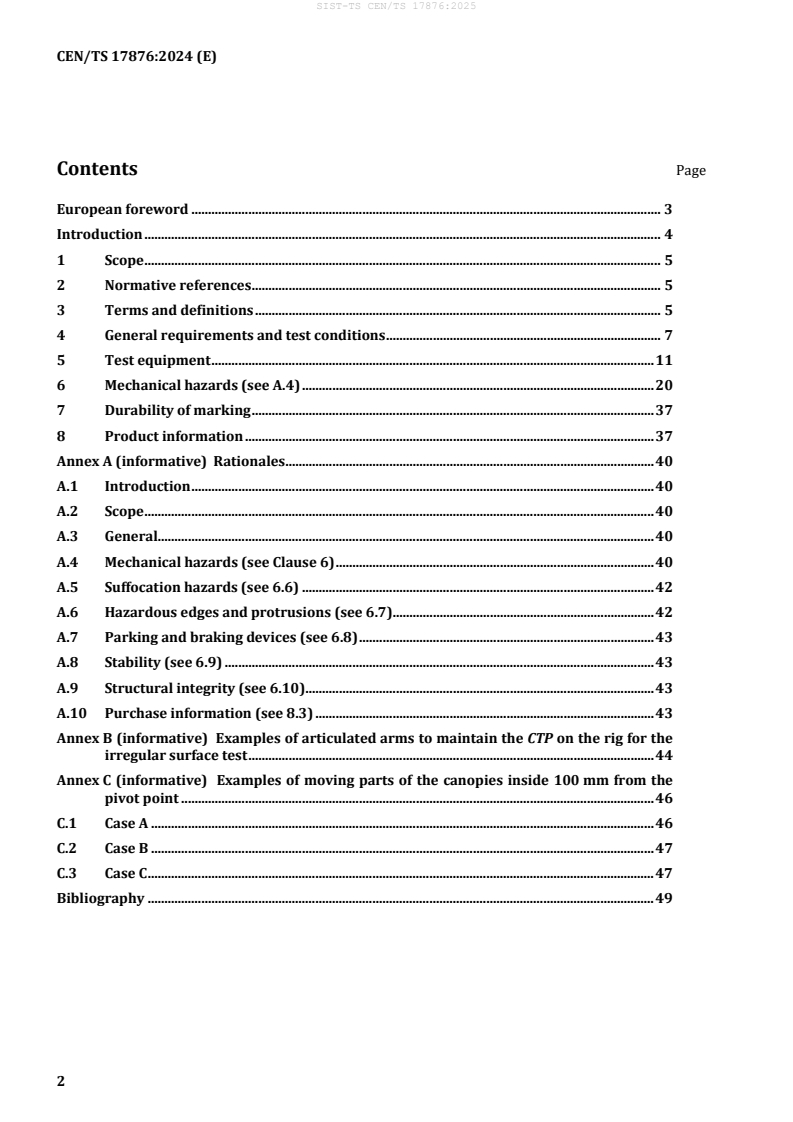
Contents Page
European foreword . 3
Introduction . 4
1 Scope . 5
2 Normative references . 5
3 Terms and definitions . 5
4 General requirements and test conditions . 7
5 Test equipment . 11
6 Mechanical hazards (see A.4) . 20
7 Durability of marking . 37
8 Product information . 37
Annex A (informative) Rationales . 40
A.1 Introduction . 40
A.2 Scope . 40
A.3 General. 40
A.4 Mechanical hazards (see Clause 6) . 40
A.5 Suffocation hazards (see 6.6) . 42
A.6 Hazardous edges and protrusions (see 6.7) . 42
A.7 Parking and braking devices (see 6.8) . 43
A.8 Stability (see 6.9) . 43
A.9 Structural integrity (see 6.10) . 43
A.10 Purchase information (see 8.3) . 43
Annex B (informative) Examples of articulated arms to maintain the CTP on the rig for the
irregular surface test . 44
Annex C (informative) Examples of moving parts of the canopies inside 100 mm from the
pivot point . 46
C.1 Case A . 46
C.2 Case B . 47
C.3 Case C . 47
Bibliography . 49
European foreword
This document (CEN/TS 17876:2024) has been prepared by Technical Committee CEN/TC 252 “Child
care articles”, the secretariat of which is held by AFNOR.
Attention is drawn to the possibility that some of the elements of this document may be the subject of
patent rights. CEN shall not be held responsible for identifying any or all such patent rights
Any feedback and questions on this document should be directed to the users’ national standards body.
A complete listing of these bodies can be found on the CEN website.
According to the CEN/CENELEC Internal Regulations, the national standards organisations of the
following countries are bound to announce this Technical Specification: Austria, Belgium, Bulgaria,
Croatia, Cyprus, Czech Republic, Denmark, Estonia, Finland, France, Germany, Greece, Hungary, Iceland,
Ireland, Italy, Latvia, Lithuania, Luxembourg, Malta, Netherlands, Norway, Poland, Portugal, Republic of
North Macedonia, Romania, Serbia, Slovakia, Slovenia, Spain, Sweden, Switzerland, Türkiye and the
United Kingdom.
Introduction
This document has been produced to provide safety guidance for designers, manufacturers, suppliers and
users of children’s tricycles providing a passive transportation function.
These guidelines have been drafted to address potential hazards associated with the transportation
function of tricycles. Where there are similar hazards to those associated with wheeled child
conveyances, these have been identified. Requirements and test methods which are given in
EN 1888-1:2018+A1:2022 and are appropriate to the transportation function of tricycles have been
included, adapted as necessary, in this document.
1 Scope
This document covers children’s tricycles providing a passive transportation function.
A tricycle is considered to provide a passive transportation function when it provides a pushing handle
and a sufficient support for the child’s back, i.e. the minimum length of the backrest is 250 mm (when
measured in accordance with 6.1.1.2 of this document), and includes any of the below pushchair features:
— Bumper bar;
— Possibility to semi-recline or recline the child’s seat;
— Reversible child’s seat;
— Footrest;
— A system for overriding front wheel steering for the child and parent.
NOTE Toys or the toy functions of Convertible Tricycle Pushchairs are covered by Directive 2009/48/EC.
Products sold as pushchairs are excluded from the scope of this document, as they are covered by
EN 1888 standard series.
2 Normative references
The following documents are referred to in the text in such a way that some or all of their content
constitutes requirements of this document. For dated references, only the edition cited applies. For
undated references, the latest edition of the referenced document (including any amendments) applies.
EN 71-1:2014+A1:2018, Safety of toys - Part 1: Mechanical and physical properties
3 Terms and definitions
For the purposes of this document, the following terms and definitions apply.
ISO and IEC maintain terminological databases for use in standardization at the following addresses:
• IEC Electropedia: available at https://www.electropedia.org/
• ISO Online browsing platform: available at https://www.iso.org/obp
3.1
convertible tricycle pushchair
CTP
vehicle designed for use by a child in at least two modes, the first being primarily for play and learning to
steer and pedal; and the second to transport a child, similar in intent and purpose to a pushchair
3.2
chassis
wheeled framework with a removable or fixed handle(s) for pushing, pulling and steering, designed to
accommodate and transport a seat(s)
3.3
seat
structure which may or may not be adjustable to achieve a reclining or recumbent position designed to
support one child
3.4
protected volume
volume accessible by the child (occupant) when sitting in the convertible tricycle pushchair, where
specific safety requirements are necessary
3.5
junction line
intersection of the seating surface and the backrest
3.6
restraint system
system to restrain the child within the CTP
Note 1 to entry: A surrounding rim or bumper bar is not considered a restraint system.
3.7
crotch restraint
device positioned between the child’s legs to prevent the child from sliding forwards
3.8
harness anchorage point
device suitable for the attachment of an additional child’s harness
3.9
footrest
support for the feet or a foot other than pedals, used when sitting
3.10
shearing hazard
hazard due to the movement of components relatively one to another resulting in a scissoring action
3.11
crushing hazard
hazard due to the movement of components relatively one to another resulting in a compression action
3.12
folding system
assembly of moving parts which enables the CTP or parts thereof to be changed from an erected position
to a folded position under the control of the carer
3.13
locking mechanism
assembly of components consisting of one or more locking device(s) and one or more operating device(s)
3.14
locking device
mechanical component that maintains part(s) of the vehicle erected in the position of use (e.g. latch(es),
hooks, over centre lock.) which could be deactivated or activated by action(s) on the operating device
3.15
operating device
part of the locking mechanism(s) designed to be activated by the carer through one or several positive
action(s)
3.16
automatic locking device
device that engages with no additional voluntary action by the carer, when the CTP is erected to its
position of use
3.17
parking device
device to maintain the CTP in a stationary position
4 General requirements and test conditions
4.1 General
Words in italics are defined in Clause 3 (Terms and definitions). Additional information on the
background and rationale for various requirements is given in Annex A.
4.2 Samples
Tests shall be carried out in the order of the clauses given in this document, unless otherwise stated. Each
test shall be carried out only using one sample, unless otherwise stated.
CTP shall comply with all applicable requirements in any possible arrangement in accordance with the
manufacturer's instructions.
4.3 Tolerances for test equipment
Unless otherwise stated, the accuracy of the test equipment shall be:
— forces ± 5 %;
— masses ± 0,5 %;
— dimensions ± 0,5 mm;
— timing ± 1 s;
— angles ± 0,5°.
4.4 Test conditions
The CTP shall be conditioned at a temperature of (23 ± 5) °C for at least 2 h prior to tests. All tests shall
be carried out at a temperature of (23 ± 10) °C unless otherwise specified.
For CTPs fitted with inflatable tyres, the tyre pressure shall be adjusted according to manufacturer’s
instructions for use before conducting the entire test procedure. If a tyre is punctured during the test
procedure, the tyre shall be replaced, and the test procedure continued.
4.5 Determination of the protected volume of the seat
The protected volume of seat shall be determined in accordance with Figure 1 below.
Dimensions in millimetres
Key
origin from which the protected volume has been defined (mid-point of the junction line, on the uncompressed
upper surface of the seat)
2 seat
3 back rest
4 leg rest
Figure 1 — Protected volume for seat
The space located behind the backrest is excluded from the protected volume.
Where a CTP is suitable for two or more children the space located behind the backrest shall be
considered if it enters another protected volume.
The space underneath the seat and underneath the leg rest is excluded from the protected volume, except
for a 50 mm wide band measured from the outermost edge of the seat/leg rest sides where the seat/leg
rest is not fitted with lateral protections of a height greater than 50 mm (textile or any rigid component)
(see Figure 2).
Dimensions in millimetres
a) 3D view b) Bottom view
Key
1 space to be checked
2 space not to be checked
3 leg rest
4 seat
5 backrest
Figure 2 —Effect of lateral protection on the determination of the protected volume
4.6 Determination of the junction line
The junction line shall be determined as the intersection between the seating surface and the backrest as
shown on Figure 3.
Key
LL junction line
1 backrest
2 seat
Figure 3 — Junction line
When the seat is in the form of a hammock, then a theoretical junction line, “LL”, is determined as follows
(see Figure 4).
Key
LL junction line
L CL vertical projection of C on the hammock
Figure 4 — Junction line for seat in form of a hammock
NOTE 1 The junction line can vary when the backrest is adjusted to different positions.
When the seat is of rigid material, then a theoretical junction line, “LL”, is determined as follows.
Key
1 angle measuring device
2 seat
3 angle between the seating surface and the backrest
Figure 5 — Determination of junction line
Place the angle measuring device (5.3) described in Figure 11 at the centre of the seat as shown in
Figure 5 and move it towards the centre line of the seat unit until both parts of the device give the smallest
angle along the seat and the backrest unit. When the smallest angle is reached (seat angle measurement
device shall not be oriented in a negative angle), the axis of the device corresponds to the junction line.
NOTE 2 In case the shape of the seat does not allow to keep the angle measurement device in position, manually
slowly slide the angle measurement device from the top of the backrest and maintain it to record the smallest angle.
5 Test equipment
5.1 Test masses
5.1.1 General
Any damage to fabric which may occur as a result of abrasion by the test masses during tests shall be
ignored. Damage can be minimized by using a convenient means of protection of negligible mass. Where
damage is not caused by abrasion by the test masses it constitutes a structural failure.
Test masses may be fitted with additional handles for carrying purposes, as long as the centre of gravity
is not changed, and mass remains within tolerances and the test procedure is not affected.
5.1.2 Test mass A
Test mass A is a rigid cylinder (160 ± 5) mm in diameter and (300 ± 5) mm in height, having a mass
+01,
of ( 9 ) kg and with its centre of gravity in the centre of the cylinder. All edges shall have a radius of
(5 ± 1) mm. Two anchorage points shall be provided, positioned (150 ± 2,5) mm from the base and at
180° to each other around the circumference as shown in Figure 6.
Dimensions in millimetres
Key
1 radius: (5 ± 1) mm
2 two anchorage points
Figure 6 — Test mass A
5.1.3 Test mass B
Test mass B is a rigid cylinder (200 ± 5) mm in diameter and (300 ± 5) mm in height, having a mass
+01,
of ( 15 ) kg and with its centre of gravity in the centre of the cylinder. All edges shall have a radius
of (5 ± 1) mm. Two anchorage points shall be provided, positioned (150 ± 2,5) mm from the base and
at 180° to each other around the circumference (see Figure 7).
The test mass may be fitted with additional handle for carrying purposes, as long as the centre of gravity
is not changed, and mass remains within tolerances and the test procedure is not affected
Dimensions in millimetres
Key
1 radius: (5 ± 1) mm
2 two anchorage points
Figure 7 — Test mass B
5.1.4 Test mass D
Test mass D is made of a rigid material with a smooth finish and a total mass of (9 ± 0,1) kg (see Figure 8).
Dimensions in millimetres
Tolerances:
— dimensions ± 2 mm
— angles ± 2°
— where shown, corner radii shall be (10 ± 1) mm
Figure 8 — Test mass D
5.2 Test probes
5.2.1 Finger probes
5.2.1.1 Finger probe with hemispherical end
0 0
Probes made from plastics or other hard, smooth material of diameters 5 mm, 7 mm and
−01, −01,
+01,
12 mm with a full hemispherical end (see Figure 9).
Dimensions in millimetres
Key
1 hemispherical end
2 scribed line around circumference
3 Ø 5 mm 7 mm and 12 mm
Figure 9 — Probes with hemispherical end
5.2.1.2 Shape assessment probe
Probes made from plastics or other hard, smooth material with the dimensions shown in Figure 10.
Dimensions in millimetres
Figure 10 — Shape assessment probe
5.2.1.3 Conical probe for mesh
Probe for assessing mesh made from plastics or other hard, smooth material as shown in Figure 11, which
shall be capable of being mounted on a force measuring device, so that the conical end can be presented
to the opening being assessed.
Dimensions in millimetres
Figure 11 — Conical probe for mesh
The tolerance on the radius is ± 0,2 mm.
5.2.2 Conical probes
0 +01,
Probes made from plastics or other hard smooth material of diameters ( ) mm and ( 45 ) mm
−01, 0
with one conical end (with an angle of 30°), that can be mounted on a force measuring device
(see Figure 12).
Dimensions in millimetres
Figure 12 — Conical probes
5.3 Angle measuring device
A 9 kg articulated steel device used to measure the angle between the seat and the backrest
(see Figure 13).
Dimensions in millimetres
Key
1 part to be placed onto the seat surface made of steel
2 part to be placed onto the backrest surface made of steel
3 hinge pin made of steel
E mass: (4495 ± 50) g
F mass: (4501 ± 50) g
G mass of hinge axle: (17 ± 0,5) g, length: 79,5 mm
total mass: (9 ± 0,1) kg
dimensions tolerance: ± 2 mm
All edges shall be chamfered.
NOTE A mark at 340 mm and 250 mm can help to quickly identify backrest height.
Figure 13 — Angle measuring device
5.4 Bite tester
The bite tester, see Figure 14, consists of two sets of teeth, see Figure 15, made from H13 high chrome
tool steel or equivalent and hardened to 45-50 Rockwell C. There are two teeth at the top and two at the
bottom of the bite tester, positioned so that the vertical centre line of one pair of teeth is (1 ± 0,1) mm in
front of the centre line of the other set of teeth. In the fully closed position, the teeth shall overlap each
other by (1 ± 0,1) mm. The outer most corners of the teeth shall have a radius of (0,3 ± 0,1) mm.
The teeth shall be mounted so as to pivot about a point (50 ± 1) mm from the rear most pair of teeth and
positioned so that when closed the centre lines of the two pairs of teeth are parallel to each other. The
bite tester shall be equipped with a stop to prevent the distance between the teeth from exceeding
(28 ± 1) mm when fully opened. The closing force of the teeth shall be set at (50 ± 5) N.
The bite tester shall be provided with a guide to prevent items entering further into the fully opened jaws
by more than (17 ± 1) mm. The bite tester shall be equipped with a means whereby a force of (50 ± 5) N
may be applied along its centre line in a direction tending to pull the teeth off the sample.
Dimensions in millimetres
Key
1 position of guide
2 pivot point
Figure 14 — Bite tester
Dimensions in millimetres
Figure 15 — Test teeth
5.5 Test surface
+05, +05,
Test surface, capable of inclination at an angle of ( 9 ) °, ( 12 ) to the horizontal and covered with
0 0
aluminium oxide paper of grade 80.
5.6 Rectangular stops
Rectangular stops of height 25 mm.
5.7 Irregular surface test equipment
5.7.1 Obstacles
The surface of the irregular surface test equipment shall comprise two types of obstacles: Type A and
Type B as shown in Figures 16 and 17.
These obstacles shall be mounted on a conveyor system as shown in Figure 18 so that the wheels on each
side of the CTP are lifted alternately. The conveyor system shall run at a speed of (5 ± 0,1) km/h.
Dimensions in millimetres
Figure 16 — Type “A” obstacle for the irregular surface test
Dimensions in millimetres
Key
1 direction of travel
Figure 17 — Type “B” obstacle for the irregular surface test
Dimensions in millimetres
Key
1 front wheels
2 back wheels
3 centre line
4 length of 1 cycle
5 direction of the travel of obstacles
Figure 18 — Arrangement for the irregular surface test
5.7.2 Articulating arms (see Annex B)
The test apparatus comprises two independent articulating arms capable of moving independently of
each other in the vertical plane.
The test apparatus shall allow the articulating arms to be adjustable in height and across the width of the
irregular surface test equipment to accommodate different types and sizes of CTP.
The articulating arms shall pivot around their fixing point.
When in the horizontal position, each arm shall exert a vertical force on the handles of (20 ± 1) N.
6 Mechanical hazards (see A.4)
6.1 Protective function (see A.4.2)
6.1.1 Suitability of CTP
6.1.1.1 Seat
When measured in accordance with 6.1.1.2:
— the angle (1) between the seating surface and the backrest (see Figure 19) shall not be less than 95°;
and
— the angle (2) between the seating surface and the horizontal (see Figure 19) shall not be less than 0°;
and
— the angle (3) between the backrest and the horizontal (see Figure 19) shall not be less than 0°.
NOTE Angles below the horizontal line are considered to be less than 0°.
The length of the backrest shall not be less than 340 mm. When tested in accordance with 6.1.1.2 the top
of the backrest of the seat shall be equal to or higher than a mark made on part 2 of the angle measuring
device.
Key
1 angle between the seating surface and the backrest
2 angle between the seating surface and the horizontal
3 angle between backrest and the horizontal
4 seat
5 angle measuring device
6 horizontal
Figure 19 — Measurement of angle of backrest
6.1.1.2 Measurement of angle and length of the backrest
Adjust the backrest of the seat to its most upright position.
Any removable head cushion shall be removed before performing the measurements.
Any component that may impair the correct positioning of part 1 of the angle measuring device
(crotchstrap, padded parts, buckle, etc.) shall be positioned such as to ensure part 1 of the device is
correctly placed onto the seat.
Place the angle measuring device (see 5.3) on the seat with part 1 against the seat and with part 2
(Figure 13) against the backrest as shown in Figure 19 and in Figure 5.
Raise the whole device for at least 50 mm from the seating surface with part 2 (Figure 13) maintaining
complete contact with the backrest. With the device in this position fold up part 1 to its maximum reach.
Then lower the whole device as far as possible by its own weight, with part 2 (Figure 13) maintaining
complete contact with the backrest. Then slowly unfold part 1 (Figure 13) in such a way that it leans fully
on the seat as far as possible under its own weight.
Measure angles 1, 2 and 3 (see Figure 19) on the top surface of the angle measuring device. During
measurement, the angle measuring device shall not move from its position.
If applicable, adjust the backrest to its lowest position allowing the angle measuring device to move freely
with the seat. Then measure angles 1, 2 and 3 (see Figure 19) on the top surface of the angle measuring
device. The angle measuring device shall not move from its position during the measurement.
Check if the top of the backrest is equal to or higher than the mark on part 2 (Figure 13) of the angle
measuring device.
6.1.2 Restraint system and fasteners
6.1.2.1 Requirements
Seats shall be fitted with a restraint system incorporating a crotch restraint for each position a child can
occupy.
The restraint system shall be designed so that it cannot be used without the crotch restraint.
The restraint system shall be adjustable.
Where straps are included in the restraint system, they shall have a minimum width of 19 mm.
All seats shall be tested in accordance with 6.1.2.2.1 and test mass D (5.1.4) shall not completely fall out
of the restraint system.
NOTE Any partial movement of test mass D is not considered a failure.
When tested in accordance with 6.1.2.2.2 the attachment of the restraint system shall not break, deform,
work loose or become torn/displaced and the seat shall remain in place without permanent damage.
When tested in accordance with 6.1.2.2.3 in any orientation, fasteners shall not be released and shall not
have suffered damage which impairs their normal operation and function.
When tested in accordance with 6.1.2.2.4 the maximum slippage of adjusters shall be 20 mm.
6.1.2.2 Tests methods
6.1.2.2.1 Effectiveness of restraint system
Initially place test mass D against the backrest in the middle of the seat with the 225 mm axis against the
back rest and attach the restraint system in accordance with the manufacturer’s instructions with the seat
in the most upright position. Fasten any waist restraint around the torso section of test mass D so that
any slackness is removed, and the waist restraint is positioned above the leg stumps. If the crotch restraint
is adjustable, adjust it so that any slackness is removed, and the waist restraint is still positioned above
the leg stumps. Where the restraint system has shoulder straps that can be positioned on the back of the
seat in a range of positions, the shoulder straps shall be placed in the highest position (to accommodate
the oldest child).
In the case of a rigid seat, the test mass D shall be placed with the bottom of the test mass aligned with
the junction line.
Where shoulder straps are fitted, place a 30 mm cuboid spacer block, made of a hard, smooth material,
on each shoulder of test mass D. Adjust each shoulder strap in accordance with manufacturer's
instructions so that any slackness is removed. Remove the spacers.
A rotating test surface shall be used to rotate the CTP smoothly through 360° at a speed of (4 ± 0,5) RPM
in a forward and reverse direction.
Rotate the CTP through 360° in a forward direction. If necessary, reposition test mass D to its initial
position without altering the adjusters on the restraint system. Rotate the CTP through 360° in the reverse
direction. If necessary, reposition test mass D to its initial position without altering the adjusters on the
restraint system.
Repeat the forward and reverse rotation cycles for two more sequences, giving a total of 3 forward
and 3 reverse rotations. If necessary, after each rotation, reposition test mass D to its initial position
without altering the adjusters on the restraint system.
6.1.2.2.2 Attachment of the restraint system to the seat
Gradually apply a tensile force of 150 N to each point of attachment of the restraint system in the most
onerous direction. Maintain this force for 1 min.
If more than one strap is attached at the same position or within a 20 mm radius, the force 150 N shall be
applied to each strap simultaneously.
6.1.2.2.3 Strength of fastener
A tensile force of 200 N shall be gradually applied to the straps either side of the fastener. Maintain this
force for 1 min.
6.1.2.2.4 Effectiveness of the adjustment system
This test shall be conducted at the end of the whole test procedure given in this document.
Use approximately 125 mm of the restraint system on either side of the adjustment system.
Fix one end of the test piece into one jaw of a dynamometer and the other end into another jaw. The
distance between the jaws shall be 200 mm.
Draw a line across the width of the test piece flush with each jaw.
Set the jaw movement speed to (500 ± 10) mm/min. Reduce the distance between the jaws to 150 mm.
Subject the test piece to a tensile force until the latter reaches (100 ± 10) N. When this strain has been
reached, return the distance between the jaws to 150 mm.
Conduct the test for a total of 10 times.
Measure the distance between the lines drawn flush with the jaws. The difference between this dimension
and original dimension of 200 mm is the amount of slippage.
6.2 Entrapment hazards (see A.4.3)
6.2.1 Holes and openings
6.2.1.1 Requirements
When testing in accordance with 6.2.1.2 there shall be no completely bounded openings in rigid materials
within the protected volume that let the 7 mm probe go through unless the depth of penetration is less
than 10 mm or unless the shape assessment probe enters. This requirement is not applicable to the
restraint system.
The size of the holes in mesh within the protected volume shall be less than 7 mm when measured in
accordance with 6.2.1.2.
There shall be no accessible holes or completely bounded openings between rigid parts of the footrest
having a width greater than 25 mm and smaller than 45 mm, when measured in accordance with 6.2.1.2.
There shall be no accessible holes or completely bounded openings between rigid parts of the pedals
having a width greater than 25 mm and smaller than 45 mm, when measured in accordance with 6.2.1.2.
NOTE Illustrations of completely bounded openings are found in A.4.3 Entrapment hazards.
6.2.1.2 Test methods
Check whether the 7 mm finger probe (5.2.1.1) with an applied force of up to 30 N, enters 10 mm or more
into any accessible opening in any possible orientation. If the 7 mm probe enters 10 mm or more then
the shape assessment probe, (5.2.1.2) shall also enter 10 mm or more with an applied force of up to 5 N.
Check whether the conical probe (5.2.1.3), penetrates holes in the mesh to the 7 mm diameter section
with an applied force of up to 30 N.
Check whether the 25 mm conical probe (5.2.2), enters into any opening in the footrest or in the pedal
with an applied force of up to 30 N. If the 25 mm conical probe enters then the 45 mm conical probe
(5.2.2) shall also enter with an applied force of up to 5 N.
6.3 Hazards from moving parts (see A.4.4)
6.3.1 General
The requirements shall be checked before and after the irregular surface test (6.10.2). These
requirements do not apply to the restraint system.
Within the protected volume there shall be no shearing or crushing hazards between rigid parts moving
relative to each other, except while the CTP is being erected for use or being folded or during adjustments
of parts that are locked when in position for use.
Contact edges between parts moving relative to each other shall be rounded or chamfered in accordance
with 6.7, unless the clearance is always less than 5 mm.
6.3.2 Shearing hazards (see A.4.4)
6.3.2.1 Requirements
After the product is set up for normal use in accordance with the manufacturer's instructions, there shall
be no accessible hazardous scissoring points which can close to less than 12mm or into which the 12mm
probe cannot enter when tested in accordance with 6.3.2.2.
For hoods and any similar items such as canopies, sunshades, etc., the requirement is applicable to the
space between the frame components and between any hood tensionner attached to them and the frame
components, within a distance of 100 mm measured from the primary pivot point of the hood
(see Figure 20, Annex C).
Figure 20 — Distance from the primary pivot point of the hood
6.3.2.2 Test method
Check for parts that have a potentially hazardous scissoring movement. Adjust the moving parts to reduce
the gap to the minimum distance possible and hold them in position without impairing the flexibility of
the parts.
When using an applied force of 30 N check whether the 12mm probe (5.2.1.1) can pass between the
moving parts.
Carry out the test at the most onerous position of the moving parts.
6.3.3 Crushing hazards, requirement
When the product is in use there shall be no accessible hazardous compression point which can close to
less than 12 mm unless the clearance is always less than 5 mm.
6.3.4 Wheels
The CTP shall meet the requirement of EN 71-1:2014+A1:2018, 4.15.1.6 b).
6.3.5 Locking mechanism(s)
6.3.5.1 Folding system for storage or transportation
6.3.5.1.1 Requirements
6.3.5.1.1.1 General requirements
CTP that can be folded for storage or transportation where the chassis can fold with the seat attached,
shall be fitted with one or more locking mechanism(s). The locking mechanism(s) shall comply with the
requirements in 6.3.5.1.1.2 and 6.3.5.1.1.3.
CTP that can be folded for storage or transportation where the chassis can only fold when the seat has
been removed, or CTPs that can only be folded after putting them in a position that clearly does not allow
transportation of a child (e.g. overturn the CTP) shall be fitted with a locking mechanism(s).
The function of any operating device shall not be impaired after being tested in accordance with
6.3.5.1.2.1.
6.3.5.1.1.2 Incomplete deployment
To avoid the hazard due to incomplete deployment, there shall be at least two locking devices and at least
one locking device shall engage automatically when the product is fully deployed for use.
If the locking device is not visible without damaging the CTP a second sample may be used.
6.3.5.1.1.3 Unintentional release of locking mechanism(s)
To avoid the hazards due to unintentional release one of the following conditions shall be fulfilled:
a) there shall be at least one operating device which fulfils the following:
1) the operating device shall require at least two consecutive actions, the second being dependent
on the first having been carried out and maintained by the user; and
2) the operating device shall not be activated or damaged in one single action during testing in
accordance with 6.3.5.1.2.2;
or
b) there shall be two separate and independent operating devices which fulfil one of the following:
3) where one operating device is intended to be operated by foot (e.g. for its position, shape,
according to the manufacturer’s instructions for use, etc.) it shall automatically return to its
original status and the locking device shall reengage when tested in accordance with 6.3.5.1.2.3;
or
4) where both operating devices are intended to be operated by hand(s) (e.g. for their position,
shape, according to the manufacturer’s instructions for use, etc.) they shall both automatically
return to their original status and the locking devices shall reengage when tested in accordance
with 6.3.5.1.2.3;
or
c) there shall be three or more separate and independent operating devices, at least one of which shall
be located out of the protected volume or shall require a force of more than 50 N to be operated.
During testing in accordance with 6.3.5.1.2.4 the CTP shall not fold. After testing in accordance with
6.3.5.1.2.4 the CTP and the locking mechanisms shall not be damaged, and the CTP shall still comply with
the requirements of 6.2 and 6.7.
When tested in accordance with:
— irregular surface test (6.10.2);
— handle strength test (6.10.3)
the CTP shall not fold, and the locking device(s) shall not be released.
6.3.5.1.2 Test methods
6.3.5.1.2.1 General
Operate the operating devices 200 times.
6.3.5.1.2.2 Unintentional release of the locking mechanism by one single action
Place the CTP fully deployed and ready for use on a horizontal flat surface.
Apply a force of 150N or a torque of 2,2 Nm to the operating device. This force or torque shall be applied
to the operating device in the direction most likely to operate the operating device in one single action.
The force or torque shall be applied for a period of 5 s.
6.3.5.1.2.3 Automatically returning operating device
Place the CTP on a horizontal flat surface.
Without any test mass in the CTP operate the operating device. Check whether the operating device
automatically returns to its original position and whether the locking device re-engages.
Place test mass B in the seat as described in 6.8.2.1 with the backrest and/or seat adjusted to the most
onerous position. Disengage the automatic operating device. Check whether the automatic operating
device automatically returns to its original position and whether the locking device re-engages.
6.3.5.1.2.4 Effectiveness of locking mechanism(s) on CTPs where the chassis can fold with the seat
installed
Place test mass B in the seat as described in 6.8.2.1. If the CTP is designed for more than one child use any
number of appropriate test masses, up to one in each place intended to be occupied by a child.
Engage all the locking mechanisms.
Restrain the wheels to prevent forward or rearward movement by means of fixed floor stops with a height
greater than the radius of the wheels as shown in Figure 21.
Apply a force F for a period of 5 s, to the handle bar (or to each handle in turn in the case of separate
handles), in each of the following directions:
a) forward horizontal;
b) rearward horizontal.
The test shall be performed with the stops between the wheels or outside them (see Figure 21).
Force F shall be either the force to raise the front or rear wheels or 200 N, whichever is the lesser force.
For CTPs with 2 or more separate and independent operating devices operate each operating device such
as to disengage each locking devices in turn and apply force F in the same manner as in (a) and (b) above.
The test is not conducted on CTPs whose test mass causes all locking devices to automatically re-engage.
Figure 21 — Positioning of the stop
6.3.5.2 Handle detachment
Handle(s) shall be fitted with devices to avoid inadvertent separation or detachment during use. The
strength is checked with test method in 6.10.3.
6.4 Entanglement and strangulation hazards
The CTP shall meet the requirement of EN 71-1:2014+A1:2018, 5.4.
6.5 Choking and ingestion hazards
6.5.1 Requirements
The CTP shall meet the requirement of EN 71-1:2014+A1:2018, 5.1.
When tested in accordance with 6.5.2 no filling, rubber, plastic, foam, etc. shall be detached from the
bumper bar. If components indicate signs of detachment, carry out tests in accordance with
EN 71-1:2014+A1:2018, 8.3 and 8.4 at the position where the components show signs of detachment.
6.5.2 Bite test
If the padding material of a bumper bar is encased by a cover that can be opened or removed by the child
during use giving access to the filling or padding material, the test procedure shall be performed on the
padding material after the cover has been removed.
The test procedure comprises two stages.
Stage 1)
Open the jaw until reaching a distance of 6 ± 0,5 mm between the teeth.
With the jaw kept open apply the 4 teeth in contact with the area to be tested.
While keeping the 4 teeth in contact apply a force of 30 N such that the force is evenly distributed on the
4 teeth. While the force is applied, let the jaw to close on the material.
Remove the 30 N force and apply a pulling force of 50 N in the opposite direction, maintaining it for 10s,
(see Figure 22).
Dimensions in millimetres
Figure 22 — Bite test, Stage 1)
Stage 2)
Then open the jaws of the bite tester as far as possible and push it horizontally at a force of 30 N onto the
bumper bar as far as the guide; allow the teeth to close on the bumper bar and apply a pulling force of
50 N, maintaining it for 10 s.
If, during the test procedure, the outer material of the bumper bar is punctured by the teeth, remove the
outer material to expose the layer below or the filling and repeat stages 1 and 2 until th
...