

EN 13725:2022
(Main)Stationary source emissions - Determination of odour concentration by dynamic olfactometry and odour emission rate
- Abstract
This document specifies a method for the objective determination of the odour concentration of a gaseous sample using dynamic olfactometry with human assessors. The standard also specifies a method for the determination of the emission rate of odours from stationary sources, in particular:
- point sources (conveyed or ducted emissions);
- active area sources (e.g. biofilters);
- passive sources.
The primary application of this standard is to provide a common basis for evaluation of odour emissions.
When this document is used for the determination of the odour concentration or the odour emission rate of stationary source emissions, the other relevant European Standards concerning stationary source emissions apply, in particular EN 15259 and EN 16911-1, especially when measurements have to be in compliance with the relevant European Directives concerning industrial air emissions.
Even so, the analysis/quantification step of the measurement method described in this document (i.e. the determination of the odour concentration of an odorous gas sample, without respect to the origin of the sample itself) can be fully applied in many cases not related with industrial emission sources (e.g. the measurement of the mass concentration at the detection threshold of pure odorous substances, the determination of effectiveness of deodorizing systems for indoor air). In those latter cases, the requirements in this document concerning the measurement planning and the sampling of stationary sources can be ignored or adapted.
This document is applicable to the measurement of odour concentration of pure substances, defined odorant compounds and undefined mixtures of odorant volatiles in air or nitrogen, using dynamic olfactometry with a panel of human assessors being the sensor. The unit of measurement is the European odour unit per cubic metre: ouE/m3. The odour concentration is measured by determining the dilution factor required to reach the detection threshold. The odour concentration at the detection threshold is by definition 1 ouE/m3. The odour concentration is then expressed in terms of multiples of the detection threshold. The range of measurement is typically from 101 ouE/m3 to 107 ouE/m3 (including pre dilution).
The field of application of this document includes:
- the measurement of the mass concentration at the detection threshold of pure odorous substances in g/m3;
- the determination of the EROM value of odorants, in mol;
- the measurement of the odour concentration of mixtures of odorants in ouE/m3;
- the measurement of the emission rate of odorous emissions from point sources, active area sources and passive area sources, including pre dilution during sampling;
- the sampling of odorous gases from emissions of high humidity and temperature (up to 200 °C);
- the determination of effectiveness of end-of-pipe mitigation techniques used to reduce odour emissions.
The determination of odour emissions requires measurement of gas velocityto determine the gas volume flow rate.
The field of application of this document does not include:
- the measurement of odours potentially released by particles of odorous solids or droplets of odorous fluids suspended in emissions;
- the measuring strategy to be applied in case of variable emission rates;
- the measurement of the relationship between odour stimulus and assessor response above detection threshold (perceived intensity);
- measurement of hedonic tone (or (un)pleasantness) or assessment of annoyance potential;
- direct measurement of odour exposure in ambient air. For this measurement purpose, field panel methods exist which are the subject of CEN standard EN 16841-1, Ambient Air - Determination of odour in ambient air by using field inspection - Grid method;
- direct olfactometry, including field olfactometry;
- static olfactometry;
- measurement of odour recognition thresholds;
- measurement of odour identification thresholds.
.....
- Status
- Published
- Publication Date
- 22-Feb-2022
- Withdrawal Date
- 30-Aug-2022
- Technical Committee
- CEN/TC 264 - Air quality
- Drafting Committee
- CEN/TC 264/WG 2 - Odours
- Current Stage
- 6060 - Definitive text made available (DAV) - Publishing
- Start Date
- 23-Feb-2022
- Due Date
- 04-Sep-2020
- Completion Date
- 23-Feb-2022



Overview
EN 13725:2022 (CEN) defines an objective, standardized method for determining odour concentration of gaseous samples by dynamic olfactometry and for calculating odour emission rate from stationary sources. The standard uses a panel of trained human assessors as the sensory “sensor” and reports odour concentration in European odour units per cubic metre (ouE/m3). Odour concentration is determined by diluting a sample until the detection threshold (1 ouE/m3) is reached. Typical measurement range is approximately 10^1 to 10^7 ouE/m3 (including pre-dilution).
Key topics and technical requirements
- Measurement principle: dynamic dilution olfactometry with human panels; odour concentration = dilution factor to detection threshold.
- Unit and threshold: detection threshold defined as 1 ouE/m3; results expressed as multiples of detection threshold.
- Panel and sensory quality: requirements for assessor selection, panel size, training and performance criteria to ensure repeatability and accuracy.
- Apparatus and sampling: specifications for dilution systems, sample containers, and sampling equipment; capability to sample high-humidity and high-temperature emissions (up to 200 °C).
- Source types: methods for point sources (ducted emissions) and active area sources (e.g., biofilters). The document addresses sampling from passive sources in some contexts but notes limitations on determining emission rates from passive area sources.
- Emission rate calculation: requires concurrent measurement of gas velocity and volume flow to convert concentration to odour emission rate.
- Quality assurance: performance characteristics, measurement uncertainty, limits of detection/quantification, field blanks, and QA/QC procedures.
- Scope exclusions: does not cover odour from suspended particles/droplets, perceived intensity above detection threshold, hedonic tone (pleasantness), direct ambient air exposure measurement (see EN 16841-1), direct/static olfactometry, or odour identification thresholds.
Applications and who uses it
EN 13725:2022 is used by:
- Environmental and emission testing laboratories for odour quantification.
- Odour consultants assessing industrial odour impact and mitigation.
- Industries with potential odour emissions (wastewater treatment, composting, food processing, chemical plants, biofilters) for compliance and abatement verification.
- Regulators and permitting authorities requiring standardized odour emission data to support enforcement and environmental impact assessments.
- Indoor-air and deodorization studies where the olfactometric analysis step is applicable (sampling requirements may be adapted).
Practical uses include measuring odour concentration of pure substances and mixtures, evaluating deodorising or end-of-pipe mitigation effectiveness, and deriving odour emission rates for dispersion modelling.
Related standards
- EN 15259 (measurement sections/sites and planning for stationary source emissions)
- EN ISO 16911-1 (manual determination of velocity and volume flow in ducts)
- EN 16841-1 (ambient air odour field inspection methods)
EN 13725:2022 provides a harmonized European basis for consistent odour measurement and reporting across industry, laboratories, and regulators.
Relations
- Effective Date
- 02-Mar-2022
- Replaces
EN 13725:2003/AC:2006 - Air quality - Determination of odour concentration by dynamic olfactometry - Effective Date
- 02-Mar-2022
- Refers
EN ISO 20988:2007 - Air quality - Guidelines for estimating measurement uncertainty (ISO 20988:2007) - Effective Date
- 28-Jan-2026
- Effective Date
- 28-Jan-2026
- Effective Date
- 28-Jan-2026
- Effective Date
- 28-Jan-2026
- Effective Date
- 28-Jan-2026
- Effective Date
- 28-Jan-2026
Get Certified
Connect with accredited certification bodies for this standard

CIS Institut d.o.o.
Personal Protective Equipment (PPE) certification body. Notified Body NB-2890 for EU Regulation 2016/425 PPE.

Kiwa BDA Testing
Building and construction product certification.
Kmetijski inštitut Slovenije
Agricultural Institute of Slovenia. Soil testing, plant health, agricultural product analysis.
Sponsored listings
Frequently Asked Questions
EN 13725:2022 is a standard published by the European Committee for Standardization (CEN). Its full title is "Stationary source emissions - Determination of odour concentration by dynamic olfactometry and odour emission rate". This standard covers: This document specifies a method for the objective determination of the odour concentration of a gaseous sample using dynamic olfactometry with human assessors. The standard also specifies a method for the determination of the emission rate of odours from stationary sources, in particular: - point sources (conveyed or ducted emissions); - active area sources (e.g. biofilters); - passive sources. The primary application of this standard is to provide a common basis for evaluation of odour emissions. When this document is used for the determination of the odour concentration or the odour emission rate of stationary source emissions, the other relevant European Standards concerning stationary source emissions apply, in particular EN 15259 and EN 16911-1, especially when measurements have to be in compliance with the relevant European Directives concerning industrial air emissions. Even so, the analysis/quantification step of the measurement method described in this document (i.e. the determination of the odour concentration of an odorous gas sample, without respect to the origin of the sample itself) can be fully applied in many cases not related with industrial emission sources (e.g. the measurement of the mass concentration at the detection threshold of pure odorous substances, the determination of effectiveness of deodorizing systems for indoor air). In those latter cases, the requirements in this document concerning the measurement planning and the sampling of stationary sources can be ignored or adapted. This document is applicable to the measurement of odour concentration of pure substances, defined odorant compounds and undefined mixtures of odorant volatiles in air or nitrogen, using dynamic olfactometry with a panel of human assessors being the sensor. The unit of measurement is the European odour unit per cubic metre: ouE/m3. The odour concentration is measured by determining the dilution factor required to reach the detection threshold. The odour concentration at the detection threshold is by definition 1 ouE/m3. The odour concentration is then expressed in terms of multiples of the detection threshold. The range of measurement is typically from 101 ouE/m3 to 107 ouE/m3 (including pre dilution). The field of application of this document includes: - the measurement of the mass concentration at the detection threshold of pure odorous substances in g/m3; - the determination of the EROM value of odorants, in mol; - the measurement of the odour concentration of mixtures of odorants in ouE/m3; - the measurement of the emission rate of odorous emissions from point sources, active area sources and passive area sources, including pre dilution during sampling; - the sampling of odorous gases from emissions of high humidity and temperature (up to 200 °C); - the determination of effectiveness of end-of-pipe mitigation techniques used to reduce odour emissions. The determination of odour emissions requires measurement of gas velocityto determine the gas volume flow rate. The field of application of this document does not include: - the measurement of odours potentially released by particles of odorous solids or droplets of odorous fluids suspended in emissions; - the measuring strategy to be applied in case of variable emission rates; - the measurement of the relationship between odour stimulus and assessor response above detection threshold (perceived intensity); - measurement of hedonic tone (or (un)pleasantness) or assessment of annoyance potential; - direct measurement of odour exposure in ambient air. For this measurement purpose, field panel methods exist which are the subject of CEN standard EN 16841-1, Ambient Air - Determination of odour in ambient air by using field inspection - Grid method; - direct olfactometry, including field olfactometry; - static olfactometry; - measurement of odour recognition thresholds; - measurement of odour identification thresholds. .....
This document specifies a method for the objective determination of the odour concentration of a gaseous sample using dynamic olfactometry with human assessors. The standard also specifies a method for the determination of the emission rate of odours from stationary sources, in particular: - point sources (conveyed or ducted emissions); - active area sources (e.g. biofilters); - passive sources. The primary application of this standard is to provide a common basis for evaluation of odour emissions. When this document is used for the determination of the odour concentration or the odour emission rate of stationary source emissions, the other relevant European Standards concerning stationary source emissions apply, in particular EN 15259 and EN 16911-1, especially when measurements have to be in compliance with the relevant European Directives concerning industrial air emissions. Even so, the analysis/quantification step of the measurement method described in this document (i.e. the determination of the odour concentration of an odorous gas sample, without respect to the origin of the sample itself) can be fully applied in many cases not related with industrial emission sources (e.g. the measurement of the mass concentration at the detection threshold of pure odorous substances, the determination of effectiveness of deodorizing systems for indoor air). In those latter cases, the requirements in this document concerning the measurement planning and the sampling of stationary sources can be ignored or adapted. This document is applicable to the measurement of odour concentration of pure substances, defined odorant compounds and undefined mixtures of odorant volatiles in air or nitrogen, using dynamic olfactometry with a panel of human assessors being the sensor. The unit of measurement is the European odour unit per cubic metre: ouE/m3. The odour concentration is measured by determining the dilution factor required to reach the detection threshold. The odour concentration at the detection threshold is by definition 1 ouE/m3. The odour concentration is then expressed in terms of multiples of the detection threshold. The range of measurement is typically from 101 ouE/m3 to 107 ouE/m3 (including pre dilution). The field of application of this document includes: - the measurement of the mass concentration at the detection threshold of pure odorous substances in g/m3; - the determination of the EROM value of odorants, in mol; - the measurement of the odour concentration of mixtures of odorants in ouE/m3; - the measurement of the emission rate of odorous emissions from point sources, active area sources and passive area sources, including pre dilution during sampling; - the sampling of odorous gases from emissions of high humidity and temperature (up to 200 °C); - the determination of effectiveness of end-of-pipe mitigation techniques used to reduce odour emissions. The determination of odour emissions requires measurement of gas velocityto determine the gas volume flow rate. The field of application of this document does not include: - the measurement of odours potentially released by particles of odorous solids or droplets of odorous fluids suspended in emissions; - the measuring strategy to be applied in case of variable emission rates; - the measurement of the relationship between odour stimulus and assessor response above detection threshold (perceived intensity); - measurement of hedonic tone (or (un)pleasantness) or assessment of annoyance potential; - direct measurement of odour exposure in ambient air. For this measurement purpose, field panel methods exist which are the subject of CEN standard EN 16841-1, Ambient Air - Determination of odour in ambient air by using field inspection - Grid method; - direct olfactometry, including field olfactometry; - static olfactometry; - measurement of odour recognition thresholds; - measurement of odour identification thresholds. .....
EN 13725:2022 is classified under the following ICS (International Classification for Standards) categories: 13.040.99 - Other standards related to air quality. The ICS classification helps identify the subject area and facilitates finding related standards.
EN 13725:2022 has the following relationships with other standards: It is inter standard links to EN 13725:2003, EN 13725:2003/AC:2006, EN ISO 20988:2007, EN ISO 16911-1:2013, EN 15259:2007, EN 12255-9:2023, EN 12255-9:2002, EN 16846-1:2017. Understanding these relationships helps ensure you are using the most current and applicable version of the standard.
EN 13725:2022 is available in PDF format for immediate download after purchase. The document can be added to your cart and obtained through the secure checkout process. Digital delivery ensures instant access to the complete standard document.
Standards Content (Sample)
SLOVENSKI STANDARD
01-september-2022
Nadomešča:
SIST EN 13725:2003
SIST EN 13725:2003/AC:2006
Emisije nepremičnih virov - Določevanje koncentracije vonjav z dinamično
olfaktometrijo in stopnja emisije vonjav iz nepremičnih virov
Stationary source emissions - Determination of odour concentration by dynamic
olfactometry and odour emission rate
Emissionen aus stationären Quellen - Bestimmung der Geruchsstoffkonzentration durch
dynamische Olfaktometrie und die Geruchsstoffemissionsrate
Émissions de sources fixes - Détermination de la concentration d'odeur par olfactométrie
dynamique et du taux d'émission d'odeurs émanant de sources fixes
Ta slovenski standard je istoveten z: EN 13725:2022
ICS:
13.040.40 Emisije nepremičnih virov Stationary source emissions
2003-01.Slovenski inštitut za standardizacijo. Razmnoževanje celote ali delov tega standarda ni dovoljeno.
EN 13725
EUROPEAN STANDARD
NORME EUROPÉENNE
February 2022
EUROPÄISCHE NORM
ICS 13.040.99 Supersedes EN 13725:2003
English Version
Stationary source emissions - Determination of odour
concentration by dynamic olfactometry and odour
emission rate
Émissions de sources fixes - Détermination de la Emissionen aus stationären Quellen - Bestimmung der
concentration d'odeur par olfactométrie dynamique et Geruchsstoffkonzentration durch dynamische
du taux d'émission d'odeurs Olfaktometrie und die Geruchsstoffemissionsrate
This European Standard was approved by CEN on 12 December 2021.
This European Standard was corrected and reissued by the CEN-CENELEC Management Centre on 6 April 2022.
CEN members are bound to comply with the CEN/CENELEC Internal Regulations which stipulate the conditions for giving this
European Standard the status of a national standard without any alteration. Up-to-date lists and bibliographical references
concerning such national standards may be obtained on application to the CEN-CENELEC Management Centre or to any CEN
member.
This European Standard exists in three official versions (English, French, German). A version in any other language made by
translation under the responsibility of a CEN member into its own language and notified to the CEN-CENELEC Management
Centre has the same status as the official versions.
CEN members are the national standards bodies of Austria, Belgium, Bulgaria, Croatia, Cyprus, Czech Republic, Denmark, Estonia,
Finland, France, Germany, Greece, Hungary, Iceland, Ireland, Italy, Latvia, Lithuania, Luxembourg, Malta, Netherlands, Norway,
Poland, Portugal, Republic of North Macedonia, Romania, Serbia, Slovakia, Slovenia, Spain, Sweden, Switzerland, Turkey and
United Kingdom.
EUROPEAN COMMITTEE FOR STANDARDIZATION
COMITÉ EUROPÉEN DE NORMALISATIO N
EUROPÄISCHES KOMITEE FÜR NORMUN G
CEN-CENELEC Management Centre: Rue de la Science 23, B-1040 Brussels
© 2022 CEN All rights of exploitation in any form and by any means reserved Ref. No. EN 13725:2022 E
worldwide for CEN national Members.
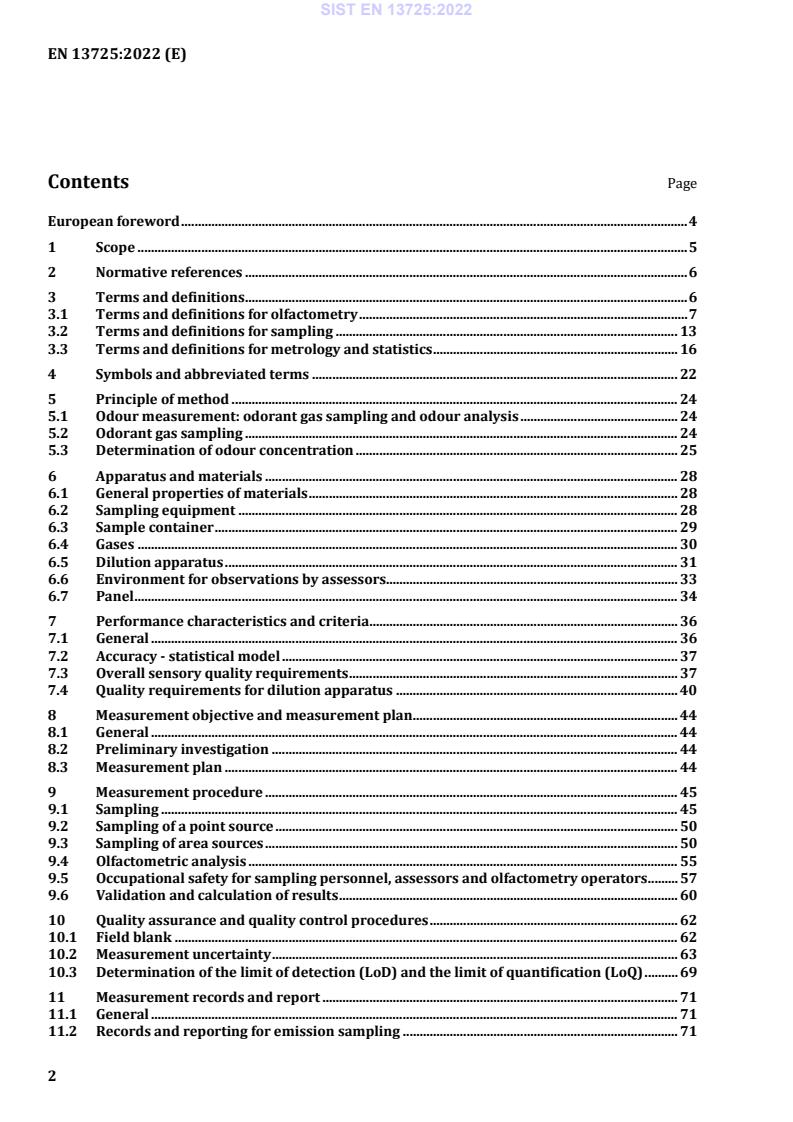
Contents Page
European foreword . 4
1 Scope . 5
2 Normative references . 6
3 Terms and definitions . 6
3.1 Terms and definitions for olfactometry . 7
3.2 Terms and definitions for sampling . 13
3.3 Terms and definitions for metrology and statistics . 16
4 Symbols and abbreviated terms . 22
5 Principle of method . 24
5.1 Odour measurement: odorant gas sampling and odour analysis . 24
5.2 Odorant gas sampling . 24
5.3 Determination of odour concentration . 25
6 Apparatus and materials . 28
6.1 General properties of materials . 28
6.2 Sampling equipment . 28
6.3 Sample container . 29
6.4 Gases . 30
6.5 Dilution apparatus . 31
6.6 Environment for observations by assessors. 33
6.7 Panel . 34
7 Performance characteristics and criteria . 36
7.1 General . 36
7.2 Accuracy - statistical model . 37
7.3 Overall sensory quality requirements . 37
7.4 Quality requirements for dilution apparatus . 40
8 Measurement objective and measurement plan . 44
8.1 General . 44
8.2 Preliminary investigation . 44
8.3 Measurement plan . 44
9 Measurement procedure . 45
9.1 Sampling . 45
9.2 Sampling of a point source . 50
9.3 Sampling of area sources . 50
9.4 Olfactometric analysis . 55
9.5 Occupational safety for sampling personnel, assessors and olfactometry operators . 57
9.6 Validation and calculation of results . 60
10 Quality assurance and quality control procedures . 62
10.1 Field blank . 62
10.2 Measurement uncertainty . 63
10.3 Determination of the limit of detection (LoD) and the limit of quantification (LoQ) . 69
11 Measurement records and report . 71
11.1 General . 71
11.2 Records and reporting for emission sampling . 71
11.3 Records and reporting for odour concentration measurement . 72
Annex A (informative) Physiological principles . 74
Annex B (informative) Example of calculation of instrumental accuracy and instability . 78
Annex C (informative) Example of calculation of odour measurements within one laboratory. 81
Annex D (informative) Example of calculations for panel selection . 83
Annex E (informative) Example of the calculation of the odour concentration from a set of
panel member responses . 85
Annex F (informative) Example of the calculation used to determine the number of odour
concentration measurements required to achieve a defined precision . 89
Annex G (informative) Example of the calculation used to determine the number of odour
concentration measurements required to determine a difference between two means . 91
Annex H (informative) Example of the calculation of the odour flow rate (standard
conditions) for a wet emission . 94
Annex I (informative) Example of the calculation of an SROM value for a new defined
odorant from an EROM comparison . 95
Annex J (informative) Example of the calculation of measurement uncertainty . 105
Annex K (informative) Dynamic dilution apparatus for sampling . 113
Annex L (informative) Considerations for the interpretation of the odour concentration
concept for air quality management . 116
Annex M (informative) Sampling of passive area sources . 117
Annex N (informative) Significant technical changes . 119
Bibliography . 123
European foreword
This document (EN 13725:2022) has been prepared by Technical Committee CEN/TC 264 “Air quality”,
the secretariat of which is held by DIN.
This European Standard shall be given the status of a national standard, either by publication of an identical
text or by endorsement, at the latest by August 2022, and conflicting national standards shall be withdrawn
at the latest by August 2022.
Attention is drawn to the possibility that some of the elements of this document may be the subject of
patent rights. CEN shall not be held responsible for identifying any or all such patent rights.
This document supersedes EN 13725:2003. The methods defined in the first edition and its associated
quality criteria have been validated in numerous proficiency tests.
The main changes in this revision relative to the first edition EN 13725:2003 are listed in informative
Annex N.
Annexes A, B, C, D, E, F, G, H, I, J, K, L, M and N are all informative.
Any feedback and questions on this document should be directed to the users’ national standards body. A
complete listing of these bodies can be found on the CEN website.
According to the CEN-CENELEC Internal Regulations, the national standards organisations of the following
countries are bound to implement this European Standard: Austria, Belgium, Bulgaria, Croatia, Cyprus,
Czech Republic, Denmark, Estonia, Finland, France, Germany, Greece, Hungary, Iceland, Ireland, Italy,
Latvia, Lithuania, Luxembourg, Malta, Netherlands, Norway, Poland, Portugal, Republic of North
Macedonia, Romania, Serbia, Slovakia, Slovenia, Spain, Sweden, Switzerland, Turkey and the United
Kingdom.
1 Scope
This document specifies an objective method for the determination of the odour concentration of a gaseous
sample using dynamic olfactometry with human assessors. The document also specifies a method for the
determination of the odour emission rate from stationary sources, in particular:
a) point sources (conveyed or ducted emissions);
b) active area sources (e.g. biofilters).
The primary application of this document is to provide a common basis for evaluation of odour emissions.
When this document is used for the determination of the odour concentration or the odour emission rate
of stationary source emissions, the other relevant European Standards concerning stationary source
emissions apply, in particular EN 15259 and EN ISO 16911-1, especially when measurements have to
comply with the relevant European Directives concerning industrial air emissions.
Even so, the analysis/quantification step of the measurement method described in this document (i.e. the
determination of the odour concentration of an odorous gas sample, without respect to the origin of the
sample itself) may be fully applied in many cases not related with industrial emission sources (e.g. the
measurement of the mass concentration at the detection threshold of odorant substances, the
determination of effectiveness of deodorising systems for indoor air). In those latter cases, the
requirements in this document concerning the measurement planning and the sampling of stationary
sources may be ignored or adapted.
This document is applicable to the measurement of odour concentration of odorous gas, mixtures of
odorants of defined composition and undefined mixtures of odorants in air or nitrogen, using dynamic
olfactometry with a panel of human assessors being the sensor. The unit of measurement is the European
odour unit per cubic metre: ou /m . The odour concentration is measured by determining the dilution
E
factor required to reach the detection threshold. The odour concentration at the detection threshold is by
definition 1 ou /m . The odour concentration is then expressed in terms of multiples of the detection
E
1 3 7 3
threshold. The range of measurement is typically from 10 ou /m to 10 ou /m (including pre-dilution).
E E
The field of application of this document includes:
1) the measurement of the mass concentration at the detection threshold of odorants in g/m ;
2) the determination of the SROM value of secondary reference odorant gas, in mol;
3) the measurement of the odour concentration of mixtures of odorants in ou /m ;
E
4) the measurement of the odour emission rate from point sources and active area sources, including pre-
dilution during sampling;
5) the sampling of odorous gases from emissions of high humidity and temperature (up to 200 °C);
6) the determination of effectiveness of mitigation techniques used to reduce odour emissions.
The determination of odour emissions requires measurement of gas velocity to determine the volume
flow rate.
The field of application of this document does not include:
i. the measurement of odours potentially released by particles of odorous solids or droplets of odorous
fluids suspended in emissions;
ii. the measuring strategy to be applied in case of variable emission rates;
iii. subjective methods for the sensory measurement of the relationship between odour stimulus and
assessor response above detection threshold (perceived intensity);
iv. subjective methods for the sensory measurement of hedonic tone (or (un)pleasantness) or assessment
of annoyance potential;
v. direct measurement of odour exposure in ambient air. For this measurement purpose field panel
methods exist which are the subject of EN 16841-1;
vi. direct olfactometry, including field olfactometry;
vii. static olfactometry;
viii. measurement of the odour identification (recognition) threshold;
ix. the determination of odour emission rate from volume sources, such as fugitive emissions from
buildings;
x. the determination of odour emission rate from passive area sources.
Although the ultimate application of odour concentration measurement is aimed at reducing odour
nuisance, the relation between emissions, dispersion, exposure and annoyance is not within the scope of
this document. The relation between measured odour concentrations and odour emissions according to
this standard and the occurrence of odour nuisance is highly complex. It is profoundly influenced by the
atmospheric processes determining the dispersion of odours, the quality of the odour (hedonic tone) and
finally by the receptor characteristics of those exposed to the odour. These receptor characteristics not
only vary strongly between individuals, but also in time within one individual.
2 Normative references
The following documents are referred to in the text in such a way that some or all of their content
constitutes requirements of this document. For dated references, only the edition cited applies. For
undated references, the latest edition of the referenced document (including any amendments) applies.
EN 15259:2007, Air quality — Measurement of stationary source emissions — Requirements for
measurement sections and sites and for the measurement objective, plan and report
EN ISO 16911-1, Stationary source emissions — Manual and automatic determination of velocity and volume
flow rate in ducts — Part 1: Manual reference method (ISO 16911-1)
EN ISO 20988:2007, Air quality — Guidelines for estimating measurement uncertainty (ISO 20988:2007)
3 Terms and definitions
For the purposes of this document, the following terms and definitions apply.
ISO and IEC maintain terminological databases for use in standardization at the following addresses:
• ISO Online browsing platform: available at https://www.iso.org/obp
• IEC Electropedia: available at https://www.electropedia.org/
The terms and definitions are categorized in:
1) terms and definitions for olfactometry;
2) terms and definitions for sampling;
3) term and definitions for metrology and statistics.
3.1 Terms and definitions for olfactometry
3.1.1
anosmia
lack of sensitivity to olfactory stimuli
[SOURCE: EN ISO 5492:2009, 2.32]
3.1.2
assessor
somebody who participates in odour testing
Note 1 to entry: See also 3.1.41.
3.1.3
delayed olfactometry
measurement of an odour concentration with a time-lag between sampling and analysis
Note 1 to entry: The odour sample is preserved in an appropriate container.
3.1.4
detection threshold
odorant concentration which has a probability of 0,5 of being detected under
the conditions of the test
3.1.5
detection threshold
dilution factor at which the odorant gas has a probability of 0,5 of being
detected under the conditions of the test
3.1.6
dilution factor
ratio between the flow rate or volume after dilution and the flow rate or volume of the odorous gas
3.1.7
dilution series
presentation of a sequence of dilutions to one assessor in order to obtain one Individual Threshold
Estimate
Note 1 to entry: See Figure 1.
3.1.8
direct olfactometry
on-line olfactometry
measurement of odour concentrations without any time-lag between the sampling (operation) and the
analysis
3.1.9
dynamic dilution
dilution achieved by mixing two known flows of gas, odorous sample and neutral gas, respectively
Note 1 to entry: The dilution factor can be determined from the flow rates.
3.1.10
dynamic olfactometer
apparatus that delivers a flow of mixtures of odorous and neutral gas with known dilution factors in a
common outlet
3.1.11
dynamic olfactometry
olfactometry using a dynamic olfactometer
3.1.12
European odour unit
amount of odorant(s) that, when evaporated into one cubic metre of neutral gas at standard conditions,
elicits a physiological response from a panel (detection threshold) equivalent to that elicited by one
European Reference Odour Mass (EROM), evaporated in 1 m of neutral gas at standard conditions
3.1.13
European Reference Odour Mass
EROM
conventional quantity value for the European odour unit, equal to a defined mass of reference odorant
Note 1 to entry: The primary reference odorant is n-butanol (CAS-Nr. 71-36-3). The conventional quantity value
for 1 EROM is 123 μg n-butanol. Evaporated in 1 m of neutral gas this produces a concentration of 0,040 μmol/mol.
3.1.14
forced-choice method
procedure in which the response “no difference” is not permitted
[SOURCE: EN ISO 5492:2009/A1:2017, 4.58]
3.1.15
individual threshold
detection threshold applying to an individual
3.1.16
individual threshold estimate
ITE
detection threshold applying to an individual estimated on the basis of one dilution series
3.1.17
instrumental dilution range
range between the minimum and maximum dilution factors
3.1.18
intensity
magnitude of the perceived sensation
[SOURCE: EN ISO 5492:2009, 2.8]
3.1.19
maximum dilution factor
highest settable dilution factor of the olfactometer
3.1.20
measurement report
report established by the testing laboratory according to the customer request and containing at least the
information required in the standards applied in the measurements programme, in particular this
document
[SOURCE: EN 15259:2007, 3.22]
3.1.21
measuring range
odour concentrations which can be measured by a specific olfactometer
Note 1 to entry: The theoretical measuring range depends on the minimum and maximum dilution factor and the
step factor. The numerical values defining the theoretical measuring range are the minimum dilution factor multiplied
with the step factor to the power 1,5 and the maximum dilution factor divided by the step factor to the power 1,5.
3.1.22
minimum dilution factor
lowest settable dilution factor of the olfactometer
3.1.23
neutral gas
odourless gas
air or nitrogen that is treated in such a way that it is as odourless as technically possible and that does,
according to panel members, not interfere with the odour under investigation
3.1.24
objective method
method in which the effects of personal opinions are minimized
[SOURCE: EN ISO 5492:2009, 4.1]
3.1.25
odorant
substance which, when volatilised in neutral gas, has the potential to stimulate the human olfactory system
so that an odour is perceived
3.1.26
odorant gas
gas that contains one or more odorants
Note 1 to entry: The odour concentration of a generic odorant gas can be greater or lower than 1 ou /m , i.e. the
E
odorants in the gas can or cannot cause an odour for human olfactory assessors.
3.1.27
odorous gas
odorant gas having an odour concentration greater than 1 ou /m
E
3.1.28
odour
sensation perceived by means of the olfactory organ in sniffing certain volatile substances
[SOURCE: EN ISO 5492:2009, 3.18]
3.1.29
odour abatement efficiency
reduction of the odour flow rate due to an abatement technique, expressed as a fraction (or percentage) of
the odour flow rate of the untreated gas stream
Note 1 to entry: Reduction of the odour concentration does not imply a proportional reduction of the perceived
odour intensity.
3.1.30
odour concentration
number of European odour units in a cubic metre of gas at standard conditions for olfactometry
3.1.31
odour detection
awareness of the sensation resulting from adequate stimulation of the olfactory system
3.1.32
odour panel
panel
group of panel members
3.1.33
odour unit
amount of (a mixture of) odorants present in one cubic metre of odorant gas (under standard conditions
for olfactometry) at the panel threshold
Note 1 to entry: This definition is different from that of the European odour unit, in that only the latter is traceable
to a known odorant mass, defined as the EROM.
3.1.34
olfactometer
apparatus in which a sample of odorant gas is diluted with neutral gas in a defined ratio and presented to
assessors
3.1.35
olfactometric analysis of one odorous gas sample
odour concentration measurement
presentation to all panel members of those dilution series necessary to produce sufficient data to calculate
the odour concentration for one sample
Note 1 to entry: See Figure 1.
3.1.36
olfactometry
measurement of the odour concentration of an odorous gas sample by sensory analysis
Note 1 to entry: This definition is specific for use within the scope of this standard.
3.1.37
olfactometry operator
person directly involved in operating the olfactometer and instructing the panel in olfactometry
3.1.38
olfactory
pertaining to the sense of smell
[SOURCE: EN ISO 5492:2009, 2.14]
3.1.39
olfactory receptor
specific part of the olfactory system which responds to one or several odorants
[SOURCE: EN ISO 5492:2009, 2.1, modified - general definition pertaining to sense organs adapted to be
specifically applicable to olfaction]
3.1.40
olfactory stimulus
that which excites an olfactory receptor
[SOURCE: EN ISO 5492:2009, 2.2, modified – general definition adapted to be specifically applicable to
olfaction]
3.1.41
panel member
assessor who is qualified to judge samples of odorous gas using dynamic olfactometry
3.1.42
panel screening
procedure to determine if the performance of panel members is in compliance with criteria
3.1.43
panel selection
procedure to determine which assessors are qualified as panel members
3.1.44
panel session
session with a series of odour concentration measurements on a day, interrupted by short breaks only,
with one panel composition
3.1.45
panel threshold
odour threshold
odour detection threshold applying to a panel
3.1.46
perception
awareness of the effects of single or multiple sensory stimuli
[SOURCE: EN ISO 5492:2009, 2.3]
3.1.47
presentation
presentation of one dilution to one assessor
Note 1 to entry: See Figure 1.
3.1.48
presentation series
presentation of one dilution to all assessors in one round
Note 1 to entry: See Figure 1.
3.1.49
presented gas flow
gas flow produced by the olfactometer and presented to the assessor
EXAMPLE 1 a diluted odorant gas sample
EXAMPLE 2 neutral gas
3.1.50
round
presentation of one dilution series to all assessors
Note 1 to entry: See Figure 1.
3.1.51
secondary reference odour mass
SROM
quantity value of mass of odorant with an olfactory stimulus quantity equivalent to the stimulus quantity
of the European Reference Odour Mass (EROM)
Note 1 to entry: For each odorant a specific SROM quantity, equivalent to the olfactory stimulus elicited by the
EROM, can be determined, according to the procedure in 5.3.2. If an SROM quantity has been established for an
odorant, it can serve as a secondary reference odorant gas.
3.1.52
sensory adaptation
temporary modification of the sensitivity of a sense organ due to continued and/or repeated stimulation
[SOURCE: EN ISO 5492:2009, 2.6]
3.1.53
sensory reference
presented gas flow to which the diluted sample is compared
3.1.54
smell (verb)
to perceive or to attempt to perceive an odour
[SOURCE: EN ISO 5492:2009, 2.15]
3.1.55
step factor
factor by which a dilution factor in a dilution series differs from adjacent dilutions
3.1.56
subjective method
method based on personal opinions
[SOURCE: EN ISO 5492:2009, 4.2, modified by removing the word ‘any’]
3.1.57
test
technical operation that consists of the determination of one or more characteristics of a given product,
process or service according to a specified procedure
Note 1 to entry: For emission measurements, a test consists of serie(s) of measurements of one measurand or of
combined measurements of several measurands.
[SOURCE: CEN/TS 15674:2007, A.2.1]
3.1.58
yes/no method
olfactometric method in which assessors are asked to judge whether an odour is detected or not
3.2 Terms and definitions for sampling
3.2.1
active area source
area source with defined dimensions which has a defined volume flow rate
EXAMPLE open biofilters
3.2.2
ambient air
outdoor air to which people, plants, animals or material may be exposed
[SOURCE: ISO 4225:2020, 3.6]
3.2.3
composite sample
sample from sampling planes or area sources comprising several sampling points that contains waste gas
from several or all sampling points
3.2.4
compound
substance composed of two or more atoms chemically bonded in definite proportions
[SOURCE: ISO 817:2014, 3.1.11]
3.2.5
field blank procedure
procedure used to ensure that no significant contamination occurred during all the steps of the
measurement
Note 1 to entry: This includes for instance the equipment preparation in laboratory, its transport and installation
in the field as well as the subsequent analytical work in the laboratory.
[SOURCE: CEN/TS 15674:2007, Annex A]
3.2.6
field blank value
result of a measurement performed according to the field blank procedure at the plant site and in the
laboratory in an identical manner to the normal measurements in the series, except that no flue gas is
sampled during the duration of the field blank
[SOURCE: CEN/TS 15674:2007, Annex A]
3.2.7
fugitive emission
emission to the atmosphere caused by leakage of an item which is designed to be sealed
EXAMPLE 1 valve and flange leakage
EXAMPLE 2 passive ventilation apertures, leakage through building cladding
[SOURCE: EN 15446:2008, 3.1, modified - examples added, loss of tightness replaced by leakage, tight
replaced by sealed]
3.2.8
odour emission rate
odour flow rate
quantity of European odour units which crosses a given surface per unit of time
Note 1 to entry: For point sources, the surface is the sampling plane. The odour flow rate is calculated as the
product of the odour concentration c , the outlet velocity v and the area of the sampling plane A or as the product of
od
the odour concentration c and the pertinent volume flow rate V
od
Note 2 to entry: The unit of odour flow rate is ou /s (or ou /min or ou /h).
E E E
Note 3 to entry: The odour flow rate, expressed in ou /s, is the quantity equivalent to the mass flow rate, expressed
E
in kg/s, as used in dispersion models for example.
3.2.9
odorant gas sample
odorous gas sample
sample
amount of gas which is assumed to be representative of the gas mass or gas flow under investigation, and
which is examined for odour concentration
3.2.10
passive area source
source with defined dimensions which does not have a controlled or controllable volume flow rate
EXAMPLE 1 waste landfills
EXAMPLE 2 lagoons
EXAMPLE 3 fields after manure spreading
EXAMPLE 4 unaerated compost piles
3.2.11
point source
discrete stationary source releasing waste gas to atmosphere via ducts of defined dimension, with a
controlled or controllable volume flow rate
EXAMPLE 1 stacks
EXAMPLE 2 vents
3.2.12
sampling duration
period of time over which the sample is taken
[SOURCE: EN 15259:2007, 3.25]
3.2.13
sampling plane
plane normal to the centreline of the duct at the sampling position
[SOURCE: EN 15259:2007, 3.13, modified - measurement plane modified in sampling plane]
3.2.14
sampling point
position in the sampling plane at which the sample stream is extracted or the measurement data are
obtained directly
[SOURCE: EN 15259:2007, 3.16, modified – measurement point modified in sampling point]
3.2.15
sampling port
measurement port
access port
opening in the waste gas duct through which access to the waste gas is gained
[SOURCE: EN 15259:2007, 3.18]
3.2.16
sampling section
region of the waste gas duct which includes the sampling plane(s) and the inlet and outlet sections
[SOURCE: EN 15259:2007, 3.12, modified – measurement section modified in sampling section]
3.2.17
sampling site
measurement site
place on the waste gas duct in the area of the sampling plane(s) consisting of structures and technical
equipment
EXAMPLE 1 Typically includes working platforms, sampling ports, energy supply.
[SOURCE: EN 15259:2007, 3.11, modified – measurement site modified in sampling site]
3.2.18
standard conditions for olfactometry
reference conditions for calculating the odour flow rate or concentration, at a temperature of 293 K and a
normal atmospheric pressure of 101,3 kPa on a wet basis
Note 1 to entry: This applies both to olfactometric measurements and volume flow rates of emissions. The
conditions were chosen by convention, to reflect typical conditions for smell perception. This implies that odour
concentration values measured by olfactometry are in practice not corrected to standard conditions.
3.2.19
static dilution
dilution achieved by mixing two known volumes of an odorous gas sample and neutral gas, respectively
3.2.20
stationary source
fixed position industrial process from which emissions to atmosphere are made
[SOURCE: CEN/TS 15674:2007, A.3.1]
3.2.21
substance
chemical substance
matter of constant composition best characterized by the entities (molecules, formula units, atoms) it is
composed of. Physical properties such as density, refractive index, electric conductivity, melting point etc.
characterize the chemical substance
[SOURCE: IUPAC. Compendium of Chemical Terminology, 2nd ed.]
3.2.22
waste gas
odorant gas emitted from stationary sources
Note 1 to entry: This definition applies within the scope of this document.
Note 2 to entry: For the application of some procedures in the present standard (e.g. the determination of odour
abatement efficiency) waste gas also includes gas flows upstream, e.g. entering a treatment equipment).
3.3 Terms and definitions for metrology and statistics
3.3.1
analytical recovery
ratio of the mass of analyte measured when a sample is analysed to the known mass of analyte in that
sample, expressed as a percentage
Note 1 to entry: The overall recovery for odour measurements (including sampling and analysis) is calculated as
the ratio of the concentration of an odorant in the presented gas flow to the concentration of the same odorant in the
waste gas under test divided by the applied dilution factor.
Note 2 to entry: A recovery less than 100 % can result from, for example, diffusion through sampling bag, physical
or chemical interaction between sample components and sampling materials, adsorption in sampling equipments,
adsorption in the olfactometer.
Note 3 to entry: The recovery is, in general, specific for a particular odorant.
[SOURCE: ISO 21438-2:2009, 3.5.1, modified- notes added]
3.3.2
certified reference material
CRM
reference material, accompanied by documentation issued by an authoritative body and providing one or
more specified property values with associated uncertainties and traceabilities, using valid procedures
[SOURCE: ISO/IEC Guide 99:2007, 5.14]
3.3.3
conventional quantity value
quantity value attributed by agreement to a quantity for a given purpose
[SOURCE: ISO/IEC Guide 99:2007, 2.12, modified – notes and example are omitted]
3.3.4
expanded uncertainty
quantity defining an interval about the result of a measurement that may be expected to encompass a large
fraction of the distribution of values that could reasonably be attributed to the measurand
[SOURCE: ISO/IEC Guide 98-3:2008, 2.3.5, modified – notes are omitted]
3.3.5
expected value
value approached by the average value with an increasing number of measurement values.
3.3.6
geometric mean
n
yy⋅ ⋅…⋅ y
antilog of the arithmetic average of the logarithms of a set of values or
1 2 n
Note 1 to entry: The formula contains an n-root (not to be confused with a square root).
3.3.7
instability
change in the measured signal comprised of drift and dispersion over a stated maintenance interval
Note 1 to entry: Drift and dispersion specify the monotonic and stochastic change with time of the measured signal,
respectively.
[SOURCE: EN 14181:2014, 3.25]
3.3.8
interlaboratory comparison
organization, performance and evaluation of measurements or tests on the same or similar items by two
or more laboratories in accordance with predetermined conditions
[SOURCE: EN ISO/IEC 17043:2010, 3.4]
3.3.9
instrumental response time
duration between the instant when an input quantity value of a dilution
apparatus is subjected to an abrupt change between two specified constant quantity values and the instant
when a corresponding indication settles within specified limits around its final steady value
[SOURCE: JCGM 200:2012, 4,23, Modified by replacing “a measuring instrument or measuring system” with
“dilution apparatus” and defining the scope]
3.3.10
intermediate precision condition of measurement
intermediate precision condition
condition of measurement, out of a set of conditions that includes the same measurement procedure, same
location, and replicate measurements on the same or similar objects over an extended period of time but
may include other conditions involving changes
Note 1 to entry: The changes can include new calibrations, calibrators, operators, and measuring systems.
[SOURCE: ISO/IEC Guide 99:2007, 2.22, modified – notes 2 and 3 are omitted]
3.3.11
intermediate measurement precision
intermediate precision
measurement precision under a set of intermediate precision conditions of measurement
[SOURCE: ISO/IEC Guide 99:2007, 2.23, modified - notes are omitted]
3.3.12
limit of detection
LoD
odour concentration above which it can be affirmed with a stated level of confidence that the odorous gas
sample is different from neutral gas, under the conditions of the test
3.3.13
limit of quantification
LoQ
odour concentration above which the measurement result for the sample has a stated acceptable
uncertainty, under the conditions of the test
Note 1 to entry: The limit of quantification is always greater or equal to the limit of detection.
3.3.14
measurand
quantity intended to be measured
[SOURCE: ISO/IEC Guide 99:2007, 2.3, modified - notes are omitted]
3.3.15
measurement
process of experimentally obtaining one or more quantity values that can reasonably be attributed to a
quantity
[SOURCE: ISO/IEC Guide 99:2007, 2.1, modified – notes are omitted]
3.3.16
measurement accuracy
closeness of agreement between a measured quantity value and a true quantity value of a measurand
[SOURCE: ISO/IEC Guide 99:2007, 2.13, modified – notes are omitted]
3.3.17
measurement bias
estimate of a systematic measurement error
[SOURCE: ISO/IEC Guide 99:2007, 2.18]
3.3.18
measurement precision
closeness of agreement between indications or measured quantity values obtained by replicate
measurements on the same or similar objects under specified conditions
Note 1 to entry: Measurement precision is usually expressed numerically by measures of imprecision, such as
standard deviation, variance or coefficient of variation under the specified conditions of measurement.
Note 2 to entry: The specified conditions can be, for example, repeatability conditions of measurement,
intermediate precision conditions of measurement, or reproducibility conditions of measurement (see ISO 5725-2
[12]and ISO 5725−3 [13]).
Note 3 to entry: Measurement precision is used to define measurement repeatability, intermediate measurement
precision, and measurement reproducibility.
Note 4 to entry: Replicate measurements means measurements that are obtained in a manner not influenced by a
previous measurement on the same or similar sample.
[SOURCE: ISO/IEC Guide 99:2007, 2.15]
3.3.19
measurement repeatability
measurement precision under a set of repeatability conditions of measurement
[SOURCE: ISO/IEC Guide 99:2007, 2.21, modified – notes are omitted]
3.3.20
measurement reproducibility
measurement precision under reproducibility conditions of measurement
[SOURCE: ISO/IEC Guide 99:2007, 2.25 modified – note is omitted]
3.3.21
measurement result
set of quantity values being attributed to a measurand together with any other available relevant
information
[SOURCE: ISO/IEC Guide 99:2007, 2.9, modified – notes are omitted]
3.3.22
measurement trueness
closeness of agreement between the average of an infinite number of replicate measured quantity values
and a reference quantity value
Note 1 to entry: Measurement trueness is inversely related to systematic measurement error but is not related to
random measurement error.
[SOURCE: ISO/IEC Guide 99:2007, 2.14, modified – notes are omitted and note 1 is added]
3.3.23
metrological traceability
property of a measurement result whereby the result can be related to a reference through a documented
unbroken chain of calibrations, each contributing to the measurement uncertainty
[SOURCE: ISO/IEC Guide 99:2007, 2.41, modified – notes are omitted]
3.3.24
performance testing
determination of laboratory testing performance on reference materials against specified quality criteria
3.3.25
proficiency testing
evaluation of participant performance against pre-established criteria by means of interlaboratory
comparisons
[SOURCE: EN ISO/IEC 17043:2010, 3.7, modified - omitting the notes]
3.3.26
quality
degree to which a set of inherent characteristic
...