

EN 747-1:2024
(Main)Furniture - Bunk beds and high beds - Part 1: Safety, strength and durability requirements
General Information
- Abstract
This document specifies requirements for the safety, strength and durability of bunk beds and high beds for domestic and non-domestic use.
It is applicable to bunk beds and high beds with an internal length greater than 1 400 mm and a maximum bed base width of 1 200 mm, and with the upper surface of a bed base of 600 mm or more above the floor.
This document does not apply to bunk beds and high beds used for special purposes, including but not limited to prisons, the military and fire brigades.
If other products are included in a bunk bed/high bed, for example a table or storage furniture, the relevant European Standards could, in addition, apply.
The document contains one annex:
- Annex A (informative) - Rationales.
- Status
- Published
- Publication Date
- 12-Mar-2024
- Technical Committee
- CEN/TC 207 - Furniture
- Drafting Committee
- CEN/TC 207/WG 2 - Kitchen and bathroom furniture
- Current Stage
- 6060 - Definitive text made available (DAV) - Publishing
- Start Date
- 13-Mar-2024
- Due Date
- 03-May-2024
- Completion Date
- 13-Mar-2024

Overview
EN 747-1:2024 (CEN) defines the safety, strength and durability requirements for bunk beds and high beds for domestic and non‑domestic use. It applies to beds with an internal length > 1 400 mm, a maximum bed base width of 1 200 mm, and where the upper surface of the bed base is ≥ 600 mm above the floor. The standard excludes beds for special purposes (e.g., prisons, military, fire brigades). Annex A provides informative rationales and EN 747‑2:2024 contains the associated test methods.
Key topics and technical requirements
The standard sets out practical, measurable requirements to reduce risk and ensure long‑term performance:
- Construction and materials
- Rounded/chamfered accessible edges, no open‑ended tubes, secure fastenings; components must not be removable without tools.
- Dimensions and clearances
- Minimum clearance between upper and lower bed bases (example requirement included in the standard).
- Specific dimensional limits for safety barrier heights and access openings.
- Safety barriers and mattress marking
- Continuous safety barriers around upper beds with controlled exception openings to means of access.
- Minimum barrier height and requirement that mattress top sits a specified distance below the barrier; maximum mattress thickness must be marked.
- Means of access
- Requirements for ladders, stairs and platforms (treads, handrails and attachment strength).
- Accessible holes, gaps and entrapment
- Limits on gaps adjacent to side/end rails (e.g., 25 mm in defined zones), limits on completely bound openings, head‑entrapment templates and probe tests referenced to EN 747‑2.
- Ventilation and structural integrity
- Minimum bed‑base ventilation area (as stated in the standard) and requirements that bed bases and fastenings resist specified loads and deflections.
- Stability, fastening and durability
- Stability requirements and provisions for fastening higher beds to lower beds or building structure for non‑domestic use.
- Product information
- Marking, instructions for use and purchase information required to ensure safe assembly, use and selection.
Applications and users
Who uses EN 747‑1:2024:
- Manufacturers and product designers - for compliant design, material selection and labelling.
- Testing laboratories and conformity assessors - in conjunction with EN 747‑2:2024 test methods.
- Procurement officers and specifiers - to define safety performance in bids for schools, hostels, hotels and residential projects.
- Retailers, installers and safety regulators - to verify safe installation, user instructions and suitability for intended use.
Related standards
- EN 747‑2:2024 - Furniture - Bunk beds and high beds - Part 2: Test methods (complements EN 747‑1:2024).
Keywords: EN 747-1:2024, bunk beds, high beds, safety requirements, strength and durability, CEN, bed base, safety barriers, means of access, test methods.
Relations
- Effective Date
- 09-Feb-2022
- Effective Date
- 08-Apr-2026
- Effective Date
- 28-Jan-2026
- Effective Date
- 28-Jan-2026
- Effective Date
- 28-Jan-2026
Frequently Asked Questions
EN 747-1:2024 is a standard published by the European Committee for Standardization (CEN). Its full title is "Furniture - Bunk beds and high beds - Part 1: Safety, strength and durability requirements". This standard covers: This document specifies requirements for the safety, strength and durability of bunk beds and high beds for domestic and non-domestic use. It is applicable to bunk beds and high beds with an internal length greater than 1 400 mm and a maximum bed base width of 1 200 mm, and with the upper surface of a bed base of 600 mm or more above the floor. This document does not apply to bunk beds and high beds used for special purposes, including but not limited to prisons, the military and fire brigades. If other products are included in a bunk bed/high bed, for example a table or storage furniture, the relevant European Standards could, in addition, apply. The document contains one annex: - Annex A (informative) - Rationales.
This document specifies requirements for the safety, strength and durability of bunk beds and high beds for domestic and non-domestic use. It is applicable to bunk beds and high beds with an internal length greater than 1 400 mm and a maximum bed base width of 1 200 mm, and with the upper surface of a bed base of 600 mm or more above the floor. This document does not apply to bunk beds and high beds used for special purposes, including but not limited to prisons, the military and fire brigades. If other products are included in a bunk bed/high bed, for example a table or storage furniture, the relevant European Standards could, in addition, apply. The document contains one annex: - Annex A (informative) - Rationales.
EN 747-1:2024 is classified under the following ICS (International Classification for Standards) categories: 97.140 - Furniture. The ICS classification helps identify the subject area and facilitates finding related standards.
EN 747-1:2024 has the following relationships with other standards: It is inter standard links to EN 747-1:2012+A1:2015, EN 1647:2026, EN 1647:2018, EN 747-2:2024, EN 1647:2018+A1:2021. Understanding these relationships helps ensure you are using the most current and applicable version of the standard.
EN 747-1:2024 is available in PDF format for immediate download after purchase. The document can be added to your cart and obtained through the secure checkout process. Digital delivery ensures instant access to the complete standard document.
Standards Content (Sample)
SLOVENSKI STANDARD
01-junij-2024
Nadomešča:
SIST EN 747-1:2012+A1:2015
Pohištvo - Pogradi in visoke postelje - 1. del: Zahteve za varnost, trdnost in
trajnost
Furniture - Bunk beds and high beds - Part 1: Safety, strength and durability
requirements
Möbel - Etagenbetten und Hochbetten - Teil 1: Anforderungen an die Sicherheit,
Festigkeit und Dauerhaltbarkeit
Meubles - Lits superposés et lits surélevés - Partie 1: Exigences de sécurité, de
résistance et de durabilité
Ta slovenski standard je istoveten z: EN 747-1:2024
ICS:
97.140 Pohištvo Furniture
2003-01.Slovenski inštitut za standardizacijo. Razmnoževanje celote ali delov tega standarda ni dovoljeno.
EN 747-1
EUROPEAN STANDARD
NORME EUROPÉENNE
March 2024
EUROPÄISCHE NORM
ICS 97.140 Supersedes EN 747-1:2012+A1:2015
English Version
Furniture - Bunk beds and high beds - Part 1: Safety,
strength and durability requirements
Meubles - Lits superposés et lits surélevés - Partie 1: Möbel - Etagenbetten und Hochbetten - Teil 1:
Exigences de sécurité, de résistance et de durabilité Anforderungen an die Sicherheit, Festigkeit und
Dauerhaltbarkeit
This European Standard was approved by CEN on 12 February 2024.
CEN members are bound to comply with the CEN/CENELEC Internal Regulations which stipulate the conditions for giving this
European Standard the status of a national standard without any alteration. Up-to-date lists and bibliographical references
concerning such national standards may be obtained on application to the CEN-CENELEC Management Centre or to any CEN
member.
This European Standard exists in three official versions (English, French, German). A version in any other language made by
translation under the responsibility of a CEN member into its own language and notified to the CEN-CENELEC Management
Centre has the same status as the official versions.
CEN members are the national standards bodies of Austria, Belgium, Bulgaria, Croatia, Cyprus, Czech Republic, Denmark, Estonia,
Finland, France, Germany, Greece, Hungary, Iceland, Ireland, Italy, Latvia, Lithuania, Luxembourg, Malta, Netherlands, Norway,
Poland, Portugal, Republic of North Macedonia, Romania, Serbia, Slovakia, Slovenia, Spain, Sweden, Switzerland, Türkiye and
United Kingdom.
EUROPEAN COMMITTEE FOR STANDARDIZATION
COMITÉ EUROPÉEN DE NORMALISATION
EUROPÄISCHES KOMITEE FÜR NORMUNG
CEN-CENELEC Management Centre: Rue de la Science 23, B-1040 Brussels
© 2024 CEN All rights of exploitation in any form and by any means reserved Ref. No. EN 747-1:2024 E
worldwide for CEN national Members.
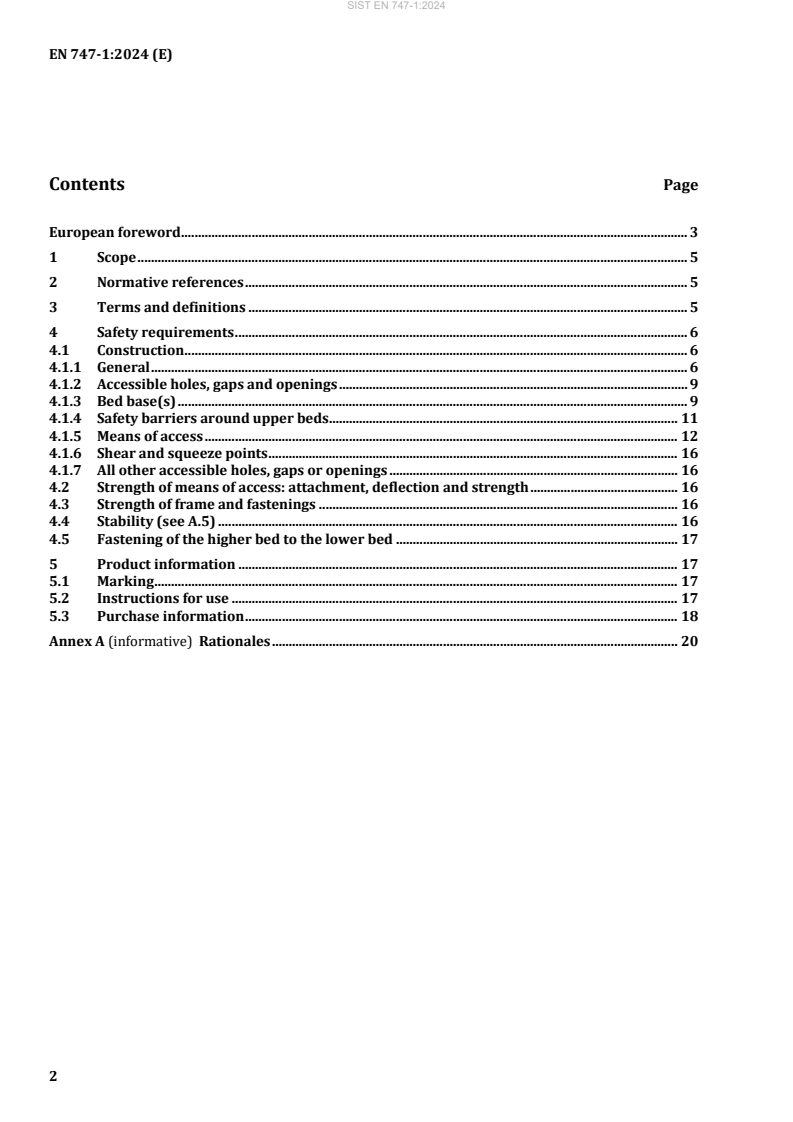
Contents Page
European foreword . 3
1 Scope . 5
2 Normative references . 5
3 Terms and definitions . 5
4 Safety requirements . 6
4.1 Construction . 6
4.1.1 General . 6
4.1.2 Accessible holes, gaps and openings . 9
4.1.3 Bed base(s) . 9
4.1.4 Safety barriers around upper beds . 11
4.1.5 Means of access . 12
4.1.6 Shear and squeeze points . 16
4.1.7 All other accessible holes, gaps or openings . 16
4.2 Strength of means of access: attachment, deflection and strength . 16
4.3 Strength of frame and fastenings . 16
4.4 Stability (see A.5) . 16
4.5 Fastening of the higher bed to the lower bed . 17
5 Product information . 17
5.1 Marking . 17
5.2 Instructions for use . 17
5.3 Purchase information . 18
Annex A (informative) Rationales . 20
European foreword
This document (EN 747-1:2024) has been prepared by Technical Committee CEN/TC 207 “Furniture”,
the secretariat of which is held by UNI.
This European Standard shall be given the status of a national standard, either by publication of an
identical text or by endorsement, at the latest by September 2024, and conflicting national standards shall
be withdrawn at the latest by September 2024.
Attention is drawn to the possibility that some of the elements of this document may be the subject of
patent rights. CEN shall not be held responsible for identifying any or all such patent rights.
This document supersedes EN 747-1:2012+A1:2015.
In comparison with the previous edition, the following technical modifications have been made:
— Standard was fully revised;
— Modification of the title;
— Specification of the scope;
— Terms and definitions of high bed, tread, completely bound opening, partially bound opening, upper
bed, means of access, and handrail added;
— Requirements for the materials improved;
— Requirements for vertically protruding parts added;
— Requirements for accessible holes, gaps and openings added;
— Requirements for bed base(s) given in more detail;
— Requirements for safety barriers around beds added;
— Requirements for means of access added;
— Requirements for shear and squeeze points added;
— Requirements for platform and stairs added;
— Requirements for all other accessible holes, gaps or openings added;
— Requirements for strength of means of access: Attachment, deflection and strength added;
— Requirements for strength of frame and fastenings given in more detail;
— Requirements for the stability given in more detail;
— Requirements for the instructions for use given in more detail;
— Requirements for the marking in more detail;
— Requirements for the purchase information added;
— Addition of informative Annex A.
EN 747 is divided into the following parts:
— EN 747-1, Furniture — Bunk beds and high beds — Part 1: Safety, strength and durability
requirements;
— EN 747-2, Furniture — Bunk beds and high beds — Part 2: Test methods.
Any feedback and questions on this document should be directed to the users’ national standards body.
A complete listing of these bodies can be found on the CEN website.
According to the CEN-CENELEC Internal Regulations, the national standards organisations of the
following countries are bound to implement this European Standard: Austria, Belgium, Bulgaria, Croatia,
Cyprus, Czech Republic, Denmark, Estonia, Finland, France, Germany, Greece, Hungary, Iceland, Ireland,
Italy, Latvia, Lithuania, Luxembourg, Malta, Netherlands, Norway, Poland, Portugal, Republic of North
Macedonia, Romania, Serbia, Slovakia, Slovenia, Spain, Sweden, Switzerland, Türkiye and the United
Kingdom.
1 Scope
This document specifies requirements for the safety, strength and durability of bunk beds and high beds
for domestic and non-domestic use.
It is applicable to bunk beds and high beds with an internal length greater than 1 400 mm and a maximum
bed base width of 1 200 mm, and with the upper surface of a bed base of 600 mm or more above the floor.
This document does not apply to bunk beds and high beds used for special purposes, including but not
limited to prisons, the military and fire brigades.
If other products are included in a bunk bed/high bed, for example a table or storage furniture, the
relevant European Standards could, in addition, apply.
The document contains one annex:
— Annex A (informative) – Rationales.
2 Normative references
The following documents are referred to in the text in such a way that some or all of their content
constitutes requirements of this document. For dated references, only the edition cited applies. For
undated references, the latest edition of the referenced document (including any amendments) applies.
EN 747-2:2024, Furniture — Bunk beds and high beds — Part 2: Test methods
3 Terms and definitions
For the purposes of this document, the following terms and definitions apply.
ISO and IEC maintain terminology databases for use in standardization at the following addresses:
— IEC Electropedia: available at https://www.electropedia.org/
— ISO Online browsing platform: available at https://www.iso.org/obp
3.1
bunk bed
two beds, one above the other, where the upper surface of one bed base (3.4) is 600 mm or more above
the floor
3.2
high bed
bed, where the upper surface of the bed base (3.4) is 600 mm or more above the floor, irrespective of the
use to which the space below is put
3.3
bed end structure
upright unit at the head and foot of the bed to which the side rails (3.6) are attached
3.4
bed base
support structure for a mattress
3.5
safety barrier
component intended to prevent an occupant falling from an upper bed (3.10)
3.6
side and end rail
member attached to the bed side or end structures (3.3) by which the bed base (3.4) can be supported
3.7
tread
structure intended as a foothold
3.8
completely bound opening
opening that is continuously surrounded
3.9
partially bound opening
opening that is partially surrounded
3.10
upper bed
bed for which the upper surface of its bed base (3.4) is 600 mm or more above the floor
3.11
means of access
ladder(s) or stairs to facilitate access to and egress from an upper bed (3.10) or an access platform
3.12
handrail
rail or another component intended to assist the user to balance
4 Safety requirements
4.1 Construction
4.1.1 General
When the bed is fully assembled, accessible edges and corners shall be rounded or chamfered and free
from burrs or sharp edges.
There shall be no open-ended tubes.
All assembly and pilot holes shall be made by the manufacturer.
There shall be no clothes hooks or similar items more than 600 mm from the floor.
If the lowest point of the vertically protruding parts are above 600 mm from the floor, they shall either
a) have an uninterrupted minimum horizontal dimension of 300 mm in at least one direction without
any other vertical protrusion (see Figure 1 a), or
b) have an uninterrupted vertical dimension of at least 600 mm measured from the highest adjacent
part (see Figure 1 b), or
c) where the largest dimension is 50 mm or more (see Figure 1), have a maximum height at which a
line, drawn at 45° touches it, of not more than 5 mm above at least one adjacent/adjoining horizontal
component; the maximum vertical protrusion above that component shall not exceed 20 % of the
largest horizontal dimension of parts (see Figure 1 c), or
d) where the largest dimension is less than 50 mm, have a maximum height at which a line, drawn at
45° touches it, of not more than 5 mm above at least one adjacent/adjoining horizontal component;
the maximum vertical protrusion above that component shall not exceed 10 mm (see Figure 1) of
parts (see Figure 1 d).
It shall not be possible to dismantle the bed or its components without the use of a tool.
The dimensional requirements in this clause apply both before and after testing without re-tightening.
Dimensions in millimetres
Key
1 vertically protruding part
2 highest adjacent part
w width of protruding part
H height of protruding part
V 45° angle to the horizontal
Figure 1 — Examples of a vertically protruding part
4.1.2 Accessible holes, gaps and openings
4.1.2.1 General
There shall be no accessible completely bound openings in rigid material with a diameter/width greater
than 7 mm and less than 12 mm, unless the depth is less than 10 mm or unless the shape assessment
probe (EN 747-2:2024, 5.2.2) enters when tested according to 6.3.1 of EN 747-2:2024.
Additionally, accessible completely bound openings in bed bases, safety barriers, and treads shall fulfil the
requirements specified in the respective clauses, i.e. 4.1.3, 4.1.4 and 4.1.5.
4.1.2.2 Head entrapment on the outside of the bunk bed/high bed
The following requirements apply only to openings where the lowest part is 600 mm or more from the
floor.
Partially bound openings, and V and irregular shaped openings shall be constructed so that:
a) portion B of the template shall not enter the opening to the full thickness of the template when tested
according to 6.3.2 of EN 747-2:2024; or
b) the apex of portion A of the template shall contact the base of the opening when tested according to
6.3.2 of EN 747-2:2024.
4.1.3 Bed base(s)
4.1.3.1 Dimensional requirements
For bunk beds, the distance between the upper surface of the bed base of the lower bed and any part of
the underside of the bed base of the top bed shall be at least 750 mm.
4.1.3.2 Gaps and openings (see A.2)
Gaps adjacent to the inner surfaces of the side and end rails (see Figure 2) shall be less than 25 mm.
For beds where the bed base is an independent component, which is fitted between the side and end rails,
the gap between the base and the side and end rails, shall be less than 25 mm when tested according to
6.3.1 of EN 747-2:2024.
Key
1 bed frame (side and end rails)
2 bed base (slat)
3 gaps between bed base and bed frame
Figure 2 — Illustration of zone in which 25 mm gaps are not permitted
For beds, where the side and/or end rails are an integral part of the bed base, e.g. where slats are mounted
directly into the side/and or end rails, or where a slatted bed base is supported by a load bearing
component fixed to the side and/or end rails, there shall be no gaps greater than 25 mm directly adjacent
to the side and end rails. These designs shall be tested according to 6.3.1 of EN 747-2:2024.
All gaps between bed base components, (e.g. slats, mesh) shall not exceed 75 mm when measured
according to 6.3.1 of EN 747-2:2024.
4.1.3.3 Ventilation (see A.3)
The bed base shall allow ventilation.
This requirement is fulfilled if there is a minimum ventilation area of 35 cm distributed across the bed
base (e.g. 8 holes with a diameter of 24 mm in a solid bed base, gaps between slats). The ventilation shall
be in more than one location. The openings shall fulfil the requirements in 4.1.2.
4.1.3.4 Structural integrity
The bed shall have means (e.g. fastening) of preventing the side rails from bending outwards. This
requirement is fulfilled if the bed base(s) and/or its elements do not break or become detached when
tested with the horizontal outwards force according to 6.4.3 of EN 747-2:2024.
When tested according to 6.4.2.1, 6.4.2.2 and 6.4.2.3 of EN 747-2:2024, the bed base and/or its elements
shall not break or become detached.
4.1.4 S
...