

prEN 115
(Main)Safety rules for the construction and installation of escalators and moving walks
General Information
- Abstract
1.1 This standard is applicable for new escalators and moving walks (pallet or belt type) as defined in clause 3.
This standard deals with all significant hazards, hazardous situations and events relevant to escalators and moving walks when they are used as intended and under conditions of misuse which are reasonably foreseeable by the manufacturer (see clause 4).
1.2 Existing escalators and moving walks are not subject to this standard. It is, however, recommended that they be adapted to this standard.
This document is not applicable to escalators and moving walks which are manufactured before the date of its publication as EN.
1.3 If some dimensions of this standard cannot be kept due to structural conditions in existing buildings, it has to be defined in the individual case which alternative requirements are necessary.
NOTE In addition, see information for use.
- Status
- Not Published
- Technical Committee
- CEN/TC 10 - Passenger, goods and service lifts
- Drafting Committee
- CEN/TC 10/WG 2 - Escalators and passenger conveyors
- Current Stage
- 4097 - End of interruption of work - split/merged
- Start Date
- 28-Oct-2005
- Completion Date
- 23-Sep-2026
- Directive
- 98/37/EC - Machinery

Overview
prEN 115, developed by CEN, establishes safety rules for the construction and installation of escalators and moving walks. This standard applies exclusively to new escalators and moving walks-whether pallet or belt type-addressing all significant hazards, hazardous situations, and events relevant to their use, including reasonably foreseeable misuse. While not mandatory for existing equipment, it is recommended that older escalators and moving walks be adapted to this updated standard to improve safety compliance.
By providing detailed safety requirements and protective measures, prEN 115 serves as a crucial framework for manufacturers, installers, and safety professionals. The scope includes the entire lifecycle from installation through operation, maintenance, and inspection. Importantly, this standard replaces the earlier EN 115:1995 and incorporates a risk assessment methodology aligned with ISO standards to reflect the current state of the art in escalator and moving walk safety.
Key Topics
Scope and Application
Applicable only to new escalators and moving walks; existing machines are recommended but not mandated for adaptation. Variances due to building constraints must be managed with alternative safety requirements.Hazard Assessment
Comprehensive identification and analysis of significant hazards associated with escalators and moving walks, including misuse that manufacturers can reasonably foresee.Safety Requirements and Protective Measures
Normative guidelines covering mechanical design, electrical safety, braking systems, handrails, skirting, and balustrades. Protective measures address risks such as trapping, slipping, and mechanical failures.Safety Circuits and Fail-Safe Systems
Specifications for electrical control and fail-safe circuits ensuring operational reliability and emergency response capabilities.Verification and Testing
Procedures for verifying that safety requirements are met, including functional tests and inspections during installation and maintenance.Information for Use
Instructions and signage requirements designed to educate users on safe operation and to reduce accident risk.Normative Annexes
Detailed technical information such as building interface conditions, electronic component failure exclusions, safety sign design, and guidelines for escalators designed for shopping trolleys.Terminology and Definitions
Clear definitions of terms such as nominal speed, rated load, balustrade components, comb plates, and stand-by operation to ensure consistent application.
Applications
Escalator and Moving Walk Installation
Ensures proper construction and installation practices that meet stringent safety criteria, reducing accident risks during use in public and private buildings such as shopping malls, airports, transit stations, and office complexes.Risk Management in Engineering
Assists designers and manufacturers in integrating risk assessment principles into the safety design, leading to safer escalators and moving walks.Maintenance and Inspection Protocols
Provides maintenance professionals with protocols to verify ongoing compliance with safety standards, promoting reliable and safe operation.Safety Signage and User Guidance
Improves user safety through standardized safety signs and instructions, facilitating awareness of potential hazards.Adaptation of Existing Installations
Though not mandatory, the standard’s recommendations guide modernization of older escalators and moving walks to enhance safety.
Related Standards
prEN 115 aligns and references multiple international and European standards critical for comprehensive safety compliance, including:
- EN ISO 12100 – Safety of machinery: General principles for design and risk assessment methodologies.
- EN 954-1 (prEN ISO 13849-1) – Safety-related parts of control systems.
- EN 13015 – Maintenance instructions for lifts and escalators.
- EN 60529 – Degrees of protection provided by enclosures (IP code).
- EN 60204-1 – Safety of machinery: Electrical equipment requirements.
- ISO 3864-1 – Design principles for safety colours and signs.
- EN 12015 and EN 12016 – Electromagnetic compatibility standards for escalators and moving walks.
These interrelated standards ensure that escalators and moving walks meet robust safety, electrical, mechanical, and user information requirements, creating a holistic approach to risk management and operational safety.
Keywords: escalator safety standards, moving walks safety, prEN 115, escalator construction, safety requirements escalators, moving walk installation, risk assessment escalators, escalator hazard prevention, safety signage escalators, CEN standards escalators, escalator maintenance guidelines, escalator risk reduction.
Relations
- Split Into
EN 115-1:2008 - Safety of escalators and moving walks - Part 1: Construction and installation - Effective Date
- 07-Mar-2023
- Effective Date
- 07-Mar-2023
- Effective Date
- 22-Dec-2008
- Effective Date
- 22-Dec-2008
Frequently Asked Questions
prEN 115 is a draft published by the European Committee for Standardization (CEN). Its full title is "Safety rules for the construction and installation of escalators and moving walks". This standard covers: 1.1 This standard is applicable for new escalators and moving walks (pallet or belt type) as defined in clause 3. This standard deals with all significant hazards, hazardous situations and events relevant to escalators and moving walks when they are used as intended and under conditions of misuse which are reasonably foreseeable by the manufacturer (see clause 4). 1.2 Existing escalators and moving walks are not subject to this standard. It is, however, recommended that they be adapted to this standard. This document is not applicable to escalators and moving walks which are manufactured before the date of its publication as EN. 1.3 If some dimensions of this standard cannot be kept due to structural conditions in existing buildings, it has to be defined in the individual case which alternative requirements are necessary. NOTE In addition, see information for use.
1.1 This standard is applicable for new escalators and moving walks (pallet or belt type) as defined in clause 3. This standard deals with all significant hazards, hazardous situations and events relevant to escalators and moving walks when they are used as intended and under conditions of misuse which are reasonably foreseeable by the manufacturer (see clause 4). 1.2 Existing escalators and moving walks are not subject to this standard. It is, however, recommended that they be adapted to this standard. This document is not applicable to escalators and moving walks which are manufactured before the date of its publication as EN. 1.3 If some dimensions of this standard cannot be kept due to structural conditions in existing buildings, it has to be defined in the individual case which alternative requirements are necessary. NOTE In addition, see information for use.
prEN 115 has the following relationships with other standards: It is inter standard links to EN 115-1:2008, EN 115-2:2010; is excused to EN 115-1:2008, EN 115-2:2010. Understanding these relationships helps ensure you are using the most current and applicable version of the standard.
prEN 115 is associated with the following European legislation: EU Directives/Regulations: 98/37/EC; Standardization Mandates: M/079. When a standard is cited in the Official Journal of the European Union, products manufactured in conformity with it benefit from a presumption of conformity with the essential requirements of the corresponding EU directive or regulation.
prEN 115 is available in PDF format for immediate download after purchase. The document can be added to your cart and obtained through the secure checkout process. Digital delivery ensures instant access to the complete standard document.
Standards Content (Sample)
SLOVENSKI oSIST prEN 115:2005
PREDSTANDARD
julij 2005
Varnostna pravila za konstruiranje in vgradnjo tekočih stopnic in trakov za
osebe
Safety rules for the construction and installation of escalators and moving walks
ICS 91.140.90 Referenčna številka
© Standard je založil in izdal Slovenski inštitut za standardizacijo. Razmnoževanje ali kopiranje celote ali delov tega dokumenta ni dovoljeno
EUROPEAN STANDARD
DRAFT
NORME EUROPÉENNE
EUROPÄISCHE NORM
April 2005
ICS Will supersede EN 115:1995
English version
Safety rules for the construction and installation of escalators
and moving walks
Règles de sécurité pour la construction et l'installation des Sicherheitsregeln für die Konstruktion und den Einbau von
escaliers mécaniques et trottoirs roulants Fahrtreppen und Fahrsteigen
This draft European Standard is submitted to CEN members for enquiry. It has been drawn up by the Technical Committee CEN/TC 10.
If this draft becomes a European Standard, CEN members are bound to comply with the CEN/CENELEC Internal Regulations which
stipulate the conditions for giving this European Standard the status of a national standard without any alteration.
This draft European Standard was established by CEN in three official versions (English, French, German). A version in any other language
made by translation under the responsibility of a CEN member into its own language and notified to the Management Centre has the same
status as the official versions.
CEN members are the national standards bodies of Austria, Belgium, Cyprus, Czech Republic, Denmark, Estonia, Finland, France,
Germany, Greece, Hungary, Iceland, Ireland, Italy, Latvia, Lithuania, Luxembourg, Malta, Netherlands, Norway, Poland, Portugal, Slovakia,
Slovenia, Spain, Sweden, Switzerland and United Kingdom.
Warning : This document is not a European Standard. It is distributed for review and comments. It is subject to change without notice and
shall not be referred to as a European Standard.
EUROPEAN COMMITTEE FOR STANDARDIZATION
COMITÉ EUROPÉEN DE NORMALISATION
EUROPÄISCHES KOMITEE FÜR NORMUNG
Management Centre: rue de Stassart, 36 B-1050 Brussels
© 2005 CEN All rights of exploitation in any form and by any means reserved Ref. No. prEN 115:2005: E
worldwide for CEN national Members.
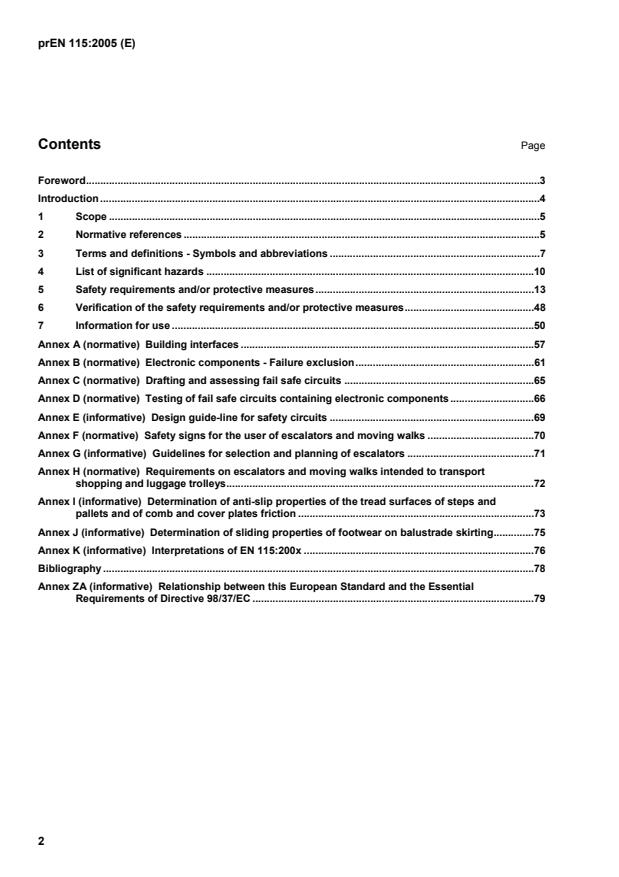
Contents Page
Foreword.3
Introduction .4
1 Scope .5
2 Normative references .5
3 Terms and definitions - Symbols and abbreviations .7
4 List of significant hazards .10
5 Safety requirements and/or protective measures.13
6 Verification of the safety requirements and/or protective measures.48
7 Information for use .50
Annex A (normative) Building interfaces .57
Annex B (normative) Electronic components - Failure exclusion.61
Annex C (normative) Drafting and assessing fail safe circuits .65
Annex D (normative) Testing of fail safe circuits containing electronic components .66
Annex E (informative) Design guide-line for safety circuits .69
Annex F (normative) Safety signs for the user of escalators and moving walks .70
Annex G (informative) Guidelines for selection and planning of escalators .71
Annex H (normative) Requirements on escalators and moving walks intended to transport
shopping and luggage trolleys.72
Annex I (informative) Determination of anti-slip properties of the tread surfaces of steps and
pallets and of comb and cover plates friction .73
Annex J (informative) Determination of sliding properties of footwear on balustrade skirting.75
Annex K (informative) Interpretations of EN 115:200x .76
Bibliography .78
Annex ZA (informative) Relationship between this European Standard and the Essential
Requirements of Directive 98/37/EC .79
Foreword
This document (prEN 115:2005) has been prepared by Technical Committee CEN/TC 10 “Lifts, escalators
and moving walks”, the secretariat of which is held by AFNOR.
This document is currently submitted to the CEN Enquiry.
This document will supersede EN 115:1995.
This document has been prepared under a mandate given to CEN by the European Commission and the
European Free Trade Association, and supports essential requirements of EU Directive(s).
For relationship with EU Directive(s), see informative Annex ZA,, which is an integral part of this document.
Considering that EN 115:1995 had given rise to requests for interpretation and this standard did not fully
comply with EN 414 (today CEN Guide 414 "Safety of machinery - Rules for the drafting and presentation of
safety standards"), CEN/TC 10 asked its working group 2 to revise EN 115:1995: This task was completed by
CEN/TC 10/WG 2 in 2005 after 19 working meetings by
taking into account the interpretations;
taking over the agreed upon points from the work carried out by ISO/TC 178/WG 5;
adapting the requirements to the state of the art using the risk assessment methodology as given in
ISO/TS 14798:2000;
improving the references to other standards according to the progress in that field;
covering the requirements of CEN Guide 414 by creating a new structure which addresses the safety
rules for the machine and provides requirements in the normative annexes and information in the
informative annexes;
increasing the measures against foreseeable misuse;
reviewing the safety requirements for escalators and moving walks.
The date of withdrawl (DOW) of EN 115:1995 and its amendments EN 115/A1:1998 and EN 115/A2:2004
shall be 2 years after the date of availability (DAV) of the revised standard.
Introduction
This standard is a Type C Standard as stated in EN ISO 12100-2.
The machinery concerned and the extent to which hazards, hazardous situations and events are covered are
indicated in the scope of this standard.
When the provisions of this C standard are different from those which are stated in type A or B standards, the
provisions of this type C standard take precedence over the provisions of the other standards, for machines
that have been designed and built according to the provisions of this type C standard.
The purpose of this standard is to define safety requirements for escalators and moving walks in order to
safeguard people and objects against risks of accidents during installation, operation, maintenance and
inspection work.
It is assumed that negotiations have been made for each contract between the customer and the
supplier/installer (see also Annex A) about:
a) intended use of the escalator or moving walk;
b) environmental conditions;
c) civil engineering problems;
d) other aspects related to the place of installation.
(0.5.2) If escalators or moving walks are intended to be operated under special conditions, such as directly
exposed to the weather or explosive atmosphere, or in exceptional cases serve as emergency exits,
appropriate design criteria, components, materials and instructions for use should be used that satisfy the
particular conditions.
(0.8) An Interpretation Committee has been established to clarify, if necessary, the spirit in which the clauses
of the standard have been drafted and to specify the requirements appropriate to particular cases. (new)The
formats of an interpretation request and the interpretation are given in Annex K.
1 Scope
1.1 This standard is applicable for new escalators and moving walks (pallet or belt type) as defined in
clause 3.
This standard deals with all significant hazards, hazardous situations and events relevant to escalators and
moving walks when they are used as intended and under conditions of misuse which are reasonably
foreseeable by the manufacturer (see clause 4).
1.2 Existing escalators and moving walks are not subject to this standard. It is, however, recommended that
they be adapted to this standard.
This document is not applicable to escalators and moving walks which are manufactured before the date of its
publication as EN.
1.3 If some dimensions of this standard cannot be kept due to structural conditions in existing buildings, it
has to be defined in the individual case which alternative requirements are necessary.
NOTE In addition, see information for use.
2 Normative references
The following referenced documents are indispensable for the application of this document. For dated
references, only the edition cited applies. For undated references, the latest edition of the referenced
document (including any amendments) applies.
EN 418:1992, Safety of machinery; emergency stop equipment, functional aspects; principles for design
(Note: To be replaced by EN ISO 13850 (2004-07).
EN 954-1:1996, Safety of machinery - Safety-related parts of control systems - Part 1: General principles for
design (Note: To be replaced by prEN ISO 13849-1 (2004-04).
EN 1050:1996, Safety of machinery - Principles for risk assessment.
EN 10025:1993, Hot rolled products of non-alloy structural steels; technical delivery conditions (includes
amendment A1:1993) (Note: To be replaced by prEN 10025-1 (2004-06), prEN 10025-2 (2003-11)).
prEN 10083-1:2003, Steels for quenching and tempering - Part 1: General technical delivery conditions (Note:
Intended as replacement for EN 10083-1+A1 (1996-08)).
EN 12015:2004, Electromagnetic compatibility - Product family standard for lifts, escalators and moving walks
– Emission.
EN 12016:2004, Electromagnetic compatibility - Product family standard for lifts, escalators and moving walks
– Immunity.
EN 13015:2001, Maintenance for lifts and escalators – Rules for maintenance instructions.
EN 13501-1:2002, Fire classification of construction products and building elements - Part 1: Classification
using test data from reaction to fire tests.
EN 60068-2-6:1994, Environmental testing - Part 2: Tests - Tests Fc: Vibration (sinusoidal) (IEC 60068-2-
6:1995 + Corrigendum 1995).
EN 60068-2-14:1999, Environmental testing - Part 2: Tests - Test N: Change of temperature (IEC 60068-2-
14:1984 + A1:1986).
EN 60068-2-27:1993, Basic environmental testing procedures - Part 2: Tests - Test Ea and guidance: Shock
(IEC 60068-2-27:1987).
EN 60204-1:1998, Safety of machinery - Electrical equipment of machines - Part 1: General requirements
(IEC 60204-1:1997) (Note: To be replaced by prEN 60204-1 (2003-07)).
EN 60249-2 series of standards, Base materials for printed circuits - Part 2: Specifications; (IEC 60249-2
series of standards).
EN 60269-1:1998, Low-voltage fuses - Part 1: General requirements (IEC 60269-1:1998).
EN 60439-1:1999, Low-voltage switchgear and controlgear assemblies - Part 1: Type-tested and partially
type-tested assemblies (IEC 60439- 1:1999).
EN 60529:1991, Degrees of protection provided by enclosures (IP code) (IEC 60529:1989).
EN 60664-1:2003, Insulation coordination for equipment within low-voltage systems - Part 1: Principles,
requirements and tests (IEC 60664-1:1992 + A1:2000 + A2:2002).
EN 60747-5-5:200X, Discrete semiconductor devices and integrated circuits -- Part 5-5: Optoelectronic
devices; Photocouplers, optocouplers.
EN 60947-4-1:2001, Low-voltage switchgear and controlgear - Part 4-1: Contactors and motor-starters;
Electromechanical contactors and motor-starters (IEC 60947-4-1:2000 (Note: To be amended by EN 60947-4-
1/prA2 (2004-04)).
EN 60947-4-1/A1:2002, Low-voltage switchgear and controlgear - Part 4-1: Contactors and motor-starters;
Electromechanical contactors and motor-starters; Amendment A1 (IEC 60947-4-1:2000/A1:2002).
EN 60947-5-1:2004, Low-voltage switchgear and controlgear - Part 5-1: Control circuit devices and switching
elements - Electromechanical control circuit devices (IEC 60947-5-1:2003).
EN 61558-1:1997, Safety of power transformers, power supply units and similar - Part 1: General
requirements and tests (IEC 61558-1:1997, modified).
EN 62326-1:2002, Printed boards - Part 1: Generic specification (IEC 62326-1:2002).
EN ISO 12100-1:2003, Safety of machinery - Basic concepts, general principles for design - Part 1: Basic
terminology, methodology (ISO 12100-1:2003).
EN ISO 12100-2:2003, Safety of machinery - Basic concepts, general principles for design - Part 2: Technical
principles (ISO 12100-2:2003).
EN ISO 13849-2:2003, Safety of machinery - Safety-related parts of control systems - Part 2: Validation (ISO
13849-2:2003).
IEC 60249-3-1:1981, Base materials for printed circuits - Part 3: Special materials used in connection with
printed circuits -. Specification No. 1: Prepreg for use as bonding sheet material in the fabrication of multilayer
printed boards.
IEC 60249-3-3:1991, Base materials for printed circuits - Part 3: Special materials used in connection with
printed circuits - Specification 3: Permanent polymer coating materials (solder resist) for use in the fabrication
of printed boards.
ISO 3864-1:2002, Graphical symbols - Safety colours and safety signs - Part 1: Design principles for safety
signs in workplaces and public areas (Note: Corrected and reprinted in 2003-12).
ISO/DIS 18738-2 (in preparation), Escalators and moving walks – Part 2: Measurement of ride quality.
HD 21.3 S3:1995, Polyvinyl chloride insulated cables of rated voltages up to and including 450/750 V - Part 3:
Non-sheathed cables for fixed wiring (IEC 60227-3:1993, modified).
HD 21.4 S2:1990, Polyvinyl chloride insulated cables of rated voltages up to and including 450/750 V – Part 4:
Sheathed cables for fixed wiring.
HD 21.5 S3:1994, Polyvinyl chloride insulated cables of rated voltages up to and including 450/750 V - Part 5:
Flexible cables (cords) (IEC 60227-5:1979, modified).
HD 22.4 S4:2004, Cables of rated voltages up to and including 450/750 V and having crosslinked insulation -
Part 4: Cords and flexible cables.
HD 384.4.41 S2:1996, Electrical installations of buildings - Part 4: Protection for safety - Chapter 41:
Protection against electric shock; incl. Amendment A1 (IEC 60364-4-41:1992/A2:1999, modified).
3 Terms and definitions - Symbols and abbreviations
3.1 Terms and definitions
For the purposes of this European Standard, the terms and definitions given in EN ISO 12100-1 and the
following apply.
3.1.1
angle of inclination
maximum angle to the horizontal in which the steps, the pallets or the belt move
3.1.2
balustrade
part of the escalator/moving walk which ensures the user's safety by providing stability, protecting from
moving parts and supporting the handrail
3.1.3
balustrade decking
transverse member of the balustrade which meets the handrail guidance profile and which forms the top cover
of the balustrade
3.1.4
brake load
load on the step/pallet/belt which the brake system is designed to stop the escalator/moving walk
3.1.5
comb/comb plate
pronged section at each landing that meshes with the grooves in the user carrying surface with a platform at
each landing to which the combs are attached
3.1.6
escalator
power-driven, inclined, continuous moving stairway used for raising or lowering persons in which the user
carrying surface (e.g. steps) remains horizontal
NOTE Escalators are in all cases machines and cannot be considered as a fixed staircase.
3.1.7
exterior panel
part of the exterior side of the enclosure of an escalator or moving walk
3.1.8
fail safe circuit
programmable and/or electronic system with safety functions
3.1.9
handrail
power-driven moving rail for persons to grip while using the escalator or moving walk
3.1.10
interior panel
panel located between the skirting or lower inner decking and the handrail guidance profile or balustrade
decking
3.1.11
lower inner decking 2
profile that connects the skirting with the interior panel when they do not meet at a common point
3.1.12
maximum capacity
maximum flow of persons that can be achieved under operational conditions
3.1.13
moving walk
power-driven installation for the conveyance of persons in which the user carrying surface remains parallel to
its direction of motion and is uninterrupted (e.g. pallets, belt)
NOTE Moving walks are in all cases machines even when they are out of operation.
3.1.14
newel
end of the balustrade
3.1.15
nominal speed
speed in the direction of the moving steps, pallets or the belt, when operating the equipment under no load
condition (i.e. without persons), stated by the manufacturer as that for which the escalator or moving walk has
been designed
NOTE Rated speed is the speed the escalator/moving walk moves under rated load conditions.
3.1.16
rated load
load which the equipment is designed to move (for maximum capacity see Annex G)
3.1.17
safety circuit
electric interconnection consisting of safety switches and/or fail safe circuits
3.1.18
skirting
vertical part of the balustrade interfacing with the steps, pallets or belt
3.1.19
skirt deflector
device to minimise the risk of trapping between the step and the skirting
3.1.20
stand-by operation
mode in which an escalator/moving walk can be stopped or operated under no load condition with any speed
below the nominal speed
3.2 Symbols and abbreviations
The following symbols and corresponding units of measurement are used in this standard.
Table 1 — Symbols and corresponding units of measurement used in this standard
Symbol Designation Unit
b Distance between the handrail centre lines m
b Width of the handrail mm
b Distance between skirting and lower inner decking mm
Horizontal part of the lower inner decking that directly joins the
b mm
interior panel
b Distance between the handrail and the edge of the balustrade mm
b ', b '' Distance between the handrail profile and guide or cover profiles mm
6 6
b Width of the grooves mm
b Web width mm
b
9 Distance between the centre line of the handrail and an obstacle m
Horizontal distance between the outer edge of the handrail and
b10 mm
walls or other obstacles
Horizontal distance between the handrails of adjacent
b mm
escalators/moving walks
Vertical distance between the lower edge of the handrail and walls
b mm
or other obstacles
b Width of the balustrade decking mm
b Combined balustrade decking width mm
Horizontal distance between the building structure (wall) and the
b mm
centreline of the handrail
Horizontal distance between the centrelines of the handrails of
b mm
adjacent escalators/moving walks
Horizontal distance of the anti-slide device to the outer edge of the
b mm
handrail
c Maximum capacity persons/h
Vertical distance between the handrail and step nose or pallet
h m
surface or belt surface
Vertical distance between top edge of skirting or bottom edge of
h
2 mm
cover joints and the tread surface of the steps, pallets or belt
h
3 Distance between the entry of handrail into the newel and the floor m
h Free height above the steps, pallets or belt m
h Vertical obstruction m
Clearance between the upper edge of the tread surface and the
h mm
root of the comb teeth
h Depth of the grooves mm
h Mesh depth of the comb into the grooves of the tread mm
Symbol Designation Unit
Vertical distance between floor and lower end of the anti-climbing
h mm
device
Vertical distance between top of the handrail and upper end of the
h mm
access restriction device
h Height of the ant-slide device mm
h Free height above handrails mm
L Root of the comb teeth -
l Distance between supports m
L Comb intersection line -
Newel including the handrail in longitudinal direction measured
l m
from the comb intersection line
Straight portion of the handrail in the direction of landing
l m
measured from the comb intersection line
Horizontal distance between the furthest point reached by the
l m
handrail and the point of entry into the newel
v Nominal speed m/s
x Step height m
y Step depth m
z Nominal width for the load carrying area (step, pallet or belt) m
z Distance between skirting m
z Transverse distance between the supporting rollers mm
Angle of inclination of the escalator or moving walk
α °(degree)
ß Design angle of the teeth of the comb °(degree)
Angle of inclination between the lower inner decking and the
γ °(degree)
interior panel
Slope of the balustrade decking °(degree)
δ
µ Friction coefficient -
4 List of significant hazards
This clause contains all the significant hazards, hazardous situations and events, as far as they are dealt with
in this standard, identified by risk assessment as significant for escalators and moving walks and which
require action to eliminate or reduce the risk. These significant hazards are based upon EN 1050.
4.1 Mechanical hazards
Mechanical hazards on escalators and moving walks and in their immediate vicinity can occur because of the
design of the machine or access to it.
These include:
contact with moving machinery parts (e.g. driving unit, handrail drive) normally not accessible to the
public;
crushing of fingers between handrail and balustrade;
impact on bodies caused by collision with building structures (wall, roof, criss-cross arrangement), or with
persons on adjacent escalators/moving walks;
drawing-in at handrail entry into the balustrade;
trapping between skirting and steps, between comb and step/pallet;
trapping between step and step or pallet and pallet.
4.2 Electrical hazards
Electrical hazardous situations can occur due to:
contact of persons (workers) with live parts;
inadequate emergency stops;
wrong assembly of electrical components;
electrostatic phenomena;
external influences on electrical equipment.
4.3 Radiation hazards
4.3.1 Electromagnetic radiation generated by the machine
Electromagnetic radiation can be emitted by the escalator or moving walk during normal operation.
4.3.2 Electromagnetic radiation received from outside
Immission of low frequency radiation, radio frequency radiation, and microwaves can occur.
4.4 Fire hazard
Fire hazards can be generated by accumulation of combustible material inside the truss, by the isolation
material for cables and overloading of drives.
4.5 Hazards generated by neglecting ergonomic principles in machinery design
Hazardous situation can occur because of:
neglecting ergonomic dimensions for the users (e.g. height of balustrade, width of handrail);
inadequate lighting in the working places and access to it;
insufficient space in working places;
missing lifting equipment for heavy loads.
4.6 Failure of control circuit
Hazardous situation can occur because of:
no stopping in case of dangerous situations;
short circuit of electrical wiring;
overload of electrical wiring;
unexpected start of machine after an interruption;
unexpected reversal of drive;
excessive speed;
excessive deceleration during stopping.
4.7 Break-up during operation
Even if the design of an escalator or moving walks follows the requirements of EN 115, there are specific
hazards which can occur due to
greater than specified user and structural loads on the truss;
loads greater than specified onto the balustrade;
loads greater than specified on the steps/pallets by unforeseeable misuse;
loads greater than specified on the drive unit.
4.8 Slip, trip and fall of persons
Most of the dangerous situations on escalators and moving walks are caused by slipping and falling of
persons.
This includes:
slipping on steps/pallets/belt, on the comb plate;
falling caused by handrail speed deviation (incl. standstill);
falling caused by change of the direction of movement;
falling caused by increased acceleration/deceleration;
falling caused by unexpected start or over-speed of the machine;
falling caused by inadequate lighting at the landings.
4.9 Particular hazards in combination with this type of machine
Many hazards are specific for that type of machine. These include
missing steps or pallets after maintenance/repair work;
misuse by transporting others items than persons (e.g. shopping or luggage trolleys);
climbing on the outside of the balustrade;
climbing over the balustrade;
surfing on the handrail;
storage of merchandise adjacent to the balustrade,
creation of traffic jam at blocked landings or intermediate exits of consecutive escalators or moving walks;
disturbance of the person flow in connected escalators/moving walks;
lifting by the handrail at the newel ends and falling over adjacent fixed barrier or the balustrade of the
escalator/moving walk.
5 Safety requirements and/or protective measures
5.1 General
Escalators and moving walks shall comply with the safety requirements and/or protective measures of this
clause. In addition, escalators and moving walks shall be designed according to the principles of
EN ISO 12100-2 for relevant but not significant hazards, which are not dealt with by this standard (e.g. sharp
edges).
Where, for elucidation of the text, an example is given this shall not be considered as the only possible design.
Any other solution leading to the same result is permissible if it is ensured that with an equivalent function the
same safety level exists.
Certain escalators and moving walks are subject to special operational and environmental conditions. For
these cases some additional recommendations are defined (see Annex G.2).
5.2 Supporting structure (truss) and enclosure
5.2.1 General
5.2.1.1 All mechanically moving parts of the escalator or moving walk shall be completely enclosed within
imperforate panels or walls. Exempt from this are the accessible steps, the accessible pallets, the accessible
belt and that part of the handrail available for the user. Apertures for ventilation are permitted (see also
5.2.1.5)
5.2.1.2 The exterior panels shall withstand a force of 250 N at any point at right angles on an area of
25 cm². The supporting structure and fixing points shall be designed in that way to carry at least twice the
dead load of the enclosure.
5.2.1.3 It is permissible to omit an enclosure of the mechanically moved parts if other measures (such as
rooms with locked doors accessible to authorised personnel only) make a hazard to the public impossible.
5.2.1.4 Accumulation of materials (e.g. grease, oil, dust, paper) represents a fire risk. Therefore it shall be
possible to clean the inner part of the escalator/moving walk.
5.2.1.5 Ventilation apertures shall be built or arranged in such a way that it is not possible to pass a
straight rigid rod 10 mm in diameter through the enclosure. It shall not be possible to touch any moving part
through a ventilation aperture.
5.2.1.6 Any exterior panels which are designed to be opened (e. g. for cleaning purposes) shall be
provided with a safety device according to Table 6 n).
5.2.2 Angle of inclination
The angle of inclination α of the escalator shall not exceed 30°, but for rises not exceeding 6 m and a nominal
speed not exceeding 0,50 m/s the angle of inclination is permitted to be increased up to 35° (see α in Figure
2).
The angle of inclination of moving walks shall not exceed 12°.
5.2.3 Access to the interior
Driving and return stations and machinery spaces inside the truss shall be lockable and only accessible to
authorised persons (see EN 13015:2001, 4.3.2.13).
5.2.4 Inspection covers and floor plates
Inspection covers and floor plates shall be provided with a control device according to Table 6 n).
It shall only be possible to open inspection covers and floor plates by a key or a tool suited for that purpose.
If rooms behind inspection covers and floor plates can be entered, it shall be possible to open them from the
inside without a key or a tool even when locked.
Inspection covers and floor plates shall be imperforate. Inspection covers shall conform to the same
conditions as required for the location where they are installed.
5.2.5 Structural design
The supporting structure shall be designed in a way that it can support the dead weight of the escalator or
moving walk plus a rated load of 5 000 N/m . An impact factor shall not be added to the rated load.
NOTE Load carrying area = (nominal width z (see Figure 3) of the escalator or moving walk) x (distance between
supports l ) (see Figure 2).
Based on the rated load, the maximum calculated or measured deflection shall not exceed 1/750 of the
distance between supports l .
5.3 Steps, pallets, belt
5.3.1 General
In the user carrying area of the escalator, the step treads shall be horizontal with a tolerance of ± 1° in the
direction of travel.
Tread surfaces for escalators and moving walks shall provide a secure foothold.
NOTE A secure foothold can be defined by a test equivalent of a minimum accessible inclination of the tread
surface (for definition of materials and test methods, see Annex I).
5.3.2 Dimensions
For escalators and moving walks the nominal width z shall be not less than 0,58 m and not exceed 1,10 m.
For moving walks with an angle of inclination up to 6° widths up to 1,65 m are permitted.
5.3.2.1 Step treads and pallets (see Figure 2, detail X and Figure 5)
5.3.2.1.1 The step height x shall not exceed 0,24 m.
5.3.2.1.2 The step depth y shall be not less than 0,38 m.
5.3.2.1.3 The surface of the step treads and pallets shall have grooves in the direction of movement with
which the teeth of the combs mesh.
5.3.2.1.4 The step risers shall be cleated and the surface shall be smooth. The ends of the step tread shall
mesh with the cleating of the next step riser.
5.3.2.1.5 The width b of the grooves shall be at least 5 mm and not exceed 7 mm.
5.3.2.1.6 The depth h of the grooves shall be not less than 10 mm.
5.3.2.1.7 The web width b shall be at least 2,5 mm and not exceed 5 mm.
5.3.2.1.8 The step treads and step risers or pallets shall not finish with a groove at their side edges.
5.3.2.1.9 The edge between the surface of the step tread and the riser shall have any sharpness relieved.
5.3.2.2 Belts (see Figure 2, detail X)
5.3.2.2.1 The belts shall have grooves in the direction of travel with which the teeth of the comb mesh.
5.3.2.2.2 The width b of the grooves shall be at least 4,5 mm and not exceed 7 mm, and shall be
measured at the tread surface of the belt.
5.3.2.2.3 The depth h of the grooves shall be not less than 5 mm.
5.3.2.2.4 The web width b shall be at least 4,5 mm and not exceed 8 mm and shall be measured at the
tread surface of the belt.
5.3.2.2.5 The belt shall not finish with a groove at the side edge of the belt.
Splicing of the treadway belt shall be such as to provide a continuous unbroken treadway surface
5.3.3 Structural design
The materials shall retain their strength characteristics during their specified life cycle taking into account the
environmental conditions, e.g. temperature, ultra violet radiation, humidity, corrosion.
The steps, pallets and the belt shall be designed to withstand all possible loading and distortion effects, which
may be imposed by the tracking, guiding and driving system and shall be designed to support an equally
distributed load corresponding to 6 000 N/m
2 2
NOTE 6000 N/m is derived from a static load of 5000 N/m (see 5.2.5.1) plus an impact factor of 1,2.
To establish the dimensions of the belt, an area of effective width x 1,0 m length shall be taken as a basis for
this specific load (in addition the requirements of 5.3.3.1.4 shall be complied with).
The step/pallet system design shall be such that the structure can accommodate torsional loading resulting
from a ± 2 mm displacement of the trailer wheel track.
Assembled steps and pallets shall be designed such that all component parts e.g. inserts or bolts are securely
attached and do not become loose during their life cycle. The inserts shall withstand the reaction force of the
comb plate (Table 6 g)) as follows: The fixings of any part of the steps/pallets shall be strong enough to
ensure satisfactory operation of the comb plate arrangement whose horizontal forces vary from 500 N on
either side or 1000 N in the centre (according to 5.7.3.2.6).
5.3.3.1 Static test
5.3.3.1.1 Steps
The step shall be tested for deflection with a single force of 3 000 N (including weight of the plate) applied
perpendicular to the tread surface on a steel plate 0,20 m x 0,30 m in size and at least 25 mm thick, in the
centre of the tread surface. The edge of the plate being 0,20 m long shall be arranged parallel to the front
edge of the step, the edge of the plate being 0,30 m long at right angles to the front edge of the step.
During this test, the deflection measured at the tread surface shall be not more than 4 mm. There shall be no
permanent deformation (setting tolerances are permitted).
The step shall be tested as a whole together with rollers (not rotating), axles or stub shafts (if existing) in a
horizontal position (horizontal support) and at the maximum inclination (inclined support) for which the step is
to be applied.
For all inclinations smaller than the maximum inclination permitted, a new test is not required. A test of the
installed step, i.e. together with the guide rails and the supporting structure of the escalator, is also not
necessary.
5.3.3.1.2 Step riser
The riser shall not deflect by more than 4 mm, when subjected to a single load of 1500 N applied normal to
the surface, on an area of 25 cm , shaped to fit the risers curvature. This load shall be applied in three
positions across the width of the riser, on the centre line, in the middle and at both ends. There shall be no
permanent deformation.
5.3.3.1.3 Pallets
The pallet shall be tested for deflection with a single force which, for a pallet area of 1 m , shall be 7500 N
(including weight of the plate). The force shall be applied perpendicular to the tread surface on a steel plate
0,30 m x 0,45 m in size and at least 25 mm thick, in the centre of the tread surface, and the edge of the plate
being 0,45 m long shall be arranged parallel to the lateral edge of the pallet.
For pallets with a depth smaller then 0,30 m the plate width shall be 0,20 m and the length of the plate shall be
the length of the pallet.
For pallets with smaller or larger areas, the force and the loading area shall be changed proportionally,
whereby for the loading area the ratio of edge length shall be 1: 1,5; however, the force shall be not below
3000 N (including weight of the plate), the size of the plate be not smaller than 0,20 m x 0,30 m and its
thickness be not less than 25 mm.
During this test the deflection measured at the tread surface shall be not more than 4 mm. There shall be no
permanent deformation (setting tolerances are permitted).
The pallet shall be tested as a whole together with rollers (not rotating), axles or stub shafts (if existing) in a
horizontal position. A test of the installed pallet, i.e. together with the guide rails and the supporting structure
of the moving walk, is not required.
5.3.3.1.4 Belts
With the belt tensioned to suit operational conditions, a single force of 750 N (including weight of the plate)
shall be applied on a steel plate 0,15 m x 0,25 m x 0,02 m in size. The plate shall be placed centrally between
the edge supporting rollers in such a way that its longitudinal axis is parallel to the longitudinal axis of the belt.
The deflection at the centre shall not exceed 0,01 z where z is the transverse distance between the
3 3
supporting rollers (see z in Figure 8).
5.3.3.2 Dynamic test
5.3.3.2.1 Steps
The step shall be tested at the maximum inclination (inclined support) for which the step is to be applied,
together with rollers (not rotating), axles or stub shafts (if existing). It shall be subjected to a load pulsating
between 500 N and 3000 N at a frequency between approximately 5 Hz and 20 Hz for at least 5 x 10 cycles
whereby an undisturbed sinusoidal force flow shall be achieved. The load shall be applied perpendicular to the
tread surface on a steel plate 0,20 m x 0,30 m in size and at least 25 mm thick, arranged as specified in
5.3.3.1.1, in the centre of the tread surface.
After the test the step shall show neither fracture nor permanent deformation greater than 4 mm, measured at
the tread surface.
If rollers are damaged during the test, it is permissible to replace them.
5.3.3.2.2 Pallets
The pallet, irrespective of its size, shall be tested in a horizontal position together with rollers (not rotating),
axles or stub shafts (if existing). It shall be subjected to a load pulsating between 500 N and 3000 N at a
frequency between approximately 5 Hz and 20 Hz for at least 5 x 10 cycles whereby an undisturbed
sinusoidal force flow shall be achieved. The load shall be applied perpendicular to the tread surface on a steel
plate 0,20 m x 0,30 m in size and at least 25 mm thick, in the centre of the tread surface.
For pallets with a smaller length then 0,30 m the plate width shall be 0,20 m and the length of the plate shall
be the length of the pallet.
After the test, the pallet shall show neither fracture nor permanent deformation greater than 4 mm, measured
at the tread surface.
If rollers are damaged during the test, it is permissible to replace them.
5.3.4 Guiding of steps, pallets and belt
The lateral displacement of the steps or pallets out of their guiding system shall not exceed 4 mm at either
side and 7 mm for the sum of clearances measured at both sides. The vertical displacement shall not exceed
4 mm for steps and pallets and 6 mm for belts.
This requirement applies only to the usable area of the escalator or moving walk.
Treadway supports for belts shall be provided at intervals not exceeding 2 m along the centre line of the
treadway. These supports shall be located at a level not more than 50 mm below the underside of the
treadway when it is loaded under the conditions required by 5.3.3.1.4.
The step/pallet must be designed to withstand all possible loading and distortion effects, which may be
imposed by the tracking, guiding and driving system during its life cycle. The step/pallet design shall be such
that the structure can accommodate torsional loading equivalent to a ± 2 mm displacement of the trailer wheel
centre, moving in an arc whose centre is the chain wheel centre. The ± 2 mm displacement is a relative to a
trailer wheel to chain wheel centre distance of 400 mm. This ratio must be maintained, when the 400 mm
dimension is varied.
5.3.5 Clearance between steps or pallets
The clearance between two consecutive steps (see also 5.3.3.1.2) or pallets in any usable position measured
at the tread surface shall not exceed 6 mm (see Figure 2, details Y, Z , Figure 6 and Figure 7, detail U).
Demarcation shall be provided for the rear edge of the step tread surface.
In the area of the transition curves of moving walks with meshed front edges and rear edges of the pallets, this
clearance is permitted to be increased to 8 mm (see Figure 7, detail V).
5.4 Drive unit
5.4.1 Driving machine
5.4.1.1 General
A drive unit shall not operate more than one escalator or moving walk.
5.4.1.2 Speed
The nominal speed shall not deviate by more than ± 5 % at nominal frequency and nominal voltage.
5.4.1.2.1 The nominal speed of the escalator shall not exceed:
0,75 m/s for an escalator with an angle of inclination α up to 30°;
0,50 m/s for an escalator with an angle of inclination α of more than 30° up to 35°.
5.4.1.2.2 The nominal speed of moving walks shall be not higher than 0,75 m/s
Contrary to the above, moving walks are permitted to have nominal speed up to 0,90 m/s provided the width
of the pallets or the belt does not exceed 1,10 m, and contrary to 5.7.2.4 at the landings, the pallets or the belt
move horizontally for a length of at least 1,60 m before entering the combs.
The before mentioned requirements do not apply to moving walks with acceleration paths or moving walk
systems with direct transition to moving walks travelling at different speeds.
5.4.1.3 Link between operational brake and step, pallet or belt drive
5.4.1.3.1 For the link between the operational brake and the step, pallet or belt drive, preferably non-friction
driving elements should be used such as shafts, gear wheels, multiplex chains, two or more single chains.
Where friction elements are used such as trapezoidal belts (flat belts are not permitted) an auxiliary brake in
accordance with 5.4.2.2 shall be used.
5.4.1.3.2 Safety factors of all driving elements shall be 5 and in accordance with 5.4.3.2 and 5.4.4.1. In the
case of trapezoidal belts at least 3 belts shall be applied.
5.4.1.4 Hand winding device
If a hand winding device is provided it shall be easily accessible and safe to operate (see 7.2.1.3 and 7.4.1 f)
for instructions).
If the hand winding device is placed outside machinery spaces, driving and return stations it shall not be
accessible to unauthorised persons.
Crank handles or perforate hand wheels are not permitted.
5.4.1.5 Stopping the machine and checking its stopped position
Stopping the escalator or moving walk by means of the electrical safety devices according to 5.12.1.2 shall be
effected as follows:
The supply shall be interrupted by two independent contactors, the contacts of which shall be in series in the
supply circuit. If, when the escalator or moving walk is stopped, one of the main contacts of one of the
contactors has not opened, restarting shall b
...